 Naru News日本語
What is a black hole star (a black hole wrapped in gas that shines like a star)?
Also called: BH*

In one minute
A black hole star is an object thought to be a young, fast-growing black hole in the early universe, wrapped so completely in extremely dense gas that from outside it shines like a single big star.
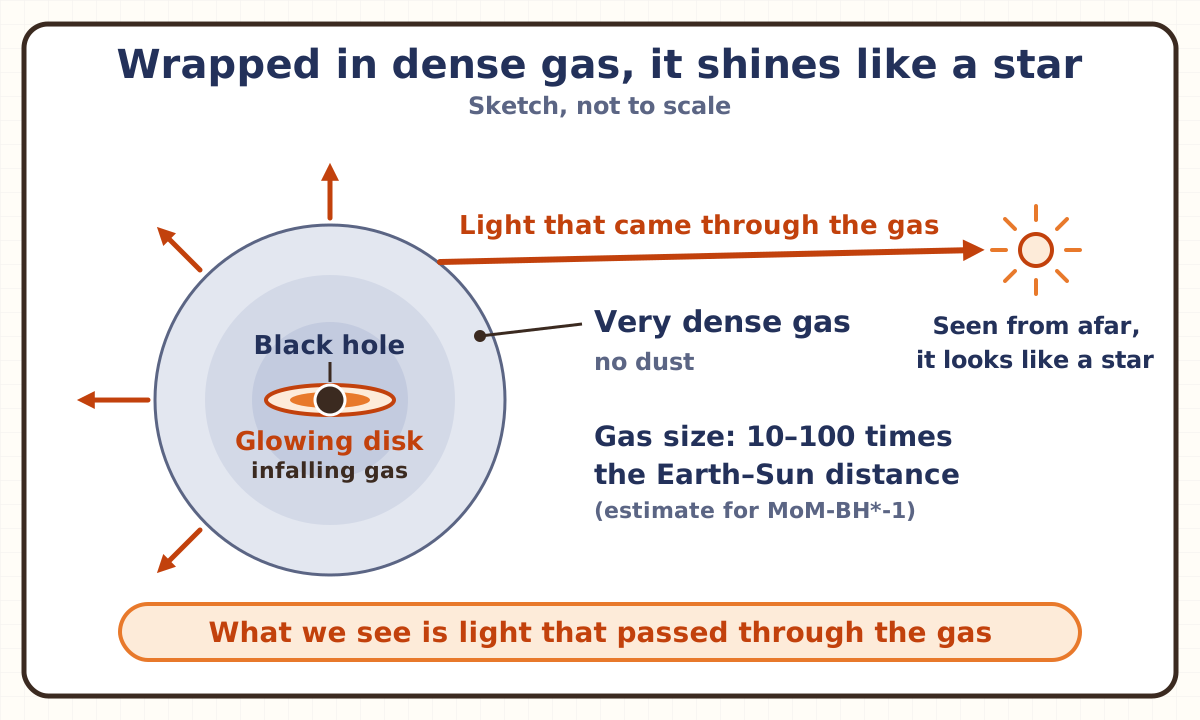
The James Webb Space Telescope has found many objects in the distant universe that look like small red dots, called “little red dots.” A 2025 paper gave the name “black hole star” to one idea for explaining what they are. At the center, a disk of gas falling into the black hole glows. In the dense gas, that light loses some of its colors, and it comes out looking like light that has passed through a star’s atmosphere (the layer of gas over its surface).
The clue is the brightness when the light is split into colors with a prism, like a rainbow. At one color, the light is much dimmer on one side only, making a big step. Light from ordinary groups of stars has a hard time explaining a step that big. But this is not a settled fact, and other explanations are still being studied.
A common mix-up
“A black hole star is a heavy star that is about to collapse into a black hole.”
The name makes this easy to think, but it’s wrong. A star of about 20 times the Sun’s mass or more does end with its core collapsing into a black hole; that part is true. But a black hole star is the other way around: the black hole comes first, and the dense gas wrapped around it looks like a star from outside. Its light doesn’t come from nuclear fusion, which is what makes stars shine (light atoms joining into heavier ones and giving off a lot of energy), but from gas falling into the black hole. The only part that’s right is that, seen from outside, it looks like a star.
Explained in pictures
You’re free to use these figures in lessons, slides and posts if you credit Naru News (naru.news). CC BY 4.0.
Think of it like this
A paper lantern
Picture seeing a Japanese paper lantern from far away on a road at night. A candle burns inside, but what you see from outside is not the flame but a glowing ball of paper that the light shines through. The paper absorbs and scatters some of the candlelight, so the color and spread of the light look different from the flame itself.
In a black hole star, the candle is the glowing disk of gas falling into the black hole, and the paper is the dense gas wrapped around it. What reaches a faraway telescope is light that came through the gas, so it looks not like a black hole but like a single star. Just as studying a lantern’s light tells you more about the paper than about the flame, a black hole star’s light reveals how thick the wrapping gas is and how it moves.
But the comparison has limits. Lantern paper is thin and dims all colors of light about equally. The gas in a black hole star, though, is extremely dense and spread over a region about the size of the solar system, and its hydrogen strongly soaks up only the light on one side of a certain color. So when the light is split into colors, it is dim on one side of that color only, making a big step. Also, the paper doesn’t fuel the candle, but the black hole may be growing by taking in the gas around it.
Key points
What are the little red dots?
Images from the James Webb Space Telescope (JWST) showed many objects in the distant universe that look like small red dots. Such objects are called “little red dots.” A paper that came out in 2023 (Matthee et al.) put this name in its title and studied 20 objects found in JWST observations whose hydrogen light lines (light of one set color given off by hydrogen) are wide.
Light from distant objects reaches us shifted toward the red (longer wavelengths, where wavelength is the length of the light’s waves), because its waves are stretched as the universe expands. The size of this shift is called redshift, and the bigger the number, the farther away and further back in time the object is. For example, MoM-BH*-1, the main object on this page, has a redshift of about 7.76, and we see it as it was about 660 million years after the universe began.
When their light is split into colors (wavelengths), giving a spectrum, the lines of light given off by hydrogen are spread out wide. This has been taken as a sign of gas moving fast around a black hole. On the other hand, their X-rays are very weak or barely seen at all. Researchers have disagreed over whether they are growing black holes or galaxies tightly packed with stars.
Black holes don’t give off light, so why does it shine?
A black hole itself gives off no light, because not even light can get out from inside it. What glows around a black hole is gas that hasn’t been swallowed yet. As it circles the black hole, the gas forms a hot, bright, flat disk (an accretion disk).
When gas falls into a supermassive black hole at the center of a galaxy (one with hundreds of thousands to billions of times the Sun’s mass) and shines very brightly, the object is called a quasar. Seen from far away, quasars looked like points of light, like stars, so they were named “quasi-stellar,” meaning star-like.
In the black hole star idea, this glowing disk is further wrapped in extremely dense, dust-free gas. The disk’s light is absorbed, scattered (bumped into new directions) and given off again in the gas before it gets out. What we see from outside is light that came through the gas, and it looks much like light that came through a star’s atmosphere (the layer of gas over its surface). The MoM-BH*-1 paper likens this gas to an “atmosphere” around the black hole and estimates that it spans about 10 to 100 times the Earth–Sun distance (about the size of the solar system).
The paper argues that the little red dots look red not because dust blocks their light but because gas absorbs it. It also says that because the gas is so thick, it blocks X-rays too, which may explain why their X-rays are weak.
Why did researchers think it is wrapped in dense gas?
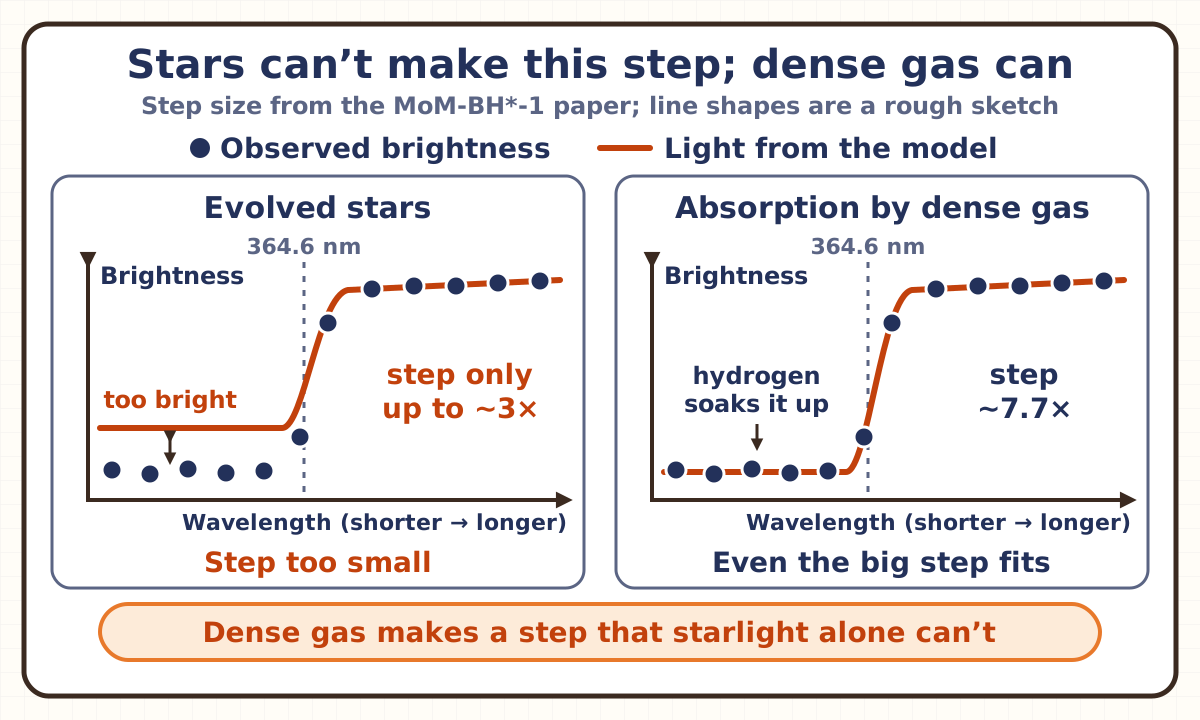
The clue is a step in brightness seen when the light is split into colors like a rainbow (the spectrum): the Balmer break. A light’s color is set by the length of its waves (wavelength). Hydrogen atoms that have taken in a little energy (with the electron on the second level from the inside) soak up all light with wavelengths shorter than 364.6 nanometers (shorter even than violet: invisible ultraviolet). So light that has passed through a lot of such hydrogen gets dimmer only on the short side of this wavelength, making a step.
A star’s atmosphere (the layer of gas over its surface) has this kind of hydrogen too. In galaxies where new stars stopped forming a few hundred million years ago and the light of a kind of star called A-type stands out, this step is clear. But for groups of stars without dust, the short side doesn’t get that dim: the ratio of brightness across the step is usually at most about 3, and under 5 even in the extreme case of nothing but A-type stars.
In MoM-BH*-1, observed by JWST in December 2024 in an observing program called “Mirage or Miracle,” that ratio was about 7.7. It is one of the biggest steps ever found, near or far. Its split light also showed dark lines made where hydrogen absorbs light of set colors (absorption lines). For such absorption lines to form, the gas has to be extremely dense: at least a billion (10 to the 9th power) hydrogen atoms per cubic centimeter.
So the paper calculated a model in which the black hole’s glowing disk is wrapped in extremely dense gas, and explained the step and the absorption lines together. In the model, the gas has about 100 billion (10 to the 11th power) hydrogen atoms per cubic centimeter and churns violently at around 500 km per second. But the paper cautions that the model is very simple and that its detailed numbers shouldn’t be read too much into.
Can’t evolved stars explain it?
In March 2025, on the same day as the MoM-BH*-1 paper, another paper (de Graaff et al.) came out. It studied a bright little red dot at a redshift (a measure of distance: the bigger, the farther) of about 3.5, nicknamed “The Cliff” because the step in brightness in its split light is so big. The ratio of brightness across its step was about 6.9, about twice as strong as any distant object found before. Only MoM-BH*-1 matches it.
The researchers first tried to explain it with light from evolved stars (stars in a group that stopped making new stars some time ago). That would need stars totaling about 25 to 40 billion times the Sun’s mass packed into a small region with a radius of only about 130 light-years. That is more than 10 times more tightly packed than the densest known groups of stars. Stars would collide about 5 times a year. And even with dust acting more strongly than anything seen so far in observations or models, the shape around the step still didn’t fully fit.
On the other hand, if something shining brightly in the center is wrapped in dense, light-absorbing gas, both the step and the hydrogen absorption line could be explained with the least strain. The researchers consider this the most plausible explanation. But they write that the model and the observations still don’t match everywhere and that starlight mixed in can’t yet be ruled out, and they also raise the possibility that what is wrapped in the gas is not a black hole but very massive stars gathered at the galaxy’s center. This paper was published in the journal Astronomy & Astrophysics in 2025.
How heavy is the black hole?
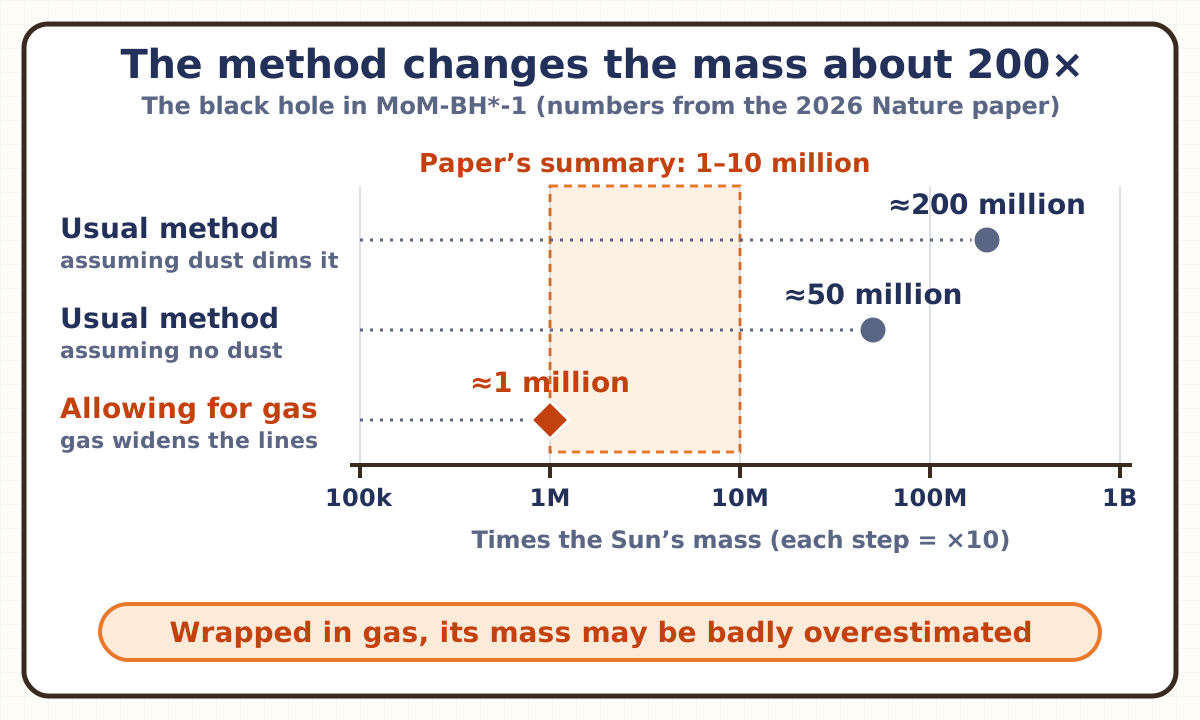
The mass of a distant black hole is usually worked out from the width of a light line (light of one set color) given off by the gas around it, and its brightness. Light from gas coming toward us shifts a little toward blue, and light from gas moving away shifts toward red, so the faster the gas moves, the more the line spreads out and the wider it gets. A heavier black hole is needed to make gas circle that fast, so the width tells the mass. This method was checked on black holes in the nearby universe.
Applying it to MoM-BH*-1 as is gives about 200 million times the Sun’s mass if dust is dimming it, or about 50 million if there is no dust. But in the black hole star idea, the light may bounce off particles and change direction many times in the dense gas (scattering), making the line look wider than it really is. Recalculating with that in mind gives about 1 million. The paper sums up the mass as about 1 to 10 million times the Sun’s and says the black hole masses of little red dots may be overestimated by a large factor. The black hole in The Cliff is estimated at about 10 million times the Sun’s mass, and it too may be overestimated.
In 2026, two studies on this question were published in Nature. A January study (Rusakov et al.) examined 12 objects in detail and concluded that in most of them, the light lines are widened because, in the dense gas, light hits electrons (one of the tiny particles that make up atoms) and changes direction as it travels. It put the black hole masses at 100,000 to 10 million times the Sun’s, about a hundredth of earlier estimates.
In contrast, a May study (Juodžbalis et al.) looked at a distant object called QSO1, which appears magnified because the gravity of something in front of it bends its light (gravitational lensing). Measuring the black hole’s mass directly from how fast the gas circles it gave about 50 million times the Sun’s mass. That agrees well with the roughly 40 million from the usual method. So it doesn’t seem that masses are overestimated for every object, and how to pin down the mass is still being studied.
What other explanations are there, and what is still unknown?
There are other ideas about what the little red dots are. One is that they are galaxies tightly packed with a huge number of stars. Another is that they are active galactic nuclei (where gas falling into the black hole at a galaxy’s center glows brightly) that look red because they are wrapped in dust. The black hole star idea shares the black hole inside with the second idea, but differs in saying the red color comes from gas, not dust.
The MoM-BH*-1 paper first came out in March 2025 as a paper not yet checked by other researchers (peer review), and it was published in Nature, under a new title, on August 12, 2026. The researchers think other little red dots may also hold black hole stars inside brighter surrounding galaxies. They also write that MoM-BH*-1 is expected to merge with a heavier galaxy nearby within about 100 million years, and that the result would look like a little red dot.
Questions remain. How very heavy black holes grew so quickly in the early universe is still a puzzle. Theory predicts that a black hole wrapped in dense gas can grow faster than usual, and MoM-BH*-1 may be an example. Whether most little red dots are black hole stars, or whether other ideas fit some of them better, will be tested by future observations and research.
Check yourself
Q1In the “black hole star” idea, what kind of light mostly reaches a faraway telescope?
Answer and explanation
Answer: B Light coming through the gas around the hole
A black hole itself gives off no light, because not even light can get out from inside it. In the black hole star idea, the light comes not from the stars around it but from a glowing disk of gas falling into the black hole. That light is absorbed, and bounced into new directions, in the dense gas wrapped around it before it gets out. What we see from outside is light that came through the gas, so it looks like a single star.
More on this → Key points: Black holes don’t give off light, so why does it shine?
Q2When the light of MoM-BH*-1, an object in the distant universe, was split into colors like a rainbow, the brightness changed sharply at one color, making a very big step. What did a 2025 paper mainly explain this step with?
Answer and explanation
Answer: C Absorption of light by gas around it
In the black hole star idea, hydrogen in the extremely dense gas around it soaks up only the light on the shorter-wavelength (more violet) side of a certain color. So only one side of that color gets much dimmer, making a big step. Light from groups of stars without dust doesn’t get that dim: the step is usually at most about 3 times, and under 5 even in extreme cases, so it can’t reach this object’s 7.7 or so. The paper also thinks the object looks red because of gas, not dust.
More on this → Key points: Why did researchers think it is wrapped in dense gas?
Q3A black hole’s mass is usually worked out from the width of a light line given off by the gas around it (the wider the line, the faster the gas and the heavier the hole). If light scattering in dense gas made the line look wider than it really is, how would the calculated mass compare with the true mass?
Answer and explanation
Answer: A Heavier than the true mass
The wider the line, the faster the gas is taken to be moving, and the heavier the black hole is calculated to be. But if part of the width comes from light scattering in the gas, the gas isn’t really moving that fast. So the calculated mass comes out heavier than the truth. The MoM-BH*-1 paper says that, against about 200 million or 50 million times the Sun’s mass from the usual method, allowing for scattering gives about 1 million. But for QSO1, an object whose black hole mass was measured directly in 2026, the result agreed well with the usual method.
Related terms
- Black hole
- Supermassive black hole
- Little red dots
- James Webb Space Telescope
- Quasar
- Active galactic nucleus
- Accretion disk
- Balmer break
- Redshift
- Spectrum
- Gravitational lensing
Sources and how we checked
- Naidu et al., "A ‘Black Hole Star’ Reveals the Remarkable Gas-Enshrouded Hearts of the Little Red Dots" (MIT and others; arXiv, March 2025; the name “black hole star (BH*),” abstract, main text, Methods and Extended Data Tables 1 and 5; read November 11, 2026)
- Naidu et al., "A gas-enshrouded and gas-reddened black hole at cosmic dawn" (Nature 656, pp. 329–333, August 12, 2026; the paper above, published under a new title; received March 20, 2025, accepted June 24, 2026; abstract, main text and the parts of Methods on mass and luminosity; read November 11, 2026)
- de Graaff et al., "A remarkable Ruby: Absorption in dense gas, rather than evolved stars, drives the extreme Balmer break of a Little Red Dot at z=3.5" (Max Planck Institute for Astronomy and others; Astronomy & Astrophysics 701, A168, 2025; abstract and Sections 1, 2, 3.1, 5, 6 and 7 of arXiv version 2, July 2025; read November 11, 2026)
- Matthee et al., "Little Red Dots: an abundant population of faint AGN at z~5 revealed by the EIGER and FRESCO JWST surveys" (arXiv, June 2023; version 3, February 2024, accepted for The Astrophysical Journal; abstract; read November 11, 2026)
- Rusakov et al., "Little red dots as young supermassive black holes in dense ionized cocoons" (Nature 649, pp. 574–579, January 14, 2026; abstract of arXiv version 4, February 2026; read November 11, 2026)
- Juodžbalis et al., "A direct black-hole mass measurement in a little red dot at high redshift" (Nature 653, pp. 1017–1021, May 27, 2026; abstract and the comparison with the usual mass estimates; read November 11, 2026)
- MIT News, "Astronomers discover a brand-new type of astrophysical object: A black hole star" (Massachusetts Institute of Technology announcement, August 12, 2026; that the light is not powered by nuclear fusion, and the solar-system size; read November 11, 2026)
- NASA, "Black Hole Anatomy" (NASA Science; black holes give off no light, and the light comes from the accretion disk around them; read November 11, 2026)
- NASA, "Black Hole Types" (NASA Science; black holes formed when the core of a star of about 20 solar masses or more collapses, and the masses of supermassive black holes; read November 11, 2026)
- NASA, "Hubble Quasars" (NASA Science; what quasars are and where the name comes from; read November 11, 2026)
- Kyoto University, Japanese press release on little red dots as hidden neutrino sources (May 26, 2026; for the Japanese name “ritoru reddo dotto”; read November 11, 2026)
- Nature Japan, Japanese research highlight on little red dots as hidden black holes (January 15, 2026; for the Japanese name “chiisana akai ten,” small red dots; read November 11, 2026)
- Kotobank, Japanese dictionary entry “Quasar” (Digital Daijisen, Britannica and others; for the Japanese name “junsei”; read November 11, 2026)
AI wrote this page from the sources above, and a different AI checked it against the text of those sources (November 11, 2026). A person with a master’s degree in science and a Japanese high-school science teaching license also read and checked it before publishing. Numbers are as of that date. If anything was hard to follow, you spot a mistake, or there’s a term you’d like explained, please write to [email protected].
Space terms
- You are hereBlack hole star