 Naru News日本語
Home › Why questions › Quantum
Adding more error-prone parts cut the errors. Has quantum computing's weakness finally been beaten?
The parts of a quantum computer, called qubits, make mistakes very easily. Add more parts to fix the mistakes, and the parts you add make mistakes just as easily.
And yet in October 2026, the quantum computing company Quantinuum announced that the more qubits it added to the group, the fewer mistakes it got.
Has quantum computing's big weakness finally been beaten?
First guess
“Because they can now find and fix the spots where the calculation doesn't add up along the way, so it's beaten?”
Half right. Checker qubits never read the contents. They measure only the relationship among a few neighbors, and a calculation estimates what likely drifted, and where. But the parts still slip about once in 1,200, and the checkers slip too. No part that never slips has been made, so what changed?

Answer
Not yet: the parts still slip about once in 1,200 two-qubit operations on average, but it has been confirmed on a real machine that, with parts that still slip, making the group bigger cuts the overall errors.
That's because when the parts are well more accurate than “the line,” a bigger group takes more overlapping mistakes to fool, and in Quantinuum's experiment (the company's own report of a memory experiment), growing the group from 13 to 37 to 73 qubits cut the remaining errors to about one twelfth per step, on average.
Still, even the storage number has a factor of five million to go to the company's example target of one in a trillion, what was confirmed is only the foundation, and one more job for calculations and fixing errors on the spot are still ahead.
Watch the video (11 min 16 sec)
Chapters (15)
- 0:00Add parts, get fewer mistakes
- 0:53Question 1: What is a qubit?
- 1:51A ruler in steps: a store and Jupiter
- 2:43Rejected: copy and vote
- 3:17Question 2: How was it beaten?
- 3:32The three test-takers
- 4:10Hearing only "it's a tie"
- 5:00Why adding more helps
- 6:03The line
- 6:30This result: to the foot of Mt. Fuji
- 7:41Answer: how it was beaten
- 8:00Question 3: Will it be practical?
- 8:41One more job
- 9:18Fixing on the spot
- 10:01Summary
Full transcript
0:00Add parts, get fewer mistakes
NaruThe parts of a quantum computer, called qubits, make mistakes very easily.
NaruSo, to fix those mistakes, we add more parts.
NaruBut the parts we add make mistakes just as easily.
NaruAnd yet...
NaruThe more parts they added, the fewer mistakes they made.
NaruThat's from Quantinuum, in October 2026.
NaruIn a memory experiment using 73 qubits, the estimated error rate was about one in 200,000 per round of checking.
ChiefNow that's amazing!
ChiefHas the big weakness finally been beaten!?
ChiefGo find out!
NaruI'm on it! What exactly is the weakness? Has a part that never slips finally been made? And will it really lead to practical machines?
NaruThe key is a way to find only the mistakes, without looking at the answers.
NaruNaru News!
0:53Question 1: What is a qubit?
NaruFirst, the weakness. What exactly is a qubit?
NaruHonestly, I was totally lost at first, too. But with qubits, there are just two things to remember.
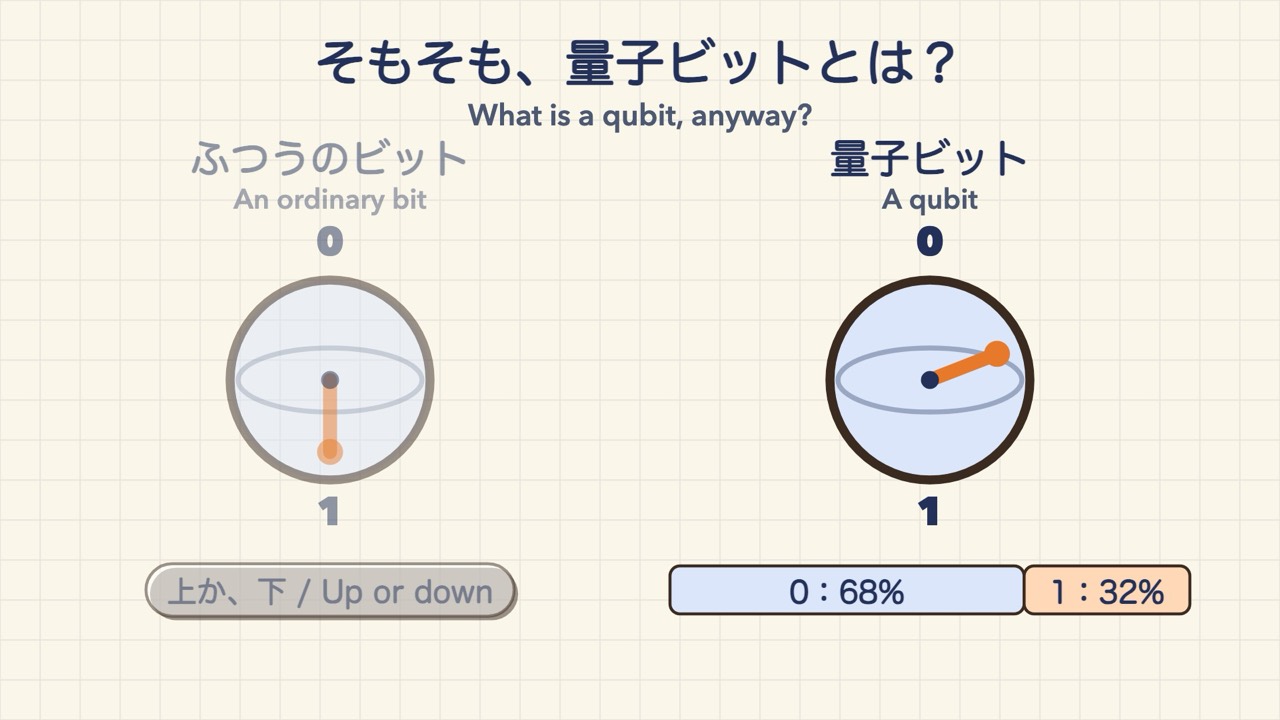
NaruA bit in an ordinary computer is either 0 or 1. Picture it as an arrow pointing up or down.
NaruA qubit can also point at a slant, holding 0 and 1 overlapped in a set proportion.
NaruOne: that slant is very delicate. Heat or tiny disturbances knock it off course right away.
NaruAnd once it drifts, the calculation's answer goes wrong.
NaruSo has a part that never slips been made?
NaruNo. Even on this machine, an operation using two qubits goes wrong about once in every 1,200 tries, on average.
NaruSuppose each one goes wrong independently like that. Then run just 1,000 of them, and more than half of the calculations go wrong somewhere.
1:51A ruler in steps: a store and Jupiter
NaruJust how error-prone is that? Here's a rough ruler to get a feel for the scale.
NaruLet's picture error rates as steps. One step is 70 centimeters. One mistake in 1,200 means, on average, one fall every 1,200 steps.
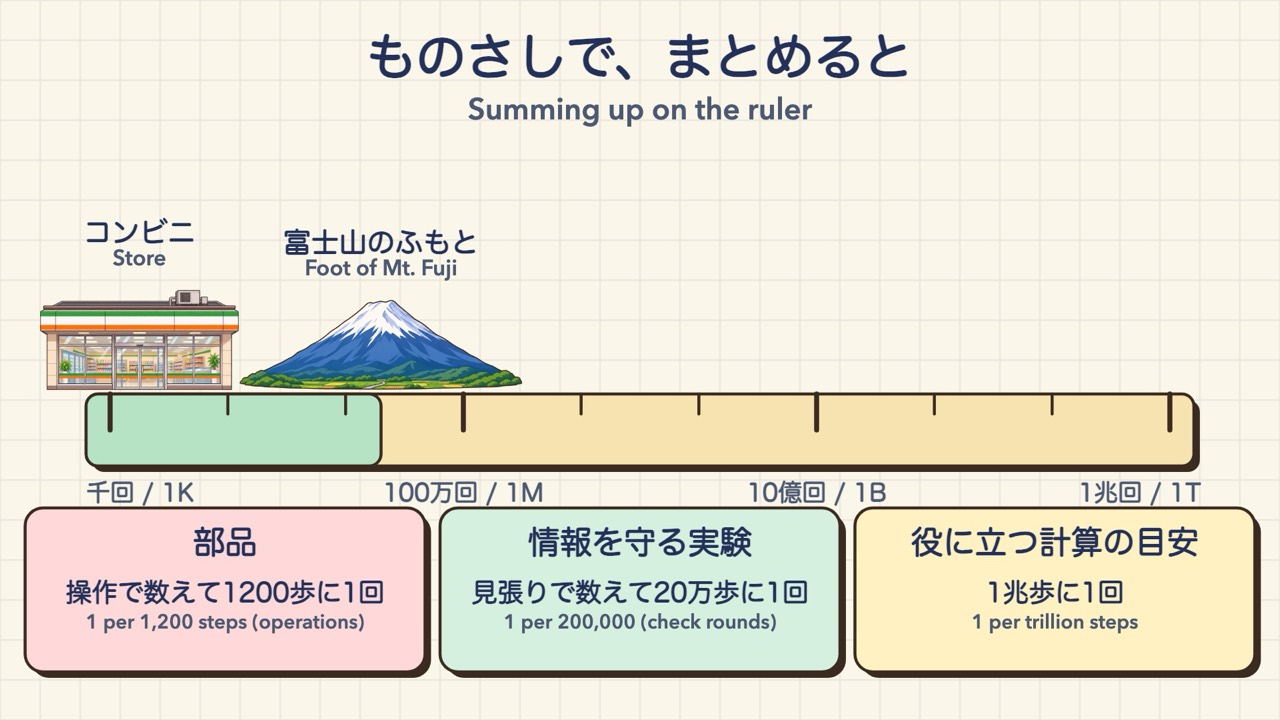
NaruSo the raw parts get about 800 meters. Right about when you reach the convenience store a ten-minute walk away, you fall once.
NaruSo how far do useful calculations need to go?
NaruIt depends on the calculation, but the example the company gives is one mistake in a trillion.
NaruA trillion steps is about 700 million kilometers. In this analogy, that's one fall on average over about the distance to Jupiter.
NaruA convenience store and Jupiter. That's a gap of roughly 800 million times.
NaruJust polishing the parts won't get you anywhere near.
2:43Rejected: copy and vote
NaruI've got it! Just like an ordinary computer, make three copies and take a majority vote!
ChiefRejected!
Naru...He says you can't copy contents you don't know, and peeking breaks them.
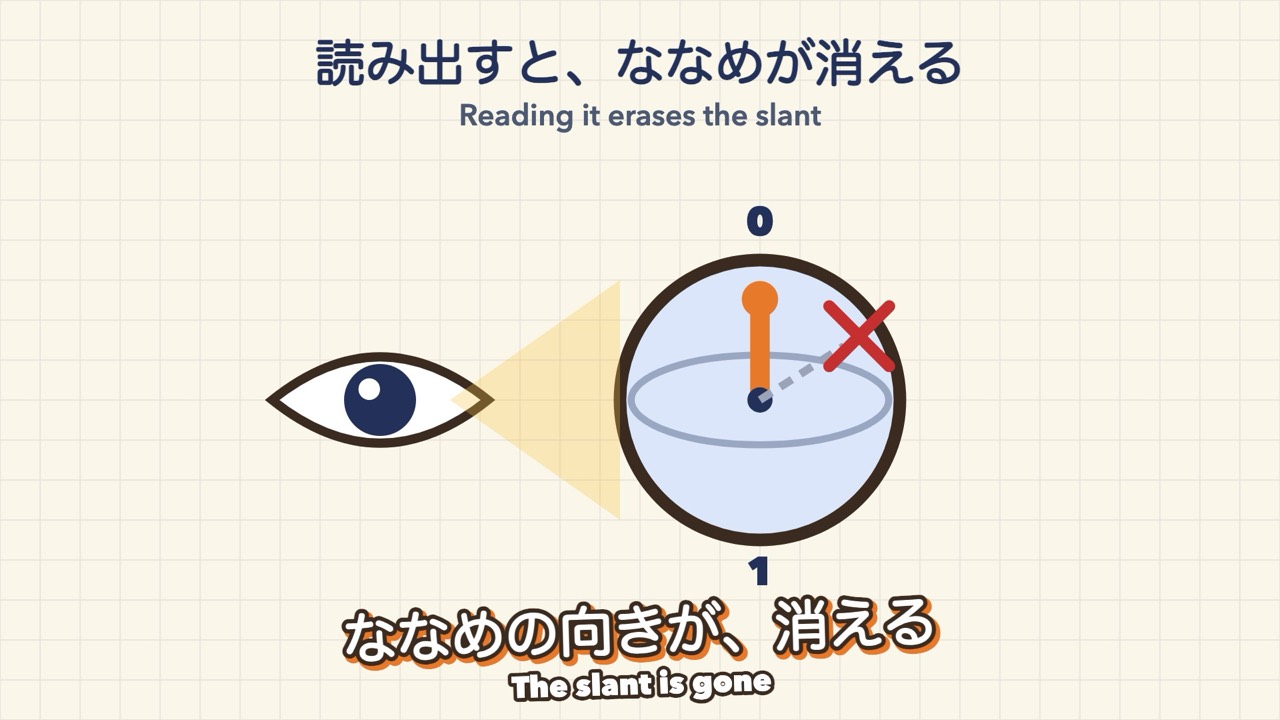
NaruThat's number two. The moment you read it out, the arrow snaps to up or down, and the slant is gone.
NaruSo what's the weakness? The parts slip so easily that long calculations can't make it to the end.
NaruAnd neither copying nor peeking can be used to fix them.
3:17Question 2: How was it beaten?
NaruSo how do you stretch the road before a fall?
NaruInstead of making copies, a whole group of qubits holds one piece of information together.
NaruBut without peeking, how do you find the mistakes?
3:32The three test-takers
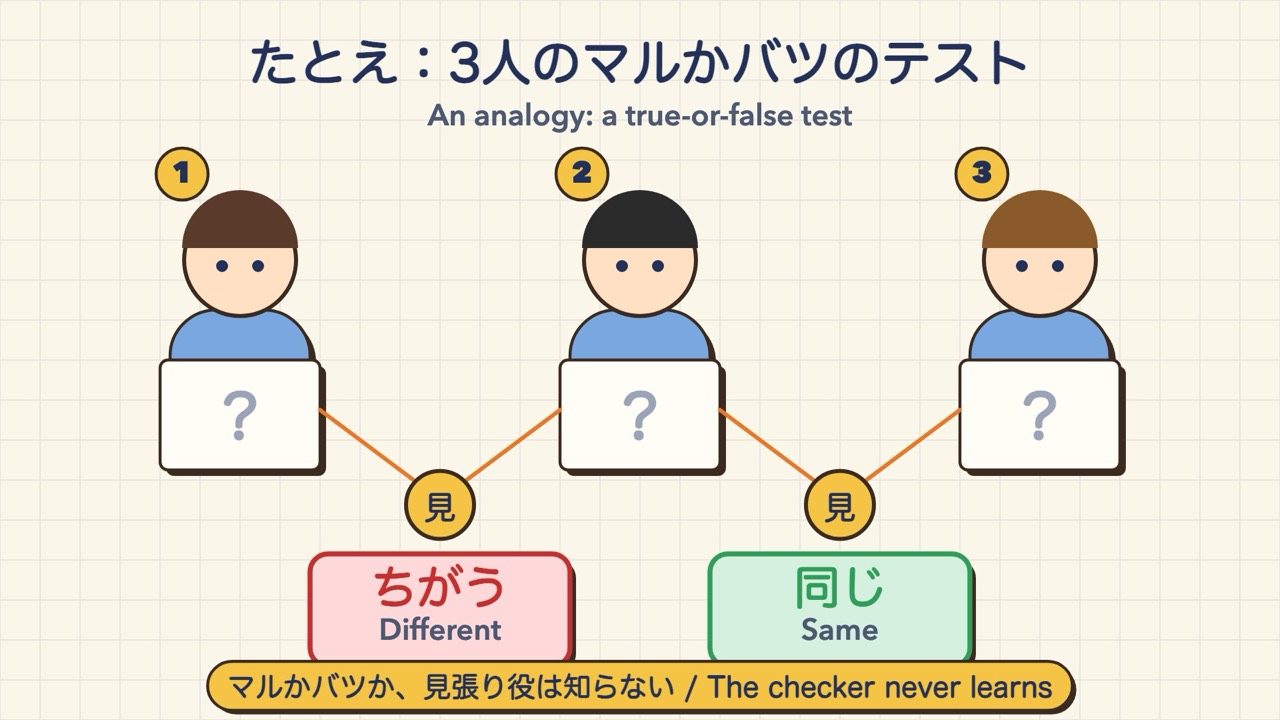
NaruLet's use an analogy. Three people who should write the same answer take a true-or-false test.
NaruSay at most one of them gets it wrong.
NaruNobody looks at the answer sheets. A checker only asks: are one and two the same? Are two and three the same?
NaruThe replies: one and two differ. Two and three match.
NaruSo who got it wrong?
NaruNumber one!
NaruTell number one to flip the answer, and it's fixed.
NaruAnd the checker still doesn't know whether the answer is true or false.
NaruWithout looking at the answer, it found only the mistake, and fixed it.
4:10Hearing only "it's a tie"
NaruWhat we borrow from that test is the idea of hunting mistakes through relationships alone.
NaruQubits make no copies; the whole group holds one piece of information.
NaruBut you can't read the qubits out one by one to compare them. Peeking would break the slant.
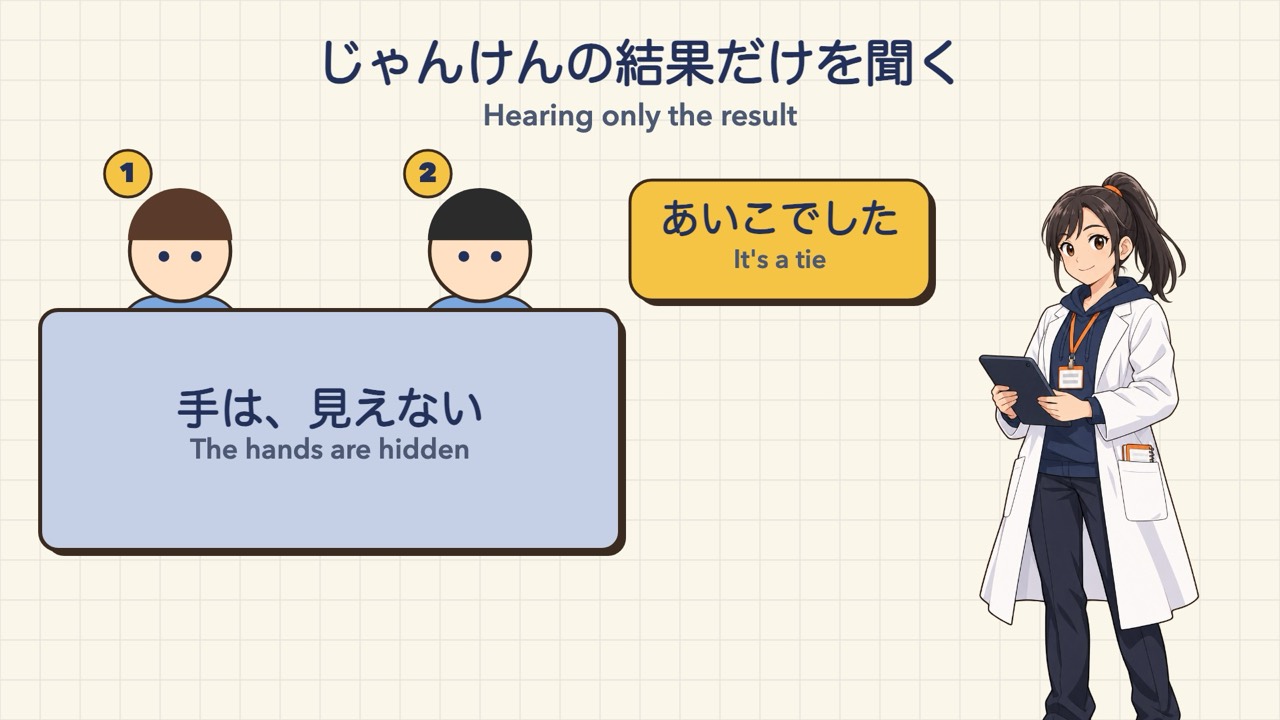
NaruSo picture someone who only hears the result of a game of rock-paper-scissors.
NaruHear "it's a tie," and you know both played the same hand. But you don't know whether it was rock, paper, or scissors.
NaruA checker qubit is like someone who only announces that tie. It measures just the relationship among a few neighbors and never reads the contents.
NaruThat's why the slant you want to protect doesn't vanish.
NaruFrom where the tie broke, a calculation estimates what likely drifted, and where.
5:00Why adding more helps
NaruSo why does adding more stretch the road? Back to our three test-takers.
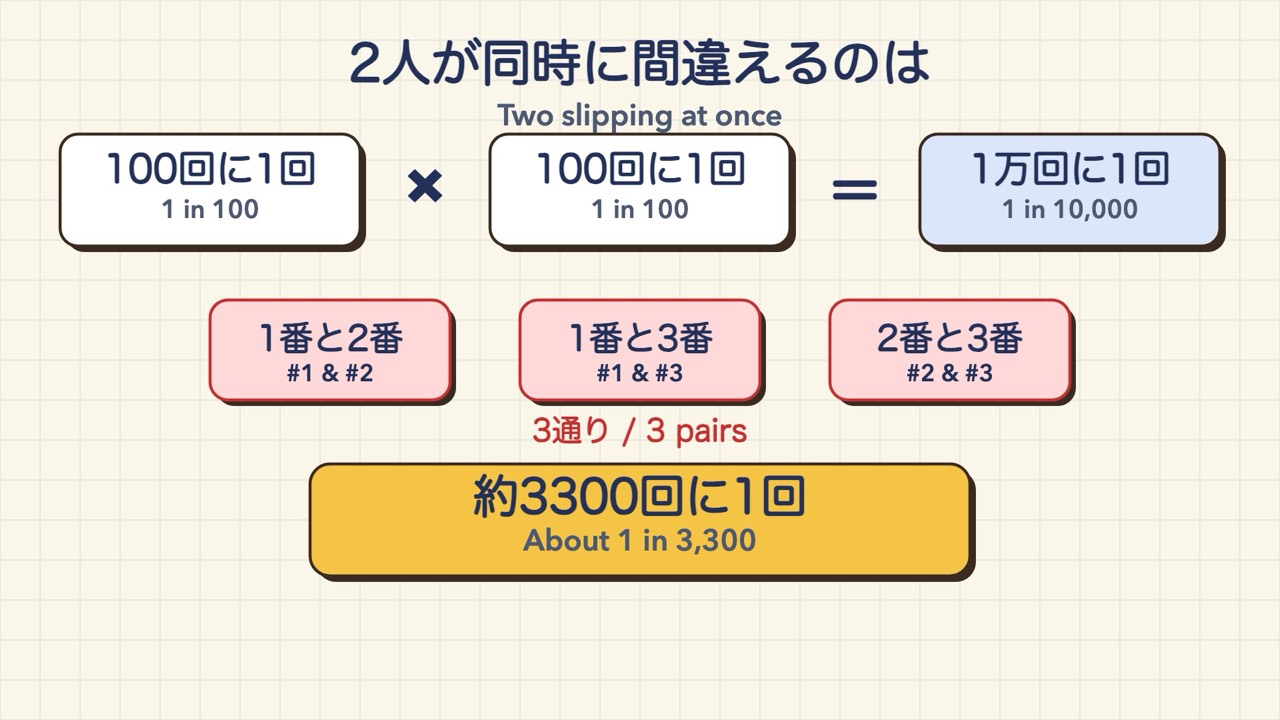
NaruIn reality, two or more can slip at the same time.
NaruThat's the only time this method gets fooled.
NaruIf each of them, on their own, slips once in 100, then two at once is once in 100, times once in 100 again.
NaruThere are three such pairs, so about once in 3,300.
NaruIt's just the analogy's math, but the road before a fall gets much longer.
NaruYou added more mistake-prone people, and the mistakes went down.
NaruAdd more people, and fooling the group takes more mistakes at once, so the errors shrink fast.
NaruThen does adding more work for any part at all?
NaruNo. Even in our test, if each person is wrong more than half the time, adding people only makes it worse.
NaruWith qubits it's even stricter. The checkers slip too, and a mistake can even spread to its neighbors.
6:03The line
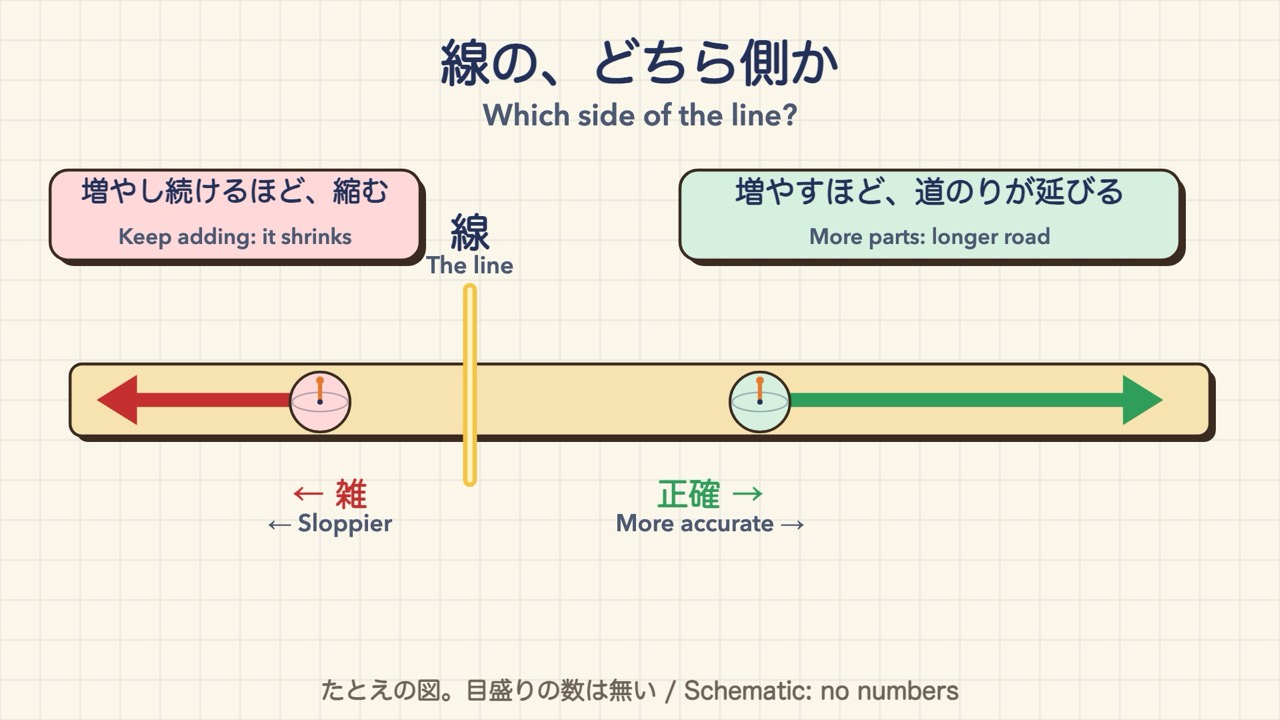
NaruEven so, if the parts are accurate enough, the benefit of adding more wins.
NaruOn our ruler, that tipping point is the line.
NaruIf the parts are well more accurate than the line, adding more stretches the road. If they're sloppier, keep adding and it shrinks.
NaruWhere that line sits depends on how the group is arranged.
NaruIn 2024, Google announced it had crossed this line with its own arrangement.
6:30This result: to the foot of Mt. Fuji
NaruAnd now Quantinuum. They polished the parts to about one slip in 1,200.
NaruThat's far past the line for their arrangement. And the farther past it you are, the more adding helps.
NaruThey grew the group from 13 qubits, to 37, to 73.
NaruLet's put them on the ruler. From here on, one step isn't an operation on a part, it's one round of checking that guards the information.
Naru13 qubits: about one in 1,800. About 1.3 kilometers.
Naru37 qubits: about one in 26,000. About 18 kilometers.
Naru73 qubits: about one in 200,000. About 140 kilometers. In this analogy, that's one fall on average over about the distance from Tokyo to the foot of Mount Fuji.
NaruThat's about one twelfth per step, on average.
NaruThis is the company's own report of an experiment in storing information. They ran 20 rounds of checking and estimated the rate per round.
NaruAnd how to fix things from those check records was worked out afterward, all at once.
7:41Answer: how it was beaten
NaruSo how was it beaten? Not by building parts that never slip.
NaruBy finding only the mistakes without looking at the answers, they cut the overall errors, with parts that still slip.
NaruThis time's step forward: showing on a real machine that bigger groups cut errors by a lot.
8:00Question 3: Will it be practical?
ChiefSo, will it actually be practical!
NaruThere are three walls on the way to practical machines.
NaruOne: the numbers. We're at the foot of Mount Fuji. To reach Jupiter, the target, even the storage number has a factor of five million to go.
NaruEven if errors keep falling at the same rate, the group has to grow by seven more steps.
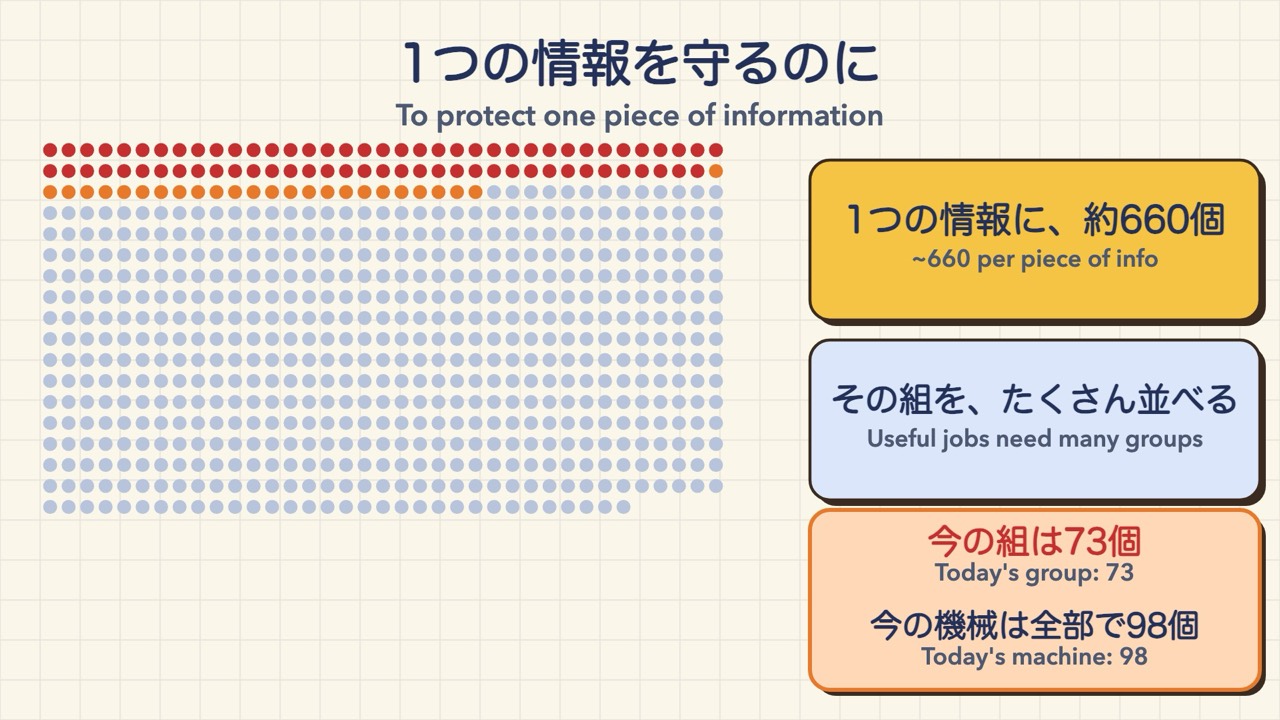
NaruThat's about 660 qubits to protect one piece of information.
NaruAnd useful calculations line up many such groups.
NaruToday's group has 73. Today's whole machine has 98.
NaruAnd only three sizes have been measured. Nobody knows yet whether it'll keep falling the same way.
8:41One more job
NaruTwo is a wall the ruler doesn't show: not all the work a calculation needs is ready yet.
NaruWhat they protected was storing information and a basic two-qubit operation. Every calculation needs that foundation.
NaruBut calculations built only from those can be imitated by an ordinary computer.
NaruTo go beyond that, this approach needs one more job: making qubits in a special state and adding them to the calculation.
NaruShowing that adding more cuts errors in that job too is still ahead, the paper itself says.
9:18Fixing on the spot
NaruThree is fixing things on the spot. This time, how to fix them was worked out after the experiment.
NaruBut when you add that special state, the calculation has to happen right then, while the machine is running.
NaruThe paper says that looks doable in time, but actually showing it across a whole calculation, while staying past the line, is still ahead.
NaruThe machine's own speed is a challenge too. One round of checking here took about 0.2 seconds.
NaruToo slow, and you won't get an answer in a useful amount of time.
NaruWill it lead to practical machines? The road is in sight.
NaruBut with more qubits to add, one more job to prepare, and on-the-spot fixes to achieve, it's still a long way off.
10:01Summary
NaruLet's sum up on the ruler. The raw parts, counting operations: one fall in 1,200 steps. To the convenience store.
NaruThe storage experiment, counting rounds of checking: one fall in 200,000 steps. To the foot of Mount Fuji.
NaruThe target for useful calculations: one fall in a trillion steps. To Jupiter. Five million times to go.
NaruSo has it finally been beaten? Not yet. The parts' weakness is still there. They still slip about once in 1,200.
NaruWhat changed is something else.
NaruWith parts that still slip, overall errors can be cut. That's been confirmed on a real machine, starting with the foundation. Naruhodo!
Chief...Quantum? Totally lost. But cutting errors while still slipping, huh? Naruhodo.
NaruThe Chief gave us a big gold star!
NaruWhat problem would you want a quantum computer to solve? Tell us in the comments.
NaruThis has been Naru News!
NaruIf you went "naruhodo!", please hit like and subscribe!
Explained in pictures
More details
What is quantum computing's weakness?
A bit in an ordinary computer is either 0 or 1: picture an arrow pointing up or down. A qubit can also point at a slant, holding 0 and 1 overlapped in a set proportion.
That slant is very delicate. Heat or tiny disturbances knock it off course right away, and once it drifts, the calculation's answer goes wrong. Even on this machine, an operation using two qubits goes wrong about once in every 1,200 tries, on average. Suppose each one goes wrong independently like that: run just 1,000 of them, and more than half of the calculations go wrong somewhere.
How few mistakes useful calculations need depends on the calculation, but the example the company gives is one in a trillion. That's a gap of roughly 800 million times from the parts' one in 1,200, and just polishing the parts won't get you anywhere near. So the weakness is that the parts slip so easily that long calculations can't make it to the end.
Why can't qubits be fixed like an ordinary computer?
On an ordinary computer, you can fix mistakes by making three copies and taking a majority vote.
But a qubit whose contents you don't know can't be copied exactly. And the moment you read it out, the arrow snaps to up or down, and the slant is gone. Neither copying nor peeking can be used to fix them.
How do you find mistakes without looking at the answers?
Instead of making copies, a whole group of qubits holds one piece of information together.
Checker qubits measure just the relationship among a few neighbors and never read the contents. It's like hearing “it's a tie” in rock-paper-scissors: you know both played the same hand, but not whether it was rock, paper or scissors (that's an analogy). That's why the slant you want to protect doesn't vanish.
From where the tie broke, a calculation estimates what likely drifted, and where. In this experiment, how to fix things from the check records was worked out afterward, all at once.
Why does adding more cut the mistakes?
Think of a majority vote among three people. The answer is true or false, and each of them, on their own, slips once in 100. The vote is fooled only when two or more slip at the same time. There are three such pairs, so that's about once in 3,300 (the analogy's math). Add more people, and fooling the group takes more mistakes at once, so the errors shrink fast.
But it doesn't work for just anyone. If each person is wrong more than half the time, adding people only makes it worse. For example, with people who are each wrong 6 times in 10, on their own, the vote goes wrong 60% of the time with one person, about 65% with three, about 68% with five and about 71% with seven.
With qubits it's even stricter. The checkers slip too, and a mistake can even spread to its neighbors. Even so, if the parts are accurate enough, the benefit of adding more wins. That tipping point is the line (the technical word is “threshold”). If the parts are well more accurate than the line, a bigger group cuts the errors; if they're sloppier, keep growing it and the errors go up. Where the line sits depends on how the group is arranged.
In 2024, Google announced it had crossed this line with its own arrangement (the hardware and the arrangement are different, so the two results can't be compared directly).
How good is this result?
Quantinuum polished its parts to about one slip in 1,200, far past the line for its arrangement. And the farther past it you are, the more adding helps.
As they grew the group from 13 qubits, to 37, to 73, the mistakes left per round of checking that guards the information were about one in 1,800, one in 26,000 and one in 200,000. That's about one twelfth per step, on average.
Pictured as steps (one step is 70 cm; a rough ruler), the raw parts fall once right about when you reach a store a ten-minute walk away, about 800 meters. The groups reach about 1.3 km, 18 km and 140 km; with 73 qubits, that's about the distance from Tokyo to the foot of Mount Fuji. The target of one in a trillion is about 700 million km, about the walk to Jupiter.
This is the company's own report of an experiment in storing information: they ran 20 rounds of checking and estimated the rate per round.
What else does a practical machine need?
One: the numbers. To reach Jupiter, the target, even the storage number has a factor of five million to go. Even if errors keep falling at the same rate, the group has to grow by seven more steps, to about 660 qubits to protect one piece of information. And useful calculations line up many such groups. Today's group has 73; today's whole machine has 98. Only three sizes have been measured, and nobody knows yet whether it'll keep falling the same way.
Two: a wall the ruler doesn't show. What they protected was storing information and a basic two-qubit operation, a foundation every calculation needs. But calculations built only from those can be imitated by an ordinary computer. To go beyond that, this approach needs one more job: making qubits in a special state (magic states) and adding them to the calculation. Showing that adding more cuts errors in that job too is still ahead, the paper itself says.
Three: fixing things on the spot. When you add that special state, how to fix things has to be worked out right then, while the machine is running. The paper says that looks doable in time, but actually showing it across a whole calculation, while staying past the line, is still ahead. The machine's own speed is a challenge too: one round of checking here took about 0.2 seconds. The company says it plans an error-resistant machine called Apollo by 2029.
 Takeaway
No part that never slips has been made. Even with parts that still slip, if they're well more accurate than the line, a bigger group cuts the overall errors.
Sources and how we checked
- Quantinuum announcement (Oct 19, 2026, full PRNewswire text)
- Lavasani et al., "Quantum error correction well below the color code threshold" (Quantinuum paper, arXiv 2610.24077, 2026)
- Quantinuum technical blog
- Google Quantum AI, "Quantum error correction below the surface code threshold" (Nature, 2025)
- Google announcement (Dec 9, 2024)
- NASA, "Jupiter Facts" (distance to Jupiter)
- Wikipedia, "Gottesman–Knill theorem"
- PostQuantum analysis (distance 21 and 661 qubits; about 0.2 s per round)
- Wikipedia, "Quantum error correction"
- Wikipedia, "Condorcet's jury theorem"
AI wrote this page from the video script and the sources above. A different AI from the one that wrote the script checked it against the text of those sources (November 3, 2026). A person with a master’s degree in science and a Japanese high-school science teaching license also read and checked it before publishing. Numbers are as of that date. If anything was hard to follow, you spot a mistake, or there’s a question you’d like us to look into, please write to [email protected].