 Naru News日本語
What is a cat qubit in quantum computing?
Also called: Cat qubits, Bosonic cat qubit, Cat state, Cat code

In one minute
A cat qubit is one way to build a qubit, the part a quantum computer computes with: it traps microwaves (the same family of radio waves used by microwave ovens and cell phones, a kind of invisible light) in a tiny box (a resonator) inside a superconducting circuit, and makes the error where 0 and 1 swap (a bit flip) very rare.
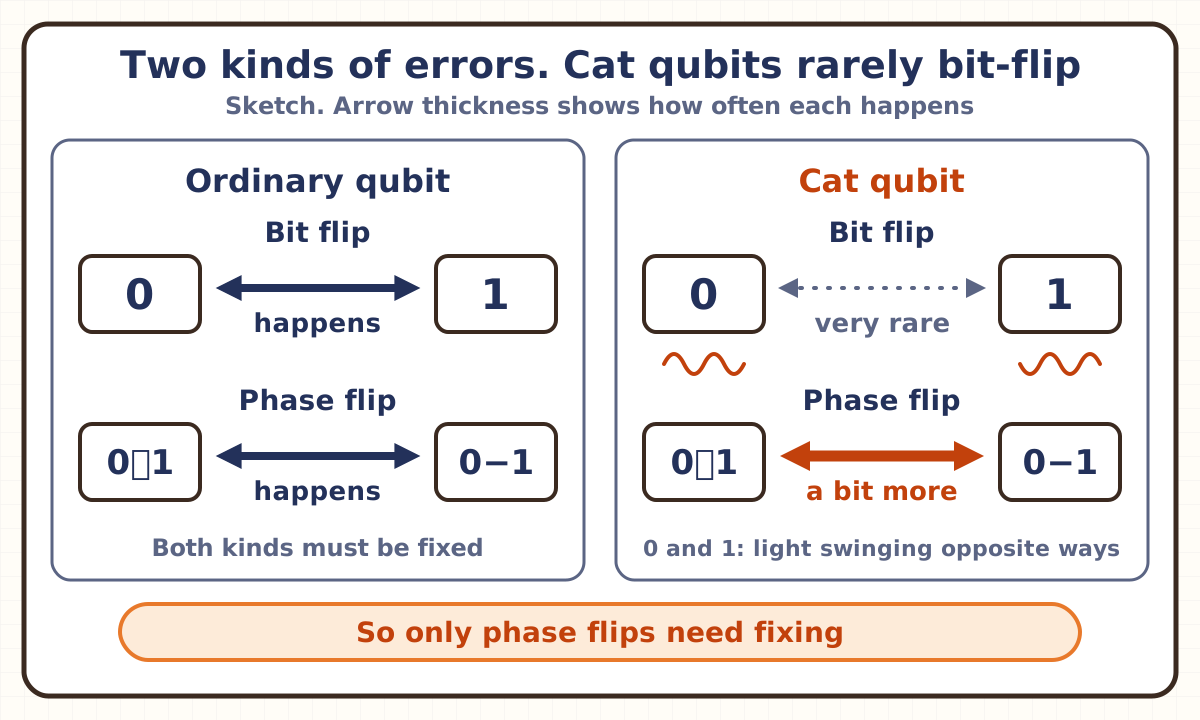
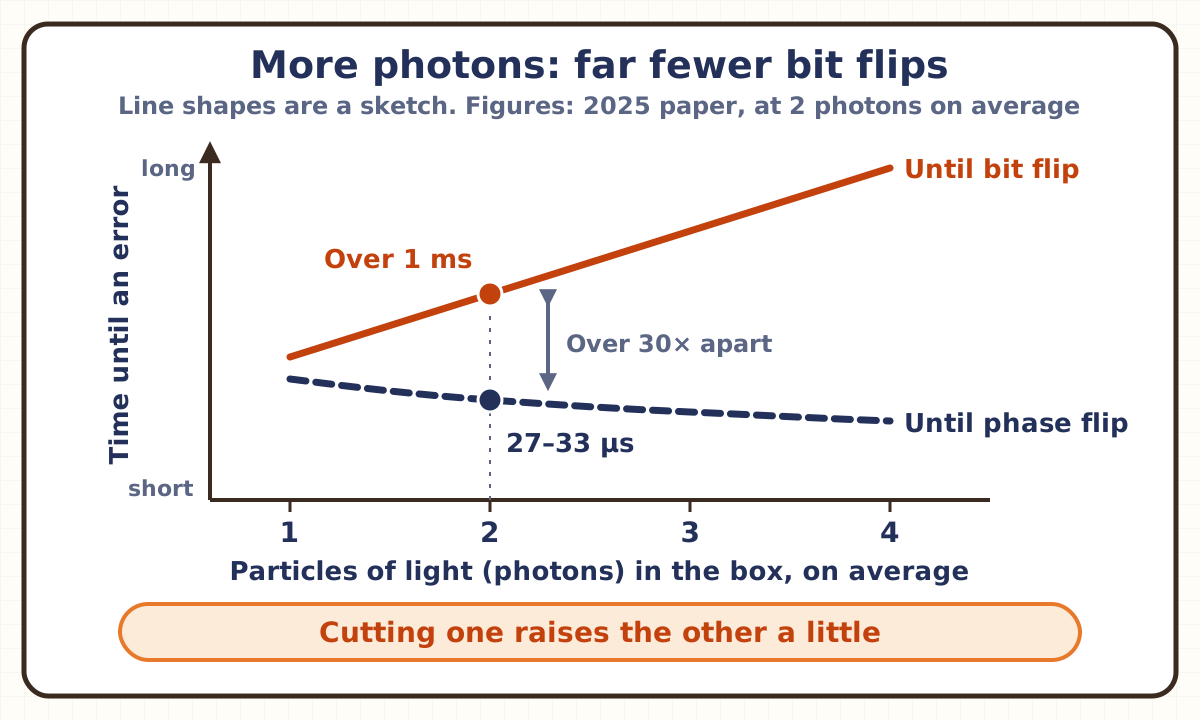
A qubit can be in a state that holds 0 and 1 at the same time (a superposition). The two can be overlapped with a plus or with a minus, and the computation uses that difference too. So errors also come in two kinds, and either one spoils the result: a bit flip, where 0 and 1 swap, and a phase flip, where the plus and minus swap. A cat qubit uses two states of light swinging in opposite ways as 0 and 1. The more particles of light (photons) in the box, the rarer bit flips become, while phase flips become a little more common.
So only the leftover phase flips are fixed, with a simple scheme that lines cat qubits up in a row. It is expected to need fewer parts than fixing both kinds.
A common mix-up
“A cat qubit doesn’t make errors.”
Only half right. In a cat qubit, bit flips, where 0 and 1 swap, become very rare. In a 2024 paper, a single cat qubit went more than 10 seconds before a bit flip, about 10,000 times longer than earlier cat qubit experiments. But the other kind of error, the phase flip (where the plus or minus in how 0 and 1 overlap swaps), remains. In the same experiment, the time until a phase flip was just over 490 nanoseconds (about a two-millionth of a second), a mere instant next to 10 seconds. What’s more, the more particles of light (photons) are added to cut bit flips, the more phase flips there are. That is why cat qubits are also used together with a way to fix errors. Even in a 2025 experiment that lined up five cat qubits to fix errors, the one piece of information held by the five still went wrong about once in every 60 checks for errors (about 1.65% per check), even at best. “Resistant to errors” doesn’t mean no errors; it means one of the two kinds is very rare.
Explained in pictures
You’re free to use these figures in lessons, slides and posts if you credit Naru News (naru.news). CC BY 4.0.
Think of it like this
A ball in one of two deep valleys
Picture land with two deep valleys side by side and a hill between them. A ball in the left valley means 0; in the right valley, 1. When the ground shakes a little, the ball just rolls around inside its valley and doesn’t cross to the other side. For 0 and 1 to swap (a bit flip), big shakes would have to pile up by chance and carry the ball over the hill.
Adding particles of light (photons) to a cat qubit’s box is like moving the two valleys farther apart and making the hill higher. Adding just a few makes crossing the hill far rarer. That is why bit flips become so much rarer as the number of photons goes up.
But the comparison has limits. A ball can only be in one valley. A qubit, though, can also be in a state that is in 0 and 1 at the same time (a superposition), and computations use that state too. In the picture, that would be one ball sitting in both valleys at once, which no real ball can do. So this picture only explains why 0 and 1 rarely swap. A superposition has a plus or minus way of overlapping, and every time a single photon escapes from the box, that sign swaps (a phase flip). This has nothing to do with the height of the hill, and the more photons there are, the more often one escapes. Also, a real cat qubit has no hills or valleys. Its 0 and 1 are two states of light swinging in exactly opposite ways. A special circuit that puts photons into the box and takes them out two at a time keeps pulling the light back to those two states (and their superpositions). That circuit plays the part of the valleys in the picture.
Key points
Why is it called a “cat”?
It is named after a famous thought experiment by the physicist Schrödinger. In it, a cat in a box, hooked up to a device that follows the rules of quantum physics, ends up in a superposition of being alive and being dead. A superposition of two clearly different states is called a “cat state,” after this story.
A cat qubit uses two states of the light in a box (a resonator) that swing in exactly opposite ways. Each is close to ordinary light, with a set strength and a set timing of its swing. A cat state, the superposition of the two, is a superposition of two clearly different states, like a living cat and a dead cat. No real cat is used anywhere.
What are the 0 and 1?
Inside a circuit made of superconducting metal (metal whose electrical resistance drops to zero when it is cooled enough), there is a resonator that acts as a tiny box. A resonator is a part that can hold, for a while, a kind of radio wave that swings at a set rate (microwaves). AWS’s 2025 chip used resonators shaped like thin lines drawn on a flat plate as the boxes for its cat qubits.
A cat qubit takes two states of the light held in this box, swinging in exactly opposite ways, as 0 and 1: when one wave is at a crest, the other is at a trough. Because it is a qubit, it can also be in a superposition of 0 and 1. Overlapping 0 and 1 half and half with a plus gives one cat state, and with a minus, the other.
The more particles of light (photons) in the box, the more clearly the two states differ, and the harder they are to mix up. In the 2025 experiment, the average number of photons was set between 1 and 4.
Why are bit flips so rare?
For 0 to turn into 1, the way the light in the box swings has to reverse completely. When a small disturbance makes a single photon escape or enter, the swing doesn’t reverse completely. On top of that, a special circuit that puts photons into the box and takes them out two at a time keeps pulling the light back to those two states (and their superpositions). This way of keeping them was proposed in a 2014 paper (Mirrahimi et al.). The more photons, the farther apart the two states are, so each extra photon makes bit flips several times rarer.
In exchange, phase flips increase. Every time a single photon escapes from the box, the plus and minus in how 0 and 1 overlap swap. With more photons, more escape, so how often phase flips happen grows roughly in proportion to the number of photons.
In AWS’s 2025 experiment, with an average of 2 photons, the time until a bit flip was more than 1 millisecond (a thousandth of a second), and until a phase flip, 27 to 33 microseconds (about 30 millionths of a second). That makes bit flips more than 30 times rarer. Errors this lopsided toward one kind are the cat qubit’s strength.
How are the leftover phase flips fixed?
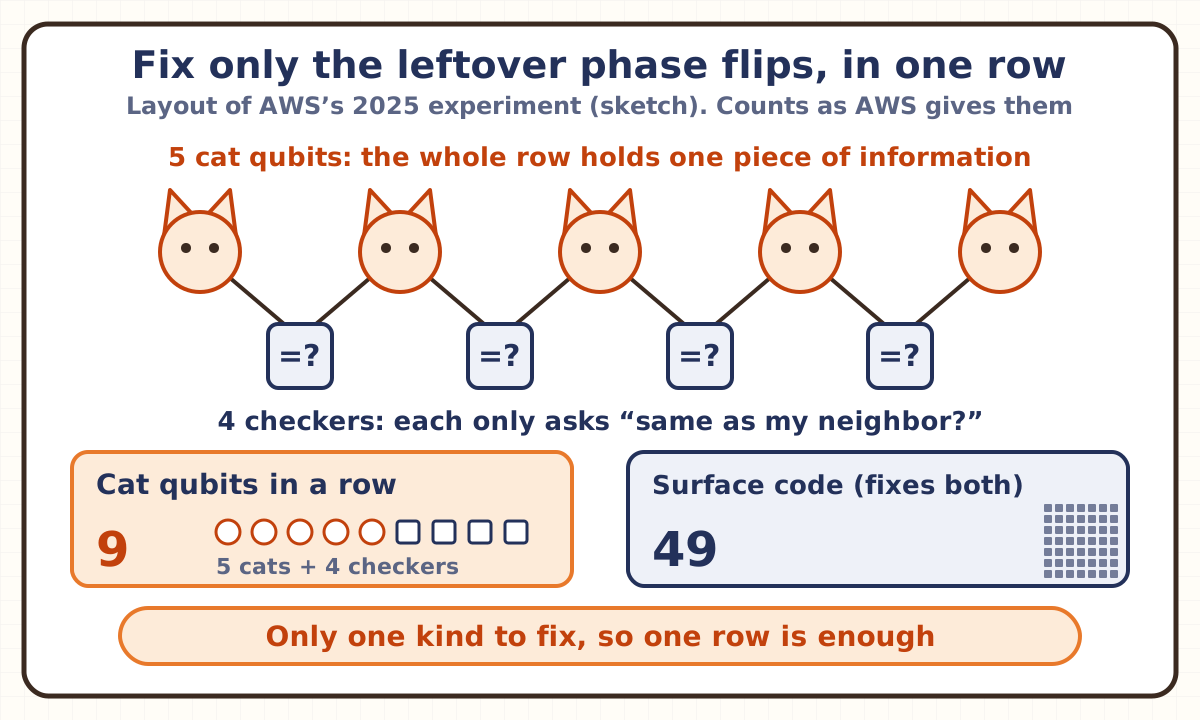
Cat qubits are lined up in a row, and the whole row holds one piece of information. One piece of information held by many parts like this is called a logical qubit. Between each pair of neighboring cat qubits sits a checker qubit (an ordinary superconducting qubit). A checker never reads the contents; it only checks whether the two neighbors are the same. From where they disagree, a calculation estimates which cat qubit likely had a phase flip. This arrangement is called a repetition code.
A repetition code can fix only one kind of error. To fix both kinds on ordinary qubits, schemes such as the surface code, which lays qubits out on a flat grid, are used, and they need many parts. Because bit flips are so rare in cat qubits, one row is enough. The idea of using cat qubits in a one-row repetition code was laid out in a 2019 paper (Guillaud and Mirrahimi).
AWS says a row of five (a code of distance 5) needs only 9 qubits, 5 cat qubits and 4 checkers. The distance of a code is a measure of how many overlapping errors it can still sort out; in a one-row code, it is the number of cat qubits in the row. A surface code of the same distance needs 49, so this is less than a fifth. On top of these, there are 5 circuits that keep the cat qubits in their two states.
How far has it come?
In February 2025, researchers at AWS (Amazon Web Services) published a paper in Nature. AWS announced the chip under the name Ocelot. On the chip, they ran an experiment storing one piece of information in a row of five cat qubits (distance 5) and in two rows of three within it that overlap as little as possible (distance 3).
Phase flips went down when the row grew from three to five, at every photon number they tested. Adding parts only cuts the overall errors when each part’s own errors are low enough, so for phase flips, the parts met that condition. Bit flips, on the other hand, rose in the longer row. A one-row code can’t fix bit flips, so a bit flip in any one cat qubit of the row spoils the whole row’s information, and a longer row has more places where that can happen. Even so, bit flips fell as photons were added, and even in the row of five, at an average of 4 photons, they dropped below 1% per round of checking.
Counting both kinds, the lowest leftover error per round of checking was 1.75% on average for the rows of three and 1.65% for the row of five (for the row of five, at an average of about 1.5 photons). The paper says the row of five, despite having more places where errors can happen, kept its errors about as low as the rows of three. One round of checking took about 2.8 microseconds.
But practical use is still a way off. Most of today’s errors come from the cat qubits’ own bit flips and phase flips. And because a repetition code can’t fix bit flips, making the row longer and longer stops cutting errors at some point. The paper says bit flips caused by the checkers will eventually need fixing too, which could be done by building cat qubits into surface codes tailored to lopsided errors. AWS says that scaling this approach up could cut the cost of fixing errors by up to 90% compared with current approaches, but that is the company’s projection, and Ocelot is still a prototype.
How many cat qubits would it take to break encryption?
In October 2026, researchers at Alice & Bob, a Paris company that builds cat qubits, estimated what it would take to break RSA-2048, one of the encryption methods widely used today, with a quantum computer. It is a paper not yet checked by other researchers, and the company’s own estimate: about 23,000 cat qubits (22,593) and about 3.14 days.
The number rests on assumptions: one round of checking takes 1 microsecond, deciding the next step from the checks takes 10 microseconds, phase flips happen at a rate of 1 in 2,000 for each operation in the circuit, and bit flips don’t happen at all (equal to about 100 years until a bit flip). If bit flips happen about once an hour, a small code that fixes bit flips has to be added, and the paper says the count rises to about 45,000.
The times until a bit flip confirmed in papers so far are more than 1 millisecond for the cat qubits on AWS’s 2025 chip, and more than 10 seconds for a single cat qubit in 2024. The estimate assumes far longer times than these. One round of checking also took about 2.8 microseconds in the 2025 experiment, longer than the assumed 1 microsecond.
For ordinary qubits with the surface code, Craig Gidney of Google Quantum AI estimated in 2025 that it could be done with fewer than a million qubits in less than a week (assuming a 0.1% error per operation, 1 microsecond per round of checking and so on). The kinds of parts and the assumptions differ, so the numbers can’t be compared directly. Both are estimates for machines that haven’t been built yet.
Check yourself
Q1In a quantum computer part called a cat qubit, as the number of particles of light (photons) in its box (a resonator) is increased, how do the two kinds of errors, bit flips and phase flips, change?
Answer and explanation
Answer: B Bit flips decrease, and phase flips increase
With more photons, the two states for 0 and 1 (two states of light swinging in exactly opposite ways) differ more clearly, and bit flips quickly become rare. But every time a single photon escapes from the box, there is a phase flip, where the plus and minus in how 0 and 1 overlap swap, so with more photons there are more phase flips. In the 2025 experiment, at an average of 2 photons, it took more than 1 millisecond until a bit flip and 27 to 33 microseconds until a phase flip. They don’t both go down: cutting one raises the other a little. It is a trade-off.
Q2Qubit errors come in two kinds: a “bit flip,” where 0 and 1 swap, and a “phase flip,” where the plus or minus in how 0 and 1 overlap swaps. A simple scheme that lines cat qubits up in a single row and checks whether neighbors are the same (a repetition code) can fix only one of these kinds. Why is this one-row scheme still thought to be enough for cat qubits?
Answer and explanation
Answer: C Cat qubits very rarely have bit flips
A repetition code only checks whether neighbors are the same, and it can fix just one kind of error. Because bit flips are very rare in cat qubits, fixing only the leftover phase flips is enough. Phase flips actually increase as more particles of light (photons) are added, so they are not rare. And since cat qubits still have phase flips, it isn’t true that neither kind of error happens much.
More on this → Key points: How are the leftover phase flips fixed?
Q3In 2026, researchers at a company that builds cat qubits estimated that breaking RSA-2048, an encryption method widely used today, with a quantum computer would take about 23,000 cat qubits. In this estimate, how often were the cat qubits’ bit flips assumed to happen?
Answer and explanation
Answer: A About once every 100 years
The estimate assumes there are no bit flips, which works out to about 100 years until a bit flip. The values confirmed in papers are more than 1 millisecond for the cat qubits on AWS’s 2025 chip, and more than 10 seconds for a single cat qubit in 2024. If bit flips happen about once an hour, the estimate adds a small code that fixes bit flips, and the count rises to about 45,000. Estimates of how many parts are needed rest on assumptions like these.
More on this → Key points: How many cat qubits would it take to break encryption?
Related terms
- Quantum computer
- Qubit
- Quantum error correction
- Logical qubit
- Superposition
- Schrödinger’s cat
- Superconductivity
- Resonator
- Photon
- Surface code
- Shor’s algorithm
Sources and how we checked
- Putterman et al., "Hardware-efficient quantum error correction via concatenated bosonic qubits" (AWS Center for Quantum Computing, Caltech, University of Chicago, Hebrew University of Jerusalem and others; Nature 638, pp. 927–934, February 2025; open-access text: abstract, the cat qubit’s 0 and 1, bit-flip and phase-flip times versus photon number, the repetition code and its checkers, distance 3 versus distance 5, captions of Figures 1–4 and the conclusion; read November 11, 2026)
- AWS, "Amazon Web Services announces a new quantum computing chip" (About Amazon, February 27, 2025; the name Ocelot, its 14 core components, the company’s up-to-90% projection and that it is a prototype; read November 11, 2026)
- Brandão and Painter, "Amazon announces Ocelot quantum chip" (Amazon Science, February 27, 2025; where the name comes from, and 9 qubits versus 49 for a surface code; read November 11, 2026)
- Mirrahimi et al., "Dynamically protected cat-qubits: a new paradigm for universal quantum computation" (New Journal of Physics 16, 045014, 2014; arXiv abstract; the proposal to keep cat states stable with two-photon driven dissipation; read November 11, 2026)
- Guillaud and Mirrahimi, "Repetition Cat Qubits for Fault-Tolerant Quantum Computation" (Physical Review X 9, 041053, 2019; arXiv abstract; bit flips suppressed exponentially with photon number, and a one-row repetition code of cat qubits; read November 11, 2026)
- Lescanne et al., "Exponential suppression of bit-flips in a qubit encoded in an oscillator" (Nature Physics, 2020; abstract and text of the arXiv version: the resonator frequency of about 8.04 GHz, a 1 ms bit-flip time, and single-photon loss mixing the plus and minus cat states; read November 11, 2026)
- Réglade et al., "Quantum control of a cat qubit with bit-flip times exceeding ten seconds" (Alice & Bob, École Normale Supérieure and others; Nature 629, pp. 778–783, May 2024; arXiv abstract: bit-flip times over 10 s, phase-flip times over 490 ns, four orders of magnitude beyond earlier cat qubits; read November 11, 2026)
- Pappalardo et al., "Shor's algorithm compiled on cat qubits: 22 593 qubits for RSA-2048 in 3.14 days" (Alice & Bob, Inria and others; IACR Cryptology ePrint Archive 2026/2665, October 2026; preprint; the abstract’s qubit counts, run times and assumptions: 1 μs cycle, 10 μs reaction time, phase-flip probability 5 × 10⁻⁴, no bit flips, about 100 years, or about 45,000 qubits at about one hour; read November 11, 2026)
- Gidney, "How to factor 2048 bit RSA integers with less than a million noisy qubits" (Google Quantum AI; arXiv, May 2025; the abstract’s qubit count, run time and assumptions: 0.1% gate error, 1 μs cycle, 10 μs reaction time; read November 11, 2026)
- Nature Asia, Japanese research highlight on the AWS paper (February 27, 2025; for the Japanese name “kyatto kyūbitto”; read November 11, 2026)
- Nature Asia, Japanese summary of Réglade et al. 2024 (for the Japanese name “neko kyūbitto”; read November 11, 2026)
- ITmedia NEWS, Japanese article on the 2024 cat qubit paper (May 13, 2024; for the Japanese name “neko ryōshi bitto”; read November 11, 2026)
- innovatopia, Japanese article on AWS’s cat qubit chip (February 27, 2025; for the Japanese name “kyatto ryōshi bitto”; read November 11, 2026)
AI wrote this page from the sources above, and a different AI checked it against the text of those sources (November 11, 2026). A person with a master’s degree in science and a Japanese high-school science teaching license also read and checked it before publishing. Numbers are as of that date. If anything was hard to follow, you spot a mistake, or there’s a term you’d like explained, please write to [email protected].
Quantum terms
- You are hereCat qubit