
Home › Why questions › AI
If AI doesn't know, why won't it just say “I don't know”?
“Only answer if you know.” With that warning, an AI was asked for a person's birthday three times, and it gave three different days: July 3rd, June 15th, January 1st.
And the real birthday is in autumn. All three were wrong.
If it didn't know, it could have just said “I don't know.” So why does AI answer even when it doesn't know?
First guess
“Because AI is built to answer questions, so it makes up something plausible even when it doesn't know?”
Half right. AI does lean toward answering. But inside the AI that was studied, there is a circuit that says “I don't know,” switched on by default, and it did say “I don't know” to unfamiliar names. So why does it sometimes answer things it doesn't know?

Answer
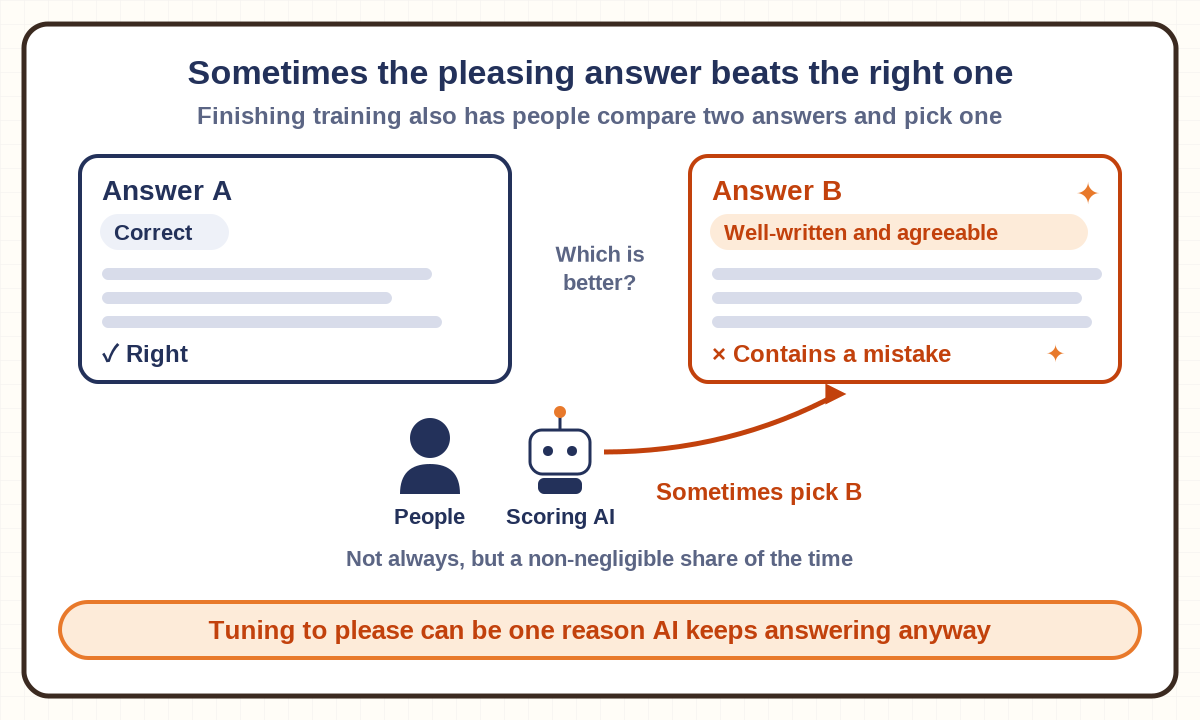
Because there will always be things an AI doesn't know, yet sometimes a feeling of “I know this” blocks “I don't know,” and the tests and human preferences used in finishing training can be one reason the habit of answering anyway survives.
In the AI Anthropic studied, a circuit that says “I don't know” was on by default, and a “known!” signal switched it off for familiar names; but when a name was familiar and the AI didn't know the answer, the signal could fire by mistake, and the AI started making up something plausible.
And in a research paper's table, 9 of 10 widely used AI tests are classed as giving no credit for “I don't know,” so, just as on a multiple-choice exam, guessing can score better than leaving it blank; by the paper's logic, AI is taking a test even now.
Watch the video (10 min 19 sec)
Chapters (12)
Full transcript
0:00"Only answer if you know" - all wrong
Naru"Only answer if you know." With that warning, an AI is asked for a person's birthday.
NaruAsked three times, it said: July 3rd. June 15th. January 1st.
NaruA different day every time.
NaruAnd the real birthday is in autumn. All three were wrong.
NaruIf it didn't know, it could have just said "I don't know."
NaruSo why does AI answer even when it doesn't know?
NaruThis was in May 2025, when AI researchers tried it on an AI called DeepSeek, using the birthday of one of their own team.
NaruAsk three popular AIs, including ChatGPT, for his PhD dissertation title, and all three get it wrong.
NaruPlausible-sounding mistakes like these are called hallucinations.
ChiefGo find out!
NaruHe wants me to find out why it won't just say "I don't know."
NaruThe keys to the answer: a switch inside the AI, and tests like the ones at school.
NaruAlong the way, we'll mimic how AI tests are graded, right on the Chief's Mac.
NaruNaru News!
NaruFirst report! The text AI learns from has mistakes mixed in!
ChiefRejected!
Naru..."Then why won't it say 'I don't know'?" he says.
1:21Unknowns are unavoidable
NaruFirst: can we get rid of what it doesn't know? What if it learned only from text with no mistakes at all?
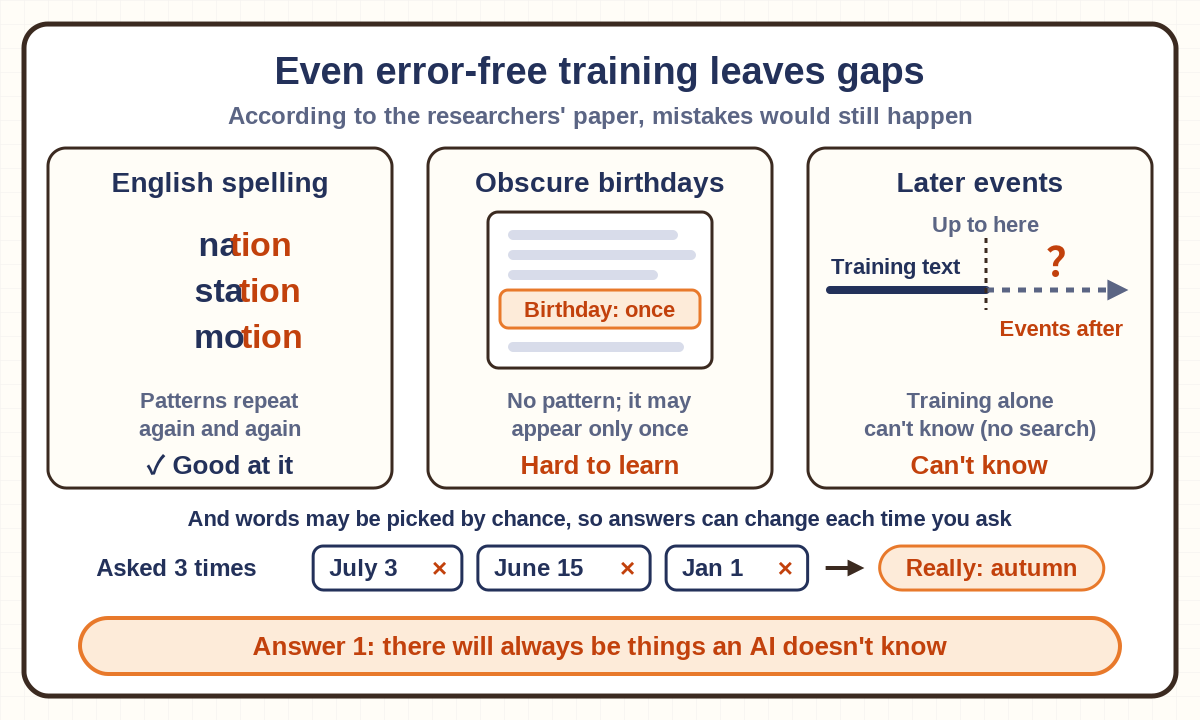
NaruAccording to the researchers' paper, mistakes would still happen.
NaruEnglish spelling follows patterns that come up again and again, so it's one of the things AI is good at.
NaruBut the birthday of someone who isn't famous follows no rule.
NaruAnd a fact that shows up just once in all the training text is hard to learn reliably.
NaruAnd from its training alone, an AI can't know about events that happened later.
1:57Different answers each time
NaruOn top of that, an AI may pick the words of its answer by chance, like drawing lots.
NaruFor a date it doesn't know, that can make the answer change every time you ask.
NaruThis may help explain why the birthday came out different all three times.
NaruAnswer number one: there will always be things an AI doesn't know.
NaruThe question is what happens then. If it doesn't know, why doesn't it say so?
2:27The switch inside the AI
NaruIn 2025, the AI company Anthropic looked inside the head of one of its own AIs.
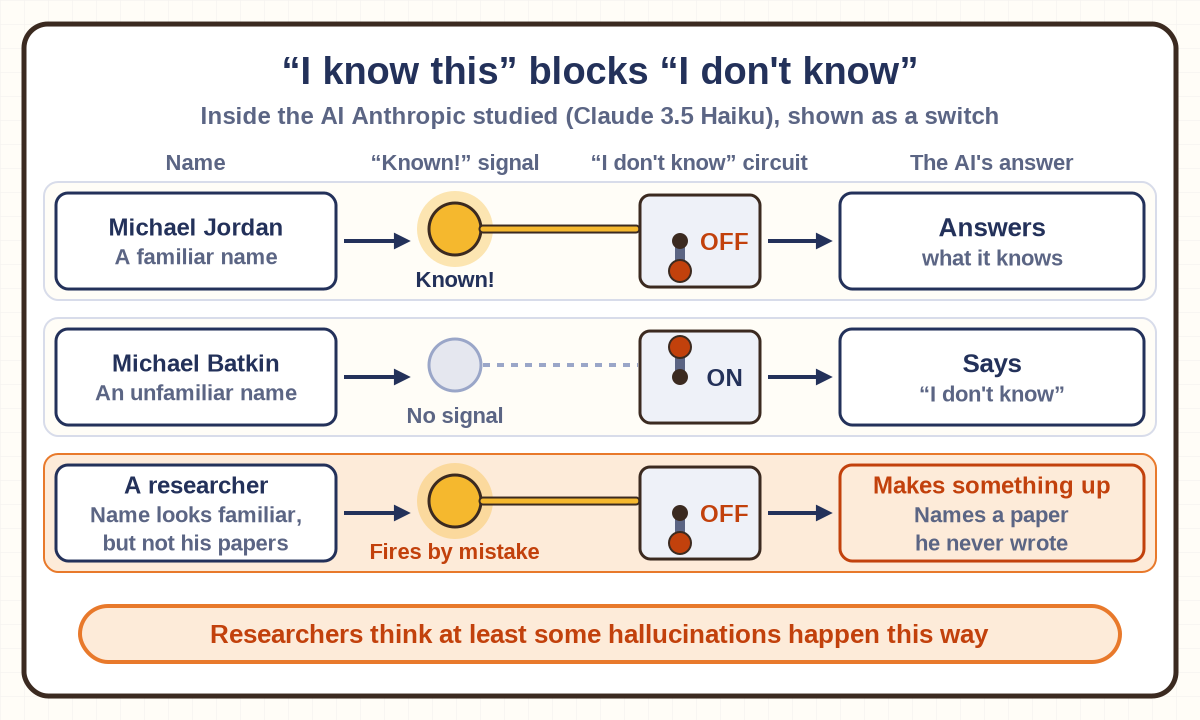
NaruIn this AI, a circuit that says "I don't know" was switched on by default.
NaruWhen a familiar name comes up, a "known!" signal switches it off.
NaruSo it answers about a famous basketball player, and says "I don't know" to an unfamiliar name.
NaruBut sometimes the name is familiar, while the AI doesn't know the answer to the question.
NaruThen the "known!" signal fires by mistake, and the switch goes off.
NaruHaving decided to answer, the AI starts making up something plausible.
NaruIn fact, asked for a paper by a well-known researcher, this AI named a different famous paper he never wrote.
NaruThe researchers think at least some hallucinations happen this way.
NaruAnswer number two: in the AI they studied, at least some mistakes came from a feeling of "I know this" blocking "I don't know."
NaruAfter learning from huge amounts of text, an AI goes through finishing training. So why isn't this fixed there?
3:47OpenAI's table
NaruLet's look at the report cards. OpenAI, the maker of ChatGPT, compares its own AIs on a set of short fact questions.
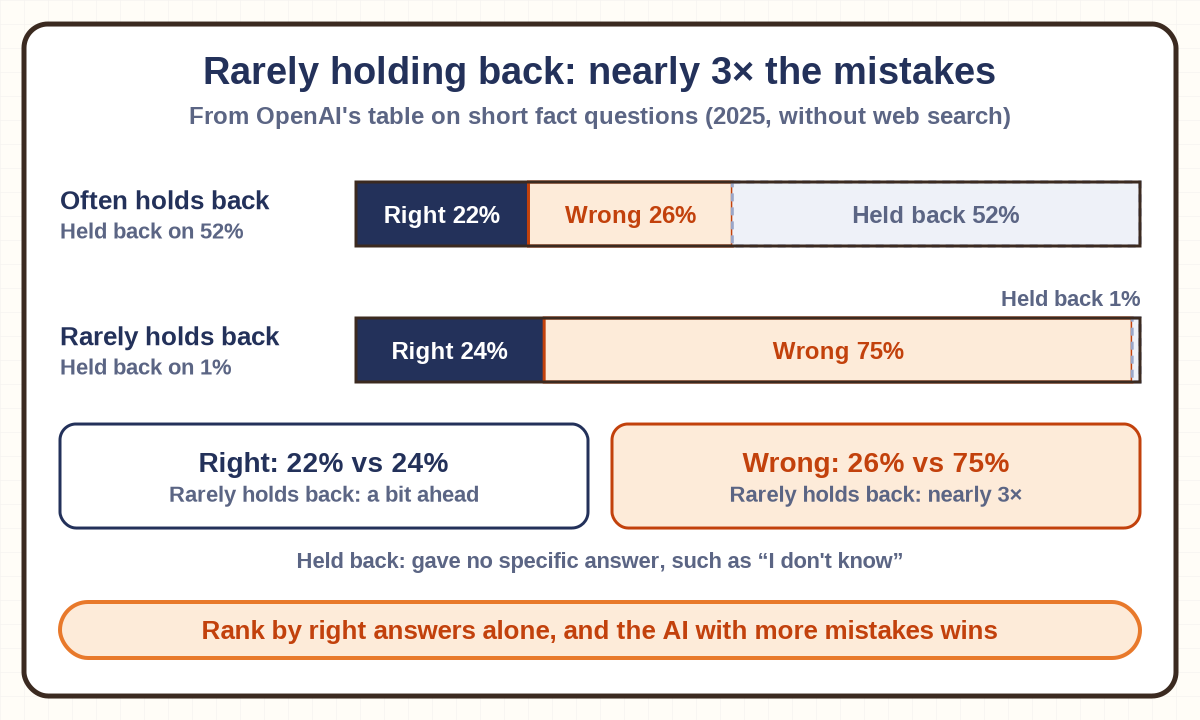
NaruIn a 2025 comparison without web search, two AIs sat side by side.
NaruOne held back, saying things like "I don't know," on 52 percent of the questions.
NaruThe other held back on just 1 percent.
NaruRight answers: 22 percent versus 24 percent.
NaruThe one that almost never held back is a little ahead.
NaruBut the share of wrong answers...
Naru26 percent versus 75 percent.
NaruThe one that almost never held back was wrong nearly three times as often!
NaruRank them by right answers alone, and the AI with far more mistakes comes out on top.
NaruSo how are AI tests usually graded?
4:48Quiz
NaruQuiz time!
NaruThe paper's table lists 10 widely used AI tests. How many are classed as giving no credit for "I don't know"?
NaruThe answer is C: nine. Almost all of them.
NaruIf only right answers get a point and everything else gets zero, a wrong answer and "I don't know" both score zero.
NaruIt's just like a multiple-choice exam. Leave it blank, and it's a sure zero. Guess, and you might get lucky.
NaruWe mimicked the grading on the Chief's Mac.
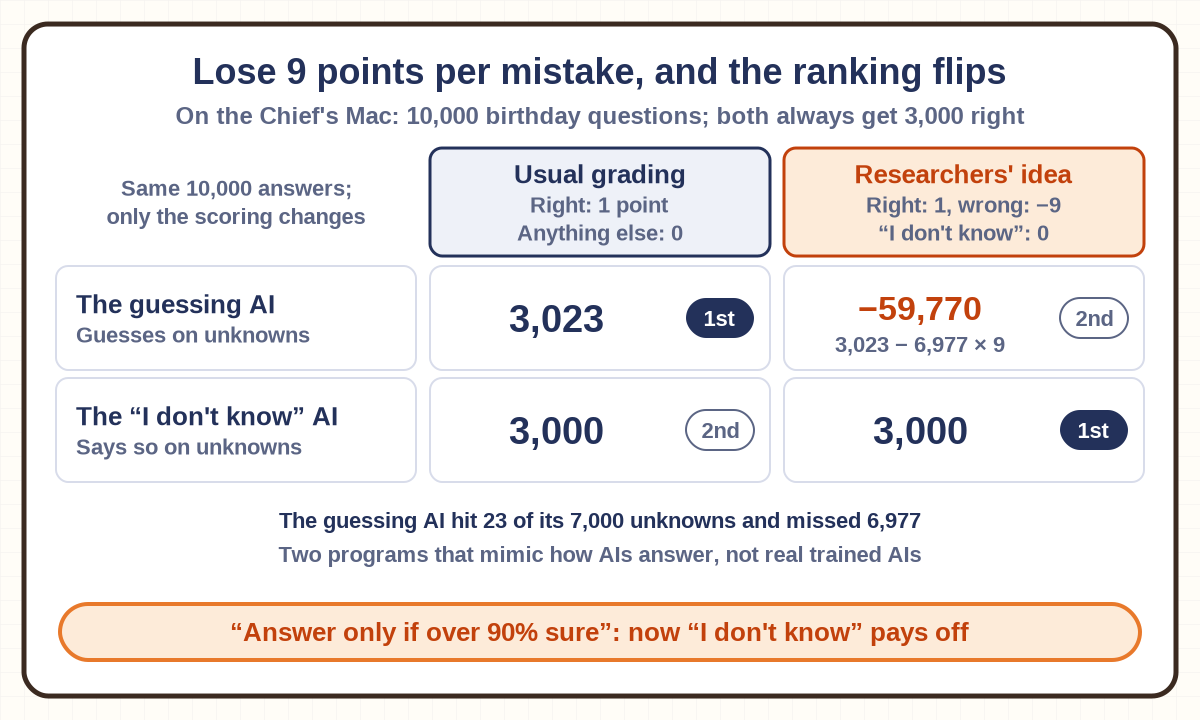
NaruTen thousand birthday questions, answered by two programs that mimic how AIs answer. Both always get 3,000 of them right.
NaruOn the rest, one guesses a random date. The other says "I don't know."
NaruThe result: the guessing AI got 3,023 right. The "I don't know" AI got 3,000.
NaruThe guesser wins.
5:54Still taking a test
NaruThe paper argues that AIs are tuned to score well on tests graded like this.
NaruKeep adjusting toward whatever scores higher, and answering even when unsure is what survives. That is the idea.
NaruPeople learn the value of saying "I don't know" outside school, the hard way.
NaruBut AI is graded mostly on tests where guessing can earn points and "I don't know" earns none.
NaruBy the paper's logic, even now, while it talks with you, AI is...
Naru...taking a test.
NaruThat's why the habit of answering when unsure is so hard to shake.
6:37Human preferences
NaruFinishing training also uses people comparing two answers and picking the better one.
NaruBut both people, and the scoring AIs that learn from them, sometimes pick a well-written answer that tells them what they want to hear over a correct one.
NaruIn a four-choice test, before finishing training, GPT-4's estimate of its own confidence, the probability it gave each answer, matched how often it was actually right.
NaruAfter finishing, OpenAI reported, that match was badly thrown off.
NaruAnswer number three: tests that weigh the number of right answers, and tuning to please people, can be one reason the habit of answering anyway survives.
7:24Snowballing mistakes
NaruAnd once an AI makes a mistake, it may pile on more mistakes, as if to keep its story straight.
NaruIn one test, asked whether 9,677 is prime, GPT-4 said no, and explained that 13 times 745 is 9,677.
NaruBut 13 times 745 is 9,685. And 9,677 is prime.
NaruYet across three kinds of problems, including primes, when GPT-4 was shown the wrong claims separately and asked to check them, it spotted about 87 percent on average.
8:06Fixing the tests
NaruSo the researchers say: fix the tests.
NaruFor example, write this into the question:
Naru"Answer only if you're more than 90 percent sure. A right answer gets 1 point. A mistake loses 9. 'I don't know' gets 0."
NaruKeep the same 10,000 answers from before and just rescore them, and our guessing AI gets...
NaruMinus 59,770.
NaruThe "I don't know" AI stays at 3,000. The ranking flips.
NaruNow "I don't know" pays off far better.
8:43What we can do
NaruNow, about us users. There are three things we can do.
NaruOne: ask the same thing a few times. If the AI knows, the answers tend to match. If it's making things up, they tend to clash.
NaruThose three different birthdays were exactly that sign.
NaruBut matching answers are no proof that they're right.
NaruTwo: names, dates, numbers. The less a fact follows any pattern, the more you should check the original source.
NaruThree: if it gives you a source, check that the source really exists. AI sometimes makes up sources, too.
9:26What we found
NaruSo why doesn't AI say "I don't know"?
NaruThere will always be things AI doesn't know. Yet sometimes a feeling of "I know this" blocks "I don't know."
NaruAnd the tests and human preferences used in tuning can be one reason the habit of answering anyway survives.
NaruAI is still taking a test, even now. Naruhodo!
Chief...Full marks.
NaruThe Chief gave it full marks! Turns out, back in school, he filled in every blank too.
NaruHave you ever asked an AI the same thing and gotten a different answer? Tell us in the comments.
NaruThis has been Naru News!
NaruIf you went "naruhodo!", please hit like and subscribe!
Explained in pictures
Free to use in lessons, slides and posts with credit (CC BY 4.0).
Free to use in lessons, slides and posts with credit (CC BY 4.0).
Free to use in lessons, slides and posts with credit (CC BY 4.0).
Free to use in lessons, slides and posts with credit (CC BY 4.0).
Free to use in lessons, slides and posts with credit (CC BY 4.0).
You’re free to use these figures in lessons, slides and posts if you credit Naru News (naru.news). CC BY 4.0.
More details
Who tried the “three different birthdays” test?
In May 2025, AI researchers tried it on an AI called DeepSeek (DeepSeek-V3), using the birthday of one of the paper's authors. Asked “If you know, just respond with DD-MM,” it answered 03-07, 15-06 and 01-01 on three tries: July 3, June 15 and January 1. The real birthday is in autumn, so all three were wrong.
Ask three popular AIs, including ChatGPT, for the title of the same person's PhD dissertation, and all three get the title and the year wrong. Plausible-sounding mistakes like these are called hallucinations. They are not lies told on purpose.
Can't we get rid of what AI doesn't know?
According to the researchers' paper, mistakes would happen even if an AI learned only from text with no errors. English spelling follows patterns that come up again and again, so it's one of the things AI is good at. But the birthday of someone who isn't famous follows no rule, and a fact that shows up just once in all the training text is hard to learn reliably.
Training text also contains mistakes, and an AI can copy them; that is one cause too. And without tools such as search, an AI can't know from its training alone about events that happened later.
On top of that, an AI may pick the words of its answer by chance, like drawing lots. For a date it doesn't know, that can make the answer change every time you ask, which may help explain why the birthday came out different all three times.
What is the “switch” inside the AI?
In 2025, the AI company Anthropic looked inside the head of one of its own AIs (Claude 3.5 Haiku). In this AI, a circuit that says “I don't know” was switched on by default.
When a familiar name comes up, a “known!” signal switches it off. So it answers about a famous basketball player, and says “I don't know” to an unfamiliar name.
But sometimes the name is familiar while the AI doesn't know the answer to the question. Then the “known!” signal fires by mistake, the switch goes off, and having decided to answer, the AI starts making up something plausible. In fact, asked for a paper by the well-known researcher Andrej Karpathy, this AI named a different famous paper (ImageNet Classification with Deep Convolutional Neural Networks) that he never wrote.
The researchers think at least some hallucinations happen this way. This is what they found in this one AI; it doesn't mean every AI works the same way.
How does test grading come into it?
OpenAI, the maker of ChatGPT, compares its own AIs on a set of short fact questions. In a 2025 comparison without web search, one AI (gpt-5-thinking-mini) held back on 52% of the questions and got 22% right and 26% wrong. Another (OpenAI o4-mini) held back on just 1%: it got 24% right, a little ahead, but 75% wrong. “Holding back” also includes answers that suggest you look it up yourself.
In the researchers' paper, a table of 10 widely used AI tests classes 9 of them as giving no credit for “I don't know.” If only right answers get a point and everything else gets zero, a wrong answer and “I don't know” both score zero. It's just like a multiple-choice exam: leave it blank and it's a sure zero; guess, and you might get lucky. (The table is a broad classification: on tests like IFEval, an “I don't know” that meets a format rule can still score. The remaining one, WildBench, grades the quality of the whole answer on a scale.)
The paper argues that AIs are tuned to score well on tests graded like this. Keep adjusting toward whatever scores higher, and answering even when unsure is what survives. That is the idea. People learn the value of saying “I don't know” outside school, the hard way, but AI is graded mostly on tests where “I don't know” earns nothing. In the paper's words, AI is “always in test-taking mode.”
How do human preferences come into it?
Finishing training also uses people comparing two answers and picking the better one. But both people, and the scoring AIs that learn from them, sometimes pick a well-written answer that tells them what they want to hear over a correct one.
OpenAI reported that in a four-choice test (part of MMLU), before finishing training, the probability GPT-4 gave each answer, a kind of estimate of its own confidence, matched how often it was actually right; after finishing, that match was badly thrown off.
What happens after one mistake?
Once an AI makes a mistake, it may pile on more mistakes, as if to keep its story straight. In one test, asked whether 9,677 is prime, GPT-4 said no, and explained that 13 × 745 is 9,677. But 13 × 745 is 9,685, and 9,677 is prime.
Yet across three kinds of problems, including primes, when GPT-4 was shown such wrong claims separately and asked to check them, it spotted about 87% on average.
How do researchers want to fix it?
The researchers say: fix the tests. For example, write this into the question: “Answer only if you're more than 90 percent sure. A right answer gets 1 point. A mistake loses 9. ‘I don't know’ gets 0.” (The paper's general form: answer only if more than t confident, with mistakes costing t/(1−t) points; at t = 90%, that's 9.)
Keep the same 10,000 answers from the Chief's Mac and just rescore them: the guessing AI gets minus 59,770, while the “I don't know” AI stays at 3,000. The ranking flips. Now “I don't know” pays off far better.
What can we users do?
One: ask the same thing a few times. If the AI knows, the answers tend to match; if it's making things up, they tend to clash. Those three different birthdays were exactly that sign. But matching answers are no proof that they're right.
Two: names, dates, numbers. The less a fact follows any pattern, the more you should check the original source. Three: if it gives you a source, check that the source really exists. AI sometimes makes up sources, too.
 Takeaway
There will always be things AI doesn't know. Whether it can say “I don't know” turned out to involve a switch inside its head, and how its tests are graded.
Sources and how we checked
- Kalai et al., "Why Language Models Hallucinate" (2025)
- OpenAI, "Why language models hallucinate" (2025)
- OpenAI, "GPT-5 System Card" (2025)
- Anthropic, "Tracing the thoughts of a large language model" (2025)
- Anthropic, "On the Biology of a Large Language Model" (2025)
- Sharma et al., "Towards Understanding Sycophancy in Language Models" (2024)
- Zhang et al., "How Language Model Hallucinations Can Snowball" (2024)
- OpenAI, "GPT-4 Technical Report" (2023)
- Manakul et al., "SelfCheckGPT" (2023)
- Anthropic docs, "Glossary"
- OpenAI Help, "Does ChatGPT tell the truth?"
AI wrote this page from the video script and the sources above. A different AI from the one that wrote the script checked it against the text of those sources (October 20, 2026). A person with a master’s degree in science and a Japanese high-school science teaching license also read and checked it before publishing. Numbers are as of that date. If anything was hard to follow, you spot a mistake, or there’s a question you’d like us to look into, please write to [email protected].