
Home › Why questions › Everyday science
Why do we still talk over each other on video calls, even after "Go ahead" and "No, you go"?
On a video call, you start to speak, and your voice crashes right into theirs. "Oh, go ahead." "No, no, you go." ...And then you both start again, at the same time.
The lag before your voice reaches the other side is usually less than a second. If there's a lag, surely you could just wait.
So why can't we wait through a lag of less than a second, and why do we crash again?
First guess
“Because even a tiny lag throws off the timing of when we start talking?”
Half right. The lag really does shift when the other person's voice arrives. But a lag of under a second sounds easy to wait out. So why can't we wait that little bit?

Answer
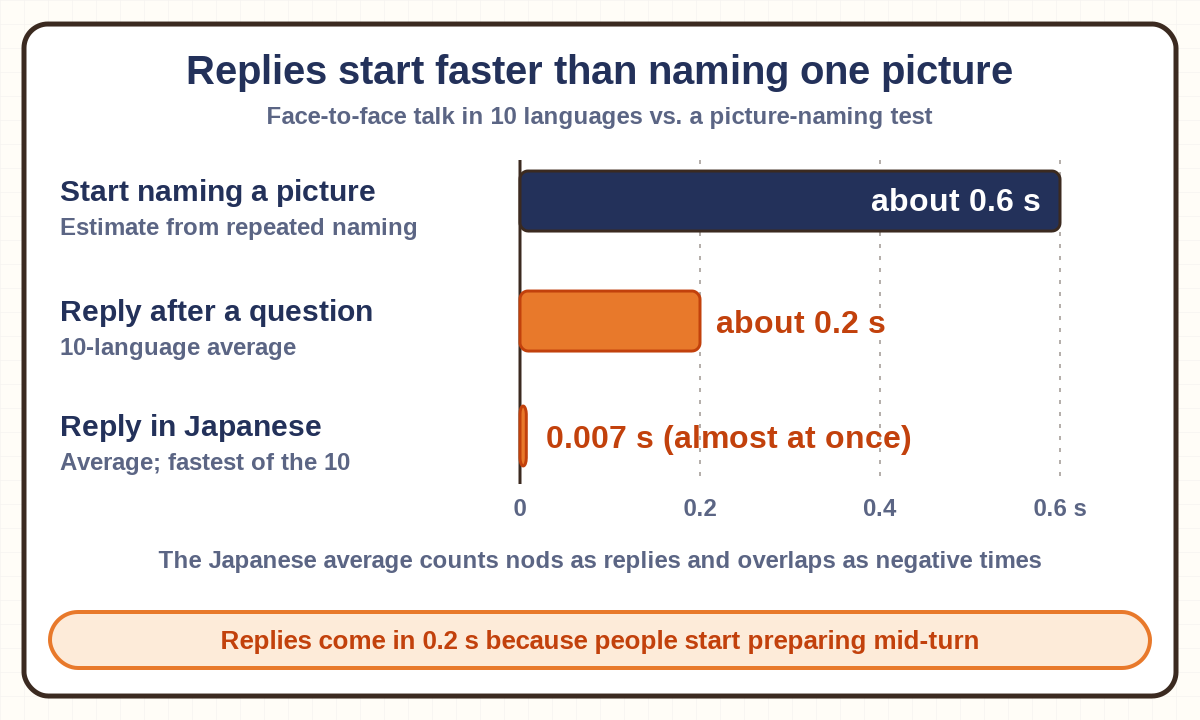
Because our conversations are very fast: we read ahead to where the other person will stop, and for a yes-or-no question, the answer starts on average about 0.2 seconds after the question ends.
Add a lag, and even when the other person answers right away, on your side it sounds as if no answer is coming, so you start asking again just as their answer arrives, and your voices can collide.
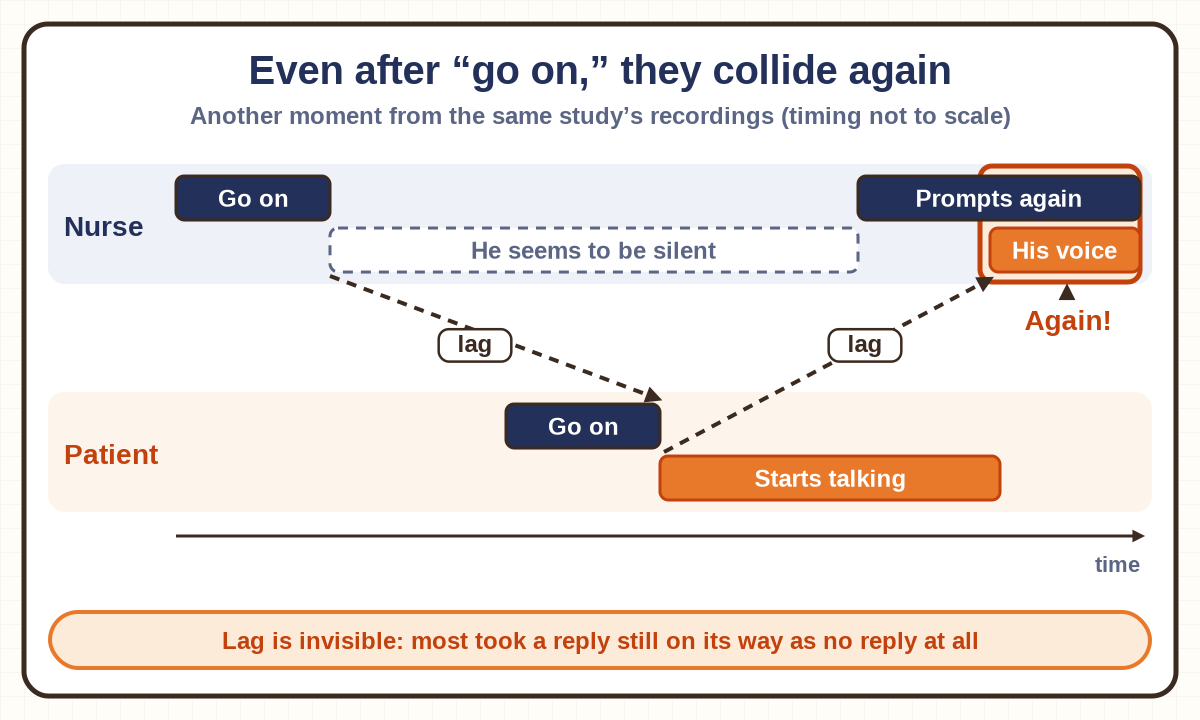
The same goes for "go ahead": the person given the floor starts talking, but before their voice arrives, the other person speaks up again, and they can crash again.
Watch the video (6 min 20 sec)
Chapters (12)
Full transcript
0:00Voices crash
NaruOn a video call, you start to speak, and your voice crashes right into theirs.
Naru"Oh, go ahead." "No, no, you go." ...And then you both start again, at the same time.
NaruThe lag before your voice reaches the other side is usually less than a second.
NaruThe Chief says: if there's a lag, just wait a moment.
ChiefWhy can't they just wait?! Go find out!
NaruWhy can't we wait through a lag of less than a second? I'm on it!
NaruThe answer was hiding in how surprisingly fast everyday conversation is.
NaruNaru News!
NaruHere's my report! It's all the slow connection's fault!
0:37Rejected!
ChiefRejected!
Naru...He says he knows it's slow. I'm supposed to find out why people can't just wait.
NaruOkay. Let's start over, with ordinary conversation.
NaruOne study recorded conversations in ten languages.
NaruThey measured the time from the end of a yes-or-no question to the start of the answer.
NaruQuiz time!
1:05Quiz
NaruAveraged across the ten languages, how long was it?
NaruThe answer is C: about 0.2 seconds.
NaruJust 0.2 seconds after the question ends, the answer is already underway.
NaruBy the way, Japanese was the shortest of the ten: 0.007 seconds on average.
1:23Japanese: almost at once
NaruThat average counts nods as answers too, and answers that start before the question ends count as negative.
NaruOn average, the answer begins almost exactly as the question ends.
NaruIn every language, people kept both the gaps and the overlaps as small as they could.
NaruBut here's something strange.
1:500.6 s vs 0.2 s
NaruWhen people see a picture, it takes about 0.6 seconds just to start saying its name.
NaruIf naming one picture takes 0.6 seconds, how can we answer in 0.2?
2:06Reading ahead
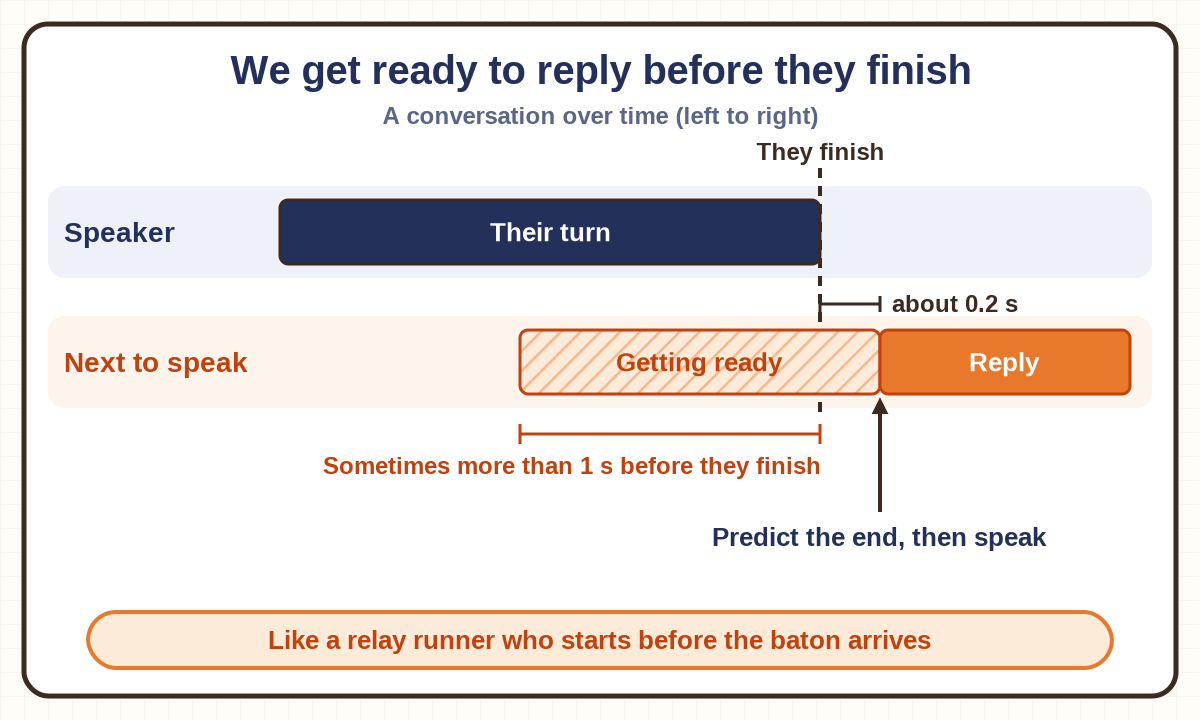
NaruThe answer: we read ahead.
NaruWe start preparing our reply while the other person is still talking. Sometimes more than a second before they finish.
NaruOne important cue is the words themselves. The shape of the sentence shows you where it ends.
NaruThen we predict where they'll stop, and start speaking right on cue.
NaruIt's like a relay race. The next runner starts running before the baton even arrives.
NaruWe don't wait for them to finish before we start getting ready. Conversation is a perfectly timed baton pass, handed over in 0.2 seconds.
NaruSo what happens when you add a lag?
NaruA study in the UK recorded video-call medical appointments from both ends.
2:52Video-call appointments
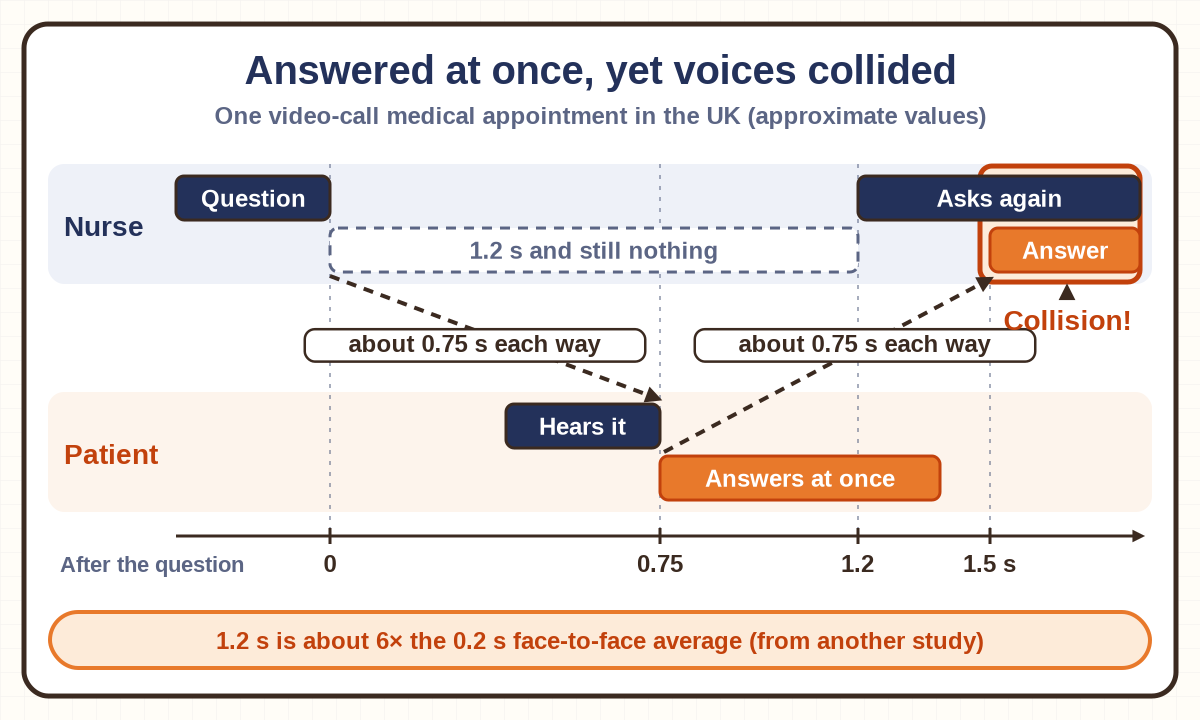
NaruIn one appointment, a voice took about 0.75 seconds to reach the other side, each way. Round trip: 1.5 seconds.
NaruThe nurse finishes her question. It reaches the patient 0.75 seconds later.
NaruThe patient answers right away. But his voice takes another 0.75 seconds to get back.
NaruOn the nurse's side, 1.2 seconds pass, and still no answer.
NaruIn the earlier study of face-to-face conversation, answers came in about 0.2 seconds on average. She has waited roughly six times that, and still hears nothing.
NaruSo the nurse starts asking the question again.
NaruAnd just then, the patient's answer arrives. Their voices crash.
NaruEven though the patient had answered on time. And the nurse had waited, too.
NaruIn this study's data, a lag of about 0.1 seconds barely disturbed the conversation.
NaruFor a baton pass that takes 0.2 seconds, a 0.75-second lag each way is huge.
NaruSo why don't people realize the lag is to blame?
4:10The unseen lag
NaruBecause you can't see a lag. In the appointments they studied, most people didn't notice it.
NaruAn answer still on its way wasn't heard as just late. It was taken as no answer at all.
4:28The "you go" loop, solved
NaruRemember the opening? "Oh, go ahead." "No, you go." ...and both at once again. Same mechanism.
NaruThe recorded appointments had a moment like that too: "sorry," "go on."
NaruThe patient, given the floor, starts talking. But his voice hasn't reached the nurse yet.
NaruTo the nurse, he looks silent, so she prompts him again. And they crash again.
NaruAnd there's a nastier side effect.
4:56It looks like their fault
NaruIn a German experiment with voice-only calls, adding a long artificial delay made people more likely to rate their partner as less attentive.
NaruThe connection is to blame, but it looks like the other person's fault.
NaruSo when voices crash on a video call, it doesn't have to be anyone's fault. It may just be the invisible lag at work.
5:14Take one breath
NaruSo here's what I'm going to try. When it feels like no answer is coming, take one breath before asking again. The answer may already be on its way.
NaruWe read ahead to where the other person will stop, and pass the baton in 0.2 seconds.
5:35What we found
NaruSo when a lag gets added, the answer seems not to be coming, and voices can collide.
NaruEven a lag of under a second can make us talk over each other, because our conversations are just that fast. Naruhodo!
Chief...Naruhodo. ...After you.
NaruAnd the Chief gave it a gold star!
NaruHave you ever ended up in a "you go", "no, you go" loop on a video call? Tell us in the comments.
NaruThis has been Naru News!
NaruIf you went "naruhodo!", please hit like and subscribe!
Explained in pictures
Free to use in lessons, slides and posts with credit (CC BY 4.0).
Free to use in lessons, slides and posts with credit (CC BY 4.0).
Free to use in lessons, slides and posts with credit (CC BY 4.0).
Free to use in lessons, slides and posts with credit (CC BY 4.0).
You’re free to use these figures in lessons, slides and posts if you credit Naru News (naru.news). CC BY 4.0.
More details
Do replies really start in 0.2 seconds?
One study recorded face-to-face conversations in 10 languages and measured the time from the end of a yes-or-no question to the start of the answer. The average was about 0.2 seconds (0.208 seconds).
Japanese was the shortest of the ten at 0.007 seconds on average: the answer began almost exactly as the question ended. Nods and other gestures count as answers, and answers that start before the question ends count as negative.
In every language, people kept both the gaps and the overlaps as small as they could.
How can we reply in 0.2 seconds?
Just starting to say the name of a pictured object takes about 0.6 seconds (an estimate from experiments naming the same pictures repeatedly; it varies with the task).
We can still reply in 0.2 seconds because we start preparing our reply while the other person is still talking, and predict where they'll stop. Sometimes we start more than a second before they finish.
We don't wait for them to finish before we start getting ready. It's like a relay race: the next runner starts running before the baton even arrives.
How do we know where a turn will end?
One important cue is the words themselves. The shape of the sentence shows you where it ends.
In an experiment using Dutch conversation, removing the rise and fall of pitch did not make listeners worse at predicting where a turn would end. But masking the words and keeping only the pitch did.
Voice cues, such as a lengthened last syllable, are used too.
What happened in the video-call appointments?
A UK study recorded video-call medical appointments from both ends, the patient's side and the clinician's side. In one appointment, a voice took about 0.75 seconds to reach the other side, each way: 1.5 seconds round trip.
When the nurse finished her question, it reached the patient 0.75 seconds later. He answered right away, but his voice took another 0.75 seconds to get back. On the nurse's side, no answer came for 1.2 seconds, so she started asking the question again, and the answer arrived on top of her.
1.2 seconds is roughly six times the 0.2-second face-to-face average from the 10-language study. But that compares it with another study's average; it is not a measured normal time for that question.
In this study's data, a lag of about 0.1 seconds barely disturbed the conversation (the authors' reading of their small data set). For a baton pass that takes 0.2 seconds, a 0.75-second lag each way is huge.
Why do we crash again, even after "go ahead"?
The recorded appointments had a moment like that too: voices overlapped, and the two said "sorry" and "go on."
The patient, given the floor, started talking, but his voice hadn't reached the nurse yet. To her he looked silent, so she prompted him again, and they crashed again.
The video-call "Oh, go ahead" / "No, you go" ...and then both at once again, works the same way.
Why don't people realize the lag is to blame?
Because you can't see a lag. In the appointments studied, most people didn't notice it, and took an answer still on its way not as late, but as no answer at all.
In a German experiment with voice-only calls, adding a long artificial delay made people more likely to rate their partner as less attentive. The connection is to blame, but it looks like the other person's fault.
So when voices crash on a video call, it doesn't have to be anyone's fault. It may just be the invisible lag at work.
 Takeaway
Even a lag of under a second can make us talk over each other, because our conversations are just that fast. When it feels like no answer is coming, take one breath before asking again. The answer may already be on its way.
Sources and how we checked
- Stivers et al. (PNAS, 2009)
- Levinson & Torreira (Frontiers in Psychology, 2015)
- de Ruiter, Mitterer & Enfield (Language, 2006)
- Seuren et al. (Journal of Pragmatics, 2021)
- Schoenenberg et al. (International Journal of Human-Computer Studies, 2014)
AI wrote this page from the video script and the sources above. A different AI from the one that wrote the script checked it against the text of those sources (October 23, 2026). A person with a master’s degree in science and a Japanese high-school science teaching license also read and checked it before publishing. Numbers are as of that date. If anything was hard to follow, you spot a mistake, or there’s a question you’d like us to look into, please write to [email protected].