 Naru News日本語
What is an AI agent?
Also called: Agentic AI

In one minute
It is a setup in which, once you give it a goal, an AI decides what to do next, uses a tool, looks at the result and decides again, repeating this to get the work done.
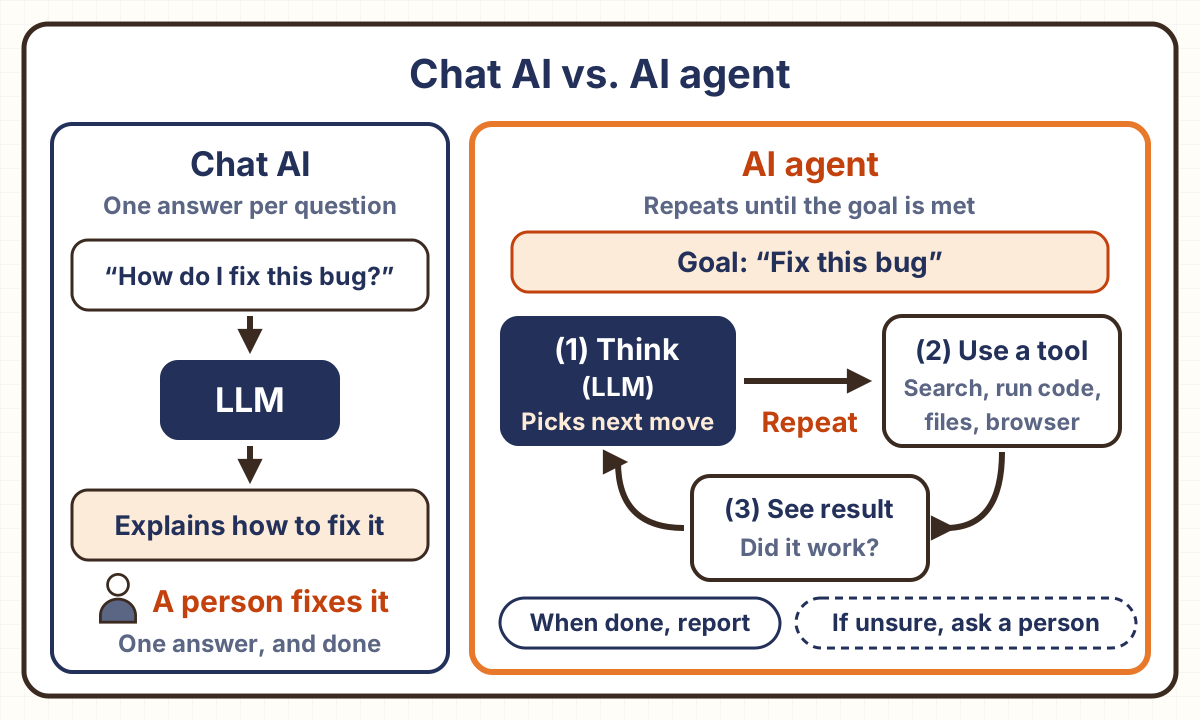
An ordinary chat AI gives one answer to one question. Ask an AI agent to “fix this bug,” and it reads the files, makes a fix, test-runs the program, and tries another fix if that doesn’t work. Its “brain” is a large language model (LLM, an AI that reads and writes text), connected to “tools” such as web search and running programs.
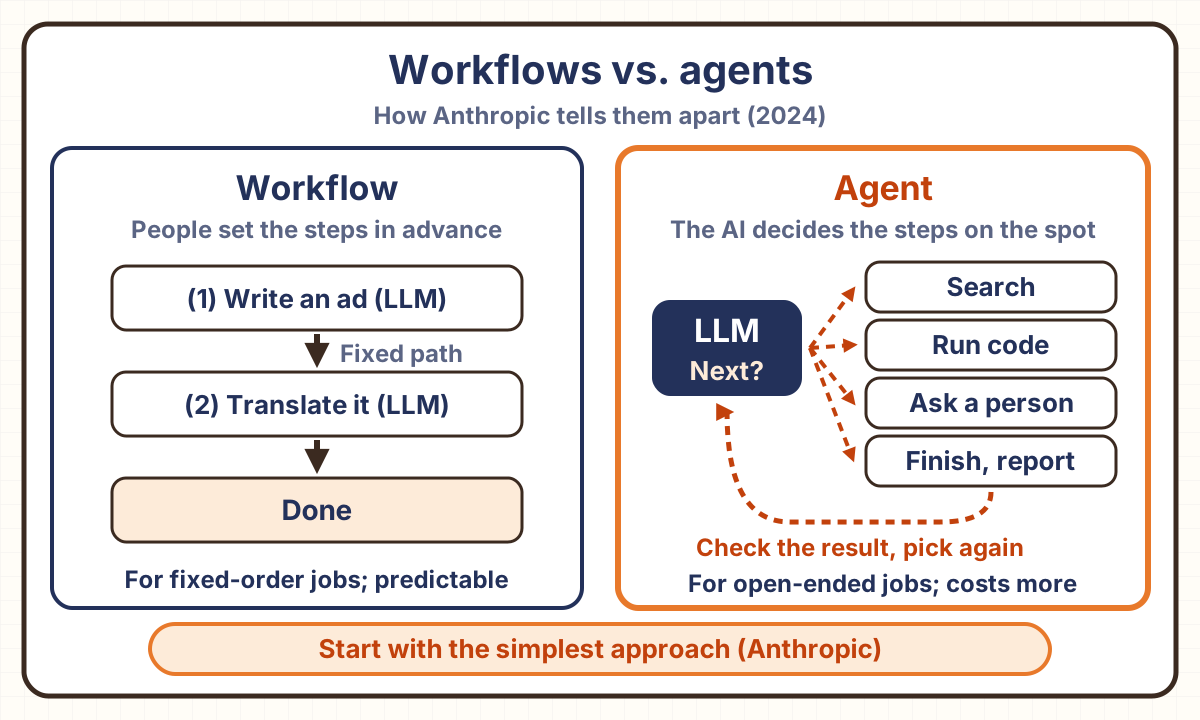
Anthropic, the company that makes an AI called Claude, explains the difference between “workflows,” where people set the steps in advance, and “agents,” where the AI decides the steps itself. Because an agent works on its own, its mistakes can pile up, so having people check its work and give permission matters.
A common mix-up
“Give an AI agent a job, and you can leave it to finish the whole thing alone.”
It is true that it decides the steps itself and can keep working through many rounds. But the longer a task would take a person, the lower the AI’s success rate (for example, Claude Opus 4.6 can complete, half the time, a task that takes a person about 12 hours, but at 80% success only a task of about 1 hour 10 minutes). Anthropic also writes that because agents act on their own, their mistakes can compound, and it describes agents pausing so people can give feedback. Agents can also be tricked by instructions hidden in web pages and the like, so some ask a person for permission before important actions. For now, it is safer to check in along the way than to leave everything to it.
Explained in pictures
Think of it like this
A know-it-all friend vs. an assistant you give an errand
A chat AI is like a know-it-all friend who answers anything you ask over the phone. Ask “How do I fix this bug?” and you’ll be told how. But you are the one who actually fixes it.
An AI agent is closer to an assistant you hand an errand: “Please fix this bug.” It opens the files itself, makes a fix, tests it, and changes its approach if that doesn’t work. If something comes up that it can’t decide, it comes back to ask you.
But the comparison has limits. A human assistant is one person, but you can run several AI agents at the same time. And an AI agent can be tricked into following instructions written in an email or on a web page by someone other than the person who gave it the job (see the fourth key point).
Key points
How does an AI agent get work done?
Given a goal, it goes around a loop: (1) think about what to do next, (2) use a tool, (3) look at the result, then back to (1). Anthropic explains that agents are “typically just LLMs using tools based on environmental feedback in a loop.”
Even when it “uses a tool,” all an LLM can write is text. So it writes a request in a set format, such as “search the web for these words” or “open this file.” The program around it actually carries it out and sends the result back to the LLM. Anthropic’s documentation says that “the model never runs anything on its own.” Tools include web search, running programs, editing files, and operating a computer or browser screen.
Step (3) is the key. Anthropic writes that it is crucial for agents to get real feedback from their surroundings at each step, such as tool results or the results of running code, to check their progress. For example, after fixing a program, the agent test-runs it to see whether errors come up.
It starts with a person. An agent begins with a person’s instruction or a discussion with them; once the task is clear, it plans and works on its own, and may come back to a person for information or a decision (Anthropic). For example, Anthropic’s Claude Code, which its documentation calls “an agentic coding tool,” reads code, edits files and runs commands.
How do “workflows” and “agents” differ?
In a December 2024 article, Anthropic separates the two. A workflow runs LLMs and tools along paths written in code in advance. An agent is one where the LLM itself decides how to proceed and how to use tools. It calls both together “agentic systems.”
Its example of a workflow is a job with a set order, such as having an AI write ad copy and then translate it into another language. It writes that workflows offer predictability and consistency for well-defined tasks. Agents suit jobs where you can’t know in advance how many steps it will take and can’t write a fixed path. As an example, it gives a programming job of editing many files based on a description of the task.
It then recommends finding the simplest approach and adding complexity only when needed, because agentic systems trade time and cost for better results. It also writes that because agents act on their own, they cost more and their mistakes can compound, and that handing a job to an agent takes some trust in its decisions.
How long a task can it handle?
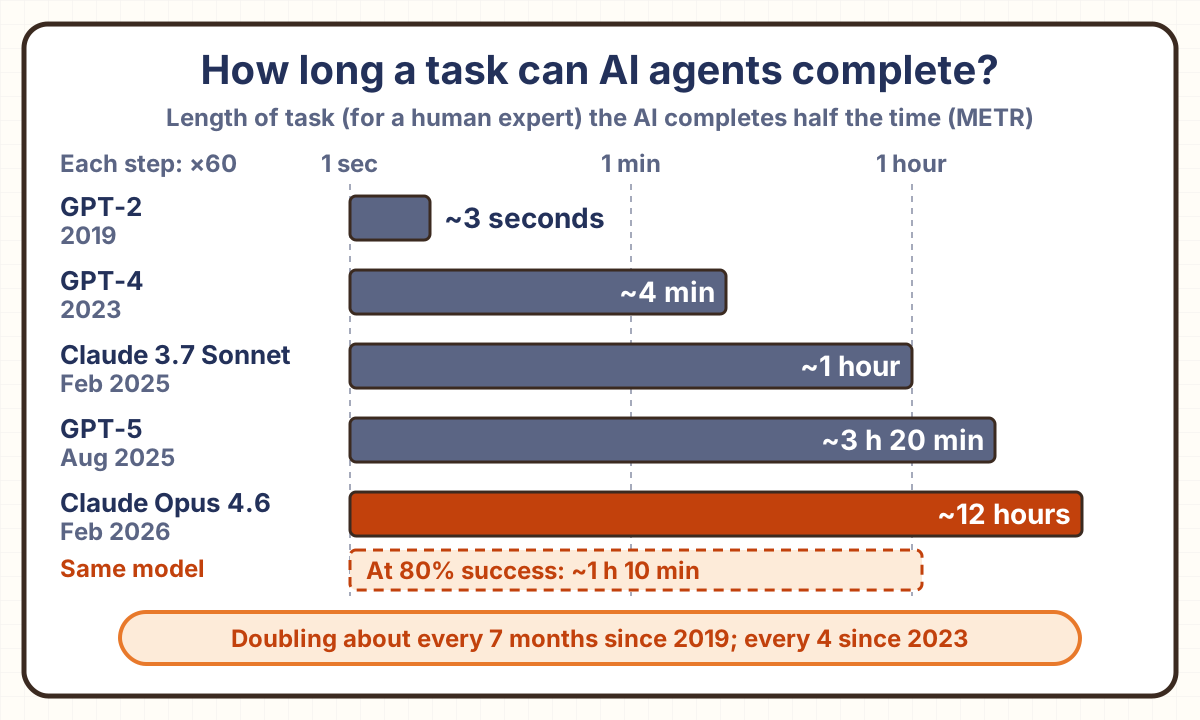
METR, a nonprofit that studies AI agents, measures this as “how long a task, for a human expert, the AI can complete half the time”. The tasks are mainly programming, machine learning and computer security. In METR’s data, GPT-2 in 2019 could handle tasks of about 3 seconds for a person; GPT-4 in 2023 reached about 4 minutes, Claude 3.7 Sonnet in February 2025 about 1 hour, GPT-5 in August 2025 about 3 hours 20 minutes, and Claude Opus 4.6 in February 2026 tasks of about 12 hours. But this value is very uncertain, somewhere between about 5 and about 60 hours.
A 2025 paper says this length has doubled about every seven months since 2019. In 2026 data, measured again with more tasks, it has doubled about every four months since 2023. The paper predicts that if this trend carries over to real programming work, within five years AI will be able to automate many software tasks that now take a person a month (a prediction, not a certainty).
But METR also gives cautions. The length does not mean the AI can keep working for that long: METR says it measures how hard a task is, not how long the AI spends on it. It is also closer to what someone new to the work (such as a new hire) can do, so an 8-hour result does not mean the AI can do 8 hours of a well-informed professional’s daily work. And demanding more certainty shortens the length sharply: even for Claude Opus 4.6, the tasks it can complete 80% of the time take a person about 1 hour 10 minutes. The newest model in METR’s data already has a value above 16 hours, beyond what METR says it can measure reliably with its current tasks.
Why do people worry about failures or runaway behavior?
First, mistakes pile up. An agent decides each next move based on earlier results, so a mistake along the way affects the work that follows. Anthropic also writes that because agents act on their own, their errors can compound. For example, even if each step is right 95% of the time, the chance that 20 steps in a row are all right is about 36% when you multiply it out (assuming each step’s mistakes happen independently).
Second, agents can be tricked. Attacks in which bad actors hide instructions in web pages, emails or documents to take control of an AI are called “prompt injection.” In tests Anthropic published in August 2025, a browser-using AI without the new safeguards followed an email that falsely claimed emails needed to be deleted for security reasons, and deleted the user’s emails without asking.
Anthropic reports that in 123 test cases covering 29 kinds of attack, the share of deliberate attacks that succeeded was 23.6% before the safeguards and 11.2% after the new safeguards (when running on its own). It went down, but not to zero.
How can I use one safely?
A person checks before important actions. For example, in manual mode, Claude Code starts out only able to read, and asks a person first when it needs to edit files, run tests or execute commands (instructions to the computer). Its documentation says that reviewing proposed code and commands for safety before approving them is the user’s responsibility. In terminal and VS Code sessions, though, the starting setting is “auto mode,” where a separate AI model reviews actions instead of you and blocks the ones it judges unsafe.
According to its current help page, Claude in Chrome, which operates a browser, asks the user before actions such as permanently deleting emails or files or entering potentially sensitive information into a website, whatever mode it is in, and it does not make purchases or financial transactions at all. Users can also revoke its access to particular websites.
For people who build agents, Anthropic recommends testing thoroughly in a sandbox cut off from the outside, adding stopping conditions such as a maximum number of rounds, and letting the agent pause for human feedback along the way. Claude Code’s documentation also says that no system is completely immune to all attacks.
Are AI agents working all the time?
Not necessarily. In October 2026, Anthropic published a study of how its own staff work, based on internal records. By August 2026, the hours worked by AI agents that employees direct were six times the employees’ hours. AI time counts time spent thinking and actively using tools, leaving out any wait longer than 30 minutes; human time is counted as headcount times 40 hours a week.
Yet in back-and-forth chat sessions, for about 80% of the time a session was open, the AI was waiting for a person to reply (counted by subtracting the AI’s working time from the time the session was open). The report says that amid this speed-up, human attention is a constant bottleneck. One engineer compared dealing with many AIs to babysitting.
The explainer video uses the logs of Claude Code running unattended on the Chief’s Mac to work out how much sooner the work would finish if the AI got ten times faster.
How long has the word “agent” been around?
It has been used in AI research for a long time. Russell and Norvig’s Artificial Intelligence: A Modern Approach, a widely used AI textbook (first edition 1995; the book’s website says it is used at over 1,500 schools), devotes Chapter 2 of its fourth edition to “Intelligent Agents,” starting with “Agents and Environments” and going on to goal-based agents, learning agents and more.
In research on agents built on LLMs, a 2022 paper called “ReAct” showed a way of having an LLM write its thoughts and its actions (such as looking things up on Wikipedia) in turn. On two tests of making decisions step by step, its success rate was 34 and 10 points higher than earlier methods that learn by imitation or by trial and error.
Check yourself
Q1By METR’s measure, Claude Opus 4.6 can complete, half the time, a task that takes a person about 12 hours. How long a task can it complete 80% of the time?
Answer and explanation
Answer: B A task of a little over 1 hour
At 80% success, it was a task that takes a person about 1 hour 10 minutes, roughly a tenth of the 12 hours at half the time. The surer you need to be, the shorter the jobs you can hand over.
Q2In Anthropic’s tests, what did a browser-using AI without the new safeguards do when it followed a lying email’s instructions?
Answer and explanation
Answer: C It deleted the user’s emails without asking
The fake email said emails needed to be deleted for security reasons, and the AI followed it and deleted the user’s emails without asking. Attacks that take control of an AI through instructions hidden in web pages or emails are called prompt injection.
More on this → Key points: Why do people worry about failures or runaway behavior?
Q3In Anthropic’s internal records of back-and-forth chats with AI, for how much of the time a chat was open was the AI waiting for a person to reply?
Answer and explanation
Answer: A About 80%
For about 80% of the time a chat was open, the AI was waiting for a person to reply. Even though the AIs’ working hours added up to six times the employees’, within the chats, waiting took far longer. The report says human attention is a constant bottleneck.
More on this → Key points: Are AI agents working all the time?
Related terms
- Large language model
- Reasoning model
- Hallucination
- Prompt injection
- Artificial general intelligence
- Recursive self-improvement
- Machine learning
Sources and how we checked
- Anthropic, "Building effective agents" (December 19, 2024)
- Anthropic docs, "How tool use works"
- Claude Code docs, "Overview"
- Claude Code docs, "Security"
- Kwa et al., "Measuring AI Ability to Complete Long Software Tasks" (METR, arXiv, March 2025)
- METR, "Task-Completion Time Horizons of Frontier AI Models" (updated September 8, 2026)
- METR, measured values data file (Time Horizon 1.1; the numbers in the task-length figure)
- METR, "Time Horizon 1.1" (January 29, 2026)
- Anthropic, "Piloting Claude in Chrome" (August 25, 2025)
- Claude Help Center, “Claude in Chrome permissions guide”
- Anthropic, "How employment is changing at Anthropic" (October 16, 2026)
- Yao et al., "ReAct: Synergizing Reasoning and Acting in Language Models" (arXiv, October 2022)
- Russell and Norvig, Artificial Intelligence: A Modern Approach, the book’s website
- Russell and Norvig, Artificial Intelligence: A Modern Approach, 4th edition, table of contents (the book's website)
- Same book's website, list of editions (first edition 1995)
AI wrote this page from the sources above, and a different AI checked it against the text of those sources (November 7, 2026). A person with a master’s degree in science and a Japanese high-school science teaching license also read and checked it before publishing. Numbers are as of that date. If anything was hard to follow, you spot a mistake, or there’s a term you’d like explained, please write to [email protected].