 Naru News日本語
What is a large language model (LLM)?

In one minute
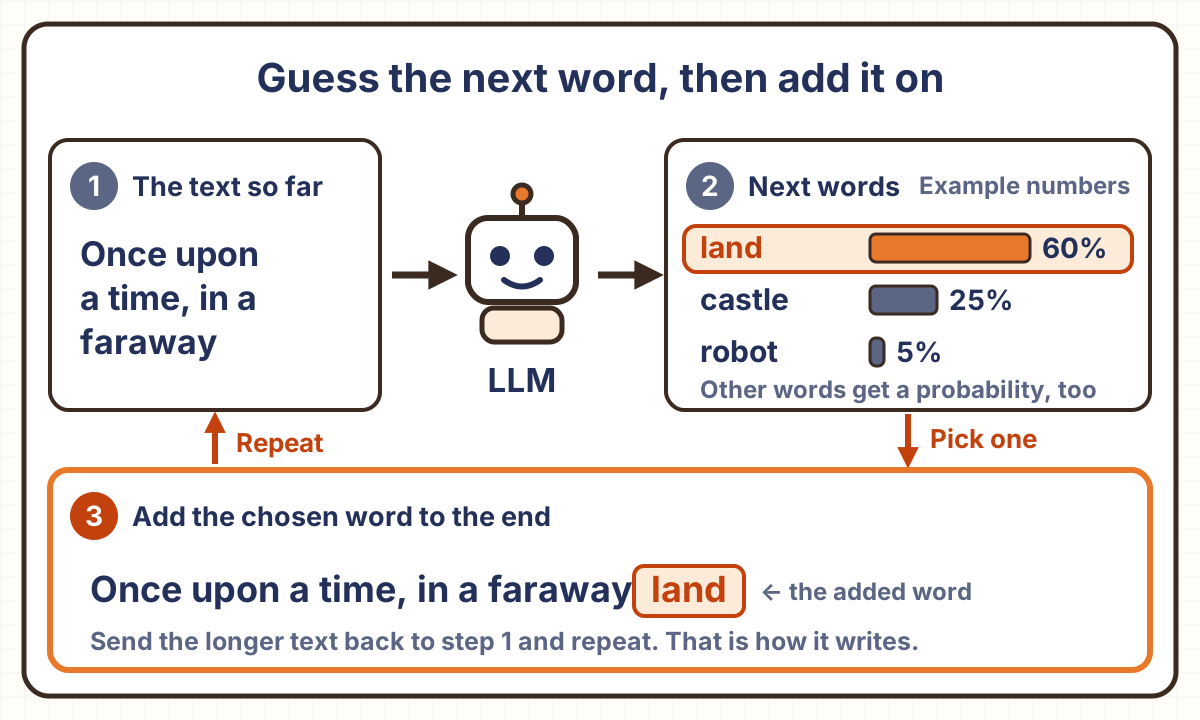
It is a very large AI that has practiced guessing “the next word” on an enormous amount of text, and so has learned to read and write.
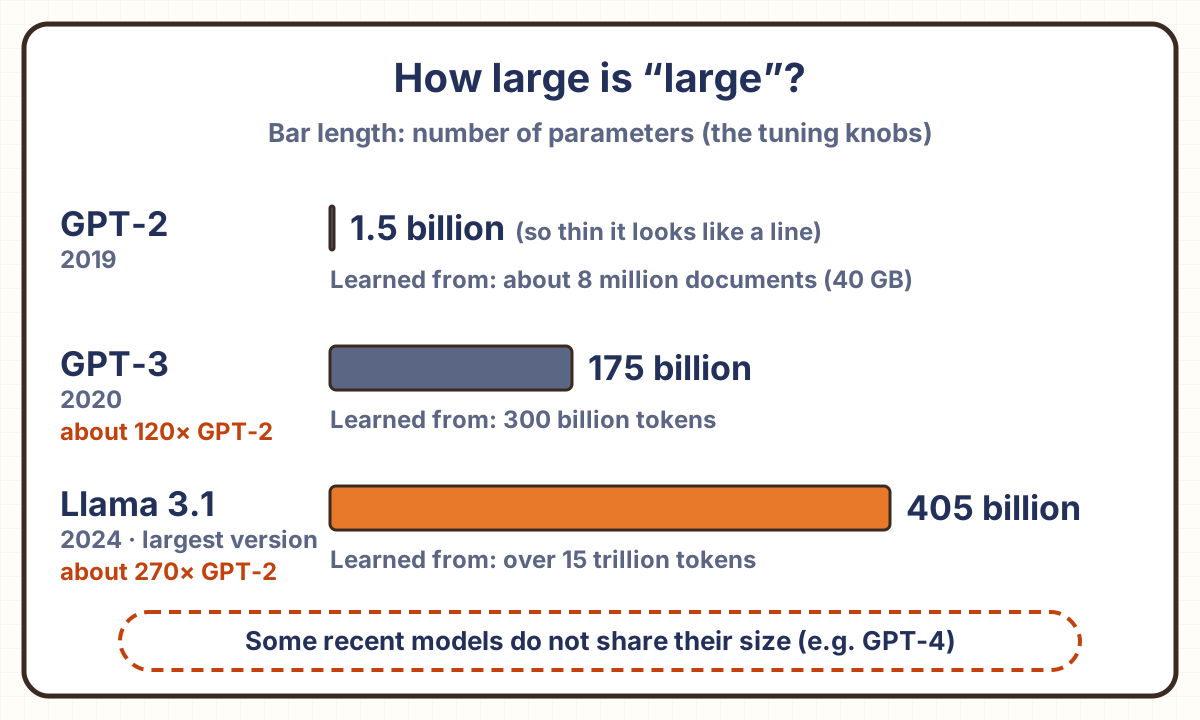
A “language model” calculates how likely each word is to come next in a sentence, as a probability (a number for how likely something is). “Large” means it has a huge number of numbers inside called parameters, and that it learns from an enormous amount of text. Parameters are like volume knobs that get turned little by little, and they are used to calculate which words are likely. Big models have hundreds of billions, and some have trillions. LLM stands for large language model.
An LLM is at the heart of chat AIs such as ChatGPT. Even when it writes an answer, it keeps picking one next word and adding it on. Because it picks words that usually come next, it can write sentences that sound right but are wrong.
A common mix-up
“AIs like ChatGPT search the internet every time you ask, and find the right answer.”
That is only half right. Some chat AIs can use a web search tool, and then they answer from what they found and show their sources. But the LLM itself builds sentences by picking “the words likely to come next,” based on the text it learned from. When it is not searching, it may not know what happened after it learned. And even with sources attached, an answer is not always right, so open the sources and check anything important.
Explained in pictures
Think of it like this
Your phone’s word suggestions, but far bigger
When you type “good” on a phone, words like “morning” may pop up as suggestions. That feature offers words that often come next, before you type them.
A large language model is a bit like that feature made enormously bigger. It has practiced guessing what comes next on a huge amount of text, so it can read the flow of a long passage before choosing the next word. Choose a word, add it, choose the next one. Repeat this, and you get an answer or an explanation.
But the comparison has limits. Word suggestions only offer choices; you are the one who picks. An LLM picks by itself and writes all the way to the end. And because an LLM practiced on vastly more text, it has picked up not only word patterns but also, to some degree, facts about the world. Still, both work by choosing “words that usually come next,” so the chosen word is not always right.
Key points
What does “language model” mean?
It is a system that calculates how likely each word is to come next in a sentence. For example, after “The water in the pond is very,” words like “clear” or “cold” are likely, and “refrigerator” is not. A language model expresses this likeliness as a probability (a number for how likely something is).
When it chooses, it does not always take the word with the highest probability. The textbook explains that it usually chooses as if by a lottery in which more likely words come up more often. That is why the same question can get a differently worded answer.
Language models themselves have been around for a long time, used for things like turning spoken words into text. Early ones worked in simple ways. Today’s LLMs are far larger and more complex versions.
What do parameters actually do?
An LLM turns words into numbers and does lots of multiplying and adding to work out the probability of the next word. The numbers it uses for this are its parameters. Like volume knobs, turning one a little changes the result a little. But one knob does not take care of one word or one fact; many knobs are used together in the calculation.
During learning, the model is asked to guess what comes next in text, and the knobs are turned little by little in the direction that raises the probability of the right word. Repeating this over a huge amount of text gradually sets the knobs. No person turns them one by one. The amount of text it learns from is counted in “tokens” (small pieces of text).
The figure “How large is ‘large’?” above shows how much the number of knobs has grown. The textbook explains that making models bigger and training them on more text tends to improve them.
Are ChatGPT and an LLM the same thing?
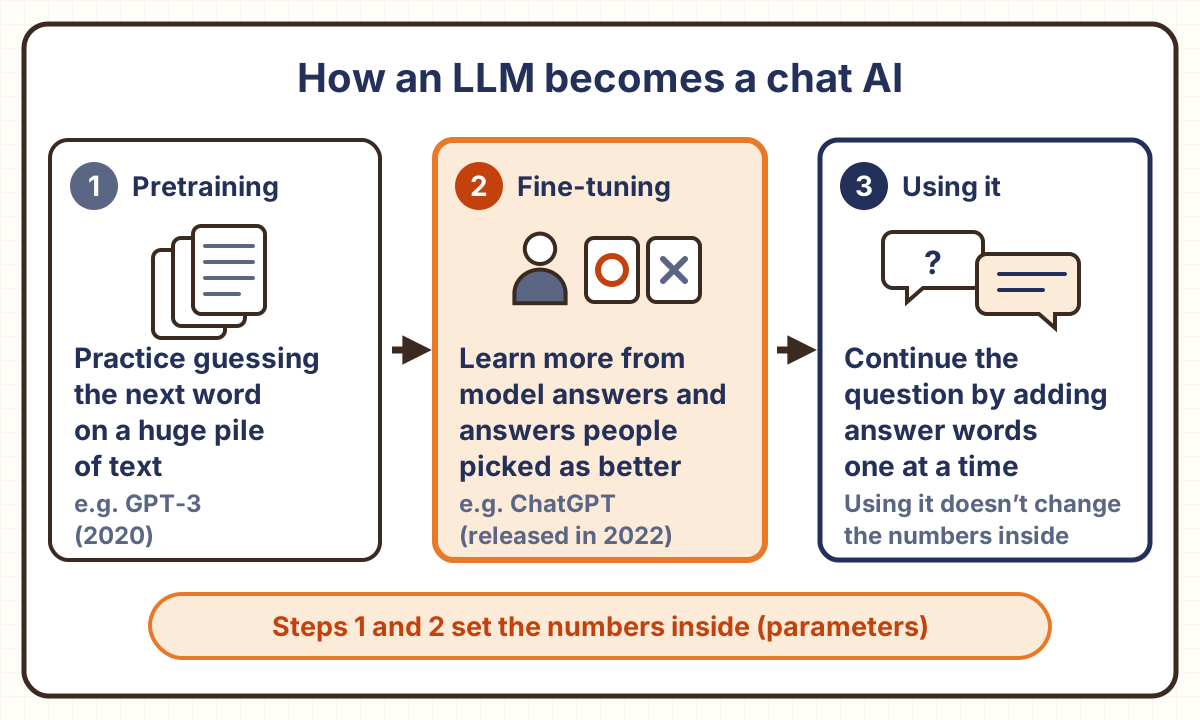
Not exactly. The LLM is the part inside a chat AI that writes the text, like its brain. ChatGPT is the name of a chat AI from a company called OpenAI. The first ChatGPT (November 2022) was made by giving a model from OpenAI’s GPT-3.5 family of LLMs further training for conversation. Claude and Gemini are names of LLMs and also of the chat AIs that use them.
An LLM that had only learned from lots of text would sometimes not answer a question, and instead write a similar question. So it is given further training, called fine-tuning, with model answers to questions and answers that people picked as better. In a 2022 OpenAI study, people preferred the answers of a fine-tuned model with 1.3 billion knobs over those of GPT-3, which has 175 billion. The researchers write that making a model bigger does not by itself make it better at doing what you ask.
How can “guessing the next word” answer questions?
Because guessing what comes next also takes knowledge. To guess what comes after “The capital of Japan is,” you need to know “Tokyo.” The textbook explains that by practicing guessing what comes next on huge amounts of text, an LLM picks up not only how words are used but also things about the world. When you ask a question, it treats the question as the start of a text and writes the continuation that is the answer.
People did not write this way of answering in, rule by rule. Anthropic, the company that makes Claude, writes that “language models like Claude aren’t programmed directly by humans—instead, they’re trained on large amounts of data.” It also writes that even its makers do not yet understand how models do most of what they do. A study by the same company also found Claude combining separate facts it knew, rather than copying out a memorized answer (for example, putting together “Dallas is in Texas” and “the capital of Texas is Austin”).
Why does it say wrong things?
The words an LLM picks are “words that usually come next,” and those are not always right. Writing text that is factually wrong in this way, especially making up people or facts that do not exist, is called a “hallucination.”
In a 2025 paper, researchers explain that, like students guessing on hard exam questions, LLMs sometimes guess when they are unsure. The paper argues that this is because the way models are trained and scored tends to reward guessing over saying “I don’t know.”
An LLM may also not know about things that happened after it finished learning. For example, most of the training data for OpenAI’s GPT-4 (2023) ended in September 2021. An AI that can use a web search tool can look up new information and answer while showing its sources. But the same 2025 paper also writes that search reduces mistakes without getting rid of them.
Does it get smarter the more you use it?
Usually, just talking with an LLM does not change its parameters (knobs). It can copy examples you show it during a conversation, but according to the textbook, that stays within the conversation and does not remain inside the LLM after it ends.
The knobs change when the makers retrain it or give it extra training to make a new version of the model.
Can the same abbreviation, “LLM,” mean something else?
Yes, a term from law that has nothing to do with AI. LL.M. or LLM is short for Master of Laws, a degree (a title that shows what you studied) given to people who have studied law in depth at graduate school. For example, Harvard University in the United States has a one-year LL.M. program. When people talk about AI, LLM usually means a large language model.
Check yourself
Q1Why can an LLM that uses no tools such as web search write “Tokyo” after “The capital of Japan is”?
Answer and explanation
Answer: A It picked this up while practicing, again and again, guessing what comes next
Guessing what comes next also takes knowledge. By practicing this again and again on huge amounts of text, an LLM picks up things about the world. People did not write in a list of facts, and it is not finding and copying a memorized sentence.
More on this → Key points: How can “guessing the next word” answer questions?
Q2In a 2022 OpenAI study, which model wrote answers that people preferred over those of GPT-3, which has 175 billion knobs?
Answer and explanation
Answer: C One with fewer knobs that learned from answers people picked
People preferred a model with 1.3 billion knobs that had been fine-tuned with model answers and answers people picked as better. The researchers write that making a model bigger does not by itself make it better at doing what you ask.
More on this → Key points: Are ChatGPT and an LLM the same thing?
Q3Why can the same question get a differently worded answer from an LLM?
Answer and explanation
Answer: B It chooses each next word again, following how likely the words are
An LLM usually chooses the next word as if by a lottery in which more likely words come up more often. If one word is different, the rest of the text can change too. Just talking does not change its knobs, and it is not copying memorized sentences.
Related terms
- Token
- Hallucination
- Reasoning model
- Mixture of experts
- AI agent
- Machine learning
- Transformer
Sources and how we checked
- Daniel Jurafsky and James H. Martin, Speech and Language Processing, 3rd ed. draft (August 19, 2026), Chapter 1, "Introduction"
- Same book, Chapter 3, "N-gram Language Models"
- Same book, Chapter 7, "Transformers and Pretraining"
- Same book, Chapter 8, "Post-training"
- Radford et al., "Language Models are Unsupervised Multitask Learners" (the GPT-2 paper, OpenAI, 2019)
- Brown et al., "Language Models are Few-Shot Learners" (the GPT-3 paper, arXiv, May 2020)
- Ouyang et al., "Training language models to follow instructions with human feedback" (arXiv, March 2022)
- OpenAI, ChatGPT announcement (November 30, 2022)
- OpenAI, "GPT-4 Technical Report" (arXiv, March 2023)
- Llama Team at Meta, "The Llama 3 Herd of Models" (arXiv, July 2024)
- Anthropic, "Tracing the thoughts of a large language model" (March 27, 2025)
- Kalai et al., "Why Language Models Hallucinate" (arXiv, September 2025)
- Anthropic documentation, "Web search tool"
- Harvard Law School, "LL.M. Program"
- LSE Law School, "LLM Master of Laws"
AI wrote this page from the sources above, and a different AI checked it against the text of those sources (November 6, 2026). A person with a master’s degree in science and a Japanese high-school science teaching license also read and checked it before publishing. Numbers are as of that date. If anything was hard to follow, you spot a mistake, or there’s a term you’d like explained, please write to [email protected].