 Naru News日本語
What is AGI (artificial general intelligence)?
Also called: General AI, Human-level AI

In one minute
It is a single AI that can handle many different kinds of thinking tasks about as well as people, or better.
“General” means it can be used for many things. An AI that is good only at a set task, like an AI that plays the board game Go, is called “narrow.” Chat AIs like ChatGPT can write, summarize and code. But researchers who looked at the chat AIs of 2023 judged that at most tasks they still fell short of people skilled at them.
There is no single agreed definition. For example, in its 2018 charter (a document setting out the company’s mission and promises), OpenAI (the company that makes ChatGPT) described AGI as “highly autonomous systems that outperform humans at most economically valuable work.” Researchers and companies also disagree widely on whether it is already here and when it will come.
A common mix-up
“AGI means a robot with a human-like mind.”
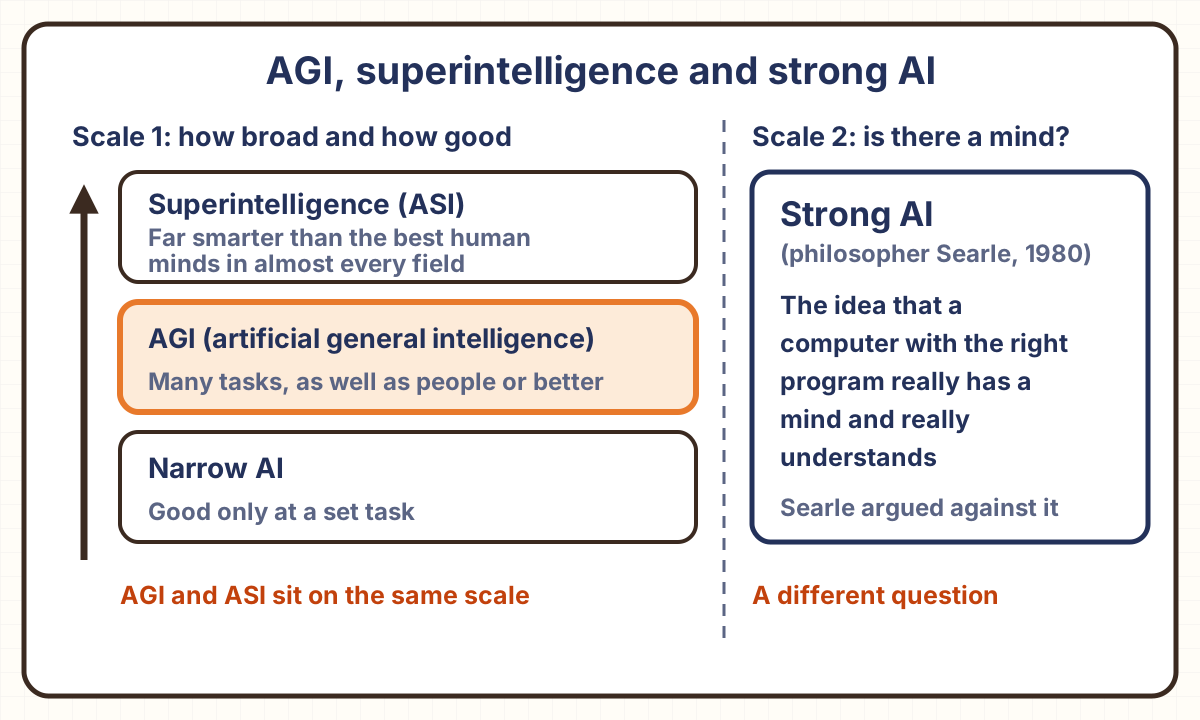
It is close in one way: like a person, it would handle many kinds of things. But most definitions are about what an AI can do, not whether it has a mind. A paper by researchers at Google DeepMind (Google’s AI lab) says AGI does not need consciousness (subjective awareness), and does not necessarily need to be able to do physical tasks. Whether a machine has a mind is a different question, called “strong AI.”
Explained in pictures
Think of it like this
A one-subject star and a student good at every subject
Imagine a student no one can beat at arithmetic drills, but who cannot even sit a language or science test. That student is an “arithmetic star,” but not “a student who can do every subject.” A narrow AI, like a Go-playing AI, is a lot like that.
AGI would be like a student who does as well as a typical student, or better, in every subject, even ones they are learning for the first time. What matters is not a high score in one subject, but how wide their skills reach and how well they learn new things.
But the comparison has limits. Today’s chat AIs are uneven. The Google DeepMind researchers who sorted AI into levels saw them as competent at short essays, but still at the early stage in math and in work where getting facts right matters. And people draw the line for “as well as a typical student” at different scores. That is one reason AGI has no single definition.
Key points
How is it different from today’s AI?
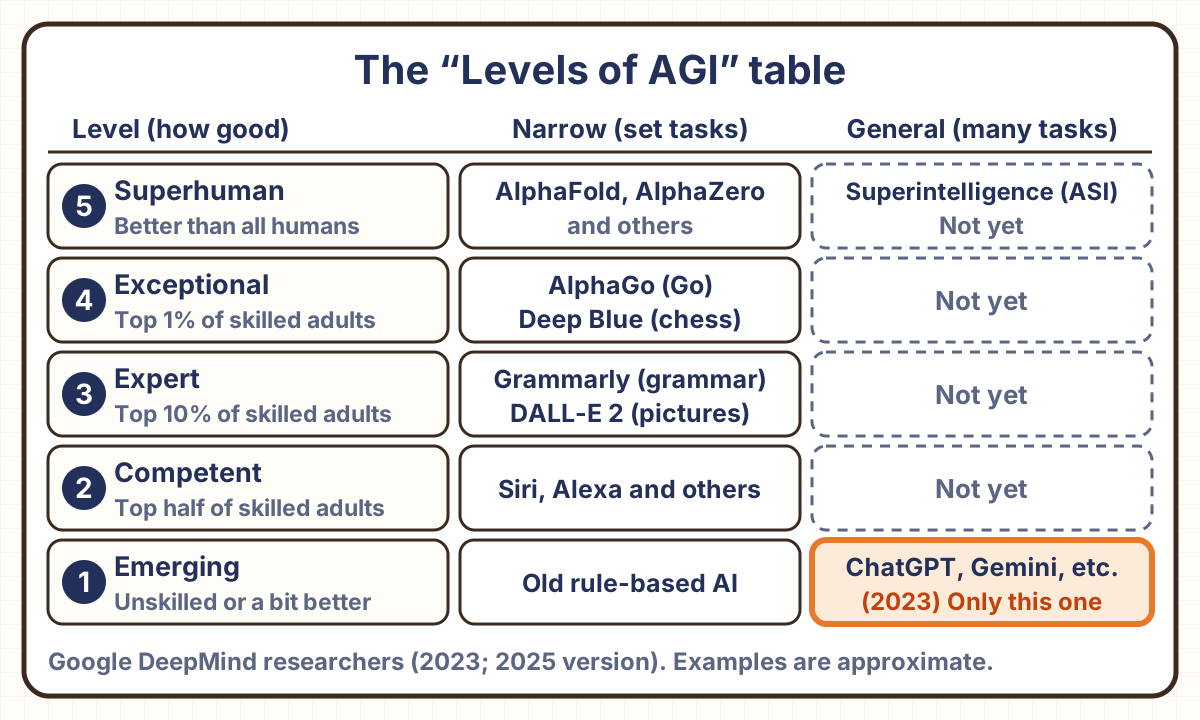
Many AIs are built for one set job and are good only at that. This is called “narrow AI.” In the “Levels of AGI” sorting by Google DeepMind researchers, AlphaGo, an AI that plays the board game Go, sits at the level of being better than 99% of skilled adult players, but AlphaGo cannot write an essay. The “general” in AGI means the opposite: one AI that handles a wide range of tasks.
Chat AIs like ChatGPT do many kinds of work, such as writing, summarizing and coding. So Google DeepMind researchers put ChatGPT and others, as of 2023, among “general” AIs. But they placed them on the lowest level, “Emerging.” The reason: they were “Competent” at some tasks, such as short essays and simple coding, but still “Emerging” at most tasks, such as math and tasks where getting facts right matters (the researchers note that their examples are approximate).
The same paper names, as key abilities for AGI, learning new tasks and knowing when to ask a person for clarification or help. Doing physical tasks, such as carrying things, would make an AI more general, it says, but is not a necessary condition for calling it AGI.
Is there an agreed definition?
No. People and companies differ on which tasks to compare, and on whether an AI must match people or beat them.
In its 2018 charter (a statement of the company’s goals and promises), OpenAI described AGI as “highly autonomous systems that outperform humans at most economically valuable work.” It compares economically valuable work and says AGI would “outperform” people. In a 2025 blog post, Google DeepMind wrote of “AI that’s at least as capable as humans at most cognitive tasks.” That one says “at least as capable.”
Google DeepMind researchers’ paper “Levels of AGI” (2023) compared nine earlier ideas and suggested thinking in levels, like the “levels” of self-driving cars, instead of a single point between “done” and “not yet”. The levels that use AI run from “Emerging” (equal to or somewhat better than an unskilled person) at the bottom to “Superhuman” (better than all humans) at the top, five in all. Dario Amodei, the head of Anthropic (the company that makes the AI Claude), calls AGI “an imprecise term that has gathered a lot of sci-fi baggage and hype,” and uses the term “powerful AI” instead.
Is AGI already here?
Opinions differ. In 2023, Microsoft researchers who studied an early version of GPT-4 (an AI by OpenAI) that was still in development wrote that it “could reasonably be viewed as an early (yet still incomplete) version” of AGI. The same year, Blaise Agüera y Arcas, a vice president at Google, and the computer scientist Peter Norvig wrote an essay titled “Artificial General Intelligence Is Already Here.” Their view is that the most important part, being general, has already been achieved. They also admit these models have many flaws.
On the other hand, the “Levels of AGI” paper put chat AIs on the lowest of the five general levels. The Microsoft paper itself also says that going further may require a new approach that moves beyond predicting the next word. Whether AGI is already here depends on which definition you use.
When will it come?
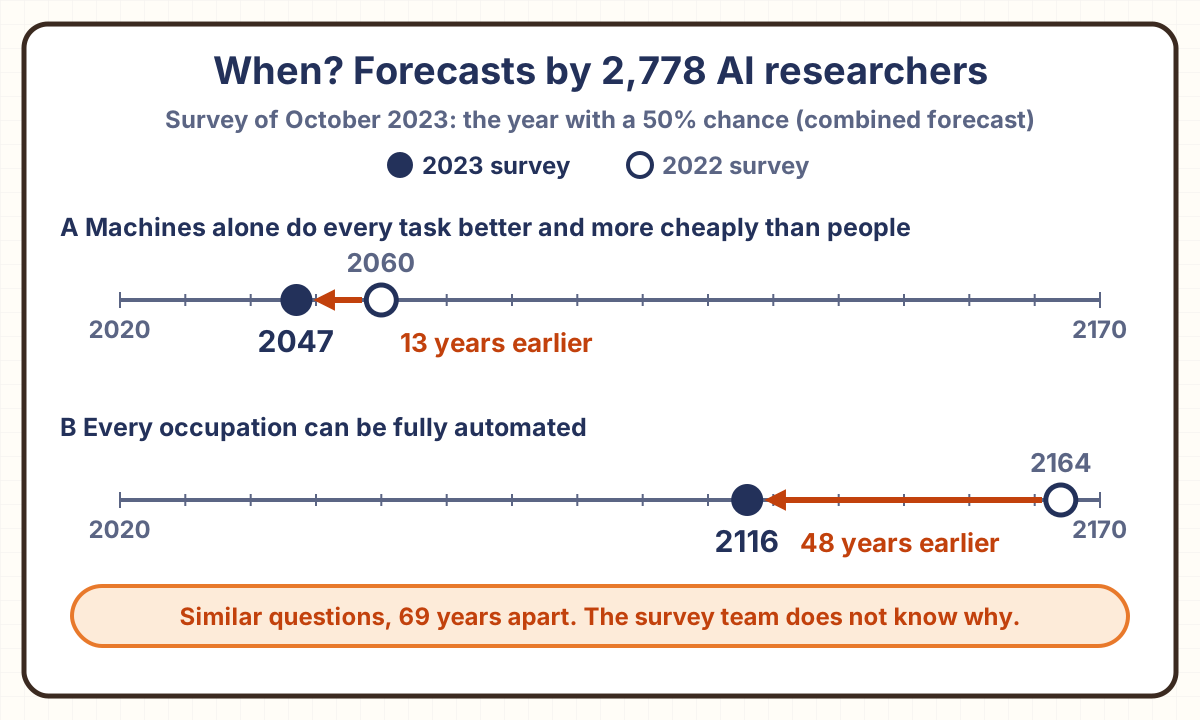
No one knows. Forecasts vary widely. In a survey of 2,778 AI researchers in October 2023, the combined forecast gave a 10% chance by 2027 and a 50% chance by 2047 that “unaided machines can accomplish every task better and more cheaply than human workers” (the survey did not use the word “AGI”; it asked in this form). That was 13 years earlier than in the survey a year before. But the 50% year for all occupations becoming fully automatable was 2116.
The survey team also writes that different people gave very different answers to the same questions, that forecasting is hard in general, and that AI researchers have no unusual skill at forecasting.
Some heads of AI companies expect it sooner, or say they already know how to build it. In 2024, Amodei wrote that “powerful AI” “could come as early as 2026, though there are also ways it could take much longer” (after noting that many people doubt it will be built soon, and some doubt it will ever be built). In a blog post in early 2025, OpenAI’s head, Sam Altman, wrote, “We are now confident we know how to build AGI as we have traditionally understood it.” And in a 2025 paper, Google DeepMind researchers, with Level 4 AGI from the “Levels of AGI” (better than 99% of skilled adults) in mind, wrote that they are highly uncertain about when such powerful AI will be developed, but find it plausible by 2030. All of these are forecasts or opinions, not a settled future.
How is it different from “strong AI” and “superintelligence (ASI)”?
“Strong AI” is a term the philosopher John Searle used in a 1980 paper. In Searle’s sense, strong AI is the idea that a computer with the right program really is a mind and can literally be said to understand. Searle argued against it. So it is a question not of what a machine can do, but of whether there is a mind inside.
Ben Goertzel, the AI researcher who put the term AGI in a book title, writes that he avoided “strong AI” because it has a specific meaning in the philosophy of AI. He also writes that the inventor Ray Kurzweil got around this by using “strong AI” as the opposite of “narrow AI.”
“Superintelligence” (ASI, artificial superintelligence) goes beyond AGI. In a 1998 paper, the philosopher Nick Bostrom described it as “an intellect that is much smarter than the best human brains in practically every field, including scientific creativity, general wisdom and social skills.” In the “Levels of AGI,” a general AI at the top, Level 5 (outperforms 100% of humans), is called superintelligence.
Why do people worry about its safety?
Because an AI that can work as broadly as people could be used for good or bad, and, as OpenAI’s definition puts it, might be “highly autonomous,” acting without waiting for instructions. In a 2025 paper, Google DeepMind researchers sorted AGI risks into four areas: “misuse,” when a person deliberately uses AI to do harm; “misalignment,” when the AI knowingly causes harm against what its developers intended; “mistakes,” when the AI causes harm without knowing it would; and “structural risks,” harms that arise as many people, organizations or AIs interact, which fixing one person or one AI would not have prevented.
The same paper puts special weight on severe harm, harm big enough to significantly hurt humanity, and calls risks that would permanently destroy humanity clear examples. In 2023, AI researchers and the heads of OpenAI, Google DeepMind and Anthropic signed a one-sentence statement: “Mitigating the risk of extinction from AI should be a global priority alongside other societal-scale risks such as pandemics and nuclear war.”
These are the views of companies and researchers. The worry that AI could speed up AI research and keep improving itself is explained on the page on recursive self-improvement.
Where did the term come from? Does it mean anything else?
According to the Google DeepMind researchers’ paper, the first use of the term “artificial general intelligence” was in a 1997 article about military technologies by Mark Gubrud.
It spread in the early 2000s. According to the AI researcher Ben Goertzel, around 2002 he and Cassio Pennachin were editing a book on powerful AI with broad abilities at the human level and beyond, and were struggling for a title, when the AI researcher Shane Legg, who had worked for him before, came up with “Artificial General Intelligence.” The paper above says Legg and Goertzel popularized the term among computer scientists in 2001 (the years differ slightly). Legg is also one of that paper’s authors.
In U.S. taxes, “AGI” means “adjusted gross income.” The U.S. tax agency, the IRS, describes it as your total income from all sources minus certain adjustments. It has nothing to do with AGI in AI.
Check yourself
Q1Where did Google DeepMind researchers place ChatGPT and others, as of 2023, in the “Levels of AGI”?
Answer and explanation
Answer: A A general AI, Level 1 (Emerging)
The researchers counted ChatGPT and others, as of 2023, as general AIs and placed them at the lowest level, Level 1 (Emerging). They saw them as Competent at some tasks, like short essays and simple coding, but still Emerging at most tasks, like math and work where getting facts right matters. No general AI is at Level 2 or above “yet.”
More on this → Key points: How is it different from today’s AI?
Q2In the 2023 survey of 2,778 AI researchers, what was the year with a 50% chance that “machines alone can do every task better and more cheaply than human workers”?
Answer and explanation
Answer: C 2047
In the 2023 survey it was 2047, 13 years earlier than 2060 in the survey a year before. 2116 is the year for when “all occupations” could be fully automated. The questions were similar, yet the answers were 69 years apart.
Q3What does “strong AI,” the term John Searle used in 1980, ask about?
Answer and explanation
Answer: B Whether an AI has a mind and really understands
Searle’s strong AI is the idea that a computer with the right program really has a mind and really understands, so it asks whether there is a mind inside. Doing physical tasks is something the “Levels of AGI” paper says AGI does not necessarily need, and acting without waiting for instructions is the “autonomous” part of OpenAI’s definition. Neither is the strong AI question. Searle himself argued against strong AI.
More on this → Key points: How is it different from “strong AI” and “superintelligence (ASI)”?
Related terms
- Recursive self-improvement
- Intelligence explosion
- Large language model
- AI agent
- Superintelligence
- Machine learning
Sources and how we checked
- Morris et al., "Levels of AGI for Operationalizing Progress on the Path to AGI" (Google DeepMind, ICML 2024; arXiv, November 2023; version 5, September 2025)
- OpenAI, "OpenAI Charter" (2018)
- Google DeepMind, "Taking a responsible path to AGI" (April 2, 2025)
- Shah et al., "An Approach to Technical AGI Safety and Security" (Google DeepMind, arXiv, April 2025)
- Grace et al., "Thousands of AI Authors on the Future of AI" (arXiv, January 2024)
- Bubeck et al., "Sparks of Artificial General Intelligence: Early experiments with GPT-4" (Microsoft Research, March 2023)
- Blaise Agüera y Arcas and Peter Norvig, "Artificial General Intelligence Is Already Here" (Noema, October 10, 2023)
- Dario Amodei, "Machines of Loving Grace" (October 2024)
- Sam Altman, "Reflections" (January 2025)
- John R. Searle, "Minds, Brains, and Programs" (Behavioral and Brain Sciences, vol. 3, 1980)
- Nick Bostrom, "How Long Before Superintelligence?" (1998)
- Ben Goertzel, "Who coined the term “AGI”?" (August 28, 2011)
- Center for AI Safety, "Statement on AI Risk" (2023)
- IRS, "Definition of adjusted gross income"
AI wrote this page from the sources above, and a different AI checked it against the text of those sources (November 7, 2026). A person with a master’s degree in science and a Japanese high-school science teaching license also read and checked it before publishing. Numbers are as of that date. If anything was hard to follow, you spot a mistake, or there’s a term you’d like explained, please write to [email protected].