 Naru News日本語
What is hallucination in AI?
Also called: AI hallucination

In one minute
It is when an AI such as ChatGPT gives a wrong answer that sounds true and confident.
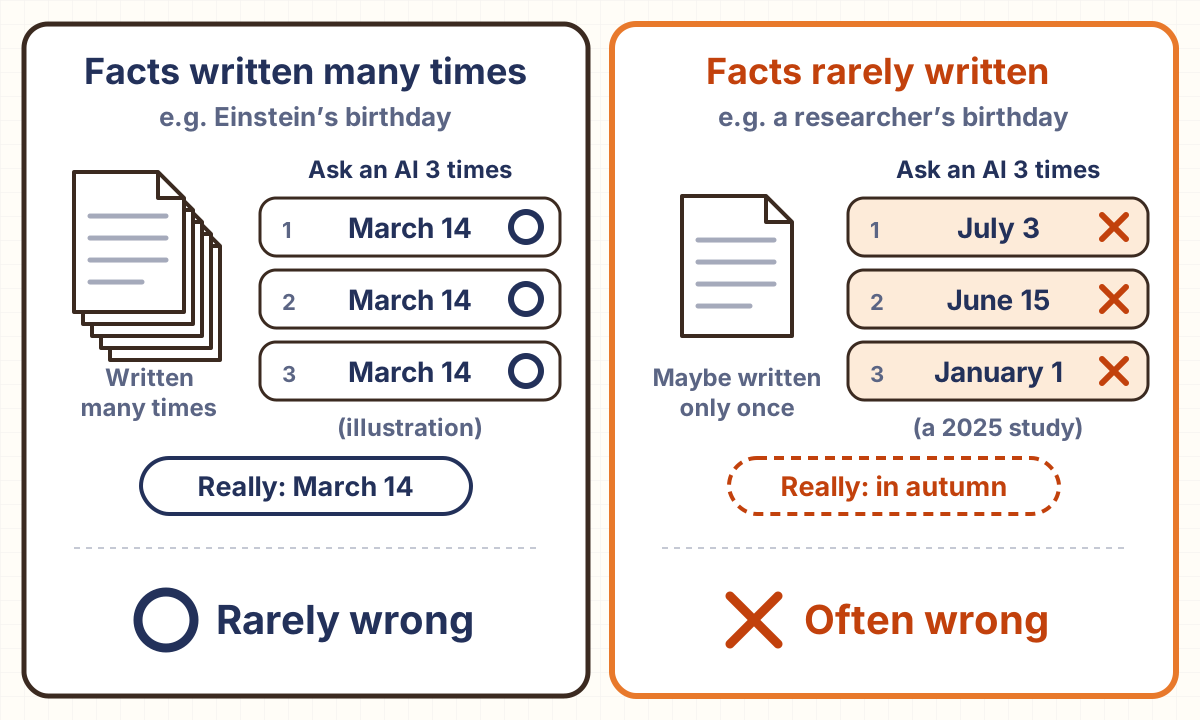
After reading huge amounts of text, an AI learns which words tend to follow which, and builds sentences by picking the word likely to come next. So even when it is asked about something it does not know, a natural-sounding answer comes out smoothly. It happens a lot with dates, numbers and facts that are rarely written down, and an AI may even point to studies or court rulings that do not exist.
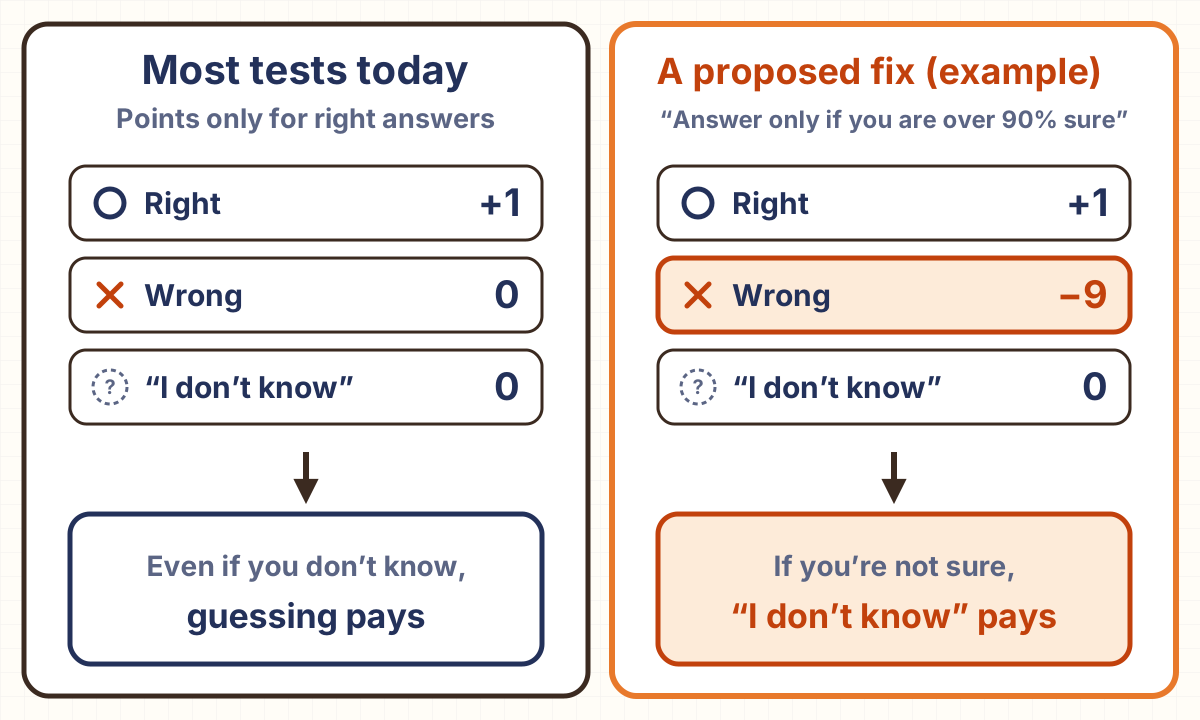
So why doesn’t it just say “I don’t know”? In a 2025 paper, researchers from OpenAI (the company that makes ChatGPT) and elsewhere suggest it is because most tests used to compare AIs give points only for right answers. Answering even when guessing raises the score, so the habit sticks. OpenAI announced that GPT-5, from 2025, makes significantly fewer of these mistakes, but says they still happen.
A common mix-up
“The AI is lying on purpose.”
It is true that it says wrong things as if it were sure. But the researchers behind the paper above explain hallucinations not as something done “on purpose,” but as “mistakes” made by guessing when the AI does not know, like a student who writes down an answer to a hard exam question without being sure. Still, there are also cases where an AI piles up mistakes about things it should know, in keeping with an earlier answer.
Explained in pictures
Think of it like this
Never leaving a blank on a test
Imagine a multiple-choice test with a question you can’t answer. Leave it blank, and you surely get zero. Take a wild guess, and you might get lucky. If wrong answers don’t lose points, filling in every blank pays.
Many of the tests used to compare AIs are graded the same way. That is why, according to the paper above, the habit of answering even when unsure tends to stick. And an AI’s guesses are often not vague, like “sometime in autumn,” but confident and specific, like “September 30.”
But the comparison has limits. People learn outside school, by being embarrassed when they make things up, that saying “I don’t know” matters. Also, an AI’s mistakes don’t always come from being unsure. Inside an AI, researchers have found cases where an “I know this name” signal fires by mistake, so the AI answers even though it doesn’t know.
Key points
Why doesn’t it say “I don’t know”?
There are three big reasons: “there will always be things it doesn’t know,” “how the AI works inside,” and “how tests are scored.” First: an AI can learn patterns that show up again and again, like the spelling of words. But the birthday of someone who is not famous may appear only once in the text it learns from, and it cannot be worked out from other facts either.
Second: in 2025, Anthropic, the company that makes an AI called Claude, looked inside its own AI and found that, by default, a brake is on against answering (something it picked up in its final training). So when asked about someone whose name it does not know at all, it says it doesn’t have enough information to answer. When a well-known name comes up, an “I know this name” signal appears inside the AI and releases the brake, so it answers. But when a name only feels familiar and the AI knows nothing more, this signal can appear by mistake and release the brake, and the AI starts making up a plausible story, Anthropic explains.
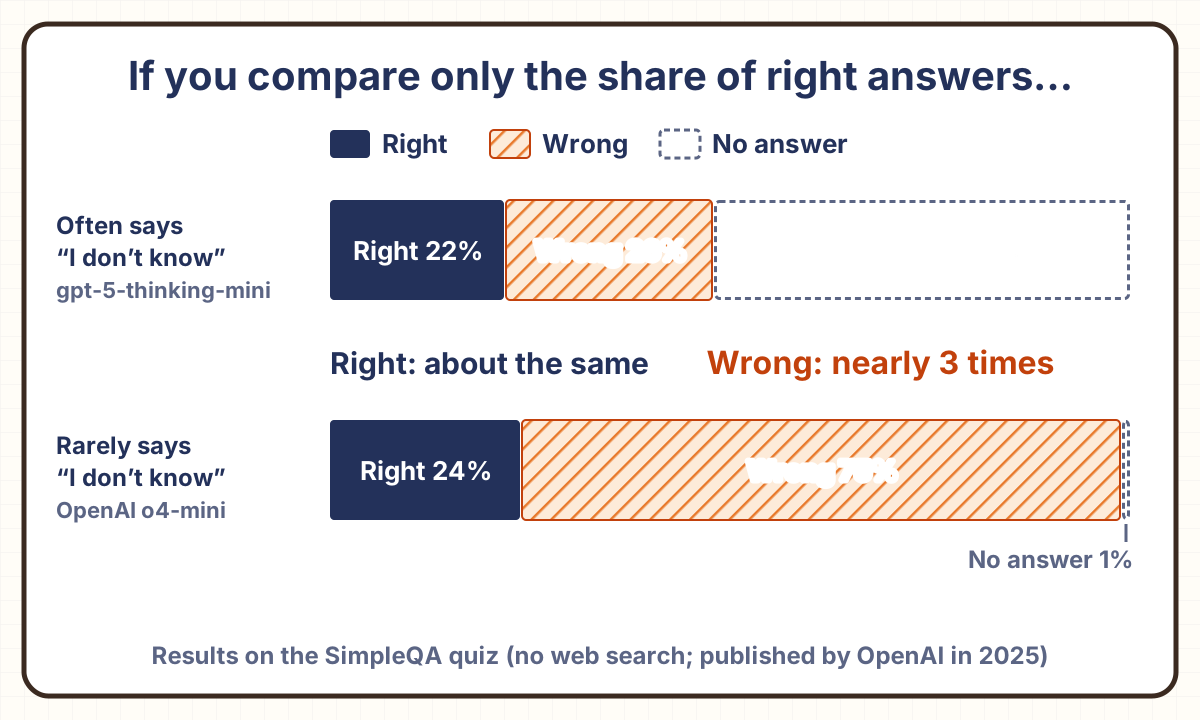
Third: because AIs are tuned to score well on tests that give points only for right answers, the habit of guessing remains. That is the view of the paper introduced in “In one minute.” In SimpleQA, a quiz of short fact questions whose results OpenAI published in 2025 (without web search), the AI that often says “I don’t know” got 22% right, 26% wrong and held back on 52%. The AI that rarely says it got 24% right, 75% wrong and held back on 1%: about the same share right, but nearly three times as many wrong. Ranking only by the share of right answers puts the AI with more mistakes on top.
When is it most likely to happen?
OpenAI’s help page for ChatGPT gives these examples of hallucinations: wrong meanings of words, dates or facts; made-up studies or quotes of things people never said; and overconfident answers to unclear or complicated questions. It is especially likely with facts that follow no pattern and are rarely written down, like birthdays.
Events that happened after the AI learned are also hard for it. An AI’s knowledge stops at the point it was trained, so later events are not part of its answers unless it uses tools such as web search. It may give an answer that used to be true, or make something up.
Writing something that differs from the text you gave it is sometimes counted as hallucination, too. For example, you ask for a summary of a document, and things that are not in the document slip in. A paper that reviews past research sorts hallucinations into two big groups: those that differ from real-world facts, and those that stray from what you asked or the text you gave, or that don’t hang together.
What should I do when I use AI?
First, for a question with only one right answer, like a birthday, ask the same question a few times, separately. Research suggests that when an AI knows something, its answers tend to match, and when it is making things up, they tend to disagree. But matching answers are not proof that they are right. And for some questions, like asking for suggestions or a story, different answers each time are normal.
Second, asking the AI “Is that true?” does not count as checking (see the court case below). Check dates, numbers and quotes against the original source. If the AI says “it is written here” and names a source, open the link and see whether the source really exists and really says that. Both OpenAI and Anthropic ask users to check important information.
Third, change how you ask. Anthropic’s guide says that telling the AI it is fine to say “I don’t know” can greatly cut down false information. When you ask about a long document, it also helps to have the AI first pull out the exact words from the document and then answer based on them. The guide also says that hallucinations still do not go away completely.
Has it caused real trouble?
Yes. In 2023, in a court case in New York, lawyers filed papers that cited court rulings that did not exist, complete with convincing quotes. ChatGPT had made them up. When a lawyer asked ChatGPT back whether one of them was a real case, ChatGPT said it “does indeed exist,” and even said it could be found on legal research services.
In an order in June 2023, the court said the lawyers had submitted rulings that did not exist and kept standing by them after their existence was questioned, and it ordered the lawyers and their law firm to pay a $5,000 penalty between them. The order says there is nothing wrong in itself with using a reliable AI tool for help, but that it is the lawyers’ job to make sure their filings are accurate.
Can hallucinations be eliminated?
Not yet. OpenAI announced that GPT-5, from 2025, has significantly fewer hallucinations, especially when it reasons before answering, but also wrote that they still happen. Web search can reduce them, but it is not a cure-all either. Even when a search finds no sure answer, a test that gives points only for right answers still rewards guessing.
OpenAI also writes that no matter how smart AI gets, its share of right answers will never reach 100%, because some questions cannot be answered, for reasons such as missing information. But it disagrees with the idea that “hallucinations will always happen,” saying an AI can avoid mistakes by answering “I don’t know” when it is unsure. That is why it calls for changing how tests are scored (this is the view of the company’s researchers).
What happens after one mistake?
An AI may back up one mistake with another. A 2023 study shows an example where an AI was asked “Is 9677 a prime number (a number that can only be divided evenly by 1 and itself)?” It is prime, but the AI said “No” and gave a wrong calculation as its reason (it wrote “13 × 745 = 9677,” but 13 × 745 is 9685).
When the researchers turned just the explanation into a separate question and had the same AI check it, it caught 87% of such mistakes across three kinds of problems. It had gotten wrong something it could tell was wrong when asked on its own. The researchers think this happens in a way that keeps the AI consistent with its first answer. Like a rolling snowball that grows, one mistake brings the next, so they call it “hallucination snowballing.”
Why is it called “hallucination”? Does it mean anything else?
Originally, “hallucination” is a word from medicine and psychology: seeing or hearing something that is not there. It can be caused by an illness or a drug. Hallucination in AI is a different meaning.
In 2023, the AI meaning of “hallucinate” was added to the Cambridge Dictionary in the UK, and the word was named its Word of the Year. The dictionary says that when an AI hallucinates, “it produces false information.” But an AI is not “seeing” anything, and the paper introduced in “In one minute” also says it is completely different from what people experience. In English, it is sometimes also called “confabulation,” a word for making things up.
Check yourself
Q1In the study that looked inside an AI, what did that AI do when asked about someone whose name it did not know at all?
Answer and explanation
Answer: C It said it had too little information
By default, the AI studied had a brake on against answering, so for a name it did not know at all, it said it did not have enough information to answer. Made-up stories could start when a name felt familiar but the AI knew nothing more: the “I know this name” signal appeared by mistake and released the brake.
More on this → Key points: Why doesn’t it say “I don’t know”?
Q2In the SimpleQA results OpenAI published in 2025, how did the AI that rarely says “I don’t know” compare with the one that often does?
Answer and explanation
Answer: A About as often right, nearly 3 times as often wrong
It got 24% right versus 22%, about the same. But it got 75% wrong versus 26%, nearly three times as many. Ranking only by the share of right answers puts the AI with more mistakes on top.
More on this → Key points: Why doesn’t it say “I don’t know”?
Q3You ask an AI for someone’s birthday 3 times, separately. According to this page, what is that for?
Answer and explanation
Answer: B To see if the answers disagree and spot made-up ones
For a question with only one right answer, like a birthday, research suggests that answers tend to match when an AI knows something and tend to disagree when it is making things up. But matching answers are not proof that they are right, so the most common answer cannot be taken as correct. Asking again and again does not count as checking, either. Check important things against the original source.
Related terms
- Large language model
- Reasoning model
- Machine learning
- Token
- Retrieval-augmented generation (RAG)
Sources and how we checked
- Kalai et al., "Why Language Models Hallucinate" (OpenAI and Georgia Tech, arXiv, September 2025)
- OpenAI, "Why language models hallucinate" (September 5, 2025)
- OpenAI, "GPT-5 System Card" (August 13, 2025), Table 8, "SimpleQA (no web)"
- OpenAI Help Center, "Does ChatGPT tell the truth?"
- Anthropic, "Tracing the thoughts of a large language model" (March 27, 2025)
- Anthropic docs, "Reduce hallucinations"
- Huang et al., "A Survey on Hallucination in Large Language Models" (arXiv, November 2023)
- Manakul et al., "SelfCheckGPT" (arXiv, March 2023)
- Zhang et al., "How Language Model Hallucinations Can Snowball" (arXiv, May 2023)
- U.S. District Court for the Southern District of New York, Mata v. Avianca, Inc., Opinion and Order on Sanctions (June 22, 2023; copy on CourtListener)
- University of Cambridge, "Cambridge Dictionary names ‘Hallucinate’ Word of the Year 2023"
AI wrote this page from the sources above, and a different AI checked it against the text of those sources (November 6, 2026). A person with a master’s degree in science and a Japanese high-school science teaching license also read and checked it before publishing. Numbers are as of that date. If anything was hard to follow, you spot a mistake, or there’s a term you’d like explained, please write to [email protected].