 Naru News日本語
Home › Glossary › Everyday science
What is dark oxygen on the deep seafloor?
Also called: Dark oxygen production, DOP

In one minute
Dark oxygen is oxygen that a 2024 paper reported being made on the deep seafloor, where no light reaches, by something other than photosynthesis.
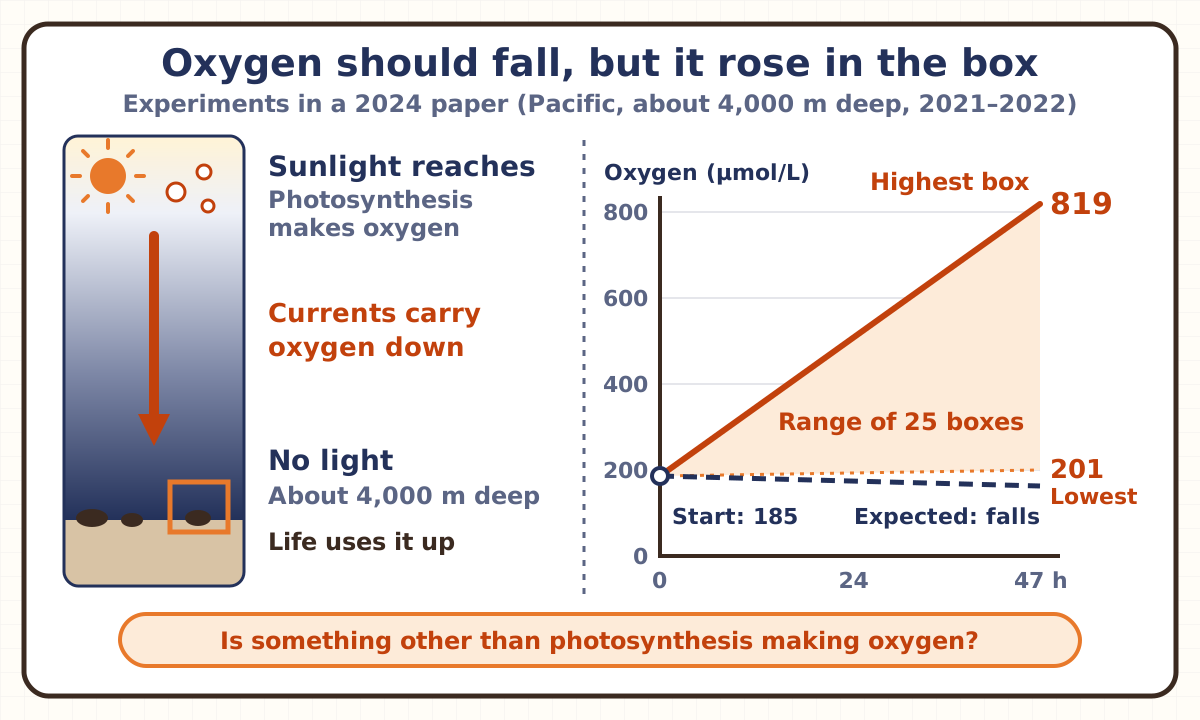
Much of the ocean’s oxygen is made by photosynthesis, by plankton and others in the sunlit upper layer, and is carried down by ocean currents. On the deep seafloor, living things use oxygen up, so in a box sealed over the seabed, the oxygen should fall. Yet on the Pacific floor about 4,000 meters down, some boxes saw it climb to more than three times the starting level in two days.
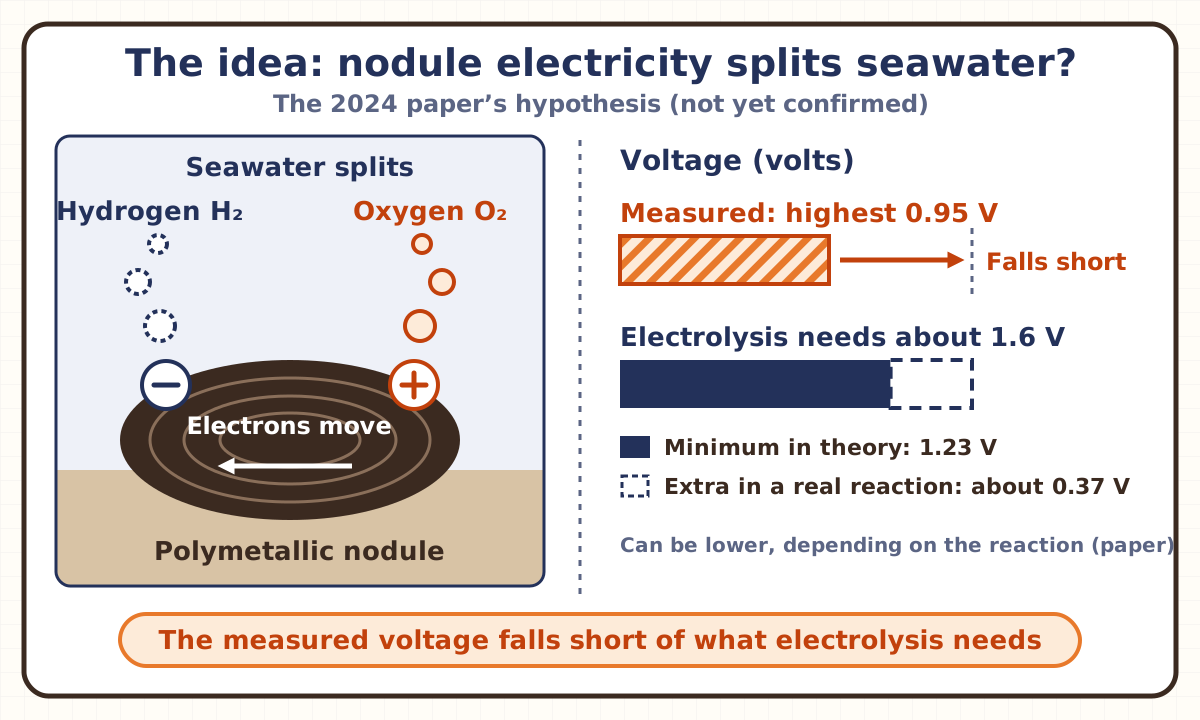
The paper proposed that electricity on the surface of stone-like, metal-bearing lumps lying on the seabed (polymetallic nodules) splits seawater and releases oxygen (electrolysis). But the voltages measured fell short of what electrolysis needs, critics suspect measurement errors, and the question is not settled.
A common mix-up
“All of Earth’s oxygen comes from photosynthesis.”
Mostly right. About half of the oxygen made on Earth comes from the ocean, and most of that is made by photosynthesizing plankton near the ocean’s surface. On land, plants make oxygen by photosynthesis. But not “all” of it. Ways of making oxygen without light are known too. A 2022 paper showed that a microbe in the sea (a kind of archaeon that feeds on ammonia) makes oxygen itself in dark places where the surrounding oxygen has run out. It then uses that oxygen to get energy from the ammonia it feeds on, but it is still making oxygen without light. Radiation given off by rocks and other material can also split water and release oxygen. The 2024 paper concluded that these processes could hardly explain the oxygen that rose in the boxes on the deep seafloor: oxygen still rose after a poison that kills microbes was added, and its calculations put radiation and similar processes at less than 0.5%. It then proposed a new idea, that metal-bearing lumps on the seabed, not living things, are involved. That is why it drew attention.
Explained in pictures
You’re free to use these figures in lessons, slides and posts if you credit Naru News (naru.news). CC BY 4.0.
Think of it like this
Money growing in a wallet you only spend from
Imagine a wallet that you take money out of every day, and that no one puts money into. Normally the money inside should shrink. Yet when you count it two days later, it has tripled. There are two possible reasons. One is that someone is putting money in without your noticing: there is a way in you didn’t know about. The other is that you counted wrong. Maybe, the first time you counted, you missed the bills in a side pocket.
The dark oxygen story has the same shape. Inside a box sealed over the deep seafloor, living things use oxygen, so the oxygen should have fallen. The 2024 paper took the rise to be an unknown way in: metal-bearing lumps on the seabed (polymetallic nodules) making oxygen. Researchers who disagree suspect a counting error, such as air bubbles that got into the box.
But the comparison has limits. You can open a wallet and look inside, but no one can watch a box on the seabed about 4,000 meters down up close; people can only reason from the instruments’ records. And while money in a wallet grows only if someone puts it in, oxygen can be made in several ways, through chemical reactions or the work of microbes, so there is more than one candidate for the way in. That makes it harder to decide which one is real.
Key points
Why is it called “dark”?
“Dark” means darkness where no light reaches. The 2024 paper’s title was “Evidence of dark oxygen production at the abyssal seafloor.” In Japanese, the term is translated as “ankoku sanso,” literally “darkness oxygen.”
In the sea, below about 200 meters there is rarely any significant light, and photosynthesis is no longer possible. Even faint light can be detected only down to about 1,000 meters. Much of Earth’s oxygen is made by photosynthesis, but the seabed in this study is about 4,000 meters down and pitch dark. Because this oxygen would be made without light, it is called “dark.”
It has nothing to do with “dark matter” in space. The word “dark” is the same, but this is a story about the deep sea, not about space.
How was it found?
It turned up in experiments meant to measure how much oxygen life on the seabed uses. The site was the Clarion–Clipperton Zone, which stretches across the northeastern Pacific. Polymetallic nodules lie scattered over wide areas of the seafloor here. A nodule is not a lump of pure metal but a stone-like lump made of a mix of minerals that contain metals. Nodules range in size from tiny particles to about the size of a potato. On three voyages in 2021 and 2022, the team lowered an instrument platform to the deep seafloor 16 times. It carries three square boxes about 22 centimeters on a side, which are pushed into the seabed to trap mud, nodules and the seawater above them. Sensors in the boxes’ lids recorded how the oxygen changed for 47 hours.
Living things in the mud use oxygen, so the oxygen in the boxes was expected to fall. Indeed, another method that measures oxygen in fine detail within the mud showed that oxygen was being used up in the mud. Yet in 25 box experiments, the oxygen rose within 47 hours, and in the highest box it reached more than four times the starting level (the average of the 25). Even after subtracting what was used, oxygen was being made, the calculation shows.
Andrew Sweetman, who led the research, said in a university news release that at first he thought the sensors were faulty. But similar readings kept showing up over 10 years. In this study, the team also confirmed the rise with a separate method, in which a chemical is added to water drawn from the box to measure its oxygen. Rechecking records from experiments done the same way in 2015 and 2018 at other places in the same zone (about 4,000 to 5,200 meters deep) also showed oxygen rising (the sensors had been calibrated months earlier, so those records show only how the oxygen changed, not its exact level).
How did they think the oxygen was made?
First, they checked whether living things were responsible. On the ship, they kept mud taken from the seabed in the dark at 1.6 °C, the same as on the seabed, and measured the oxygen. Oxygen still rose when a poison that kills microbes was added, and also in tests with nodules alone and no mud. Some microbes can make oxygen in the dark, but this poison kills them. So the paper concluded that most of the added oxygen was not made by living things and that the nodules were involved. The team also calculated how much oxygen could come from radiation splitting water or from chemical changes in the nodules’ metals, and found it came to less than 0.5% of the rise.
Next, they measured voltages (the size of the push that drives electricity, in volts) on the nodules’ surfaces. In the lab, they took 153 readings of the voltage between two spots on the surfaces of 12 nodules; the highest was 0.95 volts. Nodules are built of stacked layers containing metals. The paper proposed that voltages arising from differences between the metals in these layers might split seawater into oxygen and hydrogen (electrolysis). Franz Geiger, a chemist on the study, calls the nodules a natural “geobattery.”
But there is a weak point: the voltage is too low. The paper itself says that splitting water by electrolysis needs about 1.6 volts. The minimum in theory is 1.23 volts, but a real reaction needs some extra voltage to get going (about 0.37 volts, by the paper’s working figure). The measured voltage was 0.95 volts at most, which falls short.
On this gap, the paper writes that, depending on how the reaction proceeds, the voltage needed could be lower, and the university news release explains that when many nodules cluster together, the voltage could add up, as when batteries are connected. Both say only that this could happen. The paper itself also says it is not known where the energy to keep producing electricity comes from. A battery runs down as it is used. If nodules keep splitting water like batteries, the energy behind that electricity must be coming from somewhere.
What is the opposing view?
After the paper came out, people raised doubts about the measurements. In December 2025, the marine science journal Frontiers in Marine Science published an opinion article (Downes et al.) that had passed review by other researchers (peer review). Of its 13 authors, six are staff of The Metals Company, a deep-sea mining company that holds rights to explore for nodules in the study area (one of them a former employee); four are researchers at other companies, and three are at universities and research institutes. This company had also helped fund the 2024 study.
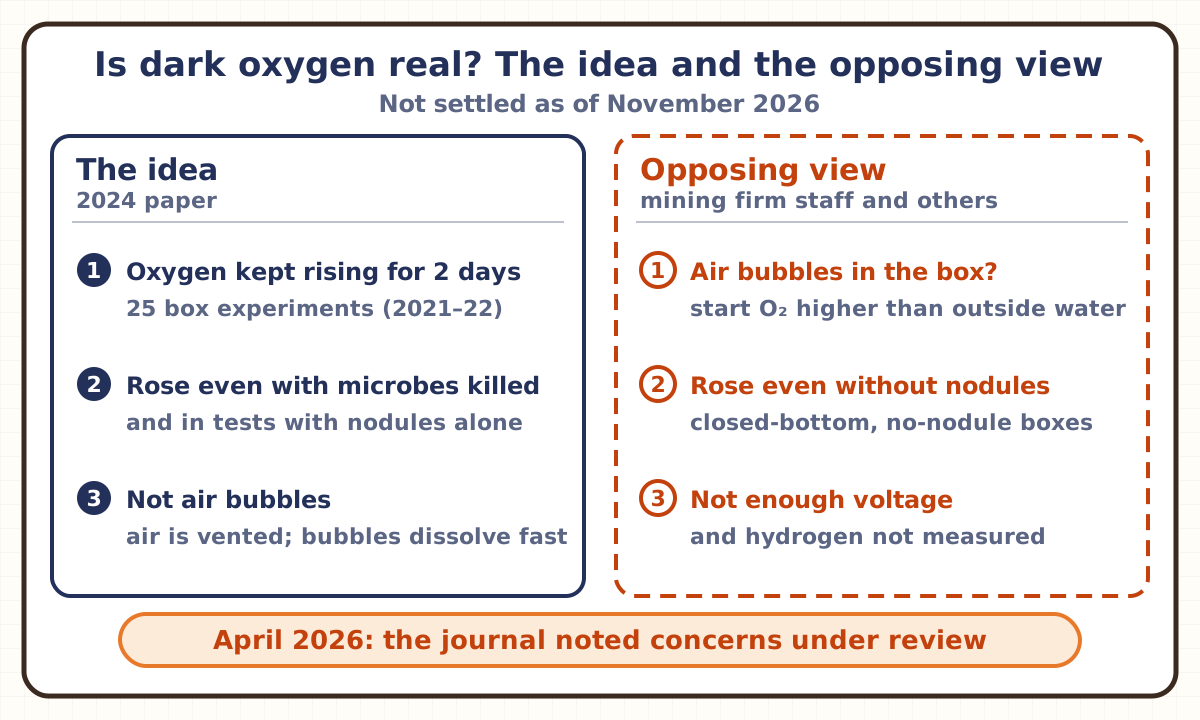
What the opinion article suspects first is air left in the boxes. Before a box is sealed on the seabed, the water inside is supposed to be fully swapped with the surrounding seawater. But the article points out that the starting oxygen in the boxes was always higher than in the surrounding seawater. It takes this as a sign that the water was not fully swapped, and that air taken in at the sea surface, among other things, was left in the boxes (in another study, trapped bubbles raised the oxygen in a box).
It also gives points such as these, and argues that the rise was an experimental error, not a process on the seabed. Oxygen rose even in tests with boxes closed at the bottom that did not enclose the seabed, and, in 2018 experiments elsewhere that the paper used as support, in boxes said to have held no nodules. The sensors and the method that tests drawn water did not agree on the starting oxygen levels. The 0.95 volts is an outlier; in the paper’s main figure the highest is only 0.24 volts. Hydrogen, which electrolysis should make along with oxygen, was not measured. Five studies that used similar methods on nodule-rich seafloor found no rise in oxygen.
In May 2026, six current and former staff of the same company (Webber et al.) published a paper saying no link can be seen between nodules and how the oxygen rose. It appeared in F1000Research, a journal that posts papers first and then has other researchers review them, with the verdicts also made public. The 2024 paper had reported a link: the larger the nodules’ surface (on average, per nodule) in a box, the more oxygen formed. This paper says that after re-measuring the nodules’ area from photos and adding three more boxes, the link weakens until it cannot be told apart from chance. The peer reviewers’ verdicts are split.
The 2024 paper had already answered the bubble question. Each box has two valves that let air out while it sinks. And even if a bubble remained, at 4,000 meters its oxygen would dissolve into the water in less than a second, so it could not explain a slow, steady rise over two days, the paper calculates. It also says that because oxygen rose by the separate method of testing drawn water too, the sensors were not faulty. The opposing article replies that this calculation takes for granted that a bubble dissolves completely into the box water. When a bubble collapses under high pressure, it argues, water rich in oxygen can collect inside the valves and tubes attached to the box, then seep slowly into the box, so the oxygen could rise in much the same shape as the records.
On April 8, 2026, Nature Geoscience, the journal that published the paper, added a note to it saying that aspects of the article are subject to concerns being considered by the editors. It says a further response will follow once the issues are resolved.
Why does it matter?
If it is real, the deep sea gets oxygen not only from above but also from a source on the seabed. Deep-sea oxygen is usually brought by seawater that cools and sinks near the poles, and oxygen used up in the deep sea can take more than a thousand years to be replaced. The paper says dark oxygen might be used for breathing by life on the seabed.
It also bears on deep-sea mining. Nodules contain cobalt, nickel, copper, lithium, manganese and other metals, and mining them is being considered because these metals are vital to batteries. The paper wrote that it is necessary to study how dark oxygen might be affected when mining stirs up seabed mud that then settles over wide areas. Geiger said in a university news release that the way these materials are mined needs rethinking, so as not to deplete the oxygen source for deep-sea life. The opposing opinion article, on the other hand, writes that research money spent in the wrong places on the strength of claims without solid evidence is also a plain, visible cost.
Sweetman, who led the team, said in the university news release that questions such as where life that uses oxygen might have begun need revisiting. The paper itself, though, says that because the results come from limited places and times, scaling up the amount to longer periods or wider areas of seabed calls for caution.
What will be checked next?
What exists now is “a record of oxygen rising inside boxes on the deep seafloor.” Whether that is because oxygen is really being made on the seabed, or because of a measurement error, is not yet settled. Getting closer to an answer needs checks like the ones below, raised by the paper’s authors and by the opposing article.
First, whether other researchers, in other places and with other instruments, also see the oxygen rise. The opposing article writes that, as of 2025, the result had not yet been confirmed by other studies. Second, whether boxes without nodules, checked the same way, show no rise. The opposing article points to the lack of this comparison as a problem. Third, whether hydrogen, which electrolysis should make along with oxygen, also builds up in the boxes. The opposing article writes that finding hydrogen is essential to confirm that electrolysis took place. Fourth, where the energy that keeps the nodules making electricity comes from; the paper itself says this is not yet known.
Sweetman’s team also plans to check again in other places. In 2025, the Nippon Foundation and the Scottish Association for Marine Science (Sweetman’s institute) announced a three-year joint project, with the foundation providing £2 million. It plans to build autonomous instrument platforms for the work and to study whether dark oxygen forms, and how it affects microbes, in the deep Pacific, including parts of the hadal zone in ocean trenches down to 11,000 meters. As of November 11, 2026, Nature Geoscience, the journal that published the paper, had not yet announced the outcome of its review.
Check yourself
Q1In a 2024 paper, boxes were sealed over the Pacific seabed about 4,000 meters down, and the oxygen inside was measured for about two days, 25 times. In the box where oxygen got highest, how did it compare with the start (the average of the 25)?
Answer and explanation
Answer: C It reached about 4 times the start
In 25 box experiments in 2021–2022, the oxygen in the highest box reached more than four times the average starting level within 47 hours. On the deep seafloor, living things use oxygen, so it should really have fallen. Even after subtracting what was used, oxygen was being made, the calculation shows. But some suspect measurement errors, and it is not settled.
Q2Oxygen rose inside boxes sealed over the deep Pacific seabed. How did the 2024 paper think it could be explained?
Answer and explanation
Answer: A Electricity on nodules splits seawater
The paper measured voltages of up to 0.95 volts on the surfaces of metal-bearing lumps on the seabed (polymetallic nodules), and proposed that this electricity might split seawater into oxygen and hydrogen (electrolysis). It concluded that microbes could not explain most of the rise, because oxygen still rose after a poison that kills microbes was added. Radiation splitting water came to less than 0.5% of the rise in its calculations. But the measured voltage falls short of the about 1.6 volts electrolysis needs, and the idea has not been confirmed.
More on this → Key points: How did they think the oxygen was made?
Q3In a 2024 paper, oxygen rose inside boxes sealed over the deep Pacific seabed. What do researchers who take the opposing view mainly suspect caused it?
Answer and explanation
Answer: B Air from the surface was left in the box
The 2025 opinion article taking the opposing view, six of whose 13 authors are current or former staff of the deep-sea mining company The Metals Company, takes the starting oxygen in the boxes, always higher than in the surrounding seawater, as a sign that the water in the boxes was not fully swapped and that air taken in at the sea surface, among other things, was left inside. It also points to rises in boxes without nodules and to voltages too low. It does not claim the sensors were broken. The 2024 paper says bubbles cannot explain the rise, because valves let air out and oxygen from any bubble would quickly dissolve, but the opposing article replies that a bubble need not dissolve fully into the box water. Which side is right is not yet settled.
Related terms
- Photosynthesis
- Phytoplankton
- Deep sea
- Polymetallic nodule (manganese nodule)
- Electrolysis
- Deep-sea mining
Sources and how we checked
- Sweetman et al., “Evidence of dark oxygen production at the abyssal seafloor” (Scottish Association for Marine Science, Heriot-Watt University, GEOMAR, Boston University, University of Leeds, Federal Institute for Geosciences and Natural Resources [BGR], Northwestern University and others; Nature Geoscience 17, pp. 737–739, August 2024, online July 22, 2024; abstract, main text, Methods [chamber experiments, shipboard incubations, voltage measurements, radiolysis and other calculations], captions of Figs. 1 and 2, acknowledgements, competing interests and the Editor’s Note added April 8, 2026; full text on Europe PMC [PMC13061637] and the Crossref record; read November 11, 2026)
- Downes et al., “Extraordinary claims require extraordinary evidence: evaluating nodule-associated dark oxygen production” (The Metals Company, Adepth Minerals, Aanderaa-Xylem, Spanish National Research Council, University of Aberdeen and University of Gothenburg; Frontiers in Marine Science 12, December 19, 2025, Opinion article; main text and conflict of interest statement; read November 11, 2026)
- Webber et al., “No link between polymetallic nodules and anomalous oxygen concentration increases in benthic experiments from the Clarion Clipperton Zone” (The Metals Company; F1000Research 15:729, version 1 May 14, 2026, version 2 September 18, 2026; abstract, peer review verdicts and competing interests; read November 11, 2026)
- Northwestern University, “Deep-ocean floor produces its own ‘dark oxygen’” (news release, July 22, 2024; remarks by Sweetman and Geiger, nodule size and metals, and the note on voltage when nodules cluster; read November 11, 2026)
- Nature Asia, Japanese summary of the Nature Geoscience paper, “Deep-sea mining target produces ‘dark oxygen’” (July 23, 2024; for the Japanese name “ankoku sanso” and nodules as a deep-sea mining target; read November 11, 2026)
- The Nippon Foundation, “The Nippon Foundation, Scottish Association for Marine Science Embarking on Landmark Research into Deep-sea ‘Dark Oxygen’ (1)” (February 28, 2025; the three-year, £2 million joint project, autonomous landers and the plan to study the Pacific including the hadal zone; read November 11, 2026)
- Kraft et al., “Oxygen and nitrogen production by an ammonia-oxidizing archaeon” (University of Southern Denmark and others; Science 375, pp. 97–100, January 2022; abstract, read on Europe PMC on November 11, 2026)
- NOAA National Ocean Service, “How much oxygen comes from the ocean?” (about half of Earth’s oxygen production in the ocean, and photosynthetic plankton in the surface layer; read November 11, 2026)
- NOAA National Ocean Service, “How far does light travel in the ocean?” (light may be detected down to 1,000 meters, but there is rarely significant light below 200 meters and photosynthesis is no longer possible; read November 11, 2026)
- NOAA Ocean Exploration, “Hold Your Breath!” (Eric Collins, University of Alaska Fairbanks, July 30, 2019; oxygen carried to the deep sea by water sinking near the poles, and replacement taking over a thousand years; read November 11, 2026)
- Nazology, Japanese news article on the discovery (July 26, 2024, page 2; only for the Japanese name “dāku okishijen”; read November 11, 2026)
AI wrote this page from the sources above, and a different AI checked it against the text of those sources (November 11, 2026). A person with a master’s degree in science and a Japanese high-school science teaching license also read and checked it before publishing. Numbers are as of that date. If anything was hard to follow, you spot a mistake, or there’s a term you’d like explained, please write to [email protected].
Everyday science terms
- You are hereDark oxygen
- Human embryo model
- Moore’s law