 Naru News日本語
Home › Glossary › Everyday science
What is a human embryo model made from stem cells?
Also called: Embryo model, Stem cell-based embryo model, SCBEM, Blastoid, Synthetic embryo

In one minute
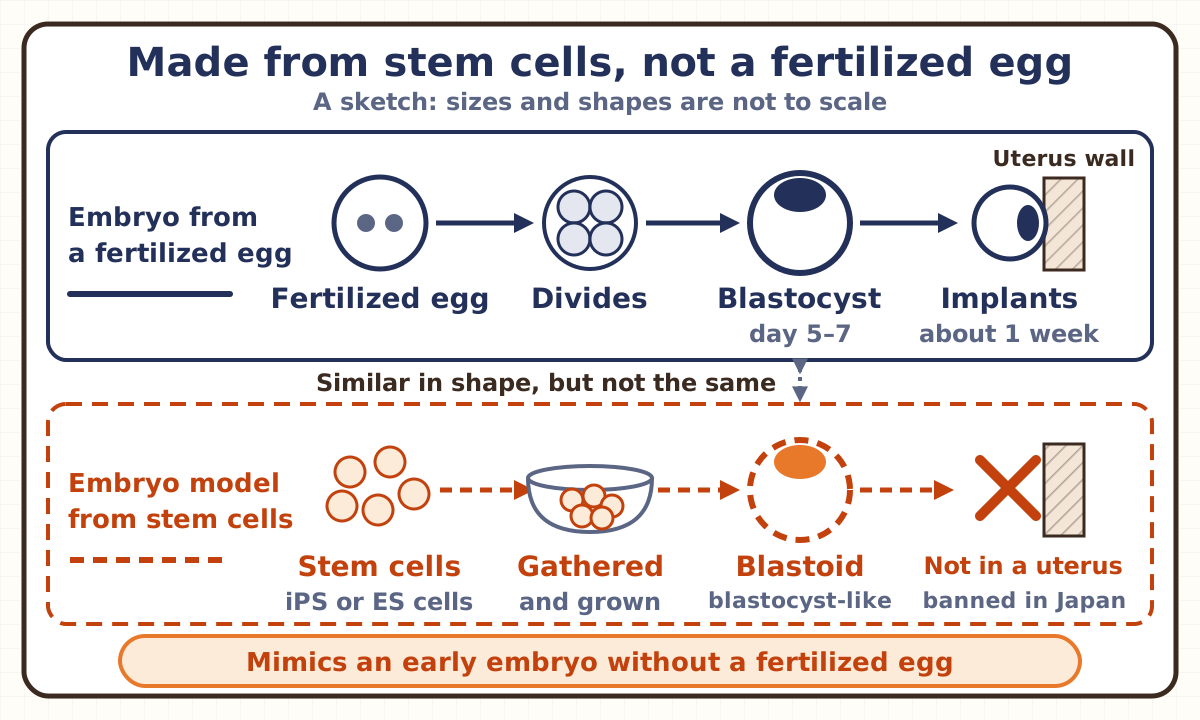
A human embryo model is a cluster of cells made from stem cells (cells that can turn into many kinds of cells) that resembles an early human embryo (a fertilized egg that has started to develop).
A fertilized egg divides into more cells; by day 5 to 7 after fertilization it is a ball of cells with a hollow inside (a blastocyst), and at about a week it burrows into the wall of the uterus (implantation). Researchers want to study this stage, but because the start of life is to be treated with care, among other reasons, the use of real embryos in research is strictly limited. So they grow stem cells into models such as the “blastoid,” which resembles a blastocyst.
The stem cells used are iPS cells, made from cells such as skin cells, and ES cells. ES cells were first made from cells of a blastocyst, but researchers use ES cells that already exist, so no new fertilized egg is needed each time.
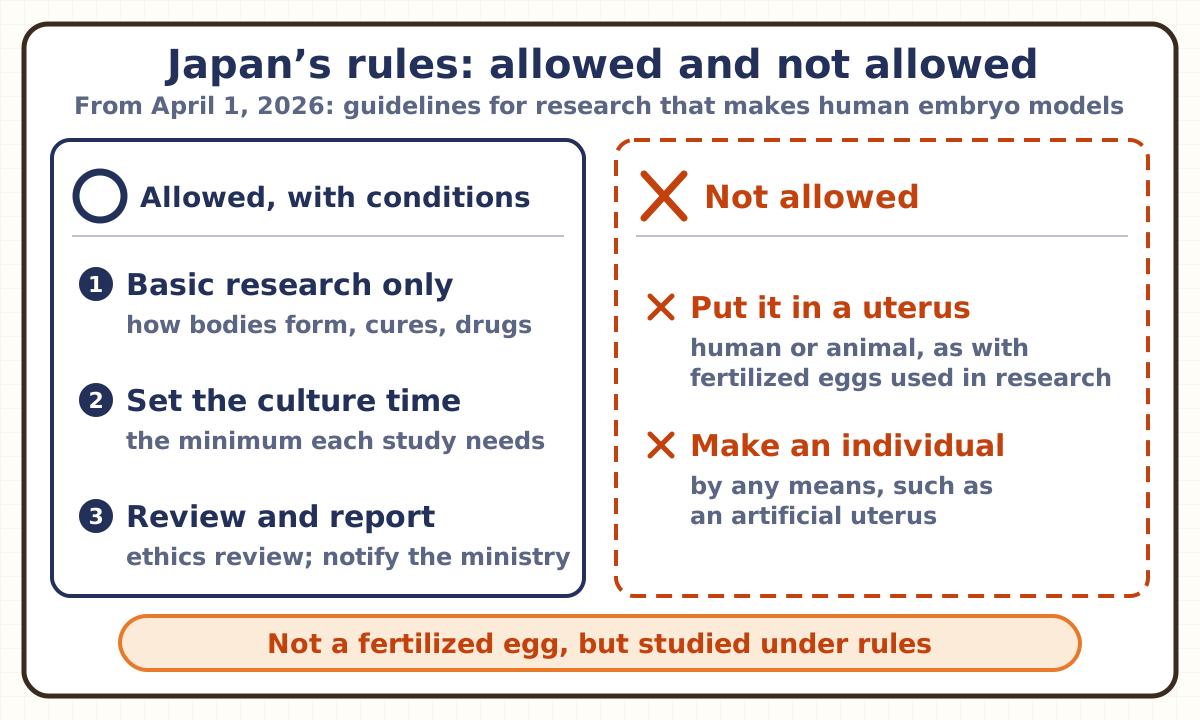
Today’s embryo models are not thought able to become a person, but research might bring them closer to real embryos. So Japan drew a line early: since April 2026 it has banned placing them in a uterus and requires review and notification for each study.
A common mix-up
“Put an embryo model in a uterus and let it grow, and it becomes a baby.”
Not with today’s embryo models. In a 2018 study, when blastoids made from mouse stem cells were placed in a mouse uterus, the inner lining of the uterus wall changed as it does at implantation. But they did not grow into embryos. As of 2024, there were no reports of offspring born from an embryo model, even in mice or other animals. A human embryo model is not thought able to become a person even if placed in a mother’s body. But it is not yet possible to tell what will happen as research advances. So Japan made rules to draw the line now, and does not allow human embryo models to be placed in a human or animal uterus, not even to test it. The guidelines of the international society of stem cell researchers (ISSCR) do not allow it either.
Explained in pictures
You’re free to use these figures in lessons, slides and posts if you credit Naru News (naru.news). CC BY 4.0.
Think of it like this
A crash-test dummy
To check how safe a car is, people deliberately crash it into a wall (a crash test), and you can’t put a real person inside. Instead, a doll with about the weight and shape of a person (a dummy) rides in the person’s place, and sensors measure where force hits the body in a crash. The dummy doesn’t copy everything about a human body, but it is useful as long as it is similar in the parts being studied.
A human embryo model is the same. Because the start of life is to be treated with care, among other reasons, the use of real embryos grown from fertilized eggs in research is strictly limited. So researchers make clumps from stem cells that copy part of the shape and workings of an early embryo, and use them to study how implantation works and why embryos sometimes fail to develop.
But the comparison has limits. A dummy is a machine that people assemble from parts, and it doesn’t change when left alone. An embryo model is a group of living cells: when people gather and grow the cells, the cells come together on their own and build a shape. Because research might bring models closer to real embryos, there are rules: each study sets how long to grow them, and they are never placed in a uterus.
Key points
What are they made for?
About a week after fertilization, a human embryo burrows into the wall of the uterus (implantation) and then starts building the beginnings of a body. Studying what happens in embryos at this stage gives clues to the causes of infertility, miscarriage and conditions present from birth. But the use of real human embryos in research is strictly limited, both by the view that the start of life is to be treated with care (ethics) and for medical reasons. Researchers can also study the embryos of animals such as mice, but mice and humans differ in how implantation happens, how the embryo develops and how important genes work, so animals are said to be a poor substitute.
Because human embryo models are made from human stem cells, no fertilized egg has to be destroyed. Since many can be made, the same experiment can be repeated again and again to confirm results, and researchers can follow over time what happens when a gene’s action is changed, or how cells signal to each other. Japan’s guidelines, too, allow embryo models to be made only for basic research on how the human body forms or for developing new ways to diagnose, prevent or treat disease, and new medicines.
How are they made?
What they copy is the embryo before implantation (the blastocyst). A blastocyst is the embryo at day 5 to 7 after fertilization. It is a ball in which a thin layer of cells wraps a hollow, with a clump of cells inside that will later become the body. A blastocyst gives rise not only to the body but also to parts outside it, such as the placenta.
In 2018, researchers showed that when two kinds of mouse stem cells are mixed and grown (ES cells, which give rise to the body, and stem cells that give rise to the placenta), the cells come together into clumps resembling blastocysts. These clumps were named “blastoids.”
For humans, two research groups each made them in 2021. One group made blastoids from human ES and iPS cells that resemble blastocysts in shape, size, cell number and mix of cell types. The other reprogrammed human body cells into blastocyst-like clumps.
Late the same year, a method was shown that made human blastoids form in more than 70% of attempts. The beginnings of all three kinds of cells that make up a blastocyst were also present. Placed on cells from the inner lining of the uterus wall that had been prepared with hormones, they attached facing a set direction, as embryos do at implantation. Besides blastoids, there are other embryo models, such as gastruloids, that copy part of a stage after implantation.
How are they different from real embryos?
The biggest difference is how they come about. A real embryo grows from a fertilized egg formed when a sperm meets an egg. A human embryo model is made from stem cells, using no fertilized egg, sperm or egg. ES cells, though, were originally made by taking cells from a blastocyst. Research uses ES cells that have already been made, so making an embryo model does not mean using a fertilized egg each time.
Their structure and workings are not the same either. Today’s human embryo models are considered groups of cells that show only some features of blastocysts or of embryos from around implantation onward (shape, structure, gene activity, cell types and so on), and they cannot be called the same as fertilized embryos. The international society of stem cell researchers also advises against the term “synthetic embryo”: in its view, embryo models that also contain cells such as those that give rise to the placenta (integrated embryo models) are neither synthetic nor embryos.
They are also different from “organoids,” clumps that resemble organs. An organoid copies a particular organ, such as the liver or brain. A human embryo model copies the way an embryo itself develops, with many parts linking up as it grows.
If they keep growing, could they someday become a person?
Today’s embryo models are considered unable to become a person. In a 2018 study, when mouse blastoids were placed in a mouse uterus, the inner lining of the uterus wall changed as it does at implantation. But they did not grow into embryos. As of 2024, there were no reports of offspring born from an embryo model, even in mice or other animals.
Still, the stages that can be copied are moving forward bit by bit. There is a report of mouse ES cells reproducing a stage equal to a mouse embryo about 8.5 days after fertilization (when the tube that becomes the brain and spinal cord has formed and a heartbeat can be seen).
What will happen next is not known. Embryo models may someday come closer to fertilized embryos and become able to be born as a person, but some researchers think this is impossible in principle, and it cannot be judged at this point. Noting that cloning took more than 30 years to go from a cloned frog (1962) to a mammal, a sheep (1996), a Japanese government panel of experts expects many difficulties before embryo models could reach the point of giving birth to an animal. And it says that if embryo models reach the stage where a mammal is born from one, Japan will consider treating them like fertilized embryos as the “budding of human life,” or regulating them like the law that prevents human cloning.
What are Japan’s rules?
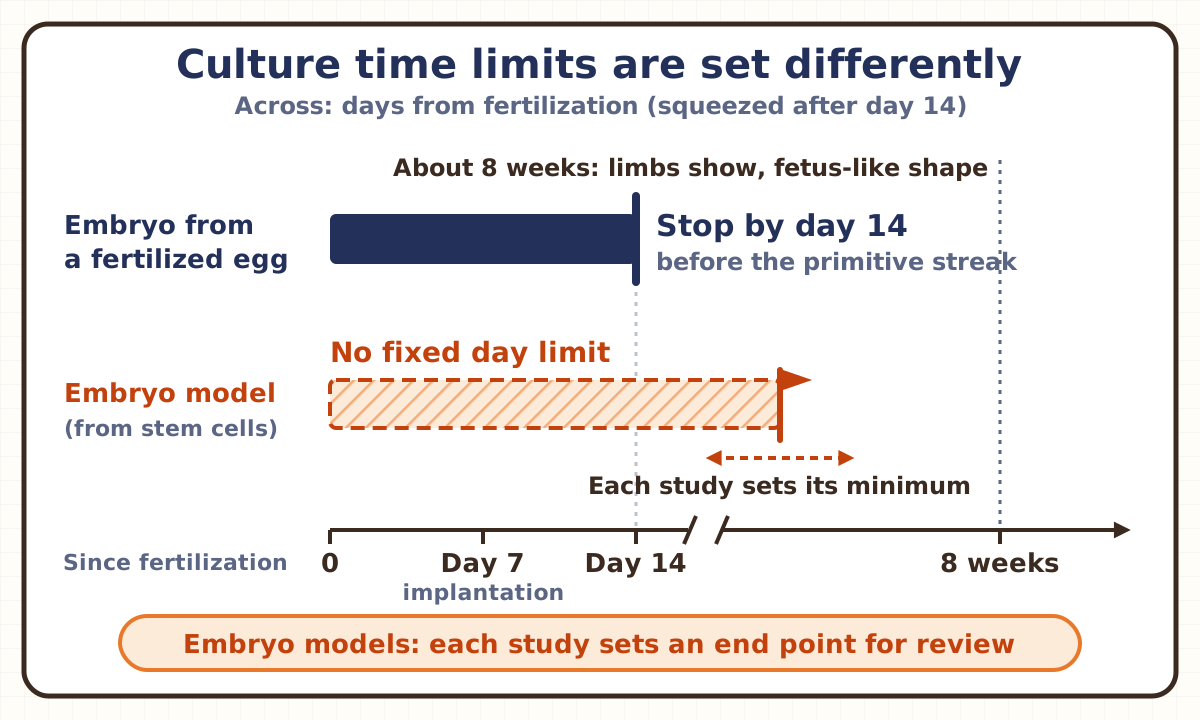
Research on human embryos grown from fertilized eggs has long had rules. Under principles Japan set out in 2004, fertilized embryos are to be treated with special respect as the “budding of human life,” and even in research they are not returned to a uterus and may be handled only until a single line (the primitive streak) appears in the embryo and organs start to form. This is set at 14 days at most. Because a human embryo model is not a fertilized embryo, these principles did not directly apply, and there were no clear rules on how to handle one.
In November 2024, a Japanese government panel of experts set out its view on how to handle human embryo models. Its view: today’s human embryo models are not treated the same as fertilized embryos, but because they might come closer to them, and because improper research such as placing them in a uterus cannot be ruled out, some rules are needed. In response, Japan’s education and health ministries revised the guidelines for research using ES cells, iPS cells and other cells, which took effect on April 1, 2026.
The main rules are these. Placing an embryo model in a human or animal uterus, and making an individual from it by other means such as an artificial uterus, are banned. Research is limited to basic research that helps explain how the human body forms or develop new ways to diagnose and treat disease and new medicines. Before starting, a study must be reviewed by the ethics committee of the institution doing it and reported to the minister of education and science. The plan must state how long the embryo models will be grown and why that is the minimum needed for its goal. Researchers are to share information about their research and work to spread public understanding.
Unlike fertilized embryos, there is no fixed limit on the number of days embryo models may be grown. A fixed limit was judged not needed for now, partly because today’s models look like clumps of cells, not like a fetus, and growing them for a long time is still hard with today’s technology. But because growing them until they look like a fetus at about 8 weeks after fertilization could cause public unease, the matter is to be reconsidered if needed as research advances.
Also, in July 2026, Japan passed a new law regulating genome-edited embryos and similar material. To match it, a draft plan was presented at a government panel meeting in October 2026: removing the rules on germ cells made from stem cells (sperm and eggs and the cells that lead to them) from the guidelines for iPS cells and other cells, so that they cover only research that makes human embryo models (still only a draft).
What are the rules around the world?
As of 2024, how embryo models are treated in national regulation was still unsettled in other countries too. One example of rules that cross borders is the guidelines of the international society of stem cell researchers (the International Society for Stem Cell Research, ISSCR). As a society’s guidelines, they are not law.
In its 2021 update, the guidelines split embryo models into two kinds. One kind contains both cells that become the body and cells that become parts outside the body, such as the placenta (such as blastoids; “integrated embryo models”); it was placed among research done only after specialized review. The other kind lacks the cells for parts outside the body and copies only part of an embryo (such as gastruloids; “non-integrated embryo models”); it was placed among research that is reported but not usually given specialized review. For both, placing a human embryo model in a human or animal uterus is not allowed.
The August 2025 update (which changed only the embryo-model parts) dropped this two-way split and now calls them all “stem cell-based embryo models (SCBEMs).” Every embryo model with a three-dimensional structure should have a clear scientific reason, a set end point and suitable review. The guidelines also say growing one with no end point is never appropriate. On top of banning transfer to a uterus, they newly ban growing embryo models, without a uterus, in an artificial device to the point where they could live on their own.
Check yourself
Q1What is the “blastoid,” the best-known kind of human embryo model, made from?
Answer and explanation
Answer: B It is made from stem cells
A blastoid is made by gathering and growing stem cells such as iPS or ES cells into a clump that resembles an embryo before implantation (a blastocyst). No fertilized egg, sperm or egg is used to make it. ES cells were first made from cells of a blastocyst, but researchers use ES cells that already exist, so no fertilized egg is used each time.
Q2Japan’s rules for research that makes human embryo models began in April 2026. What do they ban?
Answer and explanation
Answer: A Placing one in a human or animal uterus
The guidelines ban placing a human embryo model in a human or animal uterus, and making an individual from it by other means such as an artificial uterus. The limit of before the primitive streak appears (14 days at most) is a rule for embryos grown from fertilized eggs; human embryo models have no fixed day limit. Instead, each study writes the minimum time it needs into its plan, and an ethics committee checks it. Making them from iPS cells is not banned either; there are guidelines for doing so.
Q3In a 2018 study, blastoids made from mouse stem cells were placed in a mouse uterus. What happened?
Answer and explanation
Answer: C The uterus wall changed; no embryo grew
When the mouse blastoids were placed in a mouse uterus, the inner lining of the uterus wall changed as it does at implantation. But they were not seen developing into embryos, and no pups were born. As of 2024, there were no reports of offspring born from an embryo model, even in mice or other animals. Resembling a blastocyst does not mean growing the way a real embryo does.
More on this → Key points: If they keep growing, could they someday become a person?
Related terms
- iPS cell
- Embryonic stem cell (ES cell)
- Stem cell
- Fertilized egg
- Blastocyst
- Implantation
- 14-day rule
- Organoid
- Bioethics
Sources and how we checked
- Expert Panel on Bioethics, Council for Science, Technology and Innovation, Cabinet Office of Japan, “On the Handling of Human Embryo Models (Interim Summary)” (in Japanese; November 7, 2024; Parts 1–4, including the relation to fertilized and cloned human embryos, future research, the culture-period limit, research not allowed, the summary of rules, and the quoted 2023 ISSCR statement; read November 11, 2026)
- Ministry of Education, Culture, Sports, Science and Technology (MEXT), Japan, “Research to Create Human Embryo Models” (in Japanese; updated February 13, 2026; the two revised guidelines, the dates they were issued and took effect, and related council documents; read November 11, 2026)
- MEXT, Japan, “Revisions to the Related Guidelines on the Handling of Human Embryo Models” (in Japanese; overview, February 2026; how MEXT and the Ministry of Health, Labour and Welfare revised the guidelines, the dates of issue and effect, and the revised articles; read November 11, 2026)
- MEXT, Japan, “Guidelines on Research to Create Germ Cells or Human Embryo Models from Human iPS Cells and Other Cells” (in Japanese; MEXT Notice No. 88 of 2010, last revised by MEXT Notice No. 15 of February 13, 2026; Articles 1–7-2 and 11–13 and the supplementary provisions; read November 11, 2026)
- MEXT, Japan, “Guidelines on the Use of Human ES Cells” (in Japanese; MEXT Notice No. 68 of 2019, last revised by MEXT Notice No. 14 of February 13, 2026; Article 4 on requirements for use and Article 5 on prohibited acts; read November 11, 2026)
- MEXT, Japan, “Research to Create Human Embryo Models” (in Japanese; a guide for researchers, partly updated February 13, 2026; the sections on what a human embryo model is, how it differs from an organoid, and the main rules; read November 11, 2026)
- Council for Science and Technology Policy, Japan, “Basic Principles on the Handling of Human Embryos” (in Japanese; July 23, 2004; the parts calling the fertilized human embryo the “budding of human life” and limiting research use to before the primitive streak forms; read November 11, 2026)
- Council for Science, Technology and Innovation, Japan, “Second Report on the Review of the Basic Principles on the Handling of Human Embryos” (in Japanese; June 19, 2019; meeting document 2-2; the part limiting the handling of fertilized human embryos to before the primitive streak forms, within 14 days at most; read November 11, 2026)
- Children and Families Agency, MEXT and Ministry of Health, Labour and Welfare, Japan, “Review of Related Guidelines Following the Enactment of the Act on Regulating the Handling of Genome-Edited Human Embryos” (in Japanese; document 2-5 of the 165th meeting of the Expert Panel on Bioethics, October 28, 2026; the new act and the draft plan to revise the guidelines; read November 11, 2026)
- Ayaka Yanagida, “How Human Embryo Models Are Made” (in Japanese; University of Tokyo; document 2 of the 148th meeting of the Expert Panel on Bioethics, July 31, 2024; the name “blastocyst model (blastoid)” and the slides on transferring mouse embryo models to the uterus; read November 11, 2026)
- Lovell-Badge et al., “ISSCR Guidelines for Stem Cell Research and Clinical Translation: The 2021 update” (Stem Cell Reports 16, pp. 1398–1408, May 2021; the section “Embryo culture and embryo models” and Box 2; read November 11, 2026)
- International Society for Stem Cell Research (ISSCR), “The ISSCR Statement on New Research with Embryo Models” (June 26, 2023; the parts advising against the term “synthetic embryo” and saying integrated embryo models are neither synthetic nor embryos; read November 11, 2026)
- International Society for Stem Cell Research (ISSCR), “The ISSCR Releases Targeted Update to the Guidelines for Stem Cell Research and Clinical Translation” (August 11, 2025; the announcement of the update to the embryo-model sections; read November 11, 2026)
- International Society for Stem Cell Research (ISSCR), “Guidelines for Stem Cell Research and Clinical Translation” (Version 1.2, August 2025 update; online Section 2, “Laboratory-based Human Embryonic Stem Cell Research, Embryo Research, and Related Research Activities,” items 2.2.2(f) and (g), Recommendation 2.2.2.2 and item 2.2.3B(a); read November 11, 2026)
- Rivron et al., “Blastocyst-like structures generated solely from stem cells” (Maastricht University, Hubrecht Institute and others; Nature 557, pp. 106–111, May 2018; abstract; read November 11, 2026)
- Yu et al., “Blastocyst-like structures generated from human pluripotent stem cells” (University of Texas Southwestern Medical Center; Nature 591, pp. 620–626, March 2021; abstract; read November 11, 2026)
- Liu et al., “Modelling human blastocysts by reprogramming fibroblasts into iBlastoids” (Monash University; Nature 591, pp. 627–632, March 2021; abstract; read November 11, 2026)
- Kagawa et al., “Human blastoids model blastocyst development and implantation” (Institute of Molecular Biotechnology of the Austrian Academy of Sciences, IMBA; Nature 601, pp. 600–605, January 2022, online December 2, 2021; abstract; read November 11, 2026)
- Center for iPS Cell Research and Application (CiRA), Kyoto University, “What are iPS cells?” (in Japanese; FAQ; how iPS cells and ES cells are made; read November 11, 2026)
AI wrote this page from the sources above, and a different AI checked it against the text of those sources (November 11, 2026). A person with a master’s degree in science and a Japanese high-school science teaching license also read and checked it before publishing. Numbers are as of that date. If anything was hard to follow, you spot a mistake, or there’s a term you’d like explained, please write to [email protected].
Everyday science terms
- Dark oxygen
- You are hereHuman embryo model
- Moore’s law