 Naru News日本語
Home › Glossary › Everyday science
What is Moore’s law?
Also called: Moore's law, Moore’s Law

In one minute
Moore’s law is the forecast that the number of parts (such as transistors) on a single semiconductor chip keeps doubling about every two years.
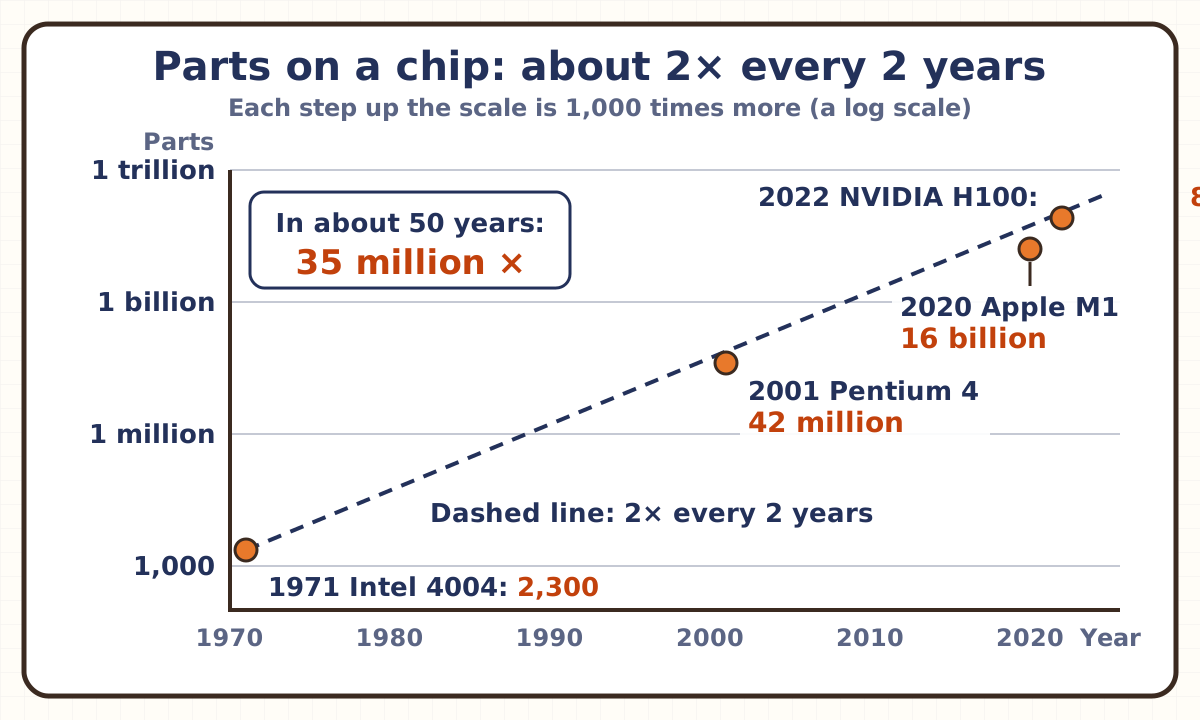
In 1965, Gordon Moore, who later cofounded Intel, set out a forecast in a paper that the number was doubling every year, and in 1975 he revised it to every two years. The Intel 4004 chip of 1971 had 2,300 transistors; NVIDIA’s H100, a chip for AI announced in 2022, has 80 billion, about 35 million times as many.
It is called a “law,” but it is not a rule of nature like the laws of physics. It is a forecast the industry has treated as a target and worked to keep up with. Nor does it mean that computers get twice as fast every two years.
A common mix-up
“Moore’s law says computers get twice as fast every two years.”
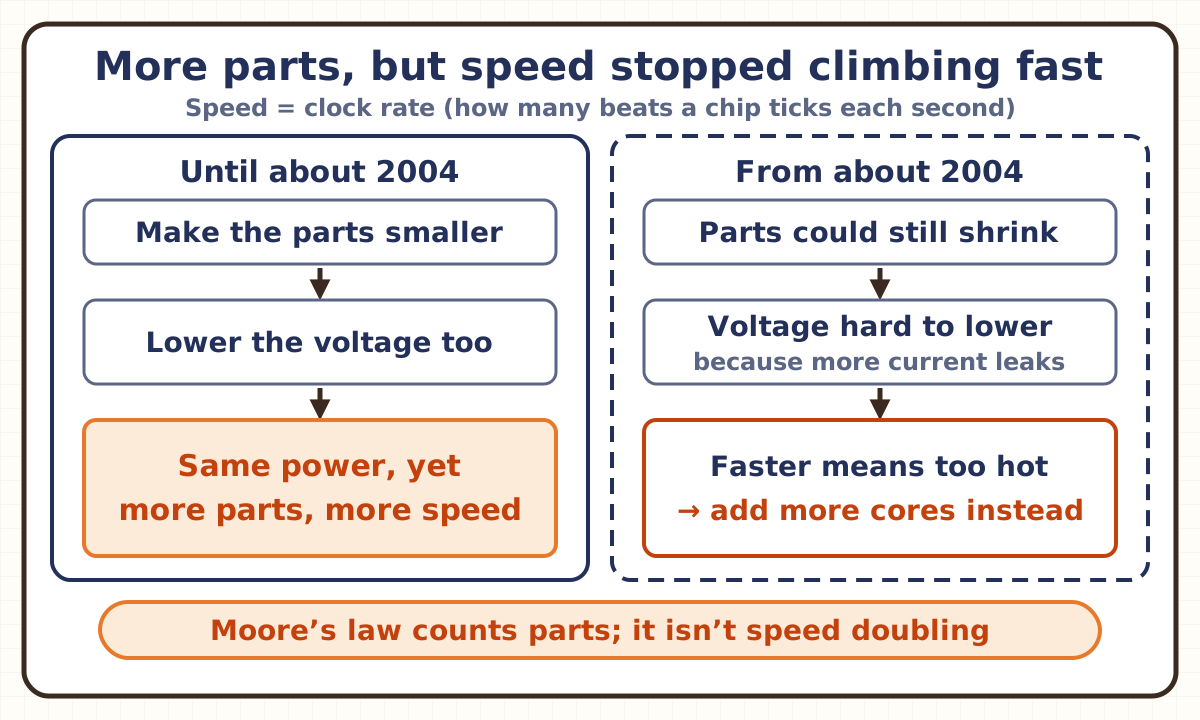
Half right. For a long time, making the parts smaller didn’t just let more of them fit; it also raised the speed (the clock rate). Shrinking the parts and lowering the voltage along with them let chips add parts and run faster without using more power. But what Moore’s law talks about is the number of parts on a chip. From around 2004, the voltage became hard to lower any further, and running faster made chips too hot, so the fast rise in speed stopped. The number of parts has kept growing since. And it isn’t a “law” in the sense of a rule of nature either: it is a forecast the industry has treated as a target and worked to keep up with.
Explained in pictures
You’re free to use these figures in lessons, slides and posts if you credit Naru News (naru.news). CC BY 4.0.
Think of it like this
A pacemaker in a marathon
Moore’s law is like a pacemaker in a marathon: a runner who sets a steady pace at the front for the others to follow. A pacemaker’s speed isn’t fixed by nature; people decide, “Let’s run at this pace.”
Chip companies, too, made “double every two years” their target, kept up their research and tried to keep pace. Moore himself said in 2008 that people in the industry recognize they have to move that fast or they fall behind. That is part of why the forecast kept coming true. (When a prediction comes true because people act to make it happen, it is called a “self-fulfilling prophecy.”)
But the comparison has limits. A marathon pace stays the same speed, while Moore’s law is about doubling, so the number added every two years keeps getting bigger. And making parts smaller has a limit set by the size of molecules, which Moore said in 2008 the industry was getting close to.
Key points
What did Moore say in his 1965 paper?
On April 19, 1965, the magazine Electronics published Gordon Moore’s paper “Cramming More Components onto Integrated Circuits.” Moore was then one of the founders of Fairchild Semiconductor, a chip company, and had been director of its research laboratories since 1959 (he cofounded Intel later).
An integrated circuit is a set of parts, such as transistors, built together on one small chip. A transistor is a part that lets electricity flow or stops it, like a tiny switch. The paper explains that for simple circuits, the more parts you put on one chip, the lower the cost of each part. But add too many, and more chips fail to come out right, so the cost goes back up. So at any given time there is a number of parts at which each part is cheapest; in 1965 it was about 50 per chip.
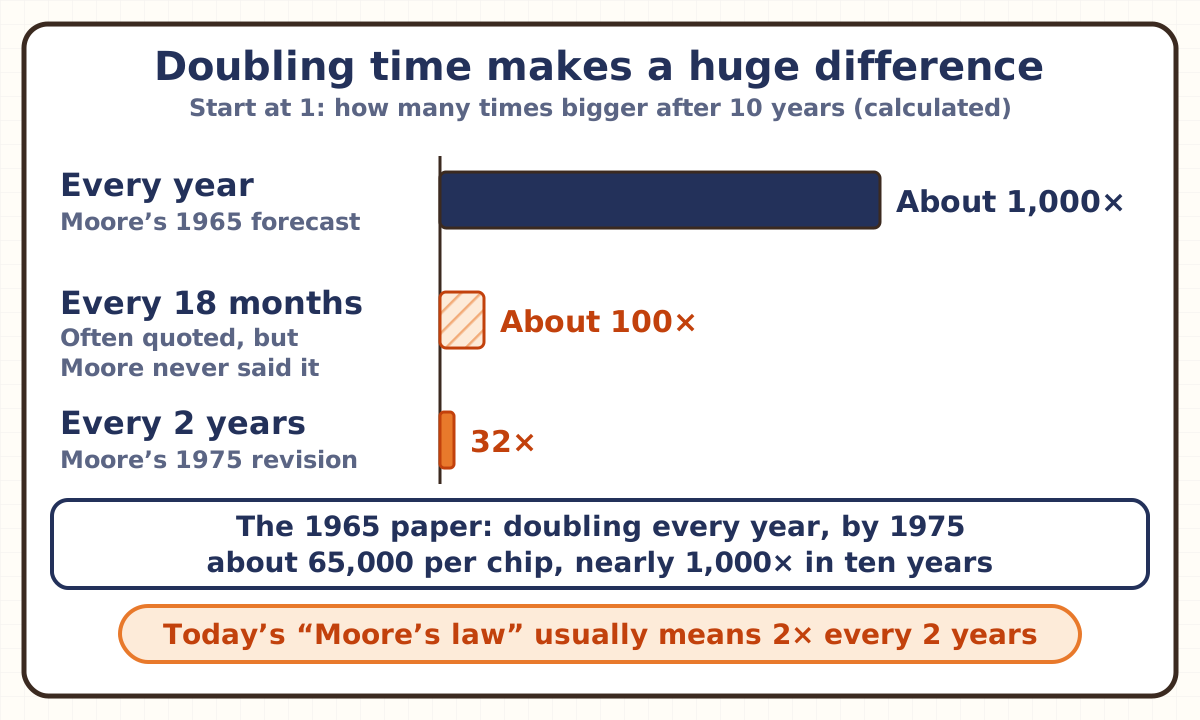
This “cheapest number” had been roughly doubling every year. Since that should continue for at least ten years, the paper forecast that by 1975 it would reach 65,000 parts per chip. In 2008, Moore looked back on it as “a wild extrapolation of very little data,” saying he was just trying to get across the idea that integrated circuits were going to be the route to cheap electronics.
The paper also said that integrated circuits would lead to such wonders as home computers (or at least terminals connected to a central computer), automatic controls for automobiles and personal portable communications equipment.
Is it “2× every two years” or “2× every 18 months”?
What Moore said was two years. In 1975, at the IEEE (an engineering society) International Electron Devices Meeting, he revised his forecast from doubling every year to doubling every two years. In 2008 he recalled that over the ten years from 1965, the ten doublings he had predicted turned out to be nine, pretty close.
“Doubling every 18 months” is also often quoted, in the press and elsewhere. But Moore himself said in a 1997 interview, “I never said 18 months.”
The difference in doubling time looks small but adds up. Starting from 1, after ten years: doubling every year gives 1,024 times (2 multiplied ten times), every year and a half about 100 times, and every two years 32 times.
The name “Moore’s law” was given by Carver Mead, who was a professor at Caltech. In a 2015 interview, Moore said, “I had a colleague who saw that and dubbed this Moore’s Law.”
If it’s a “law,” why isn’t it a law of physics?
A law of physics is a rule of nature that stays the same whatever people do. Moore’s law isn’t like that. Intel, too, says Moore’s law is not a scientific law (it’s not a natural phenomenon). The number of parts kept growing because engineers kept coming up with new ideas. Intel calls it a projection that relies on innovation and technological advancement for its continued truth.
The forecast also became the industry’s target. Because it was predicted, people worked toward it, and so it came true: it became a kind of “self-fulfilling prophecy” and one of the driving principles of the industry. Intel also describes it as a target for Intel and its competitors to deliver against time and again (this is the company’s description).
In a 2015 interview, Moore himself said the term became something that almost drove the semiconductor industry rather than just recording its progress.
Did computers also get twice as fast every two years?
For a long time, speed rose along with the number of parts. As Robert Dennard and his colleagues showed in 1974, if you make the parts smaller and lower the voltage in the same proportion, the parts get faster and use less energy each time these switches flip. So in each generation, chips could double the number of parts and raise the clock rate (how many beats a chip ticks each second to keep its steps in time; more beats means more steps each second) while using the same power. This is called “Dennard scaling.”
But as the parts got smaller, more current leaked through even when it shouldn’t, and the voltage became hard to lower any further. By around 2004, raising the clock rate pushed the power a chip used, and the heat it gave off, toward the limits of what air cooling can handle. So the fast rise in clock rate stopped, and the speed of a single processor began to rise only slowly.
Even so, the number of parts kept growing. So chip companies began putting several processors (cores) on one chip. But more cores only make things faster when the work can be split up and done at the same time, and as of 2011, relatively little software was written that way.
How long will Moore’s law last?
No one knows. There is a limit to how small parts can be made. In 2008, Moore said that any forecast of a physical quantity doubling again and again runs into trouble some day, and that the devices being made were getting pretty close to molecular dimensions, which would become a fundamental limit on shrinking them.
In a 2015 interview, he said, “We won’t have the rate of progress that we’ve had over the last few decades,” and “I guess I see Moore’s Law dying here in the next decade or so” (his own forecast).
Intel, on the other hand, wrote in 2023 that with advanced packaging technology (the way chips are enclosed and connected) and new materials, the pace of Moore’s law continues. The page also quotes an Intel executive: “we will maintain Moore’s Law for the next decade or longer” (the company’s forecast).
What does Moore’s law have to do with AI?
Training an AI takes an enormous amount of calculation, and that calculation is done by chips packed with parts. For example, the H100, announced by NVIDIA in 2022, is a computing chip (a GPU) used for things like AI training, and it has 80 billion transistors.
A 2022 study (Sevilla et al.) looked at how the amount of compute used to train AI models has changed over time. It found that before 2010, training compute grew in line with Moore’s law, doubling roughly every 20 months, but that in the deep learning era since around 2010, it has grown much faster, doubling about every 6 months.
As for the singularity, the idea that machines smarter than humans will arrive and the future can no longer be foreseen, Moore said in 2008, “I am a skeptic. I don’t believe this kind of thing is likely to happen, at least for a long time” (more on the “Technological singularity” page).
Check yourself
Q1In 1965, Gordon Moore set out a forecast in a paper (later called “Moore’s law”). Originally, what did it say was doubling every year?
Answer and explanation
Answer: A How many parts fit on one chip
Moore’s forecast was about the number of parts (such as transistors) on one chip. The 1965 paper said that the number of parts at which a chip could be made most cheaply had been roughly doubling every year, and expected it to reach 65,000 per chip by 1975. It was not about chip speed (the clock rate) or how much power a chip uses.
More on this → Key points: What did Moore say in his 1965 paper?
Q2In 1975, Gordon Moore revised the “double every year” forecast he had made in 1965. What did he change it to?
Answer and explanation
Answer: B Double every two years
In 1975, Moore revised the forecast to “double every two years.” As for the often-quoted “double every year and a half (18 months),” Moore himself said, “I never said 18 months.” Doubling every two years means 32 times in ten years.
More on this → Key points: Is it “2× every two years” or “2× every 18 months”?
Q3The number of parts on chips kept growing, yet from around 2004 the fast rise in chip speed (the clock rate) stopped. What was the main reason?
Answer and explanation
Answer: C Running faster made the chips far too hot
As the parts got smaller, more current leaked, and the voltage became hard to lower any further. So raising the clock rate pushed the power a chip used, and its heat, toward the limits of what air cooling can handle. The parts kept getting smaller and more numerous after that. Instead of raising the speed, chip companies began putting several processors (cores) on one chip.
More on this → Key points: Did computers also get twice as fast every two years?
Related terms
- Semiconductor
- Transistor
- Integrated circuit
- Artificial intelligence
- Deep learning
- Large language model
- Parameter
- Technological singularity
Sources and how we checked
- Gordon E. Moore, "Cramming More Components onto Integrated Circuits" (Electronics, vol. 38, no. 8, April 19, 1965; read in the reprint, with permission from Intel, in Appendix C of the National Research Council report The Future of Computing Performance; read November 8, 2026)
- Computer History Museum, "1965: 'Moore's Law' Predicts the Future of Integrated Circuits" (The Silicon Engine; read November 8, 2026)
- Computer History Museum, "Oral History of Gordon Moore" (interviewed by Craig Addison, January 25, 2008, transcript; read November 8, 2026)
- Computer History Museum, "Computer History Museum Presents The 40th Anniversary of Moore's Law with Gordon Moore and Carver Mead" (press release, September 15, 2005; read November 8, 2026)
- Scientific American, "Gordon E. Moore - Part 2" (interview with Moore, September 22, 1997; read November 8, 2026)
- IEEE Spectrum, "Gordon Moore: The Man Whose Name Means Progress" (interview by Rachel Courtland, March 30, 2015; read November 8, 2026)
- Intel, "Moore’s Law" (September 18, 2023; read November 8, 2026)
- Computer History Museum, "1971: Microprocessor Integrates CPU Function onto a Single Chip" (The Silicon Engine; transistor count of the Intel 4004; read November 8, 2026)
- Intel, "Intel® Pentium® 4 Processor" (press kit; photo caption for the 2 GHz Pentium 4; read November 8, 2026)
- Apple, "Apple unleashes M1" (November 10, 2020; read November 8, 2026)
- NVIDIA, "NVIDIA Announces Hopper Architecture, the Next Generation of Accelerated Computing" (March 22, 2022; read November 8, 2026)
- National Research Council, The Future of Computing Performance: Game Over or Next Level? (National Academies Press, 2011; "Summary"; read November 8, 2026)
- National Research Council, The Future of Computing Performance: Game Over or Next Level? (National Academies Press, 2011; chapter 3, "Power Is Now Limiting Growth in Computing Performance"; read November 8, 2026)
- Sevilla et al., "Compute Trends Across Three Eras of Machine Learning" (arXiv, February 2022; read November 8, 2026)
- IEEE Spectrum, "Tech Luminaries Address Singularity" (special report "The Singularity," June 2008; read November 8, 2026)
AI wrote this page from the sources above, and a different AI checked it against the text of those sources (November 8, 2026). A person with a master’s degree in science and a Japanese high-school science teaching license also read and checked it before publishing. Numbers are as of that date. If anything was hard to follow, you spot a mistake, or there’s a term you’d like explained, please write to [email protected].
Everyday science terms
- Dark oxygen
- Human embryo model
- You are hereMoore’s law