 Naru News日本語
What is a mixture of experts (MoE)?
Also called: Sparse mixture of experts (SMoE)

In one minute
It is a way of building an AI that keeps many “experts” waiting inside it, and each time a piece of text (a token) comes in, a router calls just a few of them to do the work.
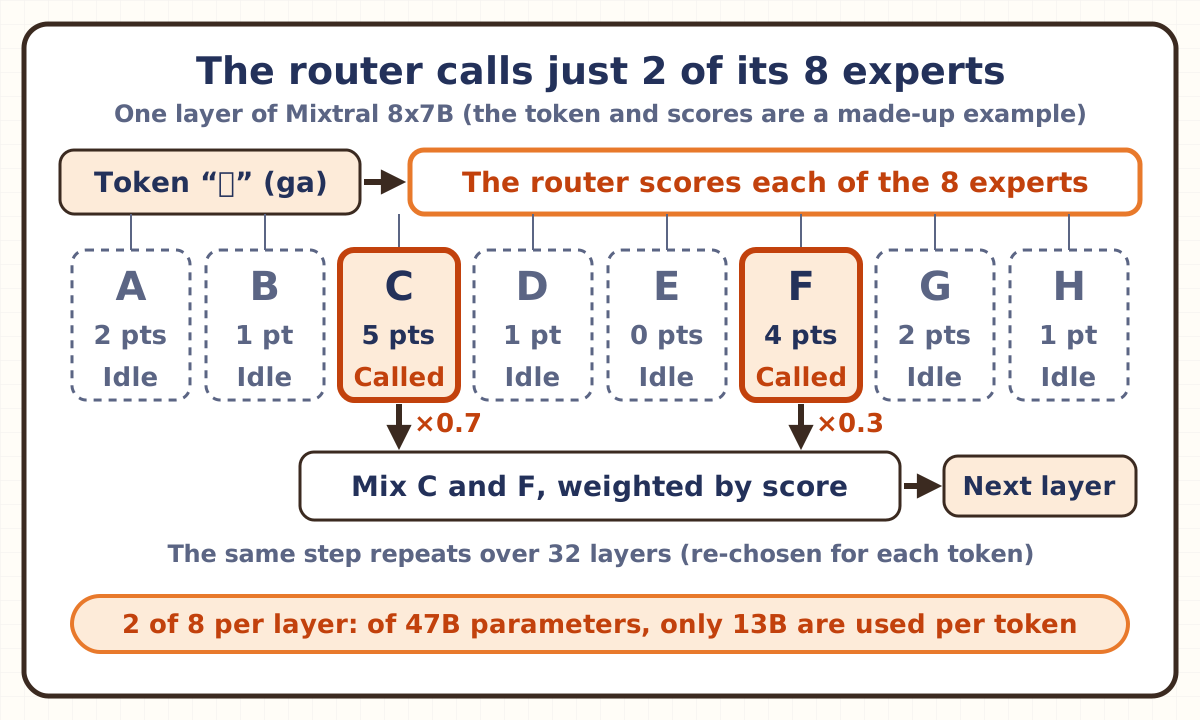
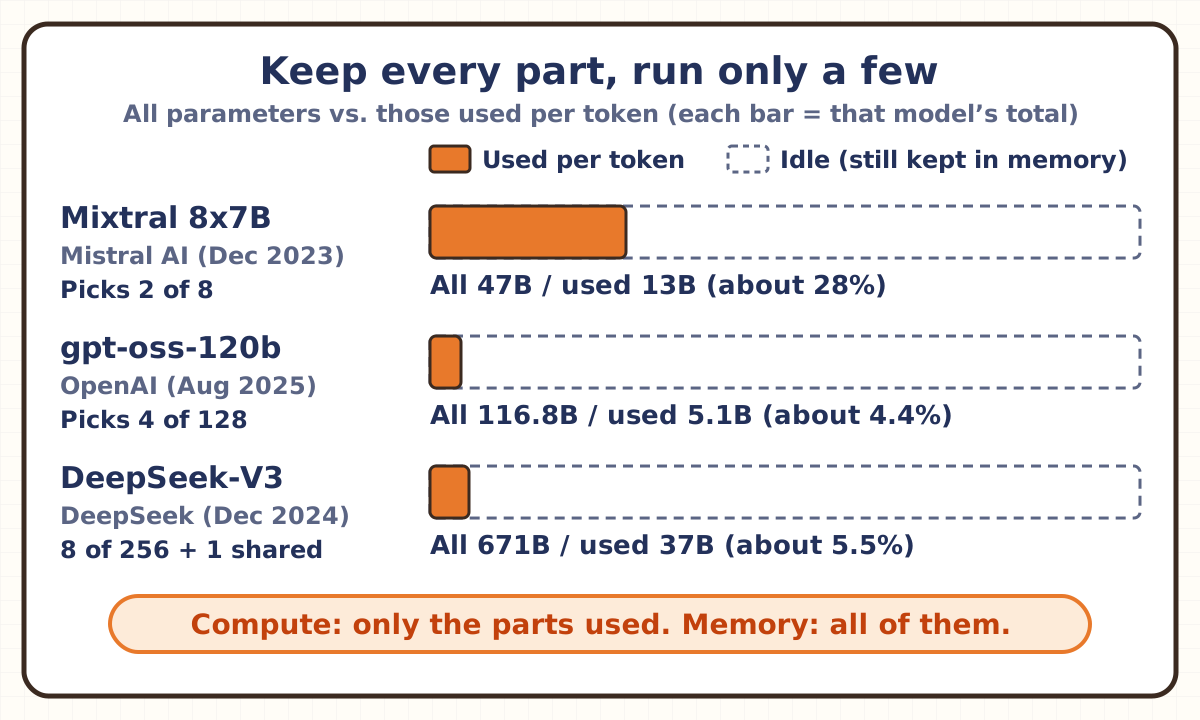
The experts are not people or separate AIs. They are groups of the numbers an AI calculates with (parameters). In Mixtral 8x7B from Mistral AI, for example, each of its many stacked layers has 8 experts, and the router picks the 2 with the highest scores. It has 47 billion parameters in all, but uses only 13 billion for each token. So an AI can be made bigger without adding much calculation. The catch: the experts that are not called must still be kept in memory.
Also, nobody assigns the experts their jobs; they split up the work as they learn. In the studies that checked, they did not clearly split by topic or language, like math or Japanese. Instead they tended to line up with the form and type of words, such as punctuation or numbers.
A common mix-up
“Inside an MoE there are experts for each topic or language, like a math expert or a Japanese expert.”
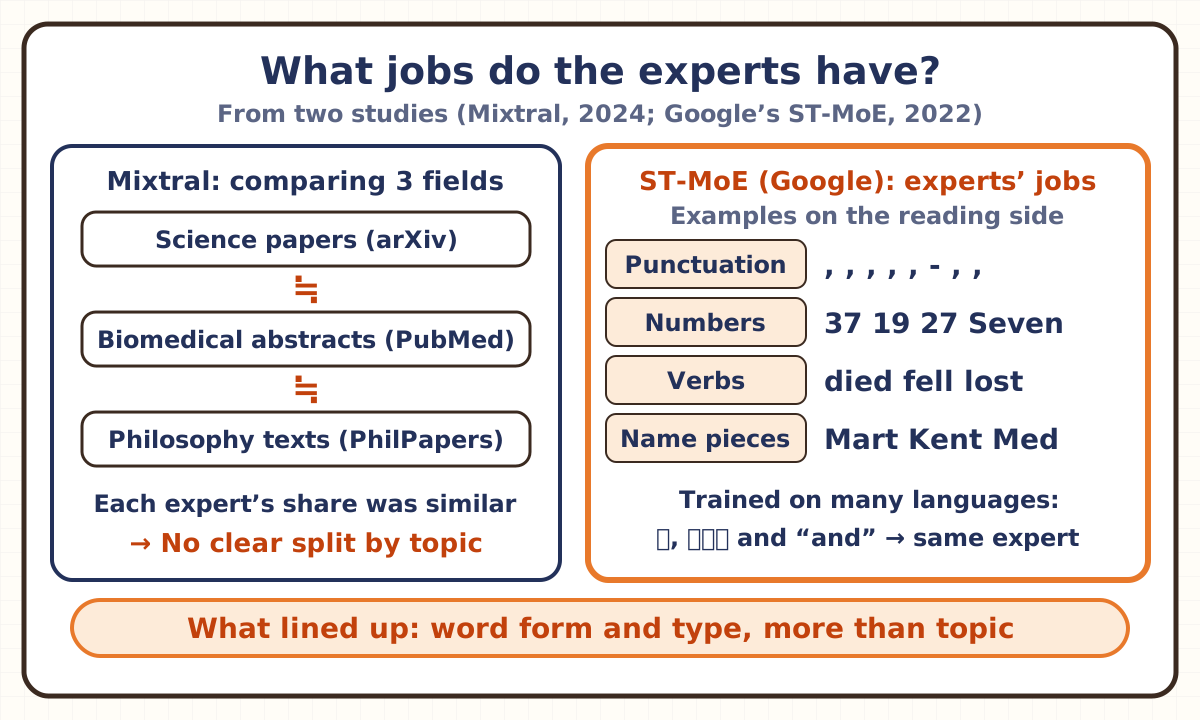
It is true that experts can show something like a job of their own. But those jobs are not necessarily school subjects or languages chosen by people. When the team that built Mixtral counted how often each expert was picked for science papers, biology and medical abstracts, and philosophy texts, the shares were very similar, with no clear split by topic. Instead, the pieces that make up one word, or tokens in a row, often went to the same expert: the experts seemed to line up with the form and order of words. In a separate Google study (ST-MoE, 2022), experts on the reading side were found that handled punctuation, verbs, numbers and so on, but the Japanese “de” and “nanode” went to the same expert as the English “and,” and no experts for single languages were found. Both are what was seen in the models studied; not every MoE has to be the same.
Explained in pictures
Think of it like this
Eight service windows and a guide at the door
Picture a big city office with 8 service windows. For each visitor, a guide at the entrance decides, “This person goes to these 2 windows.” The other 6 windows stop for that visitor and wait for the next one. That is much faster than sending everyone to every window.
The interesting part is that nobody decides what each window handles. As many visitors pass through, each window’s strengths sort themselves out. And the split is not always an obvious one like “the tax window” or “the moving window.” In studies of MoE, the experts tended to line up with the form and type of words, such as punctuation or numbers.
But the comparison has limits. In an MoE, the “visitor” is not a whole question but a single token. And the choice is made again at every layer, so even within one sentence, a different token may call different experts. The answers from the two windows are mixed, with more weight on the higher score, into one result that is passed on. And the idle windows must stay in the building (memory) the whole time.
Key points
What do the “experts” and the “router” actually do?
Google’s machine learning glossary describes a mixture of experts as “a scheme to increase neural network efficiency by using only a subset of its parameters (known as an expert) to process a given input token or example.” So an “expert” is not a person or a separate AI, but a group of the numbers an AI calculates with (parameters). Mistral AI, which released Mixtral 8x7B, likewise describes its 8 experts as “8 distinct groups of parameters.”
In Mixtral, the model is a stack of 32 layers, and one part of each layer (a block called the feedforward block) is split into 8 experts. When a token arrives, the router (also called a gate) gives each of the 8 a score and picks the 2 with the highest scores. Their results are added together with weights set from the scores and passed to the next layer. The router, too, is a part whose numbers are set during learning.
Because this happens at every layer and for every token, even within one passage a different token may call different experts. The paper puts it this way: “Even though each token only sees two experts, the selected experts can be different at each timestep.”
Multiplying the name “8x7B” gives 56 billion, but the paper’s figure is 47 billion in all (46.7 billion in the company’s announcement). That is because only one part of each layer is split into experts; the other parts are not.
Why not run all the parts?
Because we want bigger AIs (more parameters) without more calculation. A 2017 paper by Google Brain researchers opens with: “The capacity of a neural network to absorb information is limited by its number of parameters.”
But an ordinary AI uses all of its parameters for every input. The more numbers you add, the more calculation you need. The fix is to run only part of the network for each input (“conditional computation,” in the paper’s words). The paper reports that an MoE with thousands of experts gave more than a 1000x improvement in model capacity with only minor losses in computational efficiency.
The Mixtral paper likewise says the technique “increases the number of parameters of a model while controlling cost and latency.” Using one fifth as many parameters per token as Meta’s Llama 2 70B, Mixtral outperformed Llama 2 70B across most categories of the tests in the paper.
So what are the experts experts in?
The name makes it sound as if there is a math expert or a Japanese expert. But nobody assigns the jobs; they split up during learning. So what did they split by? Two studies looked.
The Mixtral paper checked whether experts had specialized in particular fields during training. For science papers (arXiv), biology and medical abstracts (PubMed) and philosophy texts (PhilPapers), the share of times each expert was picked was very similar, and the paper says: “Surprisingly, we do not observe obvious patterns in the assignment of experts based on the topic.” (Only a set of math problems, DM Mathematics, was slightly different.)
Instead, the several tokens that make up one word, such as “self” in Python or “Question” in English, often went to the same expert. In the examples shown, especially at the first and last layers, indentation tokens in code always went to the same experts. Tokens in a row were also often handled by the same expert. The paper says the choice of experts seems more aligned with the syntax (the form of sentences) than with the field.
In Google researchers’ ST-MoE (2022), experts on the side that reads text were found with jobs like punctuation only, verbs only, mostly numbers, or mostly pieces of names (proper nouns). On the side that writes text, such jobs were far less noticeable. In a model trained on many languages, the Japanese “de” and “nanode” went to the same expert as the English “and,” and the paper says it found no evidence of language specialization.
These are findings from the two models studied, though. In 2024, DeepSeek researchers proposed a design (DeepSeekMoE) that splits experts into finer pieces and sets aside “shared experts” for common knowledge, so that each expert can have a clearer job of its own.
If the calculation is light, is it all good news?
There is a trade-off. Experts that are not called may be needed for the next token, so all of them must be kept in memory (like a desk you work on). The Mixtral paper says the memory needed to run it is proportional to all 47 billion parameters, not the 13 billion used per token (though that is still smaller than Llama 2 70B).
Speed may also not rise as much as the reduced calculation suggests. The paper warns that the routing mechanism adds extra overhead, and that MoE models are more suitable for jobs that process many texts together in batches.
Memory matters when you run a big MoE on your own machine, too. OpenAI’s model card for gpt-oss-120b (116.8 billion parameters, 5.1 billion used per token) says that by storing the numbers in a smaller form (quantization), the model fits on a single GPU (a calculating chip) with 80GB of memory.
Doesn’t work pile up on the popular experts?
Left alone, it does. The 2017 paper says the router tends to end up always giving large weights to the same few experts, and that “this imbalance is self-reinforcing, as the favored experts are trained more rapidly and thus are selected even more.”
So the researchers added an extra term to the training loss (the penalty the AI learns to reduce) that encourages all experts to have equal importance. Switch Transformers (Google, 2021) also adds an auxiliary loss to encourage a balanced load across experts. In that study, if more tokens are sent to an expert than its set limit, the overflow tokens skip that expert’s calculation and are passed straight to the next layer.
The DeepSeek-V3 technical report (2024) says that too large an auxiliary loss will impair model performance, and uses another way. Each expert gets a bonus (a bias) added to its router score; at the end of each training step, the bias of an overloaded expert is lowered and that of an underloaded one is raised. The bias is used only to choose which experts to call.
Where did it come from?
The idea is old. It goes back to the 1991 paper “Adaptive Mixtures of Local Experts” by Jacobs, Jordan, Nowlan and Hinton (MIT and the University of Toronto), which describes systems of many separate networks, “each of which learns to handle a subset of the complete set of training cases.” On a vowel-recognition task, they write, learning divided the work into suitable subtasks, each solved by “a very simple expert network.”
In 2017, Shazeer and colleagues at Google Brain used this in large language AIs. Their “sparse” MoE lets a router pick only a few of up to thousands of experts, with up to 137 billion parameters. They tested it on predicting the next words in text and on translation.
Switch Transformers (Google, 2021) made routing simpler by sending each token to only one expert, and reports up to 7x faster pre-training on the same computing resources. Its largest model had 2048 experts and 1.6 trillion parameters. Later, Mistral AI released Mixtral 8x7B in December 2023 and published the paper describing it in January 2024.
Which AIs use MoE?
These are some that their makers describe as MoE in papers or docs: Mixtral 8x7B (Mistral AI; 2 of 8 per layer). DeepSeek-V3 (DeepSeek, December 2024; of 671 billion parameters, 37 billion used per token; in its expert layers, 8 of 256 experts plus 1 shared expert). gpt-oss-120b and gpt-oss-20b (OpenAI, August 2025; for each token, 4 experts are picked from 128 in the 120b and from 32 in the 20b). The gpt-oss models are open-weight: their parameters are public.
Google’s Gemini 1.5 technical report (2024) calls Gemini 1.5 Pro “a sparse mixture-of-expert (MoE) Transformer-based model,” and the Gemini 2.5 technical report (2025) also says the Gemini 2.5 models are sparse MoE. Neither gives the number of experts or parameters.
In its GPT-4 technical report (2023), OpenAI says that, given the competitive landscape and safety implications, the report contains no further details about the architecture (including model size). For Claude (Anthropic), too, we did not find an official document saying whether it is an MoE when we made this page. So we can’t say here whether ChatGPT or Claude is an MoE inside.
Check yourself
Q1When the Mixtral team counted how often each expert was picked for science, biology and medicine, and philosophy texts, what did they find?
Answer and explanation
Answer: B The three fields had very similar rates
For science papers (arXiv), biology and medical abstracts (PubMed) and philosophy texts (PhilPapers), the share of times each expert was picked was very similar. The paper says it did not see obvious patterns in the assignment of experts based on topic. Instead, they seemed to line up with the form and order of words.
More on this → Key points: So what are the experts experts in?
Q2When running Mixtral, how many parameters must be kept in memory?
Answer and explanation
Answer: C All 47 billion parameters together
Only 13 billion are used per token, but you can’t know which experts the next token will call, so all of them are kept in memory. The Mixtral paper says the memory needed is proportional to all 47 billion. Multiplying the name 8x7B gives 56 billion, but only part of each layer is split into experts, so the total is 47 billion. The calculation is light, but you need a big desk: that is the trade-off.
More on this → Key points: If the calculation is light, is it all good news?
Q3According to the 2017 paper, how does the router tend to choose experts as it learns?
Answer and explanation
Answer: A It tends to give big weights to the same few
The router tends to end up always giving large weights to the same few experts, and this imbalance reinforces itself: the favored experts learn faster and so get picked even more. That is why a rule is added to encourage all experts to be used about equally.
More on this → Key points: Doesn’t work pile up on the popular experts?
Related terms
Sources and how we checked
- Jiang et al., "Mixtral of Experts" (Mistral AI, arXiv, January 2024)
- Mistral AI, "Mixtral of experts" (December 11, 2023)
- Zoph et al., "ST-MoE: Designing Stable and Transferable Sparse Expert Models" (Google, arXiv, February 2022)
- Shazeer et al., "Outrageously Large Neural Networks: The Sparsely-Gated Mixture-of-Experts Layer" (Google Brain and others, arXiv, January 2017)
- Jacobs, Jordan, Nowlan and Hinton, "Adaptive Mixtures of Local Experts" (Neural Computation vol. 3, 1991; abstract on Hinton's page)
- Fedus, Zoph and Shazeer, "Switch Transformers: Scaling to Trillion Parameter Models with Simple and Efficient Sparsity" (Google, arXiv, January 2021)
- DeepSeek-AI and others, "DeepSeekMoE: Towards Ultimate Expert Specialization in Mixture-of-Experts Language Models" (arXiv, January 2024)
- DeepSeek-AI, "DeepSeek-V3 Technical Report" (arXiv, December 2024)
- OpenAI, "gpt-oss-120b & gpt-oss-20b Model Card" (August 2025; arXiv)
- Gemini Team, Google, "Gemini 1.5: Unlocking multimodal understanding across millions of tokens of context" (arXiv, March 2024)
- Gemini Team, Google, "Gemini 2.5: Pushing the Frontier with Advanced Reasoning, Multimodality, Long Context, and Next Generation Agentic Capabilities" (arXiv, 2025)
- OpenAI, "GPT-4 Technical Report" (arXiv, March 2023)
- Google, "Machine Learning Glossary": mixture of experts (read November 8, 2026)
AI wrote this page from the sources above, and a different AI checked it against the text of those sources (November 8, 2026). A person with a master’s degree in science and a Japanese high-school science teaching license also read and checked it before publishing. Numbers are as of that date. If anything was hard to follow, you spot a mistake, or there’s a term you’d like explained, please write to [email protected].