 Naru News日本語
What is machine learning?
Also called: ML

In one minute
It is a way of showing a computer lots of examples and letting it work out for itself how to tell things apart or make predictions.
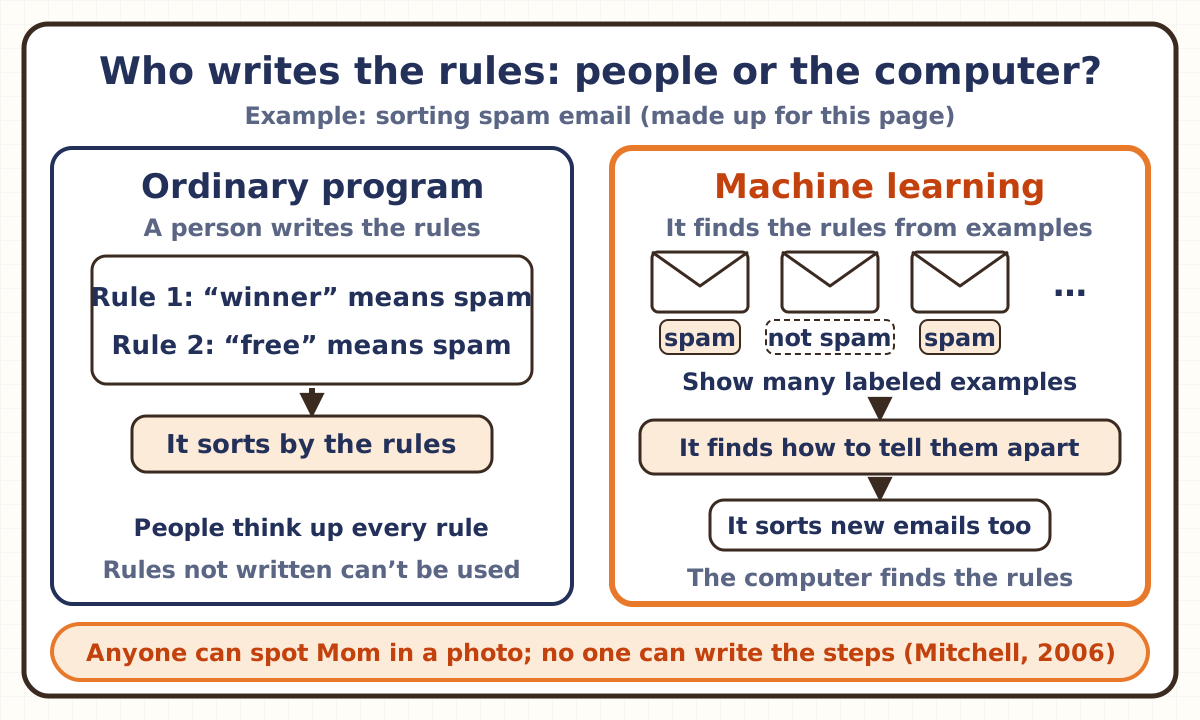
People do not write the steps one by one. For example, you can tell at a glance whether a photo has a cat in it. But writing down how to tell, as step-by-step instructions for a computer, is very hard. So instead, you show it many photos marked “cat” or “no cat” and let it learn how to tell them apart. Sorting spam email works the same way. Once it has learned, it can answer for photos and emails it has never seen.
The large language models (LLMs) inside chatbots like ChatGPT are also a kind of machine learning, trained on huge amounts of text. Machine learning is often shortened to ML.
A common mix-up
“Machine learning and AI (artificial intelligence) are the same thing.”
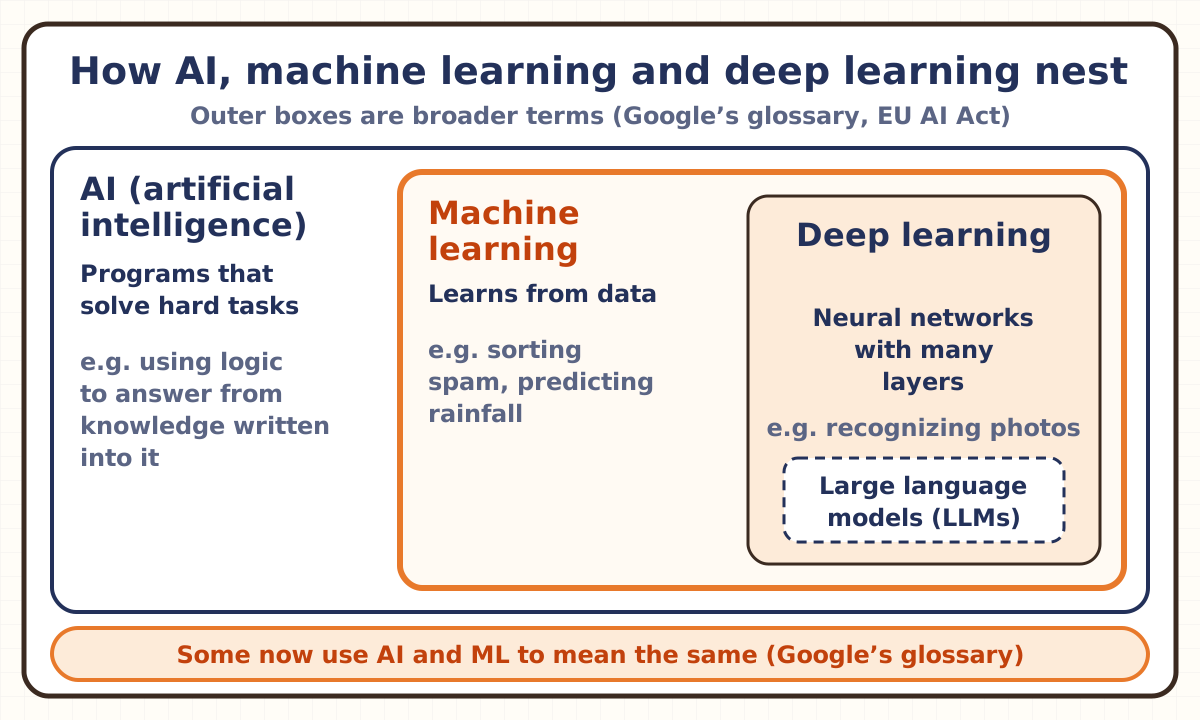
Half right. Google’s machine learning glossary notes that in recent years some organizations have begun using the two terms to mean the same thing. But strictly speaking, machine learning is one field inside AI. The EU’s AI law, for example, lists ways of building AI that include not only machine learning, which learns from data, but also approaches that use logic to work things out from knowledge that has been written in (programs that only follow rules set by people do not count as AI there). And deep learning, in turn, is one kind of machine learning. In short, machine learning is one way to build AI, not all of AI.
Explained in pictures
Think of it like this
A student told every method vs. a student who practices with a workbook
An ordinary program is like a teacher who tells you, one by one, every method: “For this kind of problem, solve it like this.” When a kind of problem you weren’t taught comes up, you’re stuck.
Machine learning is like handing over lots of problems with answers and having the student solve, check, solve, check, again and again. When an answer is wrong, they adjust their thinking a little. Over time they get the knack and can solve problems they have never seen. But if they just memorize the workbook’s answers, they score full marks on the same problems and fail new ones. That is “overfitting.” That is why the problems used to test their skill are kept aside and not used for practice.
The comparison has limits. A human student may notice when an answer in the workbook is wrong. Machine learning learns from the examples and answers it is given, so if the examples are skewed or the answers are wrong, it picks that up too. Deciding which examples to collect and show is up to people.
Key points
When it “learns,” what changes inside the computer?
What changes is a set of numbers used in a calculation. What machine learning builds is called a “model”: a calculation that takes something in (a photo, an email) and gives an answer. The numbers it uses are called “parameters.” For example, in a model that predicts rainfall from temperature and humidity, the numbers say how much weight to give each clue (an example from Google’s introduction to machine learning).
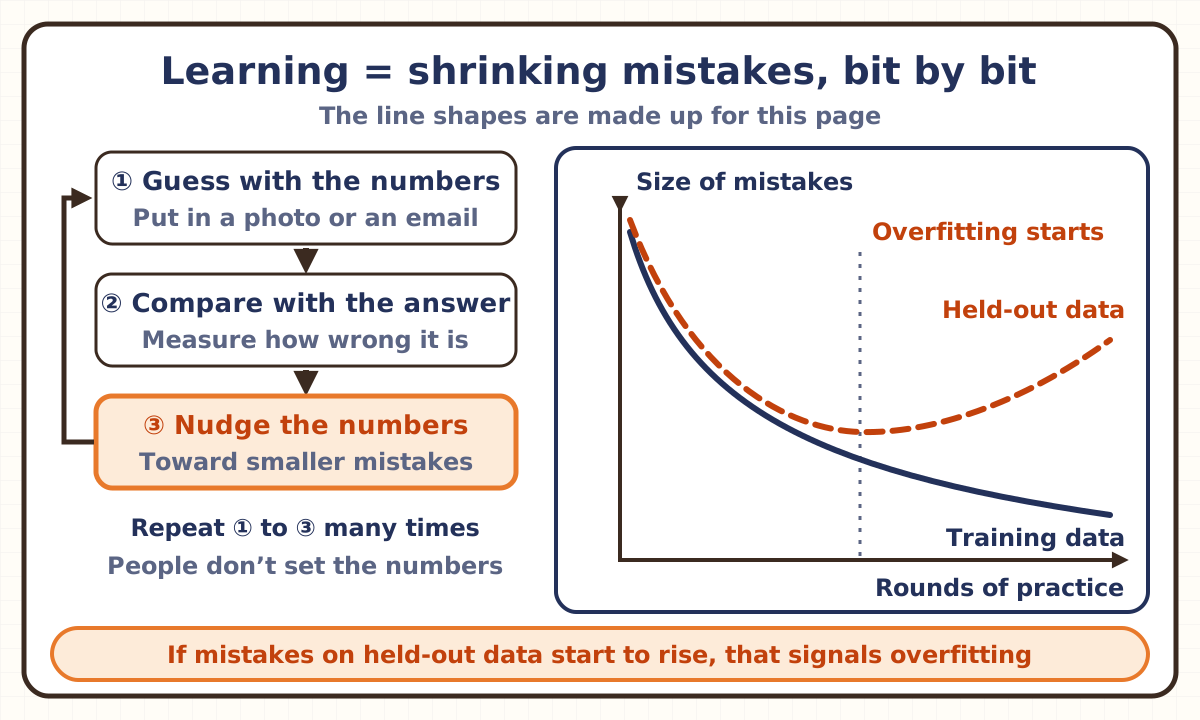
At the start, the numbers are set to random values near zero. Then it repeats three steps: ① give an answer with the current numbers, ② compare it with the right answer and measure how wrong it was (the “loss”), and ③ move the numbers a small amount in the direction that makes the mistake smaller. When the mistakes stop shrinking, learning is done. This method is called “gradient descent.” Google’s course says the goal of training is to minimize the loss, reducing it to its lowest possible value.
People do not set the numbers one by one. In large language models (LLMs), there can be hundreds of billions or even trillions of them (Google’s course; see the “Large language model” page).
What kinds of learning are there?
Google’s introduction to machine learning lists the main kinds as supervised learning, unsupervised learning and reinforcement learning, plus generative AI (models that create new content from what the user puts in).
In supervised learning, the model sees many examples with the right answers (“labels”) and learns which clues lead to those answers. Some models predict a category, like “spam or not” or “is there a cat in this photo”; others predict a number, like the amount of rain or the price of a house.
In unsupervised learning, the model looks for meaningful patterns in data that has no answers attached. A common technique is “clustering,” grouping similar things together. For example, clustering weather data by temperature might reveal groupings like the seasons. Naming the groups is up to people who understand the data.
In reinforcement learning, the system tries actions, gets rewards or penalties, and finds the way of acting that earns the most reward. It is used to train robots to do things like walking, and programs like AlphaGo to play the game of Go. It was also used to teach reasoning models how to think (see the “Reasoning model” page).
What is deep learning?
It is one way of doing machine learning, using a kind of calculation called a “neural network.” A neural network is built from layers, and the layers are made of parts called “neurons.” The layers between what goes in (the clues) and what comes out (the answer) are called “hidden layers,” and Google’s glossary calls a neural network with more than one hidden layer a “deep model.”
For example, in 2012, Alex Krizhevsky and colleagues at the University of Toronto trained a neural network with eight layers and 60 million parameters to sort 1.2 million photos into 1,000 categories. In a contest to name what is in photos (ILSVRC-2012), a version of it got a top-5 error rate of 15.3%: the share of photos where none of the AI’s five guesses was right. The second-best entry got 26.2% (lower is better).
Large language models are deep learning too. Their most widely used design, the “Transformer,” is an enormous neural network that stacks layer upon layer (Google’s course).
Why can it ace practice but get the real thing wrong?
It may be “overfitting.” Google’s course describes overfitting as matching (memorizing) the data used for learning (the training data) so closely that the model fails to make correct predictions on new data. It compares an overfit model to an invention that performs well in the lab but is worthless in the real world.
To spot it, you keep some data aside that is not used for learning, and during learning you compare the size of the mistakes on both. At first, both fall in a similar way. If, from some point on, mistakes on the training data keep falling (or hold steady) while mistakes on the held-out data start rising, that is a sign of overfitting.
It is caused by one or both of two problems: the training data doesn’t represent real data well, or the model is too complex. Google’s course advises testing a model on different examples from the ones used for training, and deleting any test examples that duplicate training examples.
What happens if the data is skewed?
Because machine learning learns from the examples it is shown, skewed examples can lead to skewed answers. Google’s course gives this example. A model is trained to predict future sales of a new product from phone surveys of people who bought the product. People who bought a competing product instead were not surveyed, so they are missing from the training data.
Skew has been found with face photos too. In 2018, researchers Joy Buolamwini and Timnit Gebru showed that two photo collections used to test face analysis systems (IJB-A and Adience) were overwhelmingly made up of lighter-skinned people (79.6% and 86.2%). They then built a collection balanced by gender and skin type and tested three companies’ systems that guess gender from a face. Error rates were as high as 34.7% for darker-skinned women, and at most 0.8% for lighter-skinned men.
In 2019, NIST, a US government research lab, also tested 189 face recognition programs from 99 developers. When checking whether two photos show the same person, the rate of wrongly matching two different people was often 10 to 100 times higher for Asian and African American faces than for white faces, depending on the program. But some programs made in Asian countries showed no such large gap between Asian and white faces. The report’s main author, noting that the study did not look into what causes the gaps, called this “an encouraging sign that more diverse training data may produce more equitable outcomes.”
Where is it used in everyday life?
Email, for one. Google wrote in 2019 that, with its machine learning models and other protections, Gmail blocks more than 99.9% of spam, phishing and malware from reaching inboxes, and that with its machine learning tool TensorFlow it was blocking about 100 million additional spam messages a day (both are the company’s own claims). Machine learning helps, it says, by finding patterns in large amounts of data that the people who write the rules might miss.
Speech recognition, which turns voices into text, and systems that recognize what is in photos have also been built with machine learning. In a 2006 essay, Tom Mitchell of Carnegie Mellon University wrote that the commercial speech recognition systems then available all used machine learning in some way, because training a system gives more accurate results than programming it by hand. He also wrote that over 85% of handwritten mail in the US was sorted automatically, using handwriting software trained with machine learning (all as of 2006).
In the same essay, Mitchell named two kinds of jobs where machine learning was already the best method available: jobs too complex for people to design the steps by hand, and jobs where the software must adapt to its users or surroundings. He also wrote that some software will remain where machine learning may never be useful, such as programs for multiplying matrices.
Where did the term come from? Is there a fixed definition?
In July 1959, Arthur Samuel published a paper in IBM’s research journal titled “Some Studies in Machine Learning Using the Game of Checkers.” It opens by saying the studies were about programming a computer to behave in a way that, if people or animals did it, would be described as learning. Its abstract says the computer could learn to play a better game of checkers than the person who wrote the program, and that this took about 8 or 10 hours of the machine playing.
There are several ways to define it. On the page for his 1997 textbook “Machine Learning,” Tom Mitchell of Carnegie Mellon University describes machine learning as the study of computer algorithms that improve automatically through experience. Google’s glossary calls it a program or system that trains a model from input data.
In his 2006 essay, Mitchell put it more precisely: a machine learns with respect to a task T, a performance measure P and a type of experience E, if its performance P at task T reliably improves after experience E. Applied to sorting spam, T is “sorting emails,” P is “the share sorted correctly,” and E is “seeing labeled emails” (an example made up for this page).
In the same essay, Mitchell wrote that while computer science had focused mainly on how to program computers by hand, machine learning asks how to get computers to program themselves, from experience plus some initial structure.
Check yourself
Q1In a 1959 paper, Arthur Samuel had a computer learn to play checkers, a board game. According to the paper’s abstract, how much machine-playing time did the computer need to learn to play better than the person who wrote the program?
Answer and explanation
Answer: A About 8 to 10 hours
The abstract says the computer could learn to play a better game of checkers than the person who wrote the program, and that it took about 8 or 10 hours of machine-playing time.
More on this → Key points: Where did the term come from? Is there a fixed definition?
Q2When a machine learning model “learns,” what changes inside the computer?
Answer and explanation
Answer: B The values of the numbers used in the calculation
What changes are the numbers used in the calculation (the parameters). It gives an answer, compares it with the right answer to measure the mistake, and moves the numbers a little in the direction of smaller mistakes, over and over. No one sets these numbers one by one.
More on this → Key points: When it “learns,” what changes inside the computer?
Q3When overfitting is happening and learning goes on, what happens to the size of the mistakes?
Answer and explanation
Answer: C They fall on the training data and rise on the held-out data
On the training data used for learning, the mistakes keep falling (or hold steady), but on the data held out from learning, they start to rise. It is a sign that the model has memorized the training data and can no longer predict new data well.
More on this → Key points: Why can it ace practice but get the real thing wrong?
Related terms
- Artificial intelligence
- Deep learning
- Neural network
- Reinforcement learning
- Large language model
- Reasoning model
- Artificial general intelligence
Sources and how we checked
- Google for Developers, "What is Machine Learning?" (Introduction to Machine Learning; read November 8, 2026)
- Google for Developers, "Supervised Learning" (Introduction to Machine Learning; read November 8, 2026)
- Google Machine Learning Crash Course, "Linear regression: Loss" (read November 8, 2026)
- Google Machine Learning Crash Course, "Linear regression: Gradient descent" (read November 8, 2026)
- Google Machine Learning Crash Course, "Overfitting" (read November 8, 2026)
- Google Machine Learning Crash Course, "Dividing the original dataset" (read November 8, 2026)
- Google Machine Learning Crash Course, "Fairness: Types of bias" (read November 8, 2026)
- Google Machine Learning Crash Course, "LLMs: What's a large language model?" (Transformers; read November 8, 2026)
- Google, "Machine Learning Glossary" (entries for artificial intelligence, machine learning, deep model and hidden layer; read November 8, 2026)
- EU, "Artificial Intelligence Act" (Regulation (EU) 2024/1689, June 13, 2024; recital 12)
- A. L. Samuel, "Some Studies in Machine Learning Using the Game of Checkers" (IBM Journal of Research and Development, vol. 3, no. 3, July 1959)
- Tom M. Mitchell, "Machine Learning" (McGraw Hill, 1997): the book's page
- Tom M. Mitchell, "The Discipline of Machine Learning" (Carnegie Mellon University, CMU-ML-06-108, July 2006)
- Krizhevsky et al., "ImageNet Classification with Deep Convolutional Neural Networks" (University of Toronto, NIPS 2012)
- Buolamwini and Gebru, "Gender Shades: Intersectional Accuracy Disparities in Commercial Gender Classification" (Proceedings of Machine Learning Research, vol. 81, 2018)
- NIST, "NIST Study Evaluates Effects of Race, Age, Sex on Face Recognition Software" (December 19, 2019; report NISTIR 8280)
- Google Workspace, "Spam does not bring us joy—ridding Gmail of 100 million more spam messages with TensorFlow" (February 7, 2019)
AI wrote this page from the sources above, and a different AI checked it against the text of those sources (November 8, 2026). A person with a master’s degree in science and a Japanese high-school science teaching license also read and checked it before publishing. Numbers are as of that date. If anything was hard to follow, you spot a mistake, or there’s a term you’d like explained, please write to [email protected].