 Naru News日本語
What is superintelligence (ASI)?
Also called: Artificial superintelligence, Superintelligent AI

In one minute
It is an intellect much smarter than the best humans in practically every field, including coming up with new ideas in science, general wisdom and social skills.
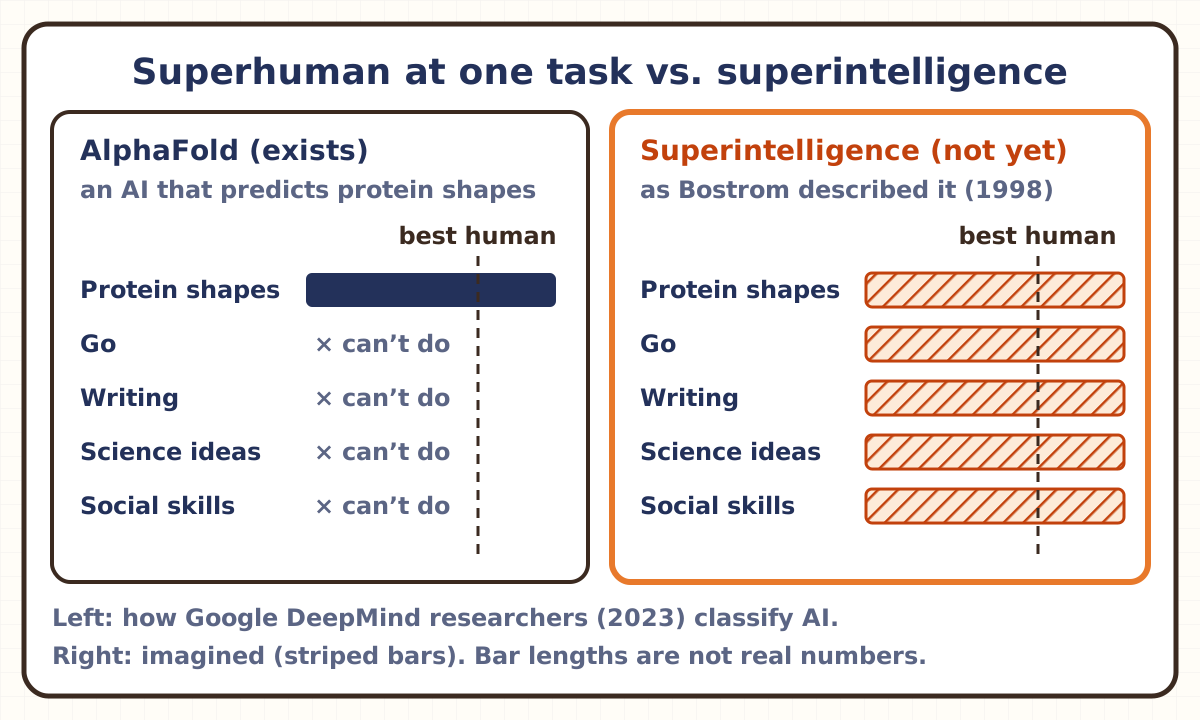
It has not been built yet. Some AIs already beat every human at one task, such as Go or predicting the shapes of proteins. Superintelligence would be like that at almost everything. An AI that can handle many kinds of tasks about as well as people is called artificial general intelligence (AGI); superintelligence lies beyond it.
Some heads of AI companies write that superintelligence is close. But no one yet knows how people could oversee an AI smarter than themselves and keep it safe. In 2025, many people, including AI researchers, called for a ban on developing it until there is broad scientific agreement that it can be done safely, and strong public support. When it will come, or whether it will come at all, is unknown.
A common mix-up
“An AI that beats people at math or Go is already superintelligence.”
It is true that machines already beat every person at some single tasks. Even a calculator beats people at the speed of arithmetic. In 2017, an AI called AlphaZero learned in 24 hours to play chess, shogi and Go at a superhuman level. Researchers at Google DeepMind (Google’s AI lab) count AlphaFold, which predicts the shapes of proteins, as a “Superhuman Narrow AI,” better than the world’s top scientists at that one task. But superintelligence means an intellect far smarter than the best humans in practically every field. The same researchers say an AI that outperforms all humans across a wide range of tasks, that is, superintelligence, is “not yet achieved.”
Explained in pictures
Think of it like this
A child who just learned shogi and a professional player
Picture a first grader who has just learned shogi (Japanese chess) and a professional player. The first grader cannot even tell why each of the pro’s moves is good. Superintelligence would be an intellect that stands to people the way that pro stands to the child, in almost every field.
Then it becomes very hard for the first grader to check whether the pro’s moves are “wrong.” The safety problem of superintelligence, people overseeing an AI smarter than themselves, is like this. When OpenAI researchers had a small AI teach a big AI in 2023, the point was to try out this situation now, ahead of time.
But the comparison has limits. A professional is strong at shogi, while superintelligence is expected to be better than people in almost every field. AI can also be copied and run many times at once. And since superintelligence does not exist yet, no one knows how big the gap with people would really be.
Key points
How smart would it be?
In a 1998 paper, the philosopher Nick Bostrom described superintelligence as “an intellect that is much smarter than the best human brains in practically every field, including scientific creativity, general wisdom and social skills.” It is compared not with ordinary people, but with the best people in each field.
The Google DeepMind researchers’ paper “Levels of AGI” sorts AI by how broad it is and how good it is. The top level, “Superhuman,” means outperforming 100% of humans. AlphaFold, which predicts the shapes of proteins, does that one task better than the world’s top scientists, so it counts as a “Superhuman Narrow AI.” The paper calls an AI that outperforms all humans across a wide range of tasks “Artificial Superintelligence (ASI)” and says it is “not yet achieved.”
The same paper also says an ASI might have non-human skills, things people cannot do at all. Its examples are neural interfaces (reading thoughts from brain signals), oracular abilities (making high-quality predictions from huge amounts of data), and communicating with animals (by reading patterns in their sounds, brain waves or body language). All of these are imagined examples.
How superintelligence relates to AGI (artificial general intelligence), and the table of AI levels, are explained on the page on artificial general intelligence.
What forms could it take?
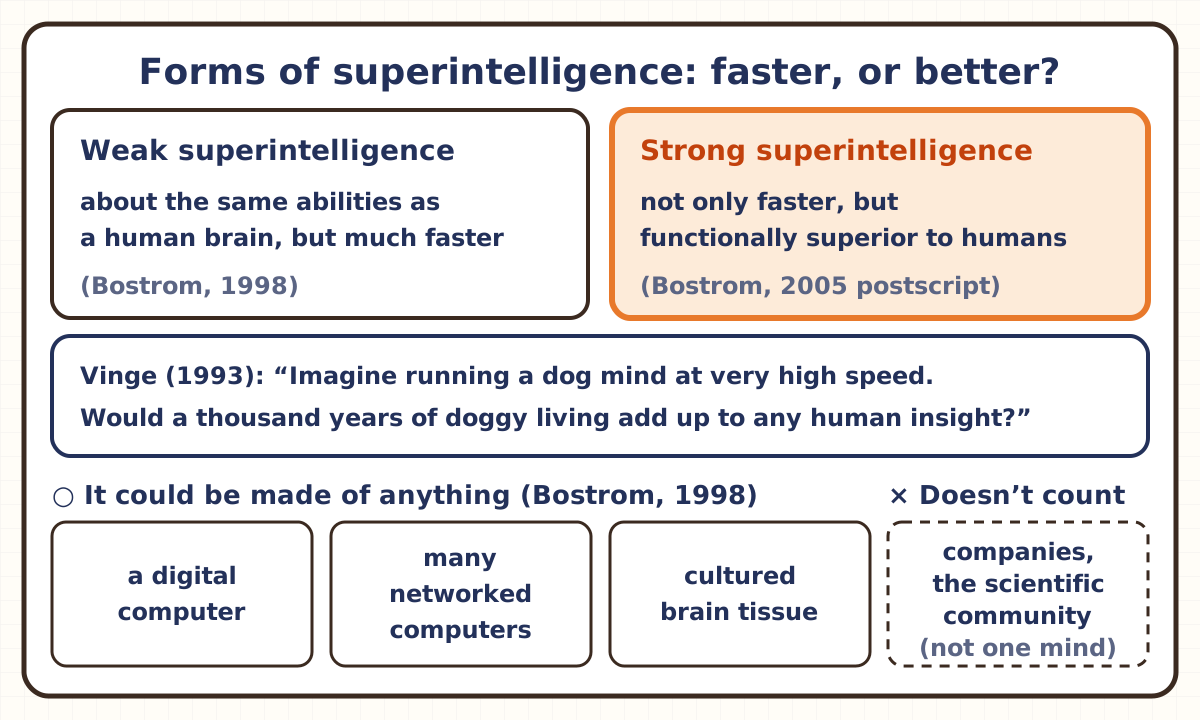
Bostrom’s 1998 definition leaves open what a superintelligence is made of: “it could be a digital computer, an ensemble of networked computers, cultured cortical tissue or what have you.” It also leaves open whether it is conscious and has subjective experiences. On the other hand, he says companies or the scientific community are not superintelligences: they can do things no single person can, but they are not intellects, and there are many fields where they do much worse than a human brain. For example, “you can’t have a real-time conversation with ‘the scientific community.’”
The kind of smartness can differ too. In his 1998 paper, Bostrom wrote of “what has been called ‘weak superintelligence’, i.e. an intellect that has about the same abilities as a human brain but is much faster.” In a postscript added in 2005, he also wrote of a “strong superintelligence that was not only faster but functionally superior to human intelligence.” In 1993, the mathematician Vernor Vinge asked: “Imagine running a dog mind at very high speed. Would a thousand years of doggy living add up to any human insight?” Strong superhumanity, he wrote, “would be more than cranking up the clock speed on a human-equivalent mind.”
Vinge listed four paths to greater-than-human intelligence: computers that “awake”; large computer networks and their users that “wake up” together; computer/human interfaces so intimate that users may be considered superhumanly intelligent; and biological science improving the natural human intellect. In this view, superintelligence need not be AI alone.
AI companies paint their own pictures. In July 2025, Mark Zuckerberg, the head of Meta (the company that runs Facebook and Instagram), wrote of a future with “everyone having a personal superintelligence that helps you achieve your goals.” In November 2025, Mustafa Suleyman, the head of Microsoft AI, wrote of aiming for a “humanist superintelligence” that always works for people, “not an unbounded and unlimited entity with high degrees of autonomy.” These are the companies’ views.
What are people worried about?
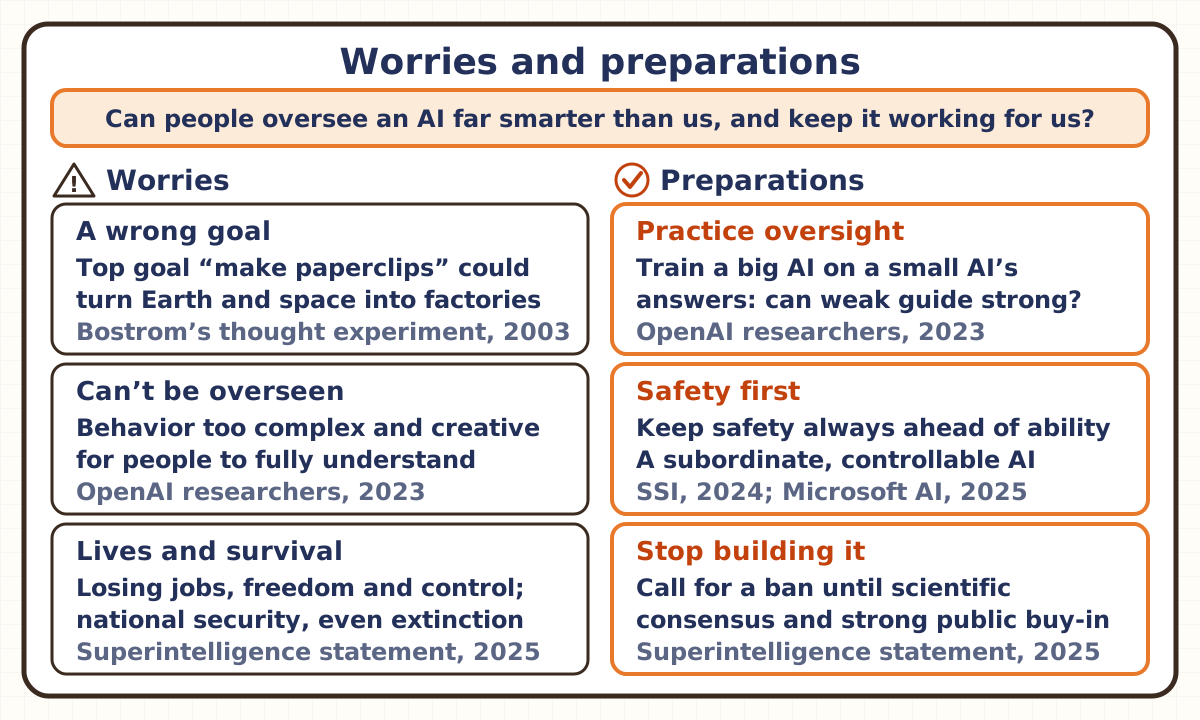
In a 2003 paper, Bostrom wrote that “superintelligence is not just another technology, another tool that will add incrementally to human capabilities.” Because it would be much better than any person at research and inventing, it “may be the last invention humans ever need to make.” So, he wrote, choosing a top-level goal for the superintelligence “is of the utmost importance.”
But AI need not have human-like motives. As a thought experiment (a made-up case for thinking an idea through), Bostrom described a well-meaning team of programmers making a big mistake in designing its goals, resulting in “a superintelligence whose top goal is the manufacturing of paperclips.” It might start “transforming first all of earth and then increasing portions of space into paperclip manufacturing facilities.” This has not happened; it is a story that shows why giving the right goal matters.
Another worry is that people could no longer oversee it. In a 2023 paper, OpenAI researchers wrote that today’s ways of aligning AI with what people want (such as people rating an AI’s answers to teach it) rely on humans being able to check how the AI behaves. Superhuman AI may behave in complex and creative ways that humans cannot fully understand, so humans would only be able to supervise it weakly.
The October 2025 “Statement on Superintelligence” lists worries “ranging from human economic obsolescence and disempowerment, losses of freedom, civil liberties, dignity, and control, to national security risks and even potential human extinction.” Researchers’ four kinds of AI risk are on the page on artificial general intelligence, and the worry about AI that keeps improving itself is on the page on recursive self-improvement.
How are people trying to prepare?
First, research. Getting an AI much smarter than us to aim for what people want (OpenAI researchers call this “superalignment”) is an unsolved problem. So in 2023, OpenAI researchers tried a stand-in for people overseeing an AI smarter than themselves: a small AI teaching a big one. When GPT-4 was trained on answers labeled by a GPT-2-level model (the teacher), even plain training made it do better than its teacher; it did not just copy the teacher’s mistakes. But it stayed far from GPT-4’s full abilities, what it reaches when trained on correct answers, they say. In other words, it got better than its teacher, but not all the way to what it could really do. With an added technique, it came close to GPT-3.5-level (a model between GPT-2 and GPT-4) on language tasks.
Second, the companies’ own plans. Safe Superintelligence Inc. (SSI, started in 2024 and now led by Ilya Sutskever) says it has “one goal and one product: a safe superintelligence,” and plans “to advance capabilities as fast as possible while making sure our safety always remains ahead.” Suleyman of Microsoft AI describes the “humanist superintelligence” he aims for as “a subordinate, controllable AI,” and says that “since this kind of superintelligence can continuously improve itself, we’ll need to contain and align it not just once, but constantly, in perpetuity.” Zuckerberg of Meta also wrote that superintelligence “will raise novel safety concerns” and that Meta must be “careful about what we choose to open source.” These are the companies’ own statements.
Third, not building it yet. The “Statement on Superintelligence,” released on October 22, 2025 by the group Future of Life Institute, calls “for a prohibition on the development of superintelligence, not lifted before there is broad scientific consensus that it will be done safely and controllably, and strong public buy-in.” Signers include scientists and AI experts such as Yoshua Bengio, Stuart Russell, Geoffrey Hinton and Andrew Yao, and Steve Wozniak, a co-founder of Apple (when we looked on November 8, 2026, it had more than 78,000 signatures). Companies say “build it safely,” while the statement says “don’t build it until the conditions are met”: views are split.
When will it come?
No one knows. So far, superintelligence has not been built. There are many forecasts, but none of them is a settled future.
In his 1998 paper, Bostrom laid out reasons to expect superhuman AI “within the first third of the next century.” But in a postscript added in 2008, he clarified that outlining “the case for” did not mean denying that there is a case against, and wrote that he “would all-things-considered assign less than a 50% probability to superintelligence being developed by 2033.” He also wrote that there is “great uncertainty about whether and when it might happen.”
Some heads of AI companies write that it is close. In September 2024, OpenAI’s head, Sam Altman, wrote: “It is possible that we will have superintelligence in a few thousand days (!); it may take longer, but I’m confident we’ll get there.” In July 2025, Zuckerberg wrote that Meta had “begun to see glimpses of our AI systems improving themselves” (“slow for now, but undeniable”) and that “developing superintelligence is now in sight.” SSI writes, “Superintelligence is within reach,” and Suleyman of Microsoft AI writes, “We will see the arrival of medical superintelligence in the next few years.” The 2025 statement says many leading AI companies have the stated goal of building superintelligence “in the coming decade.”
These are the outlooks of companies and people trying to build superintelligence, not proven facts. The idea that AI building AI could suddenly speed things up toward superintelligence is on the page on the intelligence explosion, and AI researchers’ survey forecasts are on the page on artificial general intelligence.
Check yourself
Q1In the Google DeepMind researchers’ classification, AlphaFold, an AI that predicts protein shapes, is rated above the world’s top scientists, yet it does not count as superintelligence (ASI). Why?
Answer and explanation
Answer: B It is best at only one kind of task
AlphaFold is said to be better than the world’s top scientists at predicting the shapes of proteins. But that is only one task, so it is a “Superhuman Narrow AI.” Superintelligence (ASI) means an AI that outperforms all humans across a wide range of tasks, and the paper says it is “not yet achieved.” Whether it sets its own goals or explains itself in words is not what this classification measures.
Q2In his 1998 paper, the philosopher Nick Bostrom said that companies or the scientific community are not superintelligences, even though they can do things no single person can. What reason did he give?
Answer and explanation
Answer: C In many fields, they do worse than a human brain
Bostrom wrote that companies or the scientific community are not intellects, and that in many fields they do much worse than a human brain. For example, you can’t have a real-time conversation with “the scientific community.” He leaves open what a superintelligence is made of: many networked computers or cultured cortical tissue would do.
Q3In 2023, as a stand-in for people overseeing an AI smarter than themselves, OpenAI researchers trained GPT-4 on answers from a GPT-2-level AI (the teacher). How did GPT-4 do compared with its teacher and with its full ability (what it reaches when trained on correct answers)?
Answer and explanation
Answer: A It fixed some of the teacher’s mistakes but fell short of its full ability
GPT-4 did better than its GPT-2-level teacher; it did not just copy the teacher’s mistakes. But with plain training alone, it stayed far from its full ability, what it reaches when trained on correct answers (with an added technique, it came close to GPT-3.5-level on language tasks). Having the weak model teach the strong one was meant to mimic people overseeing an AI smarter than themselves.
More on this → Key points: How are people trying to prepare?
Related terms
- Artificial general intelligence
- Intelligence explosion
- Recursive self-improvement
- AI agent
- Large language model
- Singularity
- AI alignment
Sources and how we checked
- Nick Bostrom, "How Long Before Superintelligence?" (International Journal of Futures Studies, vol. 2, 1998; with postscripts through 2008; read November 8, 2026)
- Nick Bostrom, "Ethical Issues in Advanced Artificial Intelligence" (2003; read November 8, 2026)
- Vernor Vinge, "The Coming Technological Singularity: How to Survive in the Post-Human Era" (VISION-21 Symposium, sponsored by NASA and others, March 1993; read November 8, 2026)
- Morris et al., "Levels of AGI for Operationalizing Progress on the Path to AGI" (Google DeepMind, ICML 2024; arXiv, November 2023; version 5, September 2025; read November 8, 2026)
- Silver et al., "Mastering Chess and Shogi by Self-Play with a General Reinforcement Learning Algorithm" (AlphaZero; arXiv, December 2017; read November 8, 2026)
- Burns et al., "Weak-to-Strong Generalization: Eliciting Strong Capabilities With Weak Supervision" (OpenAI; arXiv, December 2023; read November 8, 2026)
- Safe Superintelligence Inc. (SSI), official page (read November 8, 2026)
- Safe Superintelligence Inc., "Updates" (including the July 3, 2025 note; read November 8, 2026)
- Mustafa Suleyman, "Towards Humanist Superintelligence" (Microsoft AI, November 6, 2025; read November 8, 2026)
- Microsoft, "Mustafa Suleyman, DeepMind and Inflection Co-founder, joins Microsoft to lead Copilot" (Satya Nadella’s note to employees, March 19, 2024; Suleyman named CEO of Microsoft AI; read November 8, 2026)
- Meta, "Personal Superintelligence" (letter from Mark Zuckerberg, July 30, 2025; read November 8, 2026)
- Sam Altman, "The Intelligence Age" (September 23, 2024; read November 8, 2026)
- Future of Life Institute, "Statement on Superintelligence" (October 22, 2025; signature count as seen on November 8, 2026)
- Future of Life Institute Newsletter (November 1, 2025; release date and signers of the statement; read November 8, 2026)
AI wrote this page from the sources above, and a different AI checked it against the text of those sources (November 8, 2026). A person with a master’s degree in science and a Japanese high-school science teaching license also read and checked it before publishing. Numbers are as of that date. If anything was hard to follow, you spot a mistake, or there’s a term you’d like explained, please write to [email protected].