 Naru News日本語
What is the technological singularity?
Also called: Singularity, The Singularity

In one minute
The technological singularity is a predicted turning point: once technology, especially AI smarter than humans, makes change fast and huge enough, what comes after can no longer be foreseen with what we know today.
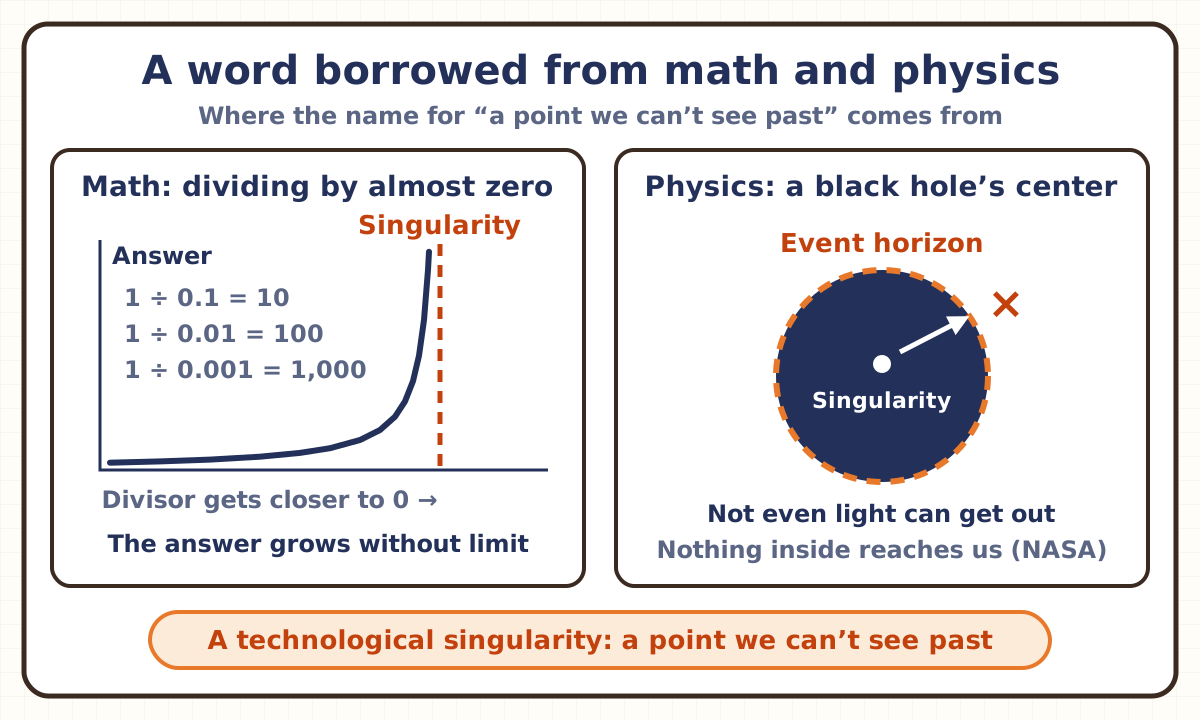
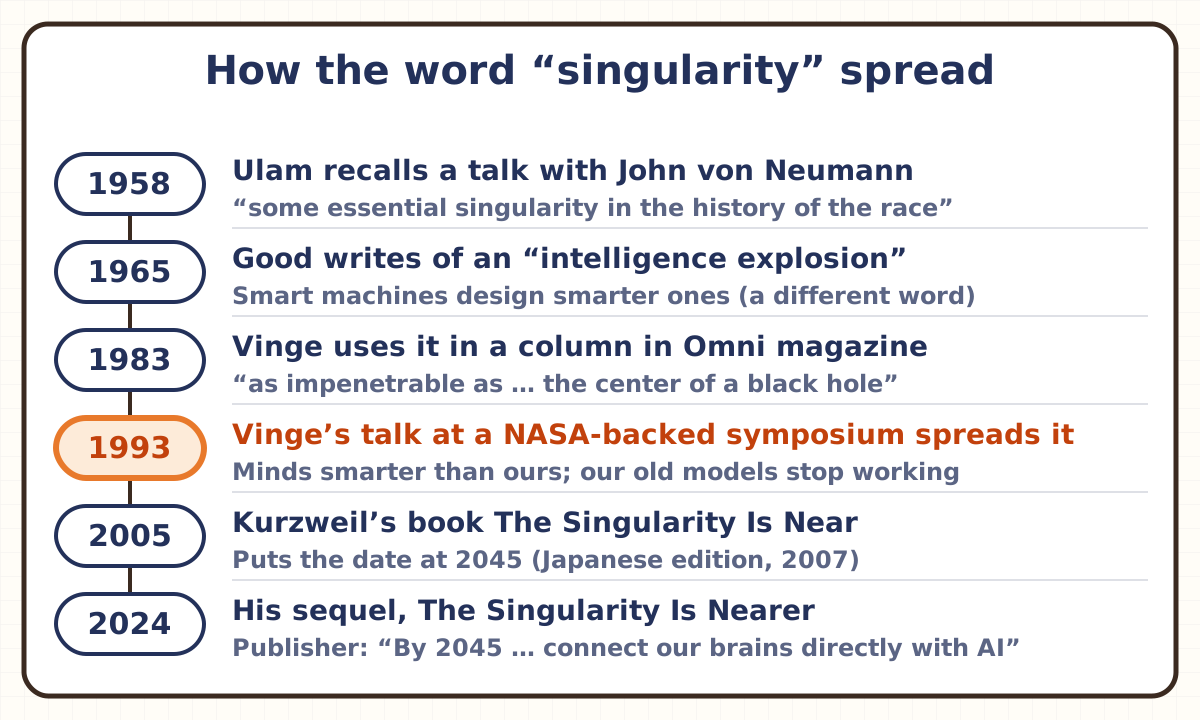
“Singularity” is a word from math and physics for a point where a value becomes infinitely large and the equations stop working. In 1958, the mathematician Stanislaw Ulam recalled a conversation with John von Neumann about approaching “some essential singularity in the history of the race,” and in 1993, the mathematician and science-fiction writer Vernor Vinge made the word widely known.
The inventor Ray Kurzweil predicted in a 2005 book that it would arrive in 2045; in Japan, the idea is sometimes called “the 2045 problem.” But these are only predictions: AI smarter than humans at nearly everything (superintelligence) has not been built. Some experts think it may never come, and opinions are divided.
A common mix-up
“The singularity is the day AI catches up with human intelligence.”
Half right. Vernor Vinge, who made the word widely known, did see the trigger as technology creating intelligence greater than ours. But the singularity refers less to the moment of catching up and more to the point after which change becomes so fast and so big that the future can no longer be foreseen. Even Ray Kurzweil, who predicted 2045, keeps two dates apart: computers reaching human-level intelligence by 2029, and the singularity in 2045. And since people use the word in different ways, it helps to check whose singularity is meant.
Explained in pictures
Think of it like this
A grandmaster’s next move
Someone who has just learned chess cannot tell in advance where a grandmaster will move next. If they could, they would have to be about as strong as the grandmaster.
The “cannot be foreseen” part of the singularity is like this. If minds smarter than humans began making the inventions and the decisions, it would be hard for human minds to work out ahead of time what would happen next. In a 2007 essay, Eliezer Yudkowsky wrote, “To know where Deep Blue would play in a chess game, you must play at Deep Blue’s level.”
But the comparison has limits. Grandmasters exist today, but AI smarter than humans at nearly everything does not yet (this is all about predictions). And the rules of chess stay the same, while in the singularity idea, the rules of the world itself might change.
Key points
Why is it called a “singularity”?
“Singularity” was first a word from math and physics. In a 2001 essay, Kurzweil explained that in math it means “the explosion of value that occurs when dividing a constant by a number that gets closer and closer to zero.” Divide 1 by 0.1 and you get 10; by 0.01, 100; by 0.001, 1,000. The closer the divisor gets to zero, the bigger the answer, and at zero it cannot be calculated.
In physics, the best-known example is the center of a black hole. According to NASA, general relativity (Einstein’s theory of gravity) predicts that the very center of a black hole contains a point where matter is crushed to infinite density. Whether it is a real physical thing or only something in the math, astronomers do not yet know. Light cannot get out from inside the “event horizon,” which you can think of as the black hole’s surface, so nothing about what happens inside can reach an outside observer.
In a January 1983 column in Omni magazine, Vinge wrote that when we create intelligences greater than our own, human history will reach “a kind of singularity, an intellectual transition as impenetrable as the knotted space-time at the center of a black hole” (as quoted by Quote Investigator, which checked scans of the magazine). In his 1993 essay, he called the Singularity “a point where our models must be discarded and a new reality rules.” The name borrows both pictures: a value that grows without limit, and a boundary we cannot see past.
Who started using the word?
Both Vinge and Kurzweil quote a 1958 passage as an early use of the word (Kurzweil’s 2001 essay, without naming Ulam, quotes it as von Neumann’s words from the 1950s). The mathematician Stanislaw Ulam wrote a long article for the Bulletin of the American Mathematical Society looking back on the mathematician John von Neumann (1903–1957), who had died the year before. In it, he recalled one of their talks: “One conversation centered on the ever accelerating progress of technology and changes in the mode of human life, which gives the appearance of approaching some essential singularity in the history of the race beyond which human affairs, as we know them, could not continue.”
These are not von Neumann’s own written words; they are Ulam’s account of a conversation. And “essential singularity” is a technical term from mathematics.
In 1965, the British mathematician I. J. Good wrote that if a machine that could far surpass any person designed even better machines, there would be an “intelligence explosion.” The idea is close, but the word Good used was “intelligence explosion.”
The person who spread “singularity” as a word about the future of technology was Vernor Vinge, a mathematician and science-fiction writer at San Diego State University. His own list of writings calls a January 1983 opinion column in Omni magazine his “first in-print fling at the Singularity.” He also used the word in his 1986 science-fiction novel Marooned in Realtime (according to Kurzweil’s essay), and in March 1993 he presented the essay “The Coming Technological Singularity” at a symposium sponsored by NASA and others.
What is Kurzweil’s “2045”?
The inventor Ray Kurzweil brought the idea to a wide audience with his 2005 book The Singularity Is Near (its Japanese edition came out in 2007). In a question-and-answer piece that went with the book, he wrote, “I set the date for the Singularity—representing a profound and disruptive transformation in human capability—as 2045,” and said that the nonbiological intelligence created in that year would be “one billion times more powerful than all human intelligence today,” meaning in 2005.
Underneath this is a view he calls the “law of accelerating returns.” In a 2001 essay, he wrote that because technological change speeds up exponentially, the 21st century will see not 100 years of progress but “on the order of twenty thousand years of progress — at today’s rate of progress.” Because the speed of progress itself keeps rising, progress that would take 20,000 years at today’s speed gets packed into 100 years. He keeps a separate date for computers reaching human-level intelligence: by 2029 (according to the publisher of his 2024 sequel).
His 2024 sequel, The Singularity Is Nearer (a Japanese edition came out the same year), still points to 2045. The publisher’s description says that “by 2045, we will be able to connect our brains directly with AI, enhancing our intelligence a millionfold,” and that “this is the Singularity.”
In Japan, because of that year, the idea is also called the “2045 problem” (2045-nen mondai). For example, a 2013 paperback by Takuya Matsuda is titled 2045-nen Mondai: Konpyuta ga Jinrui o Koeru Hi (“The 2045 Problem: The Day Computers Surpass Humanity”).
How is it different from an intelligence explosion or superintelligence?
The three overlap, but they point to different things. “Superintelligence” is a thing: an intelligence far smarter than the smartest people in nearly every field. An “intelligence explosion” is an event: AI building smarter AI, so the speed of getting smarter suddenly shoots up. “Singularity” usually names a point: the boundary beyond which we cannot see.
In a 2007 essay posted on the site of the research institute MIRI, Eliezer Yudkowsky sorted the meanings of “singularity” into three “schools.” “Accelerating Change” (Kurzweil and others): technological change follows smooth, typically exponential curves, so we can predict with fair precision when new technologies will arrive. “Event Horizon” (Vinge): once smarter-than-human intelligence exists, the future after it is unpredictable. “Intelligence Explosion” (Good and others): smarter minds build even smarter minds, in a loop.
Yudkowsky wrote that the three schools are “logically distinct,” and that while their core claims support each other, their strong claims “tend to contradict each other.” For example, a strong form of Accelerating Change says we can predict exactly when new technologies will arrive, which clashes with the Event Horizon idea that the future beyond that point cannot be predicted (this example is our own). He also wrote that the original meaning is the Event Horizon idea of Vinge, “who coined the word” (Ulam’s 1958 article already has a similar phrase). For more, see the “Intelligence explosion” and “Superintelligence” pages.
Will it really come?
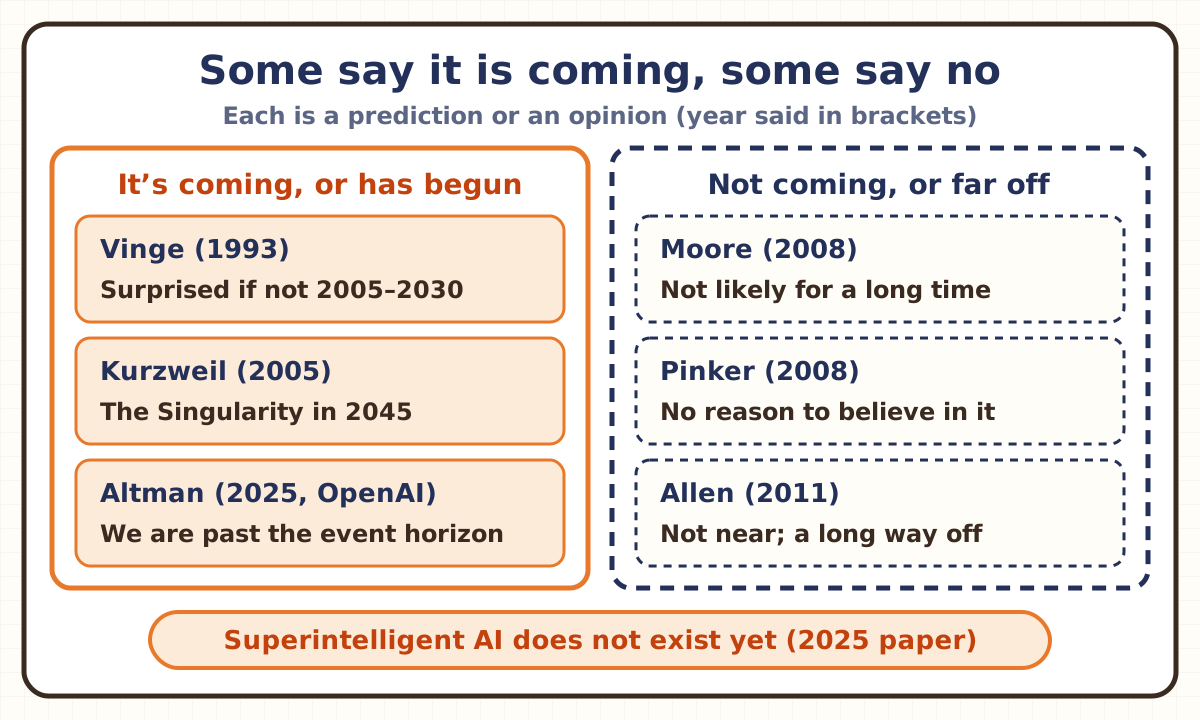
No one knows. The singularity is about a future that has not happened, so whether it will come, and when, are predictions. In 1993, Vinge wrote, “Within thirty years, we will have the technological means to create superhuman intelligence,” and “I’ll be surprised if this event occurs before 2005 or after 2030.”
Vinge himself thought it might not come. In the same 1993 essay he wrote, “Well, maybe it won’t happen at all,” and in 2007 he gave a talk titled “What If the Singularity Does NOT Happen?” Even there, though, he called the Singularity “the most likely non-catastrophic outcome for our near future.”
Some experts doubt it. In a 2008 IEEE Spectrum special report in which ten people gave their views, Gordon Moore, known for Moore’s Law (the prediction about the growing number of components on a semiconductor chip), said, “I am a skeptic. I don’t believe this kind of thing is likely to happen, at least for a long time.” Steven Pinker, a professor of psychology at Harvard, said, “There is not the slightest reason to believe in a coming singularity.”
In 2011, Microsoft cofounder Paul Allen and computer scientist Mark Greaves wrote, “While we suppose this kind of singularity might one day occur, we don’t think it is near.” Building the complex software that would allow the singularity to happen, they argued, first requires a detailed scientific understanding of how the human brain works, enough to use as a guide, or else creating it all from scratch; and with the brain, “the more we learn, the more we realize there is to know.” They called this the “complexity brake.”
Where do things stand now?
AI smarter than humans at nearly everything is considered not to exist yet. A paper by researchers at Google DeepMind (Google’s AI lab; September 2025 version) sorts AI into levels and lists artificial superintelligence (ASI), AI that outperforms all people across a wide range of tasks, as “not yet achieved.” So the trigger of Vinge’s singularity has not arrived.
On the other hand, some AI company leaders write that it has already started. Sam Altman, the head of OpenAI (the company that makes ChatGPT), opened his June 2025 blog post “The Gentle Singularity” with “We are past the event horizon; the takeoff has started,” and wrote that “the singularity happens bit by bit” (this is a company head’s view).
So the same black-hole image is used in different ways: Vinge used it for a boundary we cannot see past, while Altman says we have already crossed it and that, so far, it is “much less weird than it seems like it should be.” It helps to check who is using the word and in what sense. How much AI is already helping with AI research is covered on the “Intelligence explosion” page.
Check yourself
Q1The word “singularity” in “technological singularity” first came from math and physics. In math, what kind of point is called a singularity, for example?
Answer and explanation
Answer: B A point where the value grows without limit and the line shoots up
In math, divide 1 by 0.1 and you get 10; by 0.01, 100. The closer the divisor gets to zero, the bigger the answer grows, without limit, and at zero it cannot be calculated. A point like that is a singularity. The technological singularity borrows its name from this and from the singularity at the center of a black hole. A point where the value is 0, or where it is smallest, can be calculated normally, so it is not a singularity.
More on this → Key points: Why is it called a “singularity”?
Q2In 1958, the mathematician Stanislaw Ulam wrote that technological progress seemed to be “approaching some essential singularity in the history of the race.” What was he describing?
Answer and explanation
Answer: C Writing up what he discussed with a fellow mathematician
In 1958, in an article looking back on von Neumann, who had died the year before, Ulam recalled a conversation the two had about the ever-faster progress of technology. Von Neumann was a mathematician too, and this was a conversation between the two, not a class or an interview (these are not von Neumann’s own written words).
Q3In Japan, the technological singularity is sometimes called “the 2045 problem.” What is the year 2045?
Answer and explanation
Answer: A The year predicted by the inventor Kurzweil
2045 is the date the inventor Ray Kurzweil set for the Singularity around the time of his 2005 book, and his 2024 sequel still names it. Vinge wrote in 1993 that he would be surprised if it came before 2005 or after 2030. The conversation Ulam recorded in 1958 names no year. All of these are predictions, and some experts think it will never come.
Related terms
- Intelligence explosion
- Superintelligence
- Artificial general intelligence
- Recursive self-improvement
- Moore’s law
- Black hole
Sources and how we checked
- S. Ulam, "John von Neumann 1903-1957" (Bulletin of the American Mathematical Society, vol. 64, no. 3, part 2, May 1958; the AMS page could not be opened, so the passage was read as quoted in Vinge's 1993 essay)
- Vernor Vinge, "The Coming Technological Singularity: How to Survive in the Post-Human Era" (VISION-21 Symposium, sponsored by NASA and others, March 1993; read November 8, 2026)
- Vernor Vinge, "Miscellaneous nonfiction, and a bibliography" (his own list of writings; the January 1983 Omni column "First Word"; read November 8, 2026)
- Quote Investigator, "Quote Origin: Falling Into the Singularity is Admittedly a Frightening Thing…" (January 20, 2026; quotes Vinge in Omni, January 1983, vol. 5, no. 4, p. 10, checked against scans; read November 8, 2026)
- Vernor Vinge, "What If the Singularity Does NOT Happen?" (Seminars about Long-Term Thinking, February 15, 2007; read November 8, 2026)
- I. J. Good, "Speculations Concerning the First Ultraintelligent Machine" (Advances in Computers, vol. 6, 1965; read as quoted in Vinge's 1993 essay)
- Ray Kurzweil, "The Law of Accelerating Returns" (2001; read November 8, 2026)
- Ray Kurzweil, "A singularity q + a" (2005; questions and answers accompanying The Singularity Is Near; read November 8, 2026)
- Ray Kurzweil, The Singularity Is Near: When Humans Transcend Biology (2005), publisher’s page (Penguin Random House)
- Ray Kurzweil, The Singularity Is Nearer (2024), publisher’s description (Penguin)
- National Diet Library Search, the Japanese edition of The Singularity Is Near (essence edition, NHK Publishing, 2016; first published in Japanese in 2007 as Posuto Hyuman Tanjo)
- National Diet Library Search, the Japanese edition of The Singularity Is Nearer (NHK Publishing, 2024)
- National Diet Library Search, Takuya Matsuda, 2045-nen Mondai: Konpyuta ga Jinrui o Koeru Hi (“The 2045 Problem: The Day Computers Surpass Humanity,” Kosaido Shinsho, 2013)
- Eliezer Yudkowsky, "Three Major Singularity Schools" (MIRI blog, September 30, 2007; read November 8, 2026)
- IEEE Spectrum, "Tech Luminaries Address Singularity" (special report "The Singularity," June 2008; read November 8, 2026)
- Paul G. Allen and Mark Greaves, "The Singularity Isn't Near" (MIT Technology Review, October 12, 2011; read November 8, 2026)
- NASA Science, "Black Hole Anatomy" (read November 8, 2026)
- Morris et al., "Levels of AGI for Operationalizing Progress on the Path to AGI" (Google DeepMind, ICML 2024; arXiv, version 5, September 2025; read November 8, 2026)
- Sam Altman, "The Gentle Singularity" (June 2025; read November 8, 2026)
AI wrote this page from the sources above, and a different AI checked it against the text of those sources (November 8, 2026). A person with a master’s degree in science and a Japanese high-school science teaching license also read and checked it before publishing. Numbers are as of that date. If anything was hard to follow, you spot a mistake, or there’s a term you’d like explained, please write to [email protected].