 Naru News日本語
What is an intelligence explosion?
Also called: AI intelligence explosion

In one minute
It is the idea that as AI does more of the work of building AI, the speed at which AI gets smarter keeps rising, until years of progress happen in months or less.
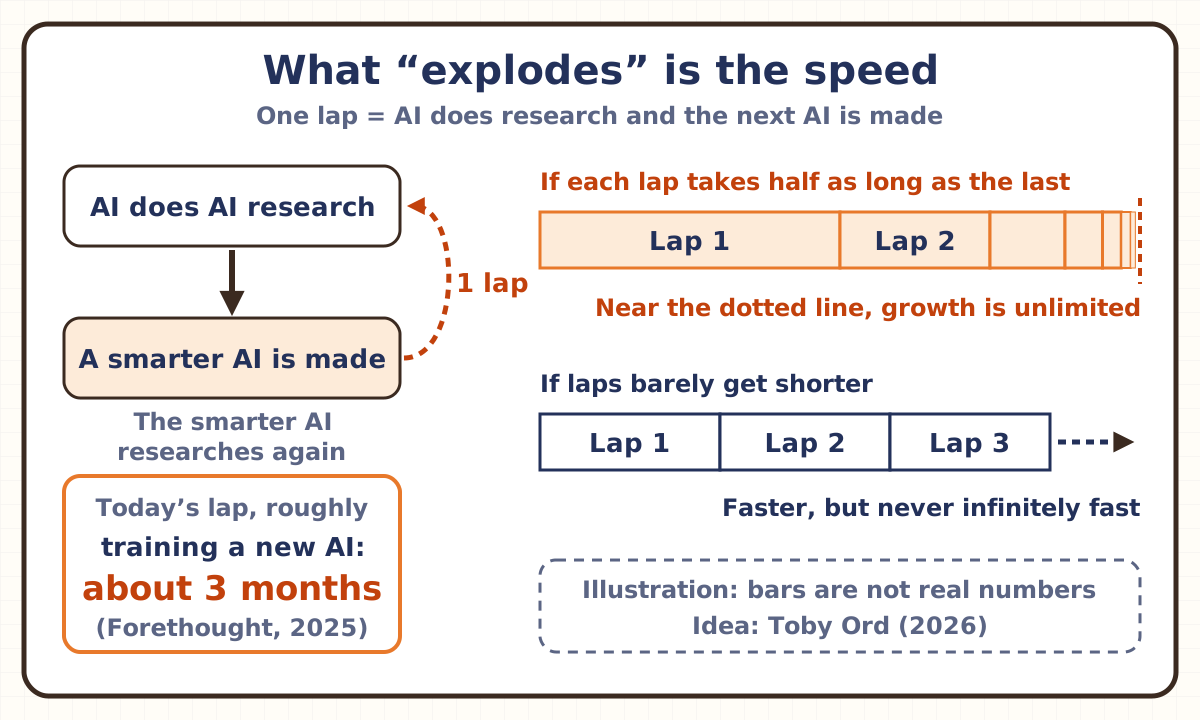
What “explodes” is not intelligence itself but the speed of improvement. A smarter AI might build the next AI better and faster. And AI can be copied and run many times at once. Some argue that automating AI research would be like adding millions of researchers. The loop of AI building the next AI is called recursive self-improvement.
Researchers disagree on whether it will happen and how fast. Sources from 2026 say AI now helps a lot with AI research, but has not yet reached the stage of building one AI after another on its own.
A common mix-up
“The intelligence explosion (the singularity) is set to happen in 2045.”
The year 2045 does come from a real forecast, by the inventor Ray Kurzweil. The publisher’s description of his 2024 book says that “by 2045, we will be able to connect our brains directly with AI, enhancing our intelligence a millionfold” and that “this is the Singularity.” But that is one person’s forecast. In 1993, the mathematician Vernor Vinge wrote, “I’ll be surprised if this event occurs before 2005 or after 2030,” and the 2025 scenario “AI 2027” imagined superintelligence arriving in 2027. Some researchers think there will be no explosion at all. And while the singularity overlaps with the intelligence explosion, people use the word in different ways.
Explained in pictures
Think of it like this
A snowball rolling downhill
Roll a small snowball down a snowy slope, and it picks up snow with every turn. The bigger it gets, the more snow sticks with each turn, so it grows faster and faster. The idea of an intelligence explosion is similar: the smarter an AI gets, the better it can do the research that builds the next AI.
But a snowball does not grow forever. It stops when the slope ends, and it grows more slowly if there is little snow or the snow is too powdery to stick. For AI, these are like the limited amount of computing power, the time it takes to run experiments to check whether an improvement really worked, and improvements getting harder to find.
The comparison has limits. There is only one snowball, but AI can be copied many times. And no one knows yet what kind of slope we are on, or what kind of snow. That is why people disagree about whether an intelligence explosion will happen.
Key points
What exactly “explodes”?
The idea is often traced back to a 1965 paper (1966 in some listings) by the British mathematician I. J. Good. He defined an “ultraintelligent machine” as one that can far surpass all the intellectual activities of any person, however clever. Since designing machines is one of those activities, he wrote, such a machine could design even better machines; there would then unquestionably be an “intelligence explosion,” and human intelligence would be left far behind.
Good went on: “the first ultraintelligent machine is the last invention that man need ever make,” but only “provided that the machine is docile enough to tell us how to keep it under control.”
Today’s researchers think of the “explosion” in terms of speed. A September 2026 paper whose authors include the AI researchers Geoffrey Hinton and Yoshua Bengio describes an intelligence explosion as one “where years of AI progress are compressed into months or less.” In an August 2026 paper, the philosopher Toby Ord focused on the time it takes to go around the loop of AI doing research and the next AI being made. For growth to shoot up without limit toward a certain point in time, he argues, that lap time must rapidly approach zero. Even without that, he adds, growth can still be faster than steady doubling.
How is it different from the singularity and superintelligence?
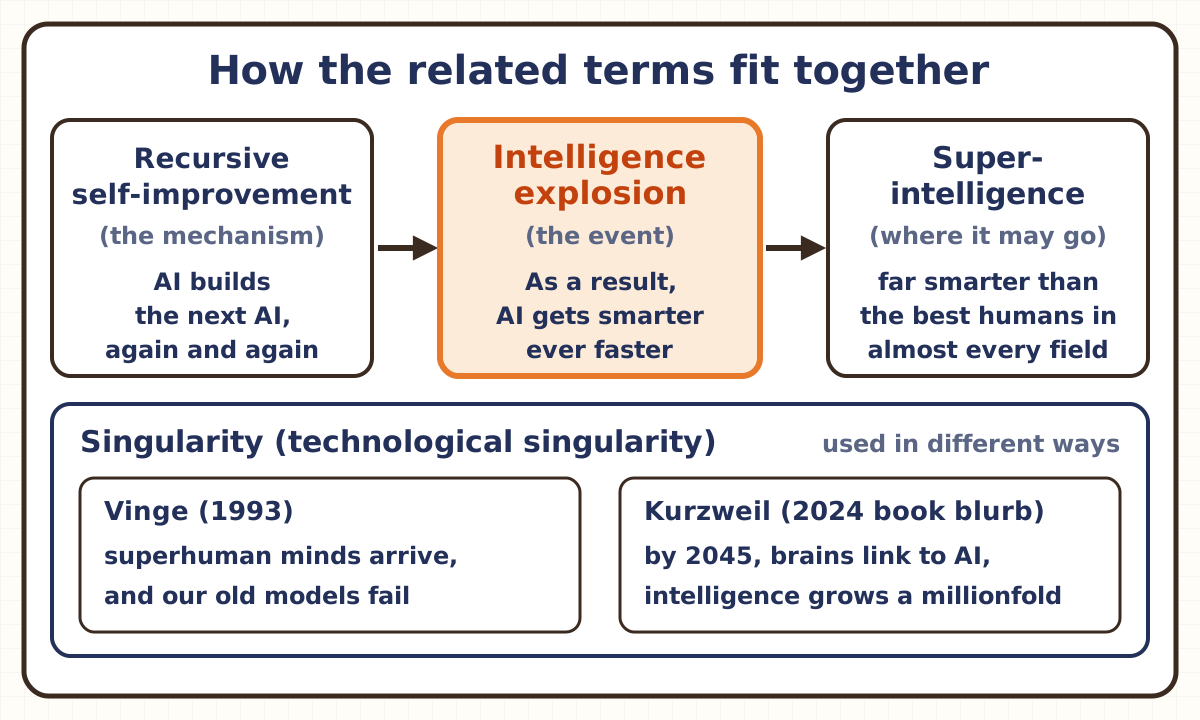
“Singularity” (the technological singularity) was popularized by the mathematician Vernor Vinge of San Diego State University in an essay he presented in 1993 at a symposium sponsored by NASA and others. Vinge expected a huge change to come from technology creating entities with greater than human intelligence. He called this the Singularity, “a point where our models must be discarded and a new reality rules.”
The inventor Ray Kurzweil uses the same word in a somewhat different way. The publisher’s description of his 2024 book says that “by 2045, we will be able to connect our brains directly with AI, enhancing our intelligence a millionfold. This is the Singularity.”
“Superintelligence,” as the philosopher Nick Bostrom described it in 1998, is “an intellect that is much smarter than the best human brains in practically every field, including scientific creativity, general wisdom and social skills.” Put together: the loop of AI building the next AI is recursive self-improvement (the mechanism), the sudden speed-up that results is the intelligence explosion (the event), and where it may lead is superintelligence. Because “singularity” means slightly different things to different people, it helps to check whose meaning is being used.
How fast could it be?
Views vary. In 1993, Vinge wrote that the change might come “perhaps in the blink of an eye.” On the other hand, in a June 2025 blog post, Sam Altman, the head of OpenAI (the company that makes ChatGPT), wrote that “the takeoff has started,” but also that “the singularity happens bit by bit” (this is a company head’s view).
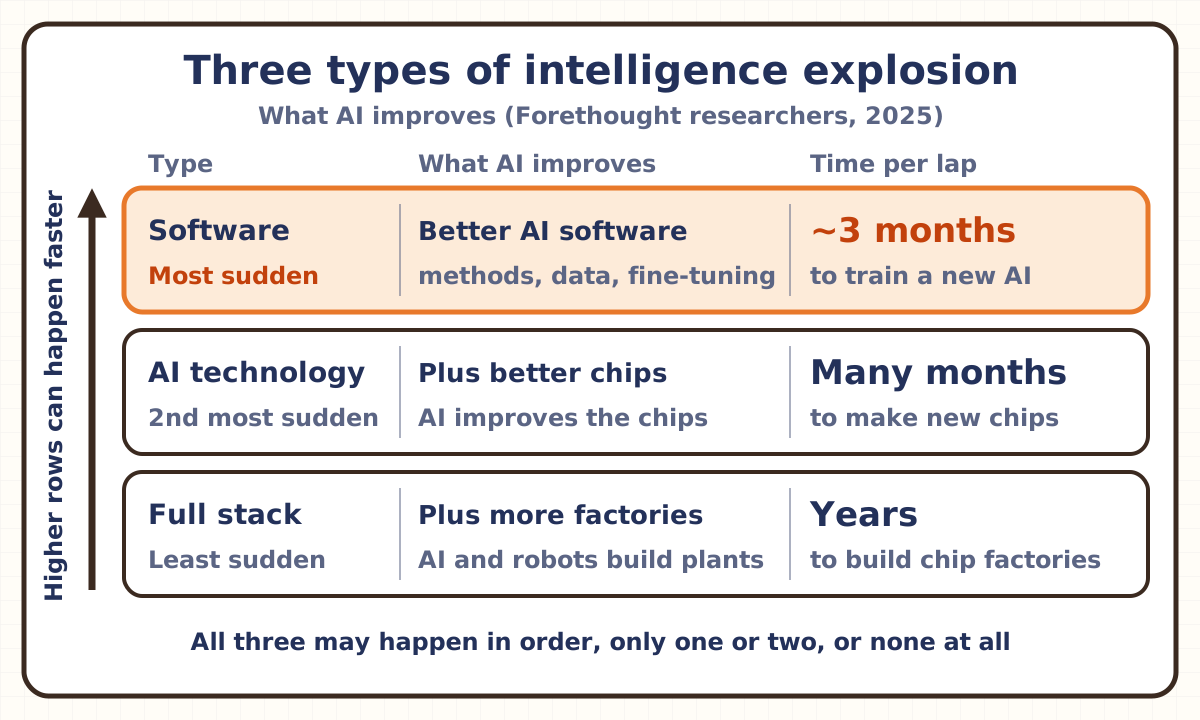
In 2025, researchers at the research group Forethought sorted intelligence explosions into three types by what AI improves: a “software” type, where AI improves AI software (such as training methods and data); an “AI technology” type, where it also improves the chips themselves (the parts that do the computing); and a “full stack” type, where it also adds chip factories. One lap takes about 3 months to train a new AI, many months to make new chips, and years to build factories, so they see the software type as the one that could happen most suddenly.
There are also numerical estimates. In 2025, Tom Davidson and Tom Houlden of the same group estimated that once AI can fully automate AI research, a software intelligence explosion has about a 60% chance of compressing more than 3 years of AI progress into less than a year, and about a 20% chance of compressing more than 10 years into less than a year. They add that the analysis “is necessarily speculative.”
The scenario (a forecast told as a story) “AI 2027,” published in April 2025, imagines an AI that is a superhuman coder in March 2027 and superintelligence by December of that year. Its authors put their median for the time from a superhuman coder to superintelligence at about a year, with wide error margins. But in November 2025 they added: “we don’t know exactly when AGI will be built,” and “2027 was our modal (most likely) year at the time of publication, our medians were somewhat longer.”
Why do some expect it?
First, AI research is itself thinking work, such as writing code and designing experiments. In 1998, the philosopher Bostrom wrote that once AI reaches human level, there will be a positive feedback loop: “AIs would help constructing better AIs, which in turn would help building better AIs, and so forth.”
Second, AI can be copied. The September 2026 paper says that today only thousands of researchers work on frontier AI research, but because AI systems can be copied and run in parallel, automating this work could add the equivalent of millions more. Davidson and Houlden’s estimate also starts from a world where AI can replace each researcher at an AI company with 30 equally capable AI systems, each thinking 30 times faster than a person.
Third, software can improve without waiting for new chips. In 2025, Daniel Eth and Tom Davidson of Forethought wrote that once AI can do the work of AI researchers, it “seems at least decently likely” that software improvements alone would cause an intelligence explosion even without more computing power, though they “can’t be confident either way.” In 2025, William MacAskill and a co-author from the same group wrote that AI that can speed up research “could drive a century of technological progress over just a few years.”
Why do others doubt it?
In a 2017 essay, the AI researcher François Chollet argued that an intelligence explosion is unlikely. Intelligence, he wrote, works only together with the body (senses and movement) and the surroundings, so improving the brain alone cannot make it grow without end. Even in a system that keeps improving itself, other parts start to act as bottlenecks and gains shrink, so in practice such systems “tend to display linear or sigmoidal improvement.” He also wrote that scientific progress is measurably linear, and that physics made no greater progress over 1950–2000 than over 1900–1950.
Other limits are named too: the limited amount of computing power (Eth and Davidson also weigh the objection that without more computing power, software gains might dry up); the long time it takes to learn whether an improvement really worked (International AI Safety Report 2026); and improvements becoming harder to find.
In 2024, researchers at the institute Epoch AI estimated how much software gets better when more research effort is put in (the returns to research). If each doubling of software ability needs less than twice the effort of the last (returns above 1), progress keeps speeding up; if it needs more than twice (below 1), progress slowly decelerates. For chess software the estimate was about 0.83, just shy of the threshold of 1. In four other areas, such as image recognition, the central estimates were above 1, but the researchers do not believe the current data provide strong evidence that software alone could explode.
How far along are we?
AI now helps a lot with the work of building AI. The International AI Safety Report 2026 (February 2026, by over 100 experts, backed by over 30 countries and international organizations) says AI is increasingly used to speed up AI research itself. But it also says there is minimal empirical understanding of the feedback loops from AI automating its own research and development.
Anthropic (the company that makes the AI Claude) reported that as of August 2026, Claude “leads” 26% of its AI research and development work (a person gives a high-level prompt and supervises), up from under 1% in February 2026. It also says Claude is not operating fully autonomously for any measured part of that work (these are the company’s own measurements).
In a 2026 report, Anthropic also wrote, “We are not there yet, and recursive self-improvement is not inevitable.” Every capability it could measure has so far followed the same curve, it says, and “we have not yet seen that curve bend” (this is the company’s view).
The September 2026 paper by Hinton, Bengio and others says an intelligence explosion could be the most consequential technological development in history, and urges policymakers, including heads of government, to understand and prepare for it now. It also says some experts think AI research and development could be fully automated within the next few years.
Why does it matter?
If change comes too fast, society may not have time to prepare. The International AI Safety Report 2026 says it is still unclear how much automating AI research will speed up AI progress, and that this uncertainty creates extreme planning challenges for policymakers and institutions: if each AI advance that speeds up AI research also helps the next one, “decades of progress could happen in years.”
The September 2026 paper says an intelligence explosion could bring unprecedented breakthroughs in science and industry sooner, but also risks arriving faster than society can adapt (such as AI-enabled pandemics, cyber attacks and large-scale job disruption), and the risk that people have little oversight of automated AI research and superintelligent systems escape human control. So it proposes steps such as letting governments see how far AI research at companies has been automated, and setting a “speed limit” on how fast capabilities grow.
Back in 1965, Good added the condition that the machine be “docile.” How to keep AI safe has been tied to the idea of an intelligence explosion from the very start.
Check yourself
Q1Of the three types of intelligence explosion, which did Forethought researchers say could happen most suddenly?
Answer and explanation
Answer: B AI gets smarter by making the software better
The software type. Its lap is the shortest: about 3 months to train a new AI. Making new chips takes many months and building factories takes years, so the other two types would not happen as suddenly as the software type.
Q2What kind of point is the “singularity” that Vinge popularized in 1993?
Answer and explanation
Answer: C A point where smarter-than-human minds arrive and we can’t see ahead
Vinge called the change that would come from technology creating greater-than-human intelligence the Singularity, “a point where our models must be discarded and a new reality rules.” Linking brains to AI to boost intelligence is the prediction for 2045 in the description of Kurzweil’s 2024 book (a millionfold, it says). What Vinge had in mind was not AI merely matching people, but intelligence greater than ours.
More on this → Key points: How is it different from the singularity and superintelligence?
Q3In 2017, why did Chollet think an intelligence explosion is unlikely?
Answer and explanation
Answer: A Because intelligence works tied to the body and the surroundings
Chollet argued that intelligence does not work in the brain alone but together with the body and the surroundings, so improving the brain alone cannot make it grow without end. Even a self-improving system runs into bottlenecks, he wrote, so growth tends to be linear or S-shaped. Ties to feelings or to computing speed are not the reasons from Chollet described on this page.
Related terms
- Recursive self-improvement
- Superintelligence
- Singularity
- Artificial general intelligence
- AI agent
- Machine learning
Sources and how we checked
- I. J. Good, "Speculations Concerning the First Ultraintelligent Machine" (Advances in Computers, vol. 6, 1965)
- Vernor Vinge, "The Coming Technological Singularity: How to Survive in the Post-Human Era" (VISION-21 Symposium, sponsored by NASA and others, March 1993)
- Nick Bostrom, "How Long Before Superintelligence?" (1998)
- Ray Kurzweil, The Singularity Is Nearer (2024), publisher’s description (Penguin)
- François Chollet, "The implausibility of intelligence explosion" (Medium, 2017; first titled "The impossibility of intelligence explosion")
- Eliezer Yudkowsky, "A reply to Francois Chollet on intelligence explosion" (MIRI, December 6, 2017; quotes and answers Chollet’s essay)
- Besiroglu, Erdil and Ho, "Do the returns to software R&D point towards a singularity?" (Epoch AI, May 17, 2024)
- Daniel Eth and Tom Davidson, "Will AI R&D Automation Cause a Software Intelligence Explosion?" (Forethought, March 26, 2025)
- Tom Davidson, Rose Hadshar and William MacAskill, "Three Types of Intelligence Explosion" (Forethought, March 17, 2025)
- William MacAskill and Fin Moorhouse, "Preparing for the Intelligence Explosion" (Forethought, March 11, 2025)
- Tom Davidson and Tom Houlden, "How quick and big would a software intelligence explosion be?" (Forethought, August 4, 2025)
- Kokotajlo et al., "AI 2027" (scenario, April 3, 2025; notes added through November 22, 2025 and later)
- Kokotajlo and Lifland, "Takeoff Forecast" (AI 2027 research, April 2025)
- Sam Altman, "The Gentle Singularity" (June 2025)
- International AI Safety Report 2026 (February 3, 2026)
- Anthropic, "When AI builds itself" (2026; updated September 18, 2026)
- Anthropic, "Measurements for understanding the pace of AI development inside frontier labs" (2026; figures as of August 2026)
- Toby Ord, "The Dynamics of Intelligence Explosions" (arXiv, August 2026)
- Chan et al. (including Hinton and Bengio), "What If Automating AI R&D Triggers an Intelligence Explosion?", research summary (GovAI, September 28, 2026)
AI wrote this page from the sources above, and a different AI checked it against the text of those sources (November 8, 2026). A person with a master’s degree in science and a Japanese high-school science teaching license also read and checked it before publishing. Numbers are as of that date. If anything was hard to follow, you spot a mistake, or there’s a term you’d like explained, please write to [email protected].