 Naru News日本語
What is deep learning?

In one minute
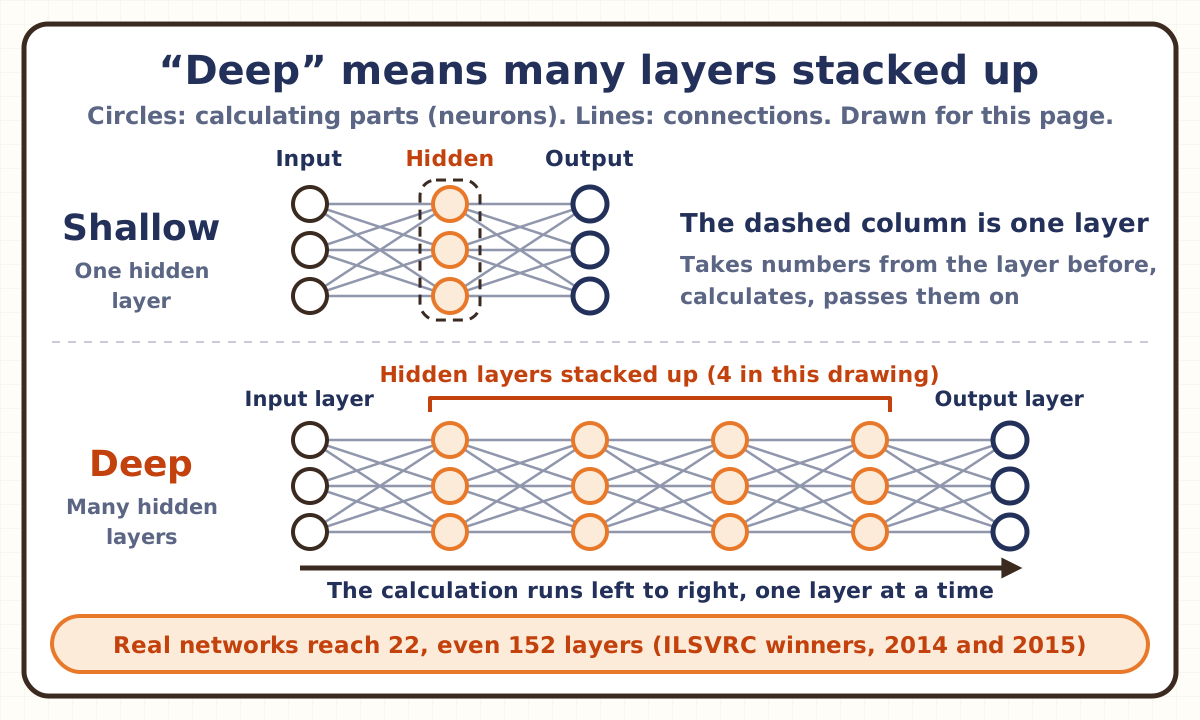
Deep learning is a kind of machine learning in which a neural network (a system of small calculating parts linked together) with many stacked layers learns from large amounts of data.
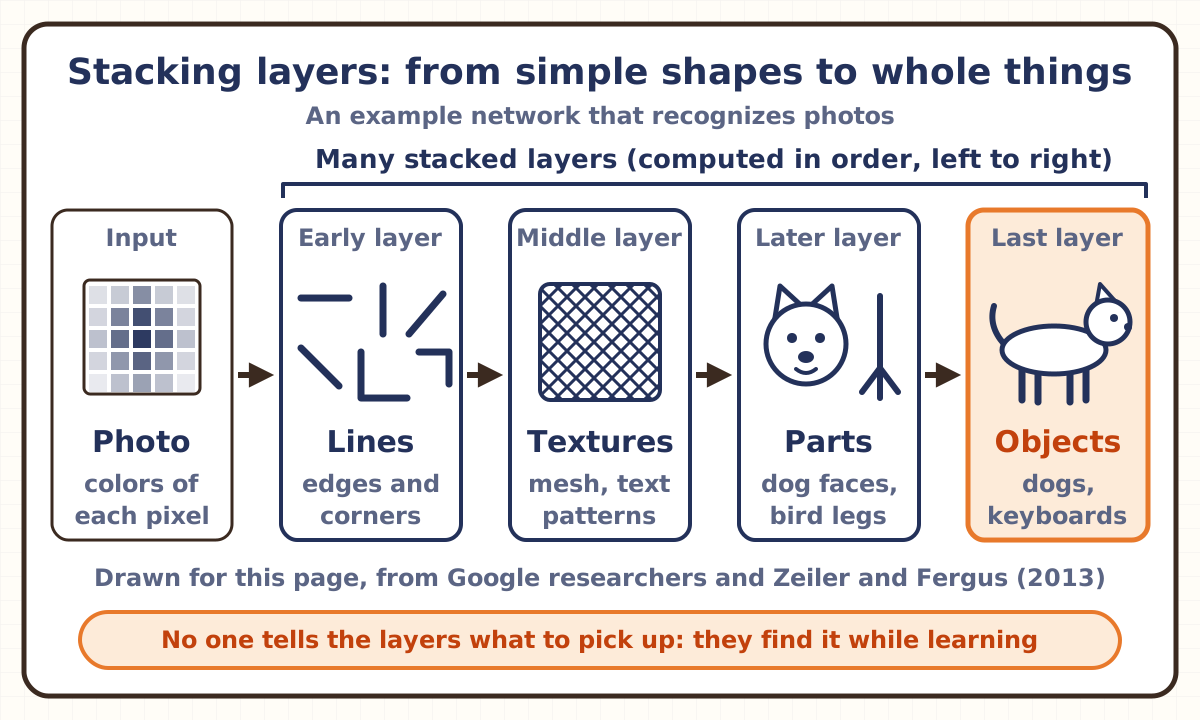
Stacking layers lets it build complex things out of simple ones. In a network that recognizes photos, early layers pick up lines and corners, middle layers textures and parts, and later layers whole objects. The big difference from earlier methods is that people don’t have to decide which clues in a photo to use: the layers find them while learning.
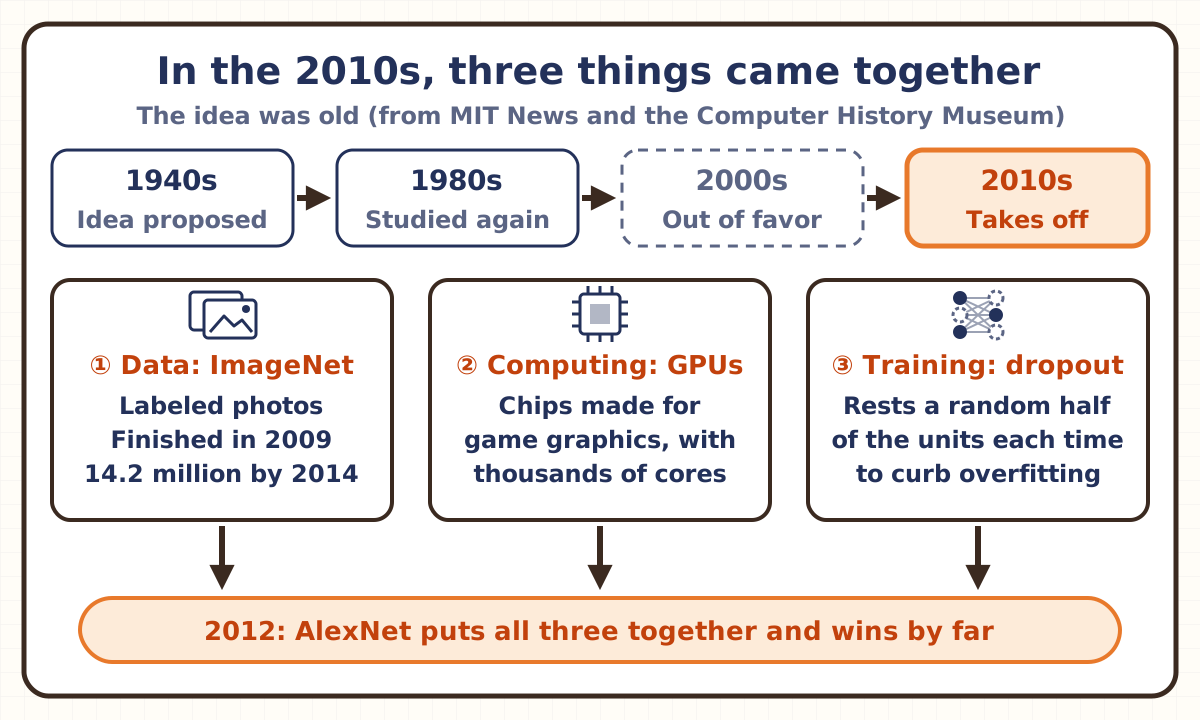
The idea is old, but it took off in the 2010s. Huge datasets and fast computing on chips built for game graphics (GPUs) came together, and in 2012 a deep learning network won a photo recognition contest by a wide margin. Today it is also used in speech recognition and in chat AIs like ChatGPT.
A common mix-up
“The deeper you make it, the smarter the AI gets.”
Half right. In the ILSVRC photo contest, a 22-layer network won in 2014 and a combination of networks up to 152 layers deep won in 2015, and deeper networks kept cutting the error rate. But just adding layers can make things worse. In 2015, when Microsoft researchers simply stacked layers, a 56-layer network made more mistakes than a 20-layer one, even on the data it learned from. That was not overfitting. So they added “shortcuts” that skip over a few layers and pass the input ahead, and then even 152 layers could learn well. Making use of depth takes smarter ways of training.
Explained in pictures
Think of it like this
From lines to letters, from letters to words
The stacked layers of deep learning are like the steps you go through when you read. What your eyes take in first are lines and dots. Lines combine into letters, letters line up into words, and words line up into the meaning of a sentence. Each step uses what the step before it found as material and picks out a bigger chunk.
Deep learning that recognizes photos works the same way: early layers pick up lines and corners, middle layers textures and parts, and later layers whole objects. With only a few steps, you would have to jump from lines straight to meaning. With more steps, each one can stay simple, and together they can represent complex things.
But the comparison has limits. People are taught the shapes of letters and how to read them. In deep learning, no one tells each layer what to pick up. While seeing many examples, the layers make up their own chunks that help them get the answer. Those chunks only become clear when people investigate, and some are hard to put into words.
Key points
What is “deep” about it?
The number of layers. In a 2015 review in the journal Nature, Yann LeCun, Yoshua Bengio and Geoffrey Hinton described deep learning as letting computer models made of many processing layers learn to represent data at multiple levels of abstraction. MIT (Massachusetts Institute of Technology) News likewise explains that the “deep” in deep learning refers to the depth of the network’s layers.
In a neural network, small parts that take in numbers and calculate (neurons) are lined up to form a layer. When data goes into the first layer, the input layer, each layer takes the results from the one before, calculates, and passes them on, until the last layer, the output layer, gives the answer. Google’s machine learning glossary calls a neural network with more than one layer between input and output (more than one hidden layer) a “deep model.” How a neural network works inside (nodes, weights and how it learns) is explained on the “Neural network” page.
According to the MIT News explainer, networks had one layer in the 1960s and two or three in the 1980s, but modern GPUs let them grow to 10, 15, even 50 layers (as of 2017). In the ILSVRC photo contest, the 2014 winner, GoogLeNet, had 22 layers, and the 2015 winner, ResNet, had up to 152.
What does stacking layers make possible?
Each layer can combine what the layer before it found to represent something more complex. In 2015, Google researchers explained that a network that recognizes photos usually has 10 to 30 stacked layers: the first layer may look for edges or corners, middle layers combine those to look for overall shapes or parts, like a door or a leaf, and the last layers put them together into a complete interpretation.
In 2013, Matthew Zeiler and Rob Fergus made it possible to see what kinds of images each layer of a trained network responds to most strongly. The second layer responded to corners and combinations of edges and colors; the third to textures like mesh patterns and text; the fourth to parts like dog faces and birds’ legs; and the fifth to whole objects like dogs and keyboards. The paper says this shows the features are built up in levels.
The key point is that no person decides what each layer picks up. In 1986, David Rumelhart, Geoffrey Hinton and Ronald Williams wrote in Nature about adjusting the strengths of the connections again and again to shrink the gap between the network’s answer and the right one (backpropagation). When you do, the in-between neurons, neither input nor output, come to represent features that matter for the task. The 2015 ResNet paper also says the levels of features can be enriched by the number of stacked layers (depth).
How is it different from ordinary machine learning?
Deep learning is a kind of machine learning too, but it gets its clues (features) differently. In earlier methods, people often designed the recipe for turning a photo into features, deciding what to pay attention to. For example, the NEC team that won the ILSVRC photo contest in 2010 turned photos into lists of numbers using feature recipes designed by researchers, called SIFT and LBP, and then sorted them with machine learning.
The University of Toronto team that won in 2012 fed the color values of a photo’s pixels (RGB values) straight into a deep network and trained it (according to the paper summing up the contest). Google’s machine learning course likewise explains that a neural network learns good ways to combine the clues in the data on its own as it trains, so people don’t have to try out many options by hand.
Some networks have even found clues without being told the answers. In 2012, a Google research team showed a network lots of unlabeled images taken from YouTube videos. No one ever told it “this is a cat,” yet one neuron inside the network came to respond to cats. According to the paper, the network had 9 layers and about 1 billion connections, and it was trained for three days on 1,000 computers (16,000 processor cores).
How deep learning relates to AI and machine learning is on the “Machine learning” page: machine learning is inside AI, and deep learning is inside machine learning, like nested boxes.
Why did it suddenly take off in the 2010s?
The idea itself had been around for a long time. According to the MIT News explainer, neural networks were first proposed in the 1940s, became a busy research area again in the 1980s, fell out of favor in the 2000s, and came roaring back in the 2010s.
The same explainer says the comeback was fueled largely by computing power. Chips built for drawing game graphics (GPUs) pack thousands of simple processing cores onto one chip, and researchers realized that this design is remarkably like a neural network. A Computer History Museum article likewise explains that training a neural network involves lots of repeated multiplications, best done at the same time, and that NVIDIA’s CUDA system, released in 2007, made GPUs easier to use for work other than graphics.
The data came together too. ImageNet, a collection of photos that the researcher Fei-Fei Li began in 2006, was completed in 2009 and was larger than any earlier image collection by several orders of magnitude (the museum article). By August 2014 it held about 14.2 million labeled photos. The photo contest uses about 1.2 million of them for training, sorted into 1,000 categories (the paper summing up the contest).
Better ways of training were added as well. In 2012, Hinton and colleagues reported that “dropout,” randomly switching off half of the neurons for each training example, greatly reduces overfitting. The museum article says the University of Toronto’s 2012 network (AlexNet) was the first to bring deep neural networks, big datasets and GPU computing together, and that each of these needed the others.
What happened at the 2012 photo contest?
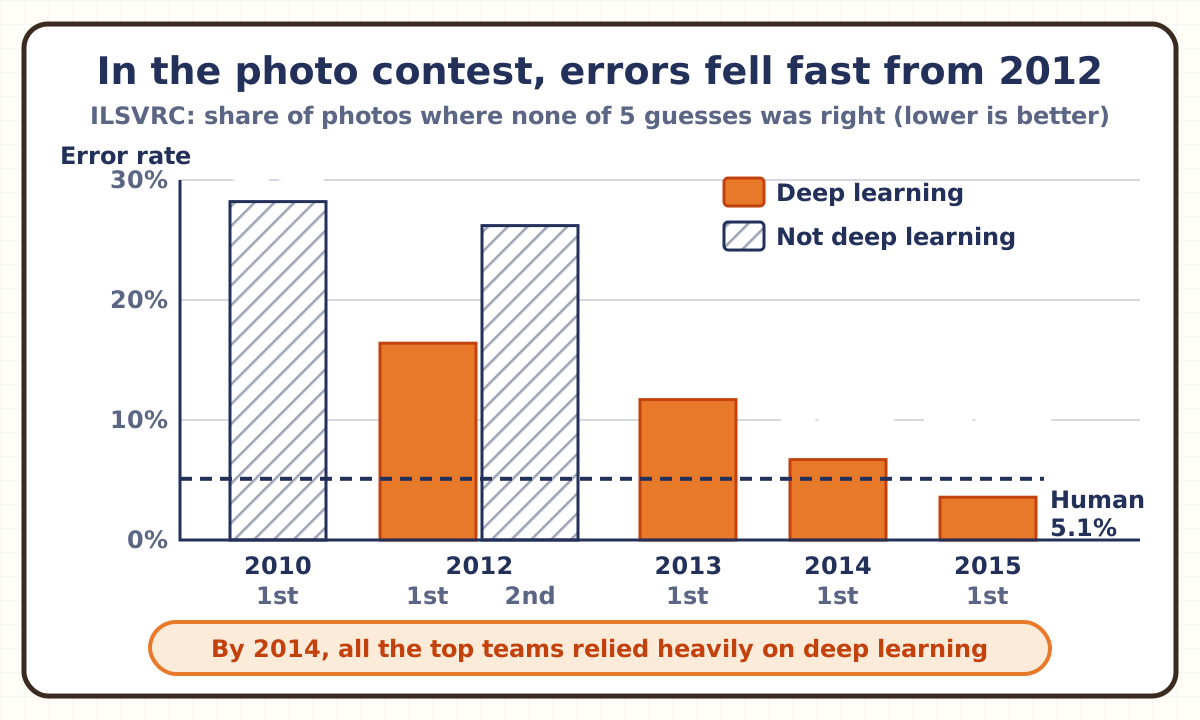
ILSVRC, a contest to name what is in photos, was held every year from 2010. For each photo, a system may give up to five guesses, and the contest compares the share of photos where none of the five was right (lower is better). When the contest began, the winner’s rate was 28.2% (the paper summing up the contest).
In 2012, a team (SuperVision) of University of Toronto graduate students Alex Krizhevsky and Ilya Sutskever and their advisor Hinton got 16.4% with a deep network that had 60 million parameters (the numbers used in its calculations); a version also trained in advance on other photos got 15.3%. Second place got 26.2%, a wide gap. The network was trained on a computer with two NVIDIA GPUs, in Krizhevsky’s bedroom at his parents’ house (the museum article).
The paper summing up the contest calls this a turning point, when large deep neural networks entered the scene. The museum article says that before AlexNet, almost none of the leading computer vision papers used neural networks, and afterward almost all of them did. By 2014, all the top teams in the contest relied heavily on deep learning (convolutional neural networks). The winning error rate fell to 6.7% in 2014 and 3.57% in 2015.
How about compared with people? In the contest paper, one expert who had practiced on 500 photos was tested on 1,500 photos and got 5.1%. On the same photos, the 2014 winner, GoogLeNet, got 6.8%, so at that point the person was better. In February 2015, Microsoft researchers got 4.94% and wrote that, to their knowledge, it was the first result to surpass human-level performance (5.1%). But the kinds of mistakes differ: according to the contest paper, the machine (GoogLeNet) struggles with very small or thin objects, while the person tends to slip when telling apart closely similar fine-grained categories.
Are more layers always better?
Not necessarily. In 2015, Microsoft researchers asked in the ResNet paper, “Is learning better networks as easy as stacking more layers?” When they simply stacked layers and tested the networks on a set of photos (CIFAR-10), a 56-layer network made more mistakes than a 20-layer one, both on the data it learned from and on test data.
The paper says this was not caused by overfitting. Overfitting means memorizing the training data so well that the network does well on it but fails on data it has never seen. With overfitting, the mistakes on the data used for learning would, if anything, be small (see the “Machine learning” page). The deeper the network, the harder it becomes to train it well in the first place.
So the paper added “shortcuts” that skip over a few layers, passing the input straight ahead and adding it to what the layers produce. The shortcuts add no extra parameters and no extra calculation. With them, even 152 layers could be trained, and a combination of ResNets of different depths won first place in classification at the 2015 ILSVRC photo contest (3.57%). Depth makes a network stronger only once training is done the right way.
What are its weak spots?
It can be fooled by changes too small for people to notice. In 2013, Christian Szegedy and colleagues showed that adding a change to a photo so small that the human eye can’t see it can make a network misidentify the photo. The same change could also fool a different network trained on a different subset of the same data.
Even the people who build these networks don’t always know why they work. In 2015, Google researchers wrote that they actually understand surprisingly little of why certain models work and others don’t. Research that looks at what each layer picks up, like Zeiler and Fergus’s, is partly a way to find out.
Needing lots of data and computing is another weak spot. The Google experiment in which a cat-detecting neuron emerged took three days on 1,000 computers. And because deep learning is a kind of machine learning, it also picks up any skew in the data it learns from (see the “Machine learning” page).
Where is it used?
Beyond photos, it also succeeded early in speech recognition, which turns voices into text. A 2012 paper written jointly by four research groups reported that deep networks with many hidden layers, trained with new methods, beat the method used until then (Gaussian mixture models) on a variety of tests, sometimes by a large margin.
AIs that write text, like ChatGPT (large language models), are deep learning too. Their most widely used design, the Transformer, stacks many layers into an enormous neural network (Google’s course). The 2020 GPT-3 had 96 layers and 175 billion parameters (see the “Transformer” and “Large language model” pages).
The 2024 Nobel Prize in Physics went to John Hopfield and Geoffrey Hinton “for foundational discoveries and inventions that enable machine learning with artificial neural networks.” The Royal Swedish Academy of Sciences, which announced it, wrote that Hinton invented a method that can find properties in data on its own, and that he helped start today’s explosive development of machine learning.
Check yourself
Q1When building an AI that recognizes photos, how does deep learning differ most from earlier methods?
Answer and explanation
Answer: C It finds the clues in photos by itself while learning
In earlier methods, people often designed the recipe for picking out clues (features) from a photo; the team that won the 2010 photo contest used recipes designed by researchers, called SIFT and LBP. In deep learning, the color values of the pixels go in as they are, and the layers find the clues while learning. It actually needs lots of photos to learn from (the contest used about 1.2 million photos for training).
More on this → Key points: How is it different from ordinary machine learning?
Q2In 2012, a University of Toronto team won the ILSVRC photo contest by a wide margin with a deep learning network. What kind of computer was that network trained on?
Answer and explanation
Answer: A One using two chips made for game graphics
It was trained on a computer with two NVIDIA GPUs, in the bedroom of team member Krizhevsky at his parents’ house (Computer History Museum). GPUs were first made for drawing game graphics, and because they can do lots of simple calculations at the same time, they suited the calculations of neural networks.
More on this → Key points: What happened at the 2012 photo contest?
Q3Just stacking layers can make a deep neural network hard to train well. In 2015, Microsoft researchers added one idea that let even a 152-layer network learn (ResNet). What did they add?
Answer and explanation
Answer: B A way to skip over a few layers and pass the input ahead
They added “shortcuts” that skip over a few layers, pass the input straight ahead, and add it to what those layers produce. Deeper does not always mean more mistakes: in the photo contest, a 22-layer network won in 2014, and a combination of networks up to 152 layers deep won in 2015. But the deeper a network, the harder it is to train, and when layers were simply stacked, making a network deeper could even increase its mistakes. The shortcuts helped with that. Resting half the neurons is dropout, a different idea that prevents overfitting. And no one sets what each layer picks up: the layers find it while learning.
Related terms
- Machine learning
- Neural network
- Transformer
- Large language model
- Reinforcement learning
- Artificial intelligence
Sources and how we checked
- LeCun, Bengio and Hinton, "Deep learning" (Nature, vol. 521, May 27, 2015; abstract; read November 8, 2026)
- Larry Hardesty, "Explained: Neural networks" (MIT News, April 14, 2017; read November 8, 2026)
- Google, "Machine Learning Glossary" (entry for deep model; read November 8, 2026)
- Mordvintsev, Olah and Tyka, "Inceptionism: Going Deeper into Neural Networks" (Google Research blog, June 18, 2015; read November 8, 2026)
- Zeiler and Fergus, "Visualizing and Understanding Convolutional Networks" (arXiv, November 2013; read November 8, 2026)
- Rumelhart, Hinton and Williams, "Learning representations by back-propagating errors" (Nature, vol. 323, October 9, 1986; abstract; read November 8, 2026)
- Google Machine Learning Crash Course, "Neural networks" (read November 8, 2026)
- Jeff Dean and Andrew Ng, "Using large-scale brain simulations for machine learning and A.I." (Google blog, June 26, 2012; read November 8, 2026)
- Le et al., "Building high-level features using large scale unsupervised learning" (arXiv, December 2011; read November 8, 2026)
- Russakovsky et al., "ImageNet Large Scale Visual Recognition Challenge" (the paper summing up the contest; arXiv, September 2014; read November 8, 2026)
- Hansen Hsu, "CHM Releases AlexNet Source Code" (Computer History Museum, March 20, 2025; read November 8, 2026)
- Krizhevsky, Sutskever and Hinton, "ImageNet Classification with Deep Convolutional Neural Networks" (NIPS 2012; abstract page; read November 8, 2026)
- Hinton et al., "Improving neural networks by preventing co-adaptation of feature detectors" (arXiv, July 2012; dropout; read November 8, 2026)
- Szegedy et al., "Going Deeper with Convolutions" (arXiv, September 2014; GoogLeNet; read November 8, 2026)
- He et al., "Deep Residual Learning for Image Recognition" (Microsoft Research, arXiv, December 2015; ResNet; read November 8, 2026)
- He et al., "Delving Deep into Rectifiers: Surpassing Human-Level Performance on ImageNet Classification" (arXiv, February 2015; read November 8, 2026)
- Szegedy et al., "Intriguing properties of neural networks" (arXiv, December 2013; read November 8, 2026)
- Hinton et al., "Deep Neural Networks for Acoustic Modeling in Speech Recognition" (IEEE Signal Processing Magazine, 2012; Google Research publication page; read November 8, 2026)
- Google Machine Learning Crash Course, "LLMs: What's a large language model?" (Transformers; read November 8, 2026)
- Brown et al., "Language Models are Few-Shot Learners" (OpenAI, arXiv, May 2020; GPT-3; read November 8, 2026)
- Royal Swedish Academy of Sciences, "The Nobel Prize in Physics 2024" (press release, October 8, 2024; read November 8, 2026)
AI wrote this page from the sources above, and a different AI checked it against the text of those sources (November 8, 2026). A person with a master’s degree in science and a Japanese high-school science teaching license also read and checked it before publishing. Numbers are as of that date. If anything was hard to follow, you spot a mistake, or there’s a term you’d like explained, please write to [email protected].