 Naru News日本語
What is a neural network?
Also called: Artificial neural network, Neural net

In one minute
A neural network is a way of calculating used in AI, built from many small parts (nodes) arranged in layers and connected, each taking in numbers, working on them and passing a number on.
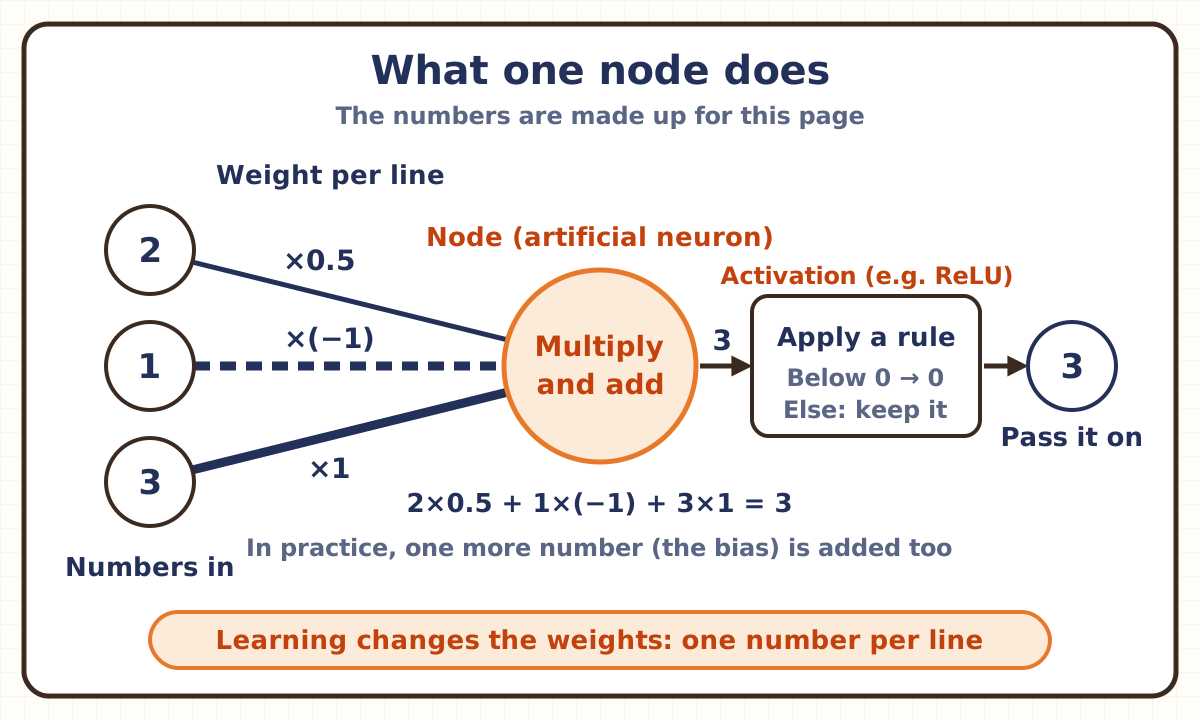
What one node does is simple. It multiplies each number coming in by a number called a “weight,” adds them up, puts the total through a fixed rule and passes the result on. Turn temperatures or photos into numbers and feed them into the input layer; they pass through the hidden layers in between, and an answer comes out of the output layer.
Learning means fixing the weights bit by bit so that the gap between the network’s answer and the right answer gets smaller. The name and idea were borrowed from brain cells (neurons), but a neural network is not a copy of the brain. AIs like ChatGPT are enormous neural networks inside.
A common mix-up
“A neural network is a copy of the human brain: a brain inside the computer.”
Half right. The idea did come from the brain. The technology was originally inspired by the structure of the brain: the nodes stand for the brain’s neurons, and the connections between them can be likened to synapses (the junctions between neurons). But only the rough shape was copied. Real neurons come in many types, a synapse is far more than a single number (a weight), and the timing of signals matters too. A node is only a very rough model of a neuron. The field was first inspired mainly by the goal of modeling the brain, but has since moved away from that and become a matter of engineering, of getting good results in machine learning.
Explained in pictures
Think of it like this
Rows of people passing numbers along
A neural network is like rows of people who settle on an answer by passing numbers along. Each person in the first row holds one number, such as the temperature or the humidity. Each person in the second row listens to everyone in the first row, gives some numbers more weight and others less (“this one counts a lot, that one only a little”), adds them up, settles on a number of their own and passes it to the next row. The last row says the answer (say, the amount of rain).
If the answer turns out wrong, the size of the error is passed back, from the last row to the rows before it. Then everyone adjusts, just a little, how much weight they give each person they listen to, in the direction that makes the error smaller. Repeat this with many examples, and the rows as a whole learn a way of listening that gets the answer right.
The comparison has limits. People think about what the numbers mean, but a node just multiplies, adds and applies a fixed rule; it does not know whether a number is a temperature or anything else. And no one tells each person how much weight to give whom: that is settled by fixing the weights again and again.
Key points
What does one node calculate?
A node in a neural network (also called a neuron) does two things: ① it multiplies each number coming in by its own weight and adds them up, and ② it puts that total through a fixed rule called an “activation function.” Each node also adds a number of its own, called the “bias,” to the total in ①. The bias is the same idea as the b in the equation of a line, y = ax + b (where the line crosses the vertical axis). The weights and biases are both numbers that are set by learning (the parameters).
For example, if the numbers coming in are 2, 1 and 3 and the weights are 0.5, −1 and 1, then 2×0.5 + 1×(−1) + 3×1 = 3 (an example made up for this page). ReLU, one of the commonly used activation functions, turns a negative number into 0 and lets anything else through unchanged. In this example, 3 goes on to the nodes in the next layer as it is.
Why is ② needed? However many layers of plain multiply-and-add you stack, the whole thing is still just multiply-and-add, so it cannot learn complicated relationships. Putting a calculation that is not a straight line (a nonlinear one) in ② lets stacked layers represent very complicated relationships.
A system that takes in some numbers, runs a function on their weighted sum and puts out a single number is called a “perceptron,” and the neurons in neural networks are perceptrons. The perceptron is the name of the system Frank Rosenblatt presented in 1958.
How are the layers arranged?
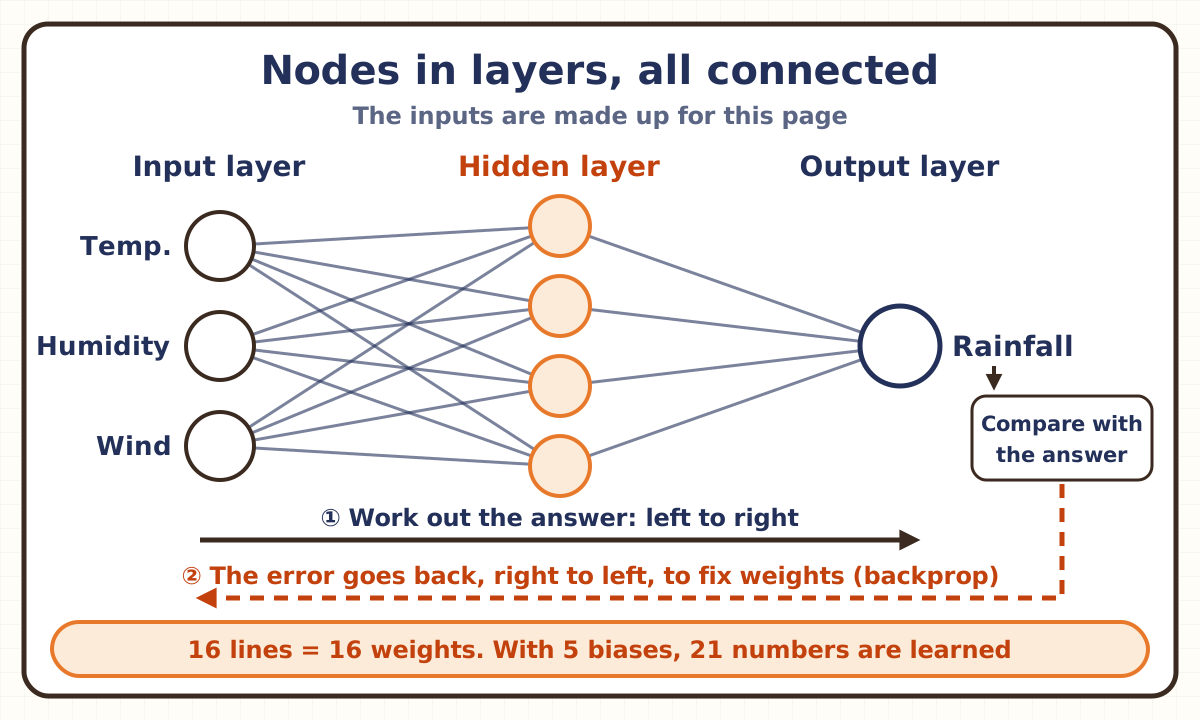
There is an “input layer” where the numbers go in, an “output layer” that gives the answer and “hidden layers” in between. For example, say a hidden layer of four nodes sits between an input layer of three numbers and a single node that gives the answer. Each hidden node has three weights (one for each number coming in) and one bias, and the network has 21 learned numbers in all.
They are called “hidden” because they are inside: neither input nor output. The 1986 paper on backpropagation says that as the weights are adjusted, internal “hidden” units (nodes), which are not part of the input or output, come to represent important features of the task. People do not decide in advance what each node stands for.
A neural network with two or more hidden layers is called a deep neural network. What changes when you stack many layers is explained on the “Deep learning” page.
Big networks have a huge number of learned numbers. Large language models (LLMs) like the ones behind ChatGPT are enormous neural networks too, and the Transformers they are built on contain hundreds of billions or even trillions of parameters (see the “Transformer” page).
What is it doing when it learns?
It is fixing the weights a little at a time. In 1986, David Rumelhart, Geoffrey Hinton and Ronald Williams described a way of learning called “backpropagation” in a paper in the science journal Nature. The method repeatedly adjusts the weights of the connections in the network to shrink the difference between the answer the network actually gives and the answer it should give.
Learning repeats a two-step cycle. ① Put in examples, get answers, compare them with the right answers and measure the error (the loss). ② Adjust the weights of all the nodes in the hidden layers to make the error smaller. Step ② is backpropagation, and it decides whether to increase or decrease each weight. This calculation starts at the output end and works its way back toward the front.
Each fix is small. The number that decides how big each fix is, is called the “learning rate”; the larger it is, the more each weight moves in one step. Backpropagation is what makes “gradient descent,” moving the numbers bit by bit in the direction of smaller mistakes (see the “Machine learning” page), possible for neural networks with many layers.
No one sets the weights one by one. Training is the process of determining a model’s ideal weights. The weights settle as checking answers and fixing them is repeated over many examples.
How is a node like a brain cell, and how is it different?
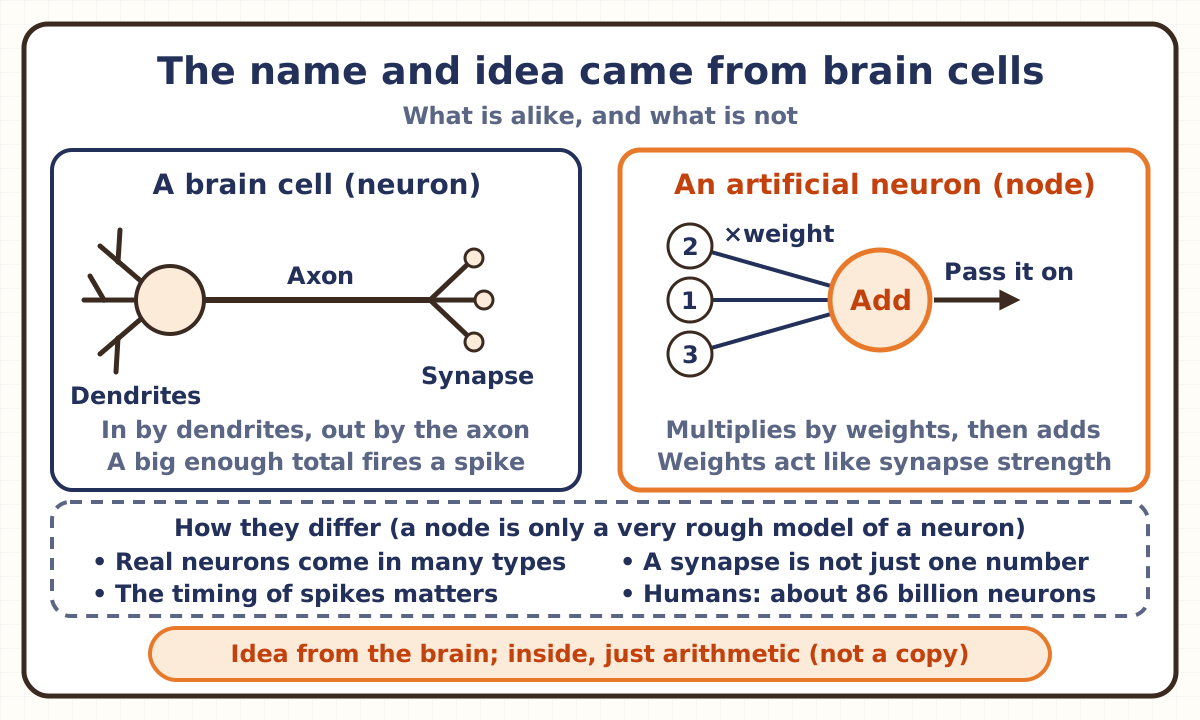
A brain cell (neuron) takes in signals from other cells through its dendrites and sends signals out along its single axon. The axon branches at the end and connects to the dendrites of other neurons at junctions called synapses. If the signals it receives add up to more than a certain threshold, the neuron sends a signal called a “spike” along its axon. The human nervous system has about 86 billion neurons, connected by roughly 100 trillion to 1,000 trillion synapses.
Nodes borrowed this idea. The numbers coming into a node stand for the signals that travel along other neurons’ axons, the weights stand for the strength of the synapses, and the activation function stands for how often the neuron fires. And like synapses, the connections between nodes can be made stronger or weaker.
But this is only a very rough copy. Real neurons come in many types, each with different properties. Dendrites themselves perform complex calculations. A synapse is not a single weight but a complex system that keeps changing. And in many systems, the exact timing of the spikes matters.
The field was originally inspired mainly by the goal of modeling the brain, but has since moved away from that and become a matter of engineering, of getting good results in machine learning. The name and idea came from the brain, but today’s neural networks are not made to copy it.
Who came up with it, and when?
In 1943, Warren McCulloch and Walter Pitts published a paper titled “A logical calculus of the ideas immanent in nervous activity.” Its idea was that because nervous activity is “all-or-none” (a neuron either fires or it doesn’t), it can be handled with logic, the kind of calculation that combines true and false. The abstract says the behavior of every net of neurons can be described this way (with more complicated logic added for nets that contain loops).
In 1958, Frank Rosenblatt, a research psychologist at the Cornell Aeronautical Laboratory, published a paper titled “The perceptron: a probabilistic model for information storage and organization in the brain.” In July that year, the US Office of Naval Research showed off the perceptron. A room-sized IBM 704 computer was fed a series of punch cards, and after 50 trials it taught itself to tell cards marked on the left from cards marked on the right. The New York Times headline read: “New Navy device learns by doing.”
The perceptron, inspired by the way neurons work together in the brain, was a single-layer neural network. In 1969, Marvin Minsky and Seymour Papert attacked Rosenblatt’s work in their book “Perceptrons,” a book said to have essentially sealed its fate. Even so, Cornell professor Thorsten Joachims says Rosenblatt’s algorithm is still fundamental to how deep networks are trained today.
Later, in 1982, John Hopfield published a paper on a network that can recall a whole stored memory from any large enough part of it. In 1985 Hinton and colleagues published a way of training “Boltzmann machines,” and in 1986 Rumelhart, Hinton and Williams published backpropagation.
Why did it win the Nobel Prize in Physics?
On October 8, 2024, the Royal Swedish Academy of Sciences announced that the Nobel Prize in Physics would go to John Hopfield of Princeton University in the US and Geoffrey Hinton of the University of Toronto in Canada, “for foundational discoveries and inventions that enable machine learning with artificial neural networks.” The two used tools from physics to develop methods that are the foundation of today’s powerful machine learning.
Hopfield’s network saves patterns, such as pictures, and recreates them. You can think of its nodes as the dots (pixels) of a picture. It uses physics that describes a material’s properties due to atomic “spin,” a property that makes each atom a tiny magnet. The connections between nodes are given values so that the saved pictures have low “energy.” Feed it a distorted or incomplete picture, and it updates the nodes step by step until it reaches the saved picture most like the one it was fed. Think of each saved picture as a dip in bumpy ground: wherever you set a ball on a slope, it rolls into the nearest dip and stops, and a damaged picture likewise settles on a nearby saved one (this comparison is our own).
Hinton used Hopfield’s network as the foundation for a new network, the “Boltzmann machine.” It uses tools from statistical physics, the science of systems built from many similar parts. Trained on examples, it learns to recognize the characteristic features of a type of data, and it can classify pictures or create new examples of the kind of pattern it was trained on. Hinton built on this work and helped start today’s explosive development of machine learning.
Ellen Moons, chair of the Nobel Committee for Physics, said that physics also uses artificial neural networks in a vast range of areas, such as developing new materials with specific properties.
Check yourself
Q1A node (an artificial neuron) in a neural network takes in numbers from the layer before. What does it do with them before passing a number on?
Answer and explanation
Answer: B Multiplies each by its weight, adds them up and applies a rule
A node multiplies each number coming in by the weight on its line, adds them up (plus a bias), puts the total through a fixed rule called an activation function and passes the result on. For example, with numbers 2, 1 and 3 and weights 0.5, −1 and 1, the total is 3. It does not pick out only the biggest number or take an average.
Q2“Backpropagation,” a way of training neural networks described in a 1986 paper, works to shrink the gap between the network’s answer and the right answer. What does it keep fixing?
Answer and explanation
Answer: A The weights of the connections, nudged toward a smaller gap
Backpropagation passes the gap between the network’s answer and the right answer back from the output end and fixes each connection’s weight a little so that the gap shrinks (Rumelhart, Hinton and Williams, Nature, 1986). It does not change the number of nodes or the order of the examples.
Q3John Hopfield shared the 2024 Nobel Prize in Physics. What happens when you feed the network he invented a distorted or incomplete picture?
Answer and explanation
Answer: C It ends up at the saved picture most like it
In Hopfield’s network, the connections between nodes are given values so that the saved pictures have low “energy.” Feed it a distorted or incomplete picture, and it updates its nodes step by step until it reaches the saved picture most like it.
More on this → Key points: Why did it win the Nobel Prize in Physics?
Related terms
- Deep learning
- Machine learning
- Artificial intelligence
- Transformer
- Large language model
- Reinforcement learning
Sources and how we checked
- Royal Swedish Academy of Sciences, "The Nobel Prize in Physics 2024: They trained artificial neural networks using physics" (announcement, October 8, 2024; read November 8, 2026)
- Google, "Machine Learning Glossary" (entries for neuron, neural network, perceptron, weight, parameter, activation function and backpropagation; read November 8, 2026)
- Google Machine Learning Crash Course, "Linear regression" (the bias and the y-intercept; read November 8, 2026)
- Google Machine Learning Crash Course, "Neural networks: Nodes and hidden layers" (read November 8, 2026)
- Google Machine Learning Crash Course, "Neural networks: Activation functions" (read November 8, 2026)
- Google Machine Learning Crash Course, "Neural Networks: Training using backpropagation" (read November 8, 2026)
- Google Machine Learning Crash Course, "LLMs: What's a large language model?" (Transformers; read November 8, 2026)
- CS231n (Stanford University course, Deep Learning for Computer Vision) notes, "Modeling one neuron" (Biological motivation and connections; read November 8, 2026)
- CS231n (Stanford University) notes, "Intuitive understanding of backpropagation" (read November 8, 2026)
- W. S. McCulloch and W. Pitts, "A logical calculus of the ideas immanent in nervous activity" (The Bulletin of Mathematical Biophysics, vol. 5, pp. 115–133, December 1943)
- F. Rosenblatt, "The perceptron: a probabilistic model for information storage and organization in the brain" (Psychological Review, vol. 65, no. 6, pp. 386–408, 1958)
- Cornell Chronicle, "Professor's perceptron paved the way for AI – 60 years too soon" (Cornell University, September 25, 2019; read November 8, 2026)
- J. J. Hopfield, "Neural networks and physical systems with emergent collective computational abilities" (PNAS, vol. 79, no. 8, pp. 2554–2558, April 1982)
- Geoffrey Hinton's list of papers (University of Toronto; including Ackley, Hinton and Sejnowski, "A learning algorithm for Boltzmann machines," Cognitive Science, vol. 9, 1985; read November 8, 2026)
- D. E. Rumelhart, G. E. Hinton and R. J. Williams, "Learning representations by back-propagating errors" (Nature, vol. 323, pp. 533–536, October 9, 1986)
AI wrote this page from the sources above, and a different AI checked it against the text of those sources (November 8, 2026). A person with a master’s degree in science and a Japanese high-school science teaching license also read and checked it before publishing. Numbers are as of that date. If anything was hard to follow, you spot a mistake, or there’s a term you’d like explained, please write to [email protected].