 Naru News日本語
What is artificial intelligence (AI)?

In one minute
Artificial intelligence (AI) is technology that has computers do some of the work our minds do, such as recognizing things, reasoning and making decisions.
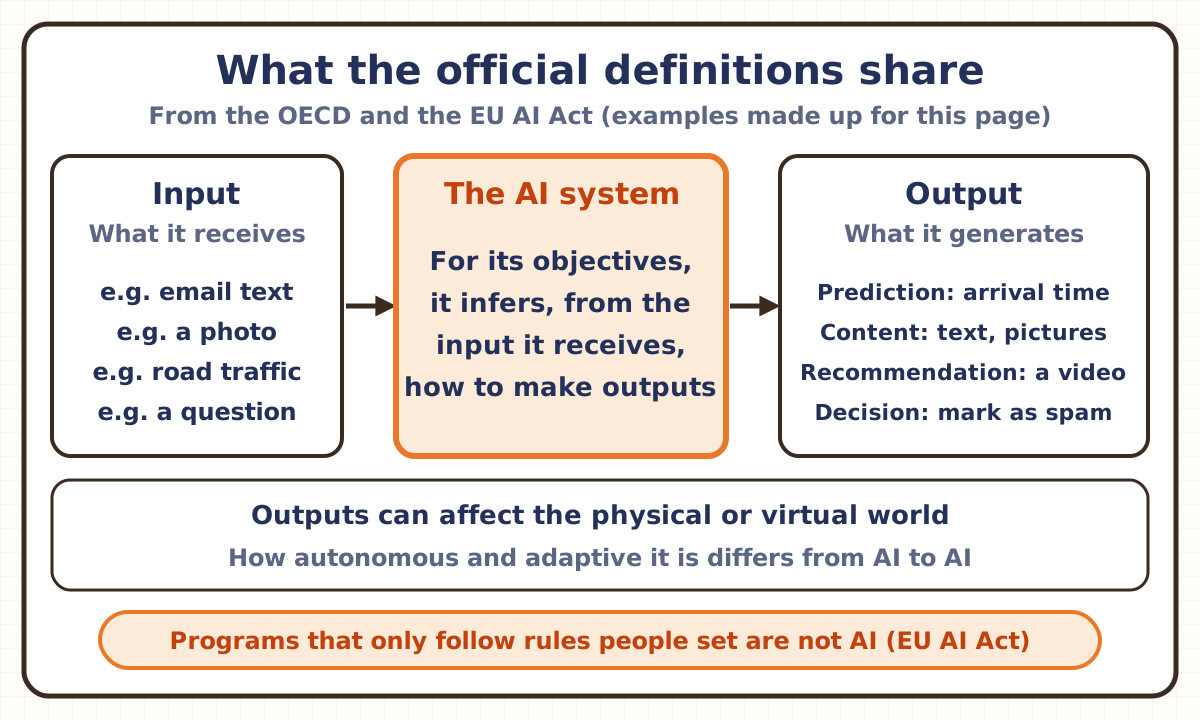
There is no single agreed definition. The OECD (an international organization) and the EU’s AI law describe it as a machine-based system that works out, from the input it receives, how to generate outputs such as predictions, content (like text or pictures), recommendations or decisions. By that measure, spam filters, arrival-time estimates in map apps and ChatGPT are all AI.
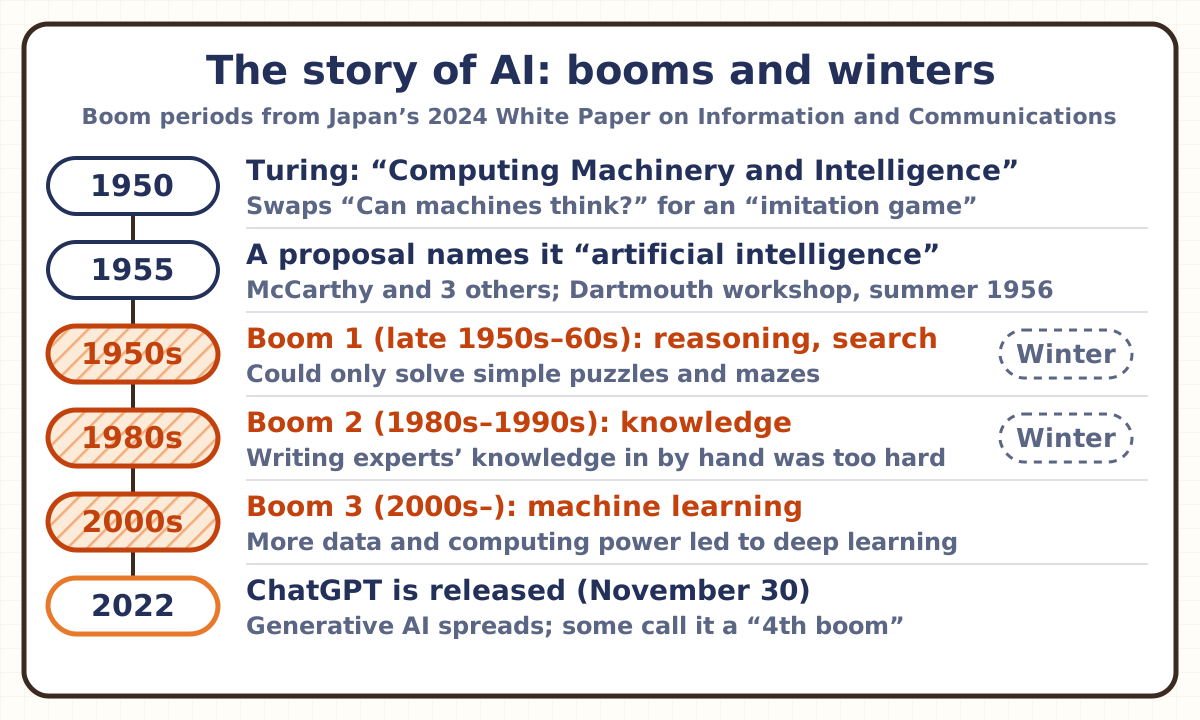
The name dates from 1955, when John McCarthy and others used it in a proposal for a research workshop. Since then, AI has gone through “booms” of high hopes and “winters” when interest faded; today, machine learning, which learns from lots of data, is at its center. Whether AI that handles a wide range of tasks as well as people do (artificial general intelligence, AGI) is already here is a matter of debate.
A common mix-up
“AI is a new technology from the last few years, like ChatGPT.”
Half right. ChatGPT was released on November 30, 2022, and with the rapid spread of generative AI (AI that creates text, pictures and more) since around 2022, some say we have entered a “fourth AI boom.” But the name “artificial intelligence” appears in a 1955 proposal for a research workshop, so it is about 70 years old. And we were using AI long before ChatGPT. Google wrote in 2019 that Gmail, with its machine learning models and other protections, blocks more than 99.9% of spam and similar email before it reaches inboxes. Arrival-time estimates in map apps, translation and the systems that find faces in photos were also using machine learning before ChatGPT. The big change of the last few years is that anyone can now get text or pictures made just by asking in plain words.
Explained in pictures
Think of it like this
An umbrella word, like “vehicle”
The word “AI” is a lot like the word “vehicle.” A bicycle, a train and an airplane move in completely different ways, but they are all vehicles, because the word groups things by what they do: carry people. AI is the same. A system that sorts spam, one that estimates arrival times in a map app, and ChatGPT are very different inside. But they do the same kind of thing, turning what they receive into predictions or answers, so we call them all AI.
Just as “vehicles with engines” are one big group within vehicles, machine learning, which learns from data, is one big group within AI. It is at the center of today’s boom. And a single vehicle that could go anywhere, on land, at sea and in the air, would be like artificial general intelligence (AGI): one AI that handles a wide range of tasks.
The comparison has limits. You can usually tell a vehicle just by looking. But where to draw the line around “AI” differs a little from person to person and from country to country (the EU’s law does not count programs that only follow rules set by people as AI). And because what AI does is described in terms of what human minds do, it brings along a question no vehicle does: is it really thinking? That is the very question Turing took on in 1950.
Key points
When was the name “artificial intelligence” coined, and by whom?
On August 31, 1955, four researchers wrote “A Proposal for the Dartmouth Summer Research Project on Artificial Intelligence”: John McCarthy of Dartmouth College, M. L. Minsky of Harvard University, N. Rochester of IBM and C. E. Shannon of Bell Telephone Laboratories. They proposed a two-month study of artificial intelligence by ten people during the summer of 1956, at Dartmouth College in Hanover, New Hampshire, in the US. McCarthy is credited with coining the name.
The proposal contains a famous sentence: “The study is to proceed on the basis of the conjecture that every aspect of learning or any other feature of intelligence can in principle be so precisely described that a machine can be made to simulate it.” It says it would try to find how to make machines use language, form abstractions and concepts, solve kinds of problems now reserved for humans, and improve themselves. The authors expected that a carefully selected group of scientists working together for a summer could make a significant advance on one or more of these problems.
Through this workshop (the Dartmouth Conference), the word AI became known among scientists, and from the 1960s, research took off, centered on reasoning and search.
What was Turing thinking about?
In October 1950, five years before the name “artificial intelligence” existed, Alan Turing published a paper titled “Computing Machinery and Intelligence” in the philosophy journal Mind. It opens: “I propose to consider the question, ‘Can machines think?’” But rather than try to answer it from what the words “machine” and “think” mean, Turing replaced the question with another, closely related one: the “imitation game.”
The game has three players: a man (A), a woman (B) and an interrogator (C) in a separate room. To keep voices from giving anything away, C sees only typewritten answers, and tries to tell which of the two is the man. Turing asked: what will happen when a machine takes the part of A? Will the interrogator decide wrongly as often as when the game is played between a man and a woman? Only digital computers are allowed to take part in the game.
Turing predicted that in about fifty years, it would be possible to program computers to play so well that an average interrogator would have no more than a 70% chance of making the right identification after five minutes of questioning. As for the original question, “Can machines think?”, he wrote that he believed it to be “too meaningless to deserve discussion.” The phrase “the Turing Test” refers to this proposal, made by Turing in 1950 as a way of dealing with the question of whether machines can think.
Is there an agreed definition?
There is no single agreed definition. McCarthy, who coined the name, later wrote in an essay called “What is Artificial Intelligence?” that it is “the science and engineering of making intelligent machines, especially intelligent computer programs.” Is there a solid definition of intelligence that doesn’t depend on comparing it with human intelligence? His answer: “Not yet,” because “we cannot yet characterize in general what kinds of computational procedures we want to call intelligent.” Japan’s white paper on information and communications describes AI as something that reproduces the intellectual activity of humans and others by computer.
Still, to make laws and rules, you have to decide what counts as AI. The OECD (Organisation for Economic Co-operation and Development), an international organization, set a definition of AI in 2019 and revised it in November 2023. It now reads: “An AI system is a machine-based system that, for explicit or implicit objectives, infers, from the input it receives, how to generate outputs such as predictions, content, recommendations, or decisions that can influence physical or virtual environments. Different AI systems vary in their levels of autonomy and adaptiveness after deployment.” To “infer” here means to work out, from what comes in, how to answer. Autonomy is how far a system can learn or act without people taking part, and adaptiveness is whether it keeps changing after it is put to use (like recommendations that adjust to your tastes). At that time, the OECD added the word “content” to make clear that generative AI, which creates text and pictures, is included.
Article 3 of the EU’s AI Act (2024) defines an “AI system” in almost the same words. Its recitals (the explanations placed before the law itself) say the definition should be closely aligned with the work of international organizations, and that a key characteristic of AI systems is their capability to infer. The techniques that make inference possible include machine learning and approaches that use logic to work things out from knowledge that has been written in; systems that only follow rules defined solely by people to carry out operations automatically are not AI systems.
In Japan, Article 2 of the “Act on Promotion of Research and Development, and Utilization of Artificial Intelligence-related Technology,” promulgated on June 4, 2025, defines “artificial intelligence-related technology.” It is the technology needed to substitute for human intellectual abilities of cognition, inference and judgment by artificial means, together with the technology for information processing systems that process input information using it and output the results. The wording differs, but each describes a machine-based system that takes in input and produces answers (outputs).
Why did AI keep going through booms and winters?
The history of AI began in the 1950s and has gone through “booms,” when research took off, and “winters,” when it faded, several times.
The first AI boom (late 1950s to the 1960s) was “the age of reasoning and search.” A problem was written down in a form a computer could handle, and the computer worked through steps and choices to find an answer. But computers had limited calculating power and ability to handle data, and modeling human intelligence was hard, so AI could only solve simple problems like puzzles and mazes, known as “toy problems.” Putting it to practical use proved difficult, and a winter followed.
The second AI boom (the 1980s to the 1990s) was “the age of knowledge.” Computers became more powerful, and research took off again with the arrival of expert systems (computer systems with specialist knowledge of one field that can reason and judge like an expert). But the amount of data to be learned was too large for the computers of the time, so the systems could imitate only part of an expert’s knowledge and could not deal with complex problems. The knowledge also had to be written down by hand in a form the computer could understand, which took enormous effort, so another winter came.
The third AI boom (the 2000s on) is “the age of machine learning.” As the internet spread to homes, huge amounts of data became available for research, and computers became more powerful, so machine learning, which learns from data, advanced. Deep learning, one technique of machine learning, made it possible to recognize images and process language, and it came to be used for things like identifying people’s faces in camera images.
Then, on November 30, 2022, OpenAI released a chat AI called ChatGPT. Its announcement drew special attention to generative AI, which creates text, images and more, and with the rapid spread of generative AI since around 2022, some say we have now entered a “fourth AI boom.”
Where is it used in everyday life?
Email, for one. Google wrote in 2019 that Gmail, with its machine learning models and other protections, blocks more than 99.9% of spam, phishing and malware from reaching inboxes (the company’s own claim).
Map apps, too. Google explained in 2020 that Google Maps combines records of past traffic with live conditions and uses machine learning to predict traffic and arrival times. It said its predicted arrival times had been accurate for more than 97% of trips (the company’s own claim).
And translation. In September 2016, Google switched all Chinese-to-English translation in the Google Translate mobile and web apps to a new system that uses a neural network (GNMT). The old system broke a sentence into words and phrases and translated them largely independently. Google wrote that the new system reduced translation errors by more than 55% to 85% on several major language pairs (the company’s own claim).
There are also systems that find faces in photos. Apple writes that it started using deep learning for face detection in iOS 10, the operating system for iPhones and other devices. It also explains that, to protect users’ privacy, this had to run on the device itself rather than on its servers over the internet (a 2017 article from Apple’s research team).
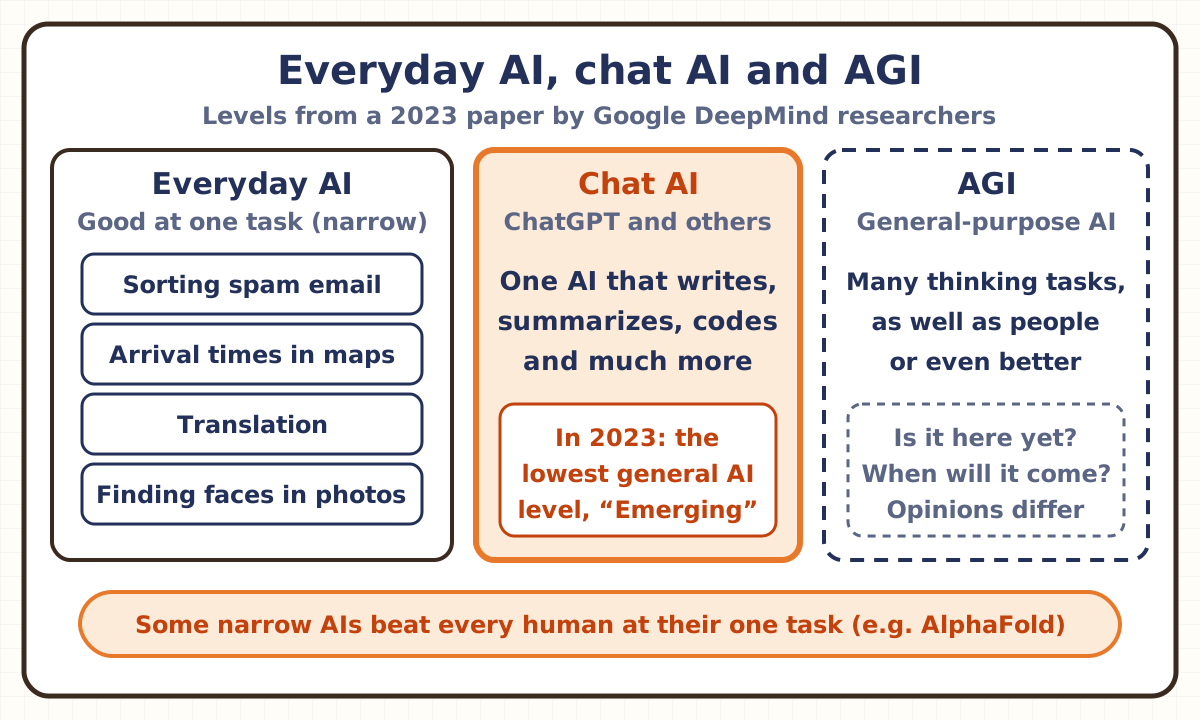
Each of these is AI built for one set job, called “narrow AI.” Smart speakers and chatbots (chat AIs) have also become part of our daily lives.
How is narrow AI different from artificial general intelligence (AGI)?
Narrow AI is AI that does a clearly scoped task (or set of tasks). In their paper “Levels of AGI” (2023), researchers at Google DeepMind (Google’s AI lab) sorted AI by how broad it is and how good it is. AlphaGo, which plays the board game Go, is an example of narrow AI at Level 4 (better than 99% of skilled adults), and AlphaFold, which predicts the shapes of proteins, is an example at Level 5 (better than all humans). For a single job, some AI already outperforms people.
Artificial general intelligence (AGI) is a single AI that can do a wide range of non-physical tasks as well as people, or better, including things like learning new skills. The same paper counted ChatGPT and others, as of 2023, as “general” AI, but put them on the lowest level of general AI, Level 1, “Emerging”; no general AI has reached Level 2 or above “yet.” Researchers and companies disagree widely on how to define AGI, whether it is already here and when it will come. See the “Artificial general intelligence” page for more.
How does it relate to machine learning and deep learning?
AI is the broadest term. Machine learning is one way of building AI within it: learning from data. Besides machine learning, AI can also be built with approaches that use logic to work things out from knowledge that has been written in. The expert systems of the second boom also worked by having experts’ knowledge written into them and reasoning or judging from it.
Deep learning is one technique of machine learning, a technology that developed the idea of the neural network. Today’s generative AI, which creates text and pictures, also came about because deep learning made AI far more capable. See the “Machine learning,” “Deep learning” and “Neural network” pages for more.
Check yourself
Q1In which document was the name “artificial intelligence” given?
Answer and explanation
Answer: B A proposal written for a workshop, in 1955
On August 31, 1955, McCarthy and three others wrote a proposal for a workshop to be held at Dartmouth College the next summer, and used “artificial intelligence” in its title. The 1950 paper was Turing’s discussion of “Can machines think?”, before the name existed. 2022 is when ChatGPT was released; the name is nearly 70 years older than that.
More on this → Key points: When was the name “artificial intelligence” coined, and by whom?
Q2What was one reason the second AI boom, which began in the 1980s, gave way to a “winter”?
Answer and explanation
Answer: A Writing in experts’ knowledge by hand took huge effort
The second boom produced expert systems, which reason and judge like experts. But their knowledge had to be written down by hand in a form the computer could understand, which took enormous effort, and they could not handle complex problems, so a winter followed. Solving only mazes and simple puzzles was the story of the first boom. Generative AI, which makes text and pictures, spread from around 2022.
More on this → Key points: Why did AI keep going through booms and winters?
Q3Which is true of email spam filtering and ChatGPT, the chat AI released in 2022?
Answer and explanation
Answer: C Both are AI, and spam filtering was in use before ChatGPT
Both are AI. Google wrote in 2019 that Gmail, with its machine learning models and other protections, blocks more than 99.9% of spam and similar email. ChatGPT was released in November 2022, so spam filtering came first. AI was part of everyday life long before ChatGPT.
More on this → Key points: Where is it used in everyday life?
Related terms
- Machine learning
- Deep learning
- Neural network
- Artificial general intelligence
- Large language model
- Generative AI
Sources and how we checked
- J. McCarthy, M. L. Minsky, N. Rochester and C. E. Shannon, "A Proposal for the Dartmouth Summer Research Project on Artificial Intelligence" (August 31, 1955; HTML version on McCarthy's Stanford pages; read November 8, 2026)
- Dartmouth College, "Artificial Intelligence (AI) Coined at Dartmouth" (the 1956 workshop; read November 8, 2026)
- Stanford Computer Science, "Professor John McCarthy" (memorial page; read November 8, 2026)
- John McCarthy, "What is Artificial Intelligence?", "Basic Questions" (Stanford University, revised November 12, 2007; read November 8, 2026)
- A. M. Turing, "Computing Machinery and Intelligence" (Mind, vol. 59, no. 236, pp. 433–460, October 1950; read November 8, 2026)
- Stanford Encyclopedia of Philosophy, "The Turing Test" (revised October 4, 2021; read November 8, 2026)
- OECD.AI, "AI principles" (definition of an AI system; read November 8, 2026)
- Stuart Russell, Karine Perset and Marko Grobelnik, "Updates to the OECD's definition of an AI system explained" (OECD.AI, November 29, 2023; read November 8, 2026)
- OECD.AI, "Updated OECD Definition of an AI system" (when the definition was revised; read November 8, 2026)
- EU, "Artificial Intelligence Act" (Regulation (EU) 2024/1689, June 13, 2024; Article 3(1) and recital 12; read November 8, 2026)
- Japan, "Act on Promotion of Research and Development, and Utilization of Artificial Intelligence-related Technology" (Act No. 53 of 2025, promulgated June 4, 2025; Article 2; Japanese text in the Japanese Law Translation database, which also has an English translation; read November 8, 2026)
- Ministry of Internal Affairs and Communications (Japan), "White Paper on Information and Communications in Japan 2024," Part I, Chapter 3, Section 1 (in Japanese; 2024; read November 8, 2026)
- OpenAI, "Introducing ChatGPT" (November 30, 2022)
- Google Workspace, "Spam does not bring us joy—ridding Gmail of 100 million more spam messages with TensorFlow" (February 7, 2019; read November 8, 2026)
- Google, "Google Maps 101: How AI helps predict traffic and determine routes" (Johann Lau, September 3, 2020; read November 8, 2026)
- Google Research, "A Neural Network for Machine Translation, at Production Scale" (Quoc V. Le and Mike Schuster, September 27, 2016; read November 8, 2026)
- Apple Machine Learning Research, "An On-device Deep Neural Network for Face Detection" (November 16, 2017; read November 8, 2026)
- Morris et al., "Levels of AGI for Operationalizing Progress on the Path to AGI" (Google DeepMind, ICML 2024; arXiv, November 2023; version 5, September 2025; read November 8, 2026)
AI wrote this page from the sources above, and a different AI checked it against the text of those sources (November 8, 2026). A person with a master’s degree in science and a Japanese high-school science teaching license also read and checked it before publishing. Numbers are as of that date. If anything was hard to follow, you spot a mistake, or there’s a term you’d like explained, please write to [email protected].