 Naru News日本語
What is an event horizon (the boundary around a black hole that not even light can get back out of)?

In one minute
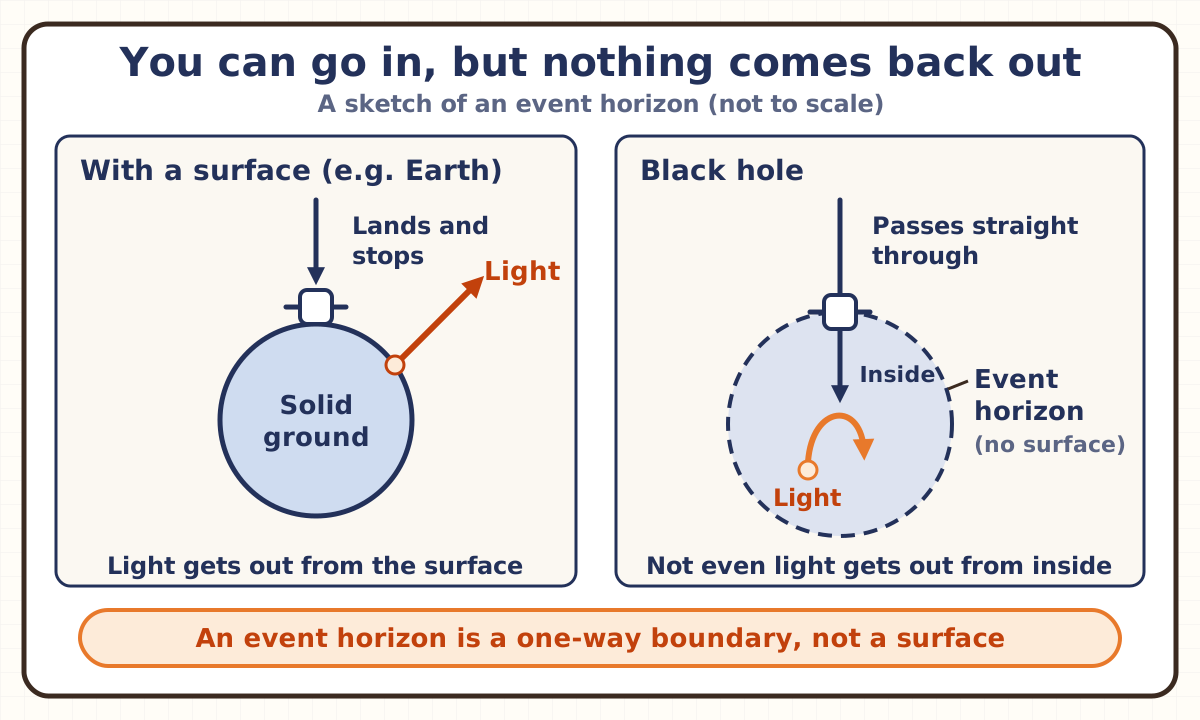
An event horizon is an invisible boundary around a black hole: anything that goes inside it, even light, can never get back out.
It isn’t a solid surface or a skin. Things can go in from outside, but nothing comes out from inside, so it is a one-way boundary. Its size grows in proportion to the mass: about 3 km in radius for a black hole with the Sun’s mass, and about 9 mm for one with Earth’s mass.
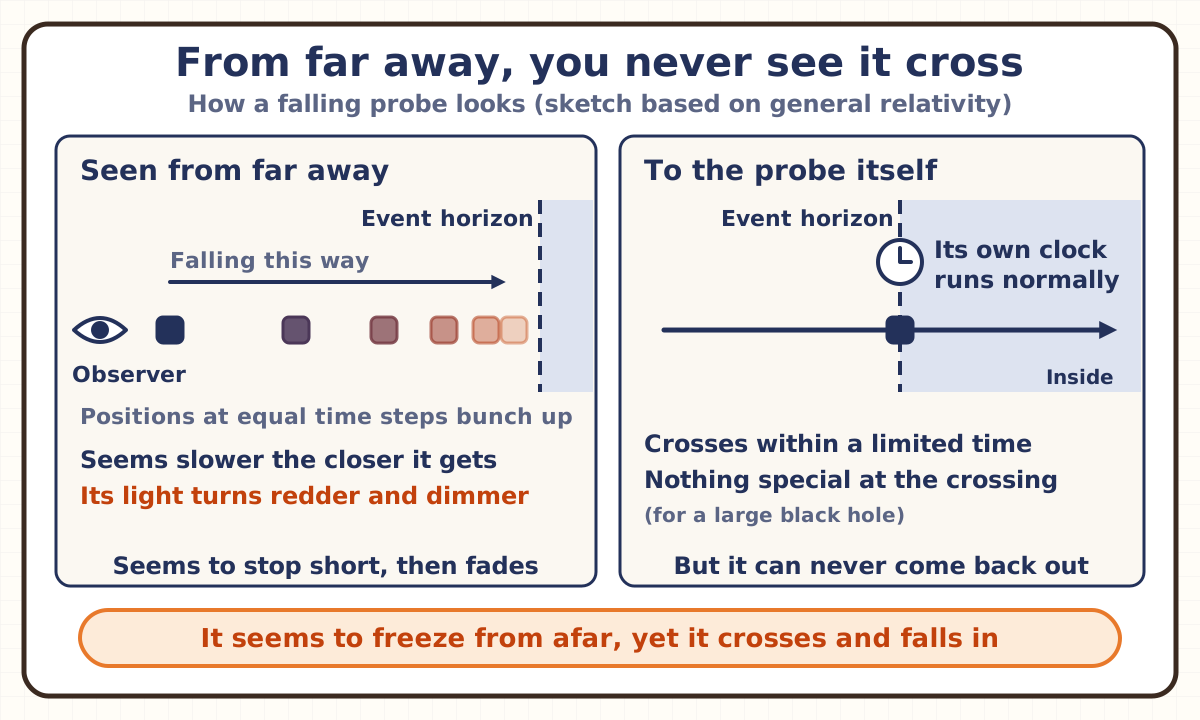
Seen from far away, something falling in seems to move more and more slowly as it nears the boundary, and its light turns redder and dimmer until it can no longer be seen. You never see it cross. Meanwhile, the one falling in crosses within a limited time on its own clock, and for a large black hole, nothing special is thought to happen at the crossing.
A common mix-up
“An event horizon is a black hole’s solid surface.”
Only partly right. The event horizon is sometimes called “the surface of a black hole,” and a black hole’s size is usually given by the size of this boundary. That much is true. But there is no ground or skin there, nothing solid at all. It is an invisible boundary at the place where the speed needed to break free of gravity becomes exactly the speed of light. Things falling in from outside pass through without hitting anything and go on inside. The matter that makes up the black hole isn’t piled up on this boundary either; it is thought to be far inside it (what the inside is really like can’t be checked from outside, so no one knows).
Explained in pictures
You’re free to use these figures in lessons, slides and posts if you credit Naru News (naru.news). CC BY 4.0.
Think of it like this
A ship sailing over the horizon
Picture standing on the shore, watching a ship sail out to sea. The ship gets farther and farther away, and at last it slips below the horizon and can no longer be seen. But there is no wall or line drawn at the horizon. The people on board don’t notice where they crossed it; they just keep sailing across the sea as usual.
An event horizon is similar. There is nothing solid there; it is a boundary that splits what someone outside can see from what they can’t. For a large black hole, nothing special is thought to happen to the one falling in at the moment of crossing. The word “horizon” in the name comes from this same idea: a boundary you can’t see beyond, like the horizon.
But the comparison has limits. The horizon at sea moves farther out if you climb somewhere high, and if the ship turns back, you can see it again. Once inside an event horizon, not even light can ever come back out. Also, a ship disappears from the bottom up behind the curve of the Earth, while something falling into a black hole seems to move more and more slowly as it nears the boundary, and turns redder and dimmer as it fades away.
Key points
Where is it, and why isn’t it a “surface”?
If you throw a ball up into the sky, the faster you throw it, the higher it goes, and from Earth, a ball faster than about 11 km per second never comes back and escapes. This speed needed to break free of gravity is bigger the closer you are to the center of a heavy object. Around a black hole there is a place where this speed is exactly the speed of light (about 300,000 km per second), and that is the event horizon. Inside it, the speed needed to escape is more than the speed of light, so neither light nor anything else can get out.
The event horizon is sometimes called “the surface of a black hole,” but it isn’t a surface made of anything, like ground or a skin. It is an invisible surface set by the speed needed to escape. Nothing is there to stop anything, so things falling in from outside pass through without hitting anything and go inside. You can go in, but you can’t come out: it is a boundary that works like a one-way membrane.
Calculations with general relativity show that anything inside the event horizon keeps falling toward the center of the black hole. The matter that makes up the black hole isn’t piled up on the boundary either; it is thought to be far inside it. But no signal of any kind comes out from inside, so what the inside is really like has not been checked.
How big is it?
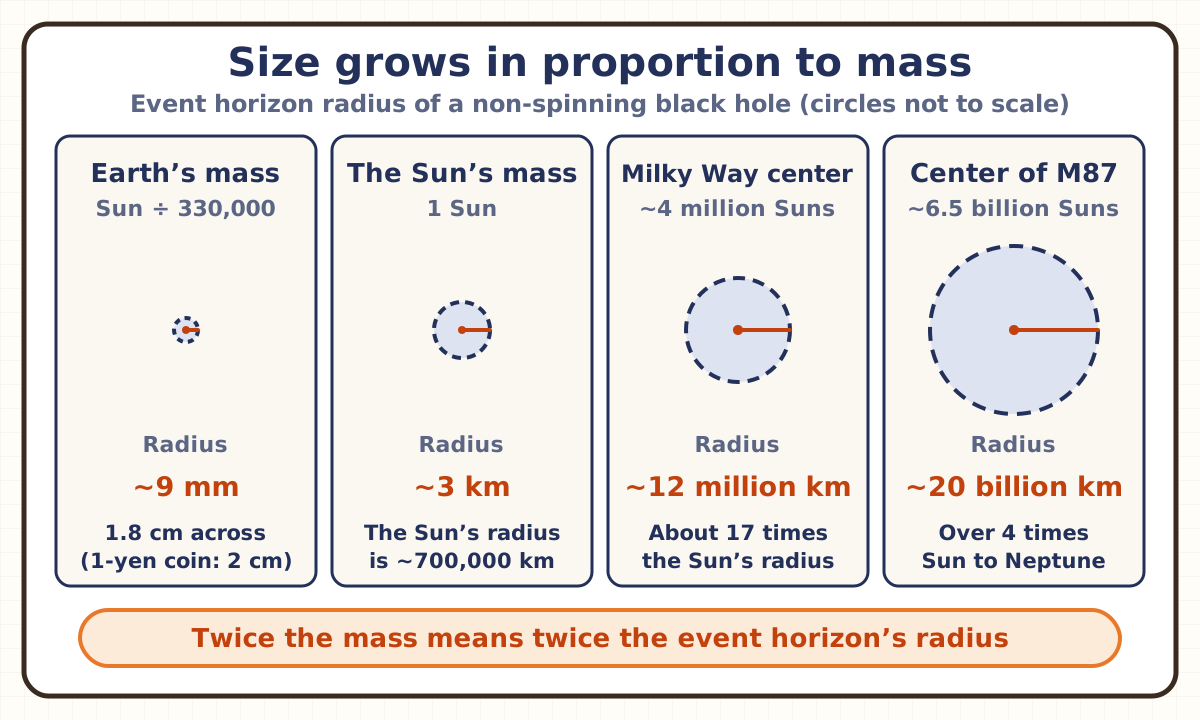
The size of the event horizon grows in proportion to the black hole’s mass: twice the mass means twice the radius. The radius of the event horizon of a non-spinning black hole is called the Schwarzschild radius. It is named after Karl Schwarzschild, who in 1916 found the first answer to the equations of general relativity that describes a black hole.
Working it out gives a radius of about 3 km for a black hole with the Sun’s mass, and about 9 mm for one with Earth’s mass. The Sun’s radius today is about 700,000 km and Earth’s is about 6,400 km, so to become black holes they would have to be squeezed down enormously. For Earth, that means packing the mass of the whole planet into a ball about 1.8 cm across, a bit smaller than a 1-yen coin (2 cm across).
The heavier the black hole, the bigger its event horizon. For the black hole at the center of the Milky Way (about 4 million times the Sun’s mass), the radius is about 12 million km, about 17 times the Sun’s radius today. For the black hole at the center of the galaxy M87 (about 6.5 billion times the Sun’s mass), whose image was released in 2019, the radius is about 20 billion km (roughly 40 billion km across), more than 4 times the distance from the Sun to Neptune (about 4.5 billion km).
Seen from far away, what does something falling in look like?
Imagine watching a probe fall into a black hole from far away. Calculations with general relativity show that the closer the probe gets to the event horizon, the more slowly it seems to move. It then seems to freeze just short of the boundary, and you never see it cross, no matter how long you wait. This is why black holes were once called “frozen stars.”
The light that reaches you changes too. Light climbing out of strong gravity has its waves stretched to longer wavelengths, so it shifts toward red (gravitational redshift). The light reaching you quickly weakens, and the probe, seeming frozen, grows dim and disappears from view. In 2001, the Hubble Space Telescope watched the ultraviolet light from clumps of hot gas around an object thought to be a black hole dim and disappear, and this was announced as possible evidence of an event horizon.
But it only seems to freeze because, near the boundary, time as seen from far away runs extremely slowly (time dilation); the probe doesn’t really stop. The probe itself crosses the boundary and keeps falling.
What would the one falling in feel?
Measured on the falling probe’s own clock, it reaches the event horizon within a limited time. In a video NASA made on a supercomputer in 2024, showing a camera falling into a black hole of about 4.3 million times the Sun’s mass, the camera reached the boundary in about 3 hours. That is very different from what someone far away sees: a probe that never quite gets there.
According to calculations with general relativity, there is nothing special at the boundary itself. So for a large black hole, the one falling in is thought not to hit anything, and nothing special is thought to happen at the moment of crossing. But once across, there is no way back out. Inside the boundary, the probe and the space it is moving through both rush toward the center of the black hole.
Still, close to a black hole, the pull on the side of the body nearer the black hole becomes much stronger than on the far side. This difference (the tidal force) stretches things lengthwise and squeezes them sideways until they look like noodles. This is called spaghettification. Black holes born from stars, up to about 30 times the Sun’s mass, have small event horizons and very strong tidal forces, so they can rip things apart before they reach the boundary. The heavier the black hole, the weaker this force is at the boundary; in the 2024 video, the camera was torn apart about 13 seconds after crossing.
Is the black disk in black hole images the event horizon?
No. The dark area in the image of the black hole at the center of the galaxy M87, released in 2019, is called the “shadow” (the black hole shadow), and it is not the event horizon itself. It is where much less light arrives, because light from the hot gas around the black hole is bent sharply by its gravity or caught inside the event horizon.
The shadow is about 2.5 times the size of the event horizon. The event horizon of the M87 black hole is roughly 40 billion km across, and the shadow in the image looks bigger than that. The event horizon itself can’t be photographed directly, because no light comes out from inside it.
The name of the international team that took the image, the Event Horizon Telescope (EHT), comes from the event horizon, the boundary around a black hole that not even light can escape.
Why is it called an “event horizon”?
An “event” is something that happens, and a “horizon” is the line where the land or sea seems to meet the sky. Just as you can’t see beyond the horizon, nothing that happens inside an event horizon can ever be seen from outside.
The term was first used by the physicist Wolfgang Rindler in a 1956 paper. In his research on models of the universe as a whole, he used the word “horizon” to mean the boundary between things that can be seen and things that can’t, and named one kind of it the event horizon. Today the term is widely used for the boundary around a black hole.
In Japanese it is called jishō no chiheimen (“horizon surface of events”), and also jishō no chiheisen (“horizon line of events”). It is called a surface rather than a line because the boundary is a surface that wraps around the black hole.
What is still unknown?
One thing is the inside of the event horizon. No signal of any kind comes out from inside, so there is no way to check it from outside. Calculations with general relativity produce a point at the center of a black hole where matter is crushed to infinite density (mass packed into the same space), called a singularity. But whether it really exists, or only shows up in the calculations, is not known.
Another is Hawking radiation. Stephen Hawking calculated, bringing in the ideas of quantum mechanics (the rules of the world of atoms and smaller things), that because a black hole has an event horizon, it should keep giving off a tiny amount of radiation (a flow of light and particles). This slowly leaking radiation is thought to make a black hole lighter over a very long time until it finally evaporates. But the radiation from black holes born from stars, or heavier ones, is far too weak, and it has not yet been confirmed by observation.
Check yourself
Q1Suppose a spaceship approaches, from outside, the event horizon of a large black hole (the boundary inside which not even light can get out). What happens to the spaceship at that boundary?
Answer and explanation
Answer: B It hits nothing and goes right on inside
The event horizon is sometimes called the “surface” of a black hole, but there is no ground or skin there. It is an invisible boundary where the speed needed to escape becomes exactly the speed of light. So the spaceship doesn’t hit anything or bounce back; it goes right on inside. But once in, not even light can ever come back out. For a large black hole, nothing special is thought to happen at the crossing.
More on this → Key points: Where is it, and why isn’t it a “surface”?
Q2Suppose you keep watching, from a spaceship far away, a probe falling into a black hole. As the probe nears the event horizon (the boundary that not even light can get back out of), how does it look from far away?
Answer and explanation
Answer: C It moves slower and turns redder and dimmer
Seen from far away, the closer the probe gets to the event horizon, the more slowly it seems to move, until it seems to freeze just short of the boundary. Light climbing out of the strong gravity has its waves stretched and turns redder, and much less of it arrives, so it grows dim and eventually can’t be seen. It doesn’t seem to speed up or turn bluer and brighter, and you never see it cross. This is why black holes were once called “frozen stars.”
More on this → Key points: Seen from far away, what does something falling in look like?
Q3In 2019, an image was released of the black hole at the center of the galaxy M87. How does the size of the dark “shadow” inside the ring of light compare with the size of the event horizon (the boundary that not even light can get back out of)?
Answer and explanation
Answer: A The shadow is bigger than the event horizon
The dark area in the image is called the “shadow”: it is where much less light arrives, because light from the hot gas around the black hole is bent or caught by its gravity. The shadow is about 2.5 times the size of the event horizon, so it looks bigger than the event horizon. For the M87 black hole, the event horizon is roughly 40 billion km across. The event horizon itself can’t be photographed directly, because no light comes out from inside it.
More on this → Key points: Is the black disk in black hole images the event horizon?
Related terms
- Black hole
- General relativity
- Schwarzschild radius
- Gravitational redshift
- Tidal force
- Spaghettification
- Hawking radiation
- Gravitational singularity
- Event Horizon Telescope
- Gravitational lensing
Sources and how we checked
- NASA, "Black Hole Anatomy" (NASA Science, updated August 12, 2026; the Event Horizon section: inside it the speed needed to escape exceeds the speed of light, whatever passes in stays inside, even light, the event horizon can be thought of as the black hole’s surface, and black holes neither emit nor reflect light; the Singularity section: general relativity predicts a point at the center where matter is crushed to infinite density, and it may be a physical structure or a purely mathematical one; read November 17, 2026)
- NASA Imagine the Universe!, "The Anatomy of Black Holes," page 22 (Goddard Space Flight Center teaching material, updated May 7, 2015; the surface of a black hole as the imaginary surface where the escape velocity equals the speed of light, which is the event horizon, the event horizon not being a physical boundary but serving as the black hole’s surface, and its radius being the Schwarzschild radius, R = 2GM/c², named after Karl Schwarzschild; read November 17, 2026)
- NASA, "Black Holes" (NASA Science, updated August 12, 2026; the event horizon not being a surface like Earth’s or even the Sun’s but a boundary that contains all the matter making up the black hole, nothing, not even light, getting out past it, and matter that gets too close being squeezed horizontally and stretched vertically like a noodle [spaghettification]; read November 17, 2026)
- NASA, "New NASA Black Hole Visualization Takes Viewers Beyond the Brink" (NASA Science, Francis Reddy, May 6, 2024; the visualization made by Jeremy Schnittman and colleagues at Goddard Space Flight Center on a NASA supercomputer: a black hole of 4.3 million solar masses whose event horizon spans about 25 million km, the camera taking about 3 hours to fall to the event horizon “in real time” (set against the next point), the camera’s image, seen from afar, slowing and seeming to freeze just shy of the horizon and never quite getting there, which is why black holes were originally called “frozen stars,” spaghettification from the pull on the near end being much stronger than on the far end, stellar-mass black holes of up to about 30 solar masses having much smaller event horizons and stronger tidal forces that can rip objects apart before they reach the horizon, the camera’s destruction by spaghettification 12.8 seconds after crossing, and both the camera and the space-time it moves in rushing toward the center once inside; read November 17, 2026)
- NASA, "'Death Spiral' Around a Black Hole Yields Tantalizing Evidence of an Event Horizon" (NASA Science [Hubble], January 11, 2001; the Hubble Space Telescope watching pulses of ultraviolet light from clumps of hot gas fade and disappear around a massive, compact object called Cygnus XR-1, the light rapidly dimming as gravity stretches it to ever-longer wavelengths [redshift], and the observation as possible evidence of an event horizon; read November 17, 2026)
- J. R. Oppenheimer and H. Snyder, "On Continued Gravitational Contraction" (Physical Review 56, pp. 455–459, 1939; the abstract on INSPIRE: seen from outside, the radius of the collapsing star only approaches its gravitational radius asymptotically, light from the star’s surface is progressively reddened, and for an observer moving with the star’s matter, the total time of collapse is finite; read November 17, 2026)
- P. K. Townsend, "Black Holes" (lecture notes, University of Cambridge, arXiv:gr-qc/9707012, 1997; main text: Section 2.3 [the surface of a star falling through R = 2M in finite proper time, nothing special happening at R = 2M, and nothing at r = 2M preventing the star from collapsing through it], Section 2.3.1 [no signal from the surface escaping once it has passed through r = 2M, the surface never reaching r = 2M for an external observer while the redshift of its light grows exponentially and the star disappears from view, and the surface r = 2M acting like a one-way membrane], and Section 7.3 [a thermal flux of particles, Hawking radiation, due to the infinite time dilation at the horizon]; read November 17, 2026)
- National Astronomical Observatory of Japan, Japanese press release on the first image of a black hole in the galaxy M87 (April 10, 2019; the Japanese name jishō no chiheimen (Event Horizon) for the surface of a black hole, the event horizon being 2.5 times smaller than the shadow, the event horizon of the M87 black hole being roughly 40 billion km across, a black hole’s size being proportional to its mass, and its distance of 55 million light-years and mass of 6.5 billion Suns; read November 17, 2026)
- National Astronomical Observatory of Japan, Japanese press release on the first image of the black hole at the center of the Milky Way (May 12, 2022; the telescope being named after the event horizon, written イベント・ホライズン (事象の地平面), the boundary of a black hole from which not even light can escape, and Sagittarius A* having 4 million times the Sun’s mass at about 27,000 light-years from Earth; read November 17, 2026)
- UNAWE (Universe Awareness), Japanese edition of a children’s space news story (September 3, 2013; the distance within which nothing can escape, called 事象の地平線, jishō no chiheisen, in Japanese; read November 17, 2026)
- W. Rindler, "Visual Horizons in World-Models" (Monthly Notices of the Royal Astronomical Society 116, pp. 662–677, 1956; the abstract on INSPIRE: a horizon defined as a frontier between things observable and things unobservable, and event horizons distinguished from particle horizons. The editor’s note and Rindler’s own short biography when it was reprinted in General Relativity and Gravitation 34, pp. 131–132 [2002]: the terms “event horizon” and “particle horizon” were first coined in this paper [read as a PDF]; read November 17, 2026)
- Carlos A. R. Herdeiro and José P. S. Lemos, "The black hole fifty years after: Genesis of the name" (arXiv:1811.06587, 2018; abstract: black holes as solutions of the equations of general relativity, the first of which was published in 1916 by Karl Schwarzschild; read November 17, 2026)
- NASA, "Shedding Light on Black Holes" (NASA Science, August 13, 2019, updated May 22, 2023; Hawking’s theory of black holes in a quantum mechanical sense, and the slow leak of what is now known as Hawking radiation causing a black hole to evaporate over time; read November 17, 2026)
- Atreya Acharyya, Giacomo Cacciapaglia, Manuel Meyer and Francesco Sannino, "Unveiling the Quantum Nature of Black Holes: Towards a Proof of Hawking Radiation through Gamma-Ray Observations" (arXiv:2509.17599, September 22, 2025; abstract: Hawking’s prediction that black holes emit thermal radiation and ultimately evaporate remains unverified, because the radiation is extremely faint for stellar-mass or larger black holes; read November 17, 2026)
- NASA, "Earth Fact Sheet" and "Sun Fact Sheet" (GM, the product of the gravitational constant and mass: 0.39860×10^6 km³/s² for Earth and 132,712×10^6 km³/s² for the Sun, the Sun-to-Earth mass ratio of 332,900, the Sun’s radius of 695,700 km, Earth’s radius of 6,371 km, and Earth’s escape velocity of 11.186 km/s. The event horizon radius, 2GM/c², was calculated from these GM values and the speed of light [about 2.95 km for the Sun, about 8.87 mm for Earth, about 11.8 million km for 4 million Suns, about 12.7 million km for 4.3 million Suns, and about 19.2 billion km for 6.5 billion Suns]; read November 17, 2026)
- NASA, "Neptune Fact Sheet" (Neptune’s semimajor axis, its average distance from the Sun, of 4,514.953 million km; read November 17, 2026)
- NIST, "CODATA Value: speed of light in vacuum" (299,792,458 m/s, exact; read November 17, 2026)
- Japan Mint, Japanese page on coins currently minted (the 1-yen aluminum coin’s 20-mm diameter, used to compare the size of a black hole with Earth’s mass; read November 17, 2026)
AI wrote this page from the sources above, and a different AI checked it against the text of those sources (November 17, 2026). A person with a master’s degree in science and a Japanese high-school science teaching license also read and checked it before publishing. Numbers are as of that date. If anything was hard to follow, you spot a mistake, or there’s a term you’d like explained, please write to [email protected].
Space terms
- Black hole
- Black hole star
- You are hereEvent horizon
- General relativity
- Gravitational lensing
- Gravitational wave
- Special relativity