 Naru News日本語
What is a gravitational wave (a ripple of warped spacetime)?
Also called: Gravitational waves

In one minute
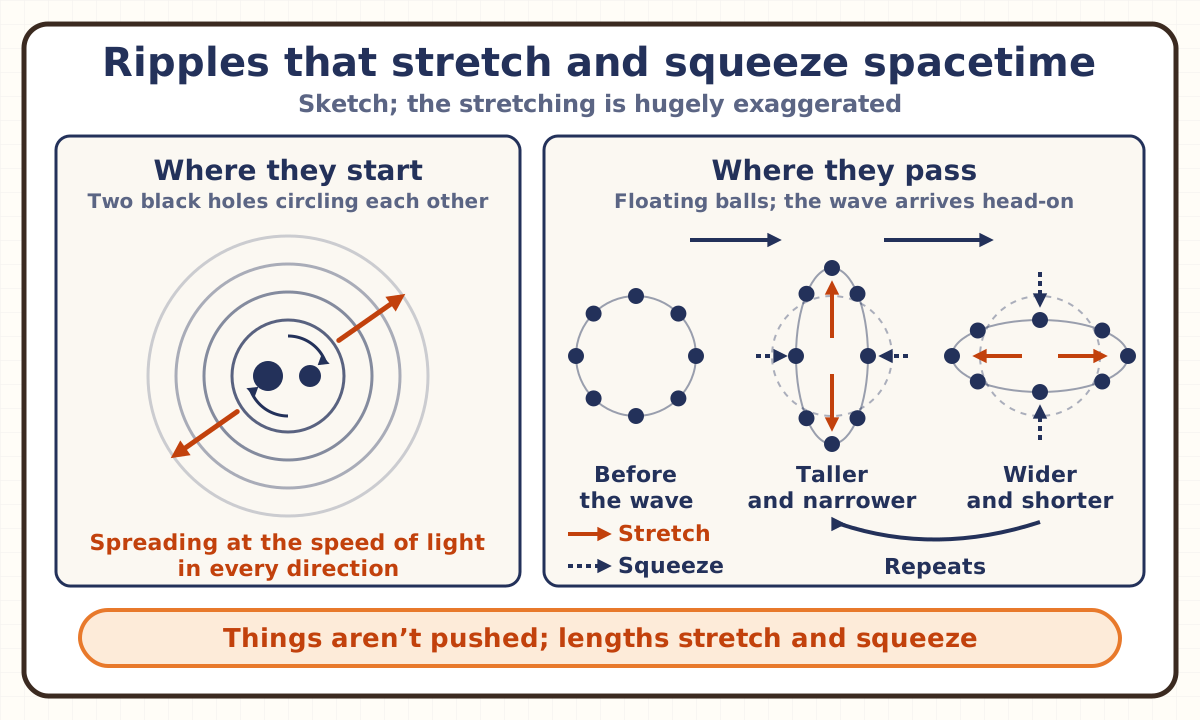
A gravitational wave is a ripple in the warping of time and space (together, spacetime) that spreads out at the speed of light when a heavy object moves while changing its speed or direction (that is, accelerates).
Warped spacetime is a bit like the dip a heavy ball makes in a trampoline. As a wave passes, space itself stretches in one direction while squeezing in the direction at right angles, then the other way round, again and again. It doesn’t push things along; the distances between things stretch and shrink. By the time the waves reach Earth they are extremely small, and Einstein himself thought they would be very hard to confirm.
On September 14, 2015, the LIGO detectors in the United States directly caught gravitational waves for the first time, from two merging black holes. Observations up to January 2025 have found 390 candidate signals. They are different from the “gravity waves” of weather (waves of air bobbing up and down under their own weight).
A common mix-up
“Gravitational waves are like a blast that blows out from black holes and pushes nearby things away.”
That’s half right. Gravitational waves come from extremely violent events, such as two black holes merging, and they carry a lot of energy. In the first gravitational waves ever caught, in 2015, energy equal to about 3 Suns’ worth of mass went out as gravitational waves in less than a second. That part is true. But gravitational waves are not waves that travel by shaking air, the way sound does. What waves is time and space (spacetime) itself. So they cross empty space at the speed of light and pass through stars, Earth and anything else. Where they pass, they don’t push things one way; they stretch lengths in one direction while squeezing them in the direction at right angles, then the reverse, again and again. And by the time they reach Earth, they are extremely small: about enough to change the distance between Earth and the Sun by the size of one hydrogen atom. No one can feel them, and buildings don’t shake.
Explained in pictures
You’re free to use these figures in lessons, slides and posts if you credit Naru News (naru.news). CC BY 4.0.
Think of it like this
Two heavy balls circling on a trampoline
Imagine two heavy bowling balls rolling around each other on a big trampoline. Their weight makes dips in the fabric, and because the dips move with the balls, ripples spread out across the fabric around them. The closer the balls get and the faster they circle, the more closely spaced the ripples become, and once the two balls become one, the ripples die down.
Applied to gravitational waves, the bowling balls are two black holes, the dented fabric is warped spacetime, and the spreading ripples are gravitational waves. The picture gets across the idea that when heavy objects move violently, changes in the warping of spacetime around them travel far away as waves.
But the comparison doesn’t fit everywhere. Trampoline ripples are the fabric moving up and down, while in gravitational waves what shakes is not a material like fabric but time and space themselves. The motion isn’t up and down either: across the direction the wave travels, a length in one direction stretches while the length at right angles shrinks. And trampoline ripples travel through the fabric, while gravitational waves cross empty space at the speed of light.
Key points
What is actually waving in a gravitational wave?
Sound travels as air shakes, and ocean waves as water moves. In gravitational waves, what shakes isn’t a material like these but time and space (spacetime) itself. In general relativity, a heavy object warps the spacetime around it. When that heavy object moves while changing its speed or direction, the shape of the warping changes too, and that change spreads out as waves in every direction. Examples are two black holes, or two neutron stars (very tightly packed stars made when the core of a star much heavier than the Sun collapsed), circling each other.
Where a gravitational wave passes, lengths change. Across the direction the wave travels, a length in one direction (say, up and down) stretches while the length at right angles (sideways) shrinks, and then up-down shrinks while sideways stretches, again and again. Lengths along the direction of travel don’t change. If small balls were floating in space in a ring, the ring would keep changing between a tall oval and a wide oval.
Gravitational waves cross empty space at the speed of light and pass through stars, Earth and anything else. And they carry news all the way to Earth about the violent events that sent them out and about the nature of gravity itself.
Despite the similar name, the “gravity waves” of weather science are something else. They are waves of air: air pushed up by mountains and the like sinks back under gravity and bobs up and down as the wave travels. Clouds can form on the crests of these waves. The gravitational waves on this page are waves of spacetime, not of air.
Did Einstein think they could be measured?
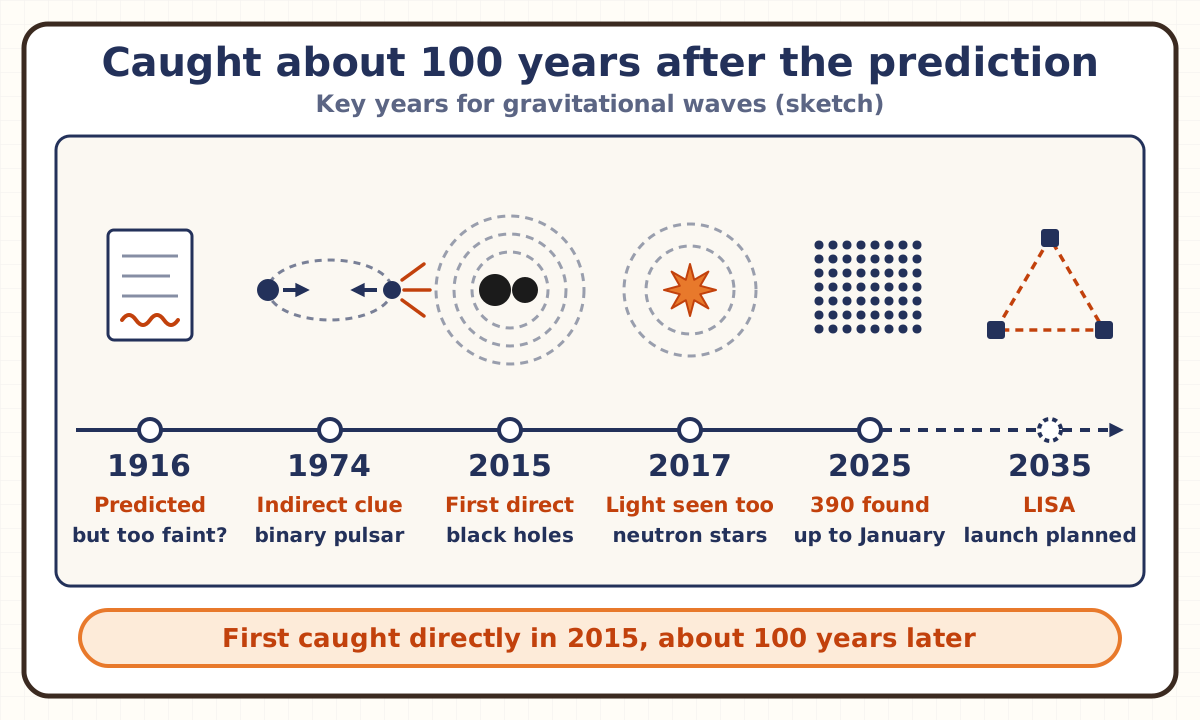
In 1916, Einstein worked out from general relativity, which he had completed in 1915, that gravitational waves should exist. But his calculations showed that their effect would be extremely small, and Einstein himself thought it would be very hard to confirm them in practice.
The first clue came in 1974. Using the Arecibo Radio Observatory in Puerto Rico, Russell Hulse and Joseph Taylor found a pair of stars circling each other (a binary) about 21,000 light years (the distance light travels in 21,000 years) from Earth. One of them was a star that gives off radio waves (a pulsar), and by following those radio waves, they could measure how the time the two stars take to go around (their orbital period) was changing.
Years of measurements showed the orbital period getting slowly shorter as the two stars drew closer together. This matched the value calculated from general relativity for gravitational waves carrying energy away. It wasn’t a catch of the gravitational waves themselves, but it was indirect evidence that they exist, and the two received the 1993 Nobel Prize in Physics.
How are they measured?
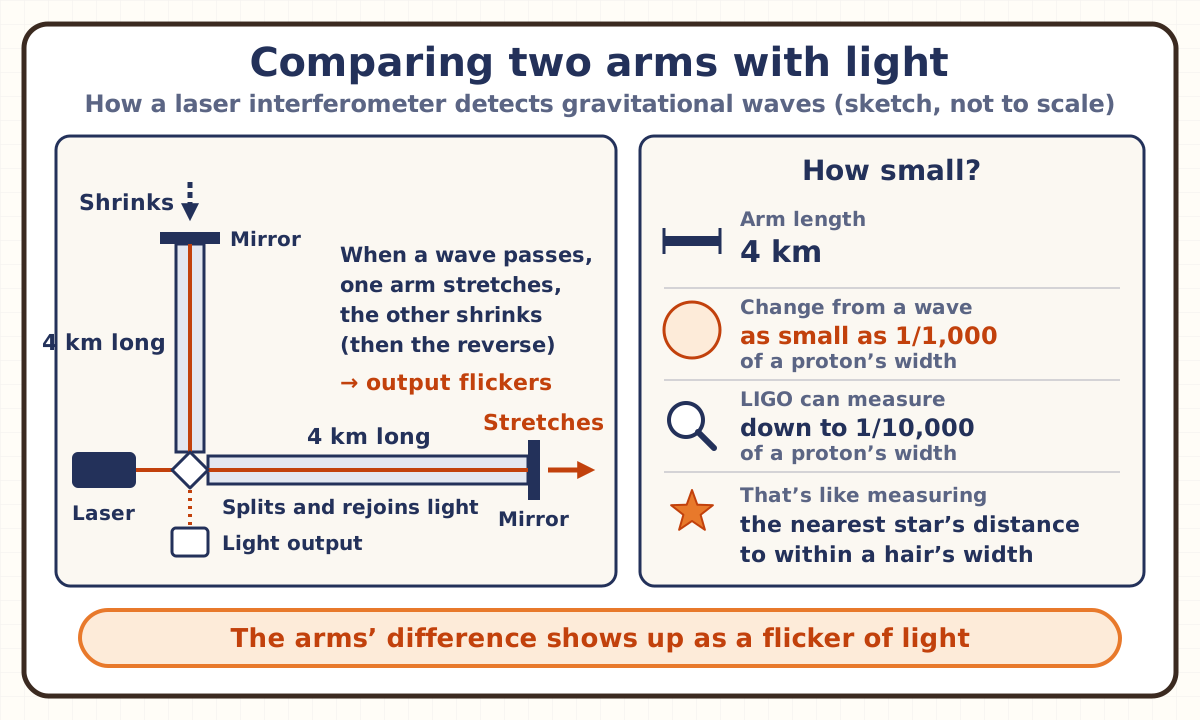
The tool is a big L-shaped instrument (a laser interferometer). Light from a single laser is split in two, sent down two arms at right angles, bounced back by mirrors at the ends, and recombined. It is built so that when the two arms are exactly matched, the two returning beams cancel each other and the light output stays dark.
When a gravitational wave passes, one arm stretches while the other shrinks, then the reverse. The peaks and troughs of the two light waves then fall out of step, so they can no longer cancel, and a faint flicker of light appears at the output. From the pattern of that flicker, scientists read the shape of the gravitational wave that arrived.
The US LIGO has detectors with 4-km arms at two sites about 3,000 km apart (Livingston, Louisiana, and Hanford, Washington). The air is pumped out of the arms to about one-trillionth of an atmosphere. The change in arm length caused by a gravitational wave can be as small as 1/1,000 of the width of a proton (one of the particles that make up the nucleus at the center of an atom), and LIGO is built to measure changes even smaller than that.
The two sites are far apart to check that a signal came from space, not from something that happened at one site. The first gravitational waves caught, in 2015, reached Livingston 7 thousandths of a second before Hanford.
What were the first waves caught, and the merger seen in light too?
On September 14, 2015, both LIGO detectors caught the same pattern of shaking. It came from two black holes, about 36 and 29 times the Sun’s mass, that circled closer and closer and merged about 1.3 billion years ago. The shaking sped up from 35 to 250 times a second. Even at its biggest, the stretch compared with the length was only about 1 part in 10^21 (a trillionth of a billionth). The black hole formed by the merger was about 3 Suns lighter than the two added together, and that much mass went out as gravitational-wave energy in less than a second. The detection was announced on February 11, 2016.
In 2017, Rainer Weiss, Barry Barish and Kip Thorne, who built up the LIGO detector and brought its observations to success, received the Nobel Prize in Physics. The design behind LIGO, an L-shaped instrument with laser light running down its arms, came from Weiss.
On August 17, 2017, the two LIGO detectors and Europe’s Virgo detector near Pisa, Italy, caught gravitational waves from two merging neutron stars about 130 million light years away. About 1.7 seconds after the gravitational waves arrived, NASA’s Fermi gamma-ray space telescope caught a short burst of gamma rays (a kind of light with very high energy). Combining data from the three detectors narrowed down the location, and some 70 optical astronomy partners (observatories and others) observed it. It was the first time an event caught in gravitational waves was also seen in light.
The light is thought to have come a little later because of the order of events at the source: first the two stars smashed together, then the material warmed up, and only then came the light. And after a journey of more than 100 million years, the arrival times differed by only about 1.7 seconds, which showed that any difference between the speed of gravitational waves and the speed of light is smaller than 3 parts in 10^15 (a thousand trillion) of the speed of light. Studying the universe by combining different kinds of messengers, such as gravitational waves and light, is called multi-messenger astronomy.
What about Japan’s KAGRA?
KAGRA is Japan’s gravitational-wave telescope, built under a mountain in Hida City, Gifu Prefecture. Like LIGO, it uses laser light to measure changes in length along two arms that branch at right angles and run 3 km each.
It has two special features. One is that it sits underground inside a mountain, where the ground shakes far less than at the surface. The other is that its mirrors are made of sapphire crystal and cooled to a very low temperature. This holds down the tiny trembling of the mirrors caused by heat, making extremely small stretches easier to pick out.
KAGRA joined the fourth joint observing run with LIGO and Virgo in 2023. The Noto Peninsula earthquake on January 1, 2024 damaged many of the systems that keep its mirrors from shaking, but they were repaired, and KAGRA returned to observing in June 2025.
How many have been found, and what comes next?
LIGO, Virgo and KAGRA observe in a series of observing runs. The first three runs found 90 signals combined. In the fourth run, the detectors were more sensitive, and the number of confident detections more than doubled. The catalog released in May 2026 covers the part of the fourth run up to January 2025. In it, the number of gravitational-wave candidates (signals with at least a 50% chance of coming from space) reached 390. Signals after that are not in this catalog.
Plans for the future include LISA, which will put a detector in space. It is a European Space Agency (ESA) mission planned for launch in 2035. Three spacecraft will form a huge triangle circling the Sun and use lasers to measure changes in the distances between test masses floating inside them. The aim is to catch gravitational waves that shake more slowly than ground-based detectors can pick up, and to study events such as huge black holes merging at the centers of galaxies.
Check yourself
Q1LIGO, which measures gravitational waves, is an L-shaped instrument with two arms, each 4 km long. What happens to the lengths of the two arms when a gravitational wave passes?
Answer and explanation
Answer: C One arm stretches slightly as the other one shrinks
Across the direction it travels, a gravitational wave stretches lengths in one direction while squeezing them in the direction at right angles, then the reverse, again and again. So of the two arms of the L, one stretches while the other shrinks. That difference means the two beams of light that went down the arms and back can no longer cancel, and a faint flicker of light appears at the output. Lengths along the direction the wave travels don’t change, and the two arms don’t stretch and shrink together by the same amount.
Q2On August 17, 2017, two neutron stars (very heavy, tightly packed stars) merged about 130 million light years away, and both their gravitational waves and gamma rays (a kind of light) from the same event reached Earth. In what order did they arrive?
Answer and explanation
Answer: A The waves came about 1.7 s first, then the light
The gravitational waves arrived first, and about 1.7 seconds later the Fermi space telescope caught a short burst of gamma rays. The light is thought to have come a little later because the two stars first smashed together, then the material warmed up, and only then came the light. After a journey of more than 100 million years, they were only about 1.7 seconds apart, which showed that any difference between the speed of gravitational waves and the speed of light is smaller than 3 parts in 10^15 of the speed of light. This was the first time an event caught in gravitational waves was also seen in light.
More on this → Key points: What were the first waves caught, and the merger seen in light too?
Q3In 1974, a pair of stars circling each other (a binary pulsar) was found. After years of measurements, what had happened to the time the two stars take to go around (their orbital period)?
Answer and explanation
Answer: C It got slowly shorter as the two stars drew closer
The orbital period was getting slowly shorter as the two stars drew closer. This matched the value calculated from general relativity for gravitational waves carrying energy away. It wasn’t a catch of the gravitational waves themselves, but it was indirect evidence that they exist, and Hulse and Taylor, who found the pair, received the 1993 Nobel Prize in Physics. Gravitational waves were caught directly a little over 40 years later, in 2015.
More on this → Key points: Did Einstein think they could be measured?
Related terms
- General relativity
- Black hole
- Neutron star
- Spacetime
- Special relativity
- Event horizon
- Pulsar
- Laser interferometer
- Multi-messenger astronomy
- LIGO
- KAGRA
- LISA
Sources and how we checked
- LIGO (Caltech), “What are Gravitational Waves?” (LIGO’s general-audience explainer; gravitational waves as “ripples” in spacetime caused by the most violent processes in the Universe, massive accelerating objects such as neutron stars or black holes orbiting each other disrupting spacetime so that waves propagate in all directions, travel at the speed of light, Einstein’s prediction in 1916, Hulse and Taylor’s 1974 discovery with the Arecibo Radio Observatory in Puerto Rico of a binary pulsar about 21,000 light years away, measuring from its radio emissions how the orbital period changed and finding the stars getting closer, and their 1993 Nobel Prize in Physics; read November 18, 2026)
- LIGO (Caltech), “What is an Interferometer?” (a laser beam split in half and sent down two perpendicular arms, reflected by mirrors at the ends and recombined, the arms designed so that equal beams cancel and no light comes out, a gravitational wave alternately stretching in one direction while compressing in the perpendicular direction so that one arm lengthens as the other shortens, a faint flicker of light then emerging, and the change in arm length caused by a gravitational wave being as small as 1/1,000th the width of a proton; read November 18, 2026)
- LIGO (Caltech), “LIGO Facts” (two L-shaped detectors with 4-km vacuum arms, 3,002 km apart and operating in unison, the Hanford and Livingston observatories, detecting a change in the distance between mirrors of 1/10,000th the width of a proton, equivalent to measuring the distance to the nearest star [about 4.2 light years] to within the width of a human hair, and the vacuum of about one-trillionth of an atmosphere inside the arms; read November 18, 2026)
- LIGO, “Gravitational Waves Detected 100 Years After Einstein’s Prediction” (LIGO at Caltech news release, February 11, 2016; confirming a prediction of Einstein’s 1915 general theory of relativity, gravitational waves as ripples in spacetime carrying information about their dramatic origins and the nature of gravity, the detection on September 14, 2015 at 09:51 UTC, the two detectors in Livingston, Louisiana, and Hanford, Washington, the merger 1.3 billion years ago with about 3 times the mass of the Sun converted into gravitational waves in a fraction of a second, Livingston recording the signal 7 milliseconds before Hanford, the widely separated detectors verifying that signals come from space and not from a local phenomenon, detecting arm-length changes smaller than one-ten-thousandth the diameter of a proton [about 10^-19 meter], and Bruce Allen of the Max Planck Institute for Gravitational Physics saying “Einstein thought gravitational waves were too weak to detect”; read November 18, 2026)
- LIGO Scientific Collaboration and Virgo Collaboration (Abbott et al.), “Observation of Gravitational Waves from a Binary Black Hole Merger” (Physical Review Letters 116, 061102, February 11, 2016; arXiv abstract: the two detectors simultaneously observing the signal on September 14, 2015 at 09:50:45 UTC, the frequency sweeping up from 35 to 250 Hz, the peak strain of 1.0×10^-21, the luminosity distance of 410 Mpc, initial black hole masses of 36 and 29 solar masses and a final mass of 62, and 3.0 solar masses radiated in gravitational waves; read November 18, 2026)
- MIT News, “MIT physicist Rainer Weiss shares Nobel Prize in physics” (Massachusetts Institute of Technology, Jennifer Chu, October 3, 2017; the 2017 Nobel Prize in Physics “for decisive contributions to the LIGO detector and the observation of gravitational waves,” half to Weiss and the other half shared by Thorne and Barish, and Weiss proposing in 1967 an L-shaped interferometer with a laser shining down each arm and a free-floating mirror at each end, which became the blueprint for LIGO; read November 18, 2026)
- LIGO, “LIGO Detection of Colliding Neutron Stars Spawns Global Effort to Study the Rare Event” (LIGO at Caltech news release, October 16, 2017; the merger of two neutron stars some 130 million light years away detected on August 17, 2017, neutron stars as the collapsed cores of stars once much more massive than the Sun with very densely packed matter, NASA’s Fermi gamma-ray space telescope recording a short gamma-ray burst 1.7 seconds after the gravitational waves arrived, Virgo near Pisa, Italy, whose data were combined with LIGO’s to locate the source, some 70 of LIGO’s optical astronomy partners observing the event, the first image of an optical counterpart to a gravitational-wave detection, and “multi-messenger astronomy” combining telescopes, neutrino detectors and gravitational-wave observatories; read November 18, 2026)
- LIGO Scientific Collaboration, Virgo Collaboration, Fermi Gamma-ray Burst Monitor and INTEGRAL (Abbott et al.), “Gravitational Waves and Gamma-Rays from a Binary Neutron Star Merger: GW170817 and GRB 170817A” (The Astrophysical Journal Letters 848, L13, 2017; arXiv abstract: the observed delay of 1.74 ± 0.05 s between GRB 170817A and GW170817, used to constrain the difference between the speed of gravity and the speed of light to between −3×10^-15 and +7×10^-16 times the speed of light; read November 18, 2026)
- LIGO Scientific Collaboration and Virgo Collaboration (Abbott et al.), “GW170817: Observation of Gravitational Waves from a Binary Neutron Star Inspiral” (Physical Review Letters 119, 161101, 2017; arXiv abstract: August 17, 2017 at 12:41:04 UTC, the Advanced LIGO and Advanced Virgo detectors, a luminosity distance of 40 Mpc, and the source localized within 28 square degrees; read November 18, 2026)
- Institute for Cosmic Ray Research, University of Tokyo, “About gravitational waves” (general-audience page on the KAGRA site, in Japanese; spacetime warping spreading as a wave at the speed of light when a heavy object moves, the prediction from Einstein’s general relativity, Einstein himself reportedly thinking the effect too small to verify in practice, Hulse and Taylor’s 1974 discovery of the neutron star binary PSR1913+16 and years of observation confirming the shortening of the orbital period expected if it emits gravitational waves, agreement with theory to about 1% in 1979 and the 1993 Nobel Prize, the effect being so small that it would change the Earth–Sun distance by about the size of one hydrogen atom, and gravitational waves passing through everything; read November 18, 2026)
- Institute for Cosmic Ray Research, University of Tokyo, “FAQ” (on the KAGRA site, in Japanese; the spacetime warping from gravitational waves being extremely small, and Einstein having said that detecting it would be impossible; read November 18, 2026)
- University of Tokyo, “A big experiment in a tunnel: the Large-scale Cryogenic Gravitational-wave Telescope KAGRA enters final adjustments before observing” (in Japanese, April 18, 2019; KAGRA in an underground tunnel in Kamioka, Hida City, Gifu Prefecture, 200 to 500 m below the foot of Mt. Ikenoyama, two vacuum ducts branching at right angles and running 3 km each, mirrors made of single-crystal sapphire cooled to minus 253 °C to suppress thermal vibration, being underground cutting vibration to 1/100 to 1/1,000 of that at the surface, and one light path stretching while the other shrinks when a gravitational wave arrives; read November 18, 2026)
- Institute for Cosmic Ray Research, University of Tokyo, “Completion of LIGO-Virgo-KAGRA’s Fourth Observing Run” (the fourth run from May 25, 2023 to November 19, 2025 [Japan time], KAGRA observing from May 25 to June 21, 2023, the January 1, 2024 Noto Peninsula earthquake damaging many of the mirrors’ vibration isolation systems, recovery by autumn 2024, and KAGRA resuming observations on June 12, 2025; read November 18, 2026)
- LIGO, “LIGO – Virgo – KAGRA Complete Fourth Observing Run” (LIGO at Caltech news release, November 18, 2025; the fourth run from May 24, 2023 through November 18, 2025, the first three runs detecting 90 signals combined, O4 having already more than doubled the number of confident detections, and the first run in which KAGRA took science data simultaneously with Virgo and LIGO; read November 18, 2026)
- LIGO Scientific Collaboration, “GWTC-5.0: Updating the catalog with observations from the second part of the fourth LIGO-Virgo-KAGRA observing run” (science summary, May 2026; 161 new candidates from O4b [April 2024 to January 2025] with at least a 50% probability of being astrophysical, bringing the total number of candidates in the catalog to 390; read November 18, 2026)
- LIGO Scientific Collaboration, Virgo Collaboration and KAGRA Collaboration, “GWTC-5.0: An Introduction to Version 5.0 of the Gravitational-Wave Transient Catalog” (arXiv:2605.27223, May 2026; abstract: the catalog covering observations in the second part of the fourth observing run up until January 28, 2025; read November 18, 2026)
- Markus Pössel, “The wave nature of simple gravitational waves” (Einstein Online, the general-audience site of the Max Planck Institute for Gravitational Physics [Albert Einstein Institute], 2006; a wave stretching the vertical distances between free particles while squeezing the horizontal ones, and then the reverse, simple gravitational waves squeezing and stretching space only in directions perpendicular to their propagation [transversal], with no change in the direction of travel, and gravitational waves propagating at the speed of light [glossary]; read November 18, 2026)
- ESA, “Capturing the ripples of spacetime: LISA gets go-ahead” (European Space Agency, January 25, 2024; ESA’s Science Programme Committee approving LISA, a constellation of three spacecraft forming an equilateral triangle with 2.5-million-km sides that trails Earth around the Sun, laser measurement of changes in the distances between test masses down to a few billionths of a millimetre, the launch planned for 2035 on an Ariane 6, and probing lower-frequency gravitational waves than is possible on Earth, including those from huge black holes colliding at the centres of galaxies; read November 18, 2026)
- NOAA NESDIS, “Gravity Waves” (U.S. National Oceanic and Atmospheric Administration, April 8, 2021; atmospheric gravity waves forming when air is forced upward by hills or mountains into a layer of stable air, gravity making the air fall back and oscillate in a ripple effect, clouds forming on the cooled crests when there is enough moisture, and gravity waves not to be confused with “gravitational waves,” waves in spacetime; read November 18, 2026)
AI wrote this page from the sources above, and a different AI checked it against the text of those sources (November 18, 2026). A person with a master’s degree in science and a Japanese high-school science teaching license also read and checked it before publishing. Numbers are as of that date. If anything was hard to follow, you spot a mistake, or there’s a term you’d like explained, please write to [email protected].
Space terms
- Black hole
- Black hole star
- Event horizon
- General relativity
- Gravitational lensing
- You are hereGravitational wave
- Special relativity