 Naru News日本語
What is a black hole (an object whose gravity is so strong that not even light can get out)?

In one minute
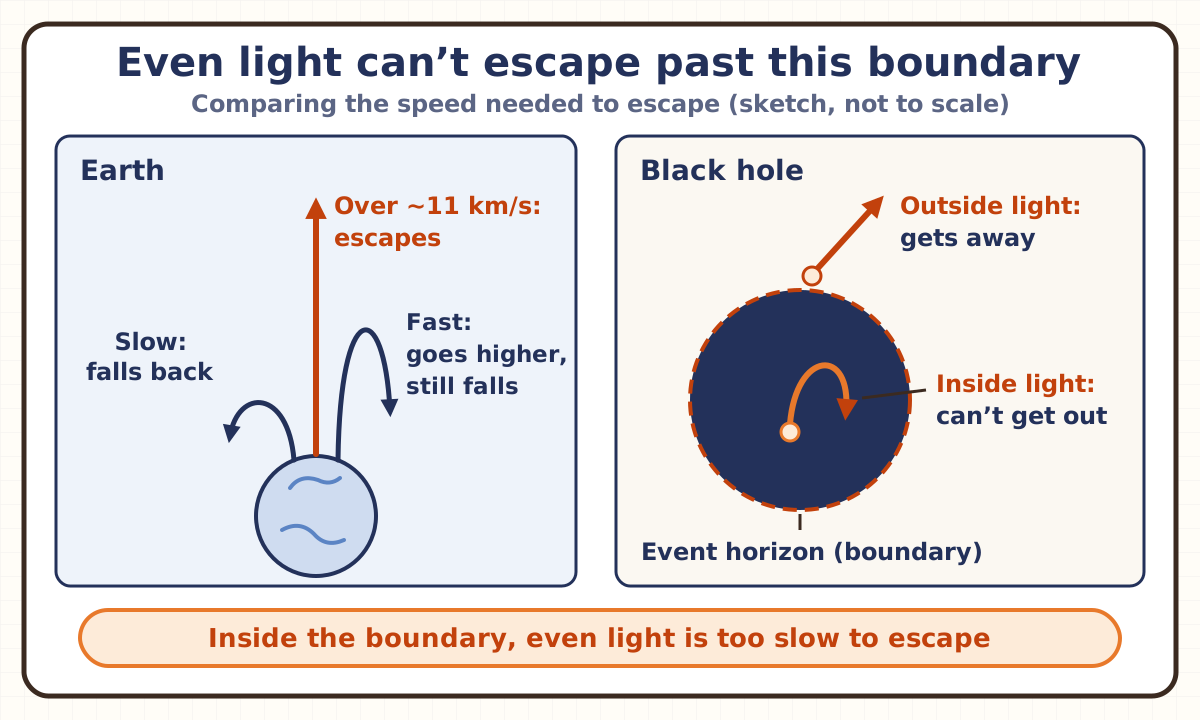
A black hole is an object where so much matter is packed into such a small space that its gravity becomes extremely strong, and not even light can get out from inside a certain boundary.
That boundary is called the event horizon. Just as you can’t see past the horizon, nothing that happens inside it can be seen from outside. It isn’t a surface made of anything, though.
Some black holes form when heavy stars collapse at the end of their lives; others, called supermassive black holes, are far heavier and sit at the centers of galaxies (huge groups of stars). The one at the center of our own Milky Way has about 4 million times the Sun’s mass.
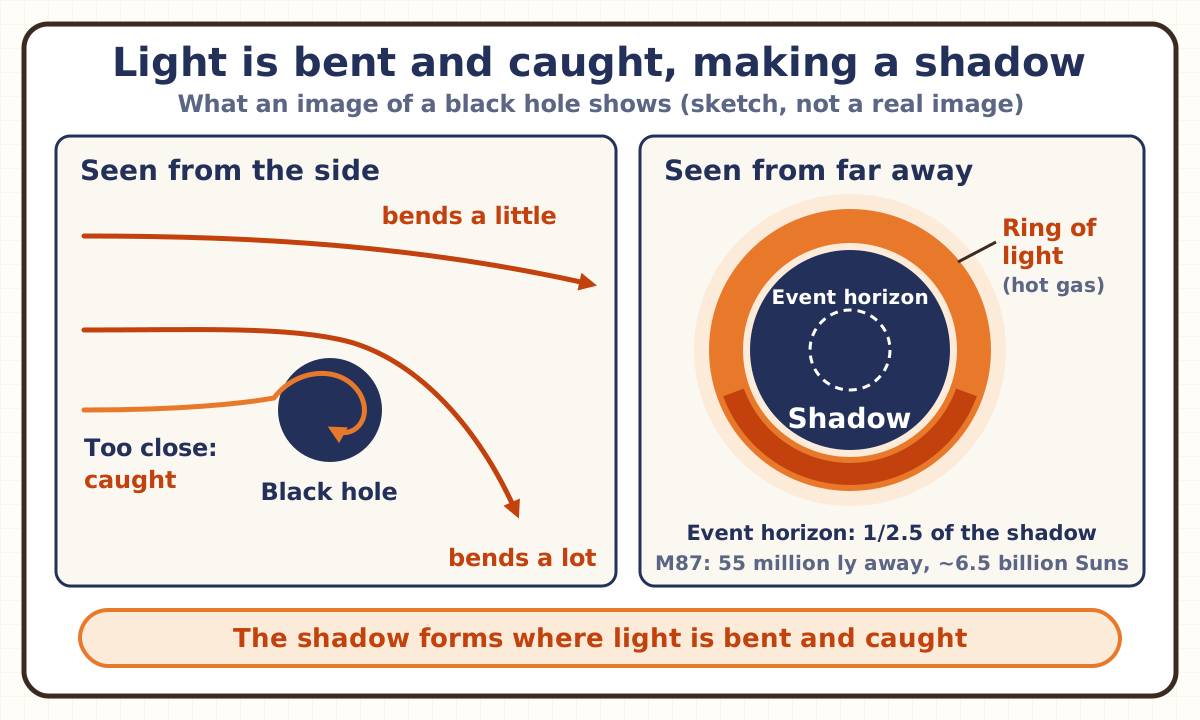
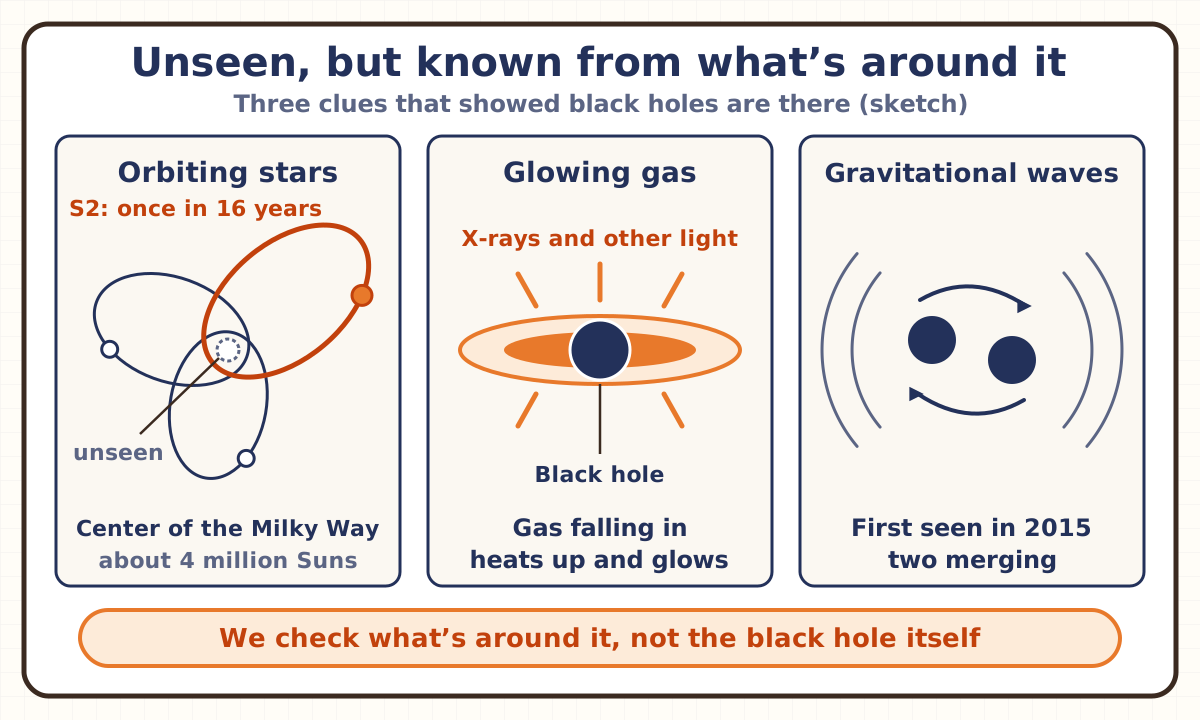
Because they give off no light, they can’t be seen directly. Even so, they have been shown to exist through the motions of stars circling them, glowing gas around them and gravitational waves (tiny stretches and squeezes of space that travel outward) sent out when two of them merged. In 2019, the first image was released showing a dark “shadow” inside a ring of light.
A common mix-up
“A black hole sucks in everything nearby, like a vacuum cleaner.”
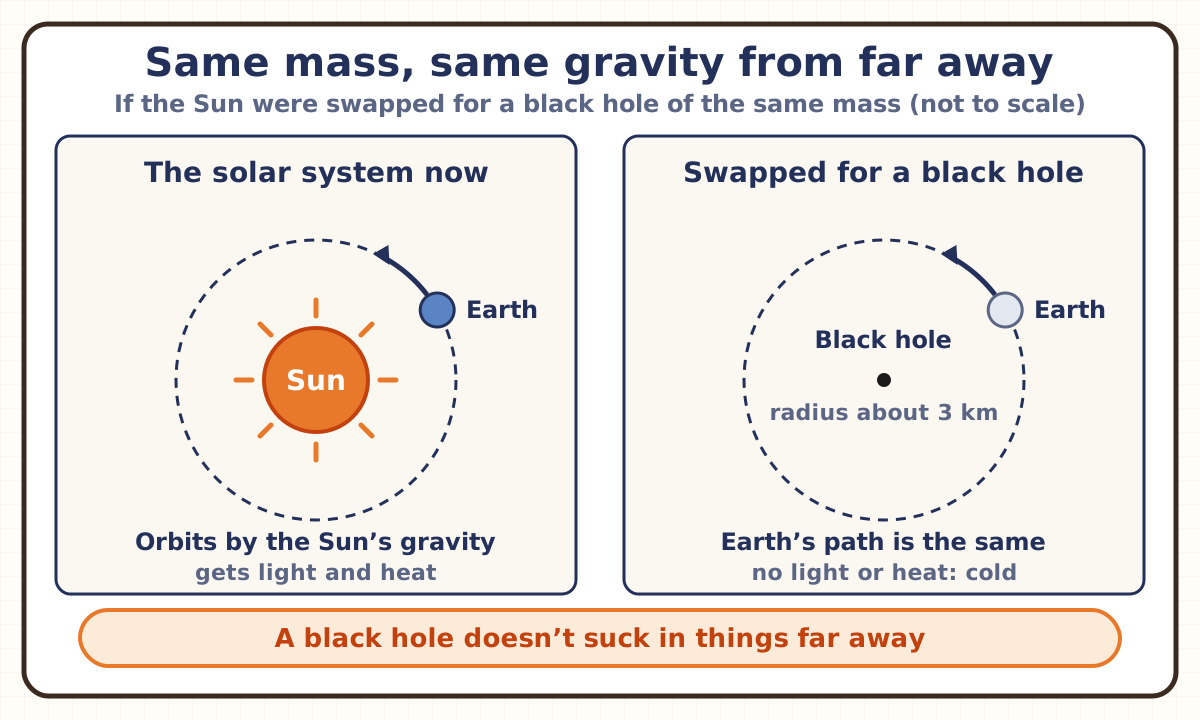
Only partly right. Anything that goes inside the event horizon, light included, can never come back out; that part is true. But a black hole doesn’t pull things toward it with some special force. The gravity it sends out to far-off places is the same as that of any other object with the same mass. For example, a black hole with the Sun’s mass has an event horizon only about 3 km in radius. If the Sun were replaced by this black hole, Earth, about 150 million km away, and the other planets would keep moving along the same paths as now (though with no sunlight or heat reaching them, it would get very cold). Only things that cross that tiny 3-km boundary are trapped for good.
Explained in pictures
You’re free to use these figures in lessons, slides and posts if you credit Naru News (naru.news). CC BY 4.0.
Think of it like this
A fish swimming in a river toward a waterfall
Picture a river flowing toward a big waterfall. Far from the falls, the current is slow, so a fish can swim back upstream. The closer you get to the falls, the faster the current becomes. At some point, the current is as fast as the fish’s top swimming speed. Closer to the falls than that, no matter how hard the fish swims, it can only be carried downstream.
In a black hole, the fish is light, and the fish’s top speed is the speed of light (about 300,000 km per second). The place where the current matches the speed of light is the event horizon. Outside it, light can still get away, but inside it, not even light can get out. And just as a fish far from the falls can swim without noticing them, a star far from a black hole moves just as it would around any other star of the same mass.
But the comparison has limits. There is no water flowing in space; the “current” stands in for gravity (in general relativity, time and space are warped around heavy objects). A fish can change its speed, but light always travels at the same speed in a vacuum. And the event horizon is a boundary that means “past here, there is no way out”; unlike the edge of a waterfall, there is nothing there you could see.
Key points
Why can’t even light get out?
If you throw a ball up into the sky, Earth’s gravity pulls it back and it falls. The faster you throw it, the higher it goes, and if it goes faster than about 11 km per second, it never comes back and escapes from Earth. This speed needed to break free of gravity is bigger for heavier objects, and bigger the closer you are to the object’s center.
Around a black hole there is a boundary where this speed equals the speed of light (about 300,000 km per second). That boundary is the event horizon. Inside it, the speed needed to escape is more than even the speed of light. Since nothing can travel faster than light, neither light nor anything else can get out from inside. Light moves more than 20,000 times faster than the speed needed to escape from Earth, and even that isn’t fast enough.
That such objects could exist came out of the equations of the theory of gravity Einstein published in 1915 (general relativity). An answer to those equations describing a black hole was first found the next year, in 1916. The size of the event horizon grows in proportion to the mass, and for a black hole with the same mass as the Sun, its radius would be about 3 km.
Why is it called a “black hole”?
Light doesn’t come out, so it looks completely dark, and whatever goes in can’t come out, so it’s like a hole. But it is not really a hole in space: it is an object with a huge amount of matter packed into a tiny space. And it looks black not because its surface is colored black, but because no light comes out.
The name is often said to have caught on after the American physicist John Wheeler used it in an article for general readers published in 1968. But one study points out that from around 1960, another physicist at the same university had already been using the phrase as a comparison for completely collapsed stars. Who really came up with the name is not clear.
How do black holes form?
One kind forms at the end of a heavy star’s life. A star shines with the heat and light given off as light atoms such as hydrogen are squeezed together into heavier ones in its core (nuclear fusion). A star much heavier than the Sun (about 20 times the Sun’s mass or more) has its core collapse into a black hole when it runs out of this fuel. Black holes made this way have a few to hundreds of times the Sun’s mass. There may be as many as 100 million of them in the Milky Way alone.
The other kind is the supermassive black hole at the center of a galaxy. These have hundreds of thousands to billions of times the Sun’s mass (the one at the center of the Milky Way has about 4 million times, and the one at the center of M87, a distant galaxy, about 6.5 billion times) and sit at the centers of almost all large galaxies, including the Milky Way. How they got so heavy is still not well understood. One idea is that they began when very heavy stars collapsed in the early universe. It is known that they can grow by taking in things around them, and by merging with other supermassive black holes when galaxies collide.
The 2020 Nobel Prize in Physics was shared between two pieces of black hole research. One was Roger Penrose’s work showing that, if general relativity holds, black holes really do form (in a 1965 paper). The other was the research on the motions of stars, described in “If we can’t see them, how do we know they’re there?” below.
If we can’t see them, how do we know they’re there?
The first clue is light from the gas around them. Gas falling into a black hole circles it and forms a flat disk (called an accretion disk). The gas heats up to millions of degrees and gives off strong light such as X-rays (invisible light, the kind used for X-ray pictures at a hospital). What glows is not the black hole but the gas that hasn’t fallen in yet.
The second is the motion of stars around them. At the center of the Milky Way, stars race around something unseen. One of them, the star S2, travels a long oval path once every 16 years, and when it came closest in May 2018, it passed less than 20 billion km from the center at more than 25 million km per hour (almost 3% of the speed of light). Making stars circle that fast takes something very heavy at the center, and from the stars’ motions its mass was found to be about 4 million times the Sun’s. Reinhard Genzel and Andrea Ghez, who studied such star motions for over 20 years from the 1990s and found a very heavy, very small object at the center of the Milky Way, shared the 2020 Nobel Prize in Physics with Penrose.
The third is gravitational waves. When very heavy objects move violently, the warping of time and space around them spreads outward like ripples. These are gravitational waves. As a wave passes, lengths in that place stretch and shrink by a tiny amount. The two LIGO detectors in the United States send laser light back and forth along L-shaped arms 4 km long and can measure changes in the distance between mirrors far smaller than a single atom. In September 2015, LIGO caught gravitational waves for the first time. They were sent out when two black holes, about 36 and 29 times the Sun’s mass, merged about 1.3 billion years ago, and they took about 1.3 billion years to reach Earth. The black hole formed by the merger was about 3 Suns lighter than the two added together. That much mass turned into gravitational-wave energy in an instant and left as the waves. It was also the first time a merger of two black holes had been observed.
What does the 2019 image show?
In April 2019, an international team called the Event Horizon Telescope (EHT) released the first image of a black hole’s “shadow.” Its target was the black hole at the center of the galaxy M87, about 55 million light-years from Earth (the distance light travels in 55 million years), with about 6.5 billion times the Sun’s mass. The observations were made in April 2017: eight radio telescopes around the world, with their clocks precisely matched, observed it together, and their observations were combined so that they worked like a single telescope the size of Earth.
What the image shows is not the black hole itself. The bright ring is light from the hot gas around it, bent by the black hole’s gravity on its way to us (light bending around the gravity of a heavy object is called gravitational lensing). The dark area inside is called the “shadow,” where much less light reaches us because light is bent and caught. It isn’t completely black: it is about a tenth as bright as the ring. The black hole itself (the event horizon) is about 1/2.5 the size of the shadow, roughly 40 billion km across. That is more than 4 times as wide as the path of Neptune, the outermost planet of our solar system (about 9 billion km across). The image matched calculations based on general relativity remarkably well.
In May 2022, an image of the black hole at the center of our Milky Way, Sagittarius A* (“A-star”), was also released. It lies about 27,000 light-years away and has about 4 million times the Sun’s mass. Seen from Earth, it looks only about as big as a doughnut placed on the Moon. Its mass is less than a thousandth of the M87 black hole’s, but because it is much closer, its ring looks about the same size. But because Sagittarius A* is much smaller, gas circles it in just minutes (days to weeks around M87). It changes even while being observed, which made it hard to image.
What is inside?
No one knows. No light or any other signal comes out from inside the event horizon, so there is no way to look inside from outside.
Calculations with general relativity predict that at the very center of a black hole, matter is crushed into a single point with no size at all. This is called a singularity. But whether such a point really exists, or only shows up in the calculations while the real inside is different, is still not known.
By the way, the “technological singularity” that comes up in talk about AI borrows its name from the word “singularity” in math and physics; it doesn’t mean the center of a black hole. It borrows the images of a point where values grow without limit and of a boundary beyond which nothing can be seen.
Check yourself
Q1Suppose the Sun were replaced by a black hole of the same mass. How far from the center is the boundary past which not even light can get out?
Answer and explanation
Answer: C About 3 km
For a black hole with the Sun’s mass, the boundary past which not even light can get out (the event horizon) has a radius of only about 3 km. The Sun’s present radius is about 700,000 km, so the mass would be squeezed into a very small space. The boundary is tiny, and the gravity reaching far-off places is the same as the Sun’s now, so Earth wouldn’t be sucked in but would keep going around on the same path. What changes is that no light or heat would reach it, so it would get very cold.
Q2In 2019, the first image was released of the black hole at the center of M87, a distant galaxy. What was the dark area inside the bright ring of light?
Answer and explanation
Answer: A A shadow from light being bent and caught
Light from the hot gas around the black hole is bent by its gravity on the way to us, and light that comes too close is caught and can’t get out. So much less light arrives from inside the ring, which looks dark and is called the “shadow” (it isn’t completely black: it is about a tenth as bright as the ring). It is not cold gas showing up, nor a dust cloud in front blocking the light. And the boundary past which light can’t get out (the event horizon) is about 1/2.5 the size of the shadow, so the dark area isn’t simply the event horizon itself either.
Q3One discovery that won the 2020 Nobel Prize in Physics was a very heavy, very small object at the center of the Milky Way (the galaxy our solar system is in). What was mainly studied to find it?
Answer and explanation
Answer: B The speeds and paths of stars circling it
The two researchers who won kept studying the motions of stars circling the center of the Milky Way for more than 20 years from the 1990s. The star S2, for example, goes around once every 16 years and passes by at more than 25 million km per hour at its closest. To make stars circle that fast, something very heavy must be at the center, and from the stars’ motions its mass was found to be about 4 million times the Sun’s. Radio waves and X-rays are also clues for studying black holes, but this prize went to the research that weighed the center from the motions of stars.
More on this → Key points: If we can’t see them, how do we know they’re there?
Related terms
- Black hole star
- Supermassive black hole
- Event horizon
- General relativity
- Gravitational wave
- Gravitational lensing
- Accretion disk
- Gravitational singularity
- Milky Way
- Event Horizon Telescope
- Technological singularity
Sources and how we checked
- The Event Horizon Telescope Collaboration, "First M87 Event Horizon Telescope Results. I. The Shadow of the Supermassive Black Hole" (The Astrophysical Journal Letters 875, L1, April 10, 2019; arXiv abstract: the ring’s diameter, the brightness of the dark center, the mass and the four days of observations; read November 15, 2026)
- National Astronomical Observatory of Japan, Japanese press release on the first image of a black hole in the galaxy M87 (April 10, 2019; the distance and mass, how the shadow forms, the size of the event horizon, when it was observed, and how the eight telescopes were synchronized to act as one Earth-sized telescope; read November 15, 2026)
- National Astronomical Observatory of Japan, Japanese press release on the first image of the black hole at the center of the Milky Way (May 12, 2022; the distance and mass of Sagittarius A*, its apparent size, how it differs from M87, and that gas circles it in minutes because it is much smaller; read November 15, 2026)
- GRAVITY Collaboration, "Detection of the gravitational redshift in the orbit of the star S2 near the Galactic centre massive black hole" (Astronomy & Astrophysics 615, L15, 2018; arXiv abstract: S2’s 16-year orbit and the 26 years of observations; read November 15, 2026)
- ESO, "First Successful Test of Einstein’s General Relativity Near Supermassive Black Hole" (eso1825, July 26, 2018; S2’s distance and speed at its closest approach in May 2018, and the black hole’s mass; read November 15, 2026)
- ESO, "2020 Nobel Prize in Physics awarded for research with ESO telescopes on Milky Way’s supermassive black hole" (eso2017, October 6, 2020; Genzel’s team tracking stars from 1992; read November 15, 2026)
- American Physical Society, "Nobel Prize in Physics Recognizes Black Hole Discoveries" (October 6, 2020; the prize citations for Penrose and for Genzel and Ghez; read November 15, 2026, as the Nobel Foundation’s page could not be opened from here)
- UCLA, "Andrea Ghez wins 2020 Nobel Prize in physics" (University of California, Los Angeles announcement, October 6, 2020; Ghez’s team studying the center of the Milky Way for many years with the Keck Observatory; read November 15, 2026)
- LIGO Scientific Collaboration and Virgo Collaboration (Abbott et al.), "Observation of Gravitational Waves from a Binary Black Hole Merger" (Physical Review Letters 116, 061102, February 11, 2016; arXiv abstract: the date, the masses of the two black holes and the merged one, and the mass turned into gravitational waves; read November 15, 2026)
- LIGO, "Gravitational Waves Detected 100 Years After Einstein’s Prediction" (LIGO at Caltech news release, February 11, 2016; the merger about 1.3 billion years ago, about 3 Suns’ worth of mass turned into gravitational waves, the two detectors with 4-km arms, and measuring tiny changes in the distance between mirrors, smaller than a ten-thousandth of a proton’s width; read November 15, 2026)
- ESA, "100 years of General Relativity" (Einstein presenting general relativity in four papers in November 1915; read November 15, 2026)
- UNAWE (Universe Awareness), Japanese edition of a children’s space news story (the boundary past which nothing can escape a black hole, called 事象の地平線, “event horizon,” in Japanese; read November 15, 2026)
- Herdeiro and Lemos, "The black hole fifty years after: Genesis of the name" (Gazeta de Física 41(2), 2018; arXiv abstract: Schwarzschild’s 1916 solution, Wheeler’s 1968 article, and Dicke and the “Black Hole of Calcutta”; read November 15, 2026)
- NASA, "Black Holes" (NASA Science; that they are matter packed into tiny spaces, that they don’t suck in matter, that replacing the Sun with a black hole of the same mass would leave the planets in their orbits but make the solar system much colder, and the mass of Sagittarius A*; read November 15, 2026)
- NASA, "Black Hole Anatomy" (NASA Science; that inside the event horizon the escape speed exceeds the speed of light, the singularity at the center and that it is not known whether it is real or purely mathematical, light from the accretion disk, and gravitational lensing; read November 15, 2026)
- NASA, "Black Hole Types" (NASA Science; formation from stars of about 20 times the Sun’s mass or more, their masses and numbers in the Milky Way, and the masses and possible origins of supermassive black holes; read November 15, 2026)
- NASA, "Black Holes" (Imagine the Universe!; that a black hole with the Sun’s mass would have a radius of about 3 km, that Earth’s orbit would be unchanged, and that gas at a few million degrees gives off X-rays; read November 15, 2026)
- NASA, "Earth Fact Sheet" and "Sun Fact Sheet" (Earth’s escape velocity of 11.186 km/s, the average Earth–Sun distance of 149.6 million km, and the Sun’s radius of 695,700 km; read November 15, 2026)
- NASA, "Neptune Fact Sheet" (Neptune’s average distance from the Sun of 4,514.95 million km; read November 15, 2026)
- NASA, "Stars" (NASA Science; nuclear fusion in a star’s core squeezing hydrogen nuclei together into helium, and the core running out of hydrogen near the end of a star’s life; read November 15, 2026)
- NIST, "CODATA Value: speed of light in vacuum" (299,792,458 m/s; read November 15, 2026)
AI wrote this page from the sources above, and a different AI checked it against the text of those sources (November 15, 2026). A person with a master’s degree in science and a Japanese high-school science teaching license also read and checked it before publishing. Numbers are as of that date. If anything was hard to follow, you spot a mistake, or there’s a term you’d like explained, please write to [email protected].
Space terms
- You are hereBlack hole
- Black hole star
- Event horizon
- General relativity
- Gravitational lensing
- Gravitational wave
- Special relativity