 Naru News日本語
What is gravitational lensing (when a heavy object’s gravity bends light, so faraway objects look distorted)?
Also called: Gravitational lens

In one minute
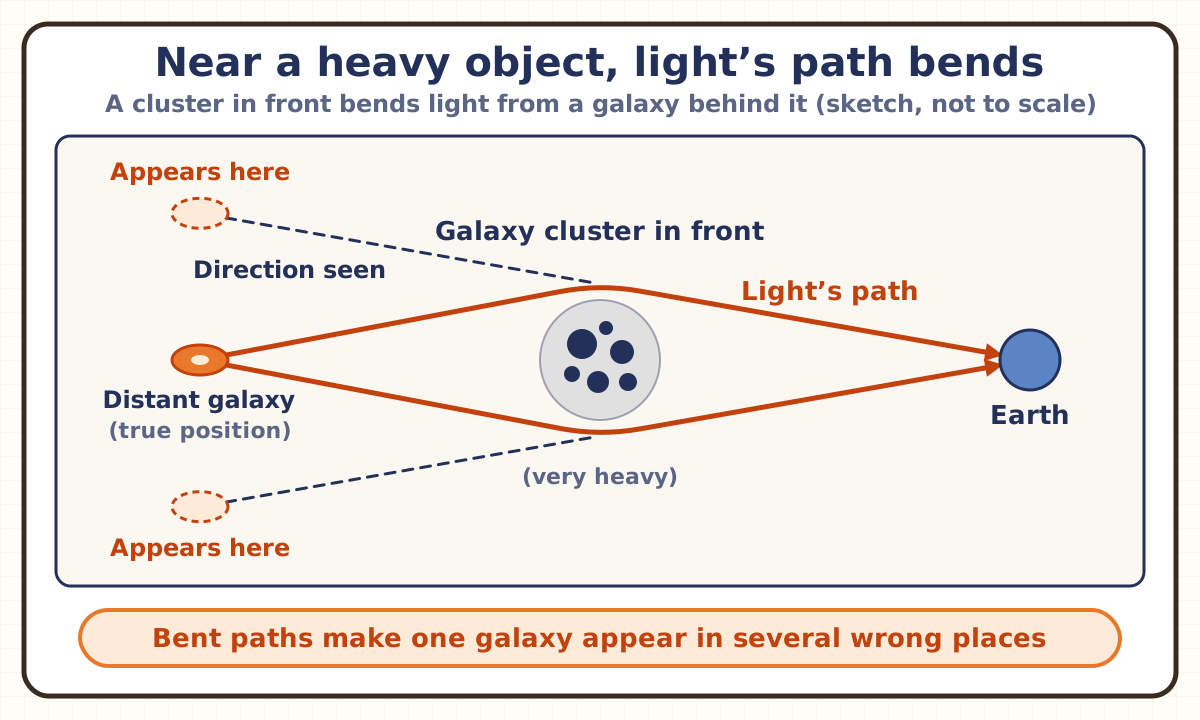
Gravitational lensing is when light from a distant object passes near a heavy object, such as a galaxy or a huge group of galaxies (a galaxy cluster), and gravity bends the light’s path, so the distant object looks distorted, brighter, or split into several images.
In Einstein’s theory of gravity (general relativity), time and space themselves are warped around heavy objects. Light tries to travel straight, but because it passes through warped places, its path looks bent from outside. This prediction was confirmed during the total solar eclipse of 1919, when starlight passing right next to the Sun was bent and the stars appeared slightly out of place.
Because the bent light makes distant objects look bigger and brighter, or distorted, much as a magnifying glass or other lens does, it is called a “lens.” Today it is used to magnify faint, distant galaxies, to find out where dark matter, which gives off no light, is, and to find planets outside our solar system.
A common mix-up
“A gravitational lens works just like a magnifying glass, gathering the light of a distant object into a single point to make it look bigger.”
Only partly right. It is true that a heavy object’s gravity bends the paths of light from a distant object and can make it look bigger and brighter. But it bends light the opposite way from a magnifying glass. Compare them by how far from the middle the light passes. A magnifying glass bends light passing farther from its middle more strongly, so the light gathers into one point (the focus). In gravitational lensing, light passing near the middle of the heavy object bends more, and light passing farther away normally bends only a little, so the light doesn’t gather into one point. That is why the distant object can look stretched into an arc, split into several images, or turned into a ring. And there is no giant piece of glass in space: what bends the light is the heavy object’s gravity.
Explained in pictures
You’re free to use these figures in lessons, slides and posts if you credit Naru News (naru.news). CC BY 4.0.
Think of it like this
A light seen through the base of a wine glass
Picture holding the thick, round glass base of a wine glass in front of a small light a little way off (a tiny bulb or a candle) and looking at the light through the base. When the middle of the base is right in front of the light, the light spreads out into a ring. Move the glass a little to the side, and the ring breaks into an arc, or into a few separate points of light.
In gravitational lensing, the light is a distant galaxy or star, and the base of the glass is a heavy galaxy or galaxy cluster in front of it. The shape of a wine glass’s base bends light more like a gravitational lens than a magnifying glass does. Both make rings, arcs and several images instead of gathering the light into one point.
But the comparison has limits. Glass bends the path of light as the light passes through it, and so a glass lens bends different colors by slightly different amounts. A gravitational lens has nothing like glass for the light to pass through. Around a heavy object, time and space themselves are warped, so even though light tries to travel straight, its path bends. The bending doesn’t depend on color: every color of light bends by the same amount. And real gravitational lenses aren’t neatly shaped like a glass: the mass of galaxies and of unseen dark matter is gathered unevenly, in lumps here and there.
Key points
Why does gravity bend light?
If you throw a ball sideways, Earth’s gravity bends its path downward. Light passing near a heavy object also has its path bent toward that object. But the way light bends is explained with a different idea from a ball being pulled down.
In the theory of gravity Einstein published in 1915 (general relativity), time and space (together called spacetime) are themselves warped around heavy objects. Light always tries to travel straight. But because it travels through warped spacetime, that straight path, seen from outside, is bent toward the heavy object. It is a bit like stretching a string tight between two cities on a globe: the string takes the straightest, shortest route, yet if you copy that route onto a flat world map, it becomes a curved line. (The comparison has a limit: on a globe only the surface is curved, while gravity warps time as well as space.)
The bending is not an optical illusion. Light leaving a star really changes direction on the way, and reaches Earth from a different direction than if it had come straight. Our eyes and telescopes see a star in the direction its light arrives from, so as a result, the star appears away from where it really is. The bending of light’s path is the cause; the star looking shifted is the result.
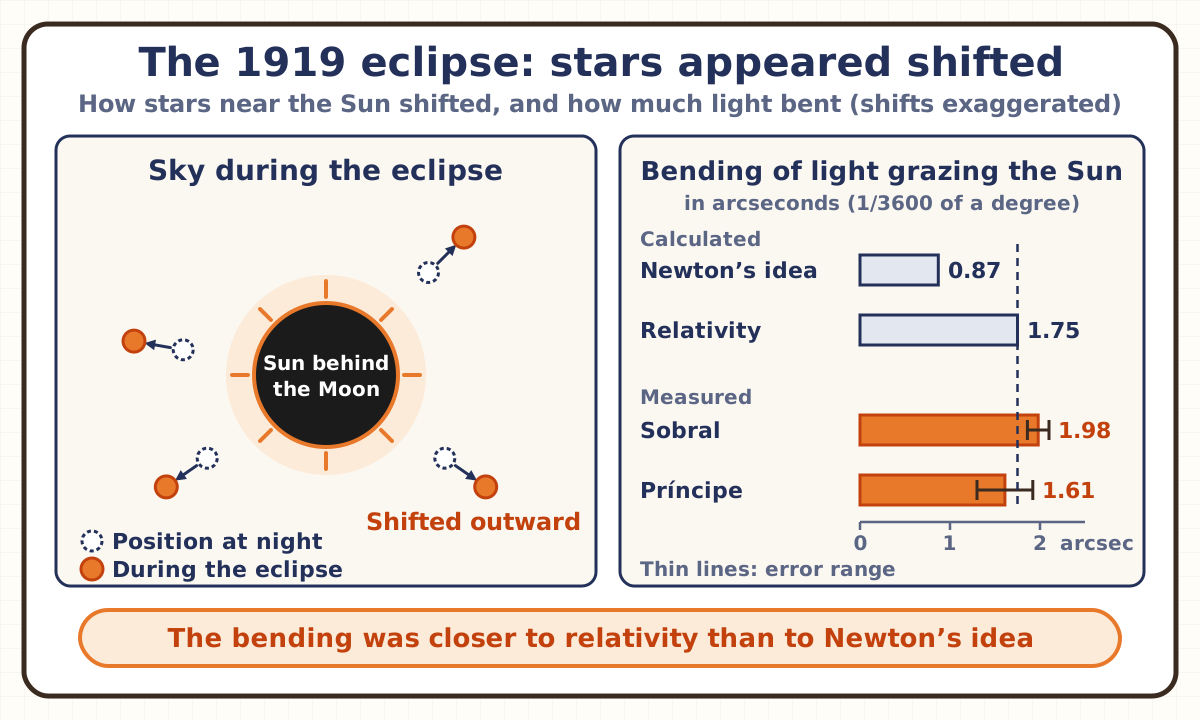
The closer to a heavy object the light passes, the bigger the bending angle. For starlight just grazing the edge of the Sun, the prediction was about 1.75 arcseconds. An arcsecond is 1/3600 of a degree, and 1.75 arcseconds is a very small angle, about the width of a 1-yen coin (2 cm across) seen from about 2.4 km away. If you treat light as tiny particles pulled by gravity and calculate with Newton’s idea of gravity, you get half that, about 0.87 arcseconds. So measuring the bending angle can tell which idea is right.
When was it first confirmed?
During the total solar eclipse of May 29, 1919. Normally, the Sun’s glare hides stars right next to it. But while the Moon covers the Sun in a total eclipse, stars near the Sun can be photographed. Their positions were compared with photos of the same stars taken at night in a season when the Sun was elsewhere in the sky (at Sobral, in July).
British teams observed from two places: Sobral in Brazil, in South America, and the island of Príncipe in the Gulf of Guinea, west of Africa. Stars near the Sun showed up slightly shifted outward, away from the Sun, compared with their positions at night. Starlight passing near the Sun bent toward it, so from Earth the stars appeared farther out than they really are. The bending angle at the Sun’s edge worked out from the shifts was about 1.98 arcseconds at Sobral and about 1.61 at Príncipe, closer to general relativity’s prediction of about 1.75 than to the 0.87 of Newton’s idea.
The result was announced in London on November 6, 1919, and a British newspaper carried the headlines “Revolution in Science” and “Newtonian Ideas Overthrown.” From then on, Einstein’s name became widely known. But the measurements of the time still had wide error ranges. In the photos from a second telescope at Sobral, the stars came out blurred, as if out of focus, because the Sun’s heat had affected the telescope’s mirror, so the observers judged them unreliable (worked out from them, the angle came to about 0.93 arcseconds). Without relying on those photos, later and far more precise measurements by other methods, using radio telescopes and other tools, have also agreed with general relativity’s prediction.
Why is it called a “lens”?
A glass lens, such as a magnifying glass, bends the path of light and makes things look bigger or distorted. The gravity of a heavy object also bends the paths of light passing near it, making distant objects look bigger and brighter, or distorted. Because this works like a lens, it is called gravitational lensing, and the heavy object doing the bending is called a gravitational lens.
But it isn’t the same as a glass lens. A magnifying glass bends light passing farther from its middle more strongly, so the light gathers into one point (the focus). Gravitational lensing normally works the other way: light passing farther from the middle of the heavy object bends less, so the light doesn’t gather into one point. And there is no glass in space: what bends the light is the heavy object’s gravity.
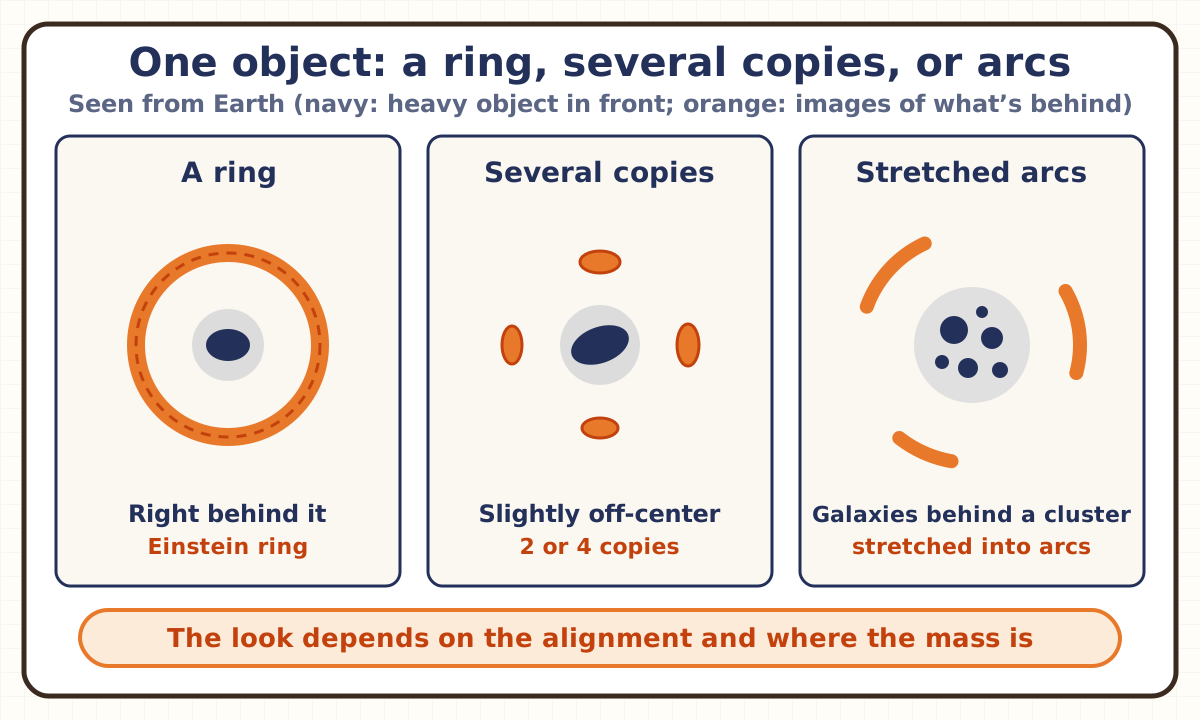
An image in which a distant object looks like a ring is called an Einstein ring, after Einstein, who created general relativity.
What does it look like?
How it looks depends on how the distant object and the heavy object in front line up, and on where the mass of the object in front is, and how much. If the distant object sits exactly behind an object in front whose mass is gathered in a neat, round shape, the distant object looks like a ring around it (an Einstein ring). If it is slightly off-center, the same object may split into 2 or 4 images, or be stretched into an arc.
Images split by gravitational lensing were first found in 1979. Two quasars (objects at the centers of distant galaxies that shine extremely brightly as gas falls into a huge black hole), about equally bright and at the same distance, sat only 5.7 arcseconds apart in the sky (about the width of a 1-yen coin seen from about 720 m away). The paper suggested they might be one and the same quasar, split in two by the gravity of something in front. Today they are regarded as the first multiple images from gravitational lensing ever found.
A lensed object looks brighter because of how its image is stretched. Each patch of the image is just as bright as it would be without the lens. But the whole image is stretched and enlarged on the sky, so altogether more of its light reaches the telescope, and it looks brighter.
What is it used for?
First, as a cosmic magnifying glass. Very distant galaxies are faint and small and hard to study as they are. When a galaxy cluster (a huge group of galaxies) in front acts as a lens, galaxies behind it are magnified and look brighter, so even distant galaxies that would normally be hard to see can be studied. In one of the James Webb Space Telescope’s first images, released in July 2022, which looked very far out into the universe, the mass of the galaxy cluster SMACS 0723 acted as a lens, magnifying more distant galaxies behind it and stretching some into arcs.
Second, as a scale for weighing. How much light bends depends on the mass of the lensing object, so the way images are distorted shows how much mass is where, including matter that gives off no light. In galaxy clusters, much of the mass weighed this way is thought to be invisible dark matter (matter that gives off no light but has mass, and whose nature is unknown). The Subaru Telescope and others make maps of dark matter from slight distortions in the shapes of many distant galaxies.
In 2006, gravitational lensing was used to find where the mass was, and how much, in an object where two galaxy clusters collided (the Bullet Cluster). In the collision, the galaxies passed through each other with hardly any crashes, but the clouds of hot gas crashed into each other, were held back, and separated from the galaxies. Most of the visible matter is in this gas, so without dark matter, the mass should have been where the gas was. Instead, the mass roughly matched where the galaxies were. This makes sense if something unseen and heavy passed through along with the galaxies, and the paper concluded that most of the matter in the object is unseen. The result is regarded as one of the strong clues that dark matter exists.
Third, for finding planets. When a star in front passes almost exactly in front of a star behind it, the front star’s gravity briefly brightens the light of the star behind (this is called microlensing). On a graph of the star’s brightness over time, this shows up as a peak that rises and falls. If the front star has a planet, the planet’s gravity adds a second, smaller peak. In observations in 2003, a planet estimated at about 1.5 times Jupiter’s mass was found this way. Of all the planets outside our solar system (exoplanets) found so far, about 2% were found by this method.
Can the same exploding star really be seen again later?
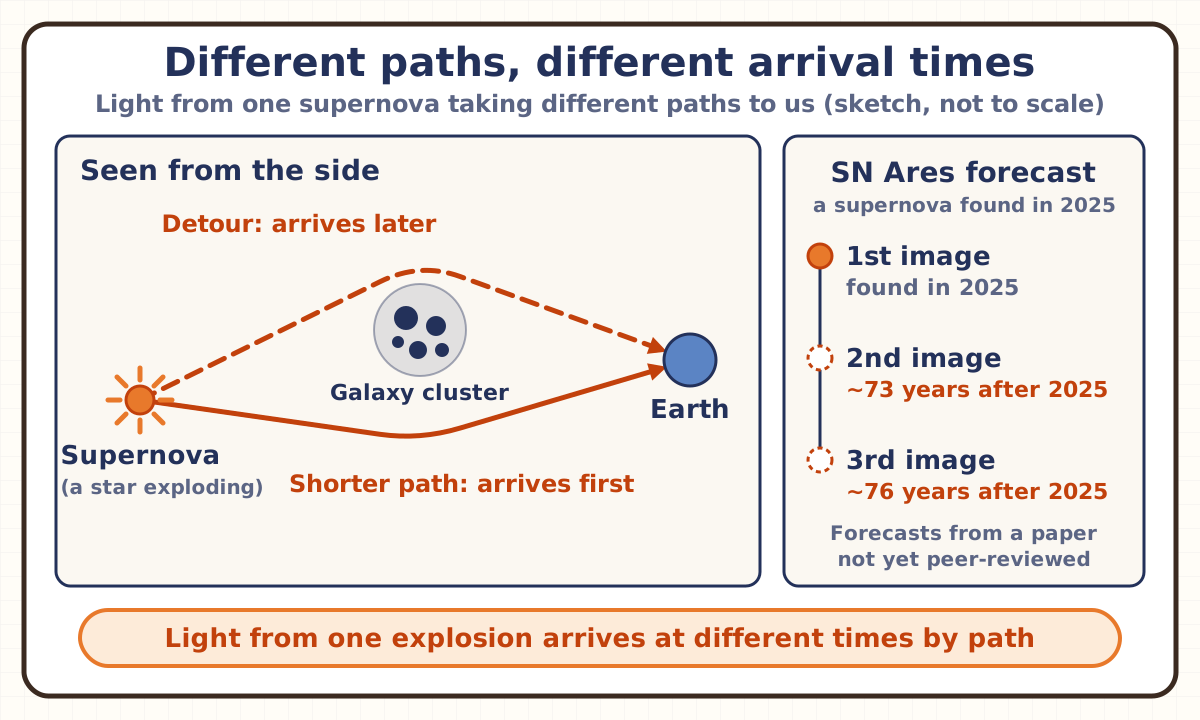
Yes. When gravitational lensing splits one object into several images, the light for each image travels a path of a different length, so it reaches Earth at a different time. For a galaxy whose brightness doesn’t change, the delay is hard to notice. But for something that suddenly brightens, such as a supernova (a huge explosion at the end of a star’s life), the same explosion is seen at different times in different images.
In November 2014, a supernova split into four images appeared in Hubble Space Telescope pictures, arranged around one galaxy in a galaxy cluster in front. It was named Refsdal, after the researcher who, in 1964, first proposed using the time delays of a lensed supernova to study how the universe expands. Calculating where the cluster’s mass is, and how much, researchers predicted that another image would appear in a different spot within about a year. On December 11, 2015, a new image was indeed found where they had predicted. It was the first time anyone had predicted in advance when and where a supernova would be seen.
The time delays between images are also a clue for measuring the Hubble constant. Galaxies farther away are moving away from us faster, and the Hubble constant gives that rate, showing how fast the universe is expanding now. Right now, its value differs a little depending on how it is measured, so it is being measured in many different ways. In 2023, the delays between Refsdal’s images gave a value meaning that for every one distance unit used in astronomy (about 3.26 million light-years) farther away a galaxy is, it moves away about 65 km per second faster (about 67 km per second using only the two calculated maps of the cluster’s mass that best match the observations).
In August 2025, the James Webb Space Telescope found a supernova named SN Ares behind another galaxy cluster. A paper released in October 2026, before review by other researchers (peer review), calculates from where the cluster’s mass is, and how much, that the supernova’s other two images will appear near the center of the cluster more than 70 years after the image found in 2025 (about 73 and 76 years later in the current best calculations). But this is a forecast from calculations, and depending on the calculated mass map it ranges from about 70 to 79 years. The paper says that such a long delay could allow the expansion of the universe to be measured very precisely.
Check yourself
Q1During the total solar eclipse of May 1919, stars right next to the Sun were photographed in Brazil. Compared with photos of the same stars taken at night in July, when the Sun was elsewhere in the sky, how did the stars’ positions during the eclipse look?
Answer and explanation
Answer: B Slightly farther out from the Sun
Starlight passing near the Sun has its path bent toward the Sun before it reaches Earth. From Earth, a star is seen in the direction its light arrives from, so during the eclipse the stars showed up farther out from the Sun than in the July photos. The bending angle at the Sun’s edge worked out from the shifts was about 1.98 arcseconds in Brazil (about 1.61 at the other site, an island), closer to general relativity’s prediction of about 1.75 than to the 0.87 of Newton’s idea.
Q2In 2006, researchers used gravitational lensing to map where the mass is, and how much, in an object where two galaxy clusters collided (the Bullet Cluster). Where was most of the mass found?
Answer and explanation
Answer: A Where most of the galaxies were
In the collision, the galaxies passed through each other with hardly any crashes, but the clouds of hot gas (which glows in X-rays and makes up most of the visible matter) crashed into each other and were held back, so the galaxies and the gas separated. The mass measured by gravitational lensing roughly matched where the galaxies were, not where the gas was. The paper concluded that most of the matter in the object is unseen and that changing the law of gravity alone can’t explain this. The result is regarded as one of the strong clues that dark matter (matter that gives off no light but has mass) exists.
Q3In 2014, a supernova appeared split into four images by the gravity of a galaxy cluster in front. Studying the cluster, researchers predicted something that would happen within about a year, and in December 2015 it did. What did they predict?
Answer and explanation
Answer: C A new image would appear elsewhere
Each image’s light travels a path of a different length, so even light from the same explosion reaches Earth at different times. Calculating where the cluster’s mass is, and how much, researchers predicted that another image would appear within about a year, in a spot apart from the four. On December 11, 2015, the Hubble Space Telescope found a new image where they had predicted. It was the first time anyone had predicted in advance when and where a supernova would be seen. It was not that two of the four images merged, or that the same four spots flashed again.
More on this → Key points: Can the same exploding star really be seen again later?
Related terms
- Black hole
- Black hole star
- General relativity
- Einstein ring
- Dark matter
- Galaxy cluster
- Supernova
- Hubble constant
- Microlensing
- Exoplanet
- Quasar
- James Webb Space Telescope
Sources and how we checked
- Malcolm Longair, "Bending space–time: a commentary on Dyson, Eddington and Davidson (1920) ‘A determination of the deflection of light by the Sun’s gravitational field’" (Philosophical Transactions of the Royal Society A 373, 20140287, 2015; the eclipse of May 29, 1919, the observations at Sobral and Príncipe, the bending at the Sun’s edge [1.75 arcsec in general relativity, 0.87 arcsec in Newton’s idea, and the measured 1.98±0.12 and 1.61±0.31 arcsec], the 0.93 arcsec from the plates blurred by the Sun’s heat on the mirror and judged unreliable, the comparison plates taken at Sobral in July, the announcement on November 6, 1919 and the newspaper headlines, and later radio and other measurements; read November 16, 2026)
- Dyson, Eddington and Davidson, "A Determination of the Deflection of Light by the Sun’s Gravitational Field, from Observations made at the Total Eclipse of May 29, 1919" (Philosophical Transactions of the Royal Society A 220, pp. 291–333, 1920; the original paper on the 1919 eclipse observations; its text could not be opened from here, so the values were checked in Longair’s commentary above)
- Adi Zitrin, "Strong Gravitational Lensing with the James Webb Space Telescope" (Ben-Gurion University of the Negev; arXiv, version 3, September 2026; Section 1.1 [massive bodies curving spacetime, light traveling along geodesics through it and seeming deflected to a distant observer, bending twice the Newtonian value, about 1.75 arcsec at the Sun’s edge, the 1919 eclipse, the doubly imaged quasar of 1979, and quasars being powered by gas falling onto a supermassive black hole], Section 1.2 [a magnifying glass bending rays farther from its center more strongly, while lensing usually bends them less, so there is no focal point; the wine-glass-base comparison; lensing being achromatic; why images look brighter, with surface brightness unchanged; Einstein rings; time delays between images], and Section 4 [one of JWST’s first images being a lensing cluster]; read November 16, 2026)
- NASA, "Hubble Gravitational Lenses" (NASA Science; gravity described as the curvature of spacetime, lensing distorting and magnifying images like a magnifying lens, most of the mass of lensing galaxy clusters being invisible dark matter, and the number and distortion of images depending on the alignment; read November 16, 2026)
- Walsh, Carswell and Weymann, "0957 + 561 A, B: twin quasistellar objects or gravitational lens?" (Nature 279, pp. 381–384, 1979; abstract: two 17th-magnitude quasars 5.7 arcsec apart at redshift 1.405, and the possibility that they are two images of one object formed by a gravitational lens; read November 16, 2026)
- National Astronomical Observatory of Japan, Subaru Telescope, Japanese press release on a rare double gravitational lens (July 25, 2016, Hawaii time; for the Japanese terms jūryoku renzu kōka, “gravitational lens effect,” and Einstein ring, and a galaxy in front strongly bending light from distant galaxies behind it; read November 16, 2026)
- National Astronomical Observatory of Japan, Subaru Telescope, Japanese press release on a dark matter map of unprecedented width and resolution (February 26, 2018, Hawaii time; making maps of dark matter from slight distortions in the shapes of distant galaxies caused by gravitational lensing; read November 16, 2026)
- NASA, "NASA’s Webb Delivers Deepest Infrared Image of Universe Yet" (July 12, 2022; the mass of the galaxy cluster SMACS 0723 acting as a gravitational lens and magnifying more distant galaxies, and the prominent arcs; read November 16, 2026)
- Clowe et al., "A Direct Empirical Proof of the Existence of Dark Matter" (The Astrophysical Journal Letters 648, L109–L113, 2006; arXiv abstract and introduction: in the merging cluster 1E0657-558 [the Bullet Cluster], the galaxies behaving as collisionless particles while the hot gas felt ram pressure, so they separated; the idea that without dark matter the mass would trace the gas, the dominant visible matter, but with collisionless dark matter it would trace the galaxies; the mass roughly traces the galaxies rather than the hot gas, an offset that a change in the law of gravity can’t explain, and the conclusion that most of the matter is unseen; read November 16, 2026)
- Bond et al., "OGLE 2003-BLG-235/MOA 2003-BLG-53: A planetary microlensing event" (The Astrophysical Journal Letters 606, L155–L158, 2004; arXiv abstract: the planet-to-star mass ratio, and that if the star is a main-sequence star, the planet has about 1.5 times Jupiter’s mass; read November 16, 2026)
- NASA, "How We Find and Characterize" (NASA Science; in microlensing, a foreground star’s gravity magnifies the light of a background star, and a planet of the foreground star shows up as a second, smaller spike; read November 16, 2026)
- NASA, "Exoplanets" (NASA Science page of the Nancy Grace Roman Space Telescope; how microlensing works, and that it has revealed about 2 percent of known exoplanets; read November 16, 2026)
- NASA, "Hubble Captures First-Ever Predicted Exploding Star" (December 2015; supernova Refsdal found in four images in November 2014, seen again on December 11, 2015 when and where predicted, each image’s light taking a path of a different length, and Refsdal’s 1964 proposal; read November 16, 2026)
- Kelly et al., "Deja Vu All Over Again: The Reappearance of Supernova Refsdal" (The Astrophysical Journal Letters 819, L8, 2016; arXiv abstract: the four images of November 2014, almost all models predicting a reappearance within a year, the new image of December 11, 2015, and the first successful advance prediction of when and where a supernova would appear; read November 16, 2026)
- Kelly et al., "Constraints on the Hubble constant from supernova Refsdal’s reappearance" (Science 380, abh1322, May 11, 2023; arXiv abstract: measuring the Hubble constant from the time delays between images, 64.8 with eight models and 66.6 with the two models most consistent with the observations [km/s/Mpc]; read November 16, 2026)
- Larison et al., "SN Ares: A Strongly Lensed Type IIb Supernova at z=1.276 with a Predicted 70-Year Time Delay" (arXiv, October 23, 2026; not yet peer-reviewed, submitted to The Astrophysical Journal; abstract and main text: discovery in JWST images taken on August 23, 2025, the cluster MACS J0308.9+2645, the observed image being the first to arrive, the forecast that the other two images will appear near the cluster center more than 70 years later [about 73 and 76 years in the current best models, about 70 to 79 years across models], the prospect of very precise measurements of cosmic expansion from the delay, and Hubble constant values from strongly lensed supernovae spanning the current cosmological tension; read November 16, 2026)
- Japan Mint, Japanese page on coins currently minted (the 1-yen aluminum coin’s 20-mm diameter, used to compare angles with how a coin looks from a distance; read November 16, 2026)
AI wrote this page from the sources above, and a different AI checked it against the text of those sources (November 16, 2026). A person with a master’s degree in science and a Japanese high-school science teaching license also read and checked it before publishing. Numbers are as of that date. If anything was hard to follow, you spot a mistake, or there’s a term you’d like explained, please write to [email protected].
Space terms
- Black hole
- Black hole star
- Event horizon
- General relativity
- You are hereGravitational lensing
- Gravitational wave
- Special relativity