 Naru News日本語
What is general relativity (the theory that explains gravity as “warped spacetime”)?
Also called: General theory of relativity

In one minute
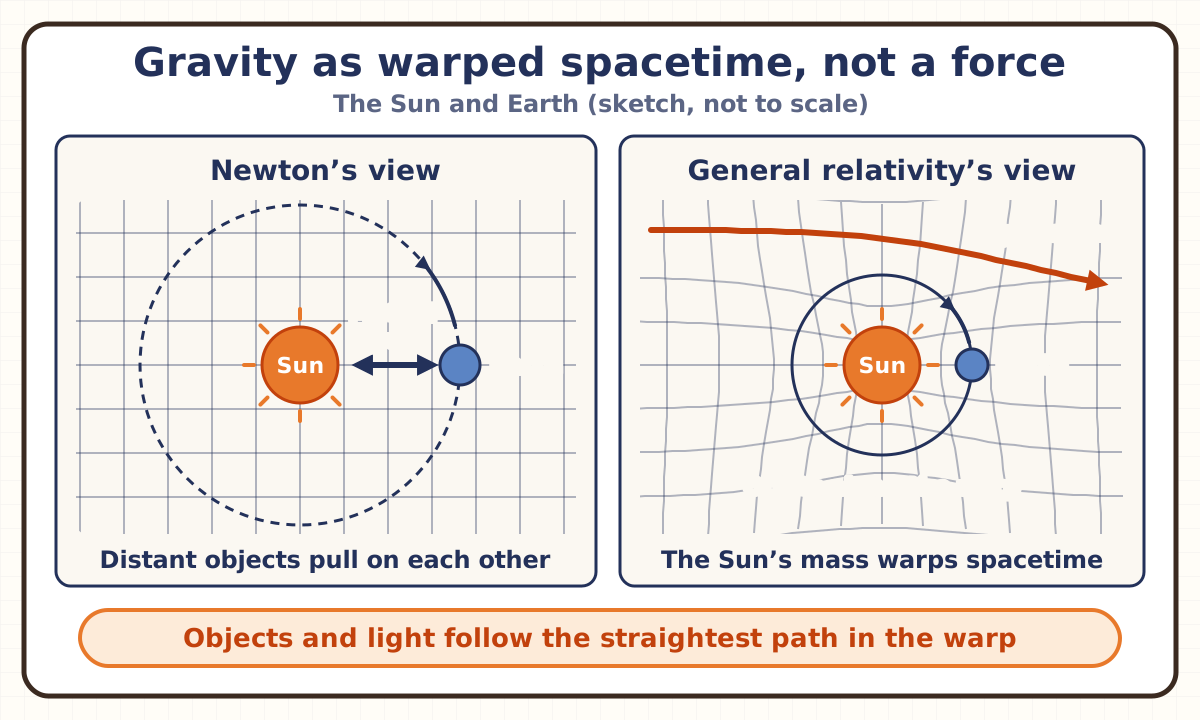
General relativity is the theory of gravity that Einstein completed in 1915. It explains gravity not as “a force by which distant objects pull on each other,” but as “heavy objects warping the time and space around them (together called spacetime), with objects and light traveling along that warp.”
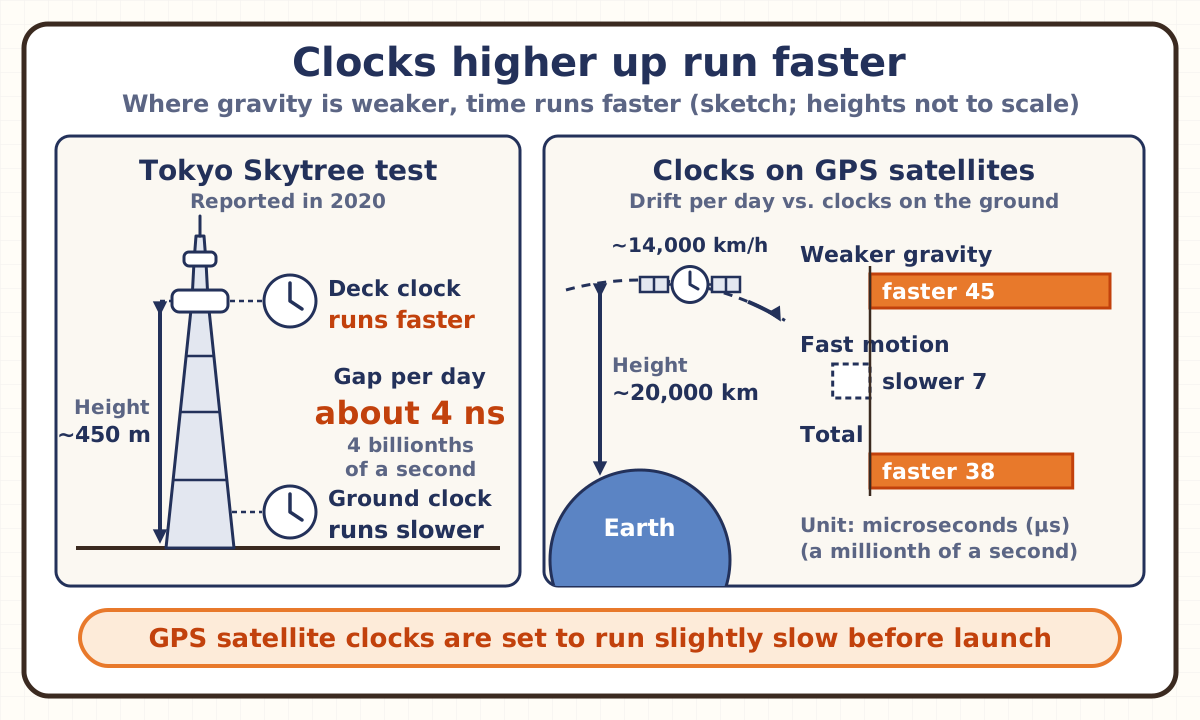
Warped spacetime shows up in how clocks run, too. The stronger the gravity, the more slowly time passes, so clocks higher up run slightly faster. Clocks on GPS satellites run slow because they move fast (as special relativity showed in 1905). But being high up speeds them up more, so they gain about 38 millionths of a second a day and are adjusted in advance.
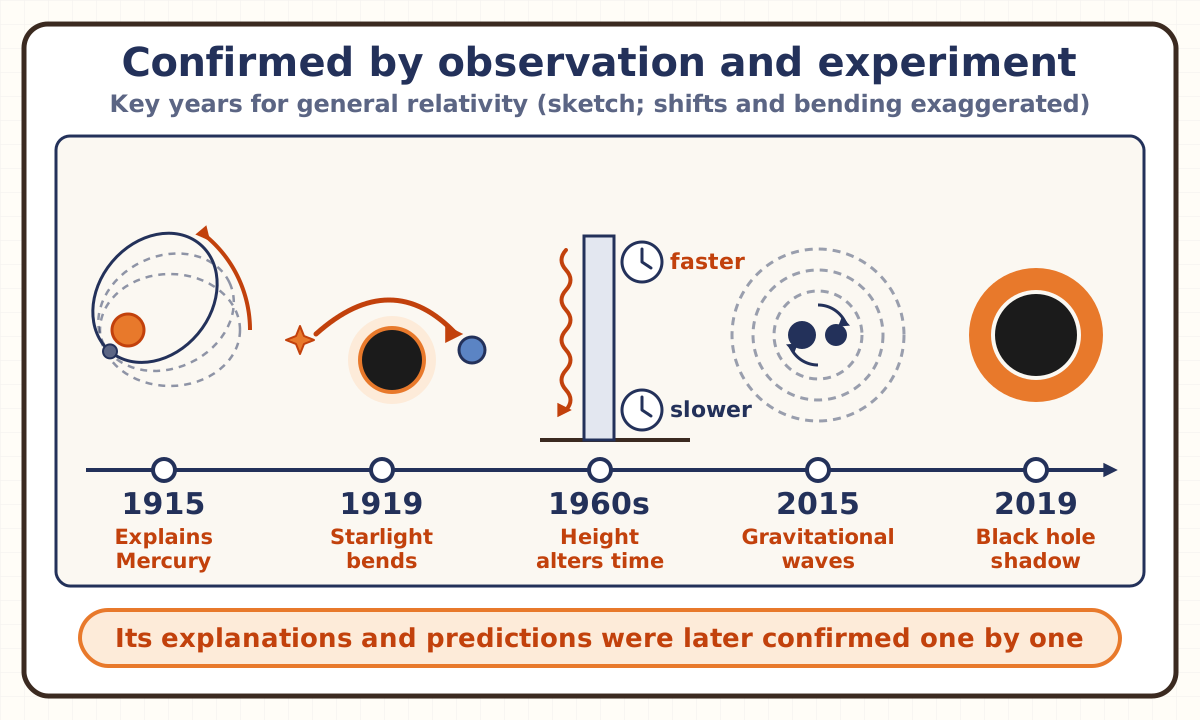
The theory explained a drift in Mercury’s orbit (the direction of the point where Mercury comes closest to the Sun slowly turns) that Newton’s law of gravity couldn’t fully account for, and predicted that light passing near the Sun would bend twice as much as Newton’s ideas give and that gravitational waves (warps in spacetime that travel as waves) exist. All of these were later confirmed.
A common mix-up
“General relativity proved Newton’s law of gravity wrong.”
Only partly right. General relativity can explain small mismatches that Newton’s law can’t (such as the slow turning of Mercury’s orbit and how much light bends near the Sun), and it greatly changed how we think about gravity. That much is true. But Newton’s law didn’t stop being useful. When gravity isn’t very strong and things move much slower than light, general relativity gives almost the same answers as Newton’s law. Newton’s law is a very good approximation of general relativity (a simpler formula that gives nearly the same answers). That is why the flight of a thrown ball and most of the planets’ motions can still be worked out well with Newton’s law. The differences show up clearly in places like the slight drift in the orbit of Mercury, the planet closest to the Sun, the bending of light, very precise clocks, and places where gravity is extremely strong, such as near black holes.
Explained in pictures
You’re free to use these figures in lessons, slides and posts if you credit Naru News (naru.news). CC BY 4.0.
Think of it like this
A heavy ball on a trampoline
Picture placing a heavy bowling ball in the middle of a big trampoline. Its weight makes the surface around it sink into a bowl shape. Roll a small marble a little sideways across it, and instead of going straight, the marble curves along the dip and rolls around the ball.
In terms of general relativity, the bowling ball is a heavy object such as the Sun, the dipped surface is warped spacetime, and the marble is a planet circling it or light passing by. The comparison gets across the idea that the Sun isn’t “grabbing and pulling” the planets; instead, the warp of spacetime around it bends the paths of planets and light.
But the comparison has limits. The marble rolls into the dip because Earth’s gravity pulls it downward, so the comparison uses gravity to explain gravity. Also, on a trampoline only a flat surface sinks, but what really warps is space, which stretches forward and back, left and right, and up and down, along with time. The warping of time, with clocks running more slowly near heavy objects, can’t be shown by a dip in a surface. And the real warp is tiny: even light grazing the edge of the Sun bends by only about 1/2000 of a degree.
Key points
What does “warped spacetime” mean?
The space around us has three directions: forward and back, left and right, and up and down. Adding time and thinking of all four together gives what is called spacetime. Special relativity, in 1905, showed that space and time are not separate but linked.
In general relativity, a heavy object warps the spacetime around it. Warping means, for example, that clocks run at different rates in different places. Objects and light moving with no other forces acting on them follow the straightest possible path through warped spacetime. Seen from outside, that path curves around the heavy object (much as the straightest flight route on a globe looks curved when drawn on a flat map). This is how general relativity explains Earth circling the Sun.
An apple you let go of works the same way. Even an object sitting still keeps moving through spacetime in the direction of time. Near Earth, spacetime is warped so that time runs more slowly lower down, and the apple’s path through time gradually turns downward along this warp. That is why an apple that was sitting still starts moving down on its own.
A key clue to this idea is that everything falls the same way, whatever its weight or material. Without air in the way, a heavy iron ball and a light wooden ball speed up in the same way as they fall. Even very precise experiments comparing how objects of different materials fall have found no difference. Newton’s law explains this by saying that a heavier object is pulled harder by Earth but is also harder to move (harder to speed up) by just as much, so the two cancel out and it falls the same way. But why the strength of the pull and the difficulty of moving match in exactly the same proportion for every object was simply accepted in Newton’s law, without an explanation. In general relativity, every object follows the same warp of spacetime, so falling the same way comes naturally.
How is it different from special relativity, and why is it called “general”?
Einstein published special relativity in 1905. Starting from the idea that the speed of light in a vacuum is the same for everyone, it showed things like a moving clock running slower as seen by someone standing still. But in this theory, the same equations describe nature (the laws of nature take the same form) only when the viewpoint (the person watching) is moving at a steady speed in a straight line (without accelerating). It also left out gravity.
“Relativity” comes from the idea that how motion looks depends on who is watching. For example, if you drop a stone from the window of a train moving at a steady speed, a person on the train sees it fall straight down, while a person standing beside the track sees it fall along a curve. Neither one is “right”: the principle of relativity says that from either viewpoint, the same equations describe nature (the laws of nature take the same form). Special relativity applied this principle only to a special case: viewpoints moving at steady speeds.
General relativity widens the principle so that it applies to viewpoints moving in any way, including accelerating ones. It is called “general” because it holds in general, not only in a special case. The clue for widening it was that acceleration and gravity can’t be told apart (the equivalence principle). Far out in space, away from stars, imagine a room-like box being pulled upward with a steady force so that it keeps speeding up. The person inside is pressed to the floor, and anything they let go of falls to the floor in the same way, whatever it is. To them, it feels no different from weight in a room on Earth. The other way around, inside a freely falling elevator, people and things float and feel no weight. So the person in the speeding-up box may just as well say, “I am at rest, and gravity is acting.” Trying to treat accelerating viewpoints alike in this way calls for a theory that handles gravity too, and it was completed in 1915 as a theory of gravity.
Does time really run slower?
Yes. It isn’t that the clocks break or that our eyes are fooled: time itself passes at different rates in different places. The stronger the gravity (the closer to a heavy object), the more slowly time passes. On Earth, that means time runs more slowly lower down and faster higher up. But the difference is far too small to notice in everyday life, and checking it takes extremely precise clocks.
At Tokyo Skytree, optical lattice clocks (extremely precise clocks that hold atoms in a grid made of laser light and keep time by counting the vibrations of the light the atoms absorb) were placed on the ground floor and on the observation deck, about 450 m above the ground, to compare how fast they ran. In results reported in 2020, the clock on the deck ran about 4 nanoseconds (4 billionths of a second) a day faster. The difference matched general relativity’s prediction well. With clocks this precise, even a height difference of a few centimeters shows up as a difference in how fast time passes.
It was first confirmed in an experiment on Earth in the early 1960s. Light is a wave, and counting how many times it vibrates each second (its frequency) can keep time, so a difference in frequency means a difference in how fast time passes. Comparing the frequency of gamma rays, a kind of light, at the top and bottom of a building, 22.5 m apart in height, found a slight difference, as predicted. Experiments up to 1965 showed that the measured difference matched the predicted size to within about 1 percent (1 part in 100).
Is it useful in everyday life?
GPS, which smartphones and car navigation use to find where you are, corrects for the differences in clock rates described by general relativity. GPS satellites, circling about 20,000 km up, send radio signals carrying the time measured by their extremely precise clocks. A receiver works out its distance from each satellite from how long the signal took to arrive, and combines the distances from several satellites to find where it is. Radio waves travel at the speed of light, so an error of just 1 nanosecond (a billionth of a second) in the time shifts the position by about 30 cm.
The satellite clocks are where gravity is weaker than on the ground, so they run about 45 microseconds (45 millionths of a second) a day faster. Meanwhile, moving clocks run slow (the part special relativity describes), so the satellite clocks, moving at about 14,000 km per hour, lose about 7 microseconds a day. Altogether, the satellite clocks run about 38 microseconds a day faster than clocks on the ground. Without any correction, position errors would build up by about 10 km every day.
So before launch, on the ground, the satellite clocks are set to run very slightly slow, by just enough to cancel this gain of about 38 microseconds a day. Once in orbit, they then tick at exactly the right rate as seen from the ground.
What else did it explain and predict?
First, the drift in Mercury’s orbit. Mercury goes around the Sun on a slightly squashed circle (an ellipse). The direction of the point where it comes closest to the Sun (its perihelion) turns a little with every orbit. Most of this is caused by the pull of the other planets and could be calculated with Newton’s law. But in 1859, a drift the calculations couldn’t explain was found to remain, and by 1895 its size was known: about 43 arcseconds per century. An arcsecond is an angle of 1/3600 of a degree, and 43 arcseconds is a very small angle, about the width of a 1-yen coin (2 cm across) seen from about 96 m away. In 1915, Einstein showed that calculating with general relativity gives just this extra 43 arcseconds or so.
Second, the bending of light. Starlight just grazing the edge of the Sun was predicted to bend by about 1.75 arcseconds (about 1/2000 of a degree), twice the value calculated with Newton’s ideas by treating light as tiny particles pulled by gravity. Observations of the positions of stars near the Sun during the total solar eclipse of May 29, 1919 confirmed this prediction. Light being bent by the gravity of a heavy object is now called gravitational lensing, and it has also become a tool for studying distant galaxies.
Third, gravitational waves. When heavy objects move violently, warps in spacetime were predicted to spread out like ripples. On September 14, 2015, two gravitational-wave detectors in the United States caught gravitational waves directly for the first time, sent out when two black holes merged. The shape of the waves matched general relativity’s prediction.
Fourth, black holes. The equations of general relativity showed that objects with gravity so strong that not even light can get out could exist. In April 2019, the first image of the “shadow” of a giant black hole at the center of a distant galaxy was released, and it matched predictions calculated from the theory remarkably well.
What don’t we know yet?
General relativity agrees with the results of many observations and experiments, such as the drift in Mercury’s orbit, the bending of light, differences in how fast clocks run, gravitational waves, and the image of a black hole’s shadow. Even so, it isn’t thought to tell the whole story of gravity.
One open question is how it fits with the world of the very small. How very small things such as atoms and electrons behave is explained by a different theory, quantum mechanics (the rules of the world of atoms and smaller), and general relativity doesn’t include the effects of quantum mechanics. Many researchers think the theory of gravity and quantum theory should be brought together at some level, and they are trying to build a theory that describes gravity in terms of quantum mechanics (quantum gravity). Those attempts are still going on.
Another is the center of a black hole. Calculating with the equations of general relativity, at the very center of a black hole, matter is packed into a single point where the density (mass per amount of space) becomes infinitely large (a singularity). But whether such a point really exists, or only appears in the calculations, isn’t known. A singularity showing up may be a sign of a place this theory alone can’t fully explain, where a more complete theory of gravity that includes quantum effects is thought to be needed.
Check yourself
Q1In an experiment at Tokyo Skytree reported in 2020, extremely precise clocks were placed on the ground floor and on the observation deck, about 450 m up, to compare how fast they ran. How did the deck clock compare with the ground-floor clock?
Answer and explanation
Answer: B It ran slightly faster
In general relativity, time passes more slowly where gravity is stronger. The deck is farther from Earth’s center than the ground floor, so gravity there is slightly weaker, and the deck clock ran about 4 nanoseconds (4 billionths of a second) a day faster. The difference matched general relativity’s prediction well. It isn’t that a clock was broken: time itself passes at different rates at different heights.
Q2General relativity was completed in 1915 by widening the special relativity of 1905. What does the name “general” say was widened?
Answer and explanation
Answer: A The viewpoints it applies to, out to accelerating ones
In special relativity, the same equations describe nature (the laws of nature take the same form) only when the viewpoint (the person watching) is moving at a steady speed in a straight line (without accelerating). General relativity widened this so that it applies to viewpoints moving in any way, including accelerating ones, so it is called “general.” Because acceleration and gravity can’t be told apart, widening it produced a theory of gravity. Things moving close to the speed of light were already covered by special relativity. And whether it can handle something as big as the whole universe is not where the name comes from.
Q3After general relativity appeared in 1915, how is Newton’s older law of gravity treated today?
Answer and explanation
Answer: C It closely matches in everyday cases, so it is used
When gravity isn’t very strong and things move much slower than light, general relativity gives almost the same answers as Newton’s law. Newton’s law didn’t become wrong: it is a very good approximation of general relativity (a simpler formula that gives nearly the same answers), so the flight of a thrown ball and most of the planets’ motions can still be worked out well with it. The differences show up clearly in places where gravity is extremely strong, such as near black holes, and in the bending of light and very precise clocks. Newton’s law is used not because it is more accurate than general relativity, but because it is simpler and gives almost the same answers in everyday cases.
Related terms
- Black hole
- Gravitational lensing
- Special relativity
- Spacetime
- Gravitational wave
- Equivalence principle
- Perihelion precession of Mercury
- GPS
- Optical lattice clock
- Quantum gravity
- Gravitational singularity
- Event horizon
Sources and how we checked
- ESA, "100 years of General Relativity" (ESA Science & Technology, Claudia Mignone, updated September 1, 2019; special relativity in 1905 linking space and time into spacetime, Einstein presenting general relativity in four papers to the Prussian Academy of Sciences in Berlin in November 1915, massive bodies curving spacetime, Newton’s theory not fully accounting for the precession of Mercury’s orbit, light bending twice as much as in Newton’s theory, black holes and gravitational waves; read November 17, 2026)
- Albert Einstein, "Relativity: The Special and the General Theory" (translated by Robert W. Lawson, Methuen, third edition, 1920; Einstein’s own book for general readers, read in the Internet Archive text. Section III [how a stone dropped from a train moving at a steady speed looks], Section VII [the constancy of the speed of light in a vacuum], Section XII [a moving clock going more slowly], Section XVIII [the special principle covering uniform motion only, and the general principle treating bodies of reference in any state of motion alike], Sections XIX and XX [bodies moving under gravity alone accelerating the same way whatever their material, the equality of gravitational and inertial mass having been recorded in mechanics but not interpreted, and the observer in a chest pulled and accelerated far out in space, who can regard the chest as at rest in a gravitational field without violating reason or known mechanical laws], Section XXII [light traveling curvilinearly in gravitational fields, and the results of the special theory holding only while gravity can be disregarded], Section XXIII [a clock’s rate depending on where it is], Section XXIX [Newton’s theory as a first approximation], and the appendix [the unexplained motion of Mercury’s perihelion found in 1859 and 1895, the theory’s 43 arcseconds per century, and the bending of 1.7 arcseconds at the eclipse of May 29, 1919]. The 1916 paper "Die Grundlage der allgemeinen Relativitätstheorie" [Annalen der Physik 49] could not be opened from here, so the same points were checked in this book; read November 17, 2026)
- Clifford M. Will, "The Confrontation between General Relativity and Experiment" (Living Reviews in Relativity 17, 4, 2014; main text of arXiv:1403.7377 [ar5iv HTML]: the introduction [the deflection of light and Mercury’s perihelion as the first confirmations, quantum gravity effects expected at the Planck length, and the open question of testable effects of quantized gravity], the postulates of metric theories [freely falling test bodies following geodesics, the straightest paths, of spacetime], the weak equivalence principle [bodies falling with the same acceleration regardless of internal structure and composition, and torsion-balance tests reaching 2×10^-13], the one-percent accuracy of the 1960–1965 series of Pound–Rebka–Snider experiments [measuring the frequency shift of gamma rays in a laboratory tower at Harvard University], the 1.7505-arcsecond deflection of light grazing the Sun, classic derivations using the corpuscular theory of light giving only half of general relativity’s value [Section 4.1.1], and Mercury’s perihelion shift left after the other planets’ effects [42.98 arcseconds per century]; read November 17, 2026)
- Markus Pössel, "Gravity: from weightlessness to curvature" (Einstein Online, the general-audience site of the Max Planck Institute for Gravitational Physics [Albert Einstein Institute]; a person and objects floating weightlessly in a freely falling elevator, an observer in an accelerating rocket feeling as heavy as on Earth, there being no straight lines on a sphere but only straightest lines [great circles] that give the shortest connection between two points, and test particles near a massive body following such straightest lines [geodesics] in curved spacetime; read November 17, 2026)
- Rickard Jonsson, "Visualizing curved spacetime" (American Journal of Physics 73, 248, 2005; main text of arXiv:0708.2483: drawing the spacetime of a line through a dense star as a curved surface, whose shape shows time running slow inside the star [Section II B], the worldlines of observers at rest running around the surface in the direction of time [Fig. 4], and freely falling objects taking the path that maximizes the proper time on their own clocks, including an object thrown away from the star and falling back [Section II C and Fig. 5]; read November 17, 2026)
- Neil Ashby, "Relativity in the Global Positioning System" (Living Reviews in Relativity 6, 1, 2003; main text: 24 satellites carrying atomic clocks and the timing signals tied to them, finding a position from measurements of four satellites, the constancy of the speed of light as the basis of GPS, a timing error of 1 ns leading to a position error of about 30 cm, the orbiting clock beating too fast mainly because of the gravitational frequency shift, which for GPS is larger than the slowing from speed, and the clocks being set lower in frequency on the ground before launch [Eqs. 35 and 36: −4.4647×10^-10, 10.23 MHz to 10.22999999543 MHz]. The figure of about 38 microseconds a day was also checked by multiplying this fraction by the seconds in a day; read November 17, 2026)
- Richard W. Pogge, "Real-World Relativity: The GPS Navigation System" (course page for Astronomy 162, The Ohio State University; satellites about 20,000 km up moving at about 14,000 km per hour, clocks losing about 7 microseconds a day from speed and gaining about 45 from gravity, a net gain of about 38, and position errors building up by about 10 km a day without correction; read November 17, 2026)
- School of Engineering, The University of Tokyo, "Test of General Relativity by a Pair of Transportable Optical Lattice Clocks" (English release, April 7, 2020; abstract of the paper by Takamoto, Ushijima, Ohmae, Yahagi, Kokado, Shinkai and Katori [Nature Photonics 14, pp. 411–415, 2020]: a clock at a higher altitude ticking faster, the height difference of about 450 m at Tokyo Skytree, and the gravitational redshift tested at (1.4±9.1)×10^-5. The paper’s full text could not be opened from here; read November 17, 2026)
- RIKEN and others, Japanese press release on transportable optical lattice clocks with 18-digit precision testing general relativity at Tokyo Skytree (April 7, 2020; the two clocks on the ground floor and on the observation deck 450 m above the ground, time dilation detectable from height differences of a few centimeters, and the Japanese phrase ippan sōtairon-teki kōka, “general-relativistic effects”; read November 17, 2026)
- Hisaaki Shinkai, Masao Takamoto and Hidetoshi Katori, "Transportable Optical Lattice Clocks and General Relativity" (arXiv:2502.06104, February 2025; main text: the introduction [the view that the theories of gravity and quantum should be integrated at some level, and ongoing attempts to build a quantum theory of gravity], Section 2.1 [an optical lattice clock as an atomic clock based on neutral atoms trapped in a standing wave of lasers, generating the second from the optical frequency of the atomic transition], Section 3.3 [the Pound–Rebka–Snider experiments of the early 1960s, their 22.5-m height difference, and changes in frequency regarded as changes in time scale due to the gravitational field], Section 4.1 [a clock at a lower elevation ticking slower], and Section 4.2 [the 2018 experiment at Tokyo Skytree, a height difference of about 452.6 m, and a shift of about 21.18 Hz on a frequency of about 429.228 THz]. The figure of about 4 ns a day was found by multiplying this fraction [about 4.9×10^-14] by the seconds in a day; read November 17, 2026)
- LIGO Scientific Collaboration and Virgo Collaboration (Abbott et al.), "Observation of Gravitational Waves from a Binary Black Hole Merger" (Physical Review Letters 116, 061102, February 11, 2016; arXiv abstract: the two LIGO detectors catching gravitational waves on September 14, 2015, the waveform matching general relativity’s prediction for two merging black holes, and the first direct detection of gravitational waves; read November 17, 2026)
- LIGO, "Gravitational Waves Detected 100 Years After Einstein’s Prediction" (LIGO at Caltech news release, February 11, 2016; gravitational waves as ripples in the fabric of spacetime, the waves from two merging black holes detected on September 14, 2015, and the confirmation of a major prediction of Einstein’s 1915 general theory of relativity; read November 17, 2026)
- RIKEN, Osaka University and Tohoku University, Japanese press release on probing quark matter with gravitational waves (October 27, 2022; both Japanese names, ippan sōtaisei riron and ippan sōtairon, gravitational waves predicted right after Einstein published general relativity and observed about 100 years later in 2015, and black holes predicted from general relativity; read November 17, 2026)
- National Astronomical Observatory of Japan, Japanese press release on the first image of a black hole in the galaxy M87 (April 10, 2019; black holes as objects predicted by Einstein’s general relativity, and the image matching theoretical predictions remarkably well; read November 17, 2026)
- NASA, "Hubble Gravitational Lenses" (NASA Science, updated August 6, 2026; general relativity describing gravity as the curvature of spacetime that bends light, and gravitational lenses magnifying background galaxies and being used to study distant objects too faint to see directly; read November 17, 2026)
- NASA, "Black Hole Anatomy" (NASA Science; general relativity predicting a point of infinite density at the center of a black hole [a singularity], it being unknown whether it is physical or purely mathematical, and the prediction possibly signaling the limits of relativity, where quantum effects not included in the theory become important in a more complete description of gravity; read November 17, 2026)
- Japan Mint, Japanese page on coins currently minted (the 1-yen aluminum coin’s 20-mm diameter, used to compare angles with how a coin looks from a distance; read November 17, 2026)
AI wrote this page from the sources above, and a different AI checked it against the text of those sources (November 17, 2026). A person with a master’s degree in science and a Japanese high-school science teaching license also read and checked it before publishing. Numbers are as of that date. If anything was hard to follow, you spot a mistake, or there’s a term you’d like explained, please write to [email protected].
Space terms
- Black hole
- Black hole star
- Event horizon
- You are hereGeneral relativity
- Gravitational lensing
- Gravitational wave
- Special relativity