 Naru News日本語
What is special relativity (the theory where the speed of light stays fixed and time and length change)?
Also called: Special theory of relativity

In one minute
Special relativity is the theory Einstein published in 1905. Starting from the rule that “the speed of light in a vacuum is the same for everyone,” it shows that the faster something moves, the more slowly its time passes and the shorter it becomes along its direction of motion, as seen by someone standing still.
It has two starting points. First, for viewpoints moving at a steady speed in a straight line, the laws of nature take the same form. Second, the speed of light (about 300,000 km per second) doesn’t depend on how the light source or the observer is moving. Keeping both means that, while the speed of light stays fixed, the passage of time and lengths change with the viewpoint.
It also shows that two things happening at the same time in different places may not be simultaneous from another viewpoint, that nothing with mass can be pushed to the speed of light, and that mass and energy are linked by E=mc². It has been confirmed by particles called muons, made high in the sky, reaching the ground, and it is used to correct GPS clocks. “Special” means it covers only viewpoints that don’t accelerate and leaves out gravity.
A common mix-up
“Moving clocks only seem to run slow; time doesn’t really slow down.”
Not right. Faraway things can look delayed because their light takes time to reach us. But the slowing in special relativity is what remains after that travel time of light is taken away. Proof that it really happens: muons made high in the sky would almost all turn into other particles before reaching the ground if time didn’t slow, yet many of them actually reach the ground. It also isn’t that speed throws a clock’s workings off. If only one kind of clock slowed, comparing two kinds would tell you that you were moving without looking outside, which breaks the starting point that “the laws of nature are the same even when you move.” In fact, the predicted slowing has been measured for atomic clocks and for the time it takes muons to turn into other particles. What slows is not the clock but the passage of time itself for the moving thing. However, which clock is behind depends on the viewpoint. Two people passing each other at a steady speed each see the other’s clock running slow, and both views are right.
Explained in pictures
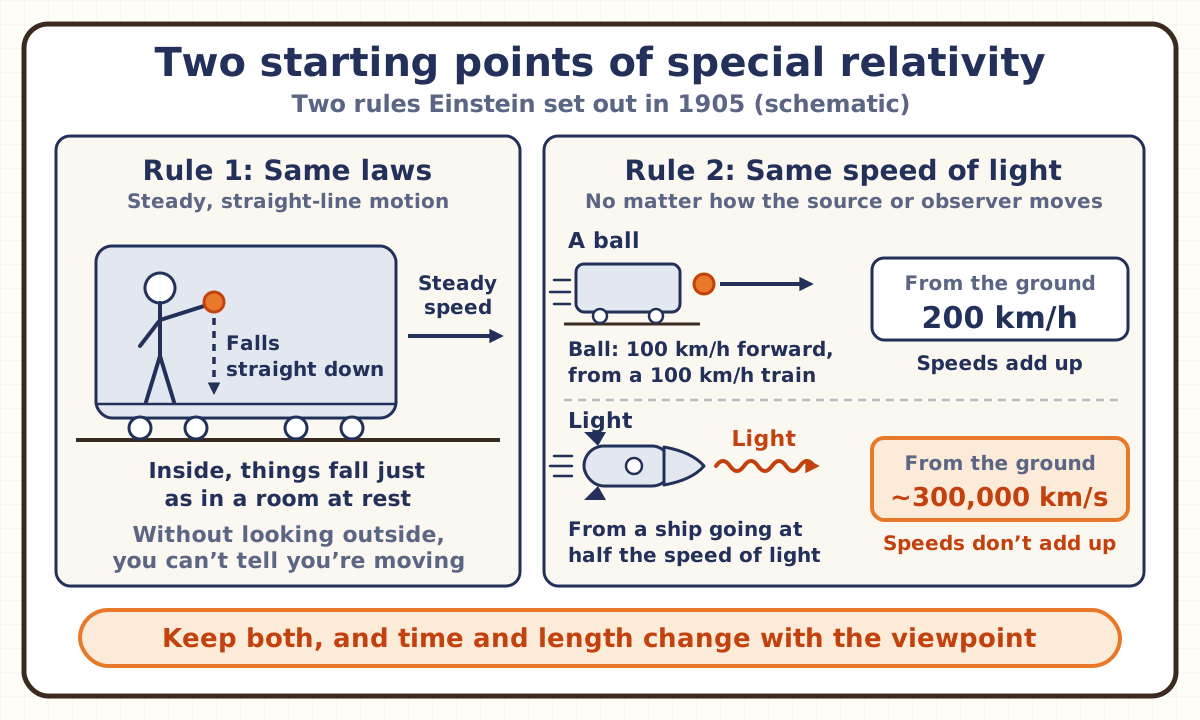
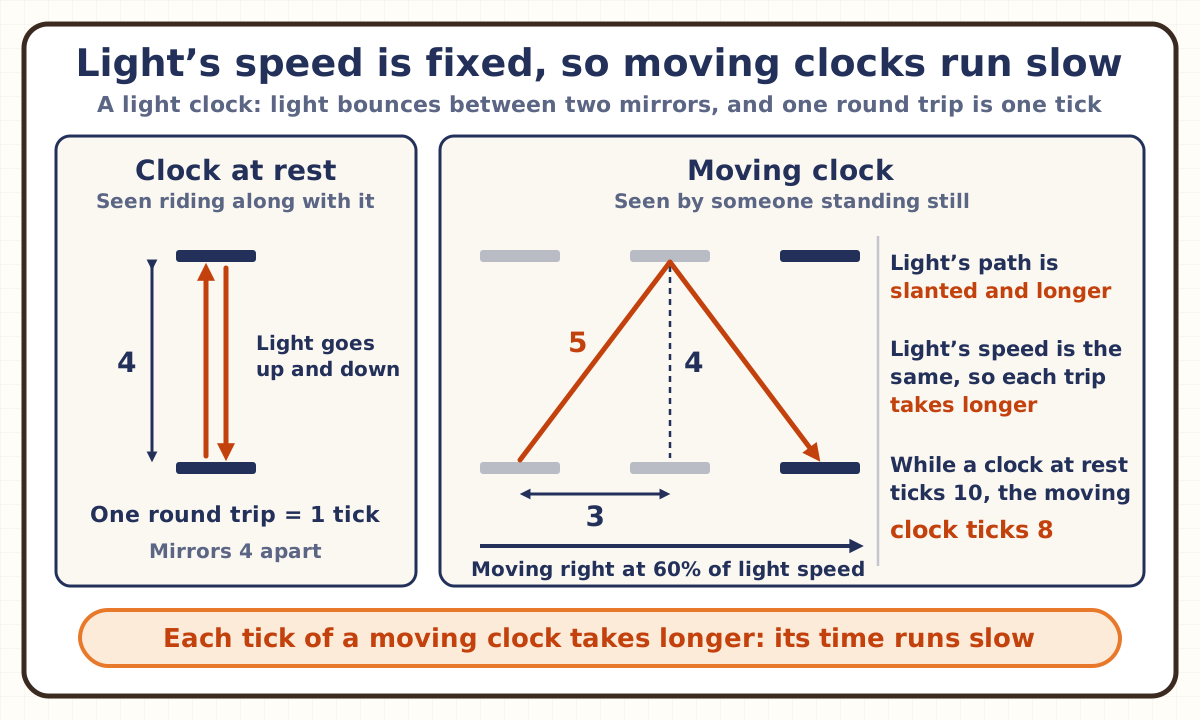
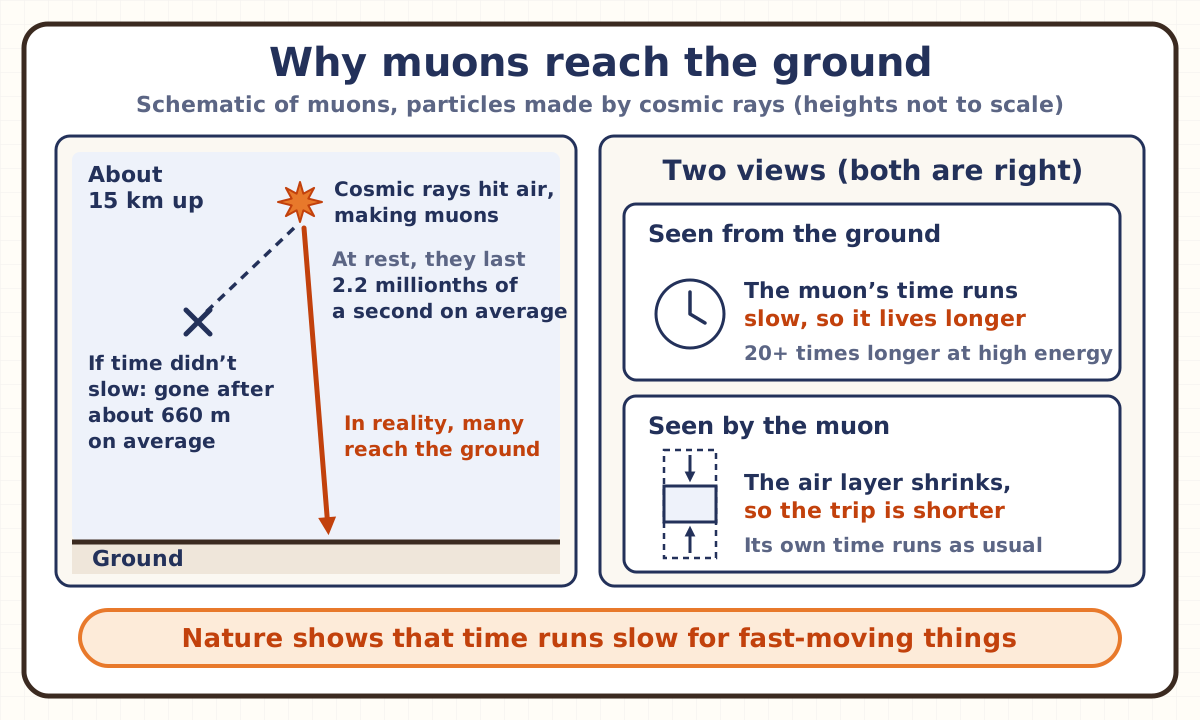
You’re free to use these figures in lessons, slides and posts if you credit Naru News (naru.news). CC BY 4.0.
Think of it like this
A car that can only drive at one speed
Picture a car whose speedometer always reads 60 km/h, and which can’t go faster or slower. Driving straight north, it covers 60 km north in an hour. But if it also tries to move east while heading north, its path becomes slanted, and the distance it covers northward in an hour is less than 60 km. The more it moves east, the slower it makes progress north.
The light in a light clock is similar. Light can only travel at a speed that is the same for everyone. When the whole clock moves sideways, the light, as seen by someone standing still, travels slantwise, and less of its motion goes into the up-and-down trip. So each round trip (one tick of the clock) takes longer, and the clock runs slow. How much it slows can be worked out with the Pythagorean theorem (the rule linking the three sides of a right triangle).
But the comparison has limits. A car’s speed looks different to someone who is running, but the speed of light is the same no matter how the observer moves. This property, which everyday things don’t have, is the starting point of special relativity. Also, the car comparison makes it seem that only the light inside a light clock slows down, but in reality the passage of time itself slows for moving things. Atomic clocks, and the time it takes a particle to turn into other particles, slow down the same way.
Key points
If the speed of light is the same, why does time slow down?
A light clock makes it clear. Face two mirrors toward each other, let light bounce between them, and count each round trip as one tick. To someone moving with the clock, the light goes straight up and down.
When someone standing still watches this clock move sideways, the mirrors shift before the light reaches the top one, so the light travels slantwise. A slanted path is longer than a straight one. A ball would gain speed from the sideways motion and make the round trip in the same time even on the longer path. But light’s speed is the same for everyone, so the longer path makes each round trip take longer. To the person standing still, each tick of the moving clock lasts longer: the clock runs slow.
How much it slows can be worked out with the Pythagorean theorem. Moving at 60% of the speed of light, if the mirrors are 4 apart, the clock shifts 3 sideways while the light goes up, and the light’s path is 5. So while a clock at rest ticks 10 times, the moving clock ticks only 8. The amount depends strongly on speed. Compared with a clock at rest, a moving clock runs at about 99.5% of the rate at 10% of light speed, about 87% at 50%, about half at 87%, about 1/7 at 99%, and about 1/10 at 99.5%.
At everyday speeds, the slowing is tiny. Even the clocks on GPS satellites, circling Earth at about 14,000 km per hour, lose only about 7 microseconds (7 millionths of a second) a day from their speed.
What does it mean that lengths shrink and “at the same time” changes?
A fast-moving object, seen by someone standing still, shrinks along its direction of motion. It shrinks by the same factor that its clock slows, so a rod moving at 87% of the speed of light is about half as long. Only the length along the motion shrinks; the width and height stay the same. A ball that is round at rest becomes squashed along its direction of motion.
Whether faraway events happen “at the same time” also depends on the viewpoint. Einstein compared this to a long train running along a track. Suppose that, as seen by someone beside the track, lightning strikes the track near the front and near the back of the train at the same time. A person standing beside the track exactly halfway between the two spots receives both flashes at once. But a person on the train who was passing right by that person when the lightning struck is moving toward the front flash and away from the back one, so the front flash reaches them first. For the person on the train too, light travels at the same speed from the front and from the back. If they were in the middle and the front flash arrived first, they must conclude that the front strike happened first. Simultaneous for the person beside the track, the strikes are not simultaneous for the person on the train. Neither one is “right.”
The shrinking of lengths is tied to this difference in “at the same time.” To measure the length of a moving rod, you have to read the positions of its front and back ends at the same time. Since “at the same time” differs between viewpoints, the measured length differs too. The rod isn’t being crushed: measured by someone moving with it, it keeps its original length.
Why can’t anything pass the speed of light, and what is E=mc²?
Speeding something up takes energy. In the everyday way of thinking about motion (Newton’s ideas), you could keep adding energy and make something go as fast as you like. But working it out with special relativity, the closer you get to the speed of light, the more energy each small gain in speed takes, and reaching the speed of light would take an infinite amount of energy. So nothing with mass can reach or pass the speed of light.
Particle accelerators (machines that speed up particles, for example with electric forces) show the same thing. They give particles enormous amounts of energy, but the particles they speed up, and the particles made when those collide, only get closer to the speed of light, reaching speeds such as 99.7% or 99.975% of it.
The same thinking leads to E=mc². E is energy, m is mass (what makes things hard to move and gives them weight), and c is the speed of light. In the autumn of 1905, Einstein showed that when an object gives off light and loses energy, its mass drops by a matching amount. Mass and energy aren’t separate things; they are linked. Because c×c is a huge number, a tiny bit of mass corresponds to a huge amount of energy.
In 2005, scientists studied a nucleus that captured a neutron (one of the particles nuclei are made of) and gave off a gamma ray (a kind of light). In separate experiments, they precisely measured the difference in mass before and after, and the energy of the gamma ray, and compared them. The two matched E=mc² to better than one part in a million.
How has it been confirmed?
For the unchanging speed of light, the 1887 experiment by Michelson and Morley is famous. They reasoned that if Earth is moving, light should measure faster or slower in different directions, but they found no difference. In 1964, at an accelerator at CERN (the European Organization for Nuclear Research) in Switzerland, scientists measured the speed of light given off by particles flying at 99.975% of light speed or more, and found it was about 300,000 km per second, the same as ordinary light. However fast the source moves, the speed of light doesn’t add up.
The slowing of moving clocks was confirmed with particles called muons. Muons are made when cosmic rays (very fast particles from space) hit the air about 15 km up, and at rest they turn into other particles in about 2.2 millionths of a second on average. Without time slowing, they would be gone after about 660 m even at the speed of light, yet many actually reach the ground. In 1941, measurements of how the number of muons changes with height confirmed the slowing of time. In 1966, at CERN, muons sent circling at 99.7% of the speed of light were found to live about 12 times longer, matching the prediction to within 2%.
It has also been confirmed at familiar speeds. In 2010, the US National Institute of Standards and Technology (NIST) compared two extremely precise atomic clocks and found that when the atom inside one clock (a single electrically charged atom) was moved at about the speed of a car going around 30 km per hour, that clock ran slightly slow. The clocks on GPS satellites lose about 7 microseconds a day because they move fast. In reality, they gain more from being high up where gravity is weaker (the part general relativity describes), so both effects are combined and corrected in advance.
Isn’t it a contradiction that each sees the other’s clock running slow?
Two people passing each other at a steady speed each see the other’s clock as running slow. Since the laws of nature take the same form from either viewpoint, neither one is the one “really” standing still. This isn’t a contradiction because the two of them disagree about what happens “at the same time” when comparing their own clock with the other’s faraway clock.
The muon example also has two views. To someone on the ground, the muon’s time runs slow, so it lives longer and reaches the ground. To the muon, its own time runs as usual; instead, the thickness of the oncoming air layer shrinks, so the trip is shorter. The person on the ground sees only the slowing of time, and the muon sees only the shrinking of length, and either way the muon reaches the ground.
Then if one person travels far away by spaceship and comes back, who is younger? This is called the “twin paradox,” and the answer is that the traveler is younger. For example, going out and back at 60% of the speed of light, the traveler ages only 8 years while the person who stayed on Earth ages 10. The two aren’t in matching positions because the traveler turns around partway and switches to a different viewpoint for the trip out and the trip back. The calculation can be done straightforwardly from the view of the person on Earth, who stays in one viewpoint the whole time.
Why is it called “special,” and how does it relate to general relativity?
“Special” means “limited to a particular case.” In this theory, the laws of nature were said to take the same form only in a particular case: between viewpoints moving at a steady speed in a straight line (not accelerating). It also leaves out gravity. So it can be used as it is only while the effects of gravity can be ignored.
Einstein widened it to cover accelerating viewpoints and to handle gravity, completing general relativity in 1915. To tell them apart, the 1905 theory is called special relativity. In Japanese, the plain word “relativity” sometimes means special relativity.
Check yourself
Q1A spaceship moving at half the speed of light sends light forward. If a person inside the ship and a person standing still outside each measure the speed of this light, what do they find?
Answer and explanation
Answer: C Both people measure the same speed
The second starting point of special relativity is that the speed of light in a vacuum is the same for everyone who measures it (about 300,000 km per second), no matter how the source or the observer moves. So the person inside the ship and the person standing still outside measure the same speed. For a ball, the person outside would measure it faster by the ship’s speed, but the speed of light doesn’t add up. In 1964, light given off by particles flying at 99.975% of light speed or more was confirmed to travel at the same speed as ordinary light.
Q2Muons, particles made by cosmic rays about 15 km up, turn into other particles in about 2.2 millionths of a second on average when at rest, so even at the speed of light they could travel only about 660 m in that time. Why do many muons still reach the ground?
Answer and explanation
Answer: A Seen from the ground, the muons’ time runs slow
Muons fly close to the speed of light, so seen from the ground their time runs slow, their lifetime stretches, and they reach the ground. Nothing with mass can move faster than light. Also, the air layer looks thinner only from the muon’s viewpoint; for a person on the ground, the height of the sky doesn’t change. The person on the ground sees the slowing of time, and the muon sees the shrinking of length, and either way the muon reaches the ground.
More on this → Key points: Isn’t it a contradiction that each sees the other’s clock running slow?
Q3At a particle accelerator (a machine that speeds up particles), energy keeps being added to a particle with mass, such as a muon. What happens to its speed?
Answer and explanation
Answer: B It gets closer to light speed but never reaches it
In the everyday picture of how things move (Newton’s ideas), adding more energy should make it faster and faster without limit. But working it out with special relativity, the closer you get to the speed of light, the more energy each small gain in speed takes, and reaching the speed of light would take an infinite amount of energy. So however much energy is added, the particle only gets closer to the speed of light and never reaches or passes it. In accelerators, particles fly at speeds such as 99.7% or 99.975% of the speed of light, but never reach it.
More on this → Key points: Why can’t anything pass the speed of light, and what is E=mc²?
Related terms
- General relativity
- Spacetime
- Speed of light
- Principle of relativity
- Lorentz transformation
- Muon
- Cosmic ray
- Twin paradox
- E=mc² (mass–energy equivalence)
- Michelson–Morley experiment
- GPS
- Atomic clock
Sources and how we checked
- Albert Einstein, "Zur Elektrodynamik bewegter Körper" (Annalen der Physik 17, p. 891, dated June 30, 1905), in the English translation "On the Electrodynamics of Moving Bodies" (W. Perrett and G. B. Jeffery, "The Principle of Relativity," Methuen, 1923; read in the Fourmilab text). The introduction [the same laws of electrodynamics and optics holding in all frames of reference, and light always traveling in empty space at a definite speed c independent of the motion of the emitting body], Section 1 [setting clocks by taking the light time from A to B equal to that from B to A], Section 2 [no absolute meaning for simultaneity], Section 4 [a moving sphere becoming an ellipsoid shortened along the motion by the factor √(1−v²/c²) with its other dimensions unchanged, and a clock moved from A to B lagging behind one that stayed], and Section 10 [the kinetic energy W becoming infinite when v=c, so speeds greater than light have no possibility of existence]; read November 17, 2026
- Albert Einstein, "Ist die Trägheit eines Körpers von seinem Energieinhalt abhängig?" (Annalen der Physik 18, p. 639, dated September 27, 1905), in the English translation "Does the Inertia of a Body Depend upon its Energy-Content?" (same "The Principle of Relativity," 1923; read in the Fourmilab text): a body giving off energy L as radiation losing mass L/c², the mass of a body being a measure of its energy content, and a possible test with bodies such as radium salts; read November 17, 2026
- Albert Einstein, "Relativity: The Special and the General Theory" (translated by Robert W. Lawson, Methuen, third edition, 1920; Einstein’s own book for general readers, read in the Internet Archive text). Section V [natural phenomena following the same laws in a coordinate system moving uniformly without rotation: the special principle of relativity], Section VII [the constant speed of light in a vacuum, and classical velocity addition making light slower than c relative to the carriage], Section IX [two lightning strikes simultaneous for the embankment not being simultaneous for the train], Section XII [a moving rod being shorter, a moving clock going more slowly, and c as a limiting speed that no real body can reach or exceed], Section XV [the inertial mass of a body changing with its energy, and the conservation of mass merging with the conservation of energy], Section XVI [Michelson and Morley’s interference experiment], Section XVIII [the special principle covering uniform motion only], and Section XXII [the results of the special theory holding only while gravitational fields can be disregarded]; read November 17, 2026
- Clifford M. Will, "Special Relativity: A Centenary Perspective" (in "Einstein, 1905–2005: Poincaré Seminar 2005," Birkhäuser, 2006, pp. 33–58; main text of arXiv:gr-qc/0504085 [ar5iv HTML]): Section 2.1 [the two postulates: the laws of physics are the same in every inertial frame, and the speed of light in vacuum is the same for every observer], Section 2.2 [the light clock with light bouncing between two mirrors, the diagonal path seen from outside making the moving clock’s tick longer, the example of lab clocks ticking 10 times while the moving clock ticks 8, and events simultaneous in one frame not being simultaneous in a moving frame, and the slowing applying to time measured by mirror clocks, atomic clocks, biological clocks and heartbeats alike, all governed by laws of physics that hold in every inertial frame], Section 2.4 [mass changing by E/c² when energy E is emitted], Section 3.1 [the 1887 Michelson–Morley experiment finding no effect], Section 3.2 [the 1964 CERN measurement of gamma rays from neutral pions moving at 99.975% of light speed or more, giving 2.9977±0.0004×10^8 m/s], Section 3.3 [Rossi and Hall’s muon measurements (1941 paper), muons that could travel only about 2/3 km even near light speed reaching sea level thanks to time dilation, and muons circling at 99.7% of light speed in the CERN storage ring in 1966 living about 12 times longer, matching the prediction to 2 percent], Section 3.5 [the twin paradox, with the traveling twin aging 8 years against 10, observers in her outbound frame agreeing that Earth’s clock ran slow, acceleration only providing the asymmetry, and switching frames between the outbound and return legs and the relativity of simultaneity as the key], and Section 7 [GPS satellite clocks losing about 7,000 ns a day from their speed]; read November 17, 2026
- Particle Data Group, "μ MEAN LIFE τ" (pdgLive data table: the muon mean life of 2.1969811±0.0000022×10^-6 s. The distance of about 660 m at light speed was found by multiplying this lifetime by the speed of light; read November 17, 2026)
- Spencer N. G. Axani, "The Physics Behind the CosmicWatch Desktop Muon Detectors" (MIT master’s thesis, 2019; main text of arXiv:1908.00146 [ar5iv HTML]): Section 2.1 [muons being unstable, muons above 2.4 GeV having a dilated decay length longer than 15 km and a good chance of reaching the surface, a mean muon energy of about 4 GeV at the surface, the hard component at sea level being essentially all muons and the soft component about 60–65% muons] and Section 6.3 [muons typically being produced near an altitude of 15 km]. The lifetime stretching more than 20 times was found from the ratio of 2.4 GeV to the muon mass of 105.65 MeV; read November 17, 2026
- HyperPhysics, "Muon Experiment" (R. Nave, relativity pages on the Georgia State University site: more muons reaching the surface than their lifetime suggests, the muon’s half-life being time dilated in the Earth frame, and one observer seeing time dilation, the other length contraction, but neither both; read November 17, 2026)
- NIST, "NIST Pair of Aluminum Atomic Clocks Reveal Einstein’s Relativity at a Personal Scale" (US National Institute of Standards and Technology news release, September 23, 2010: comparing two clocks each based on a single aluminum ion, the clock whose ion was moved at several meters per second ticking slightly slower as relativity predicts, time passing more slowly at speeds comparable to a car traveling about 20 miles per hour, a difference also measured for a 33-cm height change, and the paper by C. W. Chou et al., "Optical Clocks and Relativity" [Science, September 24, 2010]. The paper’s full text could not be opened from here; read November 17, 2026)
- MIT News, "E=mc2 passes tough MIT test" (Elizabeth A. Thomson, Massachusetts Institute of Technology, December 21, 2005: comparing the mass change with the energy released when a nucleus captures a neutron, the mass difference measured before and after the nucleus emits a gamma ray, the gamma-ray energy measured at NIST and ILL from its deflection in a silicon crystal, E=mc² holding to better than one part in a million, 55 times more precise than the best previous test, and the paper in the December 22, 2005 issue of Nature. The paper’s full text could not be opened from here; read November 17, 2026)
- Richard W. Pogge, "Real-World Relativity: The GPS Navigation System" (course page for Astronomy 162, The Ohio State University: GPS satellites orbiting about 20,000 km up at about 14,000 km per hour, and their clocks falling behind ground clocks by about 7 microseconds a day from the time dilation of their motion, gaining about 45 microseconds a day from gravity, for a net gain of about 38 microseconds; read November 17, 2026)
- Neil Ashby, "Relativity in the Global Positioning System" (Living Reviews in Relativity 6, 1, 2003; main text: gravitational frequency shifts and second-order Doppler shifts having to be taken into account together, the orbiting clock beating too fast primarily because of the gravitational blueshift, and the satellite clocks being adjusted lower in frequency on the ground before being placed in orbit; read November 17, 2026)
- NIST, "CODATA Value: speed of light in vacuum" (the speed of light in vacuum, exactly 299,792,458 m/s; read November 17, 2026)
- Kotobank, Japanese dictionary entries for tokushu sōtaisei riron, “special relativity” (Nipponica, by Fumitaka Sato: published by Einstein in 1905, based on the constancy of light speed and the principle of relativity, called “special” to tell it apart from the general theory of 1915, and the plain word “relativity” often meaning the special theory; Digital Daijisen: also called tokushu sōtairon; Britannica Japan: special theory of relativity; MyPedia: physical laws taking the same form in coordinate systems moving at a steady speed in a straight line relative to each other, and the constant speed of light in vacuum; read November 17, 2026)
AI wrote this page from the sources above, and a different AI checked it against the text of those sources (November 17, 2026). A person with a master’s degree in science and a Japanese high-school science teaching license also read and checked it before publishing. Numbers are as of that date. If anything was hard to follow, you spot a mistake, or there’s a term you’d like explained, please write to [email protected].
Space terms
- Black hole
- Black hole star
- Event horizon
- General relativity
- Gravitational lensing
- Gravitational wave
- You are hereSpecial relativity