 Naru News日本語
Home › Glossary › Everyday science
What is an iPS cell, a body cell reset to become many kinds of cells?
Also called: Induced pluripotent stem cell, iPSC, iPS cells

In one minute
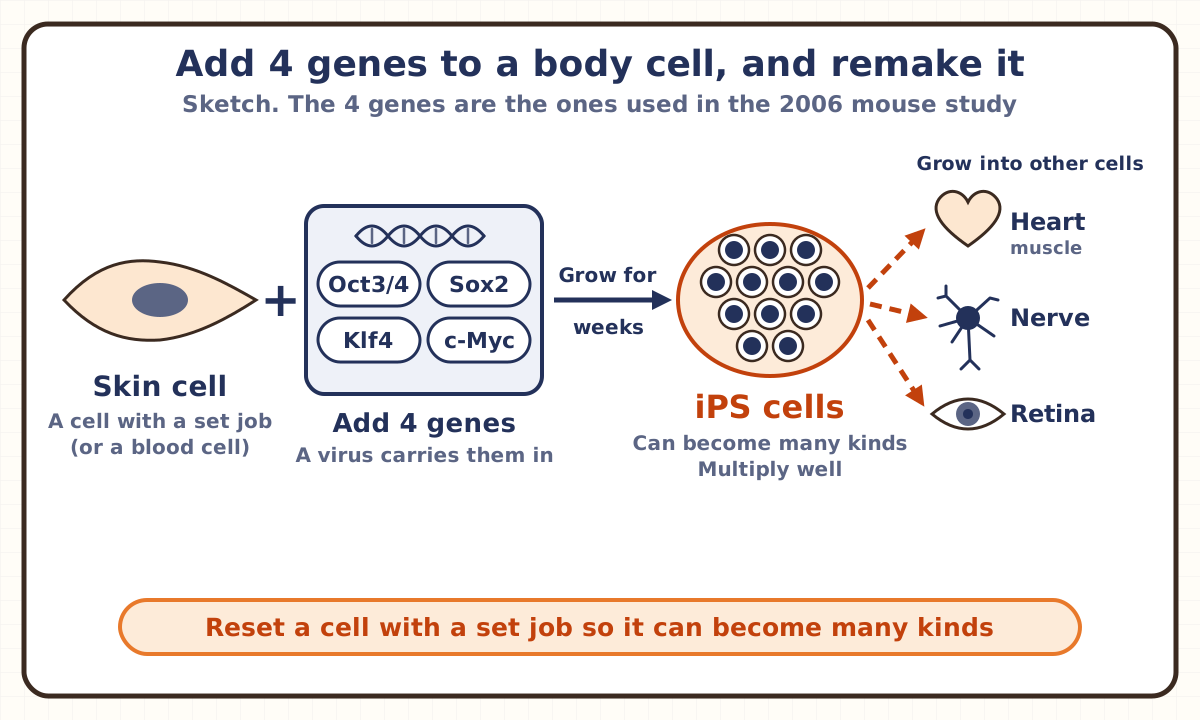
An iPS cell (induced pluripotent stem cell) is a body cell with a set job, such as a skin or blood cell, that has been given a few genes and reset to a state in which it can become many kinds of cells in the body (pluripotency).
Shinya Yamanaka and his team at Kyoto University made them in mice in 2006 and from human cells in 2007. All they added were four genes (units of body-building information written in DNA), and the cells went back close to the state of cells in an embryo that has just started to grow. The discovery led to the 2012 Nobel Prize in Physiology or Medicine.
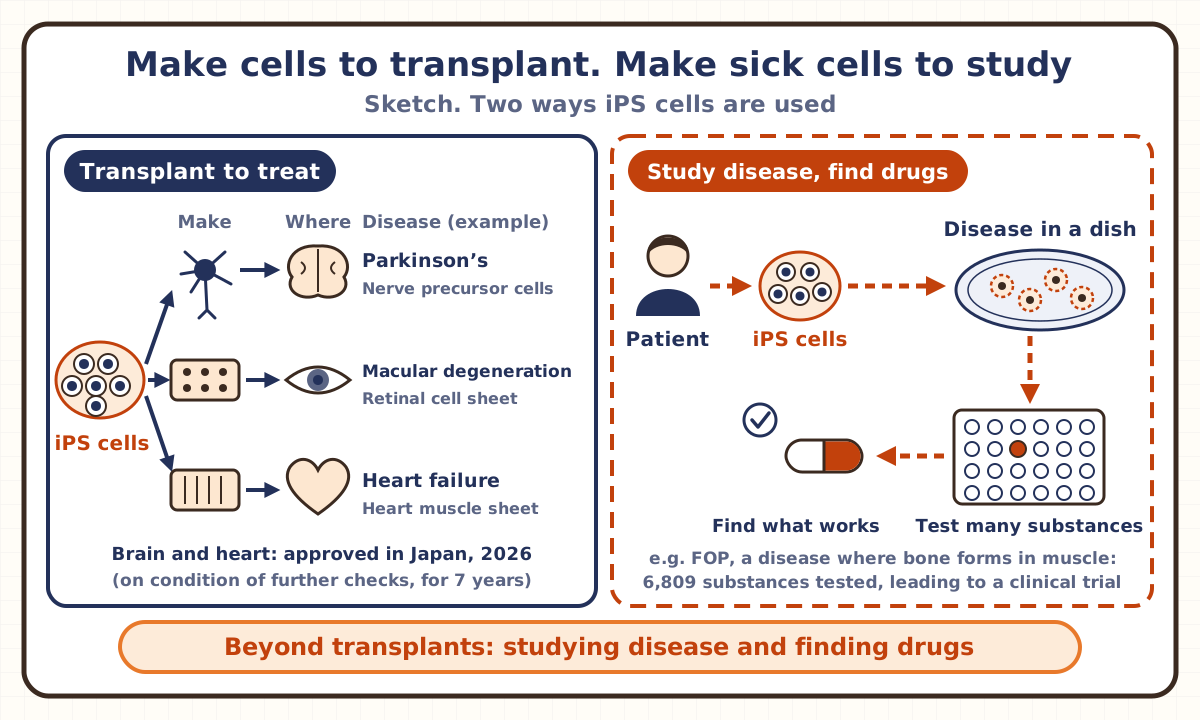
Unlike ES cells (embryonic stem cells), they can be made without destroying an embryo, and even from a patient’s own cells. Treatments that transplant cells made from them have been tested for eye, brain and heart diseases, and in 2026 Japan approved two products: the government allowed them to be sold on condition that their effect keeps being checked, within a time limit. They are also used to study how diseases work and to search for drugs.
A common mix-up
“With iPS cells, a damaged organ can be grown whole and swapped out.”
Not today. iPS cells can be turned into many kinds of body cells, such as nerve cells, heart muscle cells and cells of the retina (the layer at the back of the eye that receives light). But there is still no treatment that grows a whole organ big enough to work in a human body and swaps it in. What today’s treatments transplant are cells, or thin sheets of cells. The two products approved in Japan in 2026 are of this kind too: nerve precursor cells placed in the brains of people with Parkinson’s disease (a disease in which nerve cells in the brain are lost and the body becomes hard to move), and sheets of heart muscle cells attached to the hearts of people with severe heart failure (a state in which the heart muscle has weakened and pumps blood poorly). Both come with a condition to keep checking their effect and a 7-year time limit. And while iPS cells can in theory become any kind of body cell, that does not mean they help with every disease; each disease has to be checked on its own.
Explained in pictures
You’re free to use these figures in lessons, slides and posts if you credit Naru News (naru.news). CC BY 4.0.
Think of it like this
A ball at the top of a slope
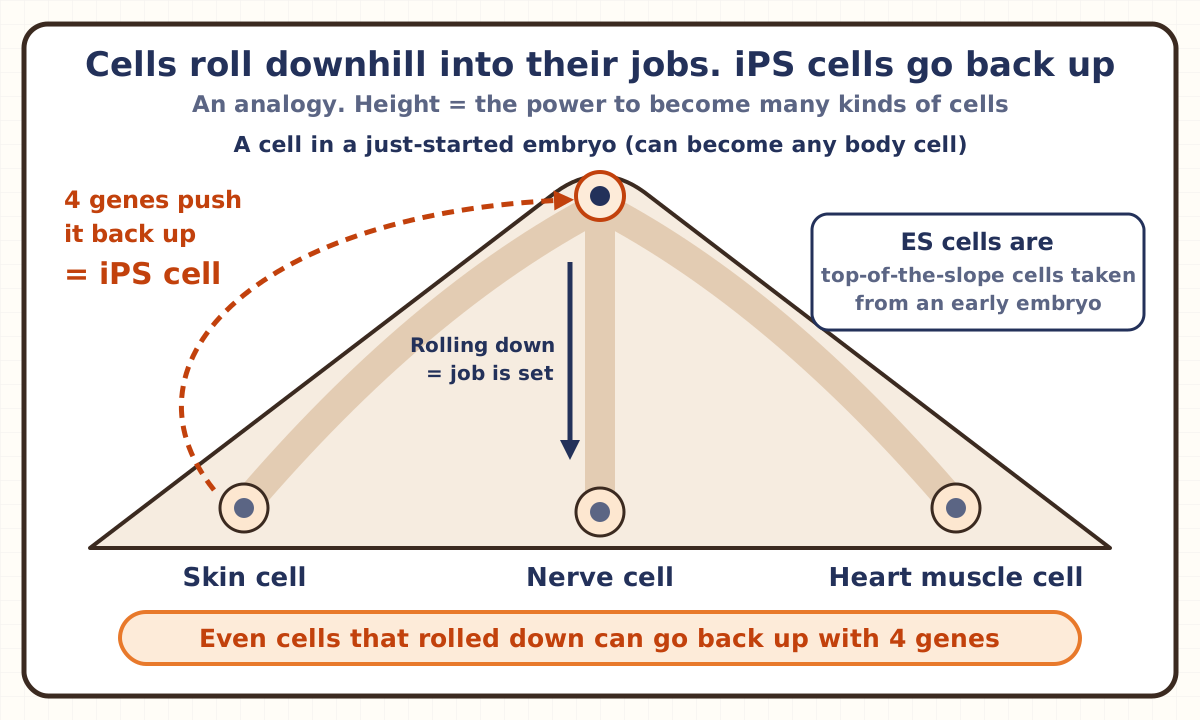
Picture a ball placed at the top of a big slope. The slope has several grooves, and as the ball rolls down, it enters one of them and settles in a valley below. Once a ball has settled in a valley, it does not roll back up the slope by itself.
Body cells are similar. Cells in an embryo that has just started to grow sit at the top of the slope and can head into any valley. As the body develops, they roll down and take on the job of the valley they reach, such as skin, nerve or heart muscle. An iPS cell is a cell, such as a skin cell in a valley, that has been pushed back up to the top by the power of four genes. Once back at the top, it can be rolled into a different valley; in other words, it can be grown again into the cells you want.
But the comparison has limits. A ball pushed back up is as good as new, but a cell may have changes in its DNA along the way, or keep leftovers of what carried the genes in. So iPS cells are checked one by one, and only usable ones are chosen. Also, rolling a cell from the top into the valley you want is not as simple as letting go of a ball. Researchers have to work out how to grow each kind of cell to guide it to the target.
Key points
How are they different from ES cells?
Both are stem cells with pluripotency (the ability to become many kinds of cells in the body) and the power to multiply almost without limit. A stem cell is a cell that can multiply and also give rise to other kinds of cells. The difference is what they are made from.
ES cells (embryonic stem cells) are grown from cells taken out of an embryo at a slightly developed stage (a small ball of cells called a blastocyst). They were first made in mice in 1981 and in humans in 1998. Because they are made by destroying a fertilized egg that could have become a baby, many people feel uneasy about them, and some countries restrict them by law. Also, when cells made from someone else’s ES cells are transplanted, the body may see them as foreign and attack them (rejection).
iPS cells can be made from adult body cells such as skin or blood cells. No fertilized egg is needed, and if they are made from a patient’s own cells, rejection is thought to be less likely.
How are cells reset?
Even a cell with a set job keeps the information needed to make every cell in the body. In 1962, John Gurdon in Britain removed the nucleus (the part that holds the genes) from a frog’s egg and put in the nucleus of a cell from a tadpole’s intestine instead. The egg grew into a tadpole.
Could a whole cell be reset without moving its nucleus? Yamanaka’s team picked 24 candidate genes from among those at work in ES cells. When they put all 24 into cells such as mouse skin cells at once, ES-like cells appeared, so they narrowed down the genes needed and found that four were enough. To carry the genes into the cells, they used viruses’ ability to enter cells.
After the four genes were added and the cells were grown for a few weeks, the cells came to look and multiply like ES cells, and genes at work in ES cells switched on. Placed under the skin of mice, they formed clumps containing many kinds of tissue: evidence that they can become many kinds of cells. And when mixed into an embryo at a slightly developed stage (a blastocyst), they joined in building the body as the embryo grew. In 2006, Yamanaka’s team named these cells “iPS cells.” In 2007, they made iPS cells from adult human skin cells with the same four genes.
Remaking a cell also brings its age, estimated from marks on its DNA, close to zero: about the same as ES cells, which are made from cells of an embryo that has just started to grow. This is about marks in the cells; it does not mean the person’s body becomes younger. In 2012, Gurdon and Yamanaka received the Nobel Prize in Physiology or Medicine for discovering that cells with set jobs can be returned to their early state.
What does the name “iPS” mean?
It stands for induced pluripotent stem cell. “Induced” means brought about (by human hands), “pluripotent” means able to become many kinds of cells, and “stem cell” means a cell that can give rise to other cells. The Japanese name means “artificial pluripotent stem cell.”
Yamanaka’s team named them, calling them “iPS (induced pluripotent stem) cells” in their 2006 paper; writing only the “i” in lowercase also dates from that paper. The name describes how they are made: pluripotent stem cells brought about by human hands from body cells.
How far has treatment come?
The first time cells made from iPS cells were transplanted into a person was for an eye disease. In age-related macular degeneration, abnormal blood vessels grow under the retina with age, among other changes, and eyesight declines. In September 2014, a woman with this disease received, by surgery, a sheet of retinal cells grown from iPS cells made from her own skin cells. One year later, the sheet was still intact, with no abnormal growth or rejection. Her eyesight neither improved nor worsened.
In Parkinson’s disease, nerve cells in the brain that make a substance called dopamine are lost, causing symptoms such as slow movement, stiffness and trembling. In a clinical trial at Kyoto University Hospital (a study that tests a new treatment in people, aiming for government approval, to check its safety and effect), nerve precursor cells made from iPS cells were transplanted into both sides of the brains of 7 patients. The iPS cells came from one healthy person. This person inherited the immune type (HLA: a type of marker, a bit like a blood type, that the body uses to tell itself from others) most common in Japan from both parents in the same form. About 17% of Japanese people match these cells. For some time after the transplant, the patients also took a drug to suppress rejection.
The 2025 paper reports no serious side effects over two years (there were mild to moderate ones), and the transplanted cells did not grow like a tumor. Brain scans showed that after two years, dopamine production was about 45% higher on average than before the transplant. The effect was assessed in the 6 people who received both sides at once (the first person received one side at a time, with a gap, to check safety). When doctors examined their movement and scored it, 4 had better scores when their medicine had worn off (after stopping it for more than 12 hours), and 5 had better scores while their medicine was working. But the group was small, there was no comparison group that did not get the cells, and both the patients and the doctors knew who had received them. Because expectations can make a treatment seem to work, the paper says the effect needs to be confirmed in larger trials.
On March 6, 2026, Japan approved two products made from iPS cells. One is Sumitomo Pharma’s Amchepry: nerve precursor cells placed in the brains of people with Parkinson’s disease whose movement is not improved enough by current medicines. It was submitted based on the results of the Kyoto University Hospital trial. The other is Cuorips’s Reheart: sheets of heart muscle cells attached to the surface of the heart, for people with severe heart failure whose heart muscle has weakened, for example because the blood vessels feeding the heart are blocked, and who are not helped enough by current treatments. Both companies say these are the world’s first products made from iPS cells. Both use iPS cells made from another person’s cells, not the patient’s own. Making iPS cells from a patient’s own cells and checking their quality takes time and money, so ways of making iPS cells in advance from healthy people’s cells have been developed (see “What are the concerns?” next).
The trial paper says the effect needs to be confirmed in larger trials, so why could they be approved? Because both are “conditional and time-limited approvals.” Products that use human cells can vary in quality, and their effect can be hard to predict in advance. So Japan has a system that allows earlier approval when the effect can be presumed and safety has been confirmed, on condition that the effect keeps being checked within a time limit. The time limit for these two products is 7 years; during that time, every patient who uses them is followed, and the companies must apply for approval again before the limit. If approval is not granted, it lapses. In the review of Reheart, regulators judged that some effect could be expected and the safety was acceptable, but that since information is still limited, it was appropriate to keep checking the effect after approval.
What are the concerns?
One major concern is tumors (growths such as cancer). Two main causes have been considered. One is that an added gene switches back on. In a 2007 study, mouse iPS cells made with the four genes were mixed into mouse fertilized eggs, which were grown into mice. When the offspring of these mice were examined, about 20% had developed tumors. This was thought to be because one of the four, a gene called c-Myc, had switched back on, and the paper says that for use in treatment, adding c-Myc with viruses should be avoided.
So the method has been improved: making iPS cells without c-Myc, using a different gene instead of c-Myc, and adding the genes with carriers that do not enter the cell’s DNA, among other ways.
The other cause is that some cells fail to grow into the target cells and stay as iPS cells, forming a benign growth called a teratoma. Researchers try to prevent this by choosing iPS cells that grow into the target cells well and by improving methods for growing them reliably. The iPS cells made are also checked one by one, and ones with changes in cancer-related genes, or with leftover gene-carrying DNA, are not used.
Another concern is time and money. Making iPS cells from a patient’s own cells and checking their quality takes time and money. The 2014 eye surgery also made clear again the problems of preparation time, cost and effort. That is why an “iPS cell stock” was created. Cells from healthy people who inherited a common Japanese immune type (HLA) from both parents in the same form match many Japanese people more easily, and are said to be less likely to be rejected after a transplant. Such people donate blood or other cells, and iPS cells are made and quality-checked in advance, then shared with research institutes and companies. As of 2022, there were 27 lines (sets of cells grown from the same cell) made from 7 people, and together they match about 40% of Japanese people. Because these are still another person’s cells, drugs to suppress rejection may be used after a transplant, as in the Parkinson’s trial.
How are they used to study disease and find drugs?
If iPS cells are made from a patient’s skin or blood cells and grown into the kind of cells affected by the disease, cells that are hard to take out of the body can be studied in a dish. Comparing them with cells from healthy people shows what is different, giving clues to how the disease works.
For example, FOP is a rare disease, said to affect about 1 in 2 million people, in which bone forms where there should be none, such as in muscles and tendons. In a 2017 study, researchers used patients’ iPS cells to recreate in a dish the change in which cartilage, the forerunner of bone, forms in this disease, and tested 6,809 kinds of substances (most with known effects on the body, including drugs sold today). They found that a certain system inside cells plays a key role, and a drug that blocks it (sirolimus) strongly reduced bone formation in two kinds of mice. Sirolimus is a drug already used to treat other diseases.
In 2017, Kyoto University and others started a clinical trial of this drug. Kyoto University calls it the world’s first doctor-led trial (a trial run mainly by doctors) to come from drug research using iPS cells. But whether an abnormality seen in cells in a dish is the true cause of a patient’s disease must be checked carefully. And how well a drug found this way works for patients, and how safe it is, can only be known by testing it in people.
Check yourself
Q1In a 2007 study, mouse iPS cells were mixed into mouse fertilized eggs, which were grown into mice. When the offspring of these mice were examined, about 20% had developed tumors. What was thought to be the main cause?
Answer and explanation
Answer: C One of the added genes switched back on
It was thought that c-Myc, one of the four added genes, had switched back on. The paper says that for use in treatment, adding c-Myc with viruses should be avoided. Later, methods were developed that use no c-Myc, or that add the genes with carriers that do not enter the cell’s DNA. In this study, the cause was thought to be the added gene, not the growing liquid. And making iPS cells actually brings the cells’ age, estimated from DNA marks, close to zero, about the same as ES cells.
Q2In March 2026, Japan approved two products made from iPS cells, with a condition to keep checking their effect and a 7-year time limit. Diseases of which body parts are they for?
Answer and explanation
Answer: A The brain and the heart
The approved products are nerve precursor cells placed in the brains of people with Parkinson’s disease whose movement is not improved enough by current medicines (Amchepry), and sheets of heart muscle cells attached to the hearts of people with severe heart failure (Reheart). For an eye disease (age-related macular degeneration), cells were first transplanted into a person in 2014, but no eye product was among those approved this time. By the 7-year limit, the companies must apply for approval again, using results such as those from every patient who used the products.
Q3In a 2017 study, researchers made iPS cells from patients with FOP, a rare disease in which bone forms in places such as muscles, recreated in a dish the change in which cartilage (the forerunner of bone) forms, and tested 6,809 kinds of substances. As a result, what kind of substance went on to be tested in a clinical trial?
Answer and explanation
Answer: B A drug already used to treat other diseases
The tests showed that a certain system inside cells plays a key role in this change. A drug that blocks it, sirolimus, strongly reduced bone formation in mice and went on to a clinical trial. Sirolimus was already used to treat other diseases, and the paper says that its being an approved drug should speed up a trial. In this study, iPS cells were used not for transplanting into the body, but to recreate diseased cells in a dish and search for a drug.
More on this → Key points: How are they used to study disease and find drugs?
Related terms
- Embryonic stem cell (ES cell)
- Stem cell
- Pluripotency
- Yamanaka factors
- Regenerative medicine
- Human embryo model
- Epigenetic clock
- Clinical trial
- Parkinson’s disease
Sources and how we checked
- Takahashi and Yamanaka, “Induction of pluripotent stem cells from mouse embryonic and adult fibroblast cultures by defined factors” (Kyoto University; Cell 126(4), pp. 663–676, August 2006; abstract [the four factors Oct3/4, Sox2, c-Myc and Klf4 added to mouse fibroblasts, the name “iPS (induced pluripotent stem) cells,” ES-like shape, growth and gene activity, tumors with tissues of all three germ layers after placing them under the skin, and contribution to embryonic development after injection into blastocysts]; read on Europe PMC on November 17, 2026)
- Takahashi et al., “Induction of pluripotent stem cells from adult human fibroblasts by defined factors” (Kyoto University and others; Cell 131(5), pp. 861–872, November 2007; abstract [iPS cells made from adult human skin fibroblasts with the same four factors, and their similarity to human ES cells]; read on Europe PMC on November 17, 2026)
- Tanabe, Takahashi and Yamanaka, “Induction of pluripotency by defined factors” (Center for iPS Cell Research and Application, Kyoto University, and others; Proceedings of the Japan Academy, Series B, 2014; the 24 candidate genes linked to ES cells, colonies appearing when all 24 were added together, four being enough, the name iPS cells, human iPS cells in 2007, and c-MYC carrying the highest cancer risk of the four; full text on Europe PMC [PMC3997808], read November 17, 2026)
- The Nobel Assembly at Karolinska Institutet, “The 2012 Nobel Prize in Physiology or Medicine” (press release, October 8, 2012; the prize motivation for Gurdon and Yamanaka, the 1962 frog nuclear transfer, the 2006 reprogramming of mouse cells with a few genes, and studying disease with cells reprogrammed from patients’ skin cells; read as the PDF of the same text on November 17, 2026)
- Mandai et al., “Autologous Induced Stem-Cell–Derived Retinal Cells for Macular Degeneration” (RIKEN and others; New England Journal of Medicine 376(11), pp. 1038–1046, March 2017; abstract [iPS cells made from the skin fibroblasts of two patients and turned into retinal pigment epithelial cells, a sheet transplanted into one patient, the sheet intact and best corrected visual acuity neither improved nor worsened at one year]; read on Europe PMC on November 17, 2026)
- RIKEN and others, press release on the transplant of retinal pigment epithelial sheets made from the patient’s own iPS cells for age-related macular degeneration (in Japanese; March 16, 2017; the first patient, a woman, operated on in September 2014, cells made from skin fibroblasts, no abnormal growth or rejection and eyesight kept at one year, a gene deletion found for the second patient whose transplant was postponed, and the preparation time, cost and effort of using a patient’s own cells; read November 17, 2026)
- Sawamoto et al., “Phase I/II trial of iPS-cell-derived dopaminergic cells for Parkinson’s disease” (Kyoto University; Nature 641, pp. 971–977, May 2025, online April 16, 2025; abstract, Introduction, Methods, Results and Discussion [investigator-initiated trial at Kyoto University Hospital, 7 people aged 50–69, iPS cells from a healthy donor homozygous for the most frequent Japanese haplotype (matching 17% of Japanese people), transplants to both sides of the brain, tacrolimus stopped at 15 months, 24 months of follow-up, no serious adverse events, no tumor-like growth, the first patient grafted one side at a time 8 months apart and included only in the safety evaluation, efficacy assessed in the 6 patients with simultaneous bilateral surgery, OFF (more than 12 h off medication) scores improved in 4 and ON scores in 5, scoring by a neurologist’s examination, a 44.7% mean rise in dopamine production, the possible influence of the placebo effect and observer bias in this open-label trial without a control group, and the need to confirm the findings in larger controlled studies]; full text on PMC [PMC12095070], read November 17, 2026)
- Sumitomo Pharma and RACTHERA, announcement of the manufacturing and marketing approval in Japan of Amchepry, dopaminergic neural progenitor cells derived from allogeneic iPS cells (in Japanese; March 6, 2026; conditional and time-limited approval on March 6, 2026, the indication [motor symptoms of Parkinson’s disease not adequately controlled by current drugs including levodopa], the application of August 5, 2025 based on the Kyoto University Hospital investigator-initiated trial, transplantation into both sides of the putamen by stereotactic surgery, and the companies’ statement that it is the world’s first iPS-cell-derived regenerative cell product; read as the timely-disclosure PDF on November 17, 2026)
- Cuorips, announcement of the conditional and time-limited manufacturing and marketing approval of heart muscle cell sheets derived from allogeneic human iPS cells (in Japanese; March 6, 2026; the conditional and time-limited approval of Reheart, its indication [severe heart failure due to ischemic cardiomyopathy not adequately helped by standard treatment], that it is made from a healthy donor’s iPS cells, and the company’s statement that it is the world’s first; read as the timely-disclosure PDF on November 17, 2026)
- Pharmaceuticals and Medical Devices Agency (PMDA), Japan, review report for Reheart (in Japanese; the report on the deliberation result [the February 19, 2026 committee found it could be approved as a conditional and time-limited approval with a 7-year limit and a condition to survey every patient] and the review report [February 10, 2026: some effectiveness can be expected and safety is acceptable, but because information is limited, effectiveness should keep being evaluated after approval; three sheets attached to the surface of the heart]; read November 17, 2026)
- Pharmaceuticals and Medical Devices Agency (PMDA), Japan, review report for Amchepry (in Japanese; the report on the deliberation result [the February 19, 2026 committee found it could be approved as a conditional and time-limited approval with a 7-year limit and a condition to survey every patient]; read November 17, 2026)
- Ministry of Health, Labour and Welfare (MHLW), Japan, overview of the 2013 act amending the Pharmaceutical Affairs Act (in Japanese; an explanatory document: regenerative medicine products can vary in quality and their effectiveness can be hard to predict, conditional and time-limited early approval when effectiveness is presumed and safety confirmed, a limit of no more than 7 years in principle, re-application within the limit, and approval or lapse; read November 17, 2026)
- Okita, Ichisaka and Yamanaka, “Generation of germline-competent induced pluripotent stem cells” (Kyoto University; Nature 448, pp. 313–317, July 2007; abstract [adult chimeras obtained from iPS cells and germline transmission, about 20% of the offspring developed tumors attributed to reactivation of the c-myc transgene, and retroviral c-Myc should be avoided for clinical use]; read on Europe PMC on November 17, 2026)
- Nakagawa et al., “Generation of induced pluripotent stem cells without Myc from mouse and human fibroblasts” (Kyoto University and others; Nature Biotechnology 26(1), pp. 101–106, January 2008; abstract [c-Myc reactivation raises tumor risk, a method without Myc, no tumors in mice from Myc-free iPS cells during the study, and human iPS cells made without MYC]; read on Europe PMC on November 17, 2026)
- Okita et al., “A more efficient method to generate integration-free human iPS cells” (Kyoto University and others; Nature Methods 8(5), pp. 409–412, May 2011; abstract [a method using L-Myc and episomal plasmid vectors that do not integrate into the chromosomes]; read on Europe PMC on November 17, 2026)
- Center for iPS Cell Research and Application (CiRA), Kyoto University, “What are iPS cells?” (in Japanese; FAQ, answered with information as of January 2021; adding a few factors to body cells, pluripotency and near-unlimited growth, ES cells made from blastocysts 6 to 7 days after fertilization, unease about destroying embryos, regulation and rejection, the years mouse and human ES cells were made, the four genes delivered by building them into viruses that infect the cells, then grown for weeks, replacing c-Myc with L-Myc and non-integrating circular DNA, the two causes of tumors and how they are addressed, large organs, not being useful for everything, and the limits of disease research and drug testing; read November 17, 2026)
- CiRA Foundation, Kyoto University, announcement of a paper summarizing 10 years of the iPS cell stock project (in Japanese; November 17, 2022; 27 lines from 7 HLA-homozygous donors matching about 40% of Japanese people, HLA as a marker for telling self from others that was first found as a white-blood-cell blood type, making and storing iPS cells in advance from donors whose HLA types are less likely to be rejected by many Japanese people, use in more than 10 clinical trials, the time and cost of making cells from a patient’s own cells, and why some lines were not selected [leftover episomal vectors, mutations in cancer-related genes, chromosome changes and so on]; read November 17, 2026)
- Hino et al., “Activin-A enhances mTOR signaling to promote aberrant chondrogenesis in fibrodysplasia ossificans progressiva” (Kyoto University and others; Journal of Clinical Investigation 127(9), pp. 3339–3352, September 2017; abstract [a screening system using patients’ iPS cells, 6,809 small-molecule compounds, the role of mTOR] and main text [a library of mostly bioactive, annotated compounds including currently marketed drugs, rapamycin strongly suppressed bone formation in two mouse models, and its approved status should speed a clinical trial]; read November 17, 2026)
- Kyoto University, announcement of the start of the world’s first clinical trial for iPS-cell-based drug discovery (in Japanese; August 1, 2017; FOP as a disease said to affect 1 in 2 million people, recreating the disease with patients’ iPS cells, sirolimus [rapamycin] blocking mTOR and suppressing bone formation, its existing use for other diseases, and the university’s statement that it is the world’s first doctor-led trial from iPS-cell drug research; read November 17, 2026)
- Horvath, “DNA methylation age of human tissues and cell types” (University of California, Los Angeles; Genome Biology 14, R115, 2013; abstract [close to zero for ES and iPS cells] and Background [making iPS cells resets the clock to zero]; full text on Europe PMC [PMC4015143], read November 17, 2026)
AI wrote this page from the sources above, and a different AI checked it against the text of those sources (November 17, 2026). A person with a master’s degree in science and a Japanese high-school science teaching license also read and checked it before publishing. Numbers are as of that date. If anything was hard to follow, you spot a mistake, or there’s a term you’d like explained, please write to [email protected].
Everyday science terms
- Dark oxygen
- Epigenetic clock
- Glymphatic system
- Human embryo model
- You are hereiPS cell
- Manganese nodule
- Moore’s law
- Stem cell