 Naru News日本語
Home › Glossary › Everyday science
What is a manganese nodule, a metal-bearing lump on the deep seafloor?
Also called: Polymetallic nodule, Ferromanganese nodule

In one minute
A manganese nodule (polymetallic nodule) is a stone-like lump lying on the deep seafloor, mostly 4,000 to 6,000 meters down, made mainly of iron and manganese and also containing metals such as nickel, cobalt and copper.
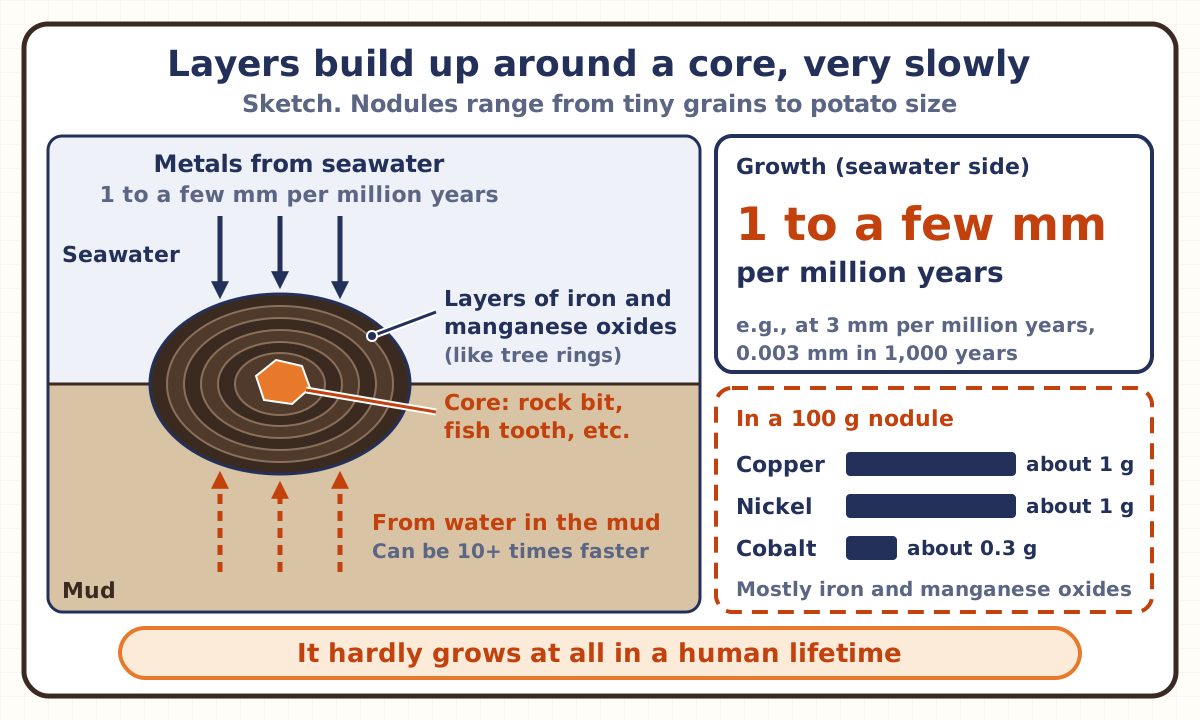
Nodules range from tiny grains to the size of a potato. Around a core, such as a rock fragment or a fish tooth, metals from the surrounding water build up little by little, layer upon layer. They grow very slowly: about a millimeter to a few millimeters per million years.
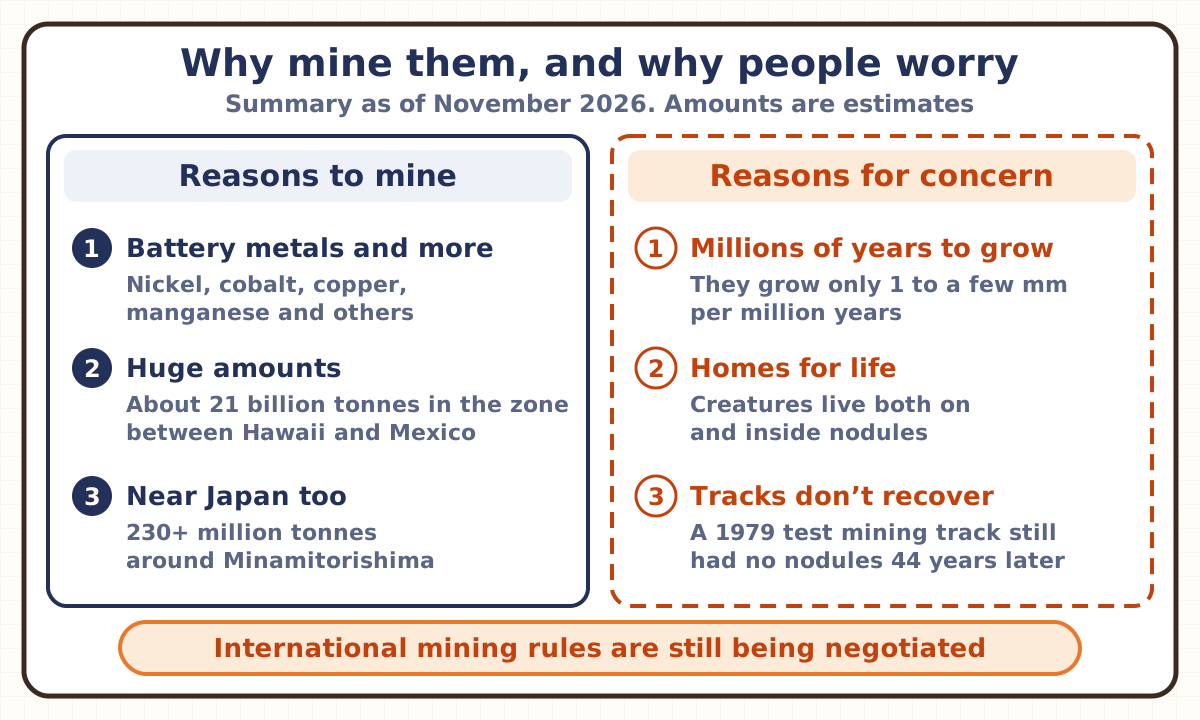
Because they contain metals used in batteries and other products, there are plans to mine them. Yet on a deep seafloor that is mostly soft mud, nodules are among the few hard footholds. Corals and other animals attach to them, and creatures smaller than a millimeter live in their cracks. A test mining track had still not recovered after decades, and international mining rules are still being negotiated.
A common mix-up
“They’re just rocks on the seafloor, so if you mine them, they’ll soon form again.”
Not true. It is right that they are stone-like lumps. But manganese nodules grow extremely slowly. Around a core, metals from seawater, and from water in the mud on the seabed, build up little by little in layers, but growth from seawater is only about a millimeter to a few millimeters per million years. At 3 millimeters per million years, a nodule grows just 0.003 millimeters in 1,000 years. Over a human lifetime, it hardly gets any bigger. In fact, when the track left by a 1979 test of a nodule-collecting machine on the deep Pacific seafloor was examined 44 years later, in 2023, there were still no nodules in it, and its shape was still clear. Nodules forming again where they were taken is not something to expect on a human timescale. On top of that, nodules are also homes for deep-sea life.
Explained in pictures
You’re free to use these figures in lessons, slides and posts if you credit Naru News (naru.news). CC BY 4.0.
Think of it like this
Apartment buildings on a muddy plain, millions of years in the making
Picture a plain of soft mud stretching as far as the eye can see. There are hardly any stones to cling to, or nooks to hide in. Here and there on it stand small apartment buildings. Living things that can only attach to hard surfaces cling to the outside walls, and tiny residents live in the small rooms inside.
Manganese nodules on the deep seafloor are like these buildings. Where nodules are dense, far more animals that live attached to hard things, such as corals and sponges, are found, and creatures smaller than a millimeter live in the cracks and gaps inside nodules. Taking nodules means carrying off whole buildings. And these buildings take millions of years to go up.
But the comparison has limits. People design and build apartments, but nodules grow on their own, as metals in the water build up little by little. Also, residents of an apartment can move out before it is torn down, but whether the tiny creatures in the gaps of nodules can survive in other nodules or other places is not yet known. And what people who want to take nodules are after is not the residents, but the metals the buildings are made of.
Key points
How do they form?
A manganese nodule is made of layers built up around a core. The core may be a rock fragment, a bit of hardened mud, a piece of fish tooth or bone, a shark’s tooth, or a bit of shell. Manganese and iron dissolved in water settle on its surface little by little as oxides (forms combined with oxygen), adding layer after layer. Cut one open, and you see a pattern like the rings of a tree.
Metals arrive in two ways. One is from the seawater above, which is very slow: about a millimeter to a few millimeters per million years. The other is from water in the mud in which a nodule is half buried, which can be more than ten times faster. Most nodules grow both ways. Either way, on a human timescale, they are all but standing still. The largest nodules around Minamitorishima, a Japanese island, are thought to have started growing tens of millions of years ago.
The Japanese name, mangan dankai, means “manganese lump.” Because nodules contain many metals, they are also called polymetallic nodules. The English word nodule means a small knob-like lump, and in Japanese they are sometimes also called mangan nojūru, from the English.
Where are they found?
Manganese nodules lie on the deep seafloor of every ocean, but they are found especially in the Pacific. Most lie on flat deep seafloor 4,000 to 6,000 meters down.
The best known area is the Clarion–Clipperton Zone, which stretches between Hawaii and Mexico and holds especially large numbers of nodules. There are also nodule-rich areas in the Peru Basin off Peru, the Penrhyn Basin near the Cook Islands in the South Pacific, and the Central Indian Ocean Basin, among others.
Near Japan, dense nodule fields spread across the seabed in Japan’s exclusive economic zone (EEZ: the area where a coastal country can use the resources of the seabed) around Minamitorishima, Japan’s easternmost island. A 2024 survey estimated that the cobalt in the nodules of a particularly rich area would exceed 75 years of Japan’s annual use.
Around Minamitorishima, “rare-earth mud,” rich in rare earths (a family of elements used in electronics and other products), is also in the news. It lies at about the same depth, but rare-earth mud is the seabed mud itself, a different thing from lump-shaped manganese nodules.
Why do people want to mine them?
Besides their main components, iron and manganese, nodules contain copper, nickel, cobalt and a little rare earth. A 100-gram nodule holds about 1 gram each of copper and nickel and about 0.3 grams of cobalt. The shares are small, but so many nodules lie on the deep seafloor that collecting them adds up to large amounts.
Cobalt, nickel, copper, manganese and the like are metals vital to batteries and other products. That is why some companies are trying to collect nodules from the deep seafloor and mine them.
The idea of mining nodules is not new. In the 1970s, groups of Western companies explored off Hawaii and ran large mining tests. But interest faded, partly because metal prices fell and new mines were found on land. Nowhere are nodules mined commercially even today.
What lives on and in them?
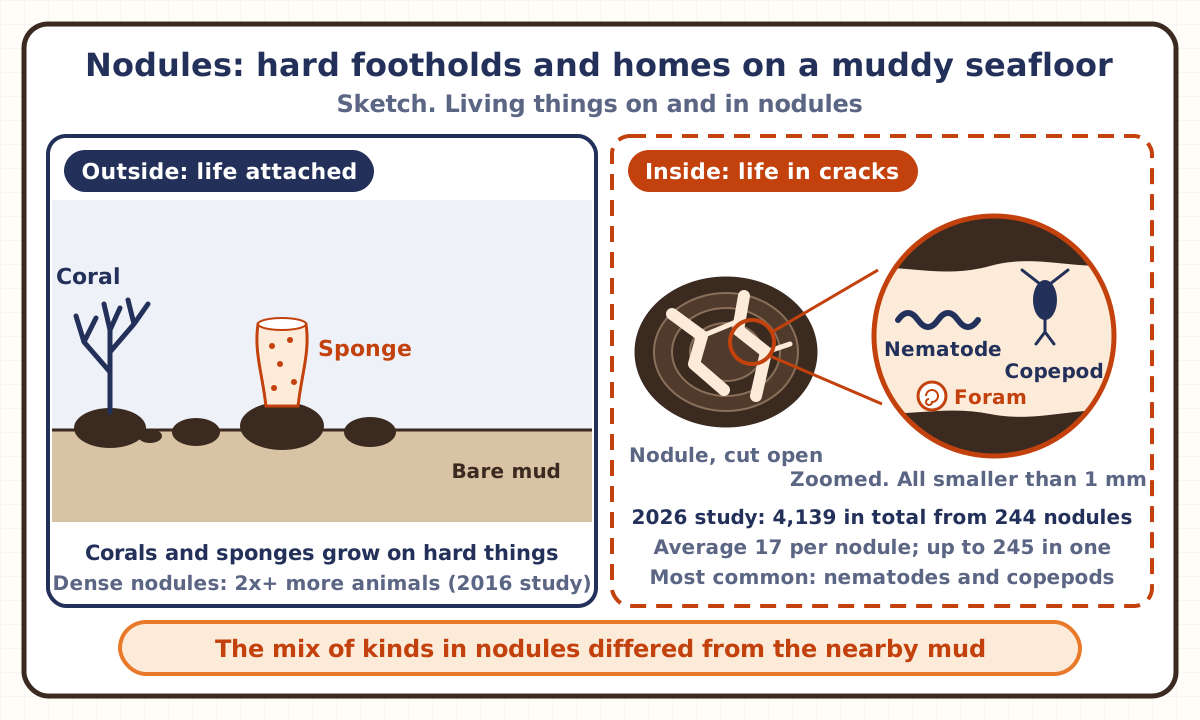
Much of the deep seafloor is soft mud, and nodules are among the few hard footholds. A 2016 study examined video of the seafloor in the eastern Clarion–Clipperton Zone taken by the camera of an underwater robot. Where many nodules lay, there were more than twice as many larger animals living on the seafloor as where nodules were scarce. Corals (soft corals and black corals) were almost absent where there were no nodules, because animals that live attached to hard things cannot live on mud.
Living things are inside nodules too. A study published in November 2026 examined 244 nodules collected in the same area. When the nodules were frozen, the hard nodules crumbled into small bits. Sieving them to pull out the living things from the cracks and gaps turned up 4,139 in total, an average of 17 per nodule. The cracks and gaps are big enough for creatures smaller than a millimeter to live in, and the bigger the nodule, the wider the cracks inside.
Most common were nematodes (tiny, slender worms) and copepods (tiny relatives of shrimp and crabs, like water fleas), along with single-celled forams that have shells, and bristle worms. For the same area of seafloor, there were fewer of them than in the nearby mud, but when the kinds of nematodes and copepods were checked by DNA, the mix inside nodules was clearly different from the nearby mud. For copepods, nodules about 1,000 kilometers apart were even more alike than nodules and the mud right next to them. The inside of a nodule is rough and intricate, and the paper suggests this is likely one reason it differs from the mud. A nodule is a home in its own right, separate from the mud.
Many unknown creatures live in this area. A 2023 study that pulled together the records so far estimated that about 90% of the animal species recorded in this area were new to science (and noted that this may be an overestimate if the same species was counted more than once).
What happens when they are taken?
Taking nodules removes not only the nodules themselves but also the homes of the living things attached to them and living in their gaps. The paper from the 2026 study writes that collecting nodules causes effectively permanent loss of nodules as a habitat, and that the living things that depend on them in that place cannot come back for geological timescales (millions of years).
A study has actually examined what happens to a track where nodules were taken. In 1979, a company tested a machine for collecting nodules on the deep Pacific seafloor. When the track was examined 44 years later, in 2023, the track where the machine had collected nodules still had no nodules, and its shape was still clear. Small creatures in the mud and some animals that move around had begun to come back, but large animals that live attached to hard things remained very scarce on the track. The paper writes that the effects of deep-sea mining will last for at least decades.
Mud stirred up during mining is another concern. In this study, right next to the track, a thin layer of mud had filled the spaces between nodules. Yet some animals were actually more common there.
Whether losing the creatures in nodules’ gaps would wipe those species off the Earth, or whether they can survive elsewhere, is not yet known. The team behind the 2026 study says this is what to study next.
Separately, there is also an idea, called “dark oxygen,” that nodules might be making oxygen on the deep seafloor, but it has been challenged and is not settled.
What are the rules for mining them?
The deep seabed of the high seas (waters that belong to no country) and its resources are “the common heritage of mankind” under the UN Convention on the Law of the Sea, and they are managed by an international organization, the International Seabed Authority (ISA). Countries and companies, Japan among them, hold contracts with the ISA for “exploration,” which means searching for and studying nodules.
But as of November 2026, the rules for mining nodules commercially have not been settled. There are reasons to want the metals, and worries that what is taken will not come back for millions of years and that homes for living things will be lost. Amid both, talks on matters such as how to share profits are set to continue in 2027.
The United States, which has not joined the Convention on the Law of the Sea, holds that under its own law it can permit U.S. companies to mine the deep seabed of the high seas. In 2026, a company asked for such a permit, but as of November no decision had been made. The ISA says that one country approving mining on its own runs counter to the principles of international law.
The waters around Japan’s Minamitorishima lie inside Japan’s exclusive economic zone, so they are not part of the deep seabed of the high seas managed by the ISA.
Check yourself
Q1Manganese nodules on the deep seafloor grow as layers of metal build up around a core. How fast do they grow when the metals come from seawater?
Answer and explanation
Answer: B About 1 to a few millimeters per million years
Growth from metals in seawater is about a millimeter to a few millimeters per million years. At 3 millimeters per million years, a nodule grows just 0.003 millimeters in 1,000 years. Growth from water in the mud can be more than ten times faster, but even so, nodules hardly grow on a human timescale. Nodules do not soon form again where they were taken.
Q2A 2026 study took tiny creatures out of the cracks and gaps of manganese nodules from the deep Pacific seafloor and compared them with the creatures in the nearby mud. What did it find?
Answer and explanation
Answer: A The mix of kinds was different from the mud
When the kinds of nematodes and copepods were checked by DNA, the mix inside nodules was clearly different from the nearby mud. Their numbers, compared over the same area of seafloor, were lower than in the mud, so the answer saying there were more is wrong too. A nodule is thought to be a home in its own right, separate from the mud.
Q3In 1979, a machine for collecting manganese nodules was tested on the deep Pacific seafloor. When its track was examined in 2023, what was it like?
Answer and explanation
Answer: A Still no nodules, and the track was still plain
Nodules had not come back, and mud had not filled the track. Even after 44 years, the track where the machine collected nodules had no nodules, and its shape was still clear. Small creatures in the mud and some animals that move around had begun to come back (large animals that live attached to hard things remained very scarce). Right next to the track, mud had only thinly filled the spaces between nodules. The paper writes that the effects of deep-sea mining will last for at least decades.
More on this → Key points: What happens when they are taken?
Related terms
- Dark oxygen
- Deep-sea mining
- International Seabed Authority (ISA)
- Exclusive economic zone (EEZ)
- Cobalt-rich crust
- Rare-earth mud
Sources and how we checked
- Diaz-Recio Lorenzo et al., “Polymetallic nodules provide a distinct habitat for abyssal meiofauna” (MARUM, University of Bremen; Royal Netherlands Institute for Sea Research [NIOZ] and others; Scientific Reports 16, 36610, November 11, 2026; abstract, Introduction [nodules are mainly iron and manganese oxides with nickel, copper and cobalt, and take millions of years to form], Results [244 nodules from 16 box cores taken in 2019 on R/V Sonne cruise SO268 in the BGR (Germany) and GSR (Belgium) exploration areas of the eastern Clarion–Clipperton Zone; 4,139 individuals in total, a mean of 17 and a maximum of 245 per nodule; Nematoda 52.9–84.0%, Copepoda 7.41–13.4%, Foraminifera 5.64–29.4% and polychaetes, with foraminifera included in the total; nematode and copepod abundances, per 10 cm² of seafloor, about 10% and 25% of those in nearby sediment; nematode and copepod assemblages from 18S rRNA differing from sediment, with copepod samples about 1,000 km apart more similar to one another; nodules binned into five volume classes from 10 ml or less to over 200 ml; internal crack diameters rising 15.7% per doubling of nodule volume], Methods [nodules frozen at −20 °C for 24 h disintegrated and were sieved at 32 µm], main text [hydrogenetic layers grow a few mm per million years, diagenetic layers tens to hundreds of mm], Discussion [rugose, structurally complex nodule interiors likely contributing to the differences from sediment assemblages; nodule collection causes effectively permanent loss of the nodule habitat, preventing recovery of nodule-associated communities on geological timescales]; full text on nature.com, read November 18, 2026)
- MARUM – Center for Marine Environmental Sciences, University of Bremen, “Hidden Worlds in the Deep Ocean” (press release, November 11, 2026; fist-sized lumps of iron and manganese oxides at depths of 4,000 to 6,000 meters that grow only a few millimeters per million years; 244 nodules, 4,139 individuals, a mean of 17 and up to 245; nematodes about 10% and copepods about 25% of sediment numbers; communities very similar across up to 1,000 km; Stratmann on cracks large enough for animals smaller than a millimeter; mining would permanently destroy the habitat because nodules take millions of years to form; future work on whether losing local communities could mean global extinction; read on Research in Germany [DAAD], November 18, 2026)
- Vanreusel et al., “Threatened by mining, polymetallic nodules are required to preserve abyssal epifauna” (Ghent University and others; Scientific Reports 6, 26808, 2016; abstract and main text [ROV Kiel 6000 video along 17 transects in four contract areas and APEI 3 in the eastern Clarion–Clipperton Zone; epifaunal densities more than twice as high at dense nodule coverage (over 25 versus 10 or fewer per 100 m²); alcyonacean and antipatharian corals virtually absent from nodule-free areas; nodules growing only a few millimeters per million years; no significant recovery in decades-old tracks]; full text on PMC [PMC4887785], read November 18, 2026)
- Jones et al., “Long-term impact and biological recovery in a deep-sea mining track” (National Oceanography Centre and others; Nature 642, pp. 112–118, 2025, online March 26, 2025; abstract and main text [the OMCO collector test of March 1979 at about 4,700 m in the Clarion–Clipperton Zone, surveyed in 2023, 44 years later; a collection track about 4.5 m wide still depleted of nodules; biological impacts persisting in many groups, with sediment macrofauna, mobile deposit feeders and even some large sessile fauna beginning to re-establish, but very few sessile megafauna on the tracks; sediment infill of up to about 10 mm between nodules within 10 m of the tracks, with higher densities of some animals there; impacts persisting over at least decadal timeframes]; full text on nature.com, read November 18, 2026)
- Rabone et al., “How many metazoan species live in the world’s largest mineral exploration region?” (Natural History Museum, London, and others; Current Biology 33(12), pp. 2383–2396, 2023; abstract [the Clarion–Clipperton Zone covers about 6 million km²; 5,578 recorded species, 436 of them named; an estimated 92% new to science, possibly inflated by synonyms]; read on Europe PMC on November 18, 2026)
- Japan Organization for Metals and Energy Security (JOGMEC), overview of marine mineral resources: manganese nodules (in Japanese; about 2–10 cm across and half-buried in sediment at depths of 4,000–6,000 m off Hawaii and in the Indian Ocean; mainly iron and manganese, with about 1% copper, about 1% nickel, about 0.3% cobalt and some rare earths; growth rings in cross-section and growth of about 1 mm per million years; large-scale mining tests off Hawaii by Western consortia in the 1970s; Japan’s claim registered in 1987 by Deep Ocean Resources Development, set up jointly by the public and private sectors, and its exploration contract with the International Seabed Authority in 2001; deep-seabed resources as the common heritage of mankind under the UN Convention on the Law of the Sea; read November 18, 2026)
- JOGMEC, “Rare-earth mud in the spotlight: Japan’s marine mineral resources explained” (in Japanese; JOGMEC NEWS plus vol. 34, May 29, 2026; manganese nodules as round or oval lumps of metals deposited from seawater over long periods, at 4,000–6,000 m, containing nickel, cobalt, copper and manganese; rare-earth mud as a mud-like sediment rich in rare earths at 4,000–6,000 m, found around Minamitorishima; read November 18, 2026)
- University of Tokyo School of Engineering, Chiba Institute of Technology and Kyoto University, press release on how deep water from the Antarctic created a vast manganese nodule field around Minamitorishima (in Japanese; January 12, 2022; nodules grow in concentric layers of iron and manganese hydroxides and oxides around a nucleus such as consolidated sediment, rock fragments, or fish teeth and bone fragments; a dense field spreads across the Minamitorishima EEZ; the largest nodules are estimated to have started growing tens of millions of years ago; read November 18, 2026)
- University of Tokyo School of Engineering, release of survey results on manganese nodules around Minamitorishima (in Japanese; June 26, 2024; a 47-day survey from late April 2024 with the Nippon Foundation; more than about 230 million tonnes of nodules in a promising area of about 10,000 km², about 2% of the Minamitorishima EEZ; cobalt expected to exceed 75 years of Japan’s annual consumption; read November 18, 2026)
- Geospatial Information Authority of Japan, latitude and longitude of Japan’s easternmost, westernmost, southernmost and northernmost points (in Japanese; Japan’s easternmost point is Minamitorishima, Tokyo; read November 18, 2026)
- World Ocean Review 3, “Manganese nodules” (2014; nodules from potato to lettuce-head size, with metals building up around a nucleus such as a shark’s tooth or a clam-shell fragment; hydrogenous growth of up to 10 mm per million years and diagenetic growth of 10–100 mm, with most nodules growing both ways; depths of 3,500–6,500 m in the Pacific and Indian Oceans; an estimated 21 billion tonnes of nodules in the Clarion–Clipperton Zone; the Peru Basin, the Penrhyn Basin near the Cook Islands and the Central Indian Ocean Basin; read November 18, 2026)
- MARUM, “Manganese nodules” (institute explainer page; potato-sized, formed extremely slowly over millions of years; at water depths of 4,000 to 6,000 meters in all oceans, especially the Pacific, with a major concentration in the Clarion–Clipperton Zone between Mexico and Hawaii; containing copper, nickel, cobalt and rare-earth elements; read November 18, 2026)
- Northwestern University, “Deep-ocean floor produces its own ‘dark oxygen’” (news release, July 22, 2024; nodules from tiny particles to an average potato in size, containing metals such as cobalt, nickel, copper, lithium and manganese that are critical elements used in batteries, and companies planning to extract them from the seafloor; read November 18, 2026)
- GEOMAR Helmholtz Centre for Ocean Research Kiel, “Der Meeresboden als Rohstoffquelle der Zukunft” (in German; institute explainer; Pacific nodule fields surveyed as a resource in the 1980s, with interest fading as metal prices fell and new land deposits were found; calling nodules renewable is misleading because they take thousands to millions of years to accumulate; read November 18, 2026)
- Sweetman et al., “Evidence of dark oxygen production at the abyssal seafloor” (Nature Geoscience 17, 2024; the abstract [the hypothesis that seawater electrolysis may contribute to dark oxygen production] and the Editor’s Note added April 8, 2026; read on nature.com on November 18, 2026; see also this site’s glossary page on dark oxygen)
- International Seabed Authority (ISA), “The Council of the International Seabed Authority advanced negotiations on the Mining Code” (March 31, 2026; Part I of the Council’s 31st session, March 9–19, 2026, negotiated the draft exploitation regulations without adopting them and continues in Part II in July; royalties and profit-sharing were reviewed; concern about unilateral action and the Secretary-General’s statement that it runs counter to the principles of international law and the common heritage of humankind; read November 18, 2026)
- International Seabed Authority (ISA), “31st session 2026” and “The Mining Code: Draft Exploitation Regulations” (the session page [Council Part II on July 13–24, 2026; the July 24 agenda with the draft regulations and a decision on continuing the work; proposed Council meetings in March, July and October–November 2027, to be confirmed] and the draft regulations page [the draft exploitation regulations are under negotiation by the Council]; read November 18, 2026; the outcome documents of the July meeting are PDFs that could not be opened, so the outcome was checked in the September 19 release below)
- International Seabed Authority (ISA), “From the 31st to the 32nd Session: advancing the Mining Code and strengthening the Common Heritage of Humankind” (September 19, 2026; the draft exploitation regulations were negotiated at the 31st session but not adopted; the Council asked the Secretariat to prepare a roadmap toward timely adoption for Part I of the 32nd session; negotiations resume in March 2027, with the Council scheduled for March 8–19 and July 12–23, 2027; read November 18, 2026)
- International Seabed Authority (ISA), “Exploration contracts: Polymetallic nodules” (the list of exploration contracts, including Deep Ocean Resources Development of Japan [2001], Germany’s BGR [2006] and Belgium’s GSR [2013], most in the Clarion–Clipperton Zone; read November 18, 2026)
- National Oceanic and Atmospheric Administration (NOAA), “NOAA advances review of first-ever deep seabed mining commercial recovery application” (August 19, 2026; The Metals Company USA’s consolidated application of February 6, 2026 for an exploration license and a commercial recovery permit in the Clarion–Clipperton Zone found to be in full compliance with the information requirements; public comment until October 19 and a hearing on October 13; next, a decision on certification, followed by an environmental impact statement if certified; read November 18, 2026)
- NOAA National Ocean Service, “Deep Seabed Hard Minerals Mining” (under the Deep Seabed Hard Mineral Resources Act, NOAA can issue exploration licenses and commercial recovery permits to U.S. companies in areas beyond national jurisdiction; the U.S. is not a party to the Law of the Sea Convention; the status of TMC USA’s applications [page last updated October 16, 2026, with the consolidated application past its comment period]; read November 18, 2026, when no NOAA announcement of a permit being issued was found)
AI wrote this page from the sources above, and a different AI checked it against the text of those sources (November 18, 2026). A person with a master’s degree in science and a Japanese high-school science teaching license also read and checked it before publishing. Numbers are as of that date. If anything was hard to follow, you spot a mistake, or there’s a term you’d like explained, please write to [email protected].
Everyday science terms
- Dark oxygen
- Epigenetic clock
- Glymphatic system
- Human embryo model
- iPS cell
- You are hereManganese nodule
- Moore’s law
- Stem cell