 Naru News日本語
Home › Glossary › Everyday science
What is a stem cell, a cell that multiplies and also gives rise to other cells?
Also called: Stem cells

In one minute
A stem cell is a cell that has both the power to divide and make more cells like itself, and the power to turn into cells with set jobs, such as blood or skin cells.
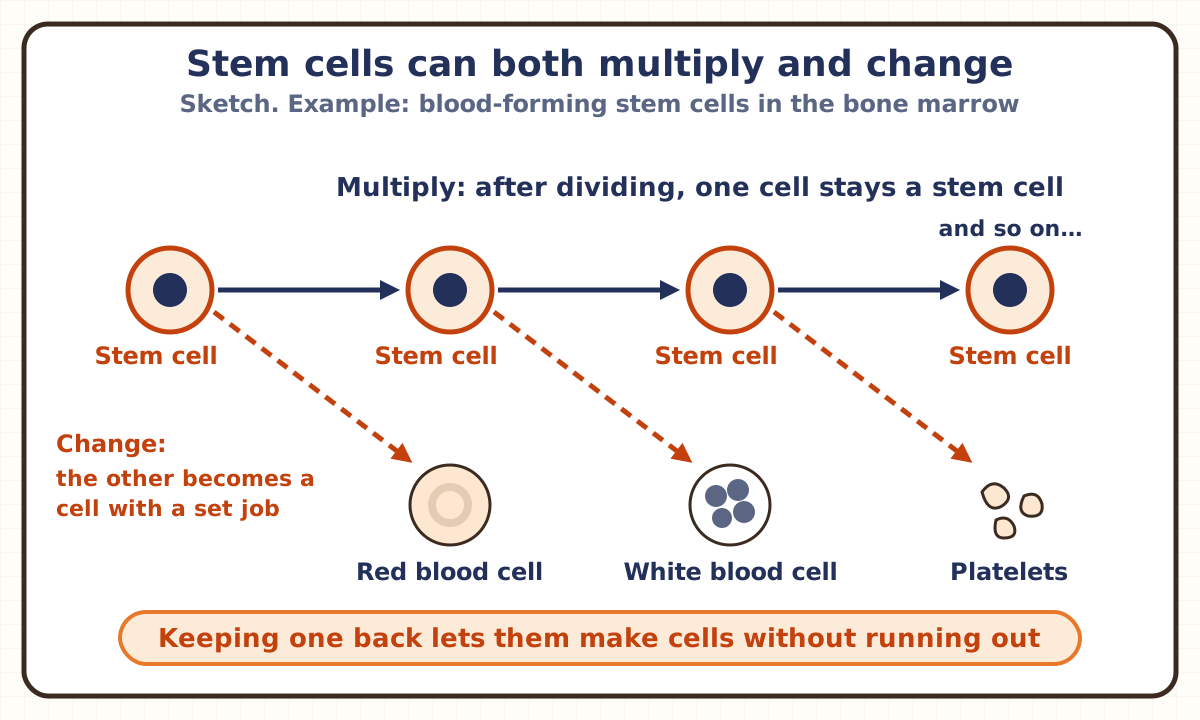
The body replaces about 330 billion cells a day, most of them blood cells and cells lining the gut. Stem cells in places such as the bone marrow inside our bones and the gut keep up this supply. Because they keep one of themselves each time they divide, they can go on making new cells without running out.
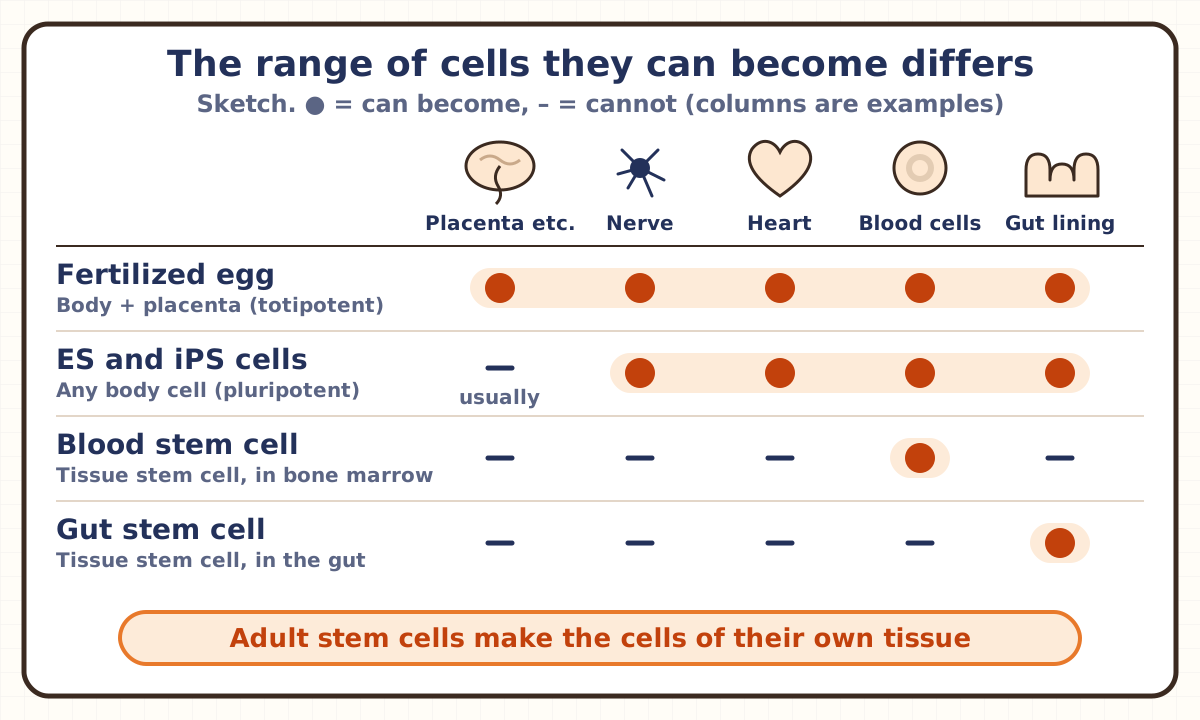
How many kinds of cells they can become depends on the type. A fertilized egg makes every cell of the body plus the placenta, and ES and iPS cells can become any kind of body cell. Tissue stem cells in the adult body make the cells of their own tissue (a group of cells with the same job): those in the bone marrow make blood cells, for example, and those in the gut make the cells lining the gut.
In medicine, blood stem cell transplants (such as bone marrow transplants), which move blood-forming stem cells into a patient, have long been used for diseases such as leukemia. Most other uses are still being tested.
A common mix-up
“A stem cell can become any kind of cell in the body.”
That is true of only some stem cells. ES cells and iPS cells are stem cells that can become any kind of body cell (a property called pluripotency). But tissue stem cells in the adult body can only become the cells of the tissue they live in. Blood-forming stem cells in the bone marrow, for example, can make red blood cells, white blood cells and platelets, but not liver, lung or brain cells. And stem cells in other tissues do not make blood cells.
Explained in pictures
You’re free to use these figures in lessons, slides and posts if you credit Naru News (naru.news). CC BY 4.0.
Think of it like this
A bakery’s starter dough
Some bakeries grow a “starter” every day and use it. A starter is a lump of dough containing tiny living things, such as yeast, that make bread rise. Each day, part of the starter is taken off and made into bread dough, and the rest is fed flour and water and grown again. If all of the starter were turned into bread, the bakery could not bake bread the next day.
Stem cells are similar. Of the two cells made when a stem cell divides, one goes on to become a cell with a set job, such as a blood cell. That is like turning part of the starter into bread. The other stays a stem cell and divides again. That is like growing the starter again. By always keeping one of themselves, stem cells can keep replacing, for a long time, the cells that are lost in large numbers every day.
A starter can make sandwich bread or bread rolls, but not noodles. In the same way, blood-forming stem cells in the bone marrow make many kinds of blood cells, such as red blood cells, white blood cells and platelets, but not liver or brain cells. ES and iPS cells, which can become any kind of body cell, are more like a dough that can become bread, noodles or sweets: their range is much wider.
But the comparison has limits. A baker decides how much starter to take off, while stem cells change how they divide to suit the body’s needs. For example, while the body is growing or after an injury, both cells from a division may become stem cells, so that the number of stem cells goes up.
Key points
Why does the body need stem cells?
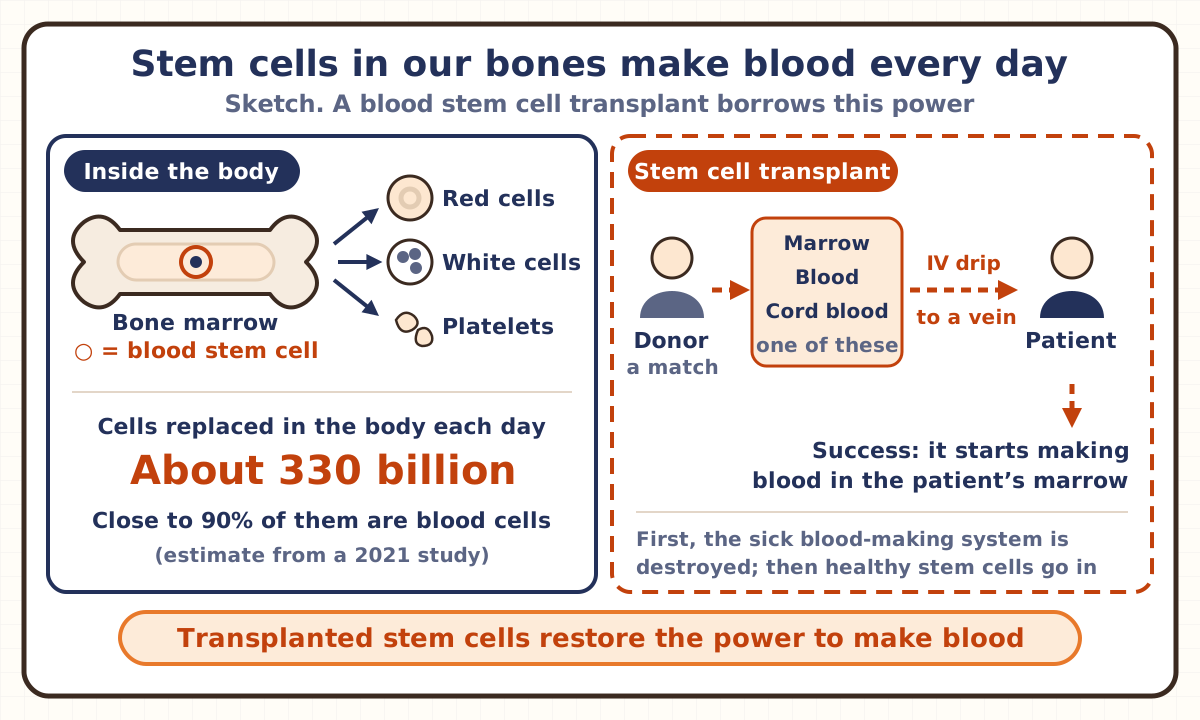
The human body is estimated to be made of about 30 trillion cells. Some of them work for a certain time, wear out and are replaced by new cells. A 2021 study estimated that about 330 billion cells are replaced in the whole body each day. That is about 3.8 million cells a second, or about 1% of the body’s cells every day.
By number, the most are blood cells, close to 90% of all the cells replaced. By weight, blood cells and the cells on the inner surface of the gut make up almost all of it. The cells on the inner surface of the gut are estimated to be replaced in about 3.5 days on average in people.
The body can keep making so many cells every day because stem cells keep one of themselves each time they divide. Blood cells are made from blood-forming stem cells in the bone marrow inside our bones. The cells on the inner surface of the gut are made from gut stem cells (in mice, these are known to sit near the bottom of small pits in the gut wall). Stem cells also replace skin and hair cells.
How does the range of cells differ by type?
The fertilized egg has the widest range. The fertilized egg and the cells from its first few divisions can make every kind of cell in the body, plus parts outside the body that support growth, such as the placenta and umbilical cord. This property is called totipotency.
Next come ES cells (embryonic stem cells) and iPS cells (induced pluripotent stem cells). ES cells are made from the clump of cells inside an embryo at a slightly developed stage. iPS cells are made by remaking body cells, such as skin or blood cells. Both can become any kind of body cell (pluripotency) and can multiply almost without limit in a dish, but they are said to usually be unable to make the placenta and similar parts.
Tissue stem cells (also called adult stem cells) are found in the adult body too. They live in many organs and tissues, such as the blood, gut and skin, and make some or all of the kinds of cells in their own tissue. But they cannot become every kind of cell in the body. Blood-forming stem cells, for example, can make all kinds of blood cells, such as red blood cells, white blood cells and platelets, but not liver, lung or brain cells. And stem cells in other tissues do not make blood cells.
So even among cells all called “stem cells,” the range of cells they can become varies widely. iPS cells are body cells with set jobs that people have returned to a state in which they can become many kinds of cells; the iPS cell page explains how they are made.
How do stem cells keep themselves when they divide?
When a stem cell divides, it makes two cells. If one stays a stem cell and the other goes on to become a cell with a set job, new cells can be made while the number of stem cells stays the same. This kind of division, in which the two cells take different paths (asymmetric division), has long been seen as typical of stem cells, because it lets them keep themselves while making cells with jobs.
But stem cells do not always divide this way. Many stem cells also divide so that the two cells take the same path (symmetric division). In particular, when the number of stem cells has to go up, such as while the body is growing or after an injury, both cells become stem cells. Switching between the two depending on the situation is thought to be important for the adult body’s ability to repair damage.
A cell with a set job usually does not take its final form straight from a stem cell. The cells that come from a stem cell gradually become cells with clearer and clearer jobs. This is called differentiation.
How far are they used in treatment?
The most widely used treatment is the blood stem cell transplant. For diseases in which the body can no longer make normal blood, such as leukemia, healthy blood-forming stem cells are transplanted to restore the ability to make blood. Besides the bone marrow, the cells are also taken from the blood, or from cord blood (the blood left in the placenta and umbilical cord after a baby is born). E. Donnall Thomas of the United States, who developed bone marrow transplantation, received the Nobel Prize in 1990.
In a bone marrow transplant, marrow is taken from the pelvic bone of the donor (the person giving the cells) and given by IV drip into a vein, such as one in the patient’s arm. It is not put directly into a bone. If the transplanted blood-forming stem cells start making blood cells in the patient’s marrow, the transplant has worked. If the white-blood-cell types do not match, severe rejection occurs, in which the body does not accept the transplanted cells, so a donor with a matching type is sought. Even between siblings, the chance of a match is 1 in 4.
According to the international society of stem cell researchers, the stem cell treatments proven safe and effective and widely used are limited to blood stem cell transplants and grafts for some bone, skin and corneal (eye) injuries and diseases. Other uses still need to be proven in clinical trials, studies that test in people whether a treatment works and is safe. Where treatments transplanting cells made from iPS cells stand today is covered on the iPS cell page.
What should I watch out for in ads for “stem cell treatments”?
Some clinics sell treatments that claim stem cells can cure many unrelated diseases, without their effect having been proven. The international society of stem cell researchers urges people to watch out for points like these.
First, tissue stem cells mainly make the cells of their own tissue, so one kind of cell is unlikely to treat many unrelated diseases. Second, even cells taken from your own body are not automatically safe: while they are taken out and put back, they may be contaminated with viruses or bacteria, for example. Third, an experimental treatment you pay for is not a clinical trial (a proper clinical trial does not make participants pay for the treatment).
A U.S. government agency has received reports of people who used unapproved products such as stem cells and went blind or got infections. In Japan, too, two deaths have been reported in treatments for chronic pain that used stem cells taken from the patients’ own fat and processed: in each case, the patient suddenly became ill while the cells were being given, and died. Because the cause was unknown in both cases, the government used the law in August 2025 and March 2026 to order those treatments, and similar ones, suspended.
In Japan, the law requires a medical institution to have its plan reviewed by a committee and submitted to the government before giving such treatments. But submitting a plan is a step required to give a treatment, and the two deaths above also happened in treatments given under such plans. The government advises people to read the explanation documents carefully, get a full explanation from the doctor, and decide only after they understand and agree.
Check yourself
Q1In the human body, many cells are replaced every day. According to a 2021 study’s estimate, which cells are replaced in the greatest numbers each day?
Answer and explanation
Answer: C Cells flowing in the blood
About 330 billion cells are estimated to be replaced in the whole body each day, and close to 90% of them are blood cells made from blood-forming stem cells in the bone marrow. The cells on the inner surface of the gut are replaced quickly too, in about 3.5 days on average in people, and by weight, blood cells and gut cells make up almost all of the turnover. Skin cells are also replaced by stem cells, but by number, blood cells are the most.
More on this → Key points: Why does the body need stem cells?
Q2A bone marrow transplant is used to treat diseases such as leukemia. How is the marrow taken from the pelvic bone of a donor (the person giving the cells) put into the patient’s body?
Answer and explanation
Answer: B Into a vein in the arm, by IV drip
The marrow is given by IV drip into a vein, such as one in the patient’s arm. Even though it is called a “bone marrow” transplant, it is not put directly into a bone. If the transplanted blood-forming stem cells start making blood cells in the patient’s marrow, the transplant has worked.
More on this → Key points: How far are they used in treatment?
Q3An ad for a treatment claims, “This one kind of stem cell cures many unrelated diseases.” Why does the international society of stem cell researchers say this is unlikely?
Answer and explanation
Answer: B Tissue stem cells mainly make the cells of their own tissue
Tissue stem cells mainly make the cells of their own tissue. Blood-forming stem cells, for example, make blood cells but not liver or brain cells. That is why the international society writes that one kind of cell is unlikely to treat many unrelated diseases. In a bone marrow transplant, stem cells put into a vein, such as one in the arm, start making blood far away, in the marrow inside the bones. And because stem cells keep one of themselves each time they divide, they do not run out.
More on this → Key points: What should I watch out for in ads for “stem cell treatments”?
Related terms
- iPS cell
- Embryonic stem cell (ES cell)
- Human embryo model
- Pluripotency
- Hematopoietic stem cell transplantation
- Bone marrow transplant
- Cell differentiation
- Regenerative medicine
- Clinical trial
Sources and how we checked
- International Society for Stem Cell Research (ISSCR), About Stem Cells, “Types of Stem Cells” (stem cells defined by two properties, self-renewal and developing into more specialized cells; pluripotent stem cells [ES and iPS cells] and tissue-specific (adult) stem cells; tissue stem cells make the cells of their own organ or tissue; blood-forming stem cells make red and white blood cells and platelets but cannot generate liver, lung or brain cells, and stem cells in other tissues do not make blood cells; stem cells replace cells in skin, hair, blood and the gut lining; blood-forming stem cells in bone marrow; read November 18, 2026)
- International Society for Stem Cell Research (ISSCR), About Stem Cells, “Stem Cell Glossary” (totipotent [can make all cells of the body plus supporting cells such as the placenta and umbilical cord], pluripotent stem cells [can become any cell in the body; ES and iPS cells], multipotent stem cells [blood stem cells make blood cells but not liver or brain cells], tissue-specific stem cells [found in adult organs and tissues, replenish that tissue; also called adult or somatic stem cells], ES cells made from the inner cell mass of the blastocyst, and the meanings of self-renewal and differentiation; read November 18, 2026)
- U.S. National Institutes of Health (NIH), Stem Cell Information, “Glossary” (archived copy from January 2009; totipotent cells can also make extraembryonic tissues such as the placenta, pluripotent cells can make all cell types of the body but not extraembryonic tissues such as the placenta, adult (somatic) stem cells make the cells of their own tissue, hematopoietic stem cells give rise to all red and white blood cells and platelets, and stem cells can divide for indefinite periods in culture; read in the University of North Texas web archive on November 18, 2026)
- RIKEN and Osaka Medical College, press release on recreating the differentiation of the blastocyst (in Japanese; August 9, 2019; totipotency as the ability to make both the body and placental tissues outside the body, found in mammals only in very limited cells such as the fertilized egg and early blastomeres, and pluripotent stem cells that usually cannot become extraembryonic tissues; read November 18, 2026)
- Morrison and Kimble, “Asymmetric and symmetric stem-cell divisions in development and cancer” (University of Michigan and others; Nature 441, pp. 1068–1074, 2006; abstract [the widely made claim that asymmetric division is a defining feature that lets stem cells self-renew and make differentiated cells at the same time, and that it is in fact not necessary for stem-cell identity; many stem cells dividing symmetrically when expanding in number during development or after injury, and flexible use of the two as a key to adult regenerative capacity]; read on Europe PMC on November 18, 2026)
- Sender and Milo, “The distribution of cellular turnover in the human body” (Weizmann Institute of Science; Nature Medicine 27(1), pp. 45–48, January 2021; abstract [about (0.33 ± 0.02) × 10^12 cells replaced per day in the whole body, close to 90% of them blood cells, and 80 ± 20 grams a day by mass, mostly blood cells and gut epithelial cells]; read on Europe PMC on November 18, 2026; the per-second number and the share of all body cells were calculated for this page)
- Sender, Fuchs and Milo, “Revised Estimates for the Number of Human and Bacteria Cells in the Body” (Weizmann Institute of Science and others; PLoS Biology 14, e1002533, 2016; abstract [a revised estimate of 3.0 × 10^13 human cells in a 70 kg reference man]; read on Europe PMC on November 18, 2026)
- Darwich et al., “Meta-analysis of the turnover of intestinal epithelia in preclinical animal species and humans” (University of Manchester; Drug Metabolism and Disposition 42(12), pp. 2016–2022, 2014; abstract [85 studies in six species pooled, with a weighted mean turnover of 3.48 ± 1.55 days for human gastrointestinal epithelia]; read on Europe PMC on November 18, 2026)
- Haegebarth and Clevers, “Wnt Signaling, Lgr5, and Stem Cells in the Intestine and Skin” (Hubrecht Institute, Utrecht; American Journal of Pathology 174(3), pp. 715–721, 2009; main text [the mouse small intestinal epithelium renewed every 5 days, stem cells near the bottom of the crypts, and Lgr5-positive cells there giving rise to all intestinal epithelial lineages]; full text on PMC [PMC2665733], read November 18, 2026)
- Ministry of Health, Labour and Welfare (MHLW), Japan, information on hematopoietic stem cell transplantation (in Japanese; transplanting healthy blood-forming stem cells to restore the ability to make blood in diseases such as leukemia, lymphoid cancers and aplastic anemia, and the three kinds: bone marrow, peripheral blood stem cell and cord blood transplants; read November 18, 2026)
- Kumamoto City, Japan, page asking people to register with the bone marrow bank (in Japanese; bone marrow contains the blood-forming stem cells that make white and red blood cells and platelets, marrow taken from the donor’s pelvis (ilium) and given by IV drip into a vein in the patient’s arm, success when the stem cells start making blood in the patient’s marrow, a 1 in 4 chance of an HLA match between siblings, and peripheral blood stem cells collected after a drug increases them; read November 18, 2026)
- Tochigi Prefecture, Japan, page on the bone marrow bank (in Japanese; bone marrow as a spongy tissue inside the bones containing the stem cells that make white and red blood cells and platelets, the patient’s blood-making system destroyed before normal stem cells are transplanted, and severe rejection when white-blood-cell types do not match; read November 18, 2026)
- Kanagawa Prefecture, Japan, page on hematopoietic stem cell transplantation (in Japanese; cord blood as the blood left in the placenta and umbilical cord after birth, whose blood-forming stem cells are transplanted, bone marrow and cord blood transplants for diseases such as leukemia and aplastic anemia, and the need for matching white-blood-cell types; read November 18, 2026)
- American Society of Hematology (ASH), “E. Donnall Thomas (1920-2012)” (the 1990 Nobel Prize for his development of bone marrow transplantation; read November 18, 2026)
- International Society for Stem Cell Research (ISSCR), About Stem Cells, “9 Things to Know About Stem Cell Treatments” (a guide for patients: very few stem cell treatments proven safe and effective, with blood-forming stem cell transplantation the best-defined and most extensively used, grafts for some bone, skin and corneal injuries and diseases also widely accepted, other uses still to be proven in clinical trials; each type of stem cell has its own role, so one cell type is unlikely to treat many unrelated diseases; your own cells are not automatically safe [contamination with viruses, bacteria or other pathogens, manipulation interfering with normal function, injection into places cells do not belong]; an experimental treatment for sale is not a clinical trial [ethics committee, registry listing, control group, cost not covered by the participant]; read November 18, 2026)
- U.S. Food and Drug Administration (FDA), “Important Patient and Consumer Information About Regenerative Medicine Therapies” (posted June 3, 2021, content current as of April 8, 2024; unapproved products including stem cells marketed by clinics for many conditions, reports of blindness, tumor formation, infections and more, and advice to check whether a product is approved or part of a clinical trial; read November 18, 2026)
- Ministry of Health, Labour and Welfare (MHLW), Japan, press release on an emergency order under the Act on the Safety of Regenerative Medicine (in Japanese; August 29, 2025; a patient died after suddenly deteriorating during a chronic-pain treatment using mesenchymal stem cells from the patient’s own fat, given under a regenerative medicine provision plan, and because the cause was unclear, that treatment and similar ones were ordered suspended on that date; the date of the death is not given; read November 18, 2026)
- Ministry of Health, Labour and Welfare (MHLW), Japan, press release on an emergency order under the Act on the Safety of Regenerative Medicine (in Japanese; March 13, 2026; a patient died after suddenly deteriorating during a chronic-pain treatment using mesenchymal stem cells from the patient’s own fat, given under a regenerative medicine provision plan, and because the cause was unclear, the treatment and the making of the cells were ordered suspended on that date; the date of the death is not given; read November 18, 2026)
- Ministry of Health, Labour and Welfare (MHLW), Japan, pages on regenerative and cell medicine and on certified committees for regenerative medicine (in Japanese; procedures required before providing regenerative medicine, the legal duty to submit a provision plan to the Minister, and committees reviewing plans against set standards; read November 18, 2026)
- Ministry of Health, Labour and Welfare (MHLW), Japan, e-Regenerative Medicine, list of submitted plans for regenerative medicine treatments (in Japanese; a list of medical institutions that submitted plans to the government, with the advice to read the consent documents carefully, get a full explanation from the doctor, and decide only after understanding and agreeing; read November 18, 2026)
AI wrote this page from the sources above, and a different AI checked it against the text of those sources (November 18, 2026). A person with a master’s degree in science and a Japanese high-school science teaching license also read and checked it before publishing. Numbers are as of that date. If anything was hard to follow, you spot a mistake, or there’s a term you’d like explained, please write to [email protected].
Everyday science terms
- Dark oxygen
- Epigenetic clock
- Glymphatic system
- Human embryo model
- iPS cell
- Manganese nodule
- Moore’s law
- You are hereStem cell