 Naru News日本語
What is a parameter in AI?
Also called: Model parameter

In one minute
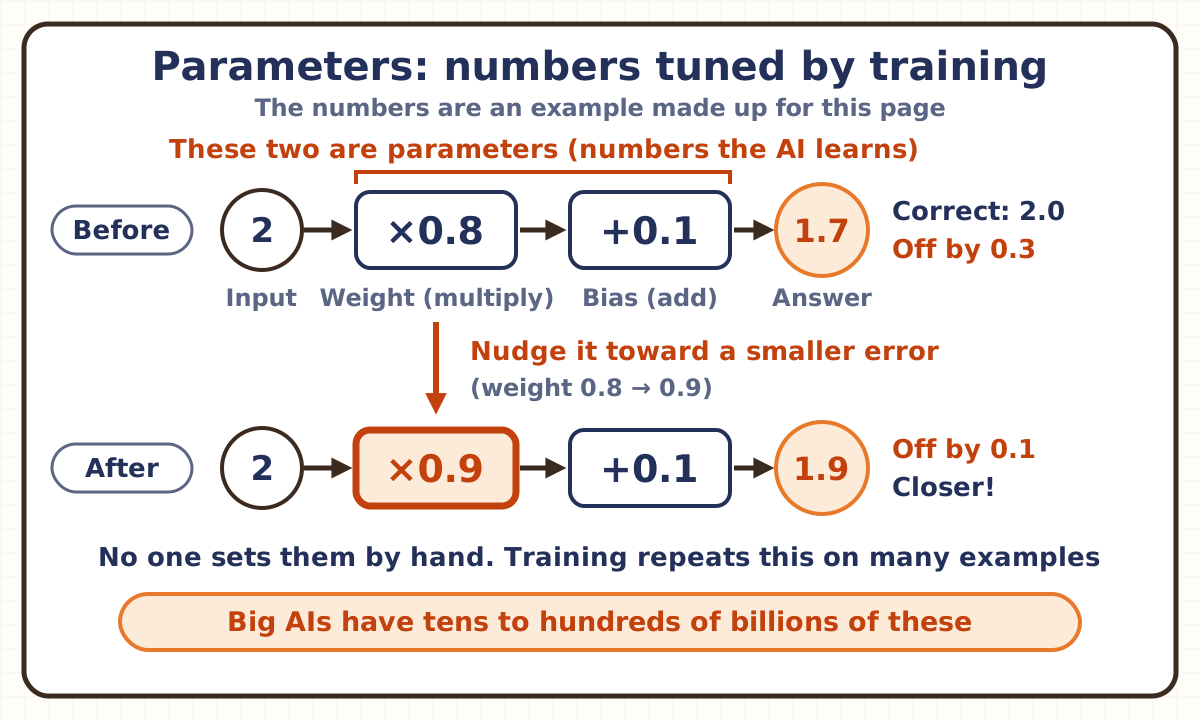
A parameter is one of the numbers an AI (a neural network) uses in its calculations. People don’t set them by hand; they are adjusted little by little during training.
They are mainly “weights,” which multiply the numbers coming in, and “biases,” which are added on. “70 billion parameters” means there are 70 billion of these numbers, so the count shows how big an AI is. GPT-3, from 2020, had 175 billion.
More parameters tend to let an AI take in more. But the count alone doesn’t decide how smart it is: how much data it learns from and how it is trained matter a lot too. And the more parameters, the more memory it needs to run.
A common mix-up
“The more parameters an AI has, the smarter it always is.”
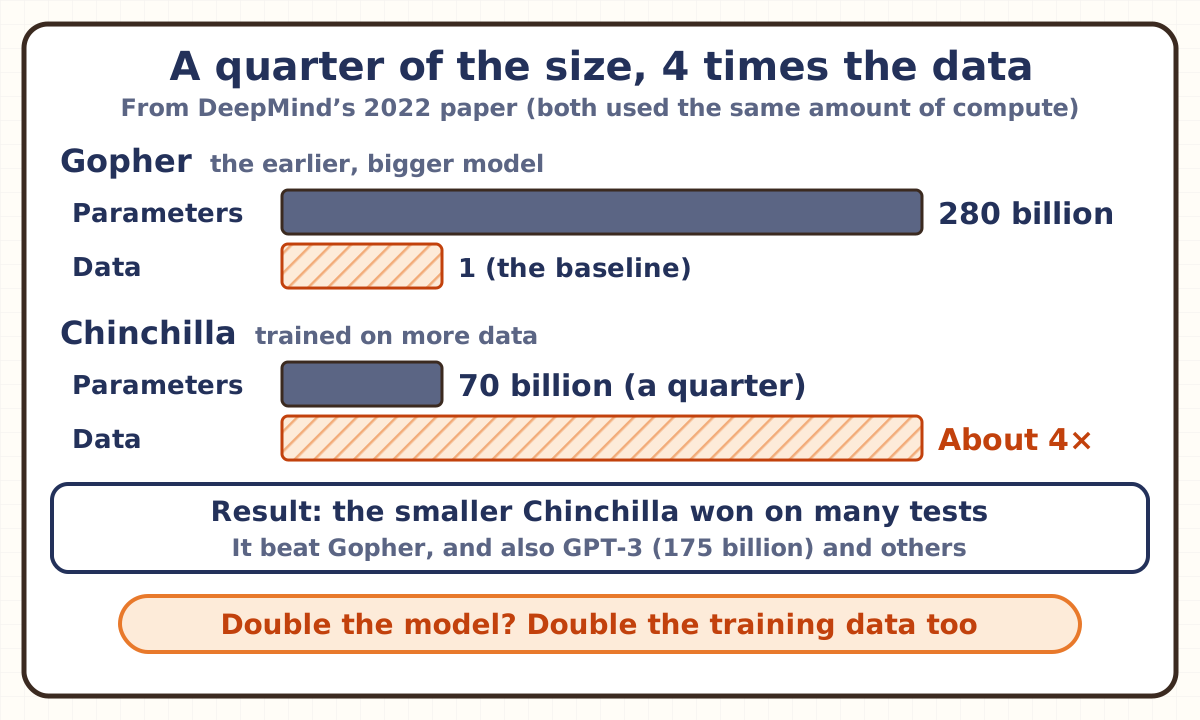
Half right. A 2020 study (Kaplan et al.) showed that the error a language AI makes when predicting the next word shrinks smoothly and predictably as you increase the number of parameters, the amount of training data and the compute used for training. But not “always.” In 2022, DeepMind reported that Chinchilla, with a quarter of the parameters (70 billion) but about 4 times the training data, beat the 280-billion-parameter Gopher on many tests. In a study the same year (Ouyang et al.), people preferred the answers of a 1.3-billion-parameter model, finished with examples written by people and people’s rankings of answers, over those of the 175-billion-parameter GPT-3. The count is an important guide, but the amount of data and the way a model is trained also make a big difference.
Explained in pictures
Think of it like this
A mixing desk with tens of billions of knobs
A parameter is like one knob on a huge sound mixing desk. Just as the positions of the knobs change the sound that comes out, the values of the parameters change the answers an AI gives. “70 billion parameters” means a desk with 70 billion knobs.
Training is like comparing the sound with a model recording and turning every knob a tiny bit toward it, again and again. The rules for turning them, such as how far to turn each time (the learning rate), are set by people in advance. Those are the hyperparameters.
But the comparison has limits. On a real mixing desk, a person turns the knobs, and each knob is labeled with its job, such as “bass.” An AI’s parameters are turned automatically by the training calculation, and none of them carries a label; many numbers work together in each calculation.
Key points
What are weights and biases?
Parameters are the “weights and biases” a model learns during training. A weight is a number the incoming number is multiplied by, and a bias is a number added to it. For example, if the input is 2, the weight 0.8 and the bias 0.1, the result is 2 × 0.8 + 0.1 = 1.7.
In the equation of a straight line, y = ax + b, a plays the part of the weight and b the bias (a bias is where the line crosses the vertical axis, the y-intercept). In a neural network, each line connecting nodes (artificial neurons) has one weight, and each node has one bias. In a small example (3 inputs, 4 nodes in a hidden layer and 1 output), there are 16 weights and 5 biases, 21 parameters in all (more on the “Neural network” page).
“Weights” is also used as a name for all the parameters together. For example, the documentation for Transformers (Hugging Face), a tool for running AI models, notes that it uses “weights” to mean all of a model’s tables and rows of numbers. (The “weight” in “open-weight” is this word.)
How are parameters decided?
By training. Training is the process of determining the ideal parameters (weights and biases) that make up a model. People don’t think them up and write them in one by one.
A common method is “gradient descent.” The AI gives an answer, the gap from the correct answer (the loss) is measured, and the weights and biases are adjusted a little in the direction that shrinks the gap. Repeating this many times brings them closer to the combination with the smallest gap. Which numbers to change, in which direction and by how much, is worked out backward from the answer side (backpropagation; more on the “Neural network” page).
For a large language model (LLM), the model is made to predict how text continues, and it is adjusted so that the correct next word becomes more likely (see the “Large language model” page). Just talking with a trained AI usually doesn’t change its parameters. In the tests in the 2020 GPT-3 paper, too, the parameters were not updated; the task and examples were only shown as text.
What does “70 billion parameters” tell you?
The number of parameters: how many numbers inside the AI were set by training. “Billion” is shortened to B, so 70B means 70 billion and 175B means 175 billion. Meta’s Llama 2 (2023) came in sizes from 7 billion (7B) to 70 billion (70B), with the size in the name, as in “Llama 2 70B.”
The more numbers, the more an AI can take in. A model’s capacity, the complexity of the problems it can learn, typically increases with the number of parameters. A neural network’s capacity to absorb information is limited by its number of parameters.
Some models, though, don’t reveal the count. In the GPT-4 Technical Report (2023), OpenAI says that, given the competitive landscape and the safety implications, it gives no further details about the architecture, including model size.
Are AIs with more parameters smarter?
There is a clear trend that bigger does better. A 2020 study (Kaplan et al.) writes that the error (loss) a language AI makes when predicting the next word shrinks smoothly, following a set pattern (a power law), as the number of parameters, the amount of training data and the training compute grow. Some of these trends held over a range of more than ten million times. It also says that, for the same count, the shape, such as the number of layers or their width, matters little within a wide range.
But the answer to what to grow, and by how much, later changed. The 2020 study said the most compute-efficient way was to train very large models on a relatively modest amount of data. In 2022, DeepMind researchers (Hoffmann et al.) looked again by training more than 400 models, from 70 million to over 16 billion parameters, and concluded that parameters and training data should grow in equal proportion: if you double the model, you should double the data too. Many large models of the time, they said, were trained on too little data.
To test this, they built Chinchilla. With the same compute as Gopher (280 billion parameters), DeepMind’s earlier model, they cut the parameters to a quarter, 70 billion, and used about 4 times the data. Chinchilla then beat Gopher, GPT-3 (175 billion), Megatron-Turing NLG (530 billion) and others on many tests. On a test called MMLU, its average accuracy of 67.5% was the best at the time. Being smaller, it also needs less compute when it is used.
How a model is trained matters too. In a 2022 study (Ouyang et al.), people preferred the answers of the 1.3-billion-parameter InstructGPT, finished using examples written by people and people’s rankings of answers, over those of the 175-billion-parameter GPT-3. The paper notes this was “despite having 100x fewer parameters.”
How do parameters differ from hyperparameters?
Parameters are numbers the model works out during training. Hyperparameters are settings that decide how the training goes, chosen beforehand by people (or by a tool that searches for settings).
Examples of hyperparameters are the learning rate (how strongly the weights and biases are changed each time), the batch size (how many examples are used before each update) and the number of epochs (how many times training goes through all the examples). If the learning rate is too low, training takes too long. If it is too high, the model bounces back and forth around the point with the smallest error and has trouble settling down.
Hyperparameters are not numbers inside the model, so they are not counted in “70 billion parameters.” In programming, the values passed to a function are also called “parameters,” but those are different from the AI parameters on this page.
What’s hard about having many parameters?
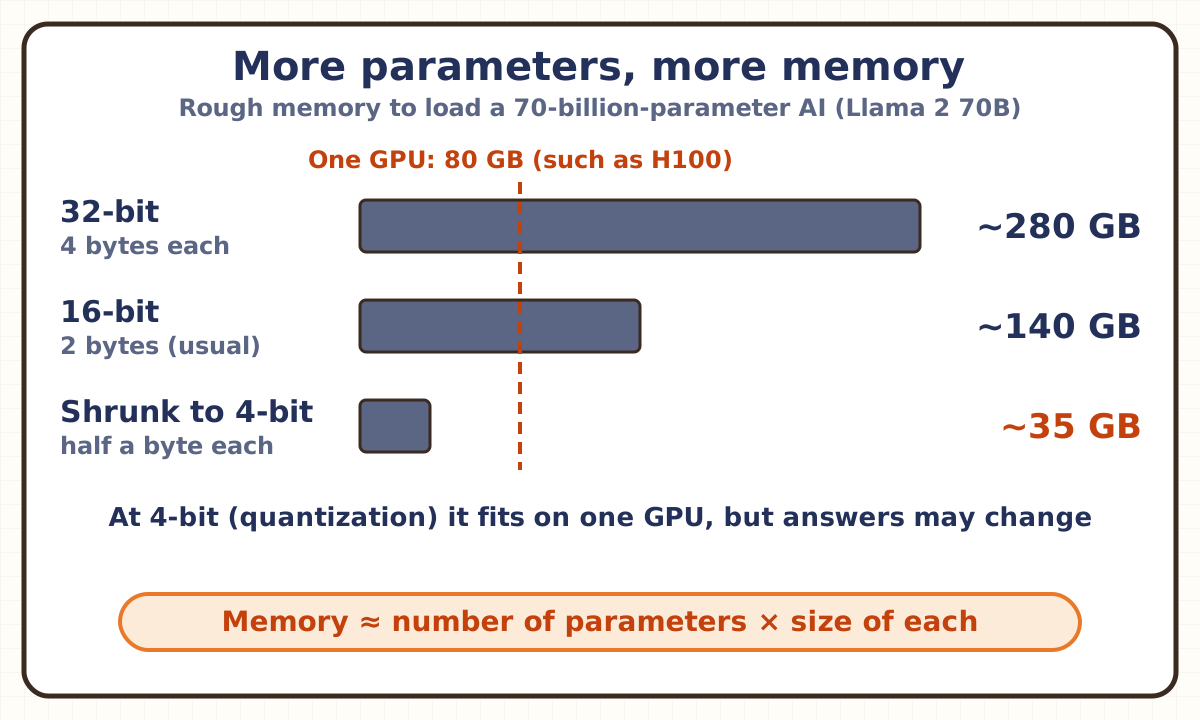
To run a model, all of its numbers must be kept in memory (the workspace used for calculating). Each parameter is usually stored as a 32-bit (4-byte) or 16-bit (2-byte) decimal number. When the documentation for Transformers (Hugging Face), a tool for running AI models, was written, nearly all models were trained in a 16-bit format. At 16 bits, the rule of thumb is “number of parameters in billions × 2” GB, so Llama 2 70B needs 70 × 2 = 140 GB.
When the documentation was written, the largest GPUs for computing (A100 and H100) had 80 GB of memory, so many big models didn’t fit on one. That is why “quantization,” storing the numbers in a smaller form, is used. Weights have been found to work at 8 or 4 bits without a big drop in performance, and in the documentation’s example, a model with more than 15 billion parameters that needs about 31 GB at 16 bits ran in about 9.5 GB at 4 bits. But it also says that 4 bits can often lead to different results.
For a mixture of experts (MoE) AI, there are two ways to count. In Mixtral 8x7B, each word piece (token) has access to 47 billion parameters but uses only 13 billion of them. The calculation needs only the 13 billion, but all 47 billion must be kept in memory, since any expert might be called (more on the “Mixture of experts” page).
What is an “open-weight” model?
It is an AI model whose trained parameters (weights) are released so that people can download them and run the model on their own computers. Such models also let users use a model without sharing their data with third parties.
For example, OpenAI released gpt-oss (August 2025) as “open-weight” models, writing in the model card that it would release the model weights, code for running them, tool environments and tokenizers (tools that split text into tokens) under a license called Apache 2.0. Meta’s Llama 2 is also a model with released weights.
Releasing the weights doesn’t necessarily mean releasing the training data. The data used for training is not among the things gpt-oss says it releases. A July 2024 report by the US Commerce Department’s National Telecommunications and Information Administration (NTIA) puts models that give no access to the weights, source code or training data in a separate group, “limited access” models.
Check yourself
Q1How are the parameters inside an AI (its weights and biases) usually decided?
Answer and explanation
Answer: B Training adjusts them bit by bit
In training, the gap between the AI’s answer and the correct answer is measured, and the weights and biases are nudged a little in the direction that shrinks it, over and over on many examples (gradient descent). People don’t write them in one by one. Just talking with a trained AI usually doesn’t change its parameters.
Q2Chinchilla (70 billion parameters), built by DeepMind in 2022, beat the 280-billion-parameter Gopher on many tests, though both were trained with the same amount of compute. What did Chinchilla do differently?
Answer and explanation
Answer: C It used about 4 times more data
Chinchilla had a quarter of Gopher’s parameters but learned from about 4 times more data. The researchers concluded that parameters and training data should grow in equal proportion, and that many large models of the time had too little data. The number of parameters alone doesn’t decide how smart a model is.
More on this → Key points: Are AIs with more parameters smarter?
Q3In AI training, the “learning rate” (a hyperparameter people set in advance) decides how strongly the parameters are changed each time. What tends to happen if it is set too high?
Answer and explanation
Answer: A It has trouble settling at the smallest error
If the learning rate is too high, each change is too big, so the model bounces back and forth around the point with the smallest error and has trouble settling down. Taking too long is what happens when it is too low. The learning rate is a setting people choose; it doesn’t change the number of parameters.
More on this → Key points: How do parameters differ from hyperparameters?
Related terms
- Neural network
- Large language model
- Machine learning
- Deep learning
- Mixture of experts
- Transformer
- Token
- Hyperparameter
Sources and how we checked
- Google, "Machine Learning Glossary" (entries for parameter, weight, bias, training, gradient descent, learning rate, hyperparameter and model capacity; read November 8, 2026)
- Google Machine Learning Crash Course, "Linear regression: Hyperparameters" (read November 8, 2026)
- Google Machine Learning Crash Course, "Neural networks: Nodes and hidden layers" (read November 8, 2026)
- Kaplan et al., "Scaling Laws for Neural Language Models" (arXiv, January 2020; read November 8, 2026)
- Hoffmann et al., "Training Compute-Optimal Large Language Models" (DeepMind, arXiv, March 2022; read November 8, 2026)
- DeepMind, "An empirical analysis of compute-optimal large language model training" (April 12, 2022; read November 8, 2026)
- Ouyang et al., "Training language models to follow instructions with human feedback" (arXiv, March 2022; read November 8, 2026)
- Brown et al., "Language Models are Few-Shot Learners" (the GPT-3 paper, arXiv, May 2020; read November 8, 2026)
- Touvron et al., "Llama 2: Open Foundation and Fine-Tuned Chat Models" (arXiv, July 2023; read November 8, 2026)
- Shazeer et al., "Outrageously Large Neural Networks: The Sparsely-Gated Mixture-of-Experts Layer" (arXiv, January 2017; read November 8, 2026)
- OpenAI, "GPT-4 Technical Report" (arXiv, March 2023; section 2, "Scope and Limitations of this Technical Report"; read November 8, 2026)
- Hugging Face, "Optimizing LLMs for Speed and Memory" (Transformers documentation, section 1, "Lower Precision"; read November 8, 2026)
- Jiang et al., "Mixtral of Experts" (Mistral AI, arXiv, January 2024; read November 8, 2026)
- OpenAI, "gpt-oss-120b & gpt-oss-20b Model Card" (arXiv, August 2025; read November 8, 2026)
- US National Telecommunications and Information Administration (NTIA), "Dual-Use Foundation Models with Widely Available Model Weights Report" (July 30, 2024; read November 8, 2026)
AI wrote this page from the sources above, and a different AI checked it against the text of those sources (November 8, 2026). A person with a master’s degree in science and a Japanese high-school science teaching license also read and checked it before publishing. Numbers are as of that date. If anything was hard to follow, you spot a mistake, or there’s a term you’d like explained, please write to [email protected].
AI terms
- AI agent
- Artificial general intelligence (AGI)
- Artificial intelligence (AI)
- Context window
- Deep learning
- Fine-tuning
- Generative AI
- Hallucination
- Hyperparameter
- Intelligence explosion
- Large language model (LLM)
- Machine learning
- Mixture of experts (MoE)
- Neural network
- You are hereParameter
- Prompt
- Prompt injection
- Reasoning model
- Recursive self-improvement (RSI)
- Reinforcement learning (RL)
- Retrieval-augmented generation (RAG)
- Superintelligence (ASI)
- Technological singularity
- Token
- Transformer