 Naru News日本語
What is generative AI?
Also called: GenAI

In one minute
Generative AI is AI that uses what it learned from huge amounts of data to create new content, such as text, pictures, sound, video and computer code.
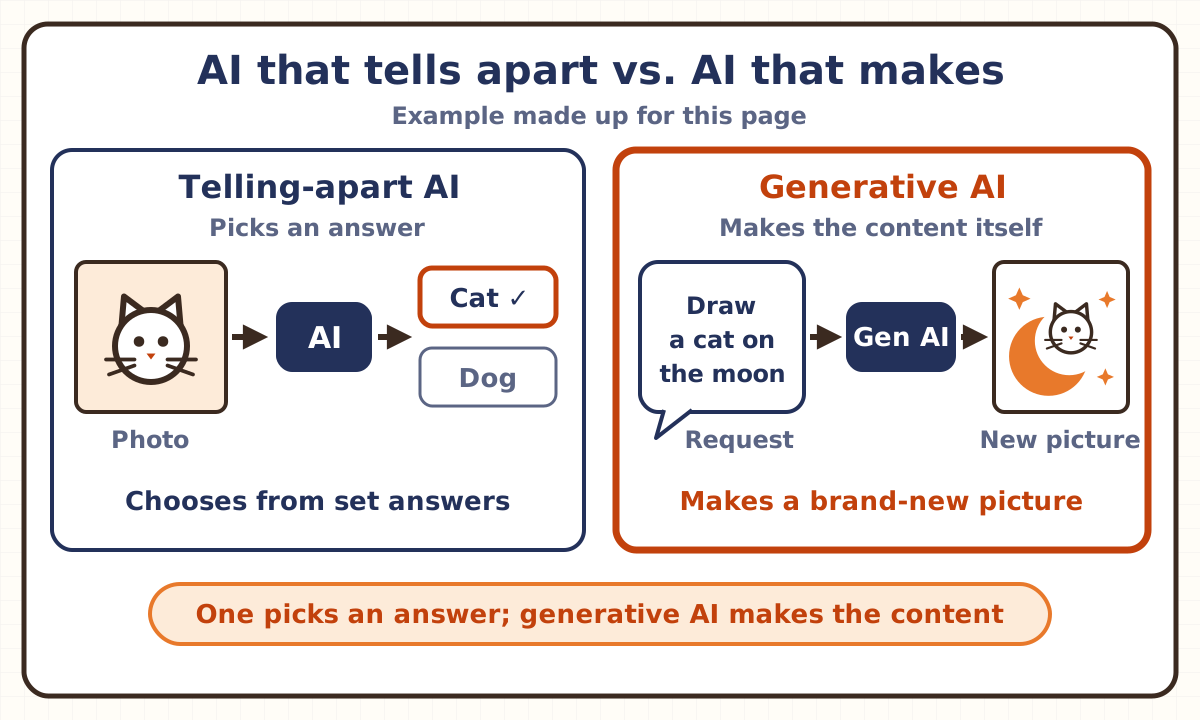
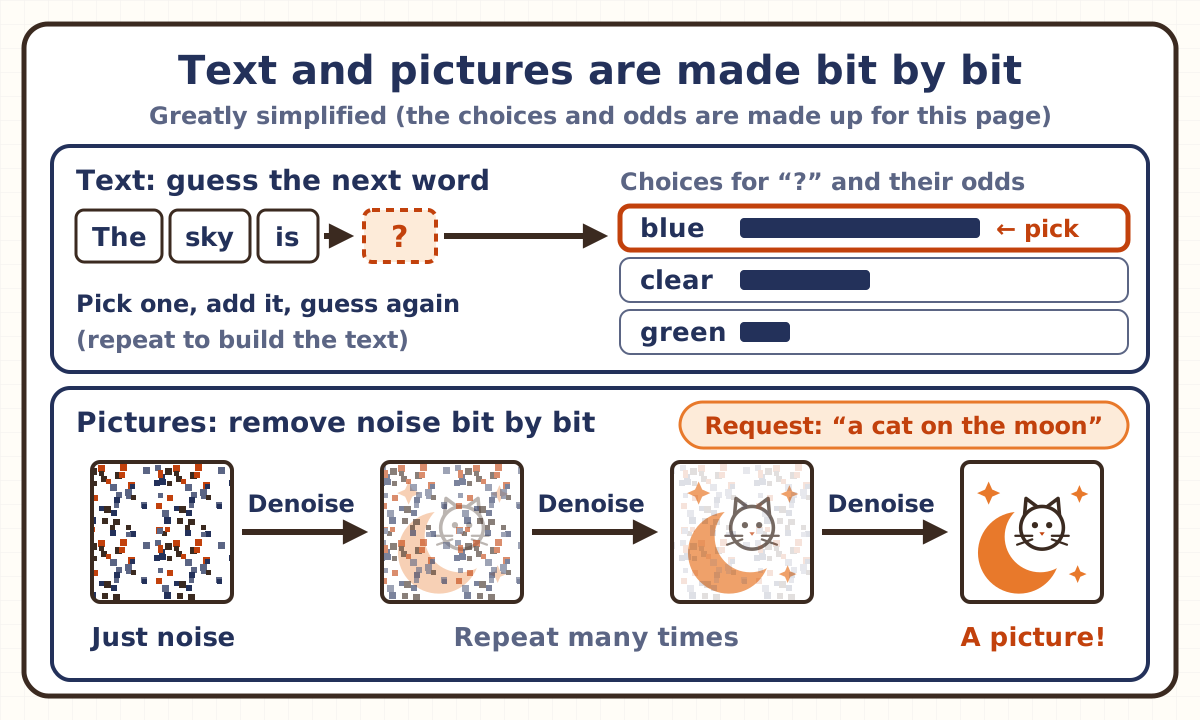
Its job is different from that of a “telling-apart” AI, which might say whether a photo shows a dog or a cat. Instead of picking from set answers, generative AI makes text or pictures that did not exist before. Chatbots such as ChatGPT write by predicting the next small piece of text (a token) and adding it on, again and again, while most picture-making AIs start from random speckles (noise) and remove the noise bit by bit until a picture appears.
When ChatGPT came out in November 2022, anyone could use it just by asking in plain words, and generative AI spread fast. It is handy, but you need to watch out for convincing mistakes (hallucinations), copyright problems and realistic fakes (deepfakes).
A common mix-up
“Generative AI just cuts and pastes text and pictures from the internet.”
Half right. Generative AI learns from text written and pictures made by people, collected from the internet and elsewhere. And it sometimes puts out things it learned almost unchanged: in a 2023 study, researchers had the picture-making AI Stable Diffusion make 175 million images and found more than 100 near-copies of pictures it had been trained on. Most were pictures that appeared again and again in the training data. But the way it normally works is not cutting and pasting. While learning, generative AI slowly adjusts the many numbers it calculates with (its parameters) to capture the features of the data, such as how words tend to follow one another or how shapes and colors are arranged. When making something, it uses calculations with those numbers to predict the next word or remove noise, producing new content that resembles what it learned.
Explained in pictures
Think of it like this
A master imitator who practiced on countless pictures
Generative AI is like a “master imitator” who has read an enormous amount of writing and looked at an enormous number of pictures for practice. Asked to “draw a cat on the moon,” the imitator uses the “cat-ness” and “moon-ness” picked up from many cat and moon pictures to draw a new one. It is not copying one picture it saw before.
A telling-apart AI is like someone who practiced the same way but only answers questions such as “Is this picture a cat or a dog?” and never draws.
But the comparison has limits. A human imitator can notice, “This looks just like that famous painting,” but generative AI sometimes puts out a picture it saw many times almost unchanged. And because AI is not checking facts as it writes, it can also write convincing mistakes.
Key points
How do official bodies define it?
Japan’s AI Guidelines for Business, from the Ministry of Internal Affairs and Communications and the Ministry of Economy, Trade and Industry (version 1.2, March 2026), define generative AI as a general term for AI based on AI models that can generate text, images, programs and so on. Japan’s White Paper on Information and Communications (2024 edition) likewise describes it as a general term for AI technology that can generate text, images, sound and more on its own. Both call it a “general term”: not the name of one mechanism, but a word that groups together AI that can create new content.
The glossary of the US National Institute of Standards and Technology (NIST) defines it as “the class of AI models that emulate the structure and characteristics of input data in order to generate derived synthetic content,” which can include images, videos, audio and text. Generative models produce outputs that approximate the statistical distribution of their training data (what kinds of things appear, and how often).
From the 2000s, systems that make predictions, suggestions or decisions in one specific area, such as recognizing images, translating or recognizing speech, came to be called AI, and now generative AI, which goes beyond that to create images and text, is spreading.
How is it different from AI that tells things apart?
Machine learning models are sometimes explained as two kinds: discriminative models, which tell things apart, and generative models, which make things. For example, a discriminative model can tell a dog from a cat, while a generative model can create new photos of animals that look like real animals.
A discriminative model tries to draw boundaries in the data, such as “dogs on this side,” while a generative model tries to model how the data is spread out as a whole. Modeling the whole is a harder task, because it has to capture much more.
In deep learning, the telling-apart kind succeeded first. When GANs were introduced in 2014, the most striking successes of deep learning had involved discriminative models, which map an input such as a photo to a class label.
How does it write text?
At the heart of chatbots like ChatGPT is a large language model (LLM). It has practiced guessing “the next word” on an enormous amount of text, and when it answers, it keeps predicting the next token (a small piece of text) and adding it on.
Text-making AI can answer questions, summarize, rephrase, translate and help with programming. And people can use generative AI just by giving instructions in everyday language, without special setup or skills.
But because it works by prediction, it can write sentences that sound right yet are false (hallucinations). This is a natural result of how generative models are designed: statistical prediction can produce accurate, consistent text, but it can also produce text that is wrong or contradicts itself. See the “Hallucination” page for more.
How does it make pictures?
Most of today’s picture-making AIs use “diffusion models.” A January 2023 paper by researchers at Google, DeepMind and elsewhere wrote that over the previous two years or so, diffusion models had largely replaced GANs and formed the basis of well-known image generators such as Stable Diffusion, DALL-E 2, Midjourney and Imagen.
The idea is simple. While learning, the model takes clean pictures, mixes in noise (random speckles) and practices removing it by guessing what noise was added. To make a picture, it starts from an “image” of pure noise and removes the noise. The trick is not to remove it all at once but a little at a time, over many steps.
AIs you can ask in words, such as “a photograph of a horse on the moon,” also take in the request turned into a list of numbers while removing noise, steering the picture toward it. The idea of diffusion models came from a 2015 paper inspired by physics (nonequilibrium statistical physics): slowly destroy the structure in data, then learn a process that restores it. A 2020 paper (DDPM) showed this method could make pictures about as good as a leading GAN (ProgressiveGAN).
When and how did it spread?
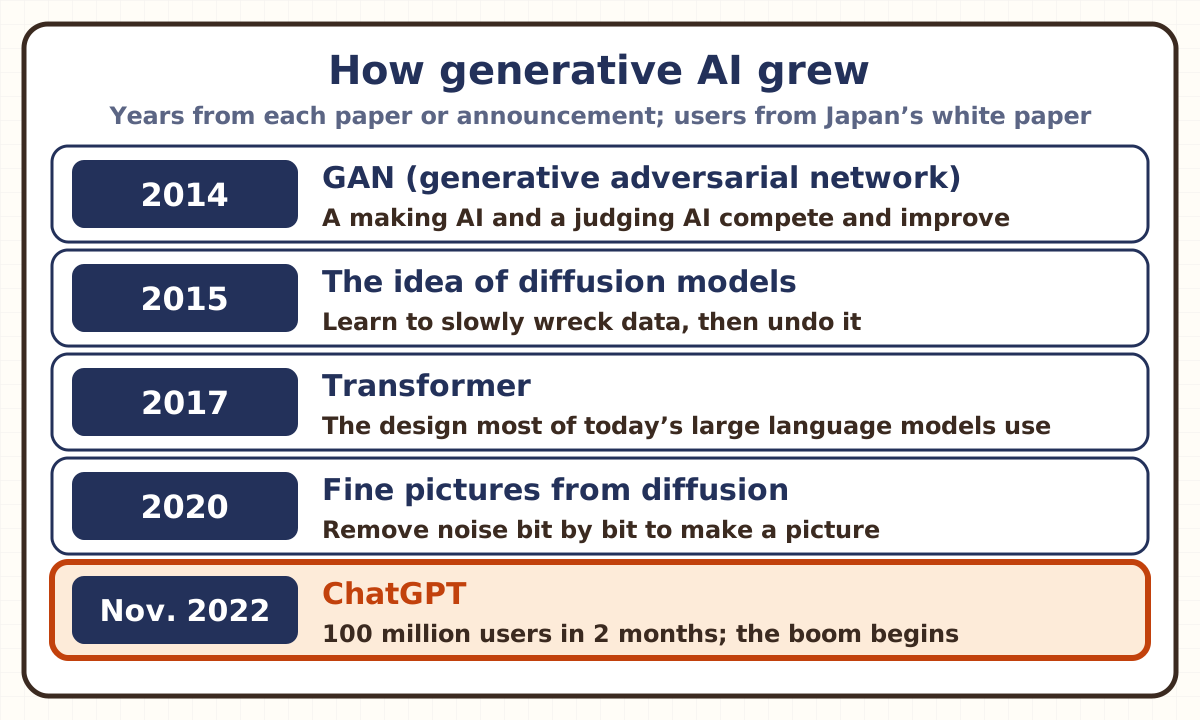
In June 2014, Ian Goodfellow and colleagues at the University of Montreal in Canada introduced GANs (generative adversarial networks). An AI that makes things resembling the data and an AI that judges whether something is real data or made up are trained together, competing. The paper compared the maker to “a team of counterfeiters, trying to produce fake currency and use it without detection,” and the judge to “the police, trying to detect the counterfeit currency.” Competing pushes both to improve until the fakes can’t be told from the real thing. A 2023 paper calls GANs the breakthrough that first made it possible to generate detailed images at scale.
In 2017, Google researchers introduced the design called the transformer, which most of today’s large language models use. The development and scaling up of deep learning and transformer models, which greatly improved accuracy in tasks such as language processing and image generation, is one reason behind the generative AI boom.
In November 2022, OpenAI released the chatbot ChatGPT. It reached 1 million users in five days and passed 100 million within two months of launch, which made generative AI the center of attention. Because generative AI has spread so fast since around 2022, some say we are now in a “fourth AI boom.”
What should you watch out for?
NIST’s July 2024 report sorts the risks that generative AI creates or makes worse into 12 kinds. Examples include confabulation (confidently stating false content, often called hallucination), leaks of personal information, amplified bias, problems with copyright and other intellectual property, and false information becoming easier to produce. Generative AI also lets anyone create information dressed up to look true, raising the risk that AI-made false or misleading information confuses society.
Realistic fakes are one of these risks. Today’s generative AI can make not only text-based disinformation but also highly realistic “deepfakes” (synthetic audio and video, and photorealistic images). One example was a fake image of an explosion at the Pentagon, the headquarters of the US Department of Defense, that went viral and briefly caused a drop in the stock market.
When you use it, don’t take answers at face value; check important points in the original sources. It also helps to have ways to avoid simply swallowing AI output and to put human judgment into its use. Note, too, that making things up is mainly a problem for text; for pictures, sound and video, freely creating things that aren’t real can be exactly what is wanted.
Does it ever put out what it learned unchanged?
Yes. A December 2020 paper (Carlini et al.) had the text-making AI GPT-2 generate text over and over and recovered hundreds of passages from its training data word for word. They included personal information that had been posted online, such as names, phone numbers and email addresses, as well as code. This worked even for passages that appeared in only one document in the training data. Larger models turned out to be more vulnerable.
It happens with pictures, too. A January 2023 paper (Carlini et al.) picked the 350,000 pictures repeated most often in Stable Diffusion’s training data and, using their captions as requests, had it make 500 images for each, 175 million in all. Among them were more than 100 near-copies of training images (109). Most were photos of people; others were products for sale, logos, posters and so on. The easiest to extract were pictures that appeared in the training data 100 times or more.
This kind of “memorization” of data can leak personal information, and if the training data included copyrighted material, outputs that reproduce it could infringe copyright.
How is copyright being handled?
In Japan, a subcommittee of the Council for Cultural Affairs under the Agency for Cultural Affairs put together its “General Understanding on AI and Copyright” in March 2024. It is not a binding rule like a law but its view, at that point, of how to read the current Copyright Act. Because different articles of the law come into play when an AI is built and trained and when it is used to make pictures and other things, it treats the two stages separately.
At the training stage, Article 30-4 of the Copyright Act means that using works not to enjoy them (by looking at or reading them) but for information analysis, such as training an AI, is in principle allowed without the copyright holder’s permission. But the article does not apply, for example, to additional training aimed at making the AI put out things that share the creative expression of the works it learned, or when the use would unreasonably harm the copyright holder’s interests.
At the making-and-using stage, the same tests apply as for ordinary copyright infringement. If a generated picture is similar to an existing work (similarity) and is based on it (reliance), posting it on social media or selling copies can be infringement (enjoying it privately on your own is a different case). The paper also takes the view that things an AI made when a person gave no or only simple instructions and pressed “generate” are not copyrighted works. When a person uses AI as a tool and makes creative contributions, the result can be recognized as a copyrighted work. In the US, too, how generative AI relates to copyright is still being debated in the courts and elsewhere.
Check yourself
Q1Most picture-making AIs use “diffusion models.” What kind of picture does a diffusion model start from when it makes a new one?
Answer and explanation
Answer: A A picture of pure, speckled noise
While learning, a diffusion model mixes noise (random speckles) into clean pictures and practices removing it. To make a picture, it starts from pure noise and removes the noise a little at a time over many steps until a picture appears. It is not layering learned pictures or tracing a person’s sketch.
Q2In a 2023 study, researchers had the picture-making AI Stable Diffusion make a huge number of images and found some that were near-copies of its training images. Which pictures were easiest to find?
Answer and explanation
Answer: C Ones that appeared often in its training data
The researchers had it make 175 million images and found more than 100 near-copies of training images. The easiest to find were pictures that appeared in the training data 100 times or more (the study deliberately searched among often-repeated pictures). Generative AI usually makes new things that resemble what it learned, but things it learned many times can come out almost unchanged.
More on this → Key points: Does it ever put out what it learned unchanged?
Q3Under the view put together by a council of Japan’s Agency for Cultural Affairs, what is the copyright status of a picture an AI made when a person gave almost no instructions and just pressed the “generate” button?
Answer and explanation
Answer: B It is nobody’s copyrighted work
A copyrighted work is a creative expression of a person’s thoughts or feelings. Things an AI made when a person gave no or only simple instructions and pressed a button are considered not to qualify. When a person uses AI as a tool and makes creative contributions, that person can be the author. The AI itself can never be the author.
Related terms
- Large language model
- Artificial intelligence (AI)
- Machine learning
- Deep learning
- Transformer
- Token
- Parameter
- Prompt
- Hallucination
- Diffusion model
- Deepfake
Sources and how we checked
- Ministry of Internal Affairs and Communications and Ministry of Economy, Trade and Industry (Japan), AI Guidelines for Business, version 1.2, main text (in Japanese; March 31, 2026; Part 1 definitions and Part 2 sections on false information and proper use; read November 8, 2026)
- Ministry of Internal Affairs and Communications (Japan), White Paper on Information and Communications 2024, Part I, Chapter 3, Section 1, “The history of AI and the impact of generative AI” (in Japanese; read November 8, 2026)
- Ministry of Internal Affairs and Communications (Japan), White Paper on Information and Communications 2023, “Trends in generative AI” (in Japanese; read November 8, 2026)
- NIST glossary, “generative artificial intelligence” (from NIST SP 800-218A; read November 8, 2026)
- NIST, “Artificial Intelligence Risk Management Framework: Generative Artificial Intelligence Profile” (NIST AI 600-1, July 2024; read November 8, 2026)
- Google for Developers, “Background: What is a Generative Model?” (Generative Adversarial Networks course; read November 8, 2026)
- Goodfellow et al., “Generative Adversarial Nets” (University of Montreal, arXiv, June 2014; read November 8, 2026)
- Sohl-Dickstein et al., “Deep Unsupervised Learning using Nonequilibrium Thermodynamics” (arXiv, March 2015; abstract; read November 8, 2026)
- Vaswani et al., “Attention Is All You Need” (Google Brain, Google Research and others, arXiv, June 2017; read November 8, 2026)
- Ho, Jain and Abbeel, “Denoising Diffusion Probabilistic Models” (arXiv, June 2020; abstract; read November 8, 2026)
- Carlini et al., “Extracting Training Data from Large Language Models” (arXiv, December 2020; abstract; read November 8, 2026)
- Carlini et al., “Extracting Training Data from Diffusion Models” (Google, DeepMind, ETH Zurich, Princeton and UC Berkeley, arXiv, January 2023; read November 8, 2026)
- Agency for Cultural Affairs (Japan), “AI and copyright” (page listing the General Understanding on AI and Copyright of March 15, 2024, and other materials; in Japanese; read November 8, 2026)
- Legal Subcommittee, Copyright Subdivision, Council for Cultural Affairs (Japan), “General Understanding on AI and Copyright” (in Japanese; March 15, 2024; Section 3 on the technical background of generative AI and others; read November 8, 2026)
- Legal Subcommittee, Copyright Subdivision, Council for Cultural Affairs (Japan), “General Understanding on AI and Copyright,” overview (Agency for Cultural Affairs, April 2024; in Japanese; read November 8, 2026)
AI wrote this page from the sources above, and a different AI checked it against the text of those sources (November 8, 2026). A person with a master’s degree in science and a Japanese high-school science teaching license also read and checked it before publishing. Numbers are as of that date. If anything was hard to follow, you spot a mistake, or there’s a term you’d like explained, please write to [email protected].
AI terms
- AI agent
- Artificial general intelligence (AGI)
- Artificial intelligence (AI)
- Context window
- Deep learning
- Fine-tuning
- You are hereGenerative AI
- Hallucination
- Hyperparameter
- Intelligence explosion
- Large language model (LLM)
- Machine learning
- Mixture of experts (MoE)
- Neural network
- Parameter
- Prompt
- Prompt injection
- Reasoning model
- Recursive self-improvement (RSI)
- Reinforcement learning (RL)
- Retrieval-augmented generation (RAG)
- Superintelligence (ASI)
- Technological singularity
- Token
- Transformer