 Naru News日本語
What is a diffusion model (how AI makes pictures)?
Also called: Diffusion probabilistic model

In one minute
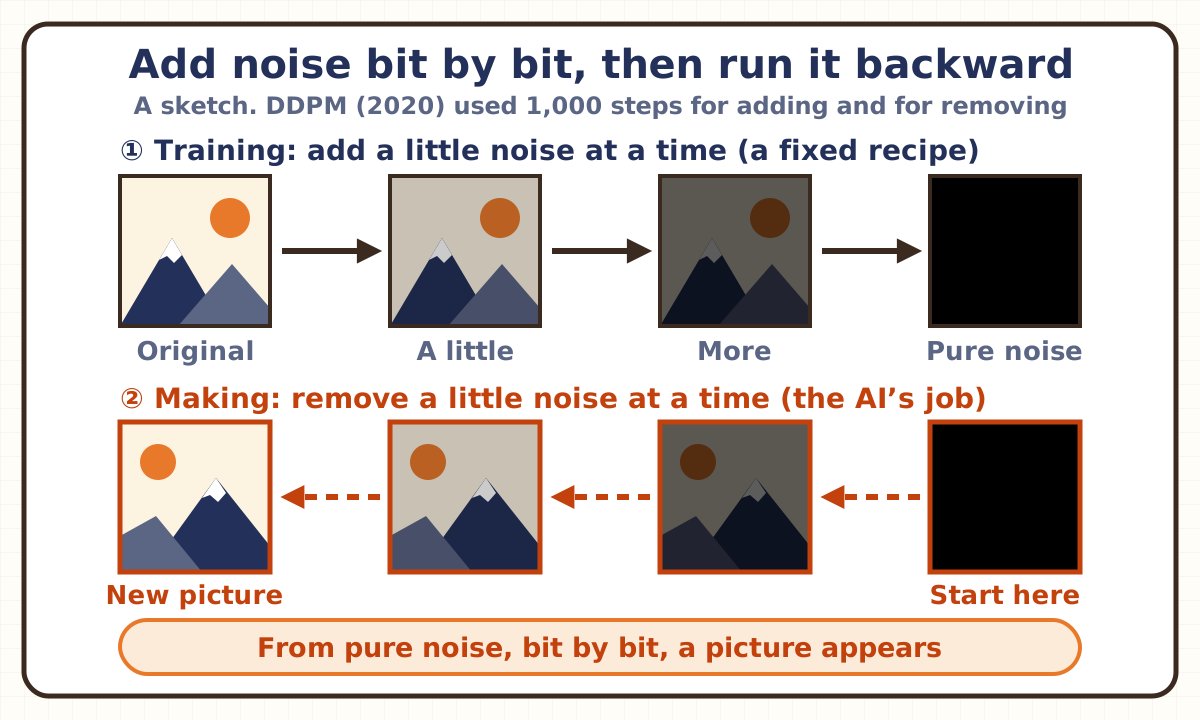
A diffusion model is a way for AI to create new pictures and more, starting from pure noise (random speckles) and removing that noise a little at a time.
In training, it adds noise to lots of pictures and practices guessing the noise it added. To make a picture, it starts from pure noise and subtracts a bit of the noise it guesses, over and over, from tens to about a thousand times, until a picture gradually emerges. In AIs you ask with words, the noise is removed in the direction that fits your words.
Its picture quality jumped from around 2020, and it became the basis of well-known image AIs such as Stable Diffusion and DALL·E 2. It is used in video-making AIs too. But it can turn out near-copies of pictures that appeared many times in its training data.
A common mix-up
“A diffusion model makes new pictures by cutting and pasting the pictures it learned from.”
Partly right, but that is not how its steps work. What a diffusion model learns is not the pictures themselves but a way of calculating: how to guess the noise mixed into a noisy picture. That is kept as the values of the numbers inside the AI (its parameters). When it makes a picture, it starts from random noise and simply subtracts noise bit by bit with that calculation; there is no step that looks up learned pictures and pastes them together. Even so, it can turn out near-copies of pictures it learned from. A 2023 study (Carlini et al.) prompted Stable Diffusion with the captions of 350,000 pictures that appeared many times in its training data, had it make 175 million pictures, and found just over 100 that were nearly identical to training pictures (a tiny fraction of those made). A major reason for this memorizing was that the same picture appeared many times. In the same study, when models were trained on a small set of photos and compared, the diffusion models had memorized more training pictures than GANs, a kind of image AI widely used before that pits two AIs against each other. The researchers write that whether such AIs truly make new things, or come closer to copying and blending the pictures they learned, is still an open question (more on the “Generative AI” page).
Explained in pictures
You’re free to use these figures in lessons, slides and posts if you credit Naru News (naru.news). CC BY 4.0.
Think of it like this
Playing spreading ink backward
Drop a little ink into a glass of water, and it slowly spreads until the whole glass is the same pale color. You can no longer tell what shape the drop had. The “adding noise” side of a diffusion model is like this: the shapes in a picture slowly break down until only noise is left.
Making a picture is like playing a video of this backward. Starting from the fully spread color, you go back one frame at a time and rebuild the shape. Because each frame changes only a little, it is easy to guess, “one frame earlier, it probably looked like this.”
But the comparison has limits. Real ink never gathers back into its original shape on its own. And a diffusion model doesn’t return to the picture that was broken down. Each time, it starts from different noise and heads toward the “likely shapes” of the pictures it learned, making a new picture. What it heads toward is decided by the calculation the AI learned and by the words in your request.
Key points
How does it learn?
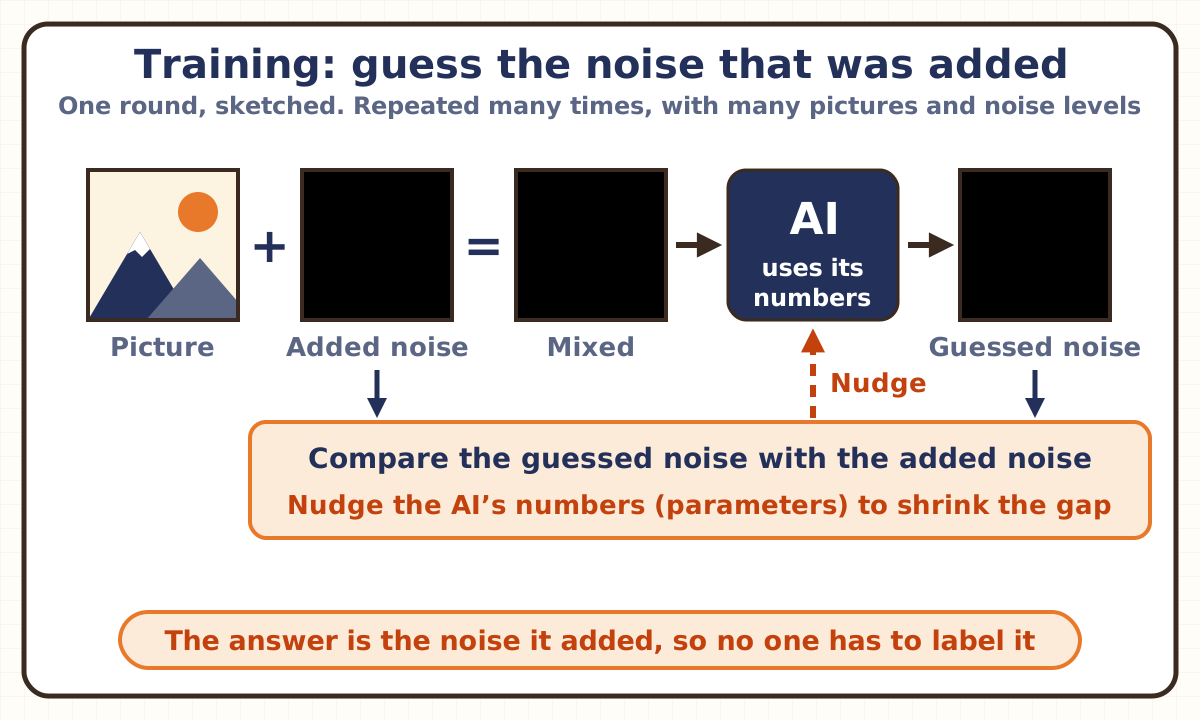
It makes its own practice problems, with answers it can check. Inside a computer, a picture is a list of numbers giving the strength of the colors at each dot, and noise is a list of random numbers of the same length. That is why they can be added and subtracted. It picks a training picture, decides at random how much noise to mix in, and adds that noise. The AI looks at the noisy picture and guesses the noise that was mixed in. Then the numbers inside the AI (its parameters) are nudged a little so that the gap between the guessed noise and the noise actually added gets smaller. This is repeated many times over many pictures. This way of training was shown in a 2020 paper (Ho et al., DDPM), and Stable Diffusion also learns from the difference between the noise added and the noise the AI guesses.
The right answer is known, because it is the noise that was added. Learning by deliberately adding noise and having a model remove it (denoising) is known as a way to learn even from data that no one has labeled, picture by picture, with answers (such as what it shows). To build an AI you can ask with words, it is trained on pairs of pictures and their descriptions.
The AI that guesses the noise is a deep-learning neural network (an AI design that stacks many layers of calculation). DDPM and Stable Diffusion used a design called U-Net, which squeezes a picture down and then brings it back up to full size. A 2022 paper (Peebles and Xie) swapped it for a transformer (the design behind chat AIs) and, on a test of making pictures of a chosen kind (using ImageNet, a large collection of photos of many kinds), got better results than earlier diffusion models.
Why remove the noise little by little?
Because when each step changes things only a tiny bit, the state one step earlier is almost the same as the state now, so it is easy to guess. So the AI only has to learn to guess “the state one step earlier, with just a little less noise.” Mathematics has shown that when each step adds only a tiny bit of noise, undoing that step can be described by the same kind of randomness as adding it (a Gaussian distribution) (Feller’s work in 1949). The 2015 paper that first proposed diffusion models (Sohl-Dickstein et al.) built on this.
So when it starts from pure noise, what does the AI go by? It is not picturing one particular image. Having practiced on many pictures, it has learned a calculation that tells “the parts that don’t look like a real picture are noise.” Each time it subtracts noise with that calculation, the picture moves a little closer to likely shapes, such as mountains or faces. Different starting noise gives a different picture.
DDPM in 2020 split the adding of noise into 1,000 steps, and when making a picture it removes noise 1,000 times, starting from pure noise. Watching along the way, the rough shapes appear first and the fine details come last.
The downside is that making a picture takes time. So ways to cut the number of steps followed one after another. DDIM in 2020 (Song et al.) kept the same training but made pictures 10 to 50 times faster. Stable Diffusion’s released program makes a picture in 50 steps by default.
Why does asking with words give that picture?
Because the words go into the calculation that removes the noise. An AI can only calculate with numbers, so in Stable Diffusion, a part that turns text into a list of numbers (a text encoder, taken from another AI called CLIP, which learned from pairs of pictures and captions) first converts your request into numbers. The AI that guesses the noise refers to those numbers at every step. Since it was also trained on pairs of pictures and descriptions, it can remove the noise so that the picture moves toward one that fits the words.
There is also a trick to make it follow the words more strongly. In the method from a 2022 paper (Ho and Salimans, Google), one AI practices guessing the noise both with and without the request (in the paper’s tests, the request was not words but the name of a kind of picture). When making a picture, at every step it guesses the noise both with and without the request, and takes the difference between the two answers (the direction the request adds), multiplied several times over. The bigger the multiplier, the more clearly the picture fits the request, but the less the pictures vary. The released Stable Diffusion (v1-4), too, was trained with the words left out 10% of the time, so that it could also give the without-request answer and this method would work well with words.
DALL·E 2 (OpenAI, 2022) first turns the words into a list of numbers that describes the features of a picture, then uses a diffusion model to turn that into a picture.
What made Stable Diffusion light?
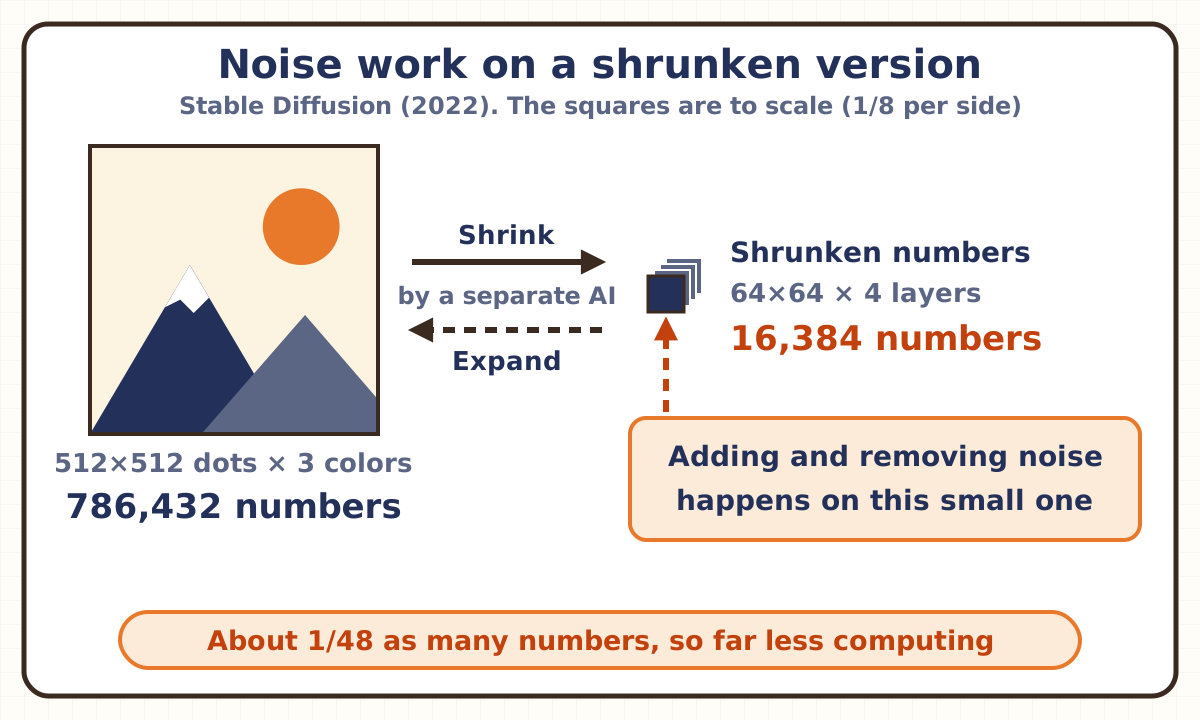
It shrinks the picture into a small set of numbers first, and adds and removes noise there (a latent diffusion model). A paper released in December 2021 (Rombach et al.) wrote that training diffusion models directly on a picture’s dots (pixels) can take hundreds of days of GPU computing for the most powerful ones (GPUs are the chips used for AI computing), and that making 50,000 pictures takes about 5 days on one GPU.
In Stable Diffusion, a separately trained AI shrinks a picture of 512×512 dots (3 numbers per dot, for the strength of red, green and blue; 786,432 numbers in all) into four 64×64 layers, 1/8 the size on each side (16,384 numbers). That is about 1/48 as many numbers. After the noise has been removed, the expanding AI paired with the shrinking one turns it back into a full-size picture. The paper says this cut the computing greatly while keeping the fine look of pictures.
In August 2022, Stable Diffusion was released for anyone to use, along with its numbers (parameters). The U-Net that guesses the noise has 860 million numbers and the part that turns words into numbers has 123 million, and it was described as running on a GPU with at least 10 GB of memory.
When did it start, and how did it spread?
The idea came in 2015. Researchers at Stanford University and elsewhere (Sohl-Dickstein et al.) took a hint from the physics of things spreading out and mixing, like ink in water (non-equilibrium statistical physics), and proposed training a model on a “diffusion” process that slowly breaks down the structure of data, and on a process that restores it. This is where the name “diffusion” comes from.
In 2019, Song and Ermon proposed a method that learns by adding noise of many strengths to data and makes samples by moving step by step from strong noise to weak. In 2020, DDPM (Ho et al., University of California, Berkeley) showed that a diffusion model could make pictures about as good as a leading GAN (an older kind of picture-making AI, explained below). It also showed that, though they look different, it and the Song and Ermon approach belong to the same family once the equations are rewritten.
In 2021, Dhariwal and Nichol of OpenAI reported, in a paper titled “Diffusion Models Beat GANs on Image Synthesis,” that diffusion models had overtaken GANs, which until then led in picture quality. On a test of making photos of a chosen kind (256×256 dots) with ImageNet, a large collection of photos of many kinds, a measure of how far the set of pictures made is from the set of real photos (FID; lower is closer to real) was 4.59, compared with 6.95 for a leading GAN (BigGAN-deep). A 2023 paper (Carlini et al.) says that over the previous two years or so, diffusion models largely replaced GANs and became the basis of well-known image AIs such as Stable Diffusion, DALL·E 2, Midjourney and Imagen.
The difference from GANs is how they make pictures. A GAN trains an AI that makes pictures by pitting it against an AI that tells real from fake, and it makes a picture in a single pass (more on the “Generative AI” page). A diffusion model removes noise over many steps, so, as the same 2021 paper notes, it is slower than a GAN at making pictures.
Can it make videos too?
Yes. An April 2022 paper (Ho et al.) extended the design used for pictures, in a natural way, into a diffusion model that makes videos. It also showed the first results on a large test of making videos from text.
In February 2024, OpenAI released a technical report on its video AI, Sora. According to the report, Sora is a diffusion model, trained to predict the original clean patches from small noisy patches. It also says Sora is a “diffusion transformer,” which cuts video into “patches,” each a few frames long and a small square of the screen, and handles them with a transformer. OpenAI says it can make up to a minute of high-definition video, but also admits that it does not accurately model the physics of many basic interactions, such as glass shattering. Details of the model are not included in the report.
Check yourself
Q1A “diffusion model,” used by many picture-making AIs, looks at pictures mixed with noise while it is being trained. What does it practice guessing?
Answer and explanation
Answer: C What the noise mixed in looks like
Noise of a randomly chosen amount is added to a training picture, and the AI guesses the noise that was mixed in. Since the right answer is the noise that was added, the numbers inside the AI (its parameters) are nudged to shrink the gap from its guess. When making a picture, it uses this skill to subtract the guessed noise little by little, starting from pure noise. Telling real from fake is the job of the judging AI in a GAN.
Q2When a diffusion model makes a new picture, why does it remove the noise over many steps, a little at a time, instead of all at once?
Answer and explanation
Answer: B Small steps make the earlier state easy for the AI to guess
When each step removes only a tiny bit of noise, the state one step earlier is almost the same as now, so it is easy to guess. So the AI only has to learn to guess the state one step earlier, with just a little less noise. The cost is that more steps mean more computing in total and slower picture-making, so ways to cut the number of steps have been studied too.
More on this → Key points: Why remove the noise little by little?
Q3“Stable Diffusion,” a picture-making AI released in 2022, does its adding and removing of noise on what?
Answer and explanation
Answer: A A shrunken, small set of numbers
A separately trained AI shrinks a picture of 512×512 dots (786,432 numbers) into four 64×64 layers (16,384 numbers), and the noise work is done there. That is about 1/48 as many numbers, so the computing gets far lighter. When the noise has been removed, the expanding AI paired with the shrinking one turns it back into a full-size picture.
More on this → Key points: What made Stable Diffusion light?
Related terms
- Generative AI
- Deep learning
- Neural network
- Machine learning
- Parameter
- Transformer
- Generative adversarial network (GAN)
- Deepfake
Sources and how we checked
- Sohl-Dickstein et al., "Deep Unsupervised Learning using Nonequilibrium Thermodynamics" (Stanford University and UC Berkeley; arXiv, March 2015; abstract, the passage citing Feller 1949 on the form of the reverse process, and the number of steps in the experiments; read November 10, 2026)
- Song and Ermon, "Generative Modeling by Estimating Gradients of the Data Distribution" (NeurIPS 2019; arXiv, July 2019; abstract; read November 10, 2026)
- Ho, Jain and Abbeel, "Denoising Diffusion Probabilistic Models" (DDPM; UC Berkeley; arXiv, June 2020; abstract, Section 2, Algorithms 1 and 2, and Section 4 [T = 1000; large-scale features appear first]; read November 10, 2026)
- Song, Meng and Ermon, "Denoising Diffusion Implicit Models" (DDIM; ICLR 2021; arXiv, October 2020; abstract; read November 10, 2026)
- Dhariwal and Nichol, "Diffusion Models Beat GANs on Image Synthesis" (OpenAI; arXiv, May 2021; abstract, introduction, Table 5 and the limitations section; read November 10, 2026)
- Rombach et al., "High-Resolution Image Synthesis with Latent Diffusion Models" (CVPR 2022; arXiv, December 2021; abstract, introduction and Section 3; read November 10, 2026)
- CompVis, "Stable Diffusion" (GitHub README: sizes of the U-Net and text encoder, downsampling factor, GPU memory and the default 50 steps; read November 10, 2026)
- CompVis, "stable-diffusion-v1-4" model card (Hugging Face: latent shape, text conditioning, training objective, 10% text dropout and memorization of duplicated images; read November 10, 2026)
- Stability AI, "Stable Diffusion Public Release" (August 22, 2022; read November 10, 2026)
- Ho and Salimans, "Classifier-Free Diffusion Guidance" (Google Research, Brain team; arXiv, July 2022; abstract and the parts on training, sampling and the quality–variety trade-off; read November 10, 2026)
- Ramesh et al., "Hierarchical Text-Conditional Image Generation with CLIP Latents" (DALL·E 2; arXiv, April 2022; abstract; read November 10, 2026)
- Peebles and Xie, "Scalable Diffusion Models with Transformers" (arXiv, December 2022; abstract; read November 10, 2026)
- Ho et al., "Video Diffusion Models" (arXiv, April 2022; abstract; read November 10, 2026)
- OpenAI, "Video generation models as world simulators" (technical report on Sora, February 2024; read November 10, 2026)
- Goodfellow et al., "Generative Adversarial Nets" (GAN; arXiv, June 2014; abstract; read November 10, 2026)
- Carlini et al., "Extracting Training Data from Diffusion Models" (Google, DeepMind, ETH Zurich, Princeton University and UC Berkeley; arXiv, January 2023; introduction, Section 2, the Stable Diffusion and CIFAR-10 results and the conclusion; read November 10, 2026)
- Google, "Machine Learning Glossary" (entry for denoising; read November 10, 2026)
AI wrote this page from the sources above, and a different AI checked it against the text of those sources (November 10, 2026). A person with a master’s degree in science and a Japanese high-school science teaching license also read and checked it before publishing. Numbers are as of that date. If anything was hard to follow, you spot a mistake, or there’s a term you’d like explained, please write to [email protected].
AI terms
- AI agent
- AI alignment
- Artificial general intelligence (AGI)
- Artificial intelligence (AI)
- Autoformalization
- Context window
- Deep learning
- You are hereDiffusion model
- Fine-tuning
- Generative AI
- Hallucination
- Hyperparameter
- Intelligence explosion
- Jailbreaking
- Large language model (LLM)
- Machine learning
- Mixture of experts (MoE)
- Neural network
- Neuralese
- Overfitting
- Parameter
- Prompt
- Prompt injection
- Reasoning model
- Recursive self-improvement (RSI)
- Reinforcement learning (RL)
- Retrieval-augmented generation (RAG)
- Shutdown resistance
- Subliminal learning
- Superintelligence (ASI)
- Technological singularity
- Time horizon
- Token
- Transformer