 Naru News日本語
What is an AI’s time horizon (how long a task it can complete)?
Also called: 50% time horizon, Task-completion time horizon, 50%-task-completion time horizon, METR time horizon

In one minute
An AI’s time horizon is a yardstick of AI ability: the length of task, measured by how long it takes a human expert, that an AI agent (an AI that decides the steps itself to get work done) can complete half the time (with 50% success).
A horizon is the edge of how far you can see; here, it is the edge of how long a task an AI can reach. METR, a group that studies AI and is not run to make money, proposed it in a 2025 paper. When tasks given to AIs, such as programming, are lined up by how long human experts took, the AI’s success rate falls the longer the task. The length where it is 50% is the time horizon.
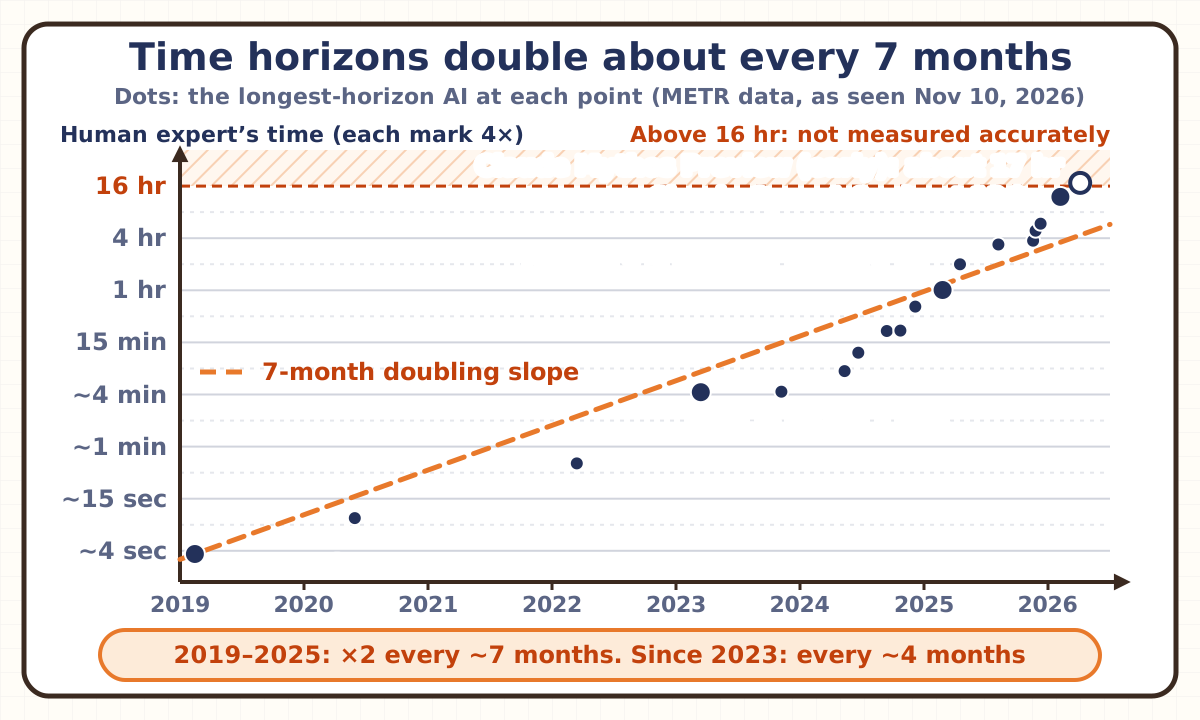
It was about 3 seconds for GPT-2 in 2019 and about 12 hours for Claude Opus 4.6 from February 2026, and from 2019 to 2025 it doubled about every seven months. But this does not mean the AI can keep working for that long.
A common mix-up
“An AI with a 2-hour time horizon can keep working on its own for 2 hours straight.”
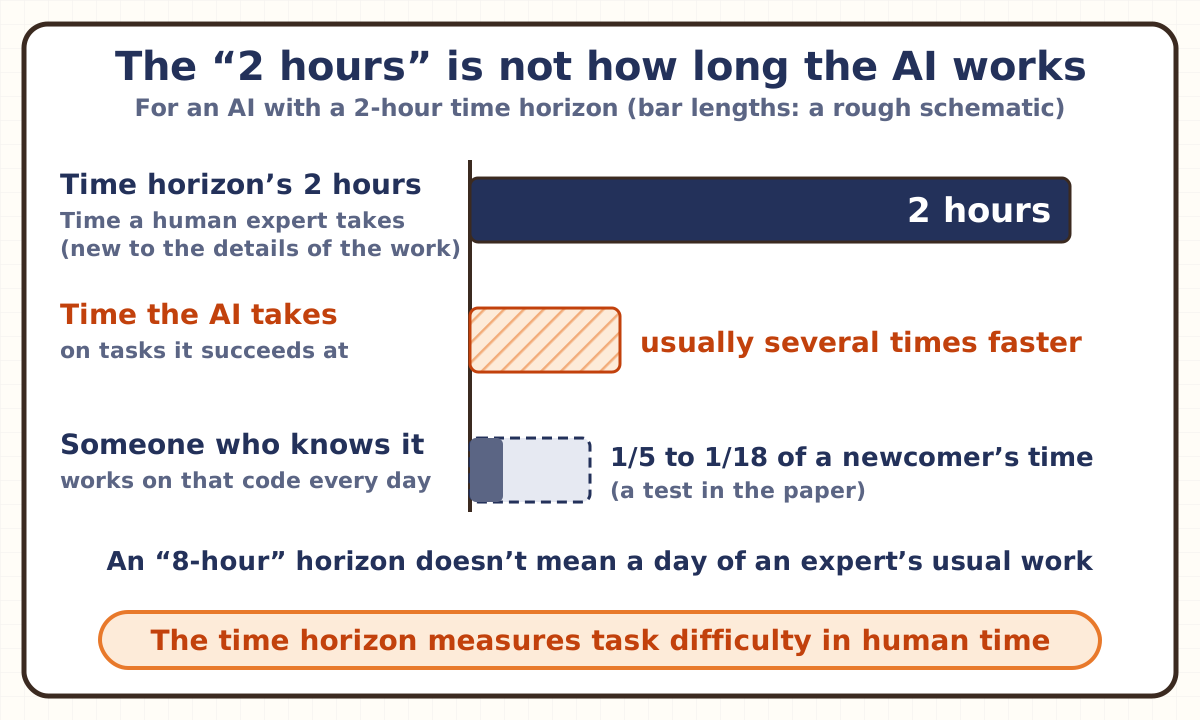
What is right: an AI with a longer time horizon can see longer tasks through to the end (the paper credits the growth in time horizons to AIs becoming more reliable, better able to adapt to their mistakes, and better at logical reasoning and using tools). What is wrong: taking the “2 hours” as how long the AI works. It is how long the task takes a human expert, a yardstick for how hard the task is. METR writes that on tasks they complete successfully, AI agents are typically several times faster than humans. Nor does a 2-hour horizon mean the AI always manages 2-hour tasks: it succeeds about half the time.
Explained in pictures
You’re free to use these figures in lessons, slides and posts if you credit Naru News (naru.news). CC BY 4.0.
Think of it like this
The bar height a high jumper clears every other try
Suppose you describe a high jumper’s ability as “the bar height they can clear one time in two.” They almost always clear low bars, hardly ever clear high ones, and in between, the share of successful jumps gradually falls. The height where it is exactly half is one number that describes the jumper’s ability. The time horizon works the same way: instead of bar height, it uses the time a human expert takes to express how hard a task is, and the length where the AI succeeds half the time becomes the number for the AI’s ability.
This number is a bar height, not the time the jumper spends jumping. In the same way, the “2 hours” of a time horizon is not the time the AI works; it expresses how hard the task is in human time. And if you asked for the height they clear every time, the answer would be lower. For AIs, too, the length they can complete 80% of the time is much shorter than the 50% length.
But the comparison has limits. A bar’s height is the same whoever measures it, but a task’s length depends on whose time you measure. In one test, people new to the work took 5 to 18 times as long as people who do it every day. Also, the high jump is a single event, but AI tasks vary, from programming to machine learning, and on “messy” tasks without clear rules, the AI’s success rate is lower even at the same length.
Key points
Why is it called a “horizon”?
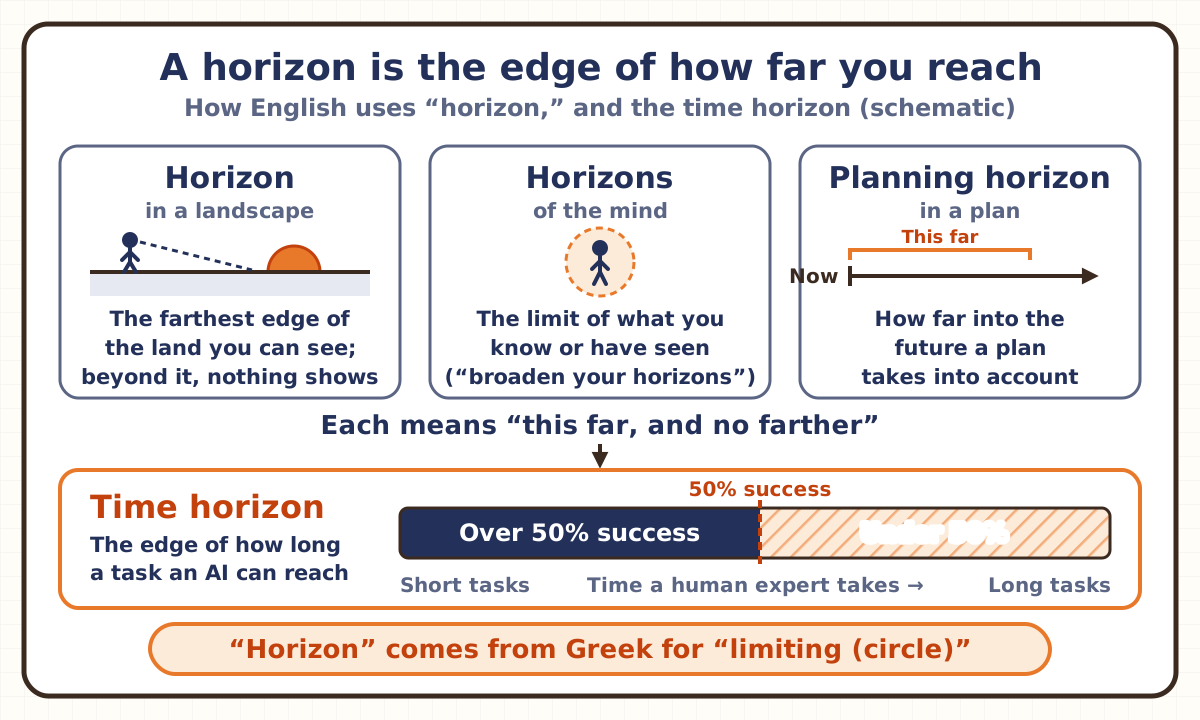
In everyday English, a horizon is the line where the land or sea seems to meet the sky: the farthest edge of the ground you can see from where you stand. Beyond it, you can’t see. The word comes from a Greek phrase meaning “limiting (circle).”
English also uses “horizon” beyond landscapes. Your horizons are the limits of what you know, have experienced or care about, as in “broaden your horizons.” It is also used for time: a plan’s planning horizon is how far into the future the plan takes into account. Each of these means an edge: this far, and no farther.
The time horizon makes sense read this way. It marks the edge of how long a task an AI can reach, measured by how long the task takes a human expert. The shorter the task, the more likely the AI is to see it through; the longer, the less likely. But unlike a real horizon, it is not a sharp line. The success rate falls off gradually, so the length where it is exactly half is chosen as the edge (see “Why 50%?” below).
As AIs have improved, this edge has moved toward longer tasks (doubling about every seven months from 2019 to 2025), a little like how the horizon moves farther away when you climb higher. The “event horizon” of a black hole (the edge beyond which not even light can escape) uses the same word, but it has nothing to do with the time horizon.
How is it measured?
First, many tasks are prepared. The 2025 paper gathered 170 tasks, such as programming, machine learning and computer security work, from three task sets: “HCAST,” a set of 97 tasks of about 1 minute to 30 hours; “RE-Bench,” a set of 7 hard machine-learning research tasks that each take 8 hours; and “SWAA,” a set of 66 short tasks of 1 to 30 seconds. Since January 2026, METR has used a version with the same method but more tasks, 228 (Time Horizon 1.1).
Next, human experts actually do the tasks, and their time is measured. They had on average about five years of experience in software, machine learning or computer security, and over 800 attempts added up to 2,529 hours. A task’s length is the average time of the people who succeeded at it (for some tasks no one did, estimated times are used).
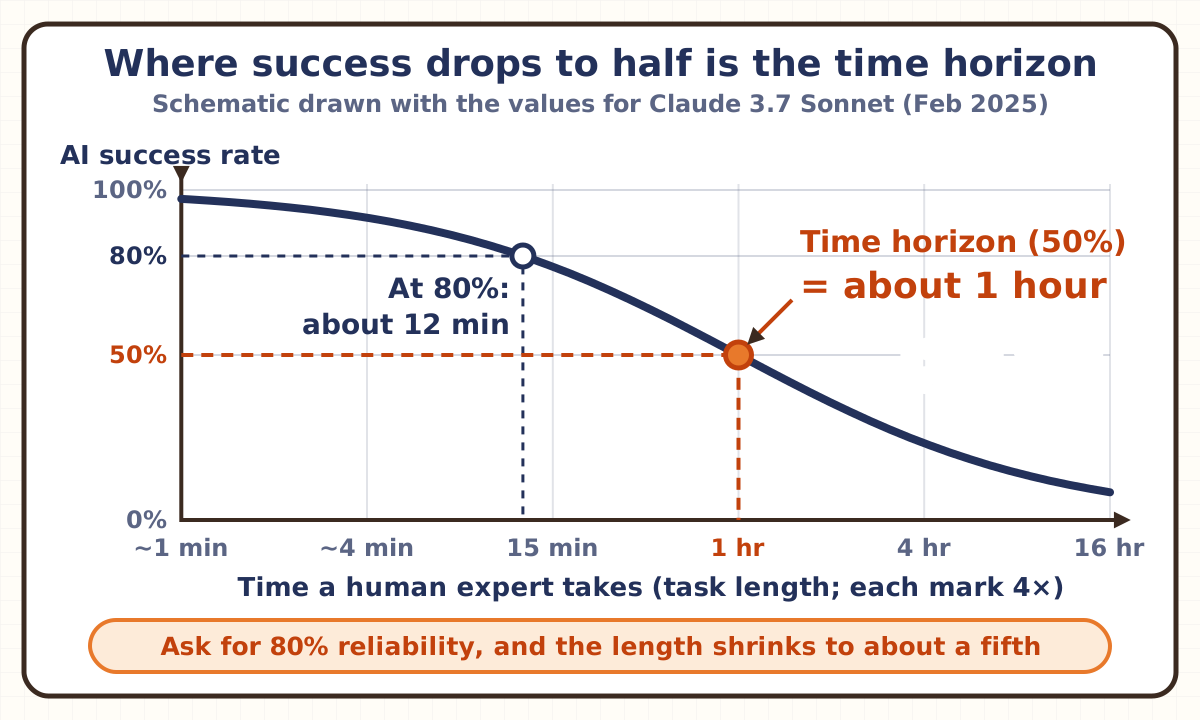
Then AI agents are given the same tasks, and whether each one succeeds is recorded. With task length across and success up, a curve shaped like a stretched-out S that slopes gently down from left to right (a logistic curve) is fitted. The scale across is one where each step multiplies the time (a logarithmic scale). The length where this curve crosses 50% is that AI’s time horizon. One curve is fitted for each AI.
Why 50%?
Even among tasks of about the same length, an AI can do some and not others. So you can’t draw a sharp line saying “it can do tasks up to so many hours.” Instead, the length at which its chance of success is exactly one half is used as a single number for the AI’s ability.
50% does not mean the AI manages every task of that length one time in two. METR gives GPT-5 as an example: among tasks that take a human expert 90 minutes to 3 hours, it always succeeded on about a third, always failed on about a third, and sometimes succeeded and sometimes failed on the remaining third.
METR also reports the length an AI can complete 80% of the time. It is much shorter, about a quarter to a sixth of the 50% length for the AIs in the paper. How many times shorter depends on how steeply that AI’s curve falls as tasks get longer, so it differs from AI to AI (about a tenth for Claude Opus 4.6 from 2026). Over the years, the 80% length has grown in much the same way as the 50% length. Lengths at higher reliability, such as 99%, are not reported, because measuring them accurately would take many more tasks.
How long is it now?
On METR’s page as seen on November 10, 2026, GPT-2 from 2019 was at about 3 seconds, GPT-4 from 2023 about 4 minutes, Claude 3.7 Sonnet from February 2025 about 1 hour, and GPT-5 from August 2025 about 3 hours 20 minutes. Claude Opus 4.6 from February 2026 is at about 12 hours, but this value comes with a very wide range, from about 5 to about 60 hours. The number of tasks measured is limited, and the value could move depending on which tasks are used and on the luck of each attempt, so the range of possible values is given. And the tasks Claude Opus 4.6 can complete 80% of the time are about 1 hour 10 minutes long, about a tenth of its 50% length (how many times shorter differs from AI to AI).
The longest at that point was an early version of Claude Mythos Preview from April 2026 (named “early” in METR’s data), at about 17 hours. But METR writes that values above 16 hours can’t be measured accurately with its current tasks (the value that comes out can’t be taken at face value). Even when it added tasks in January 2026, it wrote that there were relatively few tasks the newest AIs could not do. And in September 2026, METR added a note that the page is no longer actively updated.
How fast is it growing?
The 2025 paper showed that for AIs released from 2019 to 2025, the time horizon doubled about every seven months (207 days). A year (12 months) is about 1.7 times seven months, so in a year the time horizon doubles about 1.7 times over, a pace of roughly three times a year. That is much faster than Moore’s law, under which the number of parts on a chip doubles about every two years (see the “Moore’s law” page).
Growth has been faster recently. But the number changes a little depending on which period and which data you look at. In the 2025 paper’s data, looking only at AIs from 2024, the time horizon doubled about every three months (though the paper says extrapolating from this would not be robust). Meanwhile, in METR’s newer data measured again with more tasks (Time Horizon 1.1), looking at AIs from 2023 on, it doubled about every four months.
The paper attributes the growth mainly to AIs becoming more reliable, better able to adapt to their mistakes, and better at logical reasoning and using tools.
The paper’s authors predict that if this trend continues and carries over to real-world software work, within five years AI will be able to automate many software tasks that now take a person a month (about 167 working hours). Their central estimate is mid-2029. This extends the trend so far. The authors write that if adding more and more computing power for AI becomes harder, growth could slow (partly offset by better methods), while training in which AIs practice deciding the steps themselves and using tools to see tasks through and, eventually, having AI automate AI research itself are more likely to speed it up (for AI improving AI, see the “Recursive self-improvement” page).
Is it the same for work other than programming?
That is not yet clear. METR’s tasks are mainly software engineering, machine learning and computer security work. METR writes that a 2-hour time horizon does not mean an AI can do every intellectual task that a person can do in 2 hours.
In July 2025, METR also estimated time horizons from the results of tests in other fields, such as math contest problems, hard science questions, tasks of operating a computer by looking at the screen, and self-driving. In math, science questions and programming, the time horizons were about 50 to over 200 minutes and were doubling every 2 to 6 months. For operating a computer by looking at the screen, time horizons were 40 to 100 times shorter than in math, science questions and programming, but growing at a similar pace, following math and the others about two years behind. Self-driving was improving more slowly.
But the report cautions that the results of each test are fairly noisy and that many of the tests have no measured human times. It also says all the tests are somewhat artificial and are probably easier for AIs than real work.
What does the time horizon still not tell us?
First, how “messy” a task is. The paper scored how much each task resembles messy real-world work on 16 factors, such as having limited resources, being new, or taking place in an environment that changes. Among tasks of the same length, the messier the task, the lower the AI’s success rate (though growth over the years looked similar for the messier tasks too).
Second, whose time is used. The people who did the tasks did not know the details of that work well. When the paper tested fixes to programs inside METR, outside contractors took 5 to 18 times longer than the people who work on that code every day. METR writes that what the time horizon shows is close to what someone who has just started on the work can do, and that an 8-hour value does not mean the AI can do 8 hours of the daily work of someone who knows it well.
Third, how “success” is decided. Success on a task is usually judged automatically by a program. In August 2025, METR had Claude 3.7 Sonnet tackle 18 real fixes to open-source programs (programs whose code anyone can read). It passed the original developers’ tests 38% of the time. But when people read the answers, none of those they reviewed could be put into the main program and used as is, even those that passed the tests; they estimated each would take 42 minutes on average to fix, for missing tests, missing documentation and the like (26 minutes even for those that passed). Passing the tests and being usable as real work are different things.
Check yourself
Q1When METR, a group that studies what AI can do, says an AI has a “time horizon” (50% time horizon) of “2 hours,” what are those 2 hours?
Answer and explanation
Answer: B The time a human expert takes on it
The time horizon’s length is the time human experts took to do the task, which expresses how hard the task is. It is neither the time the AI takes nor the time a person takes to check the AI’s answer. METR writes that on tasks they complete successfully, AI agents are typically several times faster than humans. An AI with a 2-hour time horizon can complete, about half the time, tasks that would take a person 2 hours.
Q2METR calls the length of task an AI can complete half the time (50%) its “time horizon,” and also reports the length it can complete 80% of the time. For the same AI, how does the 80% length compare?
Answer and explanation
Answer: C Shorter than the 50% length
The 80% length is much shorter: for the AIs in the paper, it was about a quarter to a sixth of the 50% length. Because the AI succeeds less often on longer tasks, asking for a higher success rate limits it to shorter tasks. For example, Claude 3.7 Sonnet was at about 1 hour at 50% and about 12 minutes at 80%.
Q3A 2025 paper from METR compared the time horizons (METR’s yardstick of how long a task an AI can handle) of AIs released from 2019 to 2025. At roughly what pace did the time horizon grow over that period?
Answer and explanation
Answer: A Doubling about every 7 months
The paper showed that over about six years from 2019, the time horizon doubled about every seven months (207 days). A year (12 months) is about 1.7 times seven months, so it doubles about 1.7 times over in a year, a pace of roughly three times a year. That is much faster than Moore’s law’s doubling about every two years. It has been even faster recently: in data measured again with more tasks, looking at AIs from 2023 on, it doubled about every four months. But this is the trend so far, and it is not certain to continue the same way.
Related terms
- AI agent
- Large language model
- Reasoning model
- Moore’s law
- Recursive self-improvement
- Intelligence explosion
- Artificial general intelligence
- Benchmark
- Logistic regression
Sources and how we checked
- Kwa et al., "Measuring AI Ability to Complete Long Software Tasks" (METR; arXiv 2503.14499; version 1, March 2025, was titled "Measuring AI Ability to Complete Long Tasks"; read the abstract, Sections 1–6 and Appendices C.1 and F.1 of version 4, July 2026, and the abstract and Sections 3–4 of version 1; read November 10, 2026)
- METR, "Measuring AI Ability to Complete Long Software Tasks" (blog post accompanying the paper, March 19, 2025; the figure where Claude 3.7 Sonnet's curve crosses 50% at about one hour; read November 10, 2026)
- METR, "Task-Completion Time Horizons of Frontier AI Models" (updated September 8, 2026; the definition, FAQ, the note on values above 16 hours and the update log; viewed November 10, 2026)
- METR, measured values data file (Time Horizon 1.1; each model's 50% and 80% lengths with their ranges, release dates and doubling times; the dots in the figure by release date; viewed November 10, 2026)
- METR, "Time Horizon 1.1" (January 29, 2026; the version that grew the tasks from 170 to 228, and tasks of 8 hours or more from 14 to 31; read November 10, 2026)
- Kwa and Cheng, "How Does Time Horizon Vary Across Domains?" (METR, July 14, 2025; time horizons estimated from tests in other fields, and the caveats; read November 10, 2026)
- Rein, "Research Update: Algorithmic vs. Holistic Evaluation" (METR, August 13, 2025; a test comparing automatic tests and human review of Claude 3.7 Sonnet's fixes to 18 open-source issues; read November 10, 2026)
AI wrote this page from the sources above, and a different AI checked it against the text of those sources (November 10, 2026). A person with a master’s degree in science and a Japanese high-school science teaching license also read and checked it before publishing. Numbers are as of that date. If anything was hard to follow, you spot a mistake, or there’s a term you’d like explained, please write to [email protected].
AI terms
- AI agent
- AI alignment
- Artificial general intelligence (AGI)
- Artificial intelligence (AI)
- Autoformalization
- Context window
- Deep learning
- Diffusion model
- Fine-tuning
- Generative AI
- Hallucination
- Hyperparameter
- Intelligence explosion
- Jailbreaking
- Large language model (LLM)
- Machine learning
- Mixture of experts (MoE)
- Neural network
- Neuralese
- Overfitting
- Parameter
- Prompt
- Prompt injection
- Reasoning model
- Recursive self-improvement (RSI)
- Reinforcement learning (RL)
- Retrieval-augmented generation (RAG)
- Shutdown resistance
- Subliminal learning
- Superintelligence (ASI)
- Technological singularity
- You are hereTime horizon
- Token
- Transformer