 Naru News日本語
What is a benchmark in AI (a shared test for comparing AIs)?
Also called: AI benchmark, LLM benchmark

In one minute
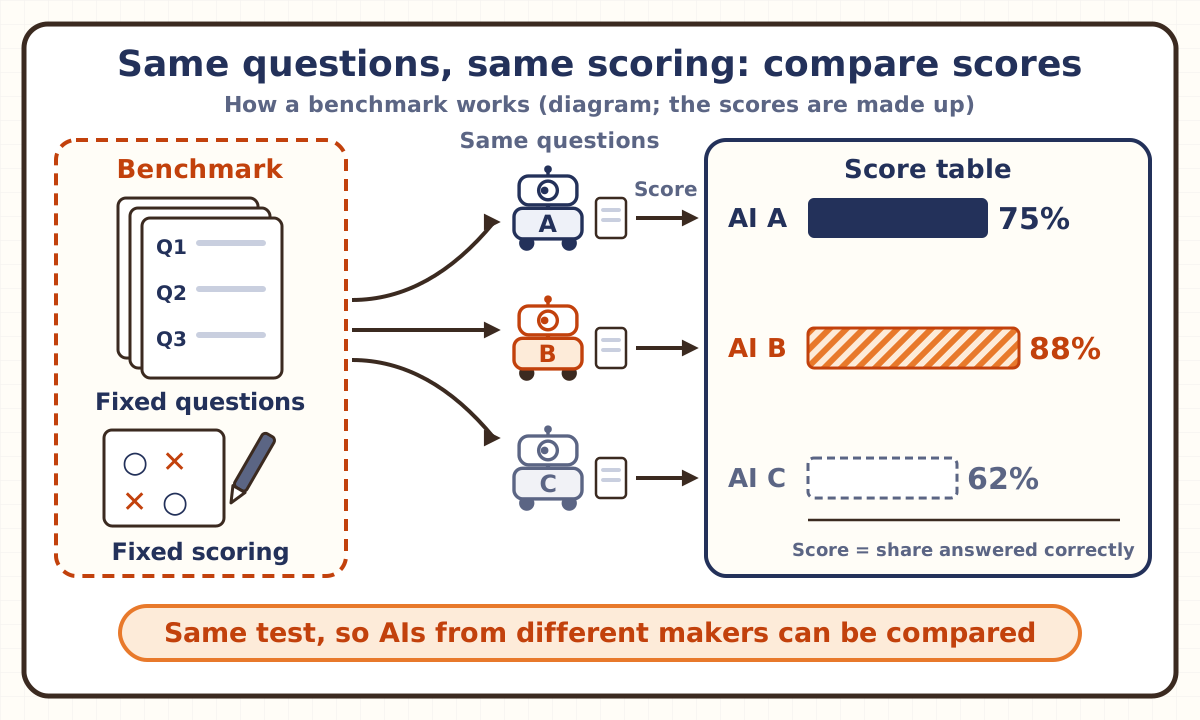
In AI, a benchmark is a shared test that pairs a fixed set of questions with a fixed way of scoring the answers; many different AIs are given the same questions, and their scores are used to compare what they can do.
For example, MMLU, built in 2020, is a test of multiple-choice questions (pick one of four answers) in 57 subjects such as math, history and law, and the score is the share answered correctly (accuracy). On the same test, AIs made by different companies can be lined up by score. When companies release a new AI, they often publish a table of benchmark scores.
But a score shows only part of what an AI can do. Once many AIs score near full marks (saturation), the test no longer tells them apart, and if a test’s questions slip into the data an AI learns from (its training data), its score can come out higher than its real ability.
A common mix-up
“The higher an AI’s benchmark scores, the better it is at any job.”
Only partly right. On the same test, it is fair to think that the higher-scoring AI does better on the kind of questions that test measures. What is wrong is “any job.” Most benchmarks measure questions whose answers can be checked in a fixed way, such as multiple-choice questions, math problems with a set numerical answer, or program fixes where running checking programs shows whether the fix really worked. Some researchers point out that fixed questions struggle to measure how useful an AI is with open-ended requests (questions or instructions given to an AI) that have no single right answer. And when a test’s questions slip into the data an AI learns from, its score comes out higher than its real ability. In a 2024 study, when people wrote new math word problems about as hard as those in an existing test, some AIs’ accuracy dropped by up to about 8 points on them (points here are the difference between two percentages: going from 50% to 42% is a drop of 8 points). A score is a guide to the ability that test measures, not the whole of what an AI can do.
Explained in pictures
You’re free to use these figures in lessons, slides and posts if you credit Naru News (naru.news). CC BY 4.0.
Think of it like this
A nationwide practice exam with the same questions for everyone
Imagine a practice exam that junior high school students across the country take, with the same questions and the same time limit. Because the questions and the marking are the same, students from different schools can be lined up by their scores. A benchmark is like this practice exam, but for AIs.
But if the questions and answers had been passed around beforehand, the score alone couldn’t tell you whether a high scorer really had the skill or had just memorized the answers. And once everyone scores close to full marks, the exam no longer separates them, and a harder one is needed.
But the comparison has limits. A practice exam for people is written fresh each time, while AI benchmarks often keep the same questions for years so that new AIs can be compared with older ones, which gives the questions more chance to spread. And because AIs learn from huge amounts of web text, if the questions appear somewhere online, an AI can learn them without even its makers noticing. Unlike a student, it hasn’t necessarily memorized the answers on purpose.
Key points
Why is it called a “benchmark”?
The English word benchmark started out as a surveying term. When land heights are measured, a benchmark is a mark made on something that doesn’t move, at a spot whose height is already known, and surveyors use it as the reference for working out the heights of other places. In Japan, marks that do the same job are called suijunten (“level points”); about 16,000 of them have been set nationwide, mainly along major national roads, to serve as the standard for heights.
Here, bench means a small support. An American English dictionary explains that the name comes from fitting a metal piece into the mark to make a little bench, on which the tall measuring staff for heights was rested.
Today benchmark is also used in a broader sense: a standard by which something can be measured or judged. In investing in stocks and the like, a yardstick for comparing results (such as Japan’s Nikkei Stock Average) is called a benchmark, and in computing, a fixed test for measuring and comparing performance under the same conditions is called a benchmark too. AI benchmarks, likewise, are a shared standard for holding every AI up to the same yardstick.
How is a benchmark built?
A benchmark is built by putting together a set of questions, the right answers (or a way to check whether an answer is right), and a way of scoring. The scoring is fixed in advance so that whoever tests whichever AI, the score comes from the same yardstick. The score is usually the share of questions answered correctly (accuracy).
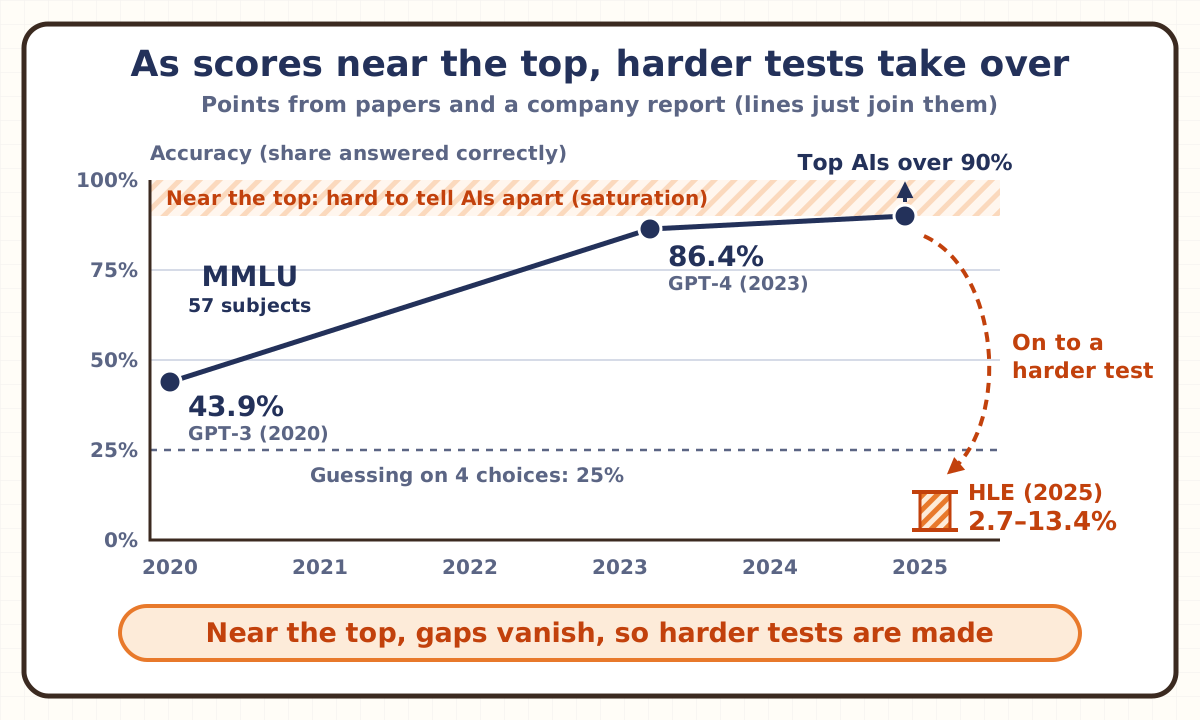
MMLU, from 2020, gathered 15,908 multiple-choice questions in 57 subjects, ranging from elementary to advanced professional level. With four choices, even guessing gets 25% right. Its creators tested GPT-3 (a text-writing AI that OpenAI announced in 2020). GPT-3 came in four versions of different size (size here means how many numbers, or parameters, the AI has inside), and the three smaller ones scored around 25%, about the same as guessing. The largest version scored 43.9%, about 20 points better than guessing, but far short of experts. Expert accuracy was estimated at about 89.8%, from the accuracy of the top 5% of people taking the real exams the questions came from (with educated guesses where that wasn’t known).
Not every benchmark uses multiple choice. GSM8K, from 2021, is a test of about 8,500 grade-school math word problems, each solvable by doing 2 to 8 calculations in a row, and an answer is scored only on whether the final number is right. SWE-bench, from 2023, is a test of 2,294 tasks that ask an AI to fix real problems reported in 12 widely used programs (with code anyone can read). The program with the AI’s fix is run through checking programs (tests) prepared in advance, and the task counts as solved only if every one of them shows it working correctly.
A shared test lets researchers compare their ideas with the same yardstick. In a contest to name the object in a photo out of 1,000 kinds (the ImageNet contest), research teams competed on the same test year after year. The error rate (the share of photos for which none of an AI’s up to five guesses was right; lower is better) fell from 28.2% in 2010 to 6.7% in 2014. The test answers were not shown to the teams; they sent in their AIs’ answers, and the organizers did the scoring.
Why do new tests keep being made?
Because as AIs improve, tests become too easy to tell them apart. When many AIs score close to full marks, the test is said to be saturated. On MMLU, the 43.9% the largest version of GPT-3 scored in 2020 became 86.4% for GPT-4 in 2023 (the company’s report), and by early 2025 the top AIs were scoring over 90%. Older tests such as MMLU and GSM8K, the math word-problem test, now hardly separate the top AIs.
So harder tests are made. Humanity’s Last Exam (HLE), released in 2025, is a test of 2,500 questions written by experts around the world, in many subjects including math, the humanities and the natural sciences (the first released version had 3,000). While collecting questions, its makers tried them on the leading AIs of the time and left out any they answered correctly. In the paper’s table, eight leading AIs of early 2025 scored between 2.7% and 13.4%.
New tests don’t stay hard forever, either. On SWE-bench, created in 2023, the share of tasks the best AI could solve rose from 4.4% at the end of 2023 to 71.7% at the end of 2024. The 71.7%, though, was on a subset of problems checked and selected by people (SWE-bench Verified), and it was reported by the company that made the AI.
HLE’s creators also write that benchmarks saturate quickly. They add that HLE may be the last school-style exam, with set answers, that AIs need to take, but that this is far from the end of tests for measuring AI.
How far can the scores be trusted?
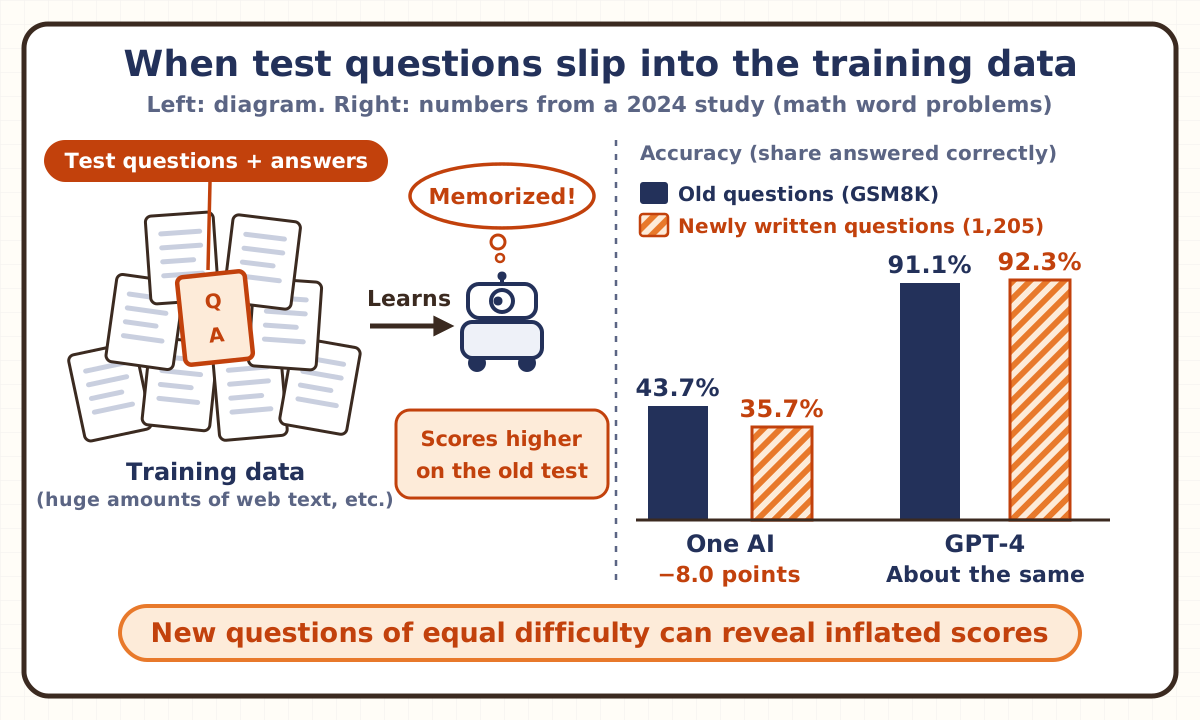
If a test’s questions and answers slip into the data an AI learns from (its training data), the AI can memorize the answers instead of learning how to solve the problems, and its score comes out higher than its real ability. This is called data contamination. Today’s large language models (text-writing AIs like those behind ChatGPT) learn from huge amounts of web text, so if a test’s questions appear somewhere online, they can get in without the makers noticing. In its 2023 GPT-4 report, OpenAI writes that parts of one test had been mixed into the training data by accident, so it left those results out (the company’s report).
One way to check for contamination is to write new questions of the same difficulty and compare. In a 2024 study, people wrote 1,205 new math word problems modeled on GSM8K, and many AIs were given both the old and the new problems. Some AIs scored up to about 8 points lower on the new problems (8 out of every 100), and the researchers see this as a sign that those AIs had been fitted too closely to the old test (overfitting). They also measured how smoothly each AI could write out GSM8K’s problems (the AI was made to predict each problem’s text from the start, word by word; the more often it matched the original, the more likely it had read that text before). The more smoothly an AI could do so, the bigger its drop tended to be. But that didn’t explain every case, and the researchers write that other things, such as collecting training problems similar to the test, may also be causes. Meanwhile, most of the most advanced AIs of the time scored about the same on both tests. GPT-4, for example, scored 91.1% on the old problems and 92.3% on the new ones, a difference small enough to count as about the same.
Test makers take steps too. The photo contest (the ImageNet contest) scored entries without publishing the test answers. HLE keeps part of its questions private, to check whether AIs have been tuned too closely to the public questions, and the 2024 math study did not publish its new problems right away, so that they wouldn’t slip into training data. SWE-bench is designed so that new tasks can be added from problems reported after an AI finished training.
An AI can also notice that it is being tested. In a 2025 study, AIs were shown exchanges from when an AI was solving test questions and exchanges from when people were really using an AI, and leading AIs told which ones came from tests far better than guessing. If an AI behaves differently only when tested, its score doesn’t show how it acts in real use (see the “Evaluation awareness” page).
How should a table of scores be read?
In short, a score is “the result on that test, measured that way.” Compare only scores from the same test under the same conditions, and also check who measured them (the company that made the AI, or someone else) and whether the test is close to how you would use the AI.
First, look at which tests are listed. The side releasing an AI chooses which tests to include, so a table could end up showing mostly tests that AI is good at. A 2022 study writes that, until then, some pairs of well-known AIs had not a single test score in common (so their scores could not be lined up side by side).
Next, check whether the scores were measured under the same conditions. Even the same AI scores differently depending on how it is asked (how the questions or instructions to it are written) and on the details of the scoring. In the 2024 math study, just changing the worked examples included in the request and the way the answer was phrased lowered one AI’s accuracy on the same math word-problem test by about 5 points. When lining up scores measured in different places, you need to check that the conditions match.
When raising the score becomes the goal in itself, the score and the real ability can drift apart. In AI research too, it has been pointed out that leaning too hard on metrics leads to gaming them and to chasing short-term numbers. This is a view known as “Goodhart’s law,” often quoted as “When a measure becomes a target, it ceases to be a good measure.” It goes back to an idea the economist Charles Goodhart wrote in 1975 about British monetary policy; the short wording is said to have been written later by another researcher (see the “Reward hacking” page).
Finally, scores don’t always match how an AI feels to use. Tests with fixed questions struggle to measure open-ended requests with no single right answer, or whether answers suit people’s preferences. So Chatbot Arena was built with no fixed questions: users ask anything they like, compare the answers of two AIs whose names are hidden, and vote for the better one (it started in 2023 and was described in a 2024 paper). By January 2024 it had gathered over 240,000 votes. When two experts also judged a sample of the matchups, they picked the same answer as the users’ votes about 70 to 80 percent of the time. The two experts agreed with each other about as often, so the researchers see the users’ votes and the experts’ judgments as agreeing well.
How is it different from red teaming?
A benchmark is a shared test that scores AIs on fixed questions so they can be compared. A red team doesn’t use fixed questions; it takes an attacker’s point of view and looks on purpose for an AI’s weak spots and dangerous behavior (see the “Red teaming” page). Benchmarks suit comparing how much different AIs can do, while red teaming suits finding dangers no one expected.
The two are connected. OpenAI writes that it uses requests tried by its red teamers as the basis for automated tests that can be run the same way again and again (the company’s account). Weak spots found by a red team can later become a fixed-question test.
There are also yardsticks that express ability in a form other than a score. The “time horizon” expresses how long a task an AI agent can complete, in terms of how long it would take a person. For example, if an AI succeeds half the time at tasks that take a human expert one hour, its time horizon is “one hour” (see the “Time horizon” page).
Check yourself
Q1MMLU, a test built in 2020, is made of questions in 57 subjects such as math, history and law, each asking you to pick one of four answers. Its creators tested four versions of GPT-3, a text-writing AI, that differ in size (how many numbers, or parameters, the AI has inside). Roughly what accuracy (share answered correctly) did the largest version get?
Answer and explanation
Answer: A About 44%
The largest version of GPT-3 scored 43.9%, about 20 points better than guessing (25% for picking one of four). The three smaller versions scored around 25%, about the same as guessing. Even so, it was far below expert accuracy (estimated at about 89.8%). Later, the top AIs came to score over 90%, and the test hardly separates them anymore.
Q2In a 2024 study, people wrote new math word problems about as hard as those in GSM8K, an existing test of grade-school math word problems. The most advanced AIs of the time (such as GPT-4) and many other AIs were given both the old and the new problems. How did their scores on the new problems compare with the old ones?
Answer and explanation
Answer: C The most advanced AIs stayed about the same, and some of the other AIs clearly dropped
Most of the most advanced AIs of the time scored about the same on both tests. GPT-4, for example, scored 91.1% on the old problems and 92.3% on the new ones. Some of the other AIs, though, dropped by up to about 8 points on the new problems, and the more smoothly an AI could write out the old problems, the bigger its drop tended to be. A high-scoring AI is not always one that memorized the answers.
More on this → Key points: How far can the scores be trusted?
Q3SWE-bench, a test created in 2023, asks AIs to fix problems reported in real programs. Comparing the best AI of each year, the best AI at the end of 2023 could solve 4.4% of the tasks. What was the best result at the end of 2024 (reported by the company that made the AI, on a subset of problems selected by people)?
Answer and explanation
Answer: B It rose to over 70%
By the end of 2024, the company that made one AI reported that it solved 71.7% of that human-checked subset. Even a new test built to be hard can see scores jump in a short time as AIs improve. Because tests quickly become too easy like this, harder ones keep being made.
More on this → Key points: Why do new tests keep being made?
Related terms
- Time horizon
- Evaluation awareness
- Red teaming
- Overfitting
- Large language model
- Parameter
- Reasoning model
- AI agent
- Data poisoning
- Reward hacking
- Pre-training
- Data contamination
- Goodhart’s law
- Leaderboard
Sources and how we checked
- Hendrycks et al., “Measuring Massive Multitask Language Understanding” (UC Berkeley, Columbia University, University of Chicago and University of Illinois; arXiv, version 1 September 2020, version 3 January 2021; read the abstract, Section 1, Section 3 (57 subjects, 15,908 questions, elementary to advanced professional level, four choices) and Section 4 (four sizes of GPT-3, 43.9% for the largest GPT-3, about 25% for the three smaller ones, estimated expert accuracy of about 89.8% and how it was estimated (from the 95th-percentile accuracy of human test-takers on the source exams, among others)); read November 16, 2026)
- Cobbe et al., “Training Verifiers to Solve Math Word Problems” (OpenAI; arXiv, October 2021; read the abstract, Section 1 and Section 2 (GSM8K’s 8.5K problems, 2 to 8 steps, scoring by the final answer); read November 16, 2026)
- Jimenez et al., “SWE-bench: Can Language Models Resolve Real-World GitHub Issues?” (Princeton University and University of Chicago; ICLR 2024; arXiv, version 1 October 2023, version 3 November 2024; read the abstract and, in the HTML version, Section 2 (how tasks are built, 2,294 tasks, 12 repositories, a task counts as resolved only if all tests pass, adding tasks created after a model’s training); read November 16, 2026)
- Russakovsky et al., “ImageNet Large Scale Visual Recognition Challenge” (12 authors; arXiv, version 1 September 2014, version 3 January 2015; read Section 1, the tasks and how they were scored (up to five guesses, test answers withheld) and Section 6.1 (from 28.2% to 6.7%); read November 16, 2026)
- Phan et al., “Humanity’s Last Exam” (organized by the Center for AI Safety and Scale AI, 1,178 authors; arXiv, version 1 January 2025, version 12 October 2026; read, in the HTML version, the abstract (over 90% on MMLU, 2,500 questions, subjects, experts worldwide), how questions were collected (questions the AIs answered correctly were rejected), Table 1 (accuracy of 2.7% to 13.4% for eight AIs), the private held-out set, and the parts on saturation and “the last academic exam”; also compared the abstract and Table 1 of version 1 (3,000 questions, seven AIs); read November 16, 2026)
- Zhang et al., “A Careful Examination of Large Language Model Performance on Grade School Arithmetic” (Scale AI; NeurIPS 2024 Datasets and Benchmarks Track; arXiv, version 1 May 2024, version 4 November 2024; read, in the HTML version of version 4, the abstract (drops of up to 8%, the link with how readily models generate the problems, little change for frontier models), how GSM1k was built (1,205 human-written problems), Table 1 (standard prompt) and Table 2 (alternative prompt: non-GSM8K worked examples and slightly different answer phrasing), the analysis of the link and its outliers, and why the set was not released; read November 16, 2026)
- OpenAI, “GPT-4 Technical Report” (arXiv, version 1 March 2023, version 6 March 2024; read Table 2 (86.4% on MMLU) and the note that portions of BIG-bench were inadvertently mixed into the training set and excluded from the reported results, in the HTML version; the company’s report; read November 16, 2026)
- Stanford HAI, “The 2025 AI Index Report,” Technical Performance chapter (Stanford Institute for Human-Centered AI; read, on the chapter page, the highlights (gains of 18.8 and 48.9 points in a year on MMMU and GPQA, introduced in 2023; SWE-bench from 4.4% to 71.7%) and the part on the saturation of MMLU, GSM8K and others; also read, in the chapter PDF, the SWE-bench part of Section 2.5 (the 71.7% is OpenAI’s reported score for o3 on the human-filtered Verified subset) and the GPQA part of Section 2.7; read November 16, 2026)
- Liang et al., “Holistic Evaluation of Language Models” (TMLR 2023; arXiv, version 1 November 2022, version 2 October 2023; read the abstract (before HELM, models had on average been evaluated on just 17.9% of the core scenarios, and some prominent models shared none); read November 16, 2026)
- Chiang et al., “Chatbot Arena: An Open Platform for Evaluating LLMs by Human Preference” (UC Berkeley, Stanford University and UC San Diego; arXiv, March 2024; read, in the HTML version, Section 1 (limits of static benchmarks), how it works (votes between two anonymous models), the more than 240,000 votes collected from April 2023 to January 2024, and Section 6.3 (two experts also judged 160 sampled battles; 72% to 83% agreement with the crowd’s votes, and similar agreement between the two experts); read November 16, 2026)
- Needham et al., “Large Language Models Often Know When They Are Being Evaluated” (5 authors; arXiv, version 1 May 2025, version 3 July 2025; read the abstract (1,000 records from 61 datasets, including benchmarks such as MMLU and SWE-bench; frontier models told them apart well above chance); read November 16, 2026)
- Ahmad et al., “OpenAI’s Approach to External Red Teaming for AI Models and Systems” (OpenAI; arXiv, January 2025; read, in the HTML version, Section 1 and Section 3.2 (using datasets generated by human red teamers to create repeatable safety evaluations); the company’s account; read November 16, 2026)
- METR, “Task-Completion Time Horizons of Frontier AI Models” (read the definition of the time horizon; read November 16, 2026)
- Manheim and Garrabrant, “Categorizing Variants of Goodhart’s Law” (arXiv, March 2018; read Goodhart’s 1975 wording, quoted from “Problems of Monetary Management: The U.K. Experience”; read November 16, 2026)
- FORRT (Framework for Open and Reproducible Research Training) glossary, “Goodhart’s Law” (read the wording “When a measure becomes a target, it ceases to be a good measure” and its attribution to Strathern’s 1997 paper; read November 16, 2026)
- Thomas and Uminsky, “The Problem with Metrics is a Fundamental Problem for AI” (arXiv, February 2020; read the abstract (overemphasizing metrics leads to manipulation, gaming and a myopic focus on short-term goals); read November 16, 2026)
- The American Heritage Dictionary of the English Language, “benchmark” (read the surveying sense, the word history (a bench for a leveling rod) and the sense of a standard; read November 16, 2026)
- NOAA, “Geodetic Bench Marks” (NOAA Manual NOS NGS 1, September 1978; read the description of bench marks in the Foreword (long-lasting points whose elevations have been determined, used to control other surveys); read November 16, 2026)
- Geospatial Information Authority of Japan, “Suijunten Q&A” (Japanese; read that level points serve as the standard for heights, are set along major national roads, and number about 16,000 nationwide; read November 16, 2026)
- Daiwa Securities, Japanese glossary entry “Benchmark” (the index a fund targets or uses to check its results; read November 16, 2026)
- SPEC (Standard Performance Evaluation Corporation), home page (a non-profit that maintains standardized benchmarks to evaluate the performance and energy efficiency of computers; read November 16, 2026)
- IBM, Japanese page “What are LLM benchmarks?” (for the Japanese name “LLM benchmark”; read November 16, 2026)
AI wrote this page from the sources above, and a different AI checked it against the text of those sources (November 16, 2026). A person with a master’s degree in science and a Japanese high-school science teaching license also read and checked it before publishing. Numbers are as of that date. If anything was hard to follow, you spot a mistake, or there’s a term you’d like explained, please write to [email protected].
AI terms
- AI agent
- AI alignment
- Alignment faking
- Artificial general intelligence (AGI)
- Artificial intelligence (AI)
- Autoformalization
- Backdoor
- You are hereBenchmark
- Chain of thought (CoT)
- Context window
- Data poisoning
- Deep learning
- Deepfake
- Diffusion model
- Embedding
- Emergent misalignment
- Evaluation awareness
- Fine-tuning
- Formal verification
- Generalization
- Generative adversarial network (GAN)
- Generative AI
- Gradual disempowerment
- Hallucination
- Hyperparameter
- Intelligence explosion
- Interpretability
- Jailbreaking
- Large language model (LLM)
- Latent space
- Lean
- Machine learning
- Mixture of experts (MoE)
- Neural network
- Neuralese
- Overfitting
- Parameter
- Persona vectors
- Pre-training
- Prompt
- Prompt injection
- Reasoning model
- Recursive language model (RLM)
- Recursive self-improvement (RSI)
- Red teaming
- Reinforcement learning (RL)
- Retrieval-augmented generation (RAG)
- Reward hacking
- Shutdown resistance
- Sleeper agent
- Subliminal learning
- Superintelligence (ASI)
- System prompt
- Technological singularity
- Time horizon
- Token
- Transfer learning
- Transformer