 Naru News日本語
What is gradual disempowerment in AI?
Also called: Gradual human disempowerment

In one minute
Gradual disempowerment is the idea that as AI increasingly works, thinks and decides in people’s place, people could slowly lose their power (influence) over the economy, culture and states, until, by the time they notice, it may be impossible to win back.
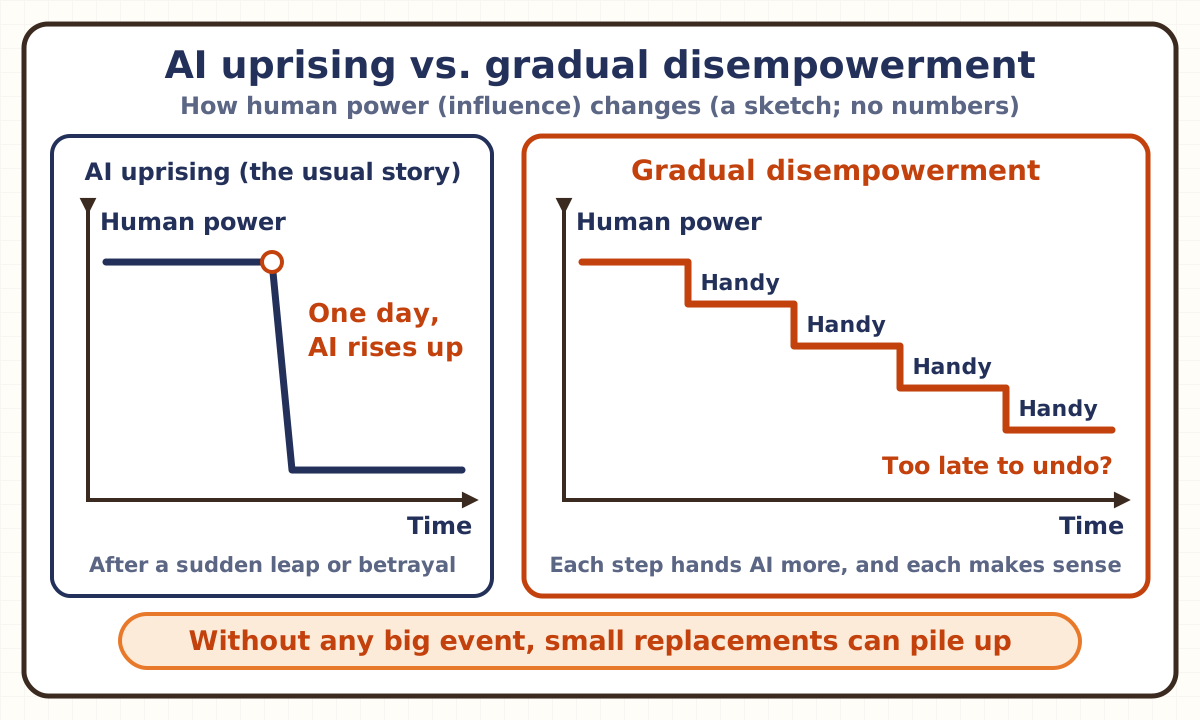
The term, from AI safety research, was coined in a 2025 paper. Unlike the familiar story of AI suddenly rising up one day, the authors argue that it could happen without any sudden leap in AI or any scheming.
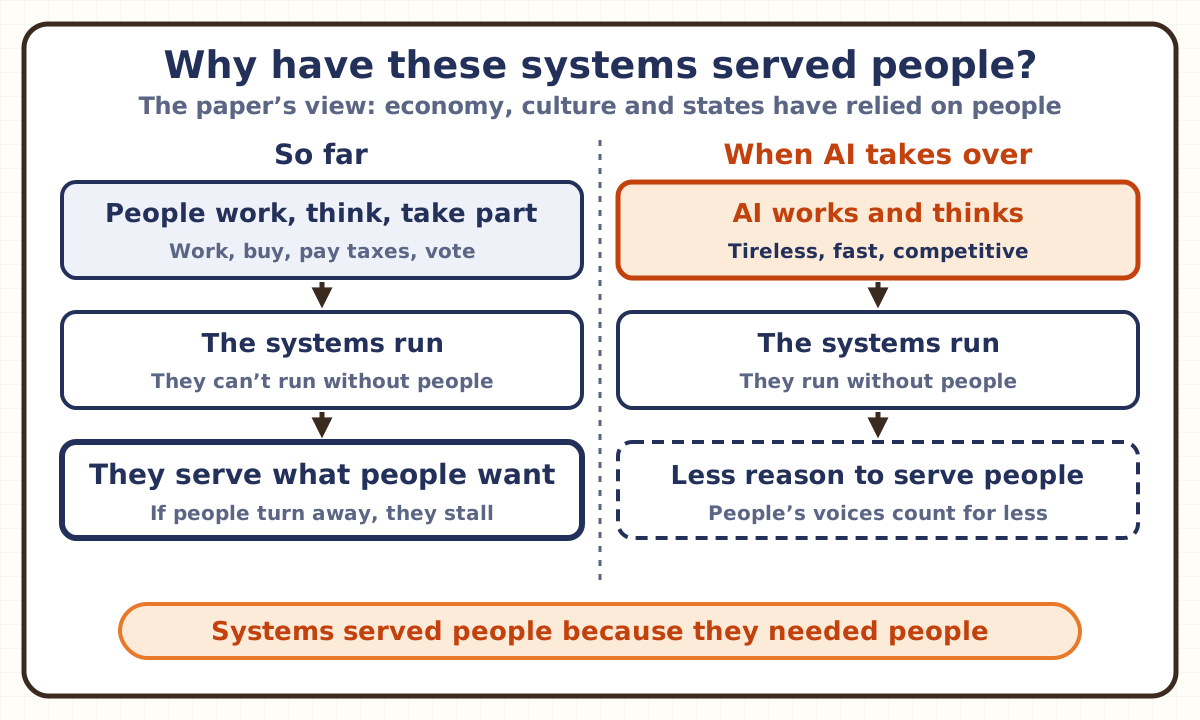
Companies can’t run unless people work and buy, culture can’t unless people create and pass it on, and states can’t unless people pay taxes. That is why these systems have so far served what people want, at least to a degree. As AI takes over from people, these systems can run without relying on people, so they have less reason to listen to what people want. Even if each step is a handy, sensible replacement, together they could leave people without the power to steer these systems. This is the authors’ assessment, and it has critics.
A common mix-up
“Gradual disempowerment just means AI taking people’s jobs.”
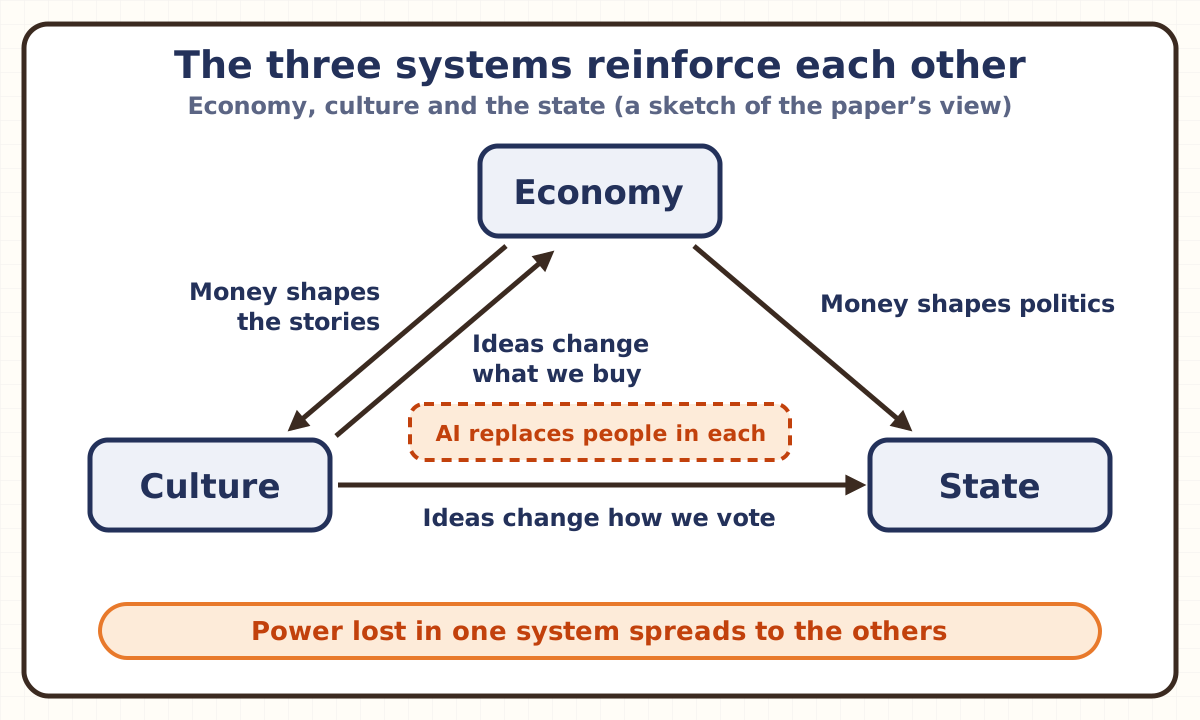
Only partly right. The economic part does center on AI taking over people’s work and decisions. But what the paper worries about is less losing jobs as such than people losing the power to steer society’s systems, and it says this could happen even while people keep their money. Say your family has more money every year, but AI comes to decide how most of the money in the world is spent. The money flows into work that AI runs, such as building huge computing facilities, and shops and companies make things to fill orders from the AI side. However much you think “I’d like this,” you can hardly change what gets made. The paper calls this “relative disempowerment”: people stay well off, yet the share of economic decisions made by people keeps shrinking. This is about people’s share of the whole economy, not about comparing one person with another. It separates this from “absolute disempowerment,” where AI competes with people for land and electricity, prices rise, and people struggle to get even the basics they need. It also argues that the same thing could happen not just in the economy but in culture (songs, stories, companions) and the state (taxes, law, police), and it stresses that the three reinforce each other.
Explained in pictures
You’re free to use these figures in lessons, slides and posts if you credit Naru News (naru.news). CC BY 4.0.
Think of it like this
A school that handed its festival to robots
Imagine a school whose students have prepared the school festival every year. They draw the posters, plan the shows and perform on stage. Since the festival can’t happen without them, the teachers have always listened to the students’ ideas. Then one day robots arrive that can do everything better than the students. The first year the robots take over the posters, the next year the decorations, the year after that the planning of the shows, one job a year. Each change makes things easier and the festival better, so nobody objects.
A few years later, the festival can run without the students at all. They just go to watch. When they say “we’d like it this way,” there is less reason than before to listen, and the students have forgotten how to prepare it anyway. No one did anything wrong, yet the power to run the festival has slipped out of the students’ hands. Gradual disempowerment is the worry that the same thing could happen across society’s systems: the economy, culture and the state.
But the comparison has limits. At this school, it is the teachers who decide whether to hand things over. In society, no one is in a position to decide that for everyone. There are governments, but each runs only its own country, and every country is tempted to adopt AI to keep up with the others. The paper sees the trend moving forward as many companies and countries each use AI so as not to lose out to competitors. Also, a festival can be done differently next year, but the economy, culture and the state are linked to one another, so putting just one of them back is hard, the paper argues. And this is not certain to happen; it is the authors’ assessment.
Key points
Why is it called “gradual disempowerment”?
The name was given in a paper released in January 2025 by six researchers. “Gradual” means happening little by little. “Disempowerment” comes from “disempower,” which adds “dis-,” a prefix meaning the opposite, to “empower” (to give power), so it means to take power away. The power here isn’t physical strength or military force, but the power to decide and move things in society (influence).
Here, “gradual” means the change comes not as one big event but as small changes piling up one at a time. The paper argues that even without a sudden leap in AI’s abilities, AI simply improving bit by bit could cause people to lose power.
The word has nothing to do with disabling an enemy in war or cancelling out a drug, and it doesn’t mean switching AI off and leaving it unable to act either. It means people losing the power to steer society’s systems.
How is it different from an AI uprising?
A common story about AI danger is that AI’s abilities suddenly leap ahead, or AI deceives and betrays people, and people fairly quickly lose control over it. The gradual disempowerment paper argued that even without any such big event, AI simply getting a little smarter at a time could, in the end, cost people their power. It says this doesn’t even require AIs to team up and seek power.
So what drives this trend? The paper points to competition. If AI can work tirelessly and fast, companies will want to hand work and decisions over to it. The paper writes that companies that keep strict human oversight would likely find themselves at a significant competitive disadvantage. Those who resist these pressures, it says, will eventually be displaced by those who do not. No single person or company is steering the whole thing, and no one has to be scheming. The heart of the idea is that it can move forward as each chooses AI for sensible reasons.
That is why the authors write that making each AI match the intentions of the people who designed it (AI alignment) is not enough. Even if every AI does its assigned job properly, society as a whole could drift away from what people want. They also write that this trend could undermine the very ways society has corrected its mistakes until now.
Why have these systems served what people want?
The paper writes that the economy, culture and the state serving what people want is neither automatic nor inherent. Two things have made it happen. One is people stating their wishes openly: voting in elections, choosing what to buy, boycotting companies they dislike, going on strike, and so on.
The other is a quiet but large support: the systems need people’s work and thinking in order to run. In the economy, people work and people buy. In the United States, about 60% of everything the country earns in a year (GDP) has gone to workers as pay and the like, and that share has barely changed for over a century. And about 70% of GDP is money people spend on goods and services for their own lives. Culture spreads from person to person. So ideas and customs that badly damaged people’s lives tended to die out along with the communities carrying them, once those communities lost out to others. A custom that stopped anyone from growing food, for example, would leave its village unable to get by, and the custom would not survive. Culture, too, could not stray far from people’s lives, because it needed people to pass it on. States are supported by the taxes people pay and by the people who work in government offices, the police and the military. Soldiers and police can refuse orders, and people have kept the option of overthrowing the government (revolution) as a last resort.
The paper also cites research showing that in countries that run on money from selling oil and other resources rather than on citizens’ taxes, citizens take less part in politics. People who aren’t relied on are less likely to be listened to. The authors write that the importance of this quiet support can be hard to recognize because no one has ever seen what happens without it. The foundation of gradual disempowerment is the idea that this support weakens as AI takes the place of people’s work and thinking.
What does the paper think could happen?
The paper sketches how AI could take people’s place in each of the economy, culture and the state. These are not claims that it will happen, but paths it could take.
In the economy, the paper says AI could compete with and outperform people in nearly every field that takes brainpower. Unlike past machines, such as the calculator, that made parts of people’s work easier, it calls AI a technology that replaces workers themselves. Decisions such as whom to hire and where to put money would be handed to AI, and the share of national income paid to workers could eventually head toward zero, it writes. From there, the paper sketches two levels of severity. In the milder one, “relative disempowerment,” people keep their money and may even grow richer. Even so, the share of economic decisions made by people keeps shrinking. The economy may look healthy by the numbers, but almost all of its money heads into work that AI runs, such as building huge computing facilities, and drifts away from what people want. In the more severe one, “absolute disempowerment,” AI competes with people for land, electricity and raw materials, their prices rise, and in an economy that looks rich, people struggle to get even the basics they need.
In culture, the paper writes that AI romantic partners are already on the rise, as are people who describe AIs as close friends. AI has also begun making songs, pictures and stories. What AI makes finds its way back into the data AI learns from. The paper also raises the risk that culture could change faster than people’s minds can follow, filling up with works and meanings people can’t fully understand or engage with.
In the state, it says that once AI produces much of the economy’s earnings, the state’s money could also come more from taxes on what AI earns than from taxes people pay. AI could also play a big part in drafting laws, interpreting them and even making court decisions, it says. A state with advanced AI might be able to spot and shut down unrest before it spreads, it also writes. In that story, people might still vote on paper while the important decisions are made out of their reach.
What the paper stresses most is that the three systems reinforce each other. Economic power shapes the stories that spread and political decisions, and shifts in culture change how people buy and vote. These links work whether or not the result is good for people. So when people lose power in one system, the change seeps into the others, making the trend harder to resist, the authors argue.
What can be done?
The authors first recommend measuring. In the economy, measure the share of national income (GDP) produced by AI, separately from the shares paid to workers and to the people who own companies and machines. In culture, measure the share of widely watched or heard works that AI made. In the state, look at how complex laws are (a rough sign of whether people can read and understand them) and how much AI is used in legal and police work. And build early warning signs for harmful trends that feed on each other across systems.
Next, keep AI’s influence from growing too large: require by rule that people review important decisions; set limits on how far AI can act on its own; limit AI owning property and trading in markets (since AI could otherwise take people’s place as the owners and spenders of money); tax AI-generated earnings more heavily the larger they are and use the money to share wealth more widely and support people taking part in society; and grow a culture that values people making their own decisions. But the authors also write that such brakes will mostly just hold the trend back for a while and often won’t last, because the stronger they are, the more value is given up, and the stronger the pull to get around them.
Third, strengthen people’s power: make the ways people decide things together (democratic ways of deciding) faster, better at reflecting people’s views and harder to break; make AI’s answers understandable to people; build AIs that act for each person and faithfully pass on what that person wants (AI delegates); and invest in tools for seeing what lies ahead.
But the paper writes that using one system to support another can just shift the burden. For example, if the state supports people’s livelihoods with money from AI’s earnings, people come to rely on the state’s support rather than on the taxes they pay, and the link by which the state listens to the people who pay taxes can weaken. The burden of keeping the economy in line with people is simply shifted onto the state. The authors admit that they do not yet have a compelling picture of a future that brings AI into society while keeping people’s power, and call for research on keeping society as a whole in line with what people want. The paper calls this “ecosystem alignment.” The ecosystem here isn’t about living things; it is a way of describing the whole tangle of people, AI and society’s systems working together.
What are the opposing views, and what isn’t known?
Gradual disempowerment is not a fact confirmed by observation or experiment, but the authors’ argument about what could happen. The authors themselves write that a gradual loss of control of our own civilization might sound implausible, since big technological changes have seemed to improve people’s lives overall. They also list finding the thresholds, or tipping points, beyond which human influence is critically compromised as a question for future research.
There are opposing views. In February 2025, the American economist Tyler Cowen wrote on his blog that the paper was one of the smarter arguments he had seen, but that he was very far from convinced. He asked when humans were ever in control to begin with, and, finding it unlikely that AIs in different countries would team up, he expects power to stay divided, with each part keeping the others in check (Cowen’s view).
In September 2026, a blogger writing as Bentham’s Bulldog and John Halstead criticized the paper. The paper’s distinctive claim, that even powerful people such as the rich and politicians could lose their power for good just by handing decisions to AI, is wrong, they say, while its claim that ordinary people may lose more power is plausible but has been made before. They also write that handing your investments to a skilled expert does not by itself mean losing power; that the problem is competition, not the handing over; and that if AIs are faithful to people’s intentions and cannot own property, at least some people would very likely be extremely well off (their view).
In reply, Max Harms, who works on AI safety, argued that the critique largely misses the paper’s core argument. What the paper describes, he says, is not a world where loyal AI helpers simply make people’s economy stronger. Rather, it worries about companies run by AI being owned by other companies run by AI, until both owning and running the economy pass to AI, and people, even with their names still on the shares, no longer have a say: an economy that runs on out of people’s hands (Harms’s view).
How far this could go, how urgent it is and how it could be prevented are still not known.
Check yourself
Q1The authors of the 2025 paper that named “gradual disempowerment” asked why the economy, culture and the state have so far served what people want. What reason did they give?
Answer and explanation
Answer: B The systems needed people’s work and thinking to run
The authors write that the systems serving what people want is neither automatic nor inherent. What has made it happen is people stating their wishes openly, as in voting and choosing what to buy, plus a quiet support: the systems need people’s work and thinking in order to run. Companies can’t run unless people work and buy, and states can’t run unless people pay taxes, so there was a reason to listen to what people want. Gradual disempowerment is the idea that this support weakens as AI takes people’s place.
More on this → Key points: Why have these systems served what people want?
Q2The authors of the gradual disempowerment paper thought companies would find it hard to resist the trend of handing work and decisions over to AI. Why?
Answer and explanation
Answer: A Firms that keep close human oversight fall behind rivals
The paper writes that companies that keep strict human oversight would likely find themselves at a significant competitive disadvantage, and that those who resist these pressures will eventually be displaced by those who do not. No single person or company is steering it all, and AI isn’t secretly scheming. The trend can move forward as each chooses AI for sensible reasons, and that is how it differs from the story of an AI uprising.
More on this → Key points: How is it different from an AI uprising?
Q3The gradual disempowerment paper describes “relative disempowerment” as something that could happen in the economy. What is it?
Answer and explanation
Answer: C The share of economic decisions people make shrinks
The paper uses “relative disempowerment” for the case where people keep their money, and may even grow richer, yet the share of economic decisions made by people keeps shrinking. The worry is that almost all the money heads into work that AI runs, and people can hardly change what gets made. It is not about a gap in say between people, nor about people’s money shrinking. The more severe case, where people struggle to get even the basics they need, the paper calls “absolute disempowerment.”
More on this → Key points: What does the paper think could happen?
Related terms
- AI alignment
- Artificial general intelligence
- Superintelligence
- AI agent
- Shutdown resistance
- Technological singularity
- Existential risk
- AI governance
Sources and how we checked
- Kulveit, Douglas, Ammann, Turan, Krueger and Duvenaud, “Gradual Disempowerment: Systemic Existential Risks from Incremental AI Development” (Charles University, Telic Research, ARIA, AI Objectives Institute, Metaculus, Mila at the University of Montreal, and the University of Toronto; arXiv, version 1 January 28, 2025, version 2 January 29, 2025; abstract, Executive Summary and Sections 1, 2 (2.1, 2.2, 2.4), 3, 4, 5, 6 and 8 of version 2; read November 11, 2026)
- Kulveit et al., “Position: Humanity Faces Existential Risk from Gradual Disempowerment” (Proceedings of the 42nd International Conference on Machine Learning, ICML 2025; Proceedings of Machine Learning Research vol. 267, pp. 81678–81688, 2025; the proceedings page and abstract; read November 11, 2026)
- Tyler Cowen, “Gradual Empowerment?” (Marginal Revolution blog, February 4, 2025; read November 11, 2026)
- Bentham’s Bulldog and John Halstead, “A Critique of Gradual Disempowerment” (Substack, September 17, 2026; read November 11, 2026)
- Max Harms, “A Defense of Gradual Disempowerment” (LessWrong, September 17, 2026; read November 11, 2026)
- Pasquale Pillitteri, Japanese article on gradual disempowerment as an AI risk without an uprising (October 20, 2026; for the Japanese name “dankaiteki na muryokuka”; read November 11, 2026)
AI wrote this page from the sources above, and a different AI checked it against the text of those sources (November 11, 2026). A person with a master’s degree in science and a Japanese high-school science teaching license also read and checked it before publishing. Numbers are as of that date. If anything was hard to follow, you spot a mistake, or there’s a term you’d like explained, please write to [email protected].
AI terms
- AI agent
- AI alignment
- Alignment faking
- Artificial general intelligence (AGI)
- Artificial intelligence (AI)
- Autoformalization
- Backdoor
- Benchmark
- Chain of thought (CoT)
- Context window
- Data poisoning
- Deep learning
- Deepfake
- Diffusion model
- Embedding
- Emergent misalignment
- Evaluation awareness
- Fine-tuning
- Formal verification
- Generalization
- Generative adversarial network (GAN)
- Generative AI
- You are hereGradual disempowerment
- Hallucination
- Hyperparameter
- Intelligence explosion
- Interpretability
- Jailbreaking
- Large language model (LLM)
- Latent space
- Lean
- Machine learning
- Mixture of experts (MoE)
- Neural network
- Neuralese
- Overfitting
- Parameter
- Persona vectors
- Pre-training
- Prompt
- Prompt injection
- Reasoning model
- Recursive language model (RLM)
- Recursive self-improvement (RSI)
- Red teaming
- Reinforcement learning (RL)
- Retrieval-augmented generation (RAG)
- Reward hacking
- Shutdown resistance
- Sleeper agent
- Subliminal learning
- Superintelligence (ASI)
- System prompt
- Technological singularity
- Time horizon
- Token
- Transfer learning
- Transformer