 Naru News日本語
What is transfer learning in AI?

In one minute
Transfer learning is a way for an AI to put what it learned on one task to use when it learns a different task.
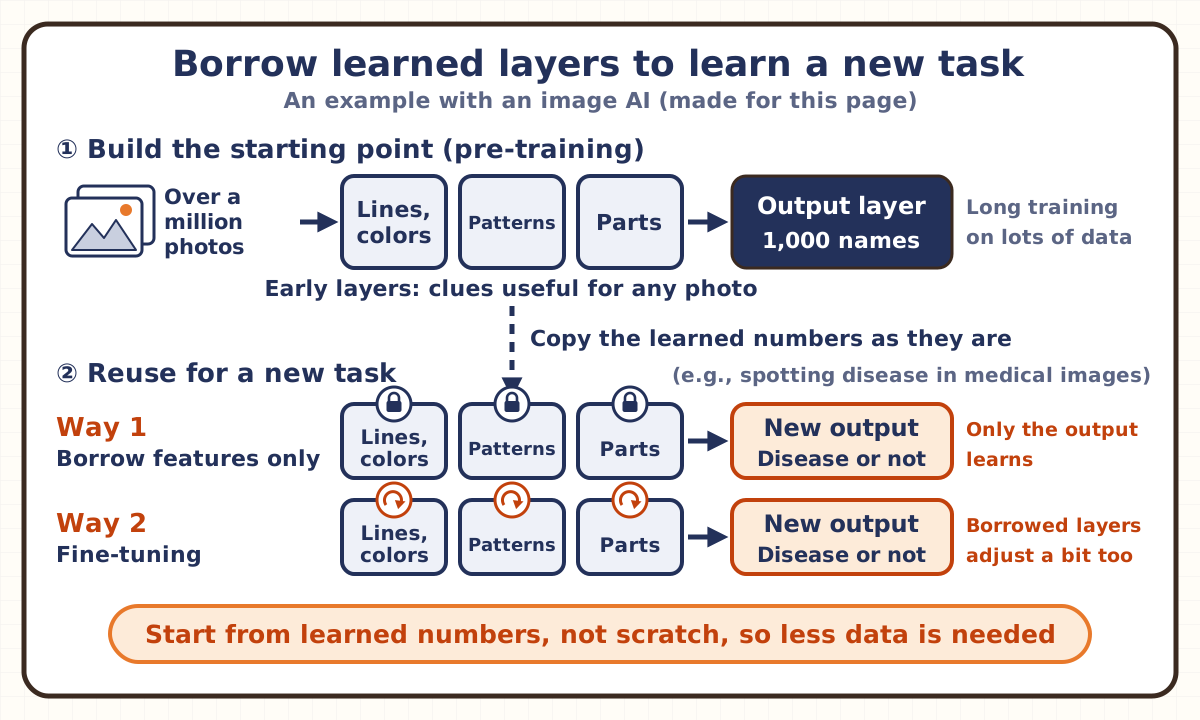
For example, an AI that practiced naming objects in more than a million photos can become the starting point for an AI that spots diseases in a small set of medical images. The early layers (stages of calculation) of an image AI have learned clues that help with almost any photo, such as lines and patterns. Borrowing them means far less data is needed than learning from scratch.
There are two common ways to reuse them: freeze the borrowed layers and train only a new last layer, or also retrain the borrowed layers a little (fine-tuning). The stage that builds the starting point from huge amounts of data is pre-training. But if the old and new tasks are too different, results can get worse instead (negative transfer).
A common mix-up
“Transfer learning and fine-tuning are two separate methods.”
Only partly right. Transfer learning is the name of an idea: putting what was learned on one task to use on another. There are two main ways to do it. One is to freeze the learned layers so they don’t change and train only a newly added last layer (it borrows just the clues, or “features,” the learned layers pull out, so this is also called feature extraction). The other is to start from the learned numbers (parameters) and also retrain the borrowed layers little by little on the new data; that is fine-tuning. It is true that these two ways differ. But fine-tuning is not a separate technique outside transfer learning. Machine learning textbooks and the guides for AI-building tools also describe it as one of the common ways to do transfer learning. Which way to choose depends on how much data you have and how close the new task is to the old one. In fine-tuning, how much the numbers inside are changed at each learning step (the learning rate) is kept very small so the borrowed numbers aren’t ruined.
Explained in pictures
You’re free to use these figures in lessons, slides and posts if you credit Naru News (naru.news). CC BY 4.0.
Think of it like this
Someone who played the violin learns the piano faster
Someone who has learned the violin doesn’t have to start over on things like reading music when they begin the piano. Both are musical instruments, so they share some knowledge. What you learned before helps you learn the next thing: that is the idea behind transfer learning. In an AI, the counterpart of reading music is the clues, such as lines and patterns, that its early layers have learned.
But not everything helps. Learning to ride a bicycle won’t make you better at the piano any faster. In AI, if the old and new tasks are too different, the borrowed clues may not just fail to help but make results worse than not borrowing at all (negative transfer).
The comparison has limits, too. A person works out for themselves which experience might help, but with an AI, the people building it choose which AI and which layers to borrow. And for an AI, “borrowing” means copying the learned numbers as they are to use as the new AI’s starting point. Because they are copied, the original AI stays as it was.
Key points
Why is it called “transfer”?
The word comes from psychology, the study of how people learn. When something learned earlier affects later, different learning, it is called “transfer of learning.” When it helps the later learning, it is “positive transfer”; when it gets in the way, it is “negative transfer.”
Transfer learning in machine learning is thought to come from the same idea. Just as someone who has learned the violin can learn the piano faster, an AI that puts what it learned before to use should be able to learn a new task well with less data.
One machine learning glossary describes it as transferring information from one task to another, for example, from a task with plenty of data to one with little. Collecting data with answers attached takes time and money, so needing less of it is a big advantage.
Why does what was learned help with another task?
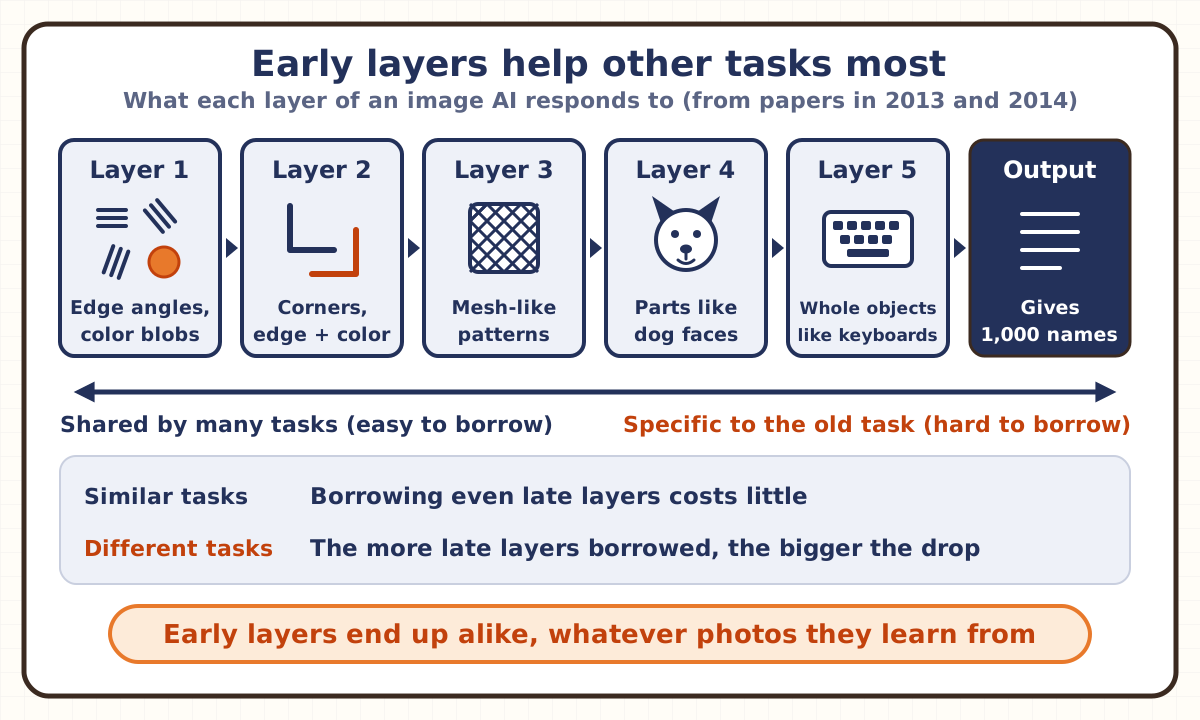
In AIs that recognize images, the early layers learn simple clues that show up in any photo. It is known that in deep networks (calculating systems with many stacked layers) trained on photos, the first layer comes to respond to stripes at various angles and to blobs of color, whatever photos it learned from. Because much the same thing forms whatever the task, these clues are thought to be shared ones that other tasks can use too.
The later the layer, the more its clues are tailored to the original task. In a 2013 study, the second layer responded to corners, the third to mesh-like patterns, the fourth to parts such as dogs’ faces, and the fifth to whole objects such as dogs and keyboards (more on the “Deep learning” page). The last, output layer gives the original task’s answers (such as 1,000 names), so it is replaced for a new task.
A 2014 study checked this layer by layer. It split the 1,000 kinds in more than a million photos into two tasks of 500 kinds each, copied the first few layers of a network trained on one task, and then trained on the other. The first two layers could be borrowed with almost no loss. When the split made the tasks different, such as man-made objects versus natural things, the more later layers were borrowed, the bigger the drop.
How is it done?
There are two common ways. Both begin by copying the layers and numbers of a trained AI and swapping only the last, output layer for one made for the new task. The old output layer is tied to the old task’s answers (such as 1,000 names).
The first way freezes the borrowed layers so they don’t change and trains only the new output layer (borrowing just the features, or feature extraction). The AI learns only how to connect the clues the borrowed layers pull out of a photo to the new answers. The layers are frozen so that retraining won’t ruin the information they hold.
The second way, done afterward, unfreezes all or some of the borrowed layers and retrains them on the new data too; that is fine-tuning. The clues are adjusted little by little to fit the new task. But the new data is often small, so changing the numbers inside by a lot at each learning step (a high learning rate) can quickly lead to overfitting (fitting the training data so closely that the AI fails on real cases).
The guide for an AI-building tool has an example. An AI learns to tell cats from dogs using 2,000 photos. It borrows a network trained on more than a million photos, keeps it frozen, and trains only a newly added output layer; its accuracy reached about 96%. Then the later layers were unfrozen and fine-tuned, and accuracy rose to nearly 98%.
How big a difference does it make when data is scarce?
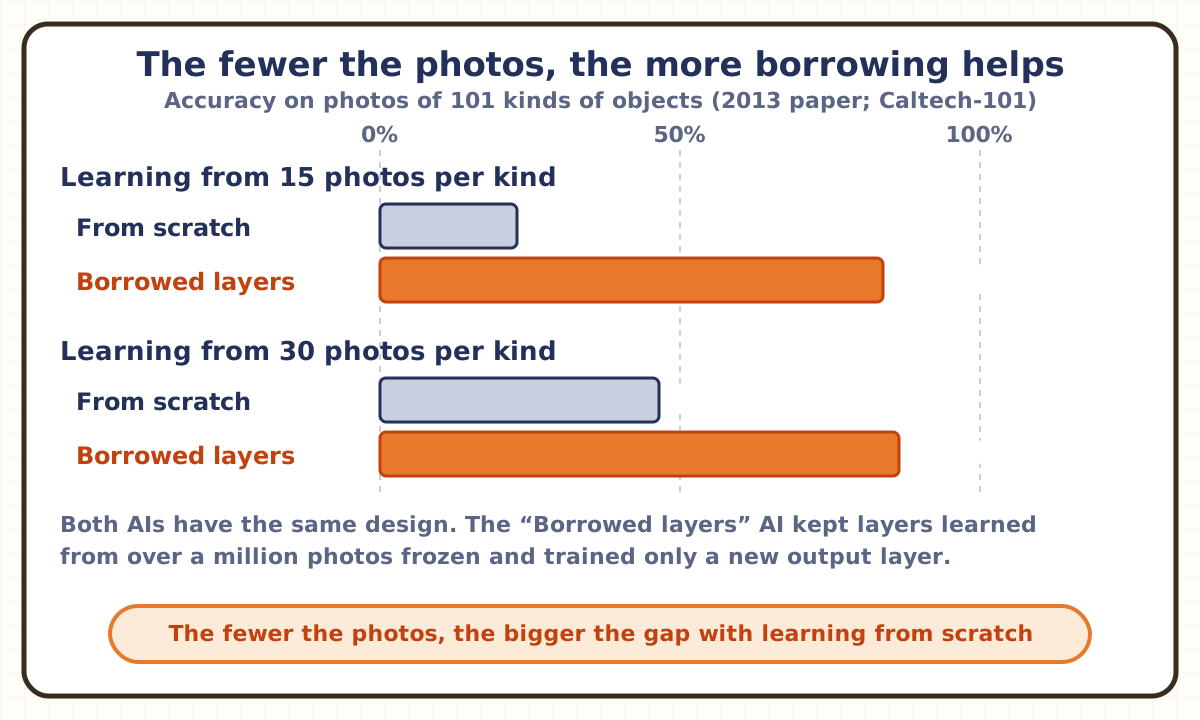
The gap can be very large. The 2013 study above, which looked at what each layer responds to, also tested how much borrowing helps, in the same paper. It borrowed the layers of a network trained on more than a million photos, kept them frozen, trained only a new output layer, and had it tell apart photos of 101 kinds of objects. Learning from 15 photos per kind, it got 83.8% right. The same network design, trained from scratch on just those photos, got 22.8%. With 30 photos per kind, the figures were 86.5% and 46.5%.
It is used for medical images too. A 2017 study started from an image AI trained on huge numbers of photos and fine-tuned all its layers on about 130,000 photos of skin conditions. On two tasks of telling skin cancers from similar non-cancerous spots (such as moles), it did as well as 21 board-certified dermatologists.
How do language AIs use it?
Transfer learning took off in language AI around 2018. A paper that year pointed out that transfer learning had transformed the image field, but in language, models were still often trained from scratch for each task. It then showed a method that fine-tunes a language model trained on huge amounts of text. On tasks of sorting texts into types, with only 100 labeled examples, it did as well as a model trained from scratch on 100 times as many.
In the image field, pre-training usually meant learning from huge numbers of labeled photos. In language, pre-training on text without answers attached became common. If the AI practices guessing the next word or a hidden word, the answer is already written in the text itself (more on the “Pre-training” page).
How is it different from pre-training and fine-tuning?
Transfer learning is the name of an idea: “put what was learned to use on another task.” Pre-training and fine-tuning are names for a stage and a method within it.
Pre-training is the stage that builds the starting point. The AI learns in advance, from huge amounts of data, a foundation that helps with many tasks. For images, this often means huge numbers of labeled photos; for language, huge amounts of text without answers attached.
Fine-tuning is one way of reusing it. Starting from the borrowed numbers, the AI is retrained little by little on data for the target task. The other way is to freeze the borrowed layers and train only the output layer (more on the “Fine-tuning” page).
Transfer learning also takes forms other than borrowing layers. Having one model handle several tasks (multi-task learning) is given as an example of transfer learning.
Can it go wrong?
Yes. If the old and new tasks are too different, borrowing can make the results worse than not borrowing at all. This is called “negative transfer.” In machine learning, a 2005 study found it by experiment and concluded that transfer learning can actually hurt performance when tasks are too dissimilar. The main cause is thought to be the difference between the old data and the new data. It can also happen when the old data has many errors or much noise.
The bigger the difference, the less there is to gain from borrowing. In the 2014 study above, which checked layer by layer, between different tasks (man-made objects versus natural things), borrowing later layers caused a much bigger drop than between similar tasks.
With plenty of data, borrowing may make no difference. A 2019 study reported that on medical image tasks with plenty of data, such as about 250,000 photos of the back of the eye, borrowing made almost no difference to results. But with the photos cut to 5,000, borrowing gave the large models better results.
Check yourself
Q1The many stacked layers of an AI trained to recognize photos are borrowed for a different photo task. Which layers tend to help other tasks as they are?
Answer and explanation
Answer: A The early layers, near the input
The early layers near the input come to respond to clues found in any photo, such as stripes at various angles and blobs of color, whatever photos they learned from. Moving back from there, the clues become more tailored to the old task, and the last, output layer is tied to the old task’s answers, so it is replaced for a new task. In a 2014 study, too, the first two layers could be borrowed for another task with almost no loss.
More on this → Key points: Why does what was learned help with another task?
Q2Which describes how “transfer learning” and “fine-tuning” in AI are related?
Answer and explanation
Answer: C Fine-tuning is a kind of transfer learning
Transfer learning is the name of the idea of putting what was learned to use on another task, and fine-tuning is one way of doing it: starting from the borrowed numbers, the AI is retrained little by little on the new task’s data. Freezing the borrowed layers and training only a new output layer is another way of doing transfer learning, so the two are not the same thing.
More on this → Key points: How is it different from pre-training and fine-tuning?
Q3A 2014 study borrowed the learned layers of a photo-recognizing AI between two tasks: photos of man-made objects and photos of natural things. When more layers, further toward the back, were borrowed, what happened to the new task?
Answer and explanation
Answer: B The more layers borrowed, the worse it did
Between different tasks such as man-made objects and natural things, the more of the later layers were borrowed, the bigger the drop in results. This is because the later the layer, the more its clues are fitted to the original task. If the old and new tasks are too different, the new task can even do worse than without borrowing. This is called negative transfer.
Related terms
- Pre-training
- Fine-tuning
- Generalization
- Deep learning
- Neural network
- Machine learning
- Large language model
- Parameter
- Overfitting
- Hyperparameter
- Catastrophic forgetting
- Multi-task learning
- Self-supervised learning
Sources and how we checked
- Zhuang et al., “A Comprehensive Survey on Transfer Learning” (a survey; arXiv, v1 November 2019, v3 June 2020; Section 1 (someone who has learned the violin can learn the piano faster, riding a bicycle does not help with the piano, the idea’s roots in educational psychology, and the negative-transfer example of a Spanish learner struggling with French) and the definition in Section 3 (an extension of the one in Pan and Yang’s 2010 survey); read November 18, 2026)
- Google, “Machine Learning Glossary” (the transfer learning entry: transferring information from one task to another, from a task with more data to one with less, and the multi-task learning example; and the fine-tuning entry: fine-tuning is a form of transfer learning; read November 18, 2026)
- Kotobank, Japanese dictionary entry “ten’i” (transfer) (Digital Daijisen on transfer of learning, and positive and negative transfer, and the Saishin Shinrigaku Jiten entry; read November 18, 2026)
- Yosinski et al., “How transferable are features in deep neural networks?” (arXiv, November 2014; NIPS 2014; the abstract (the two causes, distant tasks still beat random features, the boost that lingers after fine-tuning), Section 1 (first-layer features resembling Gabor filters and color blobs), Section 2 (splitting the 1,000 classes into two groups of 500, about 645,000 images each, and the 551 man-made and 449 natural classes), Section 4.1 (layers one and two transfer almost perfectly) and Section 4.3 (a larger drop for dissimilar tasks); read November 18, 2026)
- Zeiler and Fergus, “Visualizing and Understanding Convolutional Networks” (arXiv, November 2013; Section 3 (ImageNet 2012: 1.3 million images in 1,000 classes), Section 4 (what layers 2 to 5 respond to) and Section 5.2 with Tables 4, 5 and 6 (keeping layers 1–7 fixed and training a new softmax, Caltech-101 accuracy with 15 and 30 images per class, Caltech-256 beating the leading method with 6 images per class, and why PASCAL fell short); read November 18, 2026)
- Caltech, “Caltech 101” (dataset description: pictures of objects in 101 categories; read November 18, 2026)
- Keras, “Transfer learning & fine-tuning” (François Chollet; created April 2020, modified June 2023; the definition, its use when data is scarce, the freeze-and-add-new-layers workflow, the optional fine-tuning step with a very low learning rate, and the risk of quick overfitting; read November 18, 2026)
- TensorFlow, “Transfer learning and fine-tuning” (Google tutorial; feature extraction and fine-tuning, MobileNet V2 pre-trained on ImageNet, 2,000 training photos of cats and dogs, 1,281 trainable numbers, about 96% and about 98%, and the first layers learning simple, generic features; read November 18, 2026)
- Zhang, Lipton, Li and Smola, Dive into Deep Learning, Section 14.2, “Fine-Tuning” (fine-tuning as a common technique for transfer learning, the output layer tied to the source labels, features for edges, textures and shapes, and a small learning rate; read November 18, 2026)
- Esteva et al., “Dermatologist-level classification of skin cancer with deep neural networks” (Nature 542, 115–118, 2017; PMC author manuscript; the abstract and methods (Inception v3 pre-trained on about 1.28 million images in 1,000 categories, 129,450 clinical images of 2,032 diseases, fine-tuning across all layers, on par with 21 board-certified dermatologists on both tasks, and transfer learning being optimal for the data available); read November 18, 2026)
- Tajbakhsh et al., “Convolutional Neural Networks for Medical Image Analysis: Full Training or Fine Tuning?” (IEEE Transactions on Medical Imaging 35(5), 2016; the arXiv abstract (four applications in radiology, cardiology and gastroenterology, as good as or better than training from scratch, more robust to training set size); read November 18, 2026)
- Howard and Ruder, “Universal Language Model Fine-tuning for Text Classification” (ULMFiT; arXiv, January 2018; the abstract (transfer learning has greatly impacted computer vision, NLP still trains from scratch, and 100 labeled examples match training from scratch on 100 times more data); read November 18, 2026)
- Devlin et al., “BERT: Pre-training of Deep Bidirectional Transformers for Language Understanding” (Google AI Language; arXiv, October 2018; the abstract (fine-tuning with just one additional output layer, and 11 tasks); read November 18, 2026)
- Raffel et al., “Exploring the Limits of Transfer Learning with a Unified Text-to-Text Transformer” (T5; Google; arXiv, October 2019; the abstract (transfer learning as pre-training on a data-rich task and then fine-tuning) and Section 1 (NLP pre-trains on unlabeled data, while computer vision pre-trains on labeled data such as ImageNet), Section 3.1.4 (an objective that needs no labels: predicting missing or corrupted tokens) and Section 3.2.1 (a language model trained for next-step prediction); read November 18, 2026)
- Zhang et al., “A Survey on Negative Transfer” (arXiv, September 2020; IEEE/CAA Journal of Automatica Sinica, 2022; Sections 1 and 2 (the definition, first found by experiment by Rosenstein et al. in 2005, transfer may hinder performance if the tasks are too dissimilar, domain divergence as the root cause, and source data quality); read November 18, 2026)
- He, Girshick and Dollár, “Rethinking ImageNet Pre-training” (arXiv, November 2018; the abstract (training from random initialization on COCO is no worse, even with 10% of the data, and pre-training speeds up convergence early in training); read November 18, 2026)
- Raghu et al., “Transfusion: Understanding Transfer Learning for Medical Imaging” (NeurIPS 2019; arXiv, February 2019; the abstract, the retinal fundus (about 250,000 images) and chest X-ray tasks, and the comparison with 5,000 images; read November 18, 2026)
AI wrote this page from the sources above, and a different AI checked it against the text of those sources (November 18, 2026). A person with a master’s degree in science and a Japanese high-school science teaching license also read and checked it before publishing. Numbers are as of that date. If anything was hard to follow, you spot a mistake, or there’s a term you’d like explained, please write to [email protected].
AI terms
- AI agent
- AI alignment
- Alignment faking
- Artificial general intelligence (AGI)
- Artificial intelligence (AI)
- Autoformalization
- Backdoor
- Benchmark
- Chain of thought (CoT)
- Context window
- Data poisoning
- Deep learning
- Deepfake
- Diffusion model
- Embedding
- Emergent misalignment
- Evaluation awareness
- Fine-tuning
- Formal verification
- Generalization
- Generative adversarial network (GAN)
- Generative AI
- Gradual disempowerment
- Hallucination
- Hyperparameter
- Intelligence explosion
- Interpretability
- Jailbreaking
- Large language model (LLM)
- Latent space
- Lean
- Machine learning
- Mixture of experts (MoE)
- Neural network
- Neuralese
- Overfitting
- Parameter
- Persona vectors
- Pre-training
- Prompt
- Prompt injection
- Reasoning model
- Recursive language model (RLM)
- Recursive self-improvement (RSI)
- Red teaming
- Reinforcement learning (RL)
- Retrieval-augmented generation (RAG)
- Reward hacking
- Shutdown resistance
- Sleeper agent
- Subliminal learning
- Superintelligence (ASI)
- System prompt
- Technological singularity
- Time horizon
- Token
- You are hereTransfer learning
- Transformer