 Naru News日本語
What is a deepfake (a realistic fake video, photo or voice made with AI)?
Also called: Deep fake

In one minute
A deepfake is a video, photo or voice recording made or altered with AI so that a real person seems to say or do something they never actually said or did.
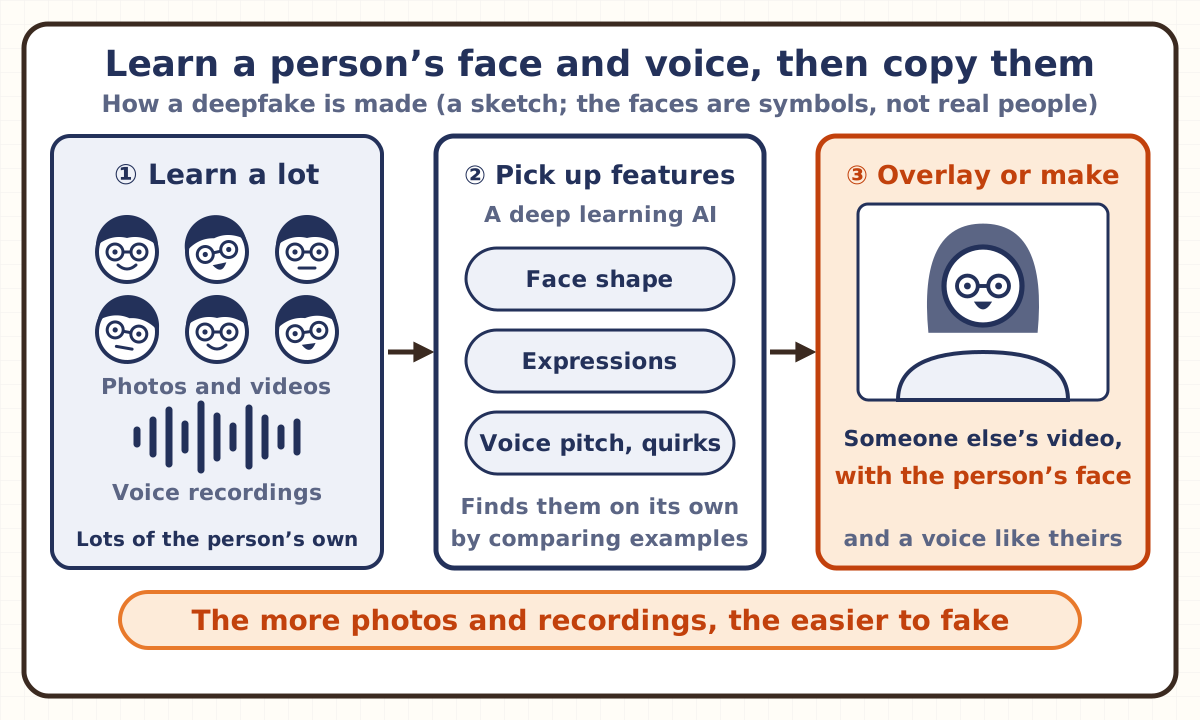
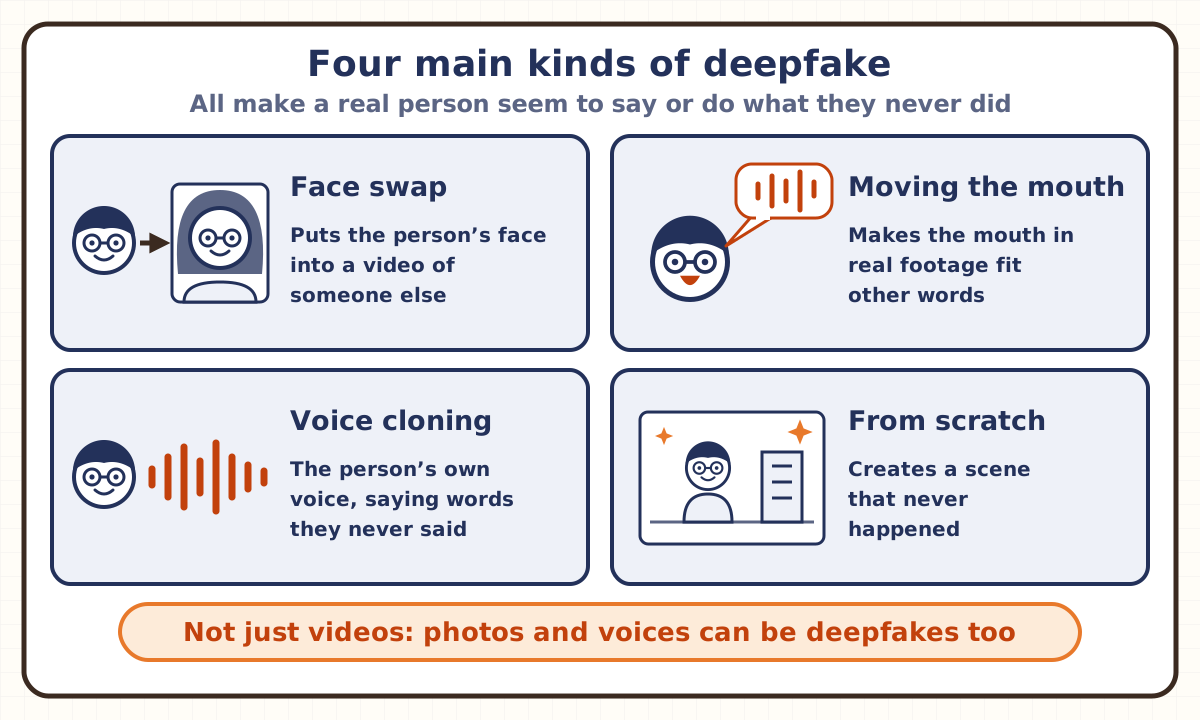
The word combines the “deep” of deep learning (a way for AI to learn from lots of data) with “fake.” When an AI is trained on many photos or recordings of a person, it picks up the features of their face and voice. It can then put their face into someone else’s video, make a mouth fit words that were never spoken, or make a voice that sounds just like them.
Deepfakes are misused to swindle money, spread false information and make sexual images of people without their consent. They can be hard to spot by look or sound alone, so checking where something came from matters.
A common mix-up
“If you look closely, you can spot a deepfake from odd details in the face or shadows.”
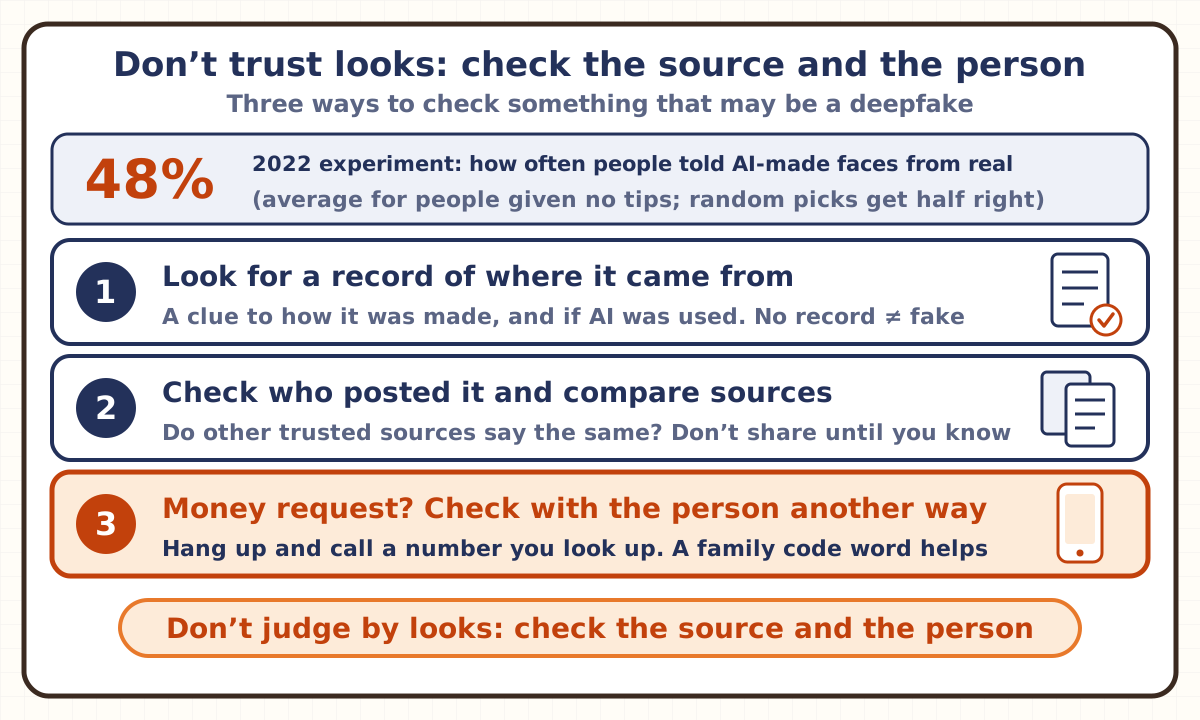
Only partly right. AI-made videos and photos sometimes show odd details, such as strange hands, teeth or eyes, shadows pointing the wrong way, or motion and voice slightly out of sync, and these can be clues. But not finding anything odd doesn’t mean something is real. In an experiment published in 2022, people were shown a mix of AI-made face photos and real ones and asked which was which. On average they got 48.2% right, no better than picking at random (with two choices, random picks get half, or 50%, right). People who were first taught how to spot the flaws got 59.0% right (AI faces with obvious flaws had been left out). Some also think that as the technology improves, spotting fakes by eye will get harder. So don’t judge by looks alone: check where it came from, or check with the person.
Explained in pictures
You’re free to use these figures in lessons, slides and posts if you credit Naru News (naru.news). CC BY 4.0.
Think of it like this
A mask that moves just like the real person
Imagine a portrait artist who studies hundreds of photos of someone, learns the shape of their face and the way they smile, and makes a mask that looks exactly like them. The mask even moves its eyes and mouth to follow the wearer’s expressions. When someone else puts it on and talks, people watching on a screen think the real person is speaking. A deepfake face swap is like having an AI make that mask.
The more photos the artist has, the closer the mask gets to the real person. In the same way, the more photos and recordings of someone an AI has, the easier it is to make a convincing fake. That is why not putting too many of your own photos and voice recordings online is one way to protect yourself.
But the comparison has limits. A mask copies only a face, while a deepfake can also copy a voice, make the mouth in real footage say different words, or create a scene that never happened from scratch. And a mask is usually obvious up close, while a deepfake can be hard to spot even when you look carefully. The AI isn’t trying to trick anyone. Whether a deepfake is used to deceive is decided by the people who make and use it.
Key points
Why is it called a “deepfake”?
The word was made by combining the “deep” of deep learning with “fake.” Deep learning is one way for AI to learn from lots of data, in which the AI works through many steps of calculation stacked one on top of another. The “deep” refers to how deep that stack of steps is.
At the end of 2017, a user called “deepfakes” on Reddit, a large online forum, was using deep learning to swap celebrities’ faces with the faces of people in sexual videos, and posting the results. When this came to light, it caused a media frenzy, and many more deepfake videos began to appear after that.
Today the word is used more broadly, not just for face swaps, for any image, audio or video made or altered with AI that could be mistaken for the real thing.
How can it look so real?
Because the AI learns from many photos, videos and voice recordings of the person. By comparing many photos of the same person, a deep learning AI finds on its own what they all share: the shape of the face and the way it moves when the expression changes. Voices work the same way: from many recordings, it picks up the pitch of a voice and the quirks of how someone speaks. People don’t have to tell it, one by one, what to look for. The more photos and recordings of the same person there are, the better it can capture what makes that person who they are.
In a face swap, the AI reads the expression and the angle of the face in the original video and redraws it as the target person’s face. In fakes that match the mouth, it redraws the area around the mouth in real footage to fit different words. In voice cloning, it learns the features of a voice from the person’s recordings and has that voice say sentences the person never said.
Some fakes are made from scratch. As generative AI (AI that creates new text, images and more) has advanced, it has become possible to make images that are hard to tell from photos, as well as realistic voices and videos. Another method, which trains an AI that makes things by pitting it against an AI that judges whether they are real or fake, has also been used to make realistic photos of faces.
What problems does it cause?
First, it is used to swindle money. In a case reported to Hong Kong police at the end of January 2024, a person received an email from someone posing as the officer in charge of the company’s money at the head office in the United Kingdom, and was invited into a group video call about supposedly confidential deals. In the end, the person authorized transfers to five bank accounts and lost about 200 million Hong Kong dollars. Hong Kong police believe the video call had been made in advance using videos found online and the voice of the person being impersonated.
It is also used for phone calls that copy a family member’s voice to say they are in trouble and need money right away, and for video calls that pose as company executives or police officers.
It is also used to spread false information. In March 2022, a fake video that made Ukraine’s president appear to tell soldiers to stop fighting and give up spread on social media. In January 2024, ahead of a US presidential primary (a vote to choose a party’s candidate), phone calls imitating the president’s voice urged people not to vote in the primary.
Making sexual images of people without their consent is another serious problem. In Japan, too, cases where face photos, such as those in school yearbooks, are turned into sexual images with generative AI and other tools are rising sharply.
There is also a worry that the better known deepfakes become, the easier it gets to wave away real videos and recordings as “fake.” The authors of a 2019 paper called this the “liar’s dividend.” A dividend is a share of the profits, so it means that people who lie gain from it.
Can people tell them apart?
Telling them apart by eye can be hard. In an experiment published in 2022, 315 people were each shown 128 face photos, a mix of AI-made faces (of people who don’t exist) and real ones, and asked which was which. On average they got 48.2% right. With two choices, picking at random gets half, or 50%, right, so they did no better than that. Another 219 people were first taught the kinds of flaws that tend to show up in fakes and were told after each photo whether they were right, but still got only 59.0% right. In this experiment, AI faces with obvious flaws had been left out in advance.
In the same experiment, another 223 people rated how trustworthy each face looked on a scale of 1 to 7. The AI-made faces averaged 4.82, a little higher than the real faces at 4.48.
AIs that spot fakes are being built too, but whenever a new way of spotting them appears, the AIs that make fakes improve, and some people work out ways to avoid being caught. A spotting AI may catch fakes made the way it learned about, yet be weak against fakes made other ways. This cat-and-mouse game goes on.
So there are also systems for checking where something came from, rather than judging by looks. C2PA is a shared format, agreed on by a group of organizations, for recording where content came from. It attaches a record to a photo or video, such as when and with what tools it was made, how it was edited and whether AI was used. The record also carries a mark that lets you check whether the data was changed along the way (a digital signature), so if the record or the content is changed later, it shows.
But this record doesn’t tell you whether the content is true. Adding it is optional, and records are often lost when files are shared on social media and elsewhere, so a missing record doesn’t mean something is fake. So how should you use it? If there is a record, it gives you clues about who put the content out, what tools made it and how it was edited. But it isn’t proof on its own, so use it together with other checks: check who posted it, compare how other trusted sources report it, and for money requests, check with the person in another way.
There are also ways to put an invisible mark (a digital watermark) inside AI-made images and sounds, but such marks can sometimes be removed.
Are there any rules?
The EU AI Act (an EU law on AI passed in 2024) defines a deepfake as image, audio or video content made or altered by AI that resembles real people, objects, places, organizations or events and would falsely appear to a person to be authentic or truthful.
From August 2, 2026, it requires those who use AI systems that make deepfake images, audio or video, for work and other purposes that are not purely personal, to disclose that the content was made or altered by AI. For things that are clearly creative works, such as films, stories or pieces that poke fun at people or society, it is enough to disclose this in a way that doesn’t spoil the work. It also requires companies and others that provide AI systems that make images, audio, video or text to mark what they make in a machine-readable way, so it can be detected as AI-made. AI systems already on the market before August 2, 2026, are given a little more time: they must do this by December 2, 2026.
A 2026 amendment added a ban on AI systems that make sexual images or videos of an identifiable person without that person’s clear consent. It bans offering AI systems built to make such images, or ones that lack adequate safeguards and so can easily make them, and using AI for the purpose of making such images. AI systems that make sexual images of children are banned in the same way. Both bans apply from December 2, 2026.
In Japan, the AI Guidelines for Business from the Ministry of Internal Affairs and Communications and the Ministry of Economy, Trade and Industry ask businesses involved with AI to take steps against false information and, following principles on AI that countries agreed on together, to introduce ways such as digital watermarks, where technically possible, for people to tell what AI has made. But these guidelines are not a law that can be enforced; they are guidance that encourages businesses to act on their own.
How can you protect yourself?
First, don’t judge by looks alone. When you see surprising video or audio, check whether whoever first put it out (the source) can be trusted, and compare several sources to see whether other trusted ones report the same thing. While you can’t tell whether it’s true, it’s also important not to share it.
Check money requests with the person in another way. If a phone or video call from someone claiming to be family or from your company asks you to send money, hang up and call back on a number you have looked up yourself. Another idea is to agree on a code word with your family to confirm it’s really them. On a video call, you can also ask the other person to turn their head up, down, left and right and watch whether the picture goes wrong, or ask questions about what you’ve been talking about to test them.
Not putting too much of your face and voice online also helps. Share fewer photos and recordings of yourself, and set your social media accounts so that only people you know can see them. It’s also important not to casually post photos of your own or your friends’ faces on social media and elsewhere.
If a photo of you is turned into a sexual image, or someone demands money to delete one, don’t pay; talk to a parent, a teacher or another adult you trust.
Check yourself
Q1In an experiment published in 2022, 315 people were shown a mix of AI-made face photos and real face photos, one at a time, and asked whether each was AI-made or real. On average, how often did they get it right?
Answer and explanation
Answer: A About 48% of the time
The 315 people got 48.2% right on average. With two choices, picking at random gets half, or 50%, right, so they did no better than that. About 59% is the figure for another 219 people who were first taught the flaws that tend to show up in fakes and were told after each photo whether they were right (AI faces with obvious flaws had been left out in advance). Telling fakes apart by looks alone can be hard.
Q2From August 2, 2026, the EU AI Act applies a rule to people and businesses that use AI systems making deepfake images, audio or video for work (not the companies that build and provide the AI, but those who use it to make content). What must they do?
Answer and explanation
Answer: B Tell viewers that the content was made with AI
The EU AI Act requires those who use AI systems that make deepfakes for work and other purposes that are not purely personal to disclose that the content was made or altered by AI. For things that are clearly creative works, such as films or stories, it is enough to disclose this in a way that doesn’t spoil the work. Putting machine-readable marks on the output is a rule for the companies that provide the AI. The rule says nothing about naming the AI system used.
Q3In a case reported to Hong Kong police at the end of January 2024, a person got an email from someone posing as the officer in charge of the company’s money at the head office in the United Kingdom, was invited into a group video call, and was swindled out of about 200 million Hong Kong dollars. What do Hong Kong police believe the faces and voices of the people in the call were made from?
Answer and explanation
Answer: C Videos posted publicly online, and their voices
Hong Kong police believe the video call was made in advance using videos found online and the voice of the person being impersonated. The more photos, videos and voice recordings of someone there are, the easier it is to make a convincing deepfake. For money requests, it’s important to hang up and check with the person on a number you have looked up yourself.
Related terms
- Generative AI
- Deep learning
- Neural network
- Diffusion model
- Generative adversarial network (GAN)
- Latent space
- Hallucination
- Digital watermarking
- Content provenance (C2PA)
Sources and how we checked
- European Commission, AI Act Service Desk, “Article 3: Definitions” (text of the EU AI Act, Regulation (EU) 2024/1689, based on the EUR-Lex consolidated version as at July 27, 2026; definitions (3) provider, (4) deployer and (60) deep fake; read November 13, 2026)
- European Commission, AI Act Service Desk, “Article 50: Transparency obligations for providers and deployers of certain AI systems” (EU AI Act, Article 50(1)–(7); consolidated version as at July 27, 2026; read November 13, 2026)
- European Commission, AI Act Service Desk, “Article 5: Prohibited AI practices” (EU AI Act, Article 5; points (ba) and (bb) of paragraph 1 and paragraphs 1a and 1b, added by the 2026 Digital Omnibus on AI; read November 13, 2026)
- European Commission, AI Act Service Desk, “Article 113: Entry into force and application” (dates from which the EU AI Act applies, including the parts amended in 2026; read November 13, 2026)
- European Commission, AI Act Service Desk, “Article 111” (EU AI Act, Article 111(4): deadline for AI systems on the market before August 2, 2026 to comply with Article 50(2); read November 13, 2026)
- EUR-Lex, “Regulation (EU) 2026/1744” (text of the 2026 amendment, the Digital Omnibus on AI; July 8, 2026, Official Journal of July 24, 2026; the points adding Article 5(1)(ba) and (bb), Article 111(4), and the application dates in Article 113 (December 2, 2026); read November 13, 2026)
- Ministry of Internal Affairs and Communications (Japan), White Paper on Information and Communications 2024, Part I, Chapter 4, Section 1 (in Japanese; the definition of deepfakes, the table of cases of information manipulation with deepfakes, and countermeasures; read November 13, 2026)
- Ministry of Internal Affairs and Communications and Ministry of Economy, Trade and Industry (Japan), AI Guidelines for Business, version 1.2, main text (in Japanese; March 31, 2026; the introduction on non-binding soft law, the Part 2 item on countermeasures against false information, and principle 7 of the Hiroshima AI Process guiding principles; read November 13, 2026)
- Ministry of Internal Affairs and Communications (Japan), special feature on image abuse with generative AI, such as school yearbook photos turned into sexual images (in Japanese; from its collection of internet trouble cases; read November 13, 2026)
- Ministry of Internal Affairs and Communications (Japan), special feature on information of uncertain truth online (in Japanese; how to check information; read November 13, 2026)
- Mirsky and Lee, “The Creation and Detection of Deepfakes: A Survey” (ACM Computing Surveys, DOI 10.1145/3425780; read arXiv version 3, September 2020, as HTML on ar5iv: Section 1 (origin of the name), Section 2 (kinds), Section 3 (how they are made) and Section 6.1 (detection); read November 13, 2026)
- Chesney and Citron, “Deep Fakes: A Looming Challenge for Privacy, Democracy, and National Security” (California Law Review, vol. 107, December 2019; the first part: origin of the name, how they are made, and the liar’s dividend; read November 13, 2026)
- Nightingale and Farid, “AI-synthesized faces are indistinguishable from real faces and more trustworthy” (PNAS, vol. 119, no. 8, e2120481119, February 2022, DOI 10.1073/pnas.2120481119; read Experiments 1–3 (accuracy and trustworthiness ratings), how the faces were chosen, and the discussion in the PubMed Central version; read November 13, 2026)
- C2PA, “C2PA Explainer” (explainer for specification 2.2: provenance, Content Credentials, digital signatures and limits; read November 13, 2026)
- NIST, “Reducing Risks Posed by Synthetic Content: An Overview of Technical Approaches to Digital Content Transparency” (NIST AI 100-4, November 2024; abstract, watermark removal (Section 3.1.1.3), metadata being stripped, automated and human-assisted detection, and the sections on CSAM and NCII; read November 13, 2026)
- FBI (IC3), “Criminals Use Generative Artificial Intelligence to Facilitate Financial Fraud” (public service announcement I-120324-PSA, December 3, 2024; misuse of vocal cloning and video calls, and tips to protect yourself; read November 13, 2026)
- Government of the Hong Kong SAR, “LCQ9: Combating frauds involving deepfake” (June 26, 2024; the Secretary for Security’s reply in the Legislative Council: three deepfake fraud cases reported to the police and the police’s advice; read November 13, 2026)
AI wrote this page from the sources above, and a different AI checked it against the text of those sources (November 13, 2026). A person with a master’s degree in science and a Japanese high-school science teaching license also read and checked it before publishing. Numbers are as of that date. If anything was hard to follow, you spot a mistake, or there’s a term you’d like explained, please write to [email protected].
AI terms
- AI agent
- AI alignment
- Alignment faking
- Artificial general intelligence (AGI)
- Artificial intelligence (AI)
- Autoformalization
- Backdoor
- Benchmark
- Chain of thought (CoT)
- Context window
- Data poisoning
- Deep learning
- You are hereDeepfake
- Diffusion model
- Embedding
- Emergent misalignment
- Evaluation awareness
- Fine-tuning
- Formal verification
- Generalization
- Generative adversarial network (GAN)
- Generative AI
- Gradual disempowerment
- Hallucination
- Hyperparameter
- Intelligence explosion
- Interpretability
- Jailbreaking
- Large language model (LLM)
- Latent space
- Lean
- Machine learning
- Mixture of experts (MoE)
- Neural network
- Neuralese
- Overfitting
- Parameter
- Persona vectors
- Pre-training
- Prompt
- Prompt injection
- Reasoning model
- Recursive language model (RLM)
- Recursive self-improvement (RSI)
- Red teaming
- Reinforcement learning (RL)
- Retrieval-augmented generation (RAG)
- Reward hacking
- Shutdown resistance
- Sleeper agent
- Subliminal learning
- Superintelligence (ASI)
- System prompt
- Technological singularity
- Time horizon
- Token
- Transfer learning
- Transformer