
What is an accretion disk (the disk of gas that spirals into a heavy object)?
Also called: Accretion disc

In one minute
An accretion disk is a disk of gas that circles a heavy object, such as a black hole, while slowly falling in.
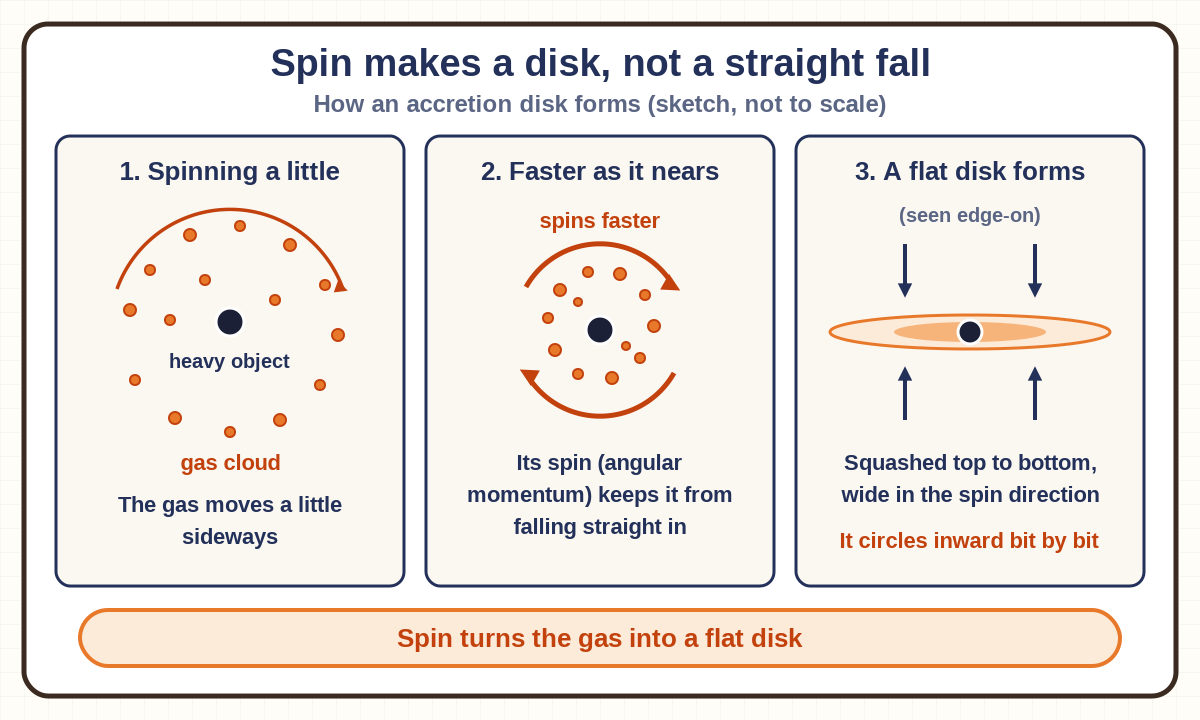
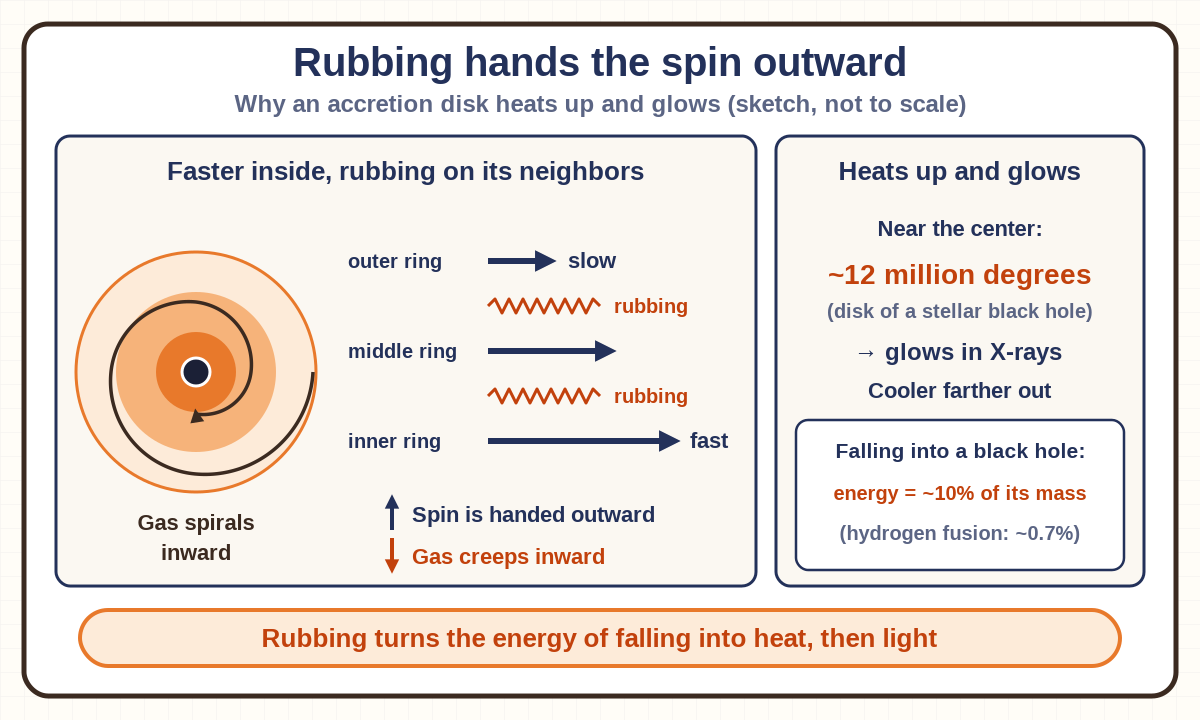
The gas is already spinning a little, so it can’t fall straight in: it circles faster as it gets closer and flattens into a disk. The inner parts circle faster, so neighboring gas rubs together. Gas that hands its spin to the gas farther out can’t keep circling and slowly falls inward. This rubbing turns the energy gained by falling into heat, so the gas glows. Around a stellar black hole, it reaches millions of degrees and glows brightly in X-rays.
A black hole itself gives off no light, but the accretion disk around it is among the brightest things in the universe. Around the giant black hole at a galaxy’s center, the disk can become a quasar brighter than the whole galaxy. Disks also form around neutron stars, white dwarfs and newborn stars, and the ring of light in black hole images is also light from hot gas circling around.
A common mix-up
“A black hole sucks nearby gas straight in, like a vacuum cleaner.”
Only partly right. It is true that gas that comes near a black hole eventually falls in. But it doesn’t fall straight in. If the gas is moving even a little sideways, it circles faster as it gets closer and keeps going around. It can move inward only as much as it hands its spin outward by rubbing against the gas around it. So the gas forms a flat disk and falls in little by little, circling many times. In fact, from far enough away, a black hole pulls with the same gravity as any other object of the same mass and has no special power to suck things in. If the Sun were replaced by a black hole of the same mass, the planets would keep circling in their present paths.
Explained in pictures
Free to use in lessons, slides and posts with credit (CC BY 4.0).
Free to use in lessons, slides and posts with credit (CC BY 4.0).
Free to use in lessons, slides and posts with credit (CC BY 4.0).
Free to use in lessons, slides and posts with credit (CC BY 4.0).
You’re free to use these figures in lessons, slides and posts if you credit Naru News (naru.news). CC BY 4.0.
Think of it like this
The swirl when you pull a bathtub plug
When you pull the plug in a bathtub, the water sometimes doesn’t pour straight into the drain but makes a swirl, circling around the drain. Even if the water was turning only a tiny bit at first, it circles faster the closer it gets to the drain, and goes down while swirling around.
For an accretion disk, the drain is the heavy object, such as a black hole, and the swirling water is the gas in the disk. The gas is already turning a little too, so it can’t fall straight in: it circles faster as it gets closer and moves inward little by little. The sizes are wildly different, but in both cases, spin keeps things from falling straight in.
But the comparison has limits. Bathwater is pulled downward by gravity and flows out through the hole in the drain. The gas in the disk is pulled toward the object in the middle, and it can’t move inward unless it rubs against the gas around it and hands its spin outward. And a bathtub swirl doesn’t get warm, but the gas in the disk heats up from this rubbing, reaching millions of degrees around a stellar black hole, and gives off strong light.
Key points
Why does the gas form a disk instead of falling straight in?
The key is spin, which physicists call angular momentum. Roughly speaking, spin is mass times speed times distance from the middle. Unless something outside interferes, it doesn’t grow or shrink on its own. So when something that is turning moves toward the middle and the distance shrinks, its speed goes up to make up for it. It is the same as a figure skater spinning faster when she pulls her outstretched arms in to her body.
Gas pulled toward a heavy object is usually moving a little sideways too. For example, where two stars circle each other as a pair, gas pulled off the companion star already carries spin from the two stars’ orbiting motion. Such gas circles faster as it gets closer, and its spin holds it up so that it can’t fall straight in.
Along the spin axis (top to bottom), on the other hand, nothing stops the gas from shrinking. So the gas gets squashed top to bottom while staying wide in the direction it spins, and becomes a flat disk. In a pair of stars, the disk forms along the plane in which the two stars circle each other. Gas with almost no spin, by contrast, doesn’t form a disk and falls in almost straight from all around.
Why does it get so hot and glow?
The gas in the disk circles faster the closer it is to the middle. So gas in neighboring rings rubs together, and the faster inner gas tugs on the gas farther out, handing it spin. Gas that gives up its spin can’t keep circling where it is and moves a little inward. In this way, spin moves outward and gas moves inward, bit by bit.
As gas falls inward, gravity speeds it up and it gains energy. Rubbing turns part of this energy into heat. In the disk of a stellar black hole, gas near the center reaches up to about 12 million °C and glows brightly in X-rays (invisible light, also used for medical X-ray pictures). Above and below the disk there is also thinner, even hotter gas (a corona) that reaches billions of degrees and gives off X-rays with even more energy.
An object’s mass is itself a huge amount of energy (Einstein’s formula E = mc²). On its way down to a black hole, falling gas can give off energy equal to about 10% of its mass as light. Hydrogen fusion inside the Sun, where hydrogen becomes helium, releases about 0.7%, so falling gas yields more than 10 times as much energy from the same amount of fuel. Apart from matter and antimatter destroying each other, it is the most efficient way to get energy in the universe.
But the ordinary stickiness (viscosity) of a gas is far too weak in a disk in space to make the gas fall as fast as observations show. Today, the idea is that weak magnetic fields in the disk use the difference in speed between inner and outer gas to stir up turbulence, which acts like a strong stickiness. This mechanism, the magnetorotational instability, was shown to work in disks by Steven Balbus and John Hawley in 1991. Earlier, in 1973, Nikolai Shakura and Rashid Sunyaev boiled the strength of the stickiness down to a single number (α, alpha) and showed how to work out a disk’s temperature and brightness. Their paper is one of the most cited in astronomy and is still the foundation of disk research.
What kinds of objects have one?
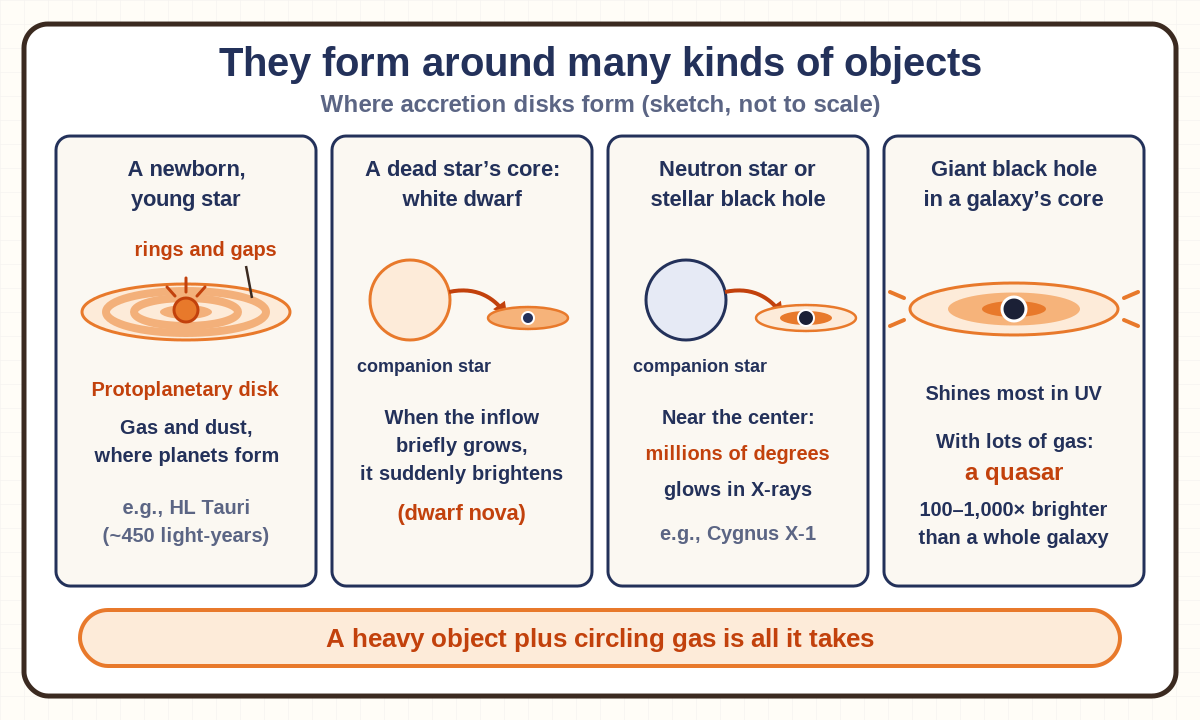
All it takes is a heavy object to pull gas in and gas circling around it. They are often found where two stars circle each other as a pair. If one of them is a small, heavy object made when a star collapsed at the end of its life (a white dwarf, neutron star or black hole), its strong gravity pulls gas off the ordinary companion star, and an accretion disk forms.
The disks around neutron stars and stellar black holes are extremely hot and glow brightly in X-rays. Such pairs are called X-ray binaries. In Cygnus X-1, for example, a black hole with about 21 times the Sun’s mass pulls gas from a heavy blue star and builds a disk around itself. It lies about 7,200 light-years from Earth (the distance light travels in 7,200 years).
In the disk around a white dwarf, the gas flowing onto the white dwarf sometimes increases for a while, and the system suddenly brightens. This is called a dwarf nova.
Accretion disks also form around supermassive black holes (hundreds of thousands to billions of times the Sun’s mass) at the centers of galaxies. Surprisingly, the heavier the black hole, the cooler its disk, and these shine most strongly in ultraviolet light (invisible light beyond violet). Disks around newborn stars belong to the same family too (see “Is the disk around a young star the same kind of thing?” below).
Is the disk around a young star the same kind of thing?
Yes. Stars are born when clouds of gas and dust shrink under their own weight. The clouds are turning a little too, so as they shrink they turn faster, and a flat disk forms around the newborn star. Gas in this disk also falls onto the star little by little, and the star takes it in. How much is falling is measured from things such as the extra ultraviolet light that gas falling onto the star gives off.
The big difference from the disks around black holes is that these disks contain a lot of dust and are also where planets are born. So they are also called protoplanetary disks. In 2014, the ALMA telescope (a radio telescope) imaged the disk of HL Tauri, a young star about 450 light-years from Earth that is no more than a million years old. The disk showed several bright rings with gaps between them, thought to be carved by planets forming in the disk.
Can it really outshine a galaxy?
Yes. When a lot of gas falls toward the supermassive black hole at a galaxy’s center, its accretion disk gives off 100 to 1,000 times as much light as the whole galaxy. Such extremely bright centers of distant galaxies are called quasars. Galaxy centers where infalling gas glows brightly, including fainter ones, are called active galactic nuclei as a group.
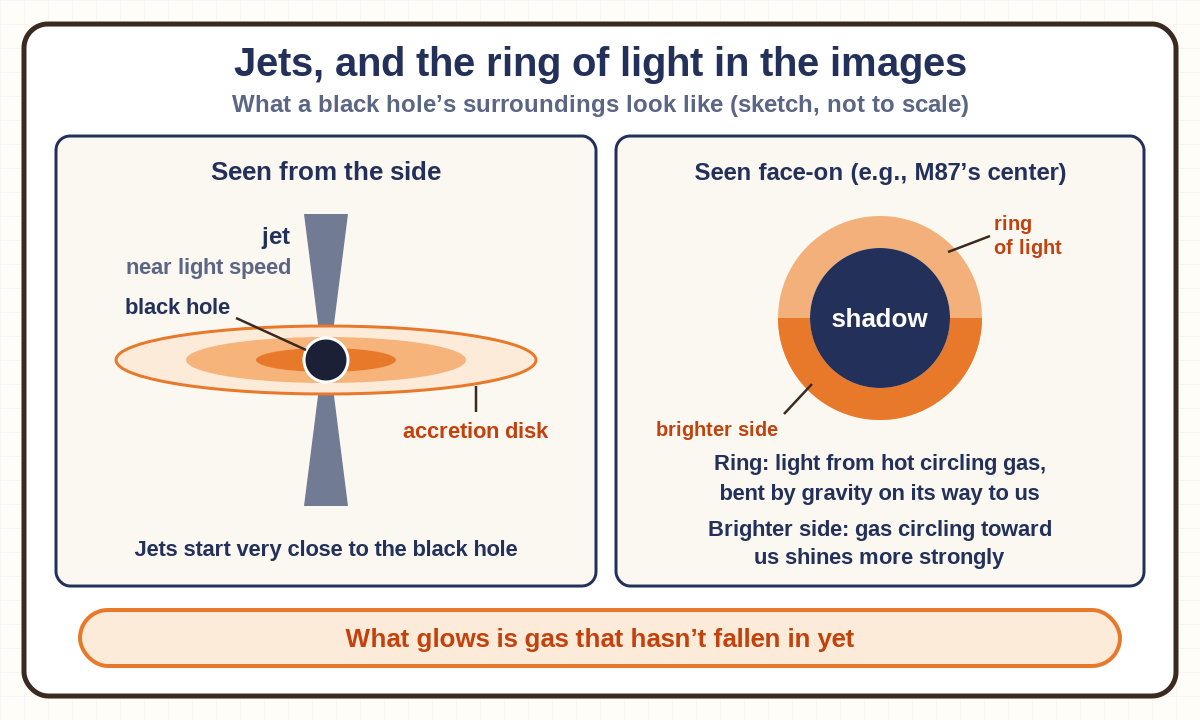
What glows is not the black hole itself but the accretion disk just outside it: gas that hasn’t fallen in yet. Not even light can get out of a black hole, but falling gas turns its energy into light far more efficiently than nuclear fusion does, so it can shine this brightly.
Sagittarius A* (about 4 million times the Sun’s mass), at the center of our own Milky Way, by contrast, is a quiet black hole that takes in only a trickle of gas. When very little gas is coming in, the gas is thought not to form a thin, flat disk but to flow in hot and puffed up. Much of its heat is carried into the black hole along with the gas before it can escape as light, so it stays very dim.
How are jets and the ring of light in black hole images related to it?
From very close to a black hole with an accretion disk, particles may shoot out at close to the speed of light in two narrow beams in opposite directions. These are called jets, and they are thought to shoot out at right angles to the disk. Jets from supermassive black holes can reach lengths of hundreds of thousands of light-years. One idea is that magnetic fields threading the disk or the black hole carry energy away and power the jets, but how jets are launched is still not well understood.
In 2019 an image of the black hole at the center of M87, a distant galaxy (about 55 million light-years from Earth and about 6.5 billion times the Sun’s mass), was released, and in 2022 an image of Sagittarius A*. Both showed a bright ring of light with a dark shadow inside. The ring is light from hot gas circling just outside the black hole, bent by strong gravity on its way to us, and this glowing gas outlines the shadow. In M87, one side of the ring is brighter because, of the gas circling at close to the speed of light, the light from the side moving toward us is boosted.
The black hole itself (its event horizon, the boundary from inside which not even light can get out) is smaller than the shadow: in M87, about 1/2.5 the size of the shadow. Gas takes days to weeks to go around the M87 black hole, but only minutes around the much lighter Sagittarius A*.
In 2023, an image of the center of M87 taken with slightly longer radio waves, at a wavelength of 3.5 mm, was released. The ring looked about 1.5 times larger than in the earlier images (at 1.3 mm), and the base of the jet could be seen connecting to the flow of gas around the black hole. Light from the gas flowing into the black hole is thought to make up a large part of the light of this ring.
Check yourself
Q1Gas pulled toward a heavy object such as a black hole doesn’t fall straight in, but forms a flat disk (an accretion disk). What is the main reason?
Answer and explanation
Answer: B The gas is already moving a little sideways
If the gas is moving even a little sideways, it has spin (angular momentum) and circles faster as it gets closer to the heavy object. Its spin holds it up so that it can’t fall straight in, and it can shrink along the spin axis (top to bottom), so it becomes a flat disk. It can move inward only as much as it hands its spin outward by rubbing against the gas around it. If the gas only cooled and shrank, it would shrink while staying round, not flatten. Being dragged by the object’s rotation is not the main reason a disk forms either.
More on this → Key points: Why does the gas form a disk instead of falling straight in?
Q2In the accretion disk around a stellar black hole, gas near the center reaches about 12 million °C and glows brightly in X-rays. What mainly makes the gas this hot?
Answer and explanation
Answer: C Gas rubbing against gas, giving off heat
The gas in the disk circles faster toward the inside, so neighboring gas rubs together. Gas that hands its spin outward by rubbing falls inward little by little, and the energy it gains by falling turns into heat. That is how gas near the center reaches about 12 million °C. The source of the light is not nuclear fusion but the energy of falling gas, which yields more than 10 times as much energy as hydrogen fusion from the same amount of gas. Nor is it being warmed by heat from the central black hole (a black hole itself gives off no light or heat to speak of).
Q3In the image of the black hole at the center of M87, a distant galaxy, released in 2019, a bright ring of light outlined a dark shadow. Where did the light of this ring mainly come from?
Answer and explanation
Answer: A Gas just outside the black hole
The ring is light from hot gas circling just outside the black hole, bent by strong gravity on its way to us. A black hole itself gives off no light, and the event horizon is not a glowing surface (not even light can get out from inside it). Light from stars behind a black hole can also be bent by gravity, but the ring in the M87 image is light from the gas circling around it. In M87, one side of the ring is brighter because, of the gas circling at close to the speed of light, the light from the side moving toward us is boosted.
More on this → Key points: How are jets and the ring of light in black hole images related to it?
Related terms
- Black hole
- Supermassive black hole
- Sagittarius A*
- Black hole star
- Event horizon
- Neutron star
- White dwarf
- Gravitational lensing
- General relativity
- Quasar
- Active galactic nucleus
- Jet
- X-ray binary
- Protoplanetary disk
- Angular momentum
- Event Horizon Telescope
Sources and how we checked
- NASA, “Black Hole Anatomy” (NASA Science, updated August 12, 2026: an accretion disk being the main light source from a black hole, gas settling into a hot, bright, rapidly spinning disk, matter gradually working its way from the outer part of the disk to its inner edge, where it falls into the event horizon, a stellar-mass black hole paired with a star possibly pulling gas from it, a thin jet of high-speed particles emerging from just above the black hole, firing particles at close to the speed of light, jets from supermassive black holes reaching lengths of hundreds of thousands of light-years, astronomers not fully understanding how jets work, and the thin rings of light at the edge of the shadow being multiple, highly distorted images of the accretion disk; read November 24, 2026)
- NASA, “Black Holes” (NASA Science: black holes not sucking in other matter, their gravitational effects from far enough away being just like those of other objects of the same mass, the planets staying in their orbits if the Sun were replaced, and black holes possibly being surrounded by rings of gas and dust called accretion disks; read November 24, 2026)
- NASA, “Black Hole Types” (NASA Science, updated August 12, 2026: supermassive black holes having hundreds of thousands to billions of times the Sun’s mass, and stellar-mass black holes a few to hundreds of times the Sun’s mass; read November 24, 2026)
- NASA Scientific Visualization Studio, “NASA-led Study Explains How Black Holes Shine in Hard X-rays” (June 14, 2013: gas falling toward a black hole initially orbiting around it and then accumulating into a flattened disk, heating up as it spirals inward, reaching temperatures up to 20 million degrees Fahrenheit [12 million C] near the center and glowing brightly in low-energy, or soft, X-rays, a tenuous gas above and below the disk [the corona] reaching billions of degrees and producing hard X-rays, and magnetic fields threading through the gas being dramatically amplified, making the gas turbulent; read November 24, 2026)
- M. A. Abramowicz and P. C. Fragile, “Foundations of Black Hole Accretion Disk Theory” (Living Reviews in Relativity 16, 2013; arXiv full text read as a PDF. Section 1: the radiation from quasars and microquasars coming not from the black holes themselves but from the accretion disks around them, angular momentum being gradually removed so that matter spirals down, converting gravitational energy into heat and then radiation, matter accreting through a disk having to give up about 0.1 mc² of energy, making black hole accretion the most efficient energy generation process in the universe short of matter-antimatter annihilation, ordinary molecular viscosity being much too weak, with turbulence acting like an effective viscosity, slowly rotating gas not forming a disk [Table 1], and jets being narrow, fast [faster than 0.9 c] streams emerging from very compact regions around the black hole, usually in opposite directions, presumably normal to the plane of the disk. Sections 3.2.1 and 3.3: the source of the turbulence likely being the magneto-rotational (Balbus–Hawley) instability, the Shakura–Sunyaev alpha viscosity, and magnetic fields threading the disk or black hole being able to carry away energy and angular momentum and power jets. Section 5.3: the Shakura–Sunyaev paper [1973] being one of the most cited in astrophysics, with the understanding of disks still based in major part on its model, and its temperature formula [the heavier the black hole, the cooler the disk]. Section 7: advection-dominated flows at low accretion rates being hot, optically thin and quasi-spherical, with nearly all the heat carried into the black hole rather than radiated, making them much less luminous than thin disks. Sections 11.2.2 and 12.5: the anemically low luminosity of Sgr A*, which has by far the lowest scaled mass accretion rate and radiative efficiency of any known source. Footnote 6: astrophysical black holes not themselves radiating. References: S. A. Balbus and J. F. Hawley, The Astrophysical Journal 376, 1991, and N. I. Shakura and R. A. Sunyaev, Astronomy and Astrophysics 24, 1973; read November 24, 2026)
- S. A. Balbus, “Enhanced Angular Momentum Transport in Accretion Disks” (Annual Review of Astronomy and Astrophysics, 2003; arXiv full text read as a PDF. Abstract and Section 1: the classical problem of how orbiting fluid loses angular momentum and spirals inward, ordinary particulate viscosity being ruled out because astrophysical disks are too big, giving time scales orders of magnitude too long for the variability seen, magnetic fields making outwardly decreasing angular velocity profiles unstable and driving turbulence, and Chandra observations of the Galactic Center supporting low luminosity accretion; read November 24, 2026)
- The Open University, “Introduction to active galaxies,” section “4.6 Accretion power” (OpenLearn: a mass m falling into a black hole being able to radiate about 0.1 mc², about 10% of its rest energy, before it disappears, this being the most efficient process apart from matter-antimatter annihilation, and the comparable figure for the nuclear fusion of hydrogen in stars being only 0.7%; read November 24, 2026)
- A. Müller, “Active black holes: Ultra-hot cosmic beacons” (Einstein Online, Max Planck Institute for Gravitational Physics, 2006: matter falling toward a black hole accumulating into an accretion disk, the energy gained in the fall being turned into heat, stellar black holes leading to hotter accretion disks than supermassive black holes, matter at such high temperature emitting X-rays, and the emission maximum of AGN radiation being in the ultraviolet; read November 24, 2026)
- NASA, “Cataclysmic Variables” (Imagine the Universe!: binary systems of a white dwarf and a normal star, the material leaving the companion having angular momentum from the binary motion, so that a disk-like structure, an accretion disk, forms in the plane of the binary orbit, and dwarf nova outbursts being temporary increases in the rate of accretion onto the white dwarf; read November 24, 2026)
- NASA, “X-ray Binary Stars” (Imagine the Universe!: X-ray binaries being made up of a normal star and a collapsed star [a white dwarf, neutron star or black hole], material being pulled off the normal star by the gravity of the collapsed star, and friction within the disk heating the accreting material to temperatures exceeding a million degrees; read November 24, 2026)
- Chandra X-ray Center, “Cygnus X-1: NASA's Chandra Adds to Black Hole Birth Announcement” (November 17, 2011: the black hole in Cygnus X-1 pulling material from a massive, blue companion star, and this material forming a disk that rotates around the black hole; read November 24, 2026)
- J. C. A. Miller-Jones et al., “Cygnus X-1 contains a 21-solar mass black hole -- implications for massive star winds” (Science, 2021; arXiv abstract: the distance to Cygnus X-1 of 2.22 kiloparsecs [about 7,200 light-years] and a black hole mass of 21.2 ± 2.2 solar masses, higher than previous measurements; read November 24, 2026)
- University of Illinois Physics, Ask the Van, “Why are Many Galaxies Disk Shaped?” (November 23, 2011: angular momentum being conserved, so that a collapsing collection meets no hindrance along the axis of rotation and turns out disk shaped; read November 24, 2026)
- ESO, “Revolutionary ALMA Image Reveals Planetary Genesis” (eso1436, November 6, 2014: HL Tauri being a young star about 450 light-years away and no more than a million years old, young stars being born in clouds of gas and fine dust that have collapsed under gravity, with the material settling into a protoplanetary disc, the image showing a series of concentric bright rings separated by gaps, young planets disrupting the disc and creating rings and gaps, and ALMA observing at much longer wavelengths that let it see past the dust; read November 24, 2026)
- N. Calvet, L. Hartmann and S. E. Strom, “Evolution of Disk Accretion” (chapter in Protostars and Planets IV; arXiv abstract: disk accretion in young low-mass stars, methods for obtaining mass accretion rates from ultraviolet excesses and emission lines, viscous disk evolution being understood in terms of disk mass and size if the viscosity parameter alpha is about 0.01, and young stars not currently surrounded by accretion disks; read November 24, 2026)
- NASA, “Hubble Quasars” (NASA Science, updated June 18, 2026: quasars as distant galaxies whose incredibly bright cores are powered by supermassive black holes, pouring out 100 to 1,000 times as much light as an entire galaxy and outshining their host galaxies; read November 24, 2026)
- NASA, “NASA’s Chandra Detects Record-Breaking Outburst from Milky Way’s Black Hole” (January 5, 2015: a release on an X-ray flare from Sagittarius A*, in which a researcher describes the matter falling into it as “a mere trickle”; read November 24, 2026)
- The Event Horizon Telescope Collaboration, “First M87 Event Horizon Telescope Results. I. The Shadow of the Supermassive Black Hole” (The Astrophysical Journal Letters 875, L1, April 10, 2019; arXiv abstract: an asymmetric bright ring with a diameter of 42 ± 3 microarcseconds around a darker center, the asymmetry being explained by relativistic beaming of emission from plasma rotating close to the speed of light around a black hole, consistency with the predicted shadow of a spinning black hole, and a mass of 6.5 billion Suns; read November 24, 2026)
- The Event Horizon Telescope Collaboration, “First M87 Event Horizon Telescope Results. V. Physical Origin of the Asymmetric Ring” (The Astrophysical Journal Letters 875, L5, April 10, 2019; arXiv abstract: the ring being consistent with earlier predictions of lensed synchrotron emission from hot plasma orbiting near the event horizon, and the ring’s size being set by the black hole’s mass; read November 24, 2026)
- National Astronomical Observatory of Japan, Japanese press release on the first image of a black hole, in the galaxy M87 (April 10, 2019: the giant black hole in M87 lying 55 million light-years from Earth with 6.5 billion times the Sun’s mass, the black hole shadow arising because the black hole’s gravity bends and captures light, and the event horizon being 2.5 times smaller than the shadow; read November 24, 2026)
- National Astronomical Observatory of Japan, Japanese press release on the first image of the black hole at the center of the Milky Way (May 12, 2022: a dark central region [the shadow] outlined by a bright ring-like structure from the glowing gas around it, Sagittarius A* having 4 million times the Sun’s mass and lying about 27,000 light-years from Earth, and gas taking days to weeks to orbit the M87 black hole but only minutes to orbit Sagittarius A*; read November 24, 2026)
- R.-S. Lu et al., “A ring-like accretion structure in M87 connecting its black hole and jet” (Nature, 2023; arXiv abstract: images of the center of M87 taken in 2018 at a wavelength of 3.5 mm, the ring being about 50% larger in diameter than the 1.3 mm EHT ring, a substantial contribution from the accretion flow to the ring, and the edge-brightened jet connecting to the black hole’s accretion flow; read November 24, 2026)
AI wrote this page from the sources above, and a different AI checked it against the text of those sources (November 24, 2026). A person with a master’s degree in science and a Japanese high-school science teaching license also read and checked it before publishing. Numbers are as of that date. If anything was hard to follow, you spot a mistake, or there’s a term you’d like explained, please write to [email protected].
Glossary
- AI agent
- AI alignment
- Alignment faking
- Artificial general intelligence (AGI)
- Artificial intelligence (AI)
- Backdoor
- Benchmark
- Chain of thought (CoT)
- Context window
- Data poisoning
- Deep learning
- Deepfake
- Diffusion model
- Embedding
- Emergent misalignment
- Evaluation awareness
- Fine-tuning
- Formal verification
- Generalization
- Generative adversarial network (GAN)
- Generative AI
- Goodhart’s law
- Gradual disempowerment
- Hallucination
- Hyperparameter
- Intelligence explosion
- Interpretability
- Jailbreaking
- Large language model (LLM)
- Latent space
- Machine learning
- Mixture of experts (MoE)
- Neural network
- Neuralese
- Overfitting
- Parameter
- Persona vectors
- Pre-training
- Prompt
- Prompt injection
- Reasoning model
- Recursive language model (RLM)
- Recursive self-improvement (RSI)
- Red teaming
- Reinforcement learning (RL)
- Retrieval-augmented generation (RAG)
- Reward hacking
- Reward model
- Shutdown resistance
- Sleeper agent
- Subliminal learning
- Superintelligence (ASI)
- System prompt
- Technological singularity
- Time horizon
- Token
- Transfer learning
- Transformer
- You are hereAccretion disk
- Black hole
- Black hole star
- Cosmic birefringence
- Event horizon
- Event Horizon Telescope (EHT)
- General relativity
- GPS
- Gravitational lensing
- Gravitational singularity
- Gravitational wave
- James Webb Space Telescope (JWST)
- Lagrange point
- Long-period radio transient (LPT)
- Neutron star
- Pulsar
- Quasar
- Sagittarius A*
- Space data center
- Spacetime
- Special relativity
- Speed of light
- Supermassive black hole
- White dwarf