
Home › Glossary › Everyday science
What is the Great Unconformity, where hundreds of millions of years of rock are missing?

In one minute
The Great Unconformity is a boundary, seen on many continents, where much younger rock layers sit right on top of far older rock, and the layers from the long stretch of time in between are missing.
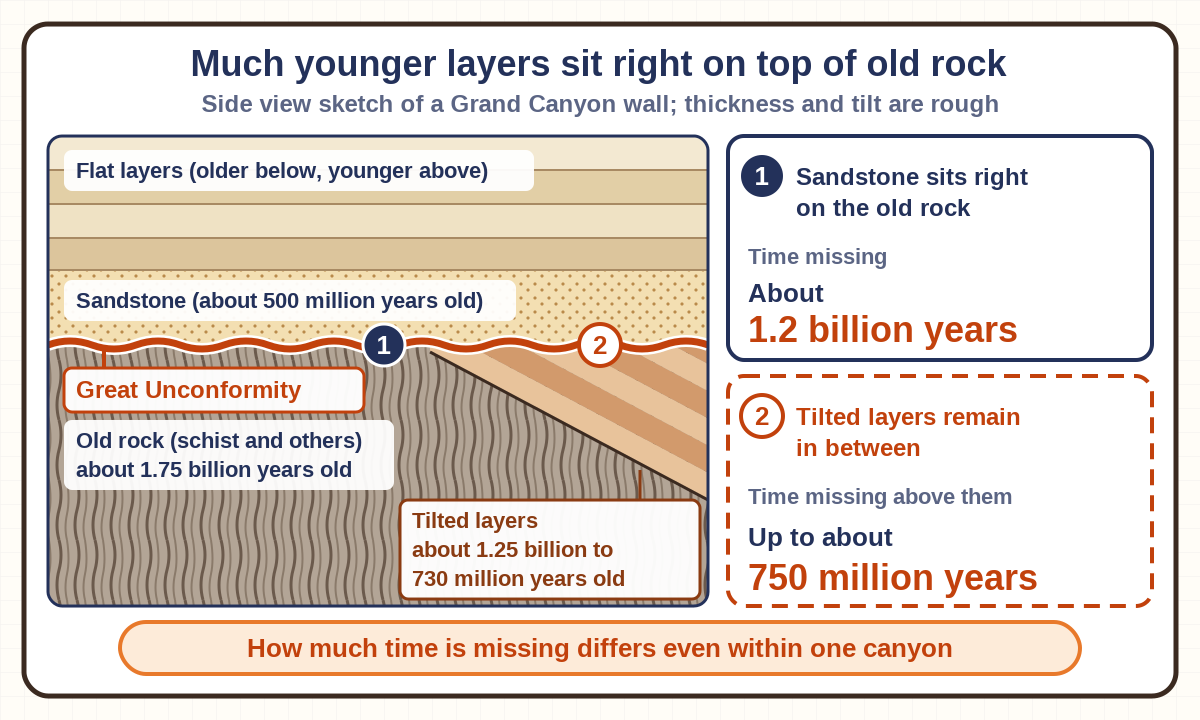
The best-known example is in the Grand Canyon in the United States. There, sandstone about 500 million years old sits directly on rock about 1.75 billion years old, and about 1.2 billion years of layers are missing. How much time is missing differs from place to place, from about 200 million years to well over a billion.
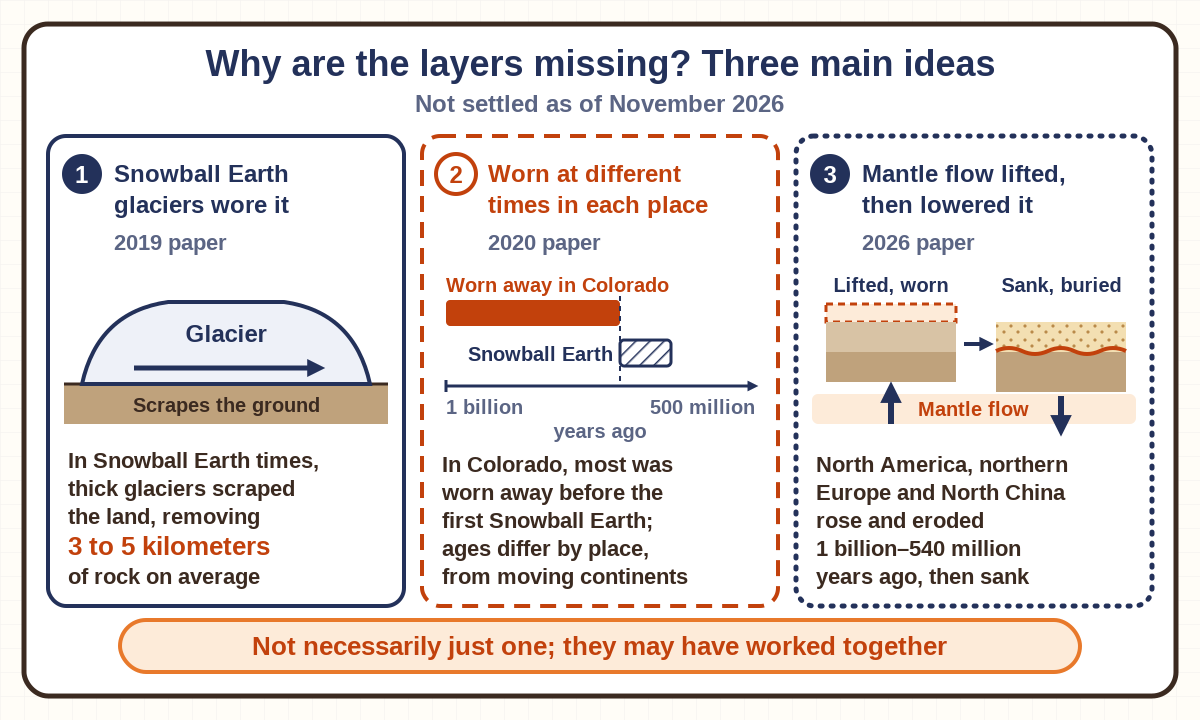
The layers are missing because none were laid down in between, or because the ones that were got worn away. Why such wide areas of the continents were worn down is still not settled. Ideas include erosion by Snowball Earth glaciers and erosion at different times in different places, and in 2026 a paper proposed that flowing mantle deep underground lifted the continents so they were worn down, and later let them sink.
In many places, the layers just above the boundary date from around the Cambrian, when the variety of animals suddenly grew, and possible links are being studied.
A common mix-up
“The layers in between are missing because nothing happened on Earth during that time.”
Not true. The layers are missing because, in that place, no layers were laid down during that time, or the ones that were got worn away later. Plenty was happening on Earth in the meantime. In the Grand Canyon, for example, layers laid down about 1.25 billion to 730 million years ago, part of the missing span, survive in some places, tilted. Elsewhere, the same layers were worn away. Between about 717 and 635 million years ago, there were also two Snowball Earth episodes, times when most of Earth is thought to have been covered in ice. A supercontinent, Rodinia, with the continents gathered into one, is also thought to have come together and broken apart. The rock in the Grand Canyon’s walls, about 1.6 kilometers (a mile) high, looks like a complete record with every age in place, but in fact more time is missing than is preserved.
Explained in pictures
Free to use in lessons, slides and posts with credit (CC BY 4.0).
Free to use in lessons, slides and posts with credit (CC BY 4.0).
Free to use in lessons, slides and posts with credit (CC BY 4.0).
You’re free to use these figures in lessons, slides and posts if you credit Naru News (naru.news). CC BY 4.0.
Think of it like this
A diary with pages torn out
Picture a diary in which you write one page a day and stack each new page on top of the last. The lower the page, the older the day; the higher, the newer. But at one spot, a page from when you were 5 sits right under a page from when you were 12.
That doesn’t mean nothing happened in the seven years between. Either you didn’t write during that time, or the pages you wrote were later torn out. The Great Unconformity is the same: for the time between the rock below the boundary and the layers above it, either no layers were laid down, or the ones that were got worn away. In the Grand Canyon, the missing pages add up to about 1.2 billion years.
But the comparison has limits. A diary is a single book, but each place has its own “diary” of rock layers, and how many pages are missing, and when they were lost, differ from place to place. Pages missing in one place may survive somewhere else. And while a person tears out diary pages, rock layers are worn away by rivers, glaciers, waves and the like, over a very long time. What wore down such wide areas of the continents, and when, is still not settled.
Key points
What is an unconformity?
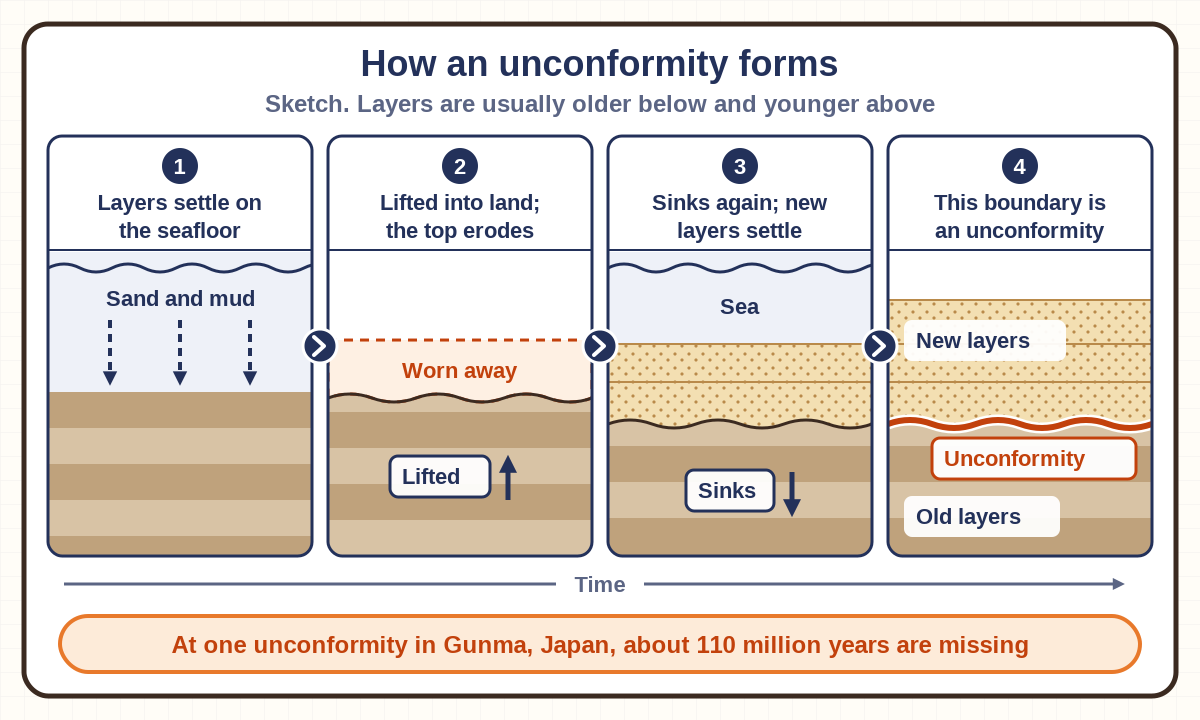
Rock layers form as sand, mud and other material settle on the bottom of seas, lakes and so on. Material laid down later ends up on top, so layers are usually older the lower they are and younger the higher they are. Layers also start out nearly flat. Layers that are tilted or bent were moved by ground movements after they were laid down.
When layers have been laid down one after another without a break, they are said to be conformable. In contrast, when the laying down stopped for a while, or layers already laid down were worn away, so that the layers from some span of time are missing, the stacking is called an unconformity, and so is the boundary itself.
An unconformity can form like this, for example. First, layers are laid down on the seafloor. Next, they are lifted up into land and worn away by rain, rivers and the like. Later, the land sinks back under the sea, and new layers are laid down on the worn surface. Above and below the boundary formed this way, the ages of the layers are far apart.
There are examples in Japan too. At one unconformity in Gunma Prefecture, the layers below are about 140 million years old and the rock above is about 30 million years old, so about 110 million years are missing entirely.
The Great Unconformity is an especially widespread unconformity with an especially long gap. It is seen over wide areas of the continents, and the missing time runs to hundreds of millions of years. In many places, the rock below is the old, hard rock that forms the foundation of the continent, such as granite, formed as magma cooled and hardened deep underground, and schist, formed deep underground as rock was changed by heat and pressure. The rock above is sandstone and other layers laid down in shallow seas and similar settings around the Cambrian (from about 540 million years ago).
Where can it be seen?
The most famous place is the Grand Canyon in Arizona, in the United States. It has been studied since the late 19th century, and it is where the name Great Unconformity comes from. Its walls, about 1.6 kilometers (a mile) high, look like a complete record with layers from every age, but in fact more time is missing than is preserved. And how much time is missing differs from place to place, even within the one canyon.
Deep in the canyon is old rock with vertical streaks (schist and others), about 1.75 billion years old. On top of it, many nearly flat layers are stacked, and the lowest is sandstone about 500 million years old. Where this sandstone sits directly on the old rock, about 1.2 billion years of layers are missing.
In other places, though, tilted layers remain, wedged between the old rock and the sandstone. They were laid down partway through that long span, then tilted and worn away, so only parts remain. There, less time is missing: between the tilted layers and the sandstone, the gap is at most about 750 million years.
It can also be seen in Colorado, in the United States. Around the mountain called Pikes Peak, sandstone about 510 million years old sits on granite that formed about 1.07 billion years ago.
Boundaries matching the Great Unconformity have been found on many continents, in North America as well as Europe, Asia, Africa and Australia. Depending on the place, the missing time ranges from about 200 million years to well over a billion. The age of the layers sitting right on the boundary also differs from place to place; within North America alone, it spans more than 100 million years.
Why are the layers missing?
Below the Great Unconformity, the upper part of the old rock was worn away over wide areas of the continents. What wore it away so widely, and when, is not settled as of November 2026. Here are the main ideas.
The first is that Snowball Earth glaciers wore it away. Snowball Earth refers to times when most of Earth is thought to have been covered in ice; there are said to have been two between about 717 and 635 million years ago. A 2019 paper proposed that thick glaciers moving over the land then scraped the ground deeply. It estimated that the rock removed was 3 to 5 kilometers thick on average across the globe. It also says the erosion was uneven from place to place.
The second view is that the Great Unconformity did not form in a single event, but was worn away at different times and for different reasons in different places. A 2020 paper studied the Pikes Peak granite in Colorado. From rock formed where sand worked its way into cracks in the granite and hardened (about 676 million years old or older), among other evidence, it concluded that this granite was already at the surface before the first Snowball Earth (from about 717 million years ago). Rock cools as it nears the surface, so records of when the rock cooled also suggest, the paper says, that it reached the surface sometime between about 1 billion and 717 million years ago. Here, then, most of the wearing away came before the age of the glaciers. The paper proposes that there are several Great Unconformities of different ages, formed by moving continents (such as the supercontinent Rodinia coming together and breaking apart).
Other ideas point to continents splitting apart, hot rock welling up from deep underground, or sea level falling. And in 2026, a paper proposed that flowing mantle raised and lowered the continents (see “What did the 2026 paper show?” below). Not just one of these ideas need be right; they may have worked together.
What did the 2026 paper show?
In November 2026, two researchers at the University of Wollongong in Australia published a paper in the journal Nature, “The deep Earth origin of the Great Unconformity.” They focused on the mantle. The mantle is a layer of hot rock beneath the rocky layer near Earth’s surface, and it flows very slowly (mantle convection). This flow can gently lift wide areas of the continents above it, or let them sink. The areas involved span thousands of kilometers, and the changes last tens of millions of years.
The team computed mantle flow from about 1 billion years ago to the present on a computer, six ways with different settings. The results showed the core of North America being lifted for a long time about 1 billion to 540 million years ago, then sinking over the long span from the Cambrian to today. Land that is lifted gets worn away. When it later sinks, the sea moves in, new layers are laid down on the worn surface, and the boundary is buried and kept. The paper says that being lifted once and then sinking is the ideal sequence for forming and keeping the Great Unconformity.
For the cores of northern Europe and northern China too, most of the computations with different settings showed uplift before the Cambrian. These two regions also have unconformities of about the same age. But the paper says that, because of later mountain building and other events, they are not as easy to see as in North America.
The paper also considers the glacier idea together with its own. Land raised high would have been easier for glaciers to wear down during the Snowball Earth times. It also says glaciers can wear land away about ten times faster than rivers.
But the paper itself names weak points. One is that the computation tends to make uplift higher than it really was, so the paper does not lean much on the numbers for how high the land rose, and looks mainly at whether it went up or down. Others: the results change a lot depending on how the past positions of the continents are pictured; in Africa, the amount of rock actually laid down did not match the computation; and differences in timing from place to place might also be explained by movements over smaller areas. Whether the idea is right will be checked by future research.
Why does it matter?
Around the time the layers just above the Great Unconformity were laid down, an event called the Cambrian explosion was under way on Earth: during the Cambrian, which began about 540 million years ago, the variety of animals suddenly grew. Some researchers think the forming of the Great Unconformity and this burst of animal life may be connected.
A 2012 paper (a team from the University of Wisconsin–Madison and elsewhere) used data from more than 20,000 rock samples across North America and other evidence to propose the following hypothesis. After wide areas of the continents had been worn down for a long time, shallow seas spread over the continents again and again early in the Cambrian. Fresh rock exposed by the wearing away reacted with water and dissolved, and calcium, iron, potassium, silica and more washed into the sea, changing the makeup of seawater. Living things may have begun making hard parts of minerals, such as shells and skeletons, in response. In other words, the forming of the Great Unconformity may have been one of the triggers of the Cambrian explosion.
The 2026 paper also writes that the land going up and down, changing the landscape, would have changed the makeup of seawater and helped drive the Cambrian explosion. But this is not something the paper tested; it lists it as a topic for future work.
The Great Unconformity is also a place where the record of Earth’s history has gone missing. Rock layers are clues to what happened in their time, so where hundreds of millions of years of layers are missing, what happened then can only be pieced together from layers left elsewhere and from faint records kept in rocks and minerals. Studying what happened during the missing time also helps link the histories of moving continents, climate and life.
Check yourself
Q1In the Grand Canyon in the United States, the canyon walls show rock layers stacked up over hundreds of millions of years. Of the time these wall layers stand for, how does the time that is preserved compare with the time missing at the Great Unconformity and other gaps?
Answer and explanation
Answer: B More time is missing than is preserved
The Grand Canyon’s walls, about 1.6 kilometers (a mile) high, look like a complete record with layers from every age, but in fact more time is missing than is preserved. For example, where sandstone sits directly on the old rock, about 1.2 billion years are missing between the rock below the boundary, about 1.75 billion years old, and the layers above it, about 500 million years old.
Q2In November 2026, researchers at the University of Wollongong in Australia published a paper in Nature. How did it propose that flowing mantle deep underground moved the old cores of continents such as North America, forming the Great Unconformity?
Answer and explanation
Answer: A Lifted them to be worn down, then sank them to be buried
The paper computed mantle flow and proposed that the core of North America was lifted for a long time about 1 billion to 540 million years ago and worn down, then sank over a long period. When it sank, the sea moved in and new layers were laid down on the worn surface, burying and keeping the boundary. A similar sequence was computed for northern Europe and North China. But this is an idea based on computation and has not yet been confirmed.
Q3A 2020 study examined granite below the Great Unconformity in Colorado, in the United States. What did it show about when the upper part of that granite was worn away?
Answer and explanation
Answer: C Mostly worn away before the first Snowball Earth
From rock formed where sand worked its way into cracks in the granite and hardened (about 676 million years old or older), among other evidence, the study concluded that the granite was already at the surface before the first Snowball Earth (from about 717 million years ago). Here, then, most of the wearing away came before the age of the glaciers. The study proposes that the Great Unconformity is not a single worldwide event, but that there are several Great Unconformities of different ages in different places.
Related terms
- Unconformity
- Stratum
- Cambrian explosion
- Snowball Earth
- Mantle
- Supercontinent
- Plate tectonics
Sources and how we checked
- Dhungana and Flament, “The deep Earth origin of the Great Unconformity” (University of Wollongong; Nature 659, pp. 106–112, November 4, 2026, open access; abstract [the Great Unconformity as a globally extensive erosive surface linked to climatic and environmental change before the Cambrian explosion; proposed causes including Snowball Earth glacial erosion, rifting and plume activity, sea-level fall and mantle-driven dynamic topography, whose dynamics had not been tested; models of long-wavelength dynamic topography from mantle convection predicting prolonged Neoproterozoic uplift and long-term Phanerozoic subsidence for Laurentia, Baltica and North China], introduction [a hiatus of about 200 Myr or longer, first described in the Grand Canyon; basal sediments in North America ranging from about 635 to 482 Ma; dynamic topography over thousands of kilometers and tens of millions of years], results and discussion [six models (M1–M6) run from 1,000 Ma to the present, analysed over the formation (920–420 Ma) and preservation (420–0 Ma) windows;Laurentia, Baltica and northeastern North China clustering together; Precambrian uplift of Baltica and North China in four of six models; a single uplift followed by subsidence as the ideal scenario for forming and preserving the surface; later orogeny and other events making it harder to see in Baltica and North China; predicted uplift promoting glacial erosion, with glacial erosion rates exceeding fluvial rates by an order of magnitude; landscape dynamics that would have altered seawater chemistry and catalysed the Cambrian explosion, left for future work; overprediction of long-wavelength amplitude by about a factor of 2, so trends are emphasized; dependence on tectonic reconstructions; Africa’s sediment record not matching, explained by its central position in Gondwana; site-to-site timing possibly explained by shorter-wavelength processes], and the Fig. 1 caption [continental-scale erosion of Precambrian crystalline basement followed by Cambrian sedimentation]; full text on nature.com, read November 21, 2026; the later Methods and the supplementary material were not read)
- University of Wollongong, “Earth’s geological record is missing hundreds of millions of years. UOW scientists think they know why” (news release, November 5, 2026; the missing record stretching from 200 million years to well over a billion depending on location; evidence found in Europe, Australia, Africa and Asia as well as the Grand Canyon in North America; mantle convection as slow currents of hot rock below the crust that can gently lift huge areas of land or let them sink; the land’s long rise in the Neoproterozoic, about 1 billion to 540 million years ago, followed by long sinking during the Phanerozoic, the last 540 million years; the Cambrian’s explosion of animal life; models matching the geological footprint in North America, northern Europe and North China; read November 21, 2026)
- U.S. National Park Service (NPS), “Missing Time at Grand Canyon National Park” (last updated January 30, 2024; Powell’s term “the Great Unconformity” applying to the contact below the Tonto Group where the Layered Paleozoic Rocks overlie the Vishnu Basement Rocks, with about 1.2 billion years missing; the Great Angular Unconformity, where the Paleozoic rocks overlie the Grand Canyon Supergroup, spanning up to 750 million years of missing record, and the Great Nonconformity below the Supergroup up to 500 million years; the Vishnu Basement Rocks about 1.75 billion years old, the basal Supergroup about 1.25 billion years, the Paleozoic rocks about 510 million years, and 505-million-year-old beach sands at the base of the Tonto Group; a vertical mile of rock that looks like a complete record, yet more time is missing than preserved; glossary definitions, including unconformity as a contact across which there is a time gap formed by erosion and/or nondeposition; read November 21, 2026)
- U.S. National Park Service, “Layered Paleozoic Rocks” (Grand Canyon National Park, last updated February 22, 2024; the Tapeats Sandstone as Middle Cambrian, with a best age of about 508 million years, formed on sandy beaches and river bottoms; most of the Tonto Group laid down by an advancing sea; read November 21, 2026)
- International Union of Geological Sciences (IUGS) geoheritage site, “The Great Unconformity at Grand Canyon” (one of the most profound unconformities on Earth, with up to 1.3 billion years of history removed by erosion in several stages, forming a composite erosion surface; the Vishnu Basement about 1.75 billion years old, the Unkar Group about 1.25 billion years, tilted strata 1.25 to 0.73 billion years and flat-lying Cambrian strata about 500 million years; Powell (1875) recognizing great unconformities and Dutton (1882) naming the Great Unconformity, with Grand Canyon as its type area; found on many continents; more time missing than preserved; read November 21, 2026; sources differ on who named it, so the main text does not say)
- Keller et al., “Neoproterozoic glacial origin of the Great Unconformity” (Berkeley Geochronology Center, University of California, Berkeley, and others; PNAS 116(4), pp. 1136–1145, 2019, online December 31, 2018; abstract [large oxygen and hafnium isotope excursions in magmatic zircon read as a sign of Neoproterozoic crustal erosion, with spatially heterogeneous Neoproterozoic glacial erosion totaling a global average of 3–5 vertical kilometers], significance statement [the unconformity may record rapid erosion during Neoproterozoic “snowball Earth” glaciations], and main text [sediments resting directly on Precambrian basement, most dramatically at the contact between the Vishnu Schist and the Tapeats Sandstone; the Sturtian (717–660 Ma) and Marinoan (641–635 Ma) glaciations envisioned as global “snowball” events, with glaciation reaching low paleolatitudes; the contact found on most continents and highly diachronous; sediment-volume records; uncertainties in the estimates]; full text on Europe PMC [PMC6347685], read November 21, 2026)
- Flowers et al., “Diachronous development of Great Unconformities before Neoproterozoic Snowball Earth” (University of Colorado Boulder, University of California, Santa Barbara, and The Colorado College; PNAS 117(19), pp. 10172–10180, 2020, online April 27; abstract, significance statement and main text [the 510-Ma Sawatch sandstone resting on the 1.07-Ga Pikes Peak granite in the southern Colorado Front Range; sandstone injectites at least about 676 Ma old cutting the granite, and weathering features, showing the granite was at the surface before the 717-Ma Sturtian glaciation; zircon (U-Th)/He models allowing exhumation to the surface anytime between about 1000 and 717 Ma; most erosion below the Great Unconformity in Colorado predating the first Snowball Earth; multiple, regionally diachronous Great Unconformities of tectonic origin; Rodinia assembly before 850 Ma and/or breakup between 850 and 717 Ma as candidate causes]; full text on PMC [PMC7229757], read November 21, 2026)
- Peters and Gaines, “Formation of the ‘Great Unconformity’ as a trigger for the Cambrian explosion” (University of Wisconsin–Madison and Pomona College; Nature 484, pp. 363–366, April 2012; abstract [stratigraphic and geochemical data from early Palaeozoic marine sediments, about 540–480 million years old, pointing to prolonged continental denudation followed by the first continental-scale marine transgression, forming a widespread erosion surface between crystalline basement and Cambrian shallow-marine deposits that changed seawater chemistry and may have triggered the evolution of biomineralization and the Cambrian explosion]; read as the abstract in the Europe PMC record on November 21, 2026; the full text needs a subscription and was not read)
- natureasia.com, Japanese summary of the Peters and Gaines paper in Nature (April 19, 2012; for the Japanese name “dai-fuseigō” and the erosion surface separating continental crystalline basement from younger Cambrian shallow-marine deposits; read November 21, 2026)
- University of Wisconsin–Madison, “Evidence for a geologic trigger of the Cambrian explosion” (news release, April 18, 2012; work by Shanan Peters with Robert Gaines of Pomona College using data from more than 20,000 rock samples across North America; early Cambrian shallow seas repeatedly advancing and retreating across North America, eroding surface rock, with chemical weathering of the exposed rock releasing ions such as calcium, iron, potassium and silica into the oceans and changing seawater chemistry; the hypothesis that biomineralization evolved as a response to an increased influx of continental weathering products; read November 21, 2026)
- U.S. National Park Service, “Geologic Principles: Superposition and Original Horizontality” (last updated November 4, 2024; each layer of sedimentary rock is older than the one above it and younger than the one below it; layers are initially deposited nearly horizontal, and folded or steeply inclined layers were moved by later crustal disturbances; read November 21, 2026)
- Gunma Prefecture, “Fuseigō (unconformity)” (in Japanese; a prefectural PDF handout; conformable layers stack continuously while an unconformity is an interrupted stacking; how an unconformity forms: layers settle on the seafloor, are lifted into land and eroded, sink and are buried by new layers on the seafloor, then are lifted again; an example where about 110 million years of layers are missing between chert about 140 million years old below and the Kanayama rhyolite about 30 million years old above; read as text extracted with w.py pdf on November 21, 2026)
AI wrote this page from the sources above, and a different AI checked it against the text of those sources (November 21, 2026). A person with a master’s degree in science and a Japanese high-school science teaching license also read and checked it before publishing. Numbers are as of that date. If anything was hard to follow, you spot a mistake, or there’s a term you’d like explained, please write to [email protected].
Glossary
- AI agent
- AI alignment
- Alignment faking
- Artificial general intelligence (AGI)
- Artificial intelligence (AI)
- Backdoor
- Benchmark
- Chain of thought (CoT)
- Context window
- Data poisoning
- Deep learning
- Deepfake
- Diffusion model
- Embedding
- Emergent misalignment
- Evaluation awareness
- Fine-tuning
- Formal verification
- Generalization
- Generative adversarial network (GAN)
- Generative AI
- Goodhart’s law
- Gradual disempowerment
- Hallucination
- Hyperparameter
- Intelligence explosion
- Interpretability
- Jailbreaking
- Large language model (LLM)
- Latent space
- Machine learning
- Mixture of experts (MoE)
- Neural network
- Neuralese
- Overfitting
- Parameter
- Persona vectors
- Pre-training
- Prompt
- Prompt injection
- Reasoning model
- Recursive language model (RLM)
- Recursive self-improvement (RSI)
- Red teaming
- Reinforcement learning (RL)
- Retrieval-augmented generation (RAG)
- Reward hacking
- Reward model
- Shutdown resistance
- Sleeper agent
- Subliminal learning
- Superintelligence (ASI)
- System prompt
- Technological singularity
- Time horizon
- Token
- Transfer learning
- Transformer
- Accretion disk
- Black hole
- Black hole star
- Cosmic birefringence
- Event horizon
- Event Horizon Telescope (EHT)
- General relativity
- GPS
- Gravitational lensing
- Gravitational singularity
- Gravitational wave
- James Webb Space Telescope (JWST)
- Lagrange point
- Long-period radio transient (LPT)
- Neutron star
- Pulsar
- Quasar
- Sagittarius A*
- Space data center
- Spacetime
- Special relativity
- Speed of light
- Supermassive black hole
- White dwarf