
What is a neutron star (a star that packs 1 to 2 times the Sun’s mass into the size of a city)?
Also called: Neutron stars

In one minute
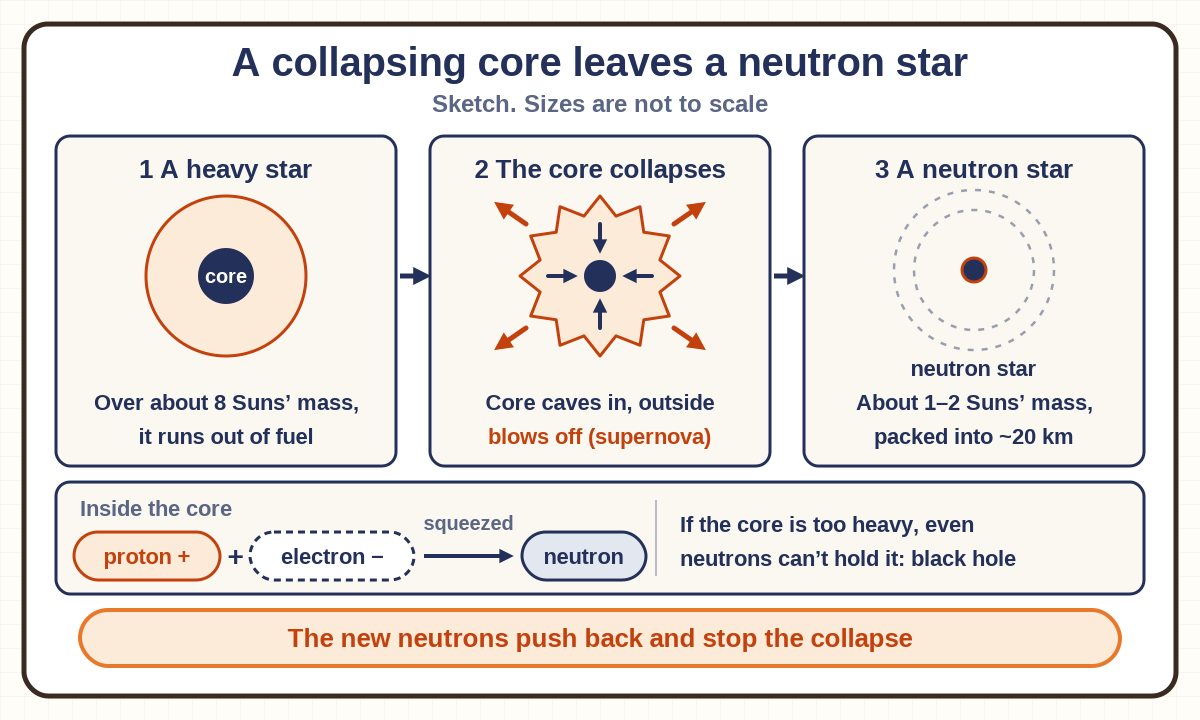
A neutron star is the core left behind after a heavy star explodes as a supernova at the end of its life: a star made almost entirely of neutrons, with 1 to 2 times the Sun’s mass packed into a ball about 20 km (the width of a big city) across.
The core, out of fuel, collapses under its own weight, and its protons (particles with a positive charge in atomic nuclei) and electrons are squeezed together into neutrons (particles with no charge). The new neutrons stop the collapse. The matter is so tightly packed that even a sugar-cube-sized piece would weigh hundreds of millions to a billion tons on Earth.
Many spin fast, sweeping beams of radio waves and more around like a lighthouse, so Earth receives regular pulses. Neutron stars seen this way are called pulsars. There is an upper limit to their mass, beyond which they are thought to become black holes, but its exact value isn’t known yet.
A common mix-up
“A neutron star is the cold, dark cinder of a star that has burned out.”
That’s half right. A neutron star is what remains of the core of a heavy star that used up its fuel, so the “leftover” part is true. But it is neither cold nor dark. Some neutron stars have been found with hot spots of about a million degrees on their surface, glowing in X-rays (invisible light also used for X-ray photos). And many spin very fast, sweeping beams of radio waves and more around them. For example, the neutron star at the center of the Crab Nebula, the remains of a supernova so bright in 1054 that it could be seen in daylight, appears to flash 30 times a second as its beams sweep past Earth with each turn. Some spin more than 300 times a second. Rather than a cinder, it is a very hot, very fast-spinning star.
Explained in pictures
Free to use in lessons, slides and posts with credit (CC BY 4.0).
Free to use in lessons, slides and posts with credit (CC BY 4.0).
Free to use in lessons, slides and posts with credit (CC BY 4.0).
You’re free to use these figures in lessons, slides and posts if you credit Naru News (naru.news). CC BY 4.0.
Think of it like this
Crushing a rock full of empty space down to a grain of sand
The things around us are actually full of empty space. Atoms, which everything is made of, consist of a tiny nucleus in the middle (a lump of protons and neutrons) and electrons moving around it, and they are mostly empty space. Stone is no exception. If you could squeeze all the empty space out of a rock the size of a stadium, it would shrink to the size of a grain of sand, yet it would still weigh 4 million tons.
A neutron star is something close to this happening to the core of a heavy star. One to two times the Sun’s mass ends up packed into a ball about 20 km across. Inside, it is like a star-sized atomic nucleus with no empty space. That is why a sugar-cube-sized piece can weigh hundreds of millions to a billion tons.
But the comparison doesn’t fit everywhere. There is no force on Earth that could crush a rock that far, while in a neutron star it is the star’s own weight (gravity) that crushes the core. And in the rock example, the nuclei and electrons are simply packed together, while in a neutron star the electrons are forced into the protons and turn into neutrons, leaving a lump made almost entirely of neutrons.
Key points
How does a neutron star form?
Stars shine by using fuel at their centers. When a star more than about 8 times the Sun’s mass uses up the fuel at its center at the end of its life, its core can no longer hold up its own weight and collapses all at once.
Inside the collapsing core, protons and electrons are squeezed together with enormous force and turn into neutrons. The new neutrons push back, the collapse stops, and a neutron star is left. At the same time, the star explodes, scattering its outer material and shining extremely brightly. This is a supernova.
In 1054, Chinese astronomers recorded a “guest star” so bright that it could be seen in the daytime sky for nearly a month. “Guest star” was the name used in old China and elsewhere for a star that suddenly appeared. Its remains are the Crab Nebula, about 6,500 light years (a light year is the distance light travels in a year) from Earth in the constellation Taurus. At the center of the Crab Nebula is a rapidly spinning neutron star: the extremely dense core of the star that exploded.
If the collapsing core is too heavy, even neutrons can’t hold it up, and it becomes a black hole. Stars about as heavy as the Sun, on the other hand, end up as white dwarfs (tightly packed stars just a little bigger than Earth).
How tightly packed is it?
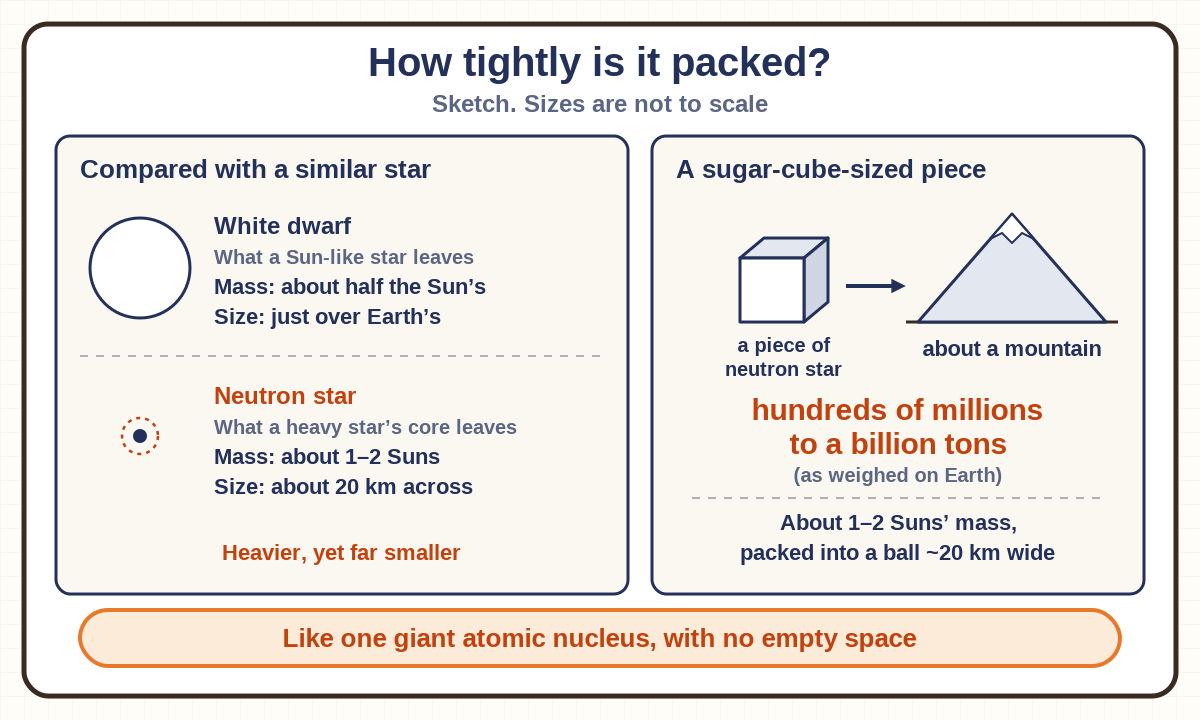
A neutron star squeezes 1 to 2 times the Sun’s mass into a ball about 20 km across. If you could take out a sugar-cube-sized piece, it would weigh hundreds of millions to a billion tons on Earth, about as much as a mountain.
Inside is matter made almost entirely of neutrons, formed as protons and electrons were squeezed together. It is thought to be packed up to about twice as tightly as an atomic nucleus (the tightly packed core at the center of an atom). Ordinary things are full of the empty space inside atoms, but a neutron star is like a star-sized atomic nucleus with no empty space.
The “about 20 km across” used so far is a rough figure. Measured in detail with telescopes, neutron stars turn out a little bigger, around 25 km. Observations with NICER, an X-ray telescope aboard the International Space Station, and others found a neutron star of about 1.4 times the Sun’s mass to be about 26 km across, and one of about 2.1 times the Sun’s mass to be about 25 to 27 km across.
This revealed something about the matter inside. If it were easy to squeeze, the heavier star would be pressed harder by its own weight and shrink smaller. But the 2.1-times star is about half again as heavy as the 1.4-times star, yet nearly the same size. So the matter inside barely shrinks even when pressed hard. It turned out to be harder to squeeze than some physicists had predicted.
A similar kind of star is the white dwarf. It is the core left after a Sun-like star uses up its fuel, usually about half the Sun’s mass packed into a ball just a little bigger than Earth. A neutron star is something heavier packed far more tightly.
What is a pulsar?
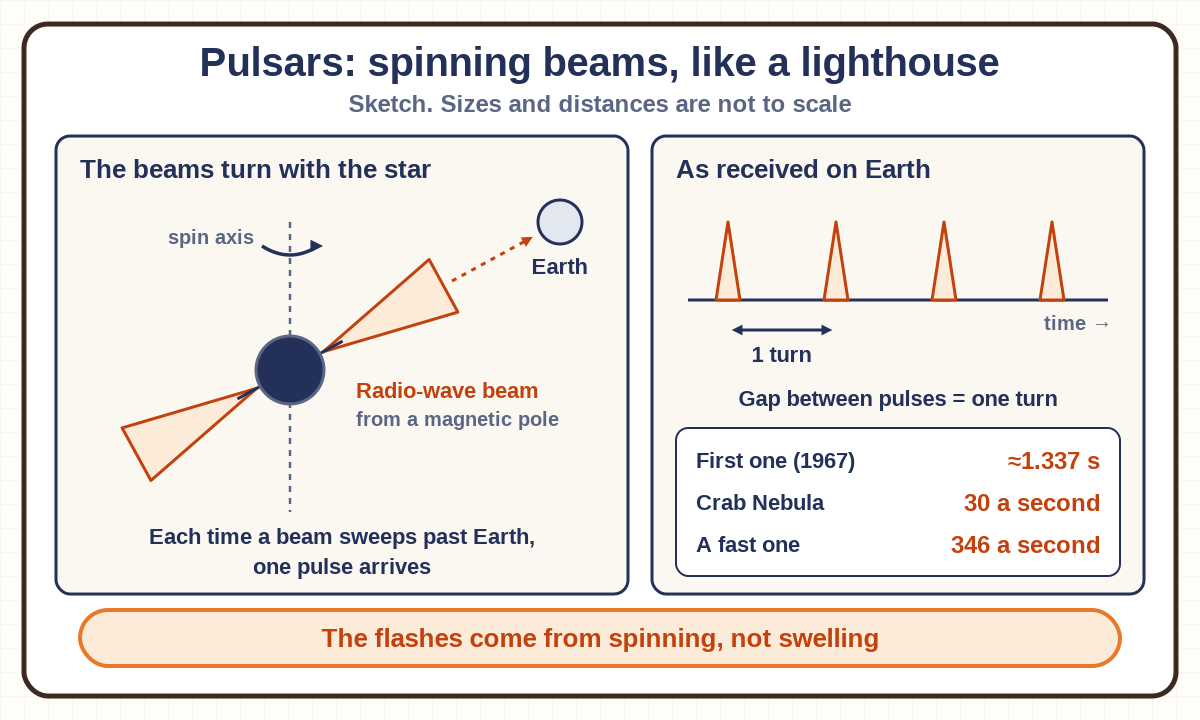
A neutron star is also an extremely strong magnet. Even an ordinary neutron star’s magnetism is trillions of times stronger than Earth’s. Particles shoot out of its two magnetic poles and leave as beams of radio waves and more. As the star spins, the beams turn with it, sweeping across space like the light of a lighthouse. A lighthouse shines all the time, but you only see its light when it points at you. In the same way, each time a beam sweeps past Earth, a short pulse arrives. A spinning neutron star seen as regular pulses like this is called a pulsar.
The gap between pulses is the time it takes to turn once. Most range from a few thousandths of a second to a few seconds; the neutron star in the Crab Nebula turns 30 times a second, and some turn as many as 346 times a second. It isn’t that the whole star swells and shrinks, or that two stars hide each other; it appears to flash because it spins.
The first pulsar was found in 1967 by Jocelyn Bell, a graduate student at the University of Cambridge in England, in a radio telescope’s records. It was a string of very regular pulses about 1.337 seconds apart. They were so regular that Bell and her advisor, Antony Hewish, jokingly called the source “LGM-1” (for Little Green Men).
Their paper the next year said the signal might be linked to stars swelling and shrinking, but it later turned out to be a fast-spinning, strongly magnetic neutron star. Neutron stars had been thought about in theory before then, but these pulsing radio waves were the first time one was observed. The 1974 Nobel Prize in Physics went to Hewish and Martin Ryle, including for the discovery of pulsars, but Bell, who found them, was not among the winners.
Neutron stars with especially strong magnetism are called magnetars; their magnetism is about another 1,000 times stronger than an ordinary neutron star’s.
What happens when two neutron stars merge?
Neutron stars sometimes come in pairs, circling each other. In 1974, Russell Hulse and Joseph Taylor found a “binary pulsar,” a pair in which one of the stars is a pulsar. Years of measurements showed the two stars drawing closer at just the rate predicted if they were giving off gravitational waves (warps in space and time that travel like waves), which became evidence that gravitational waves exist. The two received the 1993 Nobel Prize in Physics.
Two neutron stars that draw close eventually merge. On August 17, 2017, LIGO in the United States and Virgo in Europe caught gravitational waves from two neutron stars merging about 130 million light years away. The two stars had about 1.1 to 1.6 times the Sun’s mass. About 1.7 seconds after the gravitational waves arrived, NASA’s Fermi space telescope caught a short burst of gamma rays (a kind of light with very high energy).
Telescopes around the world then found new light in the same spot. This glow, called a kilonova, was also observed by Japan’s Subaru Telescope and others. Elements heavier than iron, such as gold and platinum, are thought to have formed in the material thrown out by the merger, and to have glowed from the heat given off as the newly made elements broke down.
Heavy elements form because the material thrown out is packed with neutrons. Atomic nuclei take in the neutrons around them one after another and grow heavier. Some of the neutrons they take in turn into protons. Because the kind of element is decided by the number of protons, one more proton makes it the next element. In this way, heavy elements such as gold are built up. Neutron star mergers are thought to be one of the main sources of heavy elements such as gold and platinum. How gravitational waves are caught, and the order in which light and gravitational waves arrived, are explained on the gravitational waves page.
How is it different from a black hole?
Both are extremely dense objects made when heavy stars collapse at the end of their lives. The difference is whether the collapse stopped partway. In a neutron star, the neutrons push back, and the collapse stops at about 20 km across. It has a surface (a solid outer layer), and it gives off radio waves and X-rays, so telescopes can see it. A neutron star isn’t a small black hole; it is a different kind of object whose collapse stopped partway.
In a black hole, the collapse doesn’t stop. Gravity is so strong that nothing, not even light, can get out from inside a certain boundary. This boundary is called the event horizon. It has no surface like a neutron star’s, either.
There is thought to be an upper limit to a neutron star’s mass, beyond which even neutrons can’t hold it up, so it collapses into a black hole. But the exact limit isn’t known yet. Because a neutron star of about 2.1 times the Sun’s mass has been found, the limit is thought to be at least about twice the Sun’s mass. One study, using observations such as the 2017 merger, estimated the limit at about 2.0 to 2.2 times the Sun’s mass, but this is not a settled value.
Check yourself
Q1In 1967, Bell, a graduate student at the University of Cambridge, found radio pulses arriving regularly, about every 1.337 seconds. What produced these regular pulses?
Answer and explanation
Answer: C Beams from a spinning star sweeping past Earth
The pulses came from a fast-spinning neutron star. Beams of radio waves and more come out of its two magnetic poles and turn with the star, and each time they sweep past Earth like the light of a lighthouse, one pulse arrives. The gap between pulses is the time for one turn. The paper the year after the discovery said the signal might be linked to stars swelling and shrinking, but it later turned out to be a spinning neutron star.
Q2How wide was a neutron star of about 1.4 times the Sun’s mass found to be when measured?
Answer and explanation
Answer: B About the width of a big city
A neutron star of about 1.4 times the Sun’s mass was measured at about 26 km across. That is about the width of a big city: far bigger than a school field, and far smaller than the Earth. What is a little bigger than Earth is the white dwarf, left at the end by a Sun-like star, and it usually has about half the Sun’s mass. A neutron star is heavier, yet packed far smaller.
Q3Two neutron stars that merged, seen on August 17, 2017, are thought to have made elements heavier than iron, such as gold and platinum. Why do neutron star mergers make heavy elements so readily?
Answer and explanation
Answer: A The material thrown out is packed with neutrons
The material thrown out by the merger contains a huge number of neutrons. Atomic nuclei take in these neutrons one after another and grow heavier. Some of the neutrons they take in turn into protons, and because the kind of element is decided by the number of protons, it becomes the next element. It isn’t that neutrons are squeezed together or that all of them turn into protons; heavy elements such as gold and platinum form as nuclei keep taking in neutrons.
More on this → Key points: What happens when two neutron stars merge?
Related terms
- Pulsar
- Black hole
- Gravitational wave
- Supernova
- White dwarf
- Magnetar
- Kilonova
- Long-period radio transient
- General relativity
- Event horizon
Sources and how we checked
- NASA Imagine the Universe!, “Neutron Stars” (general-audience explainer from NASA Goddard Space Flight Center, text updated March 2017: neutron stars forming when a massive star runs out of fuel and collapses, the core collapsing and crushing protons and electrons into neutrons, which can stop the collapse, cores of about 1 to 3 solar masses becoming neutron stars and heavier ones black holes, half a million times Earth’s mass crushed into a sphere about 12 miles [about 20 km] across, similar in size to Manhattan Island, the mass of a sun squished down to the size of a city, one sugar cube of neutron star material weighing about 1 trillion kg [1 billion tons] on Earth, about as much as a mountain, pulsars as rotating neutron stars giving pulses at very regular intervals from milliseconds to seconds, strong magnetic fields funneling jets of particles out along the two magnetic poles into beams that, like a lighthouse, are seen only when pointing our way, and a typical neutron star’s magnetic field being trillions of times Earth’s, with a magnetar’s another 1000 times stronger; read November 22, 2026)
- NASA Imagine the Universe!, “White Dwarf Stars” (a white dwarf being what stars like the Sun become after exhausting their nuclear fuel, and a typical white dwarf being half as massive as the Sun yet only slightly bigger than Earth; read November 22, 2026)
- NASA, “NASA’s NICER Probes the Squeezability of Neutron Stars” (NASA Goddard Space Flight Center, April 17, 2021: neutron stars as dense remnants of exploded massive stars, a star many times heavier than the Sun running out of fuel in its core, collapsing under its own weight and bursting into a supernova, immense pressure crushing protons and electrons together into a sea of mostly neutrons packed at up to twice the density of an atomic nucleus, it being unclear whether neutrons stay intact in the inner core or break down into quarks, the heaviest exploding stars leaving black holes, PSR J0740+6620 having a mass of about 2.1 times the Sun’s from previous observations, about 24.8 km and 27.4 km across in the two teams’ estimates, rotating 346 times per second, lying over 3,600 light-years away with a white dwarf companion, PSR J0030+0451 being about 1.4 times the Sun’s mass and 26 km across, J0740 being almost 50% more massive yet essentially the same size, and the matter being less squeezable than some physicists predicted; read November 22, 2026)
- NASA, “NASA’s NICER Delivers Best-ever Pulsar Measurements, 1st Surface Map” (NASA Goddard Space Flight Center, December 12, 2019: NICER as an X-ray telescope aboard the International Space Station, neutron stars packing more mass than the Sun into a sphere about as wide as Manhattan Island is long, a massive star running out of fuel, collapsing under its own weight and exploding as a supernova, PSR J0030+0451, 1,100 light-years away, revolving 205 times per second, and million-degree “hot spots” on its surface, the whole pulsar glowing faintly in X-rays with the hot spots brighter; read November 22, 2026)
- E. Fonseca et al., “Refined Mass and Geometric Measurements of the High-Mass PSR J0740+6620” (The Astrophysical Journal Letters, 2021; arXiv:2104.00880 abstract: PSR J0740+6620 as a high-mass, 2.8-ms radio pulsar orbiting a likely ultra-cool white dwarf, and its mass of 2.08 ± 0.07 solar masses from pulse arrival times measured with the Green Bank Telescope and CHIME; read November 22, 2026)
- M. C. Miller et al., “The Radius of PSR J0740+6620 from NICER and XMM-Newton Data” (The Astrophysical Journal Letters, 2021; arXiv:2105.06979 abstract: PSR J0740+6620’s mass of 2.08 ± 0.07 solar masses being the highest reliably determined mass of any neutron star, and its equatorial circumferential radius of 13.7 km [+2.6/−1.5 km]; read November 22, 2026)
- L. Rezzolla, E. R. Most and L. R. Weih, “Using gravitational-wave observations and quasi-universal relations to constrain the maximum mass of neutron stars” (The Astrophysical Journal Letters 852, L25, 2018; arXiv:1711.00314 abstract: using the GW170817 observations and arguments on kilonova modeling to estimate the maximum mass of nonrotating neutron stars as between 2.01 [±0.04] and 2.16 [+0.17/−0.15] solar masses, with the lower limit coming from pulsar observations; read November 22, 2026)
- Chandra X-ray Center, “Neutron Stars” (X-ray sources guide on the site of NASA’s Chandra X-ray Observatory, Harvard–Smithsonian Center for Astrophysics: ordinary matter, even a rock, consisting largely of empty space, a rock roughly the size of a football stadium, crushed of all its emptiness, shrinking to the size of a grain of sand and still weighing 4 million tons, the atoms being crushed completely when the central part of a massive star collapses to form a neutron star, electrons jammed inside the protons, leaving almost nothing but neutrons, a tiny star like a gigantic nucleus with no empty space, neutron stars having a surface and a crust, and black holes not having a surface in the normal sense of the word; read November 22, 2026)
- NASA Science, “Messier 1 (The Crab Nebula)” (Hubble Messier catalog page, updated April 24, 2025: Chinese astronomers noticing in 1054 a “guest star” visible in the daytime sky for nearly a month, the Crab Nebula as the remnant of that violent event, 6,500 light-years from Earth in the constellation Taurus, and a rapidly spinning neutron star, the ultra-dense core of the exploded star, at its center, appearing to pulse 30 times per second as it rotates; read November 22, 2026)
- ESA/Hubble, “Hubble observes source of gravitational waves for the first time” (heic1717, October 16, 2017: the merger creating a kilonova that ejects heavy elements such as gold and platinum into space, and a neutron star forming when the core of a massive star [above eight times the mass of the Sun] collapses, making neutron stars the smallest and densest stars known; read November 22, 2026)
- JAXA Institute of Space and Astronautical Science, kids’ site “Uchuunes,” space encyclopedia page on neutron stars (in Japanese: neutron stars having been predicted in theory but first observed as pulsed radio waves, neutron stars with strong magnetism giving off strong radio waves from both magnetic poles and spinning so fast that, like a lighthouse, the waves appear as pulses at a fixed period, some scientists at first wondering whether the signal was a message from aliens, the name coming from neutrons packed tightly together, a neutron star with the Sun’s mass being only about 20 km across, and a sugar-cube-sized piece weighing hundreds of millions of tons; read November 22, 2026)
- Teruaki Enoto, “The fascinating physics woven by neutron stars” (in Japanese, on the JAXA Institute of Space and Astronautical Science site, from ISAS News, June 2018 [No. 447]: neutron stars as what remains after a massive star explodes as a supernova, about 1.4 solar masses confined within a radius of 12 km, their discovery in 1967 as pulsars giving off periodic radio signals, and magnetars, the strongest magnets in the universe; read November 22, 2026)
- A. Hewish, S. J. Bell, J. D. H. Pilkington, P. F. Scott and R. A. Collins, “Observation of a Rapidly Pulsating Radio Source” (Nature 217, 709–713, February 24, 1968; abstract on the Nature site: unusual signals from pulsating radio sources recorded at the Mullard Radio Astronomy Observatory, apparently coming from local objects within the galaxy and possibly associated with oscillations of white dwarf or neutron stars; the editorial summary on the same page: such sources now being understood to be rapidly rotating, magnetized neutron stars, or pulsars. Only the abstract and summary could be read, not the full text; read November 22, 2026)
- University of Cambridge, “Journeys of discovery: pulsars” (Jocelyn Bell Burnell discovering pulsars in 1967 as a postgraduate student working with Antony Hewish at Cambridge’s Cavendish Laboratory, the first detection of radio signals from CP1919 on August 6, 1967 and the first observation of pulses on November 28, 1967, one and a third seconds apart, recording it as a joke as LGM for Little Green Men, pulsars being visible because they swing a beam of radio waves around the sky like a lighthouse, and the 1974 Nobel Prize in Physics for the discovery of pulsars going to Antony Hewish and Martin Ryle. The Nobel Prize site [nobelprize.org] could not be opened from here; read November 22, 2026)
- Rebecca Charbonneau, “Tick Tock, Pulsating Star” (National Radio Astronomy Observatory [NRAO], August 6, 2018: Jocelyn Bell Burnell noticing a bit of “scruff” on the chart paper she was analyzing for her PhD research on August 6, 1967, a flash occurring every 1.33730 seconds, the source dubbed “LGM-1” as a joke between Hewish and Bell, the announcement in Nature the following February, her advisor receiving the 1974 Nobel Prize for the discovery of pulsars, and pulsars as highly magnetized, rapidly rotating neutron stars; read November 22, 2026)
- LIGO (Caltech), “What are Gravitational Waves?” (Hulse and Taylor’s 1974 discovery, with the Arecibo Radio Observatory in Puerto Rico, of a binary pulsar 21,000 light years from Earth, a change in the period verifying that the stars were getting closer at the rate general relativity predicted if they were radiating gravitational waves, this being the first proof of gravitational waves’ existence, pulsars as neutron stars that emit beams of radio waves, and their 1993 Nobel Prize in Physics; read November 22, 2026)
- LIGO, “LIGO Detection of Colliding Neutron Stars Spawns Global Effort to Study the Rare Event” (LIGO at Caltech news release, October 16, 2017: the merger of two neutron stars some 130 million light years away, neutron stars as the collapsed cores of stars once much more massive than the Sun, named for matter so densely packed that it is composed primarily of neutrons, a neutron star with as much matter as the Sun being just 10 to 15 km in diameter, with a teaspoon of its material weighing about one billion tons on Earth, the two stars having 1.1 to 1.6 times the Sun’s mass, and a short gamma-ray burst recorded 1.7 seconds after the gravitational waves arrived; read November 22, 2026)
- LIGO Scientific Collaboration and Virgo Collaboration (Abbott et al.), “GW170817: Observation of Gravitational Waves from a Binary Neutron Star Inspiral” (Physical Review Letters 119, 161101, 2017; arXiv abstract: the signal observed by Advanced LIGO and Advanced Virgo on August 17, 2017 at 12:41:04 UTC, component masses of 1.17 to 1.60 solar masses when spins are restricted to the range seen in binary neutron stars, with a total of about 2.74, and Fermi-GBM detecting a gamma-ray burst about 1.7 seconds after the coalescence; read November 22, 2026)
- D. Kasen, B. Metzger, J. Barnes, E. Quataert and E. Ramirez-Ruiz, “Origin of the heavy elements in binary neutron-star mergers from a gravitational-wave event” (Nature 551, 80, 2017; arXiv:1710.05463 abstract: the cosmic origin of elements heavier than iron having long been uncertain, matter expelled in the violent merger of two neutron stars being able to assemble into heavy elements such as gold and platinum through rapid neutron capture [r-process] nucleosynthesis, the radioactive decay of heavy-element isotopes powering a thermal glow called a kilonova, the light of GW170817 being a kilonova, and such mergers being a dominant mode of r-process production in the Universe; read November 22, 2026)
- NASA JPL, “NASA Missions Catch First Light from a Gravitational-Wave Event” (October 16, 2017: neutron stars as the crushed, leftover cores of massive stars that exploded as supernovas long ago, the merging stars having masses 10 to 60 percent greater than the Sun’s, ground-based observatories quickly locating a new source, the kilonova, in NGC 4993, a kilonova’s light arising primarily through heating from the decay of radioactive elements formed in the neutron-rich debris, and crashing neutron stars possibly being the universe’s dominant source for many of the heaviest elements, including platinum and gold; read November 22, 2026)
- National Astronomical Observatory of Japan, Mail News No. 183, “First observation of light from a gravitational-wave source: catching the birthplace of heavy elements” (in Japanese, January 9, 2018: GW170817 on August 17, 2017 inferred to be gravitational waves from two merging neutron stars, a kilonova emission occurring when neutron stars merge, Japan’s follow-up team J-GEM catching the counterpart with the Subaru Telescope and others, and the neutron-capture r-process occurring in the merger, thought to have made elements heavier than iron such as gold, platinum and rare earths; read November 22, 2026)
- National Astronomical Observatory of Japan, “Rare earth elements synthesized in a neutron star merger identified for the first time” (in Japanese, October 27, 2022: collisions of neutron stars being considered a leading origin of heavy elements such as gold, platinum and rare earths, a kilonova being thought to be visible-to-infrared emission resulting from element synthesis, the elements made in neutron star mergers being all heavier than iron, and the finding that two rare earth elements, lanthanum and cerium, make absorption lines in the kilonova’s infrared spectrum, with the calculated spectra explaining the absorption features seen in the spectrum of GW170817’s kilonova; read November 22, 2026)
- RIKEN, “The importance of fundamental measurements” (RIKEN Research, April 28, 2011: half of the elements heavier than iron being thought to be produced by the rapid neutron capture process [r process], a seed nucleus capturing neutrons faster than it can decay to stability, beta decay at a so-called waiting point converting a neutron to a proton, and the extreme neutron densities the r process requires; read November 22, 2026)
AI wrote this page from the sources above, and a different AI checked it against the text of those sources (November 22, 2026). A person with a master’s degree in science and a Japanese high-school science teaching license also read and checked it before publishing. Numbers are as of that date. If anything was hard to follow, you spot a mistake, or there’s a term you’d like explained, please write to [email protected].
Glossary
- AI agent
- AI alignment
- Alignment faking
- Artificial general intelligence (AGI)
- Artificial intelligence (AI)
- Backdoor
- Benchmark
- Chain of thought (CoT)
- Context window
- Data poisoning
- Deep learning
- Deepfake
- Diffusion model
- Embedding
- Emergent misalignment
- Evaluation awareness
- Fine-tuning
- Formal verification
- Generalization
- Generative adversarial network (GAN)
- Generative AI
- Goodhart’s law
- Gradual disempowerment
- Hallucination
- Hyperparameter
- Intelligence explosion
- Interpretability
- Jailbreaking
- Large language model (LLM)
- Latent space
- Machine learning
- Mixture of experts (MoE)
- Neural network
- Neuralese
- Overfitting
- Parameter
- Persona vectors
- Pre-training
- Prompt
- Prompt injection
- Reasoning model
- Recursive language model (RLM)
- Recursive self-improvement (RSI)
- Red teaming
- Reinforcement learning (RL)
- Retrieval-augmented generation (RAG)
- Reward hacking
- Reward model
- Shutdown resistance
- Sleeper agent
- Subliminal learning
- Superintelligence (ASI)
- System prompt
- Technological singularity
- Time horizon
- Token
- Transfer learning
- Transformer
- Accretion disk
- Black hole
- Black hole star
- Cosmic birefringence
- Event horizon
- Event Horizon Telescope (EHT)
- General relativity
- GPS
- Gravitational lensing
- Gravitational singularity
- Gravitational wave
- James Webb Space Telescope (JWST)
- Lagrange point
- Long-period radio transient (LPT)
- You are hereNeutron star
- Pulsar
- Quasar
- Sagittarius A*
- Space data center
- Spacetime
- Special relativity
- Speed of light
- Supermassive black hole
- White dwarf