
Home › Glossary › Everyday science
What is polarized light (light whose waves wiggle in one direction)?
Also called: Polarization, Polarization of light

In one minute
Polarization means that the direction in which light waves wiggle is lined up, and light like this is called polarized light.
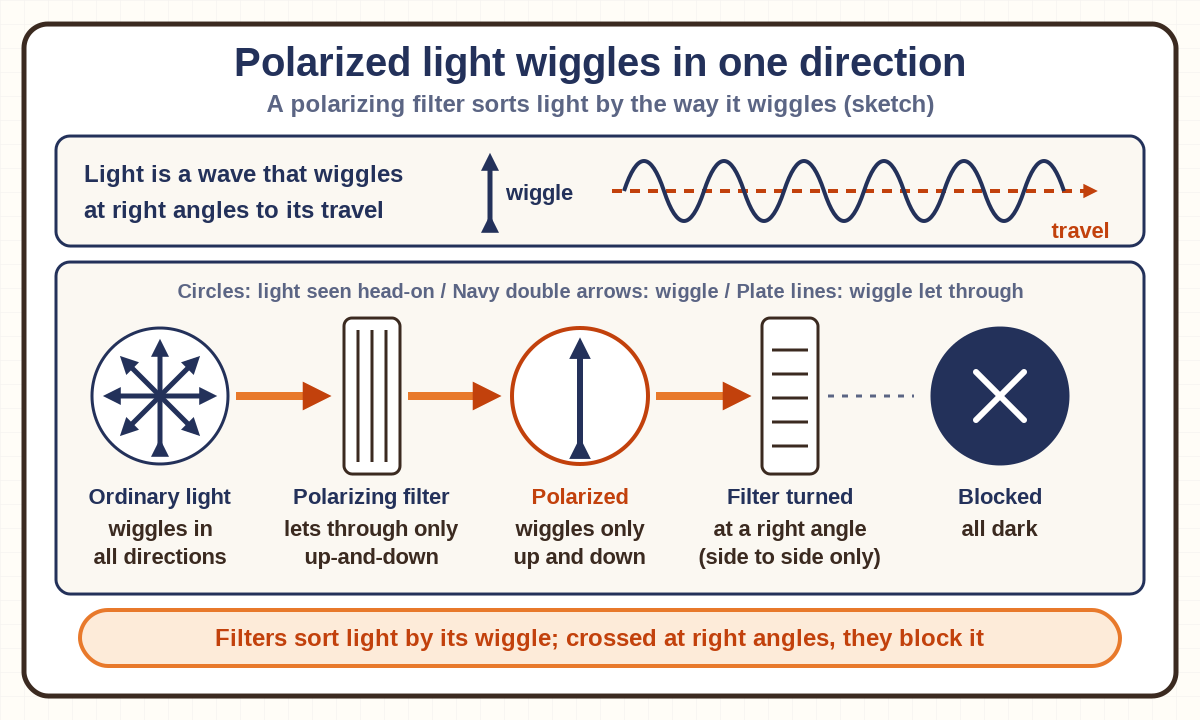
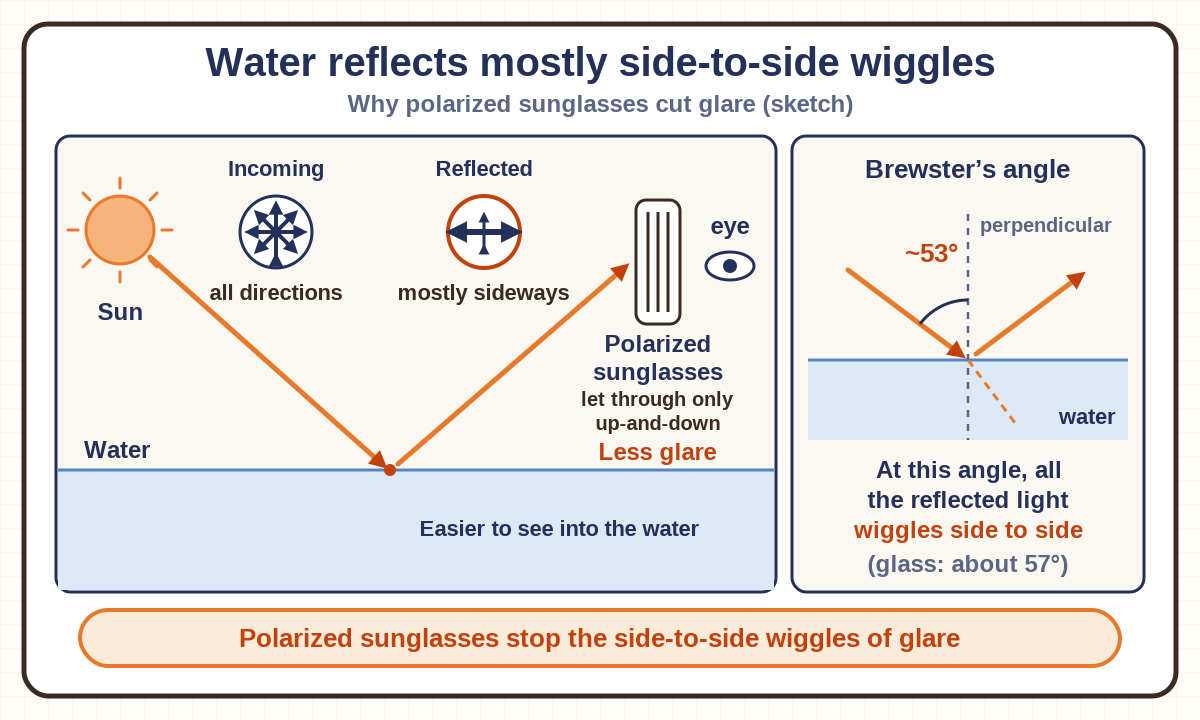
Light is a wave that wiggles at right angles to the way it travels. Ordinary light, such as sunlight, is a mix of light wiggling in all directions, but light reflected off water and light from the blue sky wiggle more in some directions than others. Polarized sunglasses let through light wiggling up and down, so they cut the glare off water, which is mostly light wiggling side to side. LCD screens and 3D movie glasses also use polarization.
Honeybees are thought to find directions from the pattern of polarization in the blue sky, even when the Sun is behind clouds. In astronomy, the polarization of light and radio waves from space reveals magnetic fields (spaces where magnetic forces act) at the edge of black holes, and scientists are checking whether the wiggle of the universe’s first light turned during its long journey.
A common mix-up
“Polarized sunglasses are just like dark sunglasses: they simply make everything dimmer.”
Only partly right. Polarized sunglasses do cut down the light that gets through, so things look dimmer. But they don’t cut all light equally: they sort light by the direction it wiggles. The lenses are made to let through light wiggling up and down and to stop light wiggling side to side. Glare reflected off water or an icy road contains a lot of light wiggling side to side, so they can pick out the glare and cut it sharply. So unlike dark lenses that dim everything, they remove the source of the dazzle, which also makes it easier to see into water.
Explained in pictures
Free to use in lessons, slides and posts with credit (CC BY 4.0).
Free to use in lessons, slides and posts with credit (CC BY 4.0).
Free to use in lessons, slides and posts with credit (CC BY 4.0).
Free to use in lessons, slides and posts with credit (CC BY 4.0).
You’re free to use these figures in lessons, slides and posts if you credit Naru News (naru.news). CC BY 4.0.
Think of it like this
The way you shake a jump rope, and a fence with slits
Tie one end of a jump rope to a post, hold the other end and shake it, and waves travel along the rope. Now set up a fence with narrow upright slits partway along, and pass the rope through one of the slits. If you shake the rope up and down, the waves pass through the slit. But if you shake it side to side, the rope hits the fence boards and the waves are stopped.
For polarization, the rope’s wiggle is light’s wiggle, and the fence is a polarizing filter. Even if you shake the rope randomly, up and down, side to side and at slants, the waves past the fence wiggle only up and down. That is light whose wiggles are lined up: polarized light. Put a second fence beyond it with sideways slits, and even the up-and-down wiggles are stopped, so no wave gets through. It is the same as two polarizing filters crossed at right angles going completely dark.
But the comparison has limits. Light’s wiggle isn’t a thing moving, like a rope, but a wiggle of electricity and magnetism. And a real polarizing filter has no slits you can see. Inside, long, thin molecules are lined up in one direction, and they soak up light wiggling along their own length. So the light left to pass through is light wiggling at right angles to the molecules. The “direction of the slits” in the comparison matches this direction the filter lets light through, which is at right angles to the lined-up molecules.
Key points
What is the “direction” light wiggles in?
Light is made of electric and magnetic wiggles traveling as a wave, and it belongs to the family of electromagnetic waves. These wiggles happen at right angles to the direction the light travels. A wave that wiggles at right angles to its travel, like a wave on a jump rope, is called a transverse wave. The direction of light’s wiggle is usually given by the direction of its electric wiggle.
Light such as sunlight is a random mix of waves wiggling in all directions. Light like this is not polarized (it is unpolarized). Light whose wiggles are lined up in one direction is called polarized. Even if not all of it is lined up, light with more wiggles in one direction is said to be partly polarized.
Polarization also comes in different shapes. Light that always wiggles back and forth along the same line is linearly polarized. Light whose wiggle direction turns round and round like a clock hand as it travels is circularly polarized. In circularly polarized light, the wiggle direction makes exactly one full turn as the light travels one wavelength, and it comes in right-handed and left-handed versions, depending on which way it turns. Radio waves are electromagnetic waves too, so they can be polarized in the same way.
How does a polarizing filter sort light?
One common kind of polarizing filter is a thin sheet with long, thin molecules all lined up in one direction. Electrons in the molecules move easily along the length of a molecule, so they soak up light wiggling in that direction. Light wiggling at right angles to the molecules is hardly absorbed and passes through. In this way, only light wiggling in one direction gets through. This kind of material was invented by Edwin Land, who founded the Polaroid company.
When light wiggling in all directions passes through a polarizing filter, only the light wiggling in the direction the filter passes remains, and the brightness drops to about half. When polarized light goes through a second filter, how much gets through depends on how far apart the two filters’ directions are. With no difference, almost all of it passes; at 45°, half; and at 90° (a right angle), none. This rule is called Malus’s law, after Malus, the French scientist who discovered in 1808 that reflected light is polarized.
Here’s a surprise: if you slip a third filter, tilted at 45°, between two filters crossed at right angles that looked completely dark, light gets through again. Light leaving the middle filter wiggles in a direction tilted by 45°, so part of it can also pass the last filter. Working it out with Malus’s law, a quarter of the light that passed the first filter gets through.
Why is light reflected off water mostly wiggling side to side?
When light strikes a smooth surface that isn’t metal, such as water or glass, at a slant, light wiggling parallel to the surface reflects more strongly. So light reflected off flat, level surfaces like water or an icy road contains a lot of light wiggling side to side. The lenses of polarized sunglasses are made to let through light wiggling up and down, so they can cut this glare.
At one particular angle, all of the reflected light wiggles parallel to the surface. This angle is called Brewster’s angle. It is measured not from the surface itself but from a line standing straight up from the surface (for water, pointing straight up). It is about 53° for water and about 57° for glass. The angle is set by how strongly the material bends light (its refractive index): the more a material bends light, the larger the angle (in math terms, the tangent [tan] of the angle equals the refractive index). It is named after the Scottish physicist David Brewster (1781–1868).
That reflection polarizes light was discovered in 1808. Malus noticed it when he looked at sunlight reflected from the windows of the Luxembourg Palace in Paris through a crystal of calcite that he rotated. The word “polarized” itself was coined by Malus.
Light reflected off a metal surface, however, is hardly polarized, so polarized sunglasses can’t remove that glare. They also don’t work on light reflected off upright surfaces such as windows.
Are sky light, LCD screens and 3D movie glasses polarized too?
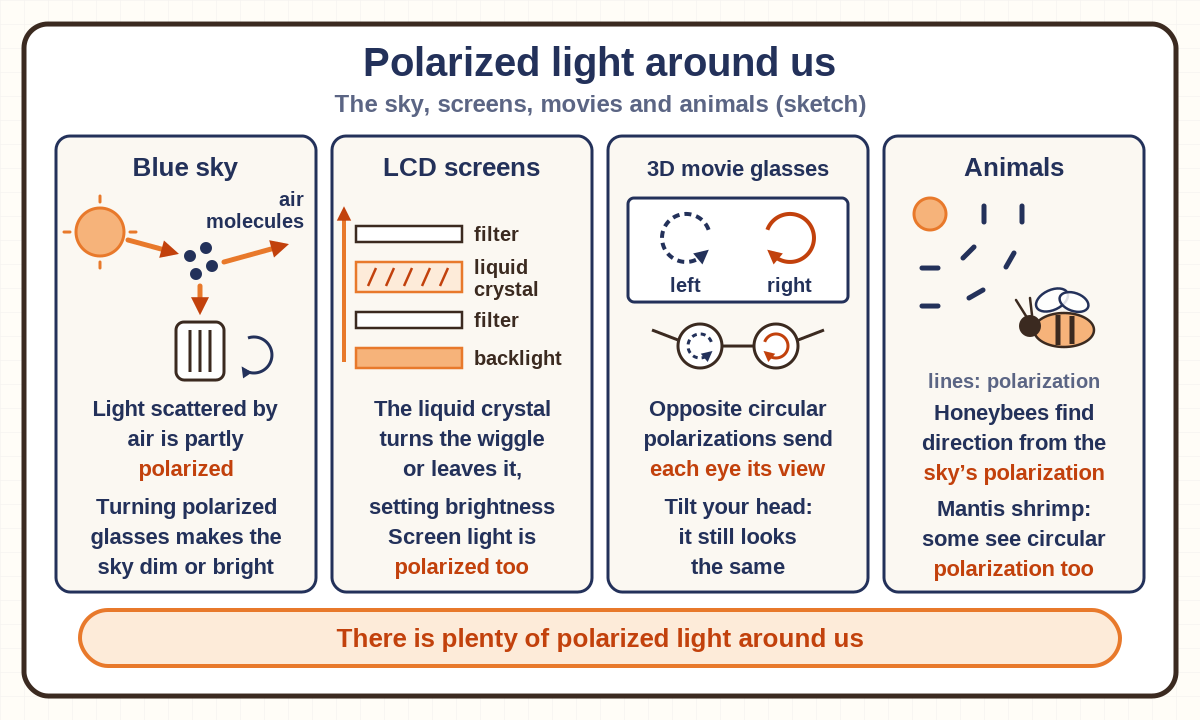
The sky looks blue because sunlight scatters off the molecules of the air (Rayleigh scattering). Blue light, with its shorter wavelength, is scattered more. Light scattered this way is partly polarized. If you look at the blue sky while turning polarized sunglasses in front of your eyes, the sky gets brighter and dimmer. Photographers use the same property when they darken the sky with a polarizing filter on the camera to make clouds stand out. When light is scattered many times, as inside clouds, the polarization is lost.
LCD screens use polarization to switch brightness. In one design, light from the back first passes through a polarizing filter and becomes polarized, then goes through a layer of liquid crystal toward a second filter turned at a right angle to the first. Liquid crystal can turn the wiggle of light passing through it by 90°, and applying a voltage switches this off. With no voltage, the wiggle turns by 90°, so the light can pass the second filter and that dot is bright. With a voltage, the wiggle doesn’t turn, so the second filter blocks the light and that dot is dark. This sets the brightness of each dot. Light leaving the screen has passed the last filter, so it is polarized, and if you wear polarized sunglasses and turn the screen, it may look dark at some angles.
Some 3D movies that use polarization turn the two pictures for the right and left eyes into circularly polarized light of opposite handedness and project them on top of each other on the same screen. Each lens of the glasses passes light of only one handedness, so the right and left eyes each get a different picture, and the scene looks 3D. Linear polarization can do the same, but tilting your head mixes the two pictures. With circular polarization, you see the same thing wherever you sit and however you tilt your head.
Can animals tell polarization apart?
Many can. Honeybees, for example, have light-sensing cells in the upper part of their eyes that respond strongly to polarized light. Even when the Sun is behind clouds, they are thought to find directions from the pattern of polarization in the patches of blue sky they can still see. Experiments have also shown that honeybees can learn a route through a maze of four connected tunnels using the direction of polarized light shining from the tunnel ceilings as a clue.
Some mantis shrimp can even tell circular polarization apart. A study published in 2008 found, for the first time in any animal, eyes that can sense circularly polarized light. In some species only the males’ bodies reflect circularly polarized light, and the researchers suspect it may serve as a secret signal between them.
Human eyes can sense polarization a tiny bit, too. If you look at a white area of an LCD screen and tilt your head from side to side, you may see a faint, yellowish bow-tie shape at right angles to the direction of polarization (Haidinger’s brushes). With practice, you can also see it in blue sky about 90° away from the Sun. In a 2015 study of 24 people, the light had to be 56% polarized on average for the shape to be seen. That is more sensitive than any other animal with a backbone tested so far, but no match for cuttlefish.
What can astronomers learn from polarization?
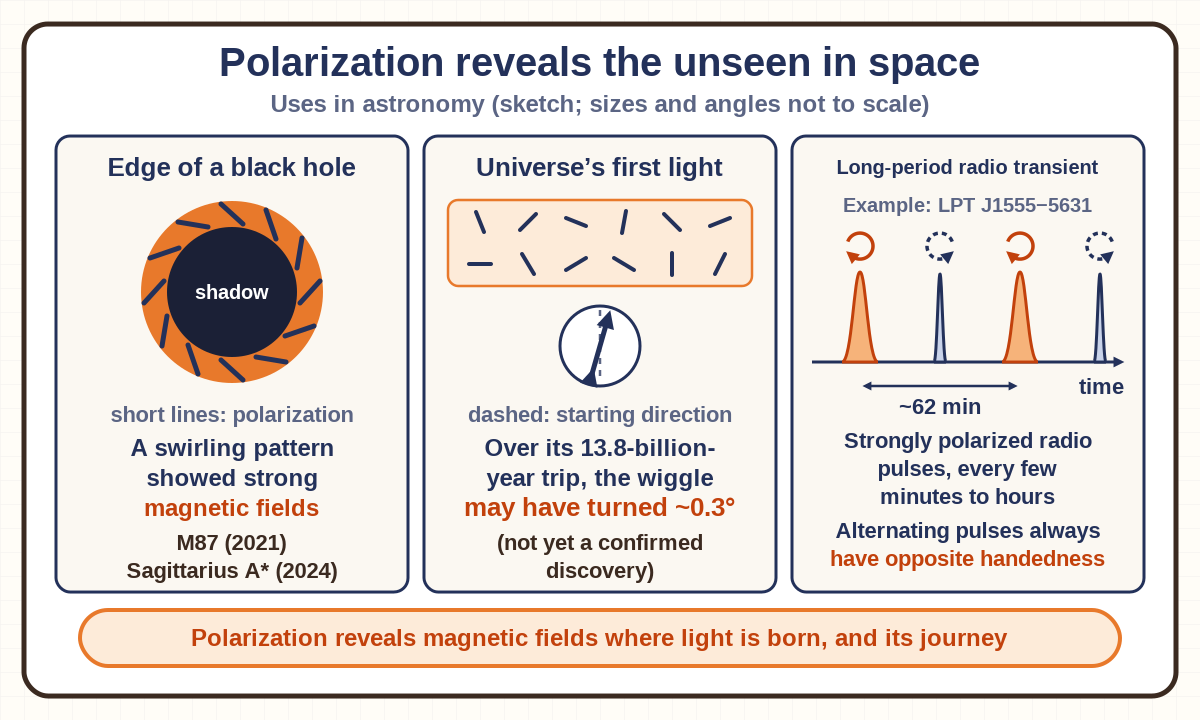
Light and radio waves arriving from space can be polarized too. Light given off in hot places with magnetic fields (spaces where magnetic forces act) is polarized, and the direction of its wiggle is tied to the direction of the magnetic field. So by laying out the directions of polarization across the sky, astronomers can read the shape of invisible magnetic fields.
In 2021, the Event Horizon Telescope, an Earth-sized radio telescope, released an image of the black hole at the center of the galaxy M87 seen in polarized light (observed in 2017). It showed magnetic fields at the black hole’s edge strong enough to hold back hot gas from falling in. In 2024, strong, well-ordered magnetic fields spiraling from the edge were also found around Sagittarius A*, at the center of our Milky Way, with a shape much like M87’s. In 2025, it was announced that the swirl of M87’s polarization had reversed between 2017 and 2021. This came as a complete surprise, and the reason is still unclear.
The universe’s first light (the cosmic microwave background, the oldest light in the universe, which took about 13.8 billion years to reach us) is also slightly polarized. About 380,000 years after the universe began, as it became transparent, this light scattered off freely moving electrons, a process similar to how blue sky light becomes polarized. The wiggle of light turning during its journey is called cosmic birefringence, and there are hints that the wiggle of this light turned by about 0.3° along the way. But it can’t yet be called a discovery.
Radio waves from a group of objects that send out strong radio waves again and again every few minutes to hours (long-period radio transients) are strongly polarized too. In LPT J1555−5631, which sends out radio waves every 62 minutes, two pulses (radio waves that get strong for just a short time) arrive alternately in each repeat, and the two always had circular polarization of opposite handedness. As with pulsars (stars that spin while sending out radio waves from around their magnetic poles), the two pulses are thought to come from two magnetic poles on opposite sides of the star.
Check yourself
Q1Polarized sunglasses greatly reduce the glare off water on a sunny day. When you wear them without tilting your head, which wiggle direction do the lenses let through, and which do they stop?
Answer and explanation
Answer: A Let up-and-down through, stop side-to-side
Light reflected off a flat, level surface that isn’t metal, like water, contains a lot of light wiggling side to side. So the lenses of polarized sunglasses are made to let through light wiggling up and down and stop light wiggling side to side, which greatly reduces the glare. A lens that let side-to-side wiggles through would send the glare straight to your eyes. A lens that let diagonal wiggles through would still pass about half of the glare’s side-to-side wiggle (when two directions differ by 45°, half gets through).
More on this → Key points: Why is light reflected off water mostly wiggling side to side?
Q2You stack two polarizing filters and hold them up to a bright light. The light that passes the first filter has its wiggles lined up. If you turn the second filter at a right angle to the first, what happens to the light passing the second filter?
Answer and explanation
Answer: C Almost none gets through, nearly dark
Light that passes the first filter wiggles only in the first filter’s direction. If you turn the second filter at a right angle, it doesn’t pass light wiggling that way, so almost no light gets through and it goes nearly dark. If the two filters’ directions differ by 45°, half gets through, and with no difference, almost all gets through (Malus’s law).
More on this → Key points: How does a polarizing filter sort light?
Q3In 2021, the Event Horizon Telescope, an Earth-sized radio telescope, released an image of the black hole at the center of the galaxy M87 seen in polarized light. What did this polarized image mainly reveal?
Answer and explanation
Answer: B A map of the magnetic field near the edge
Light and radio waves from hot places with magnetic fields (spaces where magnetic forces act) are polarized, and the direction of their wiggle is tied to the direction of the magnetic field. In the polarized image of M87, the swirling pattern of polarization directions showed magnetic fields at the black hole’s edge strong enough to hold back hot gas from falling in. What the pattern of polarization directions mainly tells us about is the magnetic field, not the speeds of the falling gas or the temperature near the edge.
More on this → Key points: What can astronomers learn from polarization?
Related terms
- Electromagnetic wave
- Speed of light
- Cosmic birefringence
- Event Horizon Telescope
- Long-period radio transient
- Brewster’s angle
- Circular polarization
- Liquid crystal
- Rayleigh scattering
- Cosmic microwave background
- Birefringence
- Black hole
Sources and how we checked
- S. J. Ling, J. Sanny and W. Moebs, University Physics Volume 3, section 1.7, “Polarization” (OpenStax, Rice University, 2016: EM waves being transverse, the direction of polarization being defined as parallel to the electric field, the Sun producing waves with electric fields in random directions, the first filter cutting the intensity of unpolarized light by a factor of 2, Malus’s law [I = I₀cos²θ], no light passing the second filter when the axes are perpendicular, reflected light being left more horizontally polarized and partially polarized parallel to the surface, reflected light being completely polarized at the angle given by Brewster’s law [tan θ = n₂/n₁], which is 53.1° for water and 56.7° for crown glass, sunglasses with vertical axes cutting the glare of light reflected from water or glass, light scattered by air being partially polarized, so that the blue sky gets bright and dim as you rotate polarizing sunglasses, photographers darkening the sky with polarizing filters to make clouds brighter by contrast, and liquid crystals being able to rotate the polarization of light passing through them by 90°; read November 25, 2026)
- P. P. Urone and R. Hinrichs, College Physics 2e, section 27.8, “Polarization” (OpenStax, Rice University: the analogy of waves on a rope through a vertical slit [vertical waves pass, horizontal waves are blocked], the Sun and many other light sources producing randomly polarized, unpolarized light, Polaroid materials invented by Edwin Land, the founder of the Polaroid Corporation, polarizing filters made of long molecules aligned perpendicular to the axis, whose electrons absorb waves with an electric field parallel to the molecules and let perpendicular fields pass, polarized light passing a filter at 45° being reduced to 50%, liquid crystals rotating polarization by 90° unless a voltage is applied, LCDs combining liquid crystals with polarizing filters, and reflected light being left more horizontally polarized, so that polarizing sunglasses cut the glare of light reflected from water or glass; read November 25, 2026)
- R. Nave, “Classification of Polarization” (HyperPhysics, Georgia State University: linear polarization, circular polarization, in which the electric field vector makes one complete revolution as the light advances one wavelength, and the naming of right- and left-circular polarization by the direction of rotation; read November 25, 2026)
- R. Nave, “Blue Sky” (HyperPhysics, Georgia State University: the blue color of the sky being caused by the scattering of sunlight off the molecules of the atmosphere, called Rayleigh scattering, which is more effective at short wavelengths; read November 25, 2026)
- S. A. Bowling, “Polarized Light” (Alaska Science Forum, Geophysical Institute, University of Alaska Fairbanks, February 29, 1988: light consisting of electric and magnetic fields vibrating at right angles to each other and to the direction of travel, polarized light being light in which one direction of vibration of the electric field dominates, light reflected from smooth, non-conducting surfaces such as water, ice or glass being polarized mostly horizontally, while metals do not polarize light on reflection, vertically oriented polarizing sunglasses blocking glare from horizontal surfaces but having no effect on reflections from vertical windows, and sky light scattered once being polarized much like reflected light, while multiple scattering, as in clouds, destroys the polarization; read November 25, 2026)
- M. W. Davidson, “Etienne Louis Malus (1775-1812)” (Molecular Expressions optics timeline, Florida State University: Malus discovering in 1808 that light could be polarized by reflection, by viewing sunlight reflected from the windows of the Luxembourg Palace in Paris through an Iceland spar crystal that he rotated, “polarized” being a term coined by Malus, and Malus’s law for the intensity of light passing through a pair of polarizing filters; read November 25, 2026)
- M. W. Davidson, “Sir David Brewster (1781-1868)” (Molecular Expressions optics timeline, Florida State University: Brewster being a Scottish physicist, and light reflected from a surface at a particular angle being plane-polarized, with the tangent of that angle equal to the refractive index; read November 25, 2026)
- University of Arizona Wyant College of Optical Sciences, Outreach, “3D Television” (for a 3D movie, two images being projected overlaid onto the same screen through circular polarizing filters of opposite handedness, with analyzing filters in the glasses so that each eye sees one image, circular polarization letting you sit anywhere and tilt your head with the same viewing experience, and linear polarization working best directly in the center, with head tilts making the images bleed into each other; read November 25, 2026)
- P. Kraft, C. Evangelista, M. Dacke, T. Labhart and M. V. Srinivasan, “Honeybee navigation: following routes using polarized-light cues” (Philosophical Transactions of the Royal Society B 366, 2011; full text: the polarization pattern of the sky being created by Rayleigh scattering of sunlight in the atmosphere, bees being believed to obtain a compass reference from the unoccluded part of the sky when the Sun is obscured by a cloud, photoreceptors in the dorsal region of the honeybee’s compound eyes being strongly sensitive to polarized light, and bees learning a route through a maze of four interconnected tunnels using directional information from polarized light shining from the tunnel ceilings; read November 25, 2026)
- T. W. Cronin and J. Marshall, “Patterns and properties of polarized light in air and water” (Philosophical Transactions of the Royal Society B 366, 2011; abstract: the strong, predictable polarization pattern that sunlight or moonlight creates in the sky, used by many animals for navigation, and circularly polarized light being rare in nature but produced by some animal surfaces; read November 25, 2026)
- Cell Press, “Mantis shrimp vision reveals new way that animals can see” (March 20, 2008, on the Current Biology paper by T.-H. Chiou et al., “Circular Polarization Vision in a Stomatopod Crustacean”: mantis shrimp being able to see circularly polarized light, a way of seeing never observed in any animal before, circularly polarized light being reflected from the cuticles of males but not females in three Odontodactylus species, and the researchers’ speculation that these reflections could act as a secret communication channel; read November 25, 2026)
- University of Bristol, “Bow ties and cuttlefish: Bristol researchers gain new insight into a human visual supersense” (July 1, 2015, on the Proceedings of the Royal Society B paper by S. E. Temple et al.: humans being able to perceive the polarization of light with the naked eye, Haidinger’s brushes appearing like a yellow bow tie at right angles to the polarization angle, being visible on a blank white area of an LCD screen when you tilt your head from side to side and, with practice, in the blue sky 90 degrees from the Sun, the average polarization threshold of 24 participants being 56 per cent, with some seeing the brushes at less than 25 per cent, and humans being more sensitive than any other vertebrate tested so far but not as good as cuttlefish; read November 25, 2026)
- ESO, “Astronomers image magnetic fields at the edge of M87’s black hole” (eso2105, March 24, 2021: light becoming polarized when it goes through filters like the lenses of polarized sunglasses, or when it is emitted in hot regions of space where magnetic fields are present, this being the first time polarization was measured this close to the edge of a black hole, polarization allowing astronomers to map the magnetic field lines at the edge, the magnetic fields there being strong enough to push back on the hot gas, the data being collected in 2017, and M87 lying 55 million light-years away; read November 25, 2026)
- ESO, “Astronomers unveil strong magnetic fields spiraling at the edge of Milky Way’s central black hole” (eso2406, March 27, 2024: light being an oscillating electromagnetic wave, called polarized when it oscillates in a preferred orientation, particles whirling around magnetic field lines imparting a polarization pattern perpendicular to the field, strong and organized magnetic fields spiraling from the edge of Sagittarius A*, strikingly similar to those of M87, hinting at a hidden jet, and the observations being made in April 2017; read November 25, 2026)
- EHT-Japan, Japanese version of the Event Horizon Telescope Collaboration’s September 16, 2025 release on the unexpected reversal of the polarization of the M87 black hole (the polarization near the black hole reversing between 2017 and 2021 into a spiral of the opposite direction, a possible explanation combining changes in the magnetic field structure with Faraday rotation, and the reversal being completely unexpected; read November 25, 2026)
- UC San Diego Today, “Is the Universe Twisted? A New Check on a Possible Twist in the Universe’s Oldest Light” (University of California San Diego, M. Franklin, September 24, 2026: scattering of radiation by free electrons about 380,000 years after the Big Bang, as the universe became transparent, generating a small amount of linear polarization in the cosmic microwave background, the process being somewhat analogous to the polarization produced when sunlight scatters in Earth’s atmosphere, and hints that the polarization rotated slightly during its journey, known as cosmic birefringence; read November 25, 2026)
- Kavli IPMU (Kavli Institute for the Physics and Mathematics of the Universe, University of Tokyo), Japanese release on a hint of new physics in polarized light from the early universe (November 24, 2020: the cosmic microwave background being emitted about 13.8 billion years ago, with a slight bias in the direction of its wave oscillation [polarization], and the rotation of the plane of polarization being observed with 99.2% confidence, while a discovery requires more than 99.99995%; read November 25, 2026)
- University of Tokyo, Graduate School of Science, Japanese release on a method to reduce an uncertainty in observations of cosmic birefringence (January 28, 2026: the polarization direction of the cosmic microwave background possibly having rotated slightly to the left or right over the history of the universe, and measurements so far reporting about 0.3 degrees; read November 25, 2026)
- N. Rea, N. Hurley-Walker, M. Caleb et al., “Long Period Transients (LPTs): a comprehensive review” (arXiv:2601.10393, 2026; abstract: LPTs being characterized by periodic radio bursts repeating every minutes to hours, with strong polarization; read November 25, 2026)
- S. D. Hyman, N. Hurley-Walker, D. A. Frail, E. Polisensky and W. D. Cotton, “Discovery of a 62-min long-period transient with near-orthogonal rotator geometry” (arXiv:2609.34102, September 2026; abstract and HTML full text: LPT J1555−5631 having a period of 62.2 min, with a main pulse and an interpulse separated by 165.4°, the circular polarization of the two pulses always being of opposite sign, such pulse–interpulse pairs in pulsars generally being associated with opposite magnetic poles, and emission from both magnetic poles being visible during one rotation; read November 25, 2026)
AI wrote this page from the sources above, and a different AI checked it against the text of those sources (November 25, 2026). A person with a master’s degree in science and a Japanese high-school science teaching license also read and checked it before publishing. Numbers are as of that date. If anything was hard to follow, you spot a mistake, or there’s a term you’d like explained, please write to [email protected].
Glossary
- AI agent
- AI alignment
- Alignment faking
- Artificial general intelligence (AGI)
- Artificial intelligence (AI)
- Backdoor
- Benchmark
- Chain of thought (CoT)
- Context window
- Data poisoning
- Deep learning
- Deepfake
- Diffusion model
- Embedding
- Emergent misalignment
- Evaluation awareness
- Fine-tuning
- Formal verification
- Generalization
- Generative adversarial network (GAN)
- Generative AI
- Goodhart’s law
- Gradual disempowerment
- Hallucination
- Hyperparameter
- Intelligence explosion
- Interpretability
- Jailbreaking
- Large language model (LLM)
- Latent space
- Machine learning
- Mixture of experts (MoE)
- Neural network
- Neuralese
- Overfitting
- Parameter
- Persona vectors
- Pre-training
- Prompt
- Prompt injection
- Reasoning model
- Recursive language model (RLM)
- Recursive self-improvement (RSI)
- Red teaming
- Reinforcement learning (RL)
- Retrieval-augmented generation (RAG)
- Reward hacking
- Reward model
- Shutdown resistance
- Sleeper agent
- Subliminal learning
- Superintelligence (ASI)
- System prompt
- Technological singularity
- Time horizon
- Token
- Transfer learning
- Transformer
- Accretion disk
- Black hole
- Black hole star
- Cosmic birefringence
- Event horizon
- Event Horizon Telescope (EHT)
- General relativity
- GPS
- Gravitational lensing
- Gravitational singularity
- Gravitational wave
- James Webb Space Telescope (JWST)
- Lagrange point
- Long-period radio transient (LPT)
- Neutron star
- Pulsar
- Quasar
- Sagittarius A*
- Space data center
- Spacetime
- Special relativity
- Speed of light
- Supermassive black hole
- White dwarf