
What is cosmic birefringence (a slight turn in the direction the universe’s oldest light wiggles)?
Also called: Cosmological birefringence

In one minute
Cosmic birefringence is the possibility that the “oldest light in the universe” (the cosmic microwave background), released about 380,000 years after the universe began, has had the direction it wiggles in (its polarization) turn slightly during its roughly 13.8-billion-year trip to Earth.
Unlike gravitational lensing, which bends light’s path, the path stays straight and only the wiggle direction turns. The name comes from “birefringence,” the effect that makes letters look doubled through a crystal called calcite. If it is real, the laws of physics would be slightly different in a mirror-image world, and it could be a clue to the unknown dark matter and dark energy.
Data from the Planck satellite and others show a hint of a turn of about 0.3°. But a telescope detector set at a very slightly wrong angle looks just the same, so the two are hard to tell apart, and it can’t be called a discovery yet.
A common mix-up
“As its name says, cosmic birefringence is when light’s path bends during its trip through space, so distant objects look doubled.”
The name part is right. If you set a clear crystal called calcite on a printed letter, the letter looks doubled. Inside the crystal, light splits into two kinds that wiggle at right angles to each other and travel at different speeds, so they bend by different amounts. This is called birefringence (double refraction), and cosmic birefringence takes its name from it. But in cosmic birefringence, the direction light travels doesn’t change. Cosmic birefringence doesn’t bend light’s path or make images look doubled. What may turn is the direction in which the light wiggles (its polarization), and only by a tiny angle, about 0.3°. Bending of light’s path, which makes distant objects look distorted or split into several images, is gravitational lensing, a different effect. If, in space, right-handed and left-handed light travel at very slightly different speeds, the path doesn’t bend, but the wiggle direction turns. Two kinds of light traveling at different speeds is what it shares with the birefringence of crystals.
Explained in pictures
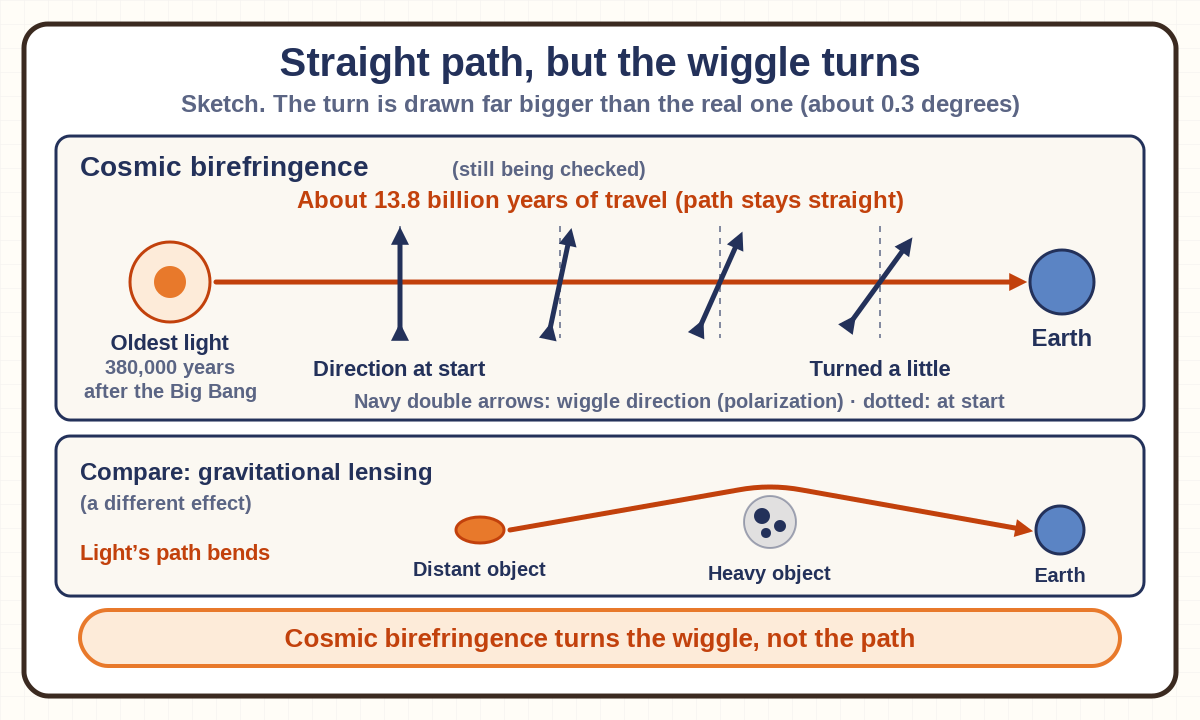
Free to use in lessons, slides and posts with credit (CC BY 4.0).
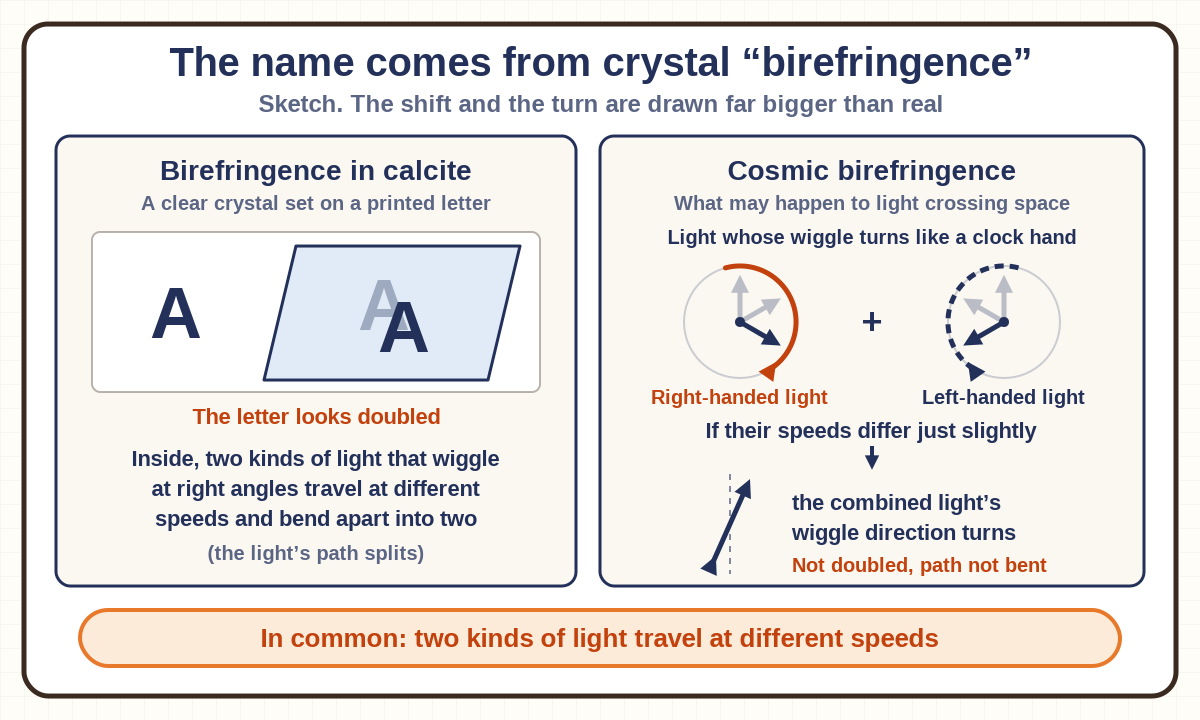
Free to use in lessons, slides and posts with credit (CC BY 4.0).
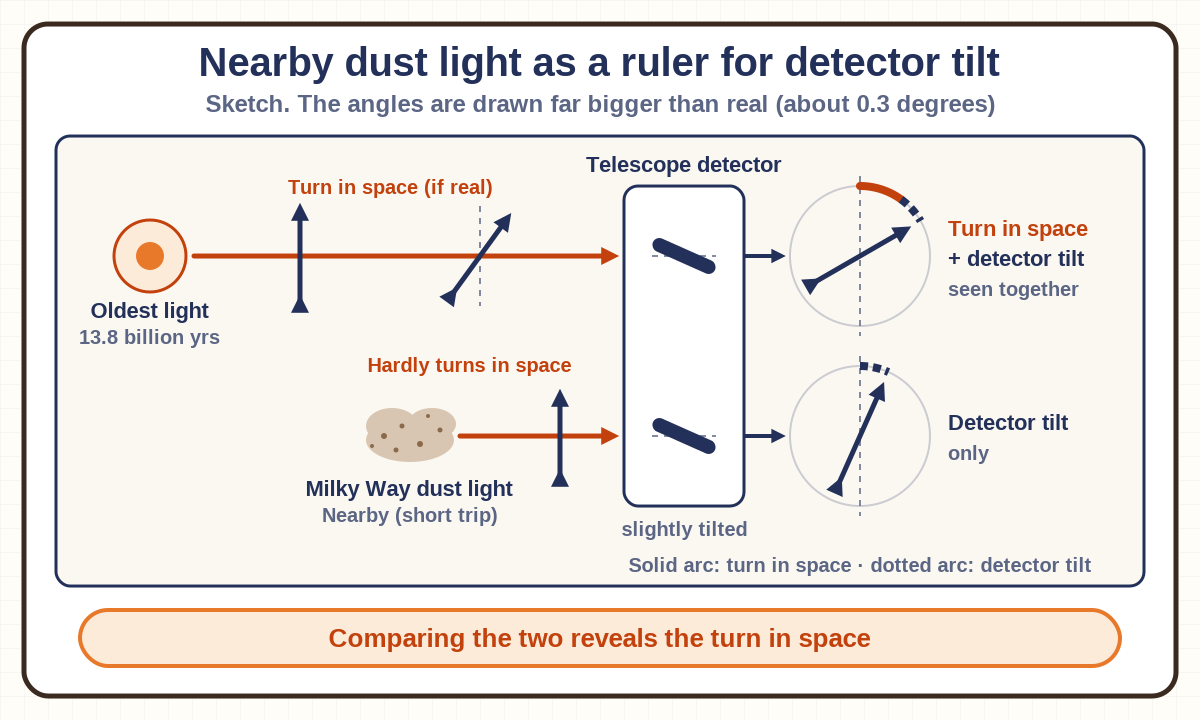
Free to use in lessons, slides and posts with credit (CC BY 4.0).
You’re free to use these figures in lessons, slides and posts if you credit Naru News (naru.news). CC BY 4.0.
Think of it like this
A long ribbon with a very slight twist
Picture a very long ribbon stretched straight from a faraway post all the way to your hand. At the far end, the ribbon’s flat face stands upright. If the ribbon twists very slightly along the way, then at the end in your hand, its face is tilted a little. The ribbon’s route stays straight; only the direction of its face has turned.
Applied to cosmic birefringence, the far end is where the universe’s oldest light set out, the direction of the ribbon’s face is the direction the light wiggles (its polarization), and the ribbon’s length is the 13.8-billion-year trip. When you photograph the tilt of the end in your hand, a slightly tilted camera makes it look tilted even with no twist. So you also photograph a short ribbon right next to you, which stands for the light from dust in the Milky Way. The short ribbon is too short to twist, so if it looks tilted, that’s the camera. Subtract that, and you find the long ribbon’s twist.
But the comparison has limits. The real oldest light wiggles in different directions in different parts of the sky, so there’s no way to know the starting direction of each “ribbon” one by one. Instead, the turn is worked out from the properties of the polarization patterns across the whole sky. And the short ribbon next to you might have a slight kink of its own. If the patterns in the dust light have a built-in bias, the ruler is off, so researchers are checking that too.
Key points
What is polarization? Where do we see it?
Light is a wave, and it wiggles at right angles to the direction it travels. Light from the Sun or a light bulb is a mix of light wiggling in all sorts of directions. Light whose wiggle direction is lopsided toward some direction is called polarized.
A familiar example is the glare off water. Light reflected from water contains a lot of light wiggling sideways. The lenses of polarized sunglasses are made to let through light wiggling up and down, so they cut the glare from water and icy roads. A polarizing filter on a camera lens also sorts light by the direction it wiggles.
Light can become polarized not only when it reflects, but also when it bumps into tiny particles and scatters. The universe’s oldest light, too, scattered off electrons about 380,000 years after the universe began, as the universe was becoming transparent, and that left a slight lopsidedness in its wiggle direction. The direction of that lopsidedness can be measured all over the sky.
Why is it called “birefringence”?
If you set a clear crystal called calcite on a printed letter, the letter looks doubled. Light entering the crystal splits into two kinds that wiggle at right angles to each other, and the two travel at different speeds. So they bend by different amounts and come out along separate paths. Because the light splits and refracts (bends) in two, it is called birefringence, or double refraction.
Cosmic birefringence shares the idea of two kinds of light traveling at different speeds. But in space, the idea is that of light whose wiggle direction turns like a clock hand as it travels (circular polarization), right-handed and left-handed light travel at very slightly different speeds. Add together a right-handed and a left-handed spin of the same speed, and the spinning cancels out, leaving a wiggle back and forth along one straight line. If one is slightly faster, that line turns little by little as the light goes. In this view, something filling space makes the universe behave like a crystal.
Unlike the birefringence of crystals, in cosmic birefringence the light’s path doesn’t bend, and the image isn’t doubled. The longer light travels, the bigger the turn, so the universe’s oldest light, which has traveled for about 13.8 billion years, is well suited for checking.
How can a turn be seen without knowing the starting direction?
The oldest light wiggles in different directions in different parts of the sky, and there’s no way to know each starting direction one by one. So scientists study what patterns the wiggle directions form across the whole sky.
The sky’s polarization patterns come in two kinds. In one, the wiggle directions line up straight with the pattern (parallel or at right angles). In the other, they line up slanted, like the blades of a pinwheel, forming a twisted pattern (experts call these E modes and B modes). Seen in a mirror, a pinwheel twists the opposite way.
If the laws of physics are the same in a mirror-image world, right-twisted and left-twisted patterns should show up with no link to the straight patterns. But if the wiggle directions across the whole sky turn by the same angle, every straight pattern looks slightly twisted, all the same way. A slight link appears between the straight and twisted patterns, and the strength of that link gives the angle of the turn.
What makes it hard?
The turn is about 0.3°, tiny, roughly the angle a clock’s minute hand moves in about 3 seconds. Meanwhile, if a telescope detector that measures polarization is mounted at a very slightly wrong angle, the polarization across the whole sky looks turned by the same amount. The turn in space and the detector’s tilt can’t be told apart from the oldest light alone.
A 2016 analysis using data from Europe’s Planck satellite also seemed to show a turn of about 0.3°. But the uncertainty in the detectors’ angles was about as large, so the result was also consistent with no turn at all (0°).
So in 2019, Yuto Minami and colleagues devised a method that uses the light given off by dust in the Milky Way (our galaxy) as a ruler. Dust light is also polarized, but its trip to Earth is far shorter than the oldest light’s, so it hardly turns in space. A detector’s tilt, though, shows up by the same amount in both kinds of light. The starting directions of the dust light aren’t known one by one either, but by studying its patterns across the sky, just as with the oldest light, and comparing the two, the detector’s tilt can be separated from the turn in space.
In 2020, Minami and Eiichiro Komatsu applied this method to Planck data and found a turn of about 0.35°. But the answer from this method depends on how the patterns in the dust light are treated. In a 2022 analysis, the more of the sky near the Milky Way was left out of the calculation, the smaller the angle came out.
If it is real, what would it tell us?
It would mean the laws of physics are slightly different in a mirror-image world. If the polarization turns only one particular way, either right or left, then in a mirror-image world it would turn the opposite way. The laws of physics staying the same in a mirror is called parity symmetry, so this symmetry would be broken (parity violation).
About 95% of what the universe is made of is dark matter and dark energy, whose nature is unknown and which today’s theory of particles can’t explain. If space is filled with particles like axions that interact with light in a way that flips in a mirror, cosmic birefringence is thought to follow. Axion-like particles draw attention as candidates for what dark matter or dark energy is, but they haven’t been found; they are hypothetical.
How much is known so far?
In short, there are hints, but it can’t be called a discovery yet.
Minami and Komatsu’s 2020 result ruled out no turn (0°) with 99.2% confidence. Since then, many more analyses with different data and methods have been done, and all show a turn in the same direction, of a similar size, about 0.2° to 0.4°. The data used include Planck, WMAP and Planck combined, and the ground-based ACT (Atacama Cosmology Telescope), and some results have shown confidence higher than 99.2%.
There are two reasons it still isn’t a discovery. First, a discovery in science is said to need more than 99.99995% confidence. 99.2% sounds high, but it falls far short of that bar. Second, even in analyses with higher confidence, the researchers themselves say that problems not yet understood remain in the data, so no strong conclusion can be drawn. In fact, the answer can change depending on how the detector angles are estimated and how the dust light from the Milky Way is handled.
In September 2026, a team at UC San Diego published a paper on a new way of checking. When Planck maps made by separate sets of detectors are compared two at a time, any turn in space is in every map by the same amount and cancels, leaving only the differences between the detectors’ tilts. The differences found this way matched those from Minami and Komatsu’s method. But the team writes that because it uses the same data, it isn’t a check of cosmic birefringence with different data, and this method alone can’t fix the angle of the turn in space itself.
What comes next?
At the Simons Observatory in Chile’s Atacama Desert in South America, a large telescope captured its first image of the sky (Mars) in February 2025. Together with three smaller telescopes, it will measure the universe’s oldest light in detail.
LiteBIRD, a satellite of the Japan Aerospace Exploration Agency (JAXA), is planned to measure the polarization of the oldest light precisely from space, aiming for launch in fiscal year 2036.
A big challenge ahead is to set detector angles more precisely without relying on dust in the Milky Way. It is estimated that fixing detector angles to within about 0.05° would allow a secure measurement of cosmic birefringence. The paper on the 2026 method of comparing detector sets says it can be used in such observations to check the differences between detector angles.
Check yourself
Q1The universe’s “oldest light,” released about 380,000 years after the universe began, takes about 13.8 billion years to reach Earth. If cosmic birefringence is really happening, what about this light changes along the way?
Answer and explanation
Answer: B Its wiggle direction turns, little by little
What may turn in cosmic birefringence is the direction the light wiggles (its polarization). The light’s path stays straight, and the image doesn’t split in two. Bending of the path, which makes distant objects look distorted or split into several images, is gravitational lensing, a different effect. In the birefringence of calcite, which gave the name, letters look doubled, but in space the idea is that right-handed and left-handed light travel at very slightly different speeds, so the combined light’s wiggle direction turns.
Q2When measuring cosmic birefringence, a tiny offset in a telescope’s detector can look just like cosmic birefringence. Yuto Minami and Eiichiro Komatsu’s 2020 analysis told the two apart by using light given off by dust in the Milky Way as a ruler. Why does dust light work as a ruler?
Answer and explanation
Answer: C Its short trip leaves it almost unchanged
Dust light’s trip to Earth is far shorter than that of the oldest light, which takes about 13.8 billion years to arrive, so it hardly turns in space. A detector’s tilt, on the other hand, shows up by the same amount in both the dust light and the oldest light. So measuring the detector’s tilt with dust light, which barely turns in space, and subtracting it reveals the turn in space.
Q3Cosmic birefringence, which may be happening to the universe’s oldest light, has been analyzed many times since 2020, and hints have appeared. Yet it still isn’t called a discovery. Which is a correct reason?
Answer and explanation
Answer: A Its confidence hasn’t reached the bar for discovery
The hints have come from several sets of data, Planck, WMAP and Planck combined, and the ground-based ACT, all in the same direction and of a similar size, about 0.2 to 0.4 degrees. It still isn’t a discovery because the confidence hasn’t reached the bar for a discovery (more than 99.99995%). The 99.2% of 2020 falls far short of it. Even in analyses with higher confidence, the researchers themselves say problems not yet understood remain in the data, so no strong conclusion can be drawn.
Related terms
- Cosmic microwave background
- Polarization
- Birefringence
- Parity symmetry
- Axion
- Dark matter
- Dark energy
- Gravitational lensing
- Gravitational wave
- Planck satellite
- LiteBIRD
- Simons Observatory
Sources and how we checked
- Anto I. Lonappan, Brian Keating and Kam Arnold, “Differential Polarization Calibration: A Consistency Test for Cosmic Birefringence” (The Astrophysical Journal Letters 1009, L12, September 17, 2026; journal page: all three authors at UC San Diego, received and published dates, and the abstract [the birefringence angle β being degenerate with instrumental polarization-angle offsets, the Minami–Komatsu likelihood breaking this with Galactic foreground polarization and so depending on the foreground model, the differential estimator cancelling β, its application to eight Planck NPIPE detector-set maps agreeing with the Minami–Komatsu pattern (χ² = 8.18 for 7 degrees of freedom), the test being a consistency check rather than independent confirmation and not an absolute measurement of β, and a conditional β = 0.37° ± 0.12°]; read November 19, 2026)
- The arXiv version of the same paper (arXiv:2609.09149, September 8, 2026; HTML full text: CMB polarization spectra depending only on the total rotation α + β, so CMB data alone can’t separate them; the eight maps being Planck’s 100, 143, 217 and 353 GHz split into A/B halves, giving 28 pairs; 0.40° ± 0.13° with a Galactic mask; β being a conditional value with the common mode taken from the Minami–Komatsu likelihood, not an independent determination; and the test serving as a validation layer for future analyses such as Simons Observatory and LiteBIRD; read November 19, 2026)
- UC San Diego Today, “Is the Universe Twisted? A New Check on a Possible Twist in the Universe’s Oldest Light” (University of California San Diego, Michelle Franklin, September 24, 2026; the oldest light [the cosmic microwave background] being polarized by free electrons scattering radiation about 380,000 years after the Big Bang, a real cosmic rotation affecting all maps equally and cancelling in the comparison, agreement with the Minami–Komatsu analysis without being an independent measurement, dark matter and dark energy making up about 95% of the universe’s energy density, an axion-like field coupled to light as one possible explanation with such particles being hypothetical, the method helping to find calibration errors that convert E modes into spurious B modes and so aiding searches for the B modes of primordial gravitational waves, and the Simons Observatory; read November 19, 2026)
- Yuto Minami and Eiichiro Komatsu, “New Extraction of the Cosmic Birefringence from the Planck 2018 Polarization Data” (Physical Review Letters 125, 221301, 2020; arXiv abstract: searching for parity-violating physics, earlier measurements limited by the uncertainty in the absolute polarization angles of Planck’s detectors, determining β and the miscalibration simultaneously from the EB correlation of the CMB and the Galactic foreground emission, β = 0.35° ± 0.14° [68% C.L.], excluding β = 0 at 99.2% C.L. [2.4σ]; read November 19, 2026)
- Kavli IPMU, Japanese press release on a hint of new physics in polarized light from the early universe (November 24, 2020; Yuto Minami [KEK] and Eiichiro Komatsu [Kavli IPMU], the cosmic microwave background as the afterglow of the early universe released about 13.8 billion years ago, with a slight bias in the direction its waves vibrate [polarization], parity symmetry defined as a phenomenon unchanged when space is inverted as in a mirror, the plane of polarization rotating if parity-violating dark matter or dark energy interacts with light, the uncertainty in calibrating the detectors’ rotation having limited earlier measurements, light from dust in our Galaxy traveling a far shorter distance so its plane of polarization hardly rotates while the detectors’ rotation appears in both, the 99.2% confidence, a discovery requiring more than 99.99995%, the axion as a candidate for dark matter and dark energy, and tests with the Simons Array and LiteBIRD; read November 19, 2026)
- Max Planck Institute for Astrophysics, “A hint of new physics in polarized radiation from the early Universe” (news, November 23, 2020; light whose waves oscillate in a preferred direction being called polarized, dark matter or dark energy possibly rotating the plane of polarization by an angle β, polarized dust emission from the Milky Way used to tell apart detector miscalibration, a discovery requiring a confidence level of 99.99995 percent, dark matter and dark energy making up 25 and 70 percent of today’s energy budget, and Eiichiro Komatsu saying “we have not found definitive evidence for new physics yet”; read November 19, 2026)
- Yuto Minami et al., “Simultaneous determination of the cosmic birefringence and miscalibrated polarisation angles from CMB experiments” (arXiv:1904.12440, April 2019; abstract: both effects rotate the CMB polarization, but only the miscalibration rotates the polarization of Galactic foreground emission, so the two can be determined simultaneously; read November 19, 2026)
- Planck Collaboration, “Planck intermediate results. XLIX. Parity-violation constraints from polarization data” (Astronomy & Astrophysics 596, A110, 2016; arXiv abstract: a rotation of the polarization plane producing TB and EB correlations that are otherwise zero, α = 0.31° ± 0.05° (stat.) ± 0.28° (syst.), compatible with no parity violation, and the measurement being limited by the uncertainty in the orientation of Planck’s polarization-sensitive bolometers; read November 19, 2026)
- Eiichiro Komatsu, “New physics from the polarised light of the cosmic microwave background” (Nature Reviews Physics 4, 452–469, 2022; arXiv HTML full text, version 4: space filled with dark matter and dark energy behaving as if it were a birefringent material like a crystal, the two circular polarization states traveling at slightly different phase velocities and rotating the plane of linear polarization, the rotation being proportional to the path length, an axion-like field coupling to the electromagnetic field in a parity-violating manner, photons traveling 13–14 billion years, the path within our Galaxy being much shorter so β can be ignored for the foreground, β being degenerate with instrumental miscalibration, E modes with polarization parallel or perpendicular to the wave direction and B modes tilted by ±45°, E having even and B odd parity, rotation mixing E and B and producing an EB correlation, the result being a roughly 3σ “hint,” not yet a convincing detection, and a calibration to ±0.05° yielding a secure detection, calling for innovation in calibration; read November 19, 2026)
- P. Diego-Palazuelos et al., “Cosmic Birefringence from Planck Data Release 4” (Physical Review Letters 128, 091302, 2022; arXiv abstract: β = 0.30° ± 0.11° [68% C.L.] for nearly full-sky data, the values decreasing as the Galactic mask is enlarged, attributed to polarized foreground emission, and the choice not to assign cosmological significance to the measured value until foreground polarization is better understood; read November 19, 2026)
- Johannes R. Eskilt and Eiichiro Komatsu, “Improved Constraints on Cosmic Birefringence from the WMAP and Planck Cosmic Microwave Background Polarization Data” (Physical Review D 106, 063503, 2022; arXiv abstract: combining WMAP and Planck polarization data from 23 to 353 GHz, β = 0.342° (+0.094°/−0.091°), excluding β = 0 at 99.987% C.L. [3.6σ], with no evidence of frequency dependence; read November 19, 2026)
- P. Diego-Palazuelos and E. Komatsu, “Cosmic Birefringence from the Atacama Cosmology Telescope Data Release 6” (arXiv:2509.13654, September 2025, accepted by Physical Review D; abstract: from the EB and TB correlations in ACT DR6 polarization data, with priors on the miscalibration angles from the ACT optics model, β = 0.215° ± 0.074° [68% C.L.], 2.9σ from zero, consistent with WMAP and Planck, and some systematics not understood, so the data do not support strong cosmological conclusions; read November 19, 2026)
- Johannes R. Eskilt, “Cosmic birefringence from a joint analysis of ACT and Planck” (arXiv:2608.06480, August 6, 2026; not yet peer-reviewed; abstract: combining ACT DR6 and Planck PR4, taking the reported instrumental priors at face value, β = 0.277° ± 0.057°, non-zero at 4.8σ, still 3.5σ after mitigating dust, and unresolved systematics having to be understood before strong cosmological conclusions; read November 19, 2026)
- Graduate School of Science, University of Tokyo, Japanese press release on a way to reduce ambiguity in observing cosmic birefringence (January 28, 2026; the Japanese name uchū fukukussetsu for cosmic birefringence, the possibility that the CMB’s polarization direction has rotated slightly to the left or right over cosmic history, earlier measurements reporting about 0.3°, axion-like particles as hypothetical particles outside the Standard Model and strong candidates, clues to dark matter and dark energy, and near-future observations such as the Simons Observatory and LiteBIRD; read November 19, 2026)
- Luca Pagano et al., “CMB Polarization Systematics, Cosmological Birefringence and the Gravitational Waves Background” (Physical Review D 80, 043522, 2009; arXiv abstract: the name “cosmological birefringence,” and a miscalibration of the polarization reference frame being able to mimic a gravitational-wave background or a cosmological birefringence signal; read November 19, 2026)
- Florida State University, Molecular Expressions, “Double Refraction (Birefringence)” (microscopy primer page on Iceland spar calcite; objects producing a double image through the crystal, light being refracted into two wavefronts polarized at right angles and traveling at different velocities, the ordinary and extraordinary rays, and the term birefringence coming from “bi-refraction”; read November 19, 2026)
- Canon Science Lab Kids, Japanese page on why water surfaces shine (light as a transverse wave whose vibration is at right angles to its direction of travel, polarization occurring only in transverse waves, water reflecting much light whose plane of vibration is horizontal, and polarizing filters on camera lenses; read November 19, 2026)
- Sue Ann Bowling, “Polarized Light” (Alaska Science Forum, Geophysical Institute, University of Alaska Fairbanks, February 29, 1988; polarized light as light in which one direction of vibration of the electric field dominates, most light reflected from a horizontal surface [water, ice, roads] vibrating horizontally, vertically polarized sunglasses blocking glare from icy roads or water, and light scattered just once being polarized much as reflection does; read November 19, 2026)
- Simons Foundation, “Simons Observatory Large Aperture Telescope Achieves First Light Milestone” (March 17, 2025; near the summit of Cerro Toco in Chile’s Atacama Desert, the Large Aperture Telescope with two mirrors each roughly six meters across capturing its first image, of Mars, on February 22, 2025, and four telescopes in all with three Small Aperture Telescopes measuring the cosmic microwave background, the afterglow of the Big Bang; read November 19, 2026)
- ISAS/JAXA, Japanese page on LiteBIRD, the space telescope for observing the polarization of the cosmic microwave background (precise polarization observations of the cosmic microwave background, aiming for launch in fiscal year 2036, and observing for three years; read November 19, 2026)
AI wrote this page from the sources above, and a different AI checked it against the text of those sources (November 19, 2026). A person with a master’s degree in science and a Japanese high-school science teaching license also read and checked it before publishing. Numbers are as of that date. If anything was hard to follow, you spot a mistake, or there’s a term you’d like explained, please write to [email protected].
Glossary
- AI agent
- AI alignment
- Alignment faking
- Artificial general intelligence (AGI)
- Artificial intelligence (AI)
- Backdoor
- Benchmark
- Chain of thought (CoT)
- Context window
- Data poisoning
- Deep learning
- Deepfake
- Diffusion model
- Embedding
- Emergent misalignment
- Evaluation awareness
- Fine-tuning
- Formal verification
- Generalization
- Generative adversarial network (GAN)
- Generative AI
- Goodhart’s law
- Gradual disempowerment
- Hallucination
- Hyperparameter
- Intelligence explosion
- Interpretability
- Jailbreaking
- Large language model (LLM)
- Latent space
- Machine learning
- Mixture of experts (MoE)
- Neural network
- Neuralese
- Overfitting
- Parameter
- Persona vectors
- Pre-training
- Prompt
- Prompt injection
- Reasoning model
- Recursive language model (RLM)
- Recursive self-improvement (RSI)
- Red teaming
- Reinforcement learning (RL)
- Retrieval-augmented generation (RAG)
- Reward hacking
- Reward model
- Shutdown resistance
- Sleeper agent
- Subliminal learning
- Superintelligence (ASI)
- System prompt
- Technological singularity
- Time horizon
- Token
- Transfer learning
- Transformer
- Accretion disk
- Black hole
- Black hole star
- You are hereCosmic birefringence
- Event horizon
- Event Horizon Telescope (EHT)
- General relativity
- GPS
- Gravitational lensing
- Gravitational singularity
- Gravitational wave
- James Webb Space Telescope (JWST)
- Lagrange point
- Long-period radio transient (LPT)
- Neutron star
- Pulsar
- Quasar
- Sagittarius A*
- Space data center
- Spacetime
- Special relativity
- Speed of light
- Supermassive black hole
- White dwarf