
What is a long-period radio transient (an object that repeats strong radio pulses every few minutes to hours)?
Also called: Long-period transient, LPRT

In one minute
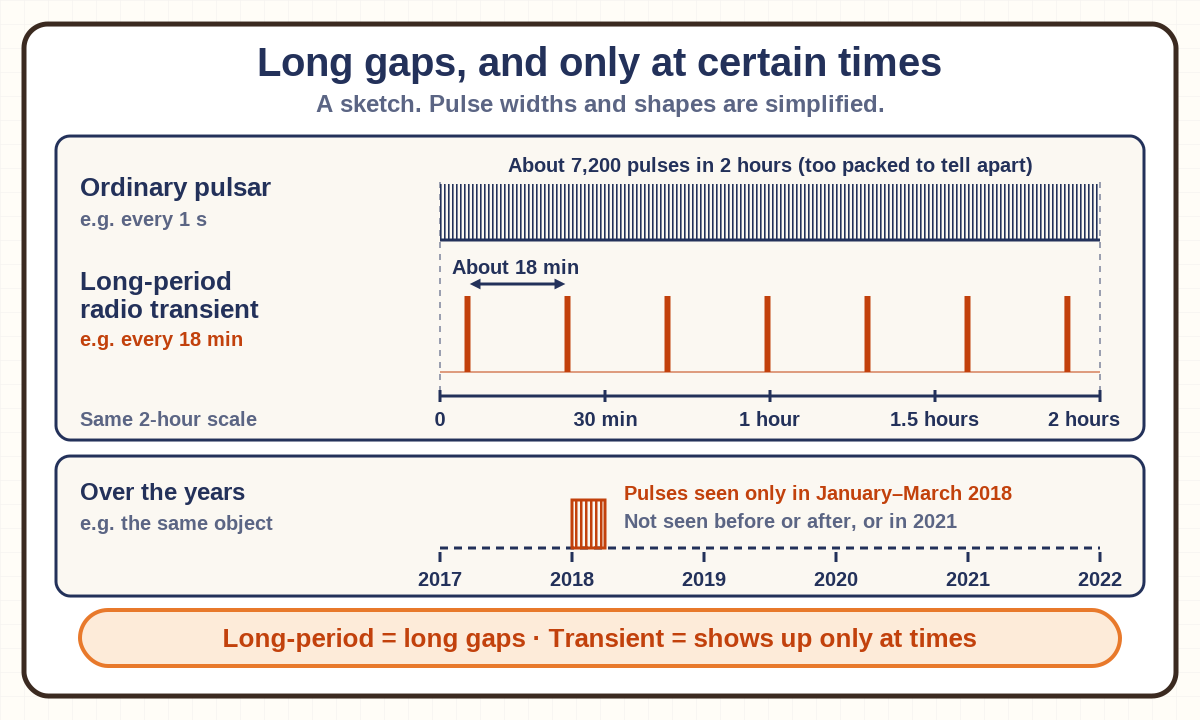
A long-period radio transient (LPT) is one of a group of objects in space that give off strong pulses of radio waves (radio waves that get strong for only a short time) again and again, every few minutes to several hours.
Pulsars (fast-spinning neutron stars) also repeat radio pulses, but usually every fraction of a second to a few seconds. LPTs repeat far more slowly, and by the usual thinking, a neutron star spinning that slowly shouldn’t be able to give off radio waves.
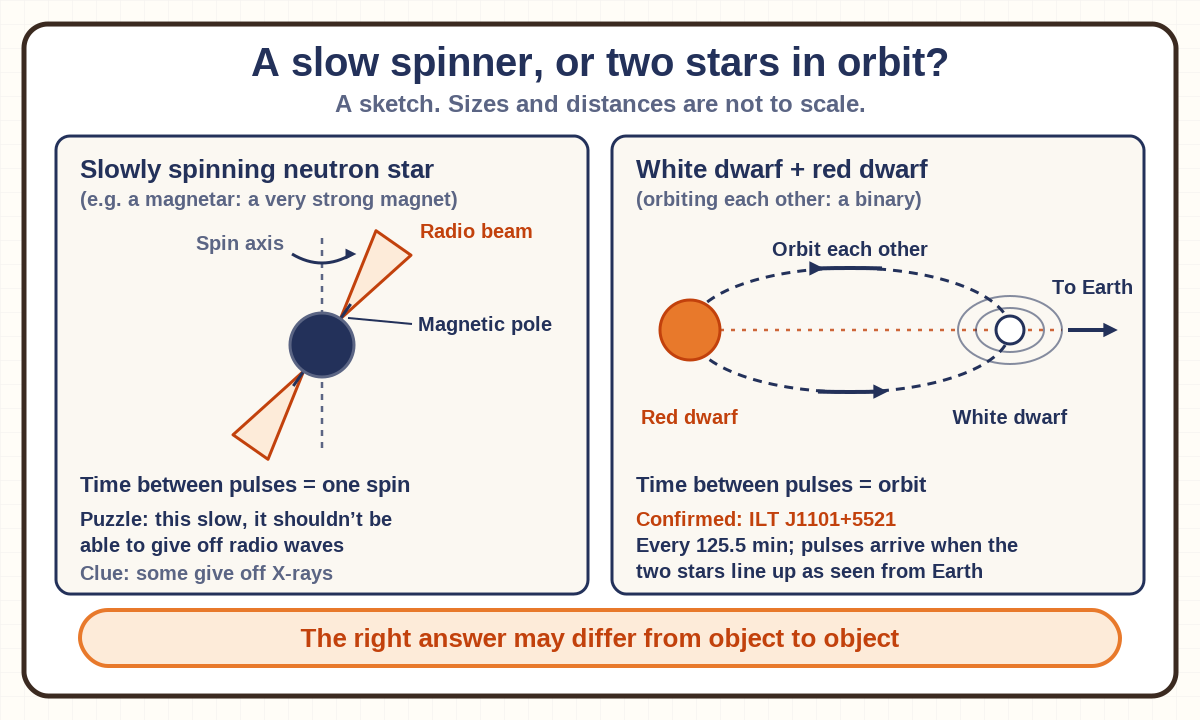
Candidates include neutron stars with extremely strong magnetism (magnetars) and pairs of a white dwarf and a red dwarf orbiting each other, and the answer may differ from object to object. Only a dozen or so have been found. “Transient” means short-lived: the radio waves aren’t always on, but show up only at certain times.
A common mix-up
“A long-period radio transient is just a pulsar spinning very slowly, and what it is has already been worked out.”
That’s half right. Radio waves arriving at regular times look a lot like a pulsar (a fast-spinning neutron star), and some LPTs may indeed be neutron stars spinning very slowly. But the usual workings of a pulsar can’t explain how a neutron star spinning that slowly could give off radio waves. What’s more, some have been confirmed to be pairs of a white dwarf and a red dwarf orbiting each other (binaries), so they don’t seem to be just one kind of thing. For most of these objects, what makes the radio waves is still unclear.
Explained in pictures
Free to use in lessons, slides and posts with credit (CC BY 4.0).
Free to use in lessons, slides and posts with credit (CC BY 4.0).
Free to use in lessons, slides and posts with credit (CC BY 4.0).
You’re free to use these figures in lessons, slides and posts if you credit Naru News (naru.news). CC BY 4.0.
Think of it like this
A bike light that shines brightly even when you pedal slowly
Picture a bicycle light powered by a dynamo that runs off the turning wheel. Pedal fast and it shines brightly; pedal slowly and it dims; go so slowly you almost stop, and it hardly shines at all. That’s because the light’s energy comes from your pedaling.
A pulsar is like this light. The spinning neutron star’s magnetism makes a voltage like a generator and turns part of its spin into radio waves. Spin too slowly and the voltage falls short, so the radio waves stop; that’s the “death line.” A long-period radio transient is like a bike creeping along so slowly it nearly stops, yet with its light shining dazzlingly. So researchers wonder whether it has a battery besides the pedaling (energy stored in strong magnetism), or whether it isn’t shining on its own at all, but because of another bike riding alongside it (a binary).
But the comparison doesn’t fit everywhere. A bike light shines ahead all the time, while a pulsar’s radio waves reach us only when a beam from a magnetic pole points toward Earth. And in a binary LPT, the time between pulses may be not the time a star takes to spin but the time the two stars take to orbit each other.
Key points
What does the name mean?
“Long-period radio transient” is made of three parts. “Long-period” means the time between repeats (the period) is long. Ordinary pulsars repeat every fraction of a second to a few seconds; these repeat every few minutes to several hours, far longer.
“Radio” means radio waves, a kind of light our eyes can’t see. They are also used for radio broadcasts. Radio waves from space are caught with radio telescopes, such as big dishes or fields of antennas.
“Transient” means short-lived. The radio waves aren’t on all the time; they get strong only during pulses lasting seconds to minutes. On top of that, some give off pulses only for a while and then can’t be seen anymore. For example, one object that repeats about every 18 minutes showed pulses only from January to March 2018, and none were seen in observations before and after that or in 2021. The “short-lived” in the name describes this kind of behavior. But later checks found that some last much longer. An object that repeats about every 22 minutes turned up, when old records were searched, even in observations from 1988: it had kept switching on and off for more than 30 years.
They are also called long-period transients (LPTs).
How are they different from ordinary pulsars?
A pulsar is a fast-spinning neutron star. A neutron star forms when the core of a heavy star collapses: about the mass of the Sun packed into a ball about 20 km across. It is also a powerful magnet, and beams of radio waves come out of both of its magnetic poles. As the star spins, the beams sweep around like the light of a lighthouse, and each time one passes over Earth, it arrives as a pulse. The time between repeats is from a few thousandths of a second to a few seconds; even the slowest known is only about 76 seconds.
LPT periods run from about 7 minutes for the shortest known to more than 6 hours for the longest. That is so much longer than ordinary pulsars that most traditional pulsar searches, built to look only for periods up to a few seconds, missed them.
What’s puzzling is that if they are neutron stars, they shouldn’t be able to give off radio waves while spinning so slowly. A spinning neutron star’s magnetism is thought to make a voltage, like a generator, and that voltage makes the particles that radio emission comes from. The slower the spin, the smaller the voltage, and once the spin gets slower than a certain boundary, the particles can’t be made and the radio waves stop. This boundary is called the “death line.” LPT J1555−5631, which repeats every 62 minutes, spins far slower than that boundary, on the side where it shouldn’t be able to give off radio waves.
There’s also an energy problem. A pulsar gives off radio waves using the energy it loses as its spin slowly winds down, and usually only a small part of that becomes radio waves. But in the object that repeats about every 18 minutes, it’s the other way around: the radio waves carry more energy than the slowing spin provides. Since the spin alone can’t pay for the radio waves, another source of energy seems to be needed.
What could they be?
There are three main candidates. The first is a slowly spinning neutron star, especially a magnetar: a neutron star with magnetism about another 1,000 times stronger than an ordinary neutron star’s. It might give off radio waves using energy stored in its magnetism rather than its spin. An LPT that gives off X-rays along with radio waves has also been found, and one idea is that it is an old magnetar.
The second is a lone white dwarf. A white dwarf is the core left behind after a star like the Sun uses up its fuel, only slightly bigger than Earth. But radio waves like these have not yet been confirmed from a lone white dwarf.
The third is a pair of a white dwarf and a red dwarf (a star much smaller and cooler than the Sun) orbiting each other, called a binary. ILT J1101+5521 gives off a pulse every 125.5 minutes. When it was studied in visible light, the red dwarf was moving back and forth, and its unseen partner turned out to be a white dwarf. The time the two stars take to orbit each other is the same as the time between pulses, and the pulses arrived when the two stars lined up as seen from Earth. This was the first LPT confirmed to be a binary. Things like the wind of gas blowing off the red dwarf are thought to interact with the white dwarf’s strong magnetism to make the radio waves.
The current view is that they may not all be the same thing. A 2026 theory paper (not yet peer-reviewed, meaning other researchers had not yet checked it) suggests they may split into two broad groups: those repeating faster than about once an hour being lone stars, and slower ones being binaries.
How are they found?
Most LPTs have been found with radio telescopes that take pictures of wide areas of sky over and over. A pulse fades within seconds to minutes, so astronomers take radio pictures of the same part of the sky every short while, compare them, and look for spots that appear and disappear. Radio telescopes in Australia, South Africa and elsewhere have been used.
The first example is thought to be an object found in 2002 during observations watching the direction of the center of our galaxy; bursts lasting about 10 minutes repeated every 77 minutes (reported in 2005). Some are found by searching old data again. The object that repeats about every 18 minutes was found by searching 2018 data from a radio telescope in Australia again and was reported in 2022. The one that repeats about every 22 minutes was found in 2022; when old records from a radio telescope in the United States were checked, it showed up in observations from as early as 1988.
A review (a paper summing up the research so far) at the start of 2026 counted 12 known LPTs. New ones have kept being reported since.
What did the 62-minute LPT J1555−5631 show?
LPT J1555−5631 is an LPT in the direction of the Milky Way in the southern sky, described in a paper published in November 2026. It was found by chance in sky data taken for other purposes by radio telescopes in South Africa and Australia on May 14, 2022. Its pulses repeated every 62.2 minutes.
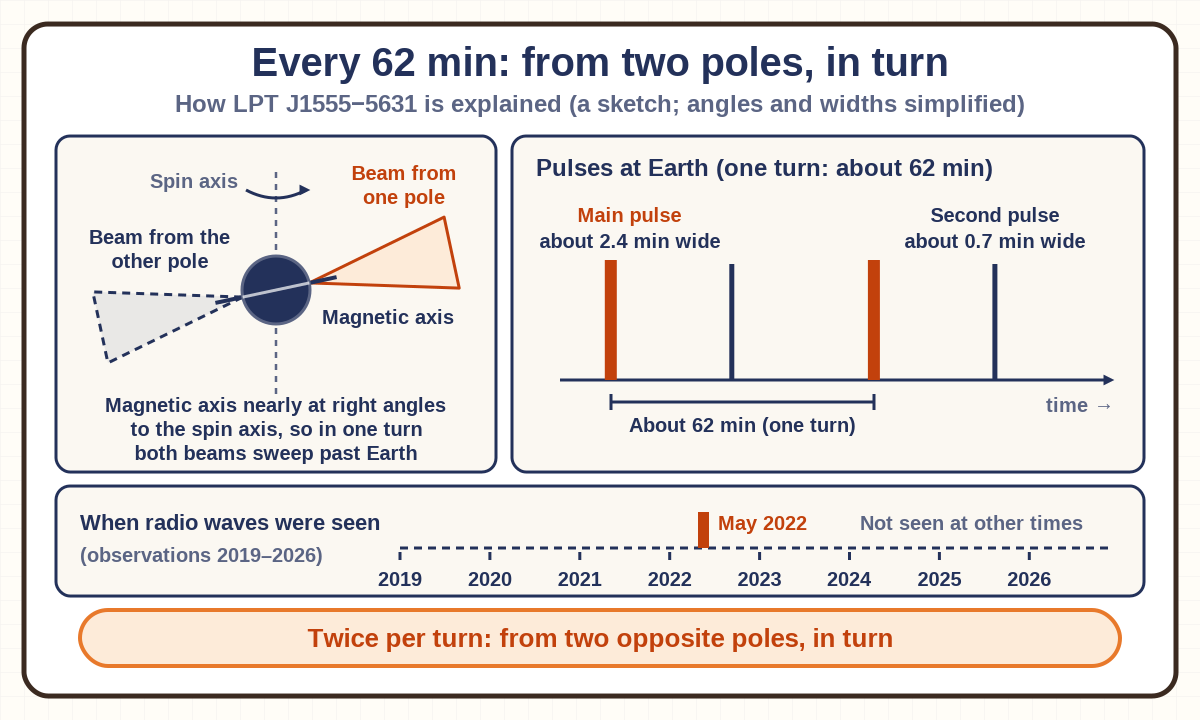
Within each period, a wide main pulse (about 2.4 minutes) and a narrow second pulse (about 0.7 minutes) arrived in turn, offset by nearly half a period. They were about equally bright, and the direction in which their radio waves twist (circular polarization) was opposite. In ordinary pulsars too, pairs of pulses like this are thought to come from two magnetic poles on opposite sides of the star.
So the team concluded that the magnetic axis is nearly at right angles to the spin axis, so that in one turn, the beams from both poles sweep past Earth. Among ordinary pulsars, only 2–3% are like this, but among LPTs, this is the second, making up about 15% of known LPTs.
Its radio waves were seen only in that day’s observations, and not in other observations from 2019 to 2026. It seems to have given off radio waves for at least the length of the observations on the day pulses were seen (about 15 hours), and at most the roughly 10 months between the observations before and after that saw nothing. The team says it can’t yet decide whether it is a neutron star or a white dwarf.
Isn’t it a signal from aliens?
A radio signal that repeats regularly might make you think of aliens. In fact, when the first pulsar was found in 1967, its discoverer Jocelyn Bell and her advisor Antony Hewish jokingly called it “LGM-1,” short for “Little Green Men.” But it turned out to be a natural object: a fast-spinning neutron star.
A spinning star, or two stars orbiting each other, makes an accurate clock all by itself. Among LPTs, too, there are cases like ILT J1101+5521, where the time between pulses matches exactly the time a white dwarf and a red dwarf take to orbit each other. The candidates considered in research papers, such as neutron stars, white dwarfs and their binaries, are all natural objects. The 2026 review sums up that today’s explanations can reproduce some of the properties of LPTs, but still can’t explain well how their bright, regular radio pulses are made.
Check yourself
Q1A pulsar (a fast-spinning neutron star) usually repeats radio pulses every fraction of a second to a few seconds. If a long-period radio transient, which repeats every few minutes to hours, is a neutron star, why is it considered puzzling?
Answer and explanation
Answer: B Spinning slowly, it would lack the voltage to make radio particles
In a pulsar, the spinning neutron star’s magnetism is thought to make a voltage like a generator, and that voltage makes the particles that radio emission comes from. The slower the spin, the smaller the voltage, and once the spin gets slower than a certain boundary (the death line), it should stop giving off radio waves. LPT J1555−5631, which repeats every 62 minutes, spins far slower than that boundary. The radio waves don’t get trapped inside the star, and a spinning star’s beams don’t stop sweeping toward Earth.
More on this → Key points: How are they different from ordinary pulsars?
Q2ILT J1101+5521 is a long-period radio transient that gives off a radio pulse every 125.5 minutes. When it was studied closely in visible light, what did it turn out to be?
Answer and explanation
Answer: C A white dwarf and a red dwarf, a pair of stars orbiting each other
Studied in visible light, the red dwarf was moving back and forth, and its unseen partner turned out to be a white dwarf. The time the two stars take to orbit each other is the same 125.5 minutes as the time between pulses, and the pulses arrived when the two stars lined up as seen from Earth. This was the first LPT confirmed to be a binary. Some other LPTs may be neutron stars like magnetars, so what they are may differ from object to object.
Q3In LPT J1555−5631, described in a 2026 paper, a wide pulse and a narrow pulse arrived in turn within each period of about 62 minutes. Where did the research team think the two pulses come from?
Answer and explanation
Answer: A From two magnetic poles on opposite sides of one star
The two pulses arrived in turn, offset by nearly half a period, and the direction in which their radio waves twist (circular polarization) was opposite. In ordinary pulsars too, pairs of pulses like this are thought to come from two magnetic poles on opposite sides of the star. The team concluded that the magnetic axis is nearly at right angles to the spin axis, so that in one turn, the beams from both poles sweep past Earth. Among LPTs, this is the second object like this.
More on this → Key points: What did the 62-minute LPT J1555−5631 show?
Related terms
- Pulsar
- Neutron star
- Magnetar
- White dwarf
- Red dwarf
- Binary star
- Radio telescope
- Polarization
- X-ray
Sources and how we checked
- Scott D. Hyman, Natasha Hurley-Walker, Dale A. Frail, Emil Polisensky and W. D. Cotton, “Discovery of a 62 minute Long-period Transient with Near-orthogonal Rotator Geometry” (The Astrophysical Journal 1011, 261, published November 6, 2026; journal page: author affiliations [Sweet Briar College, ICRAR at Curtin University, the National Radio Astronomy Observatory and the U.S. Naval Research Laboratory], received [July 27], accepted [September 25] and published [November 6] dates, and the abstract [serendipitous discovery in MeerKAT and ASKAP survey data, a 62.2-minute period, bright pulses during a 15-hour active window in May 2022 and no other emission over about 5 years, a main pulse and an interpulse alternating each cycle, separated by 165.4° with similar amplitudes, duty cycles of 3.9% and 1.1%, the interpulse being about 100% circularly polarized, classification as a near-orthogonal rotator with nearly perpendicular magnetic and rotation axes, and the progenitor and emission physics not being uniquely determined]; read November 20, 2026)
- The arXiv version of the same paper (arXiv:2609.34102, September 2026; HTML full text: discovery in MeerKAT supernova-remnant survey data and the ASKAP EMU pilot survey, both from observations on May 14, 2022 [MeerKAT 2 hours, ASKAP 600 minutes], the source appearing in only that one of 59 ASKAP epochs and in none of the other observations from 2019 to 2026 [56 ASKAP and 13 MeerKAT], an active window of at least 15 hours and no more than 10 months, a period of 62.20 minutes, pulse widths at half maximum of about 2.44 minutes for the main pulse and about 0.66 minutes for the interpulse, the interpulse’s circular polarization being opposite in sign to the main pulse’s, pulse–interpulse pairs in pulsars generally coming from opposite magnetic poles, this being the second near-orthogonal rotator among LPTs after ASKAP J183950.5−075635.0, about 15% of the LPT sample versus 2–3% of pulsars, the 62.2-minute period placing a neutron star far beyond the pulsar death line where standard pair production and coherent radio emission are thought to cease, no coherent emission ever detected from isolated white dwarfs, a white dwarf binary requiring an unseen companion, no observation conclusively identifying it as a neutron star or a white dwarf, no X-ray or infrared counterpart and a nearby optical source judged a chance coincidence, and Galactic coordinates [l = 326.36°, b = −2.27°]; read November 20, 2026)
- Nanda Rea, Natasha Hurley-Walker and Manisha Caleb, “Long Period Transients (LPTs): a comprehensive review” (arXiv:2601.10393, January 2026, accepted by the Journal of High Energy Astrophysics; abstract and HTML full text: LPTs as sources of bright, highly polarized periodic radio pulses with periods of minutes to hours, a sample of 12 sources with periods from about 7 minutes to about 9 hours, the periods in Table 1 [GCRT J1745−3009 with bursts of about 10 minutes every 77 minutes, GLEAM-X J1627−5235 at 18.2 minutes, CHIME J0630+25 at about 7 minutes, ASKAP J1839−0756 at 387 minutes (about 6.45 hours), and others], the millisecond-to-second periods of ordinary pulsars and magnetars and the slowest radio pulsar at 76 seconds, traditional pulsar surveys being typically sensitive only to periods of a few seconds, wide-field radio surveys with rapid imaging making them detectable, GLEAM-X J1627−5235 detectable for 3 months (January–March 2018), GPM J1839−10 showing activity over more than three decades, the traditional death line where coherent radio emission was thought to be suppressed by an insufficient voltage drop across the magnetic polar cap, the radio luminosity of isolated neutron-star interpretations exceeding the rotational energy loss rate by several orders of magnitude so that LPTs cannot be rotation-powered neutron stars, explanations including magnetars, isolated white dwarfs and white dwarf–M dwarf binaries, emission in binaries likely related to interactions between the companion’s wind and the white dwarf’s magnetic field, one or several physical pathways both remaining possible, current scenarios partly reproducing LPT properties but struggling to explain their bright, highly polarized periodic radio emission, and the X-ray counterpart of ASKAP J1832−0911 found serendipitously by Chandra; read November 20, 2026)
- Yuanhong Qu and Bing Zhang, “On the Physical Origins of Long Period Radio Transients” (arXiv:2608.08243, August 2026; not yet peer-reviewed; abstract and HTML full text: long-period radio transients with periods of minutes to hours separating into two broad classes, shorter-period sources (roughly under one hour) that are likely isolated compact objects and longer-period sources that are likely binaries, isolated neutron stars’ spin-down power being generally insufficient so that another energy source such as magnetic energy is needed, isolated white dwarfs having adequate spin-down power but lying below the death line when rotating slowly, the companion’s motion through a white dwarf’s field generating a potential drop by unipolar induction in binaries, bright X-ray counterparts favoring magnetar-related systems, the central engine remaining uncertain for most sources, and the engines discussed being white dwarfs, neutron stars and their binaries; read November 20, 2026)
- S. D. Hyman et al., “A powerful bursting radio source towards the Galactic Centre” (Nature 434, 50–52, 2005; arXiv abstract: the new transient GCRT J1745−3009 found in 2002 during a 0.33-GHz transient monitoring program of the Galactic Centre region, bursts unlike those of any known class of radio transient, and its being the first member of a new class; read November 20, 2026)
- N. Hurley-Walker et al., “A radio transient with unusually slow periodic emission” (Nature 601, 526–530, 2022; abstract and text of the arXiv version [arXiv:2503.08033]: GLEAM-X J162759.5−523504.3 found in archival MWA data from the GLEAM-X survey, emission lasting 30 to 60 seconds every 18.18 minutes, 71 pulses from January to March 2018 and none in December 2017, April 2018 or 2021, a location within our Galaxy [about 1.3 kpc], pulsars converting only a small share of spin-down energy into radio emission while this source shows the reverse so that the emission is not generated purely by spin-down, a possible ultra-long period magnetar, and a white dwarf as an alternative; read November 20, 2026)
- N. Hurley-Walker, N. Rea et al., “A long-period radio transient active for three decades” (Nature 619, 487–490, 2023; abstract and text of the arXiv version [arXiv:2503.08036]: GPM J1839−10 found in 2022 in the MWA Galactic Plane Monitoring programme, a period of 1318 seconds [about 22 minutes; the abstract says 21], pulses lasting 30 to 300 seconds and varying in brightness by two orders of magnitude, VLA archives showing it repeating since at least 1988, a nulling fraction of 50–70%, its lying at the very edge of the most generous death line, and coherent periodic radio emission not yet directly detected from highly magnetic isolated white dwarfs; read November 20, 2026)
- Ziteng Wang et al., “Detection of X-ray Emission from a Bright Long-Period Radio Transient” (Nature, 2025; arXiv:2411.16606 abstract: radio and X-ray emission from the extremely bright ASKAP J1832−0911 both repeating with a 44.2-minute period, LPTs having emission cycles thousands of times longer than ordinary radio pulsars, no LPT detected in X-rays before, and an old magnetar or an extremely magnetized white dwarf with a dwarf companion as possible explanations, both with significant difficulties; read November 20, 2026)
- Nature’s Japanese summary of the paper on X-ray emission from a bright long-period radio transient (natureasia.com, Nature 642, June 19, 2025; the Japanese name chōshūki denpa toranjento (LPT), emission cycles thousands of times longer than radio pulsars, discovery made possible by advances in wide-field radio surveys, and the proposed models [strongly magnetized neutron stars or white dwarf pulsars, and white dwarf binaries with low-mass companions]; read November 20, 2026)
- I. de Ruiter et al., “Sporadic radio pulses from a white dwarf binary at the orbital period” (Nature Astronomy 9, 672–684, 2025; abstract and text of the arXiv version [arXiv:2408.11536]: ILT J1101+5521 found in a transient search of LOFAR all-sky survey data, roughly minute-long pulses recurring every 125.5 minutes, seven pulses in observations from 2015 to 2020, the M dwarf’s radial velocity varying with an orbital period that matches the radio period and its companion being a white dwarf, all pulses emitted when the M dwarf was at superior conjunction, the first long-period radio source confirmed to be a binary, and likely multiple progenitors of long-period radio pulses; read November 20, 2026)
- N. Hurley-Walker et al., “A 2.9-hour periodic radio transient with an optical counterpart” (The Astrophysical Journal Letters, 2024; arXiv:2408.15757 abstract: GLEAM-X J0704−37 found in archival MWA data, a period of 2.9 hours, an optical counterpart consistent with a cool M3 main-sequence star, and the high Galactic latitude and M dwarf companion ruling out a magnetar in favor of an M dwarf–white dwarf binary; read November 20, 2026)
- NASA Imagine the Universe!, “Neutron Stars” (general-audience explainer from NASA Goddard Space Flight Center, text updated March 2017; the mass of a sun squished down to the size of a city [about 20 km], formed when a massive star’s core collapses, pulsars as rotating neutron stars giving off pulses at very regular intervals typically from milliseconds to seconds, magnetic fields funneling jets of particles out along the two magnetic poles into beams that sweep like a lighthouse, and a magnetar’s field being another 1,000 times stronger than a typical neutron star’s; read November 20, 2026)
- NASA Imagine the Universe!, “White Dwarf Stars” (a white dwarf being what stars like the Sun become after exhausting their nuclear fuel, a typical white dwarf being half as massive as the Sun yet only slightly bigger than Earth, and the hot core left after the star expels its outer material; read November 20, 2026)
- NASA Science, “Star Types” (updated August 12, 2026; red dwarfs as the smallest and coolest main sequence stars, just a fraction of the Sun’s size and mass, making up around 75% of the Milky Way’s stars, and pulsars as a type of rapidly rotating neutron star; read November 20, 2026)
- NASA Science, “Radio Waves” (updated August 3, 2023; radio waves having the longest wavelengths in the electromagnetic spectrum, being used for radio broadcasts, radio telescopes viewing stars, galaxies and more, and pulsars standing out in the sky seen at 408 MHz; read November 20, 2026)
- Rebecca Charbonneau, “Tick Tock, Pulsating Star” (National Radio Astronomy Observatory [NRAO], August 6, 2018; pulsars as highly magnetized, rapidly rotating neutron stars, Jocelyn Bell Burnell spotting the signal on chart paper on August 6, 1967 during her PhD research at Cambridge, and the source being dubbed “LGM-1,” for “Little Green Men,” as a joke between her and her advisor Antony Hewish; read November 20, 2026)
AI wrote this page from the sources above, and a different AI checked it against the text of those sources (November 20, 2026). A person with a master’s degree in science and a Japanese high-school science teaching license also read and checked it before publishing. Numbers are as of that date. If anything was hard to follow, you spot a mistake, or there’s a term you’d like explained, please write to [email protected].
Glossary
- AI agent
- AI alignment
- Alignment faking
- Artificial general intelligence (AGI)
- Artificial intelligence (AI)
- Backdoor
- Benchmark
- Chain of thought (CoT)
- Context window
- Data poisoning
- Deep learning
- Deepfake
- Diffusion model
- Embedding
- Emergent misalignment
- Evaluation awareness
- Fine-tuning
- Formal verification
- Generalization
- Generative adversarial network (GAN)
- Generative AI
- Goodhart’s law
- Gradual disempowerment
- Hallucination
- Hyperparameter
- Intelligence explosion
- Interpretability
- Jailbreaking
- Large language model (LLM)
- Latent space
- Machine learning
- Mixture of experts (MoE)
- Neural network
- Neuralese
- Overfitting
- Parameter
- Persona vectors
- Pre-training
- Prompt
- Prompt injection
- Reasoning model
- Recursive language model (RLM)
- Recursive self-improvement (RSI)
- Red teaming
- Reinforcement learning (RL)
- Retrieval-augmented generation (RAG)
- Reward hacking
- Reward model
- Shutdown resistance
- Sleeper agent
- Subliminal learning
- Superintelligence (ASI)
- System prompt
- Technological singularity
- Time horizon
- Token
- Transfer learning
- Transformer
- Accretion disk
- Black hole
- Black hole star
- Cosmic birefringence
- Event horizon
- Event Horizon Telescope (EHT)
- General relativity
- GPS
- Gravitational lensing
- Gravitational singularity
- Gravitational wave
- James Webb Space Telescope (JWST)
- Lagrange point
- You are hereLong-period radio transient (LPT)
- Neutron star
- Pulsar
- Quasar
- Sagittarius A*
- Space data center
- Spacetime
- Special relativity
- Speed of light
- Supermassive black hole
- White dwarf