
What is a white dwarf (the Earth-sized core a Sun-like star leaves behind)?
Also called: White dwarf star

In one minute
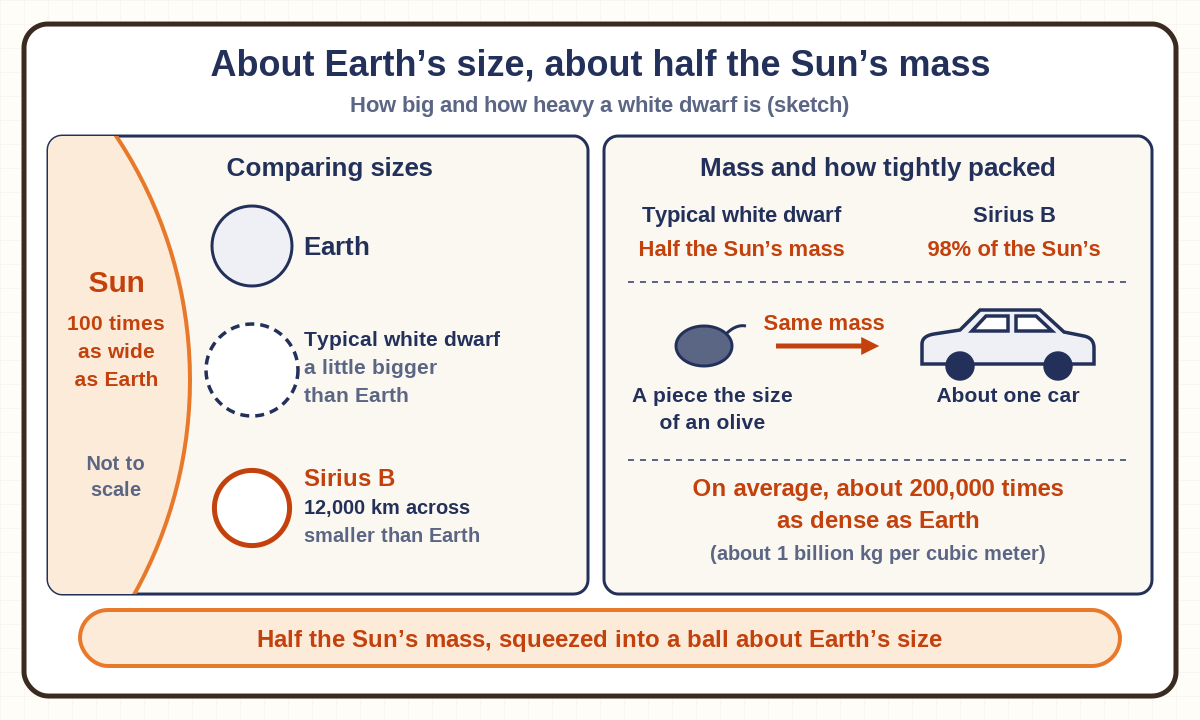
A white dwarf is the core left behind after a star like the Sun uses up its fuel at the end of its life: usually about half the Sun’s mass, packed into a ball a little bigger than Earth.
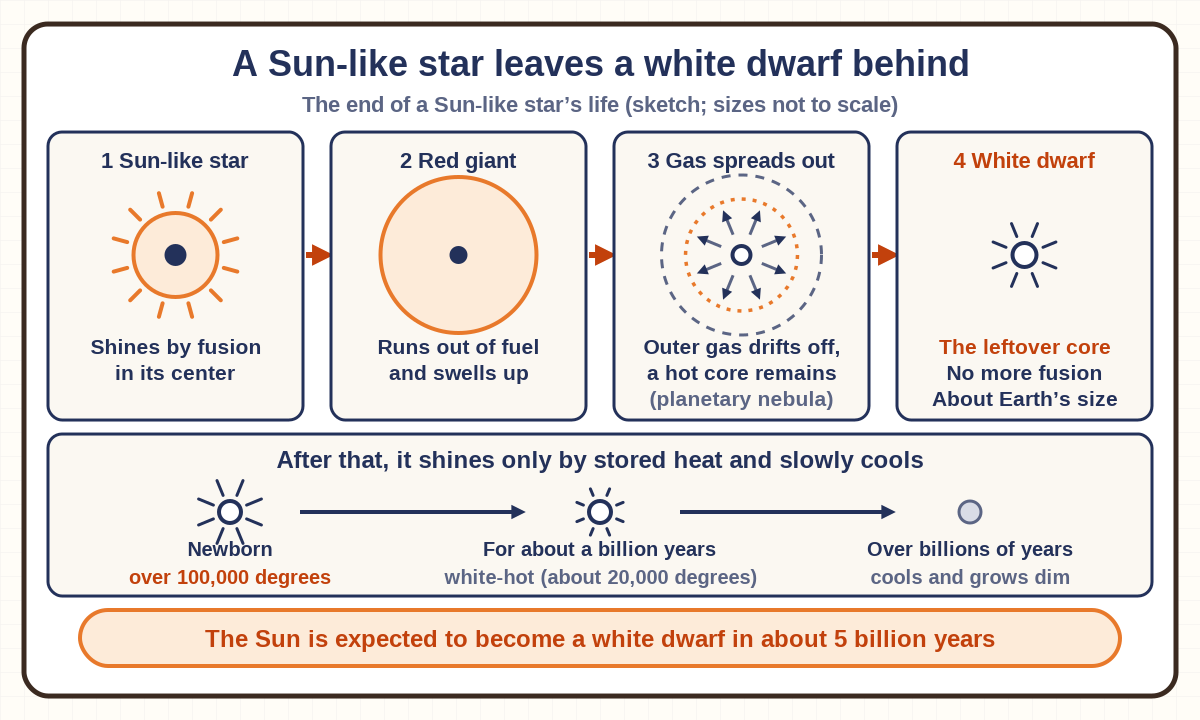
Inside, nuclear fusion (light atomic nuclei joining together and giving off energy) has normally stopped. It shines because heat stored from its time as a star is still left, and over billions of years it slowly cools and grows dim. The Sun, too, is expected to become a white dwarf in about 5 billion years.
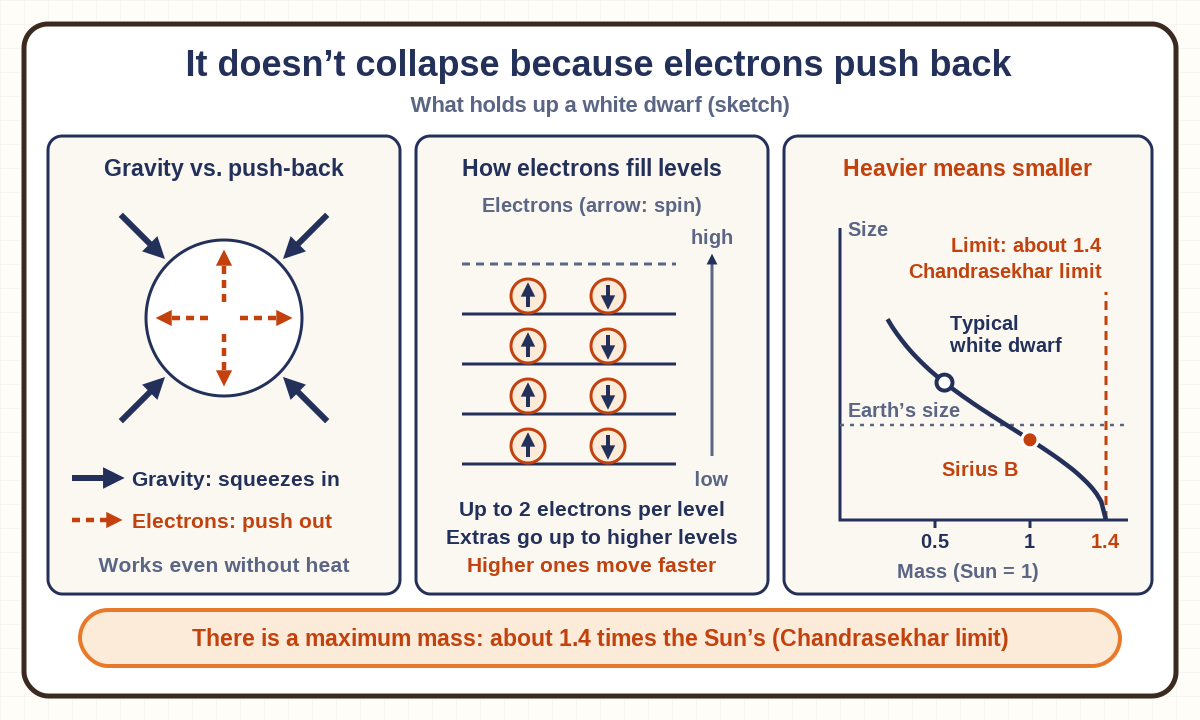
It doesn’t collapse under its own weight because tightly packed electrons push back (electron degeneracy pressure). There is a limit to the mass this push can hold up: about 1.4 times the Sun’s (the Chandrasekhar limit). If a white dwarf nears this limit, for example by taking gas from a star it circles with as a pair, it is thought to blow itself apart as a Type Ia (“type one-A”) supernova.
A common mix-up
“A white dwarf is a small, light star that glows white because it is burning.”
Half right. A white dwarf is only about the size of Earth, and it is true that a newborn one is extremely hot, over 100,000 degrees, and that it glows white while it is hot. The name itself comes from their small size and white color. But it is not burning. Stars like the Sun shine by nuclear fusion in their centers, but inside a white dwarf, fusion has normally stopped. It glows because heat stored from its time as a star is escaping from its surface. No new heat is made, so over billions of years it cools and grows dim. And it is not light, either. A typical white dwarf has about half the Sun’s mass, and a piece the size of an olive would weigh about as much as a car.
Explained in pictures
Free to use in lessons, slides and posts with credit (CC BY 4.0).
Free to use in lessons, slides and posts with credit (CC BY 4.0).
Free to use in lessons, slides and posts with credit (CC BY 4.0).
Free to use in lessons, slides and posts with credit (CC BY 4.0).
You’re free to use these figures in lessons, slides and posts if you credit Naru News (naru.news). CC BY 4.0.
Think of it like this
A lump of iron glowing white out of the forge
A lump of iron heated in a blacksmith’s forge keeps glowing whitish for a while after it comes out. It isn’t burning; it glows because it is hot. If no more heat is added, the iron slowly loses its heat, turning yellow, then red, and finally stops glowing.
A white dwarf is the same. Fusion has stopped inside, so no new heat is made. It glows with the heat stored from its time as a star, and as that heat escapes into space, it slowly cools and grows dim.
But the comparison has limits. A lump of iron cools within hours, while a white dwarf takes billions of years. Also, iron keeps its shape because its atoms are bound together, while a white dwarf keeps its shape because packed-in electrons push back against its enormous gravity. And its mass is on another level: an olive-sized piece of a white dwarf weighs about as much as a car.
Key points
How does a white dwarf form?
A star shines by fusing hydrogen into helium in its center and using that energy. When a star about as heavy as the Sun uses up the hydrogen in its center, it swells into a red giant. In time, it lets its outer gas flow off into space, and only a hot core is left in the middle. The spreading gas glows, lit by the hot core, and is called a planetary nebula (a name that comes from how it looks like the disk of a planet in a small telescope). The leftover core is the white dwarf.
The Sun formed about 4.6 billion years ago and is a little less than halfway through its life. In about 5 billion years, it is expected to pass through the red giant stage and become a white dwarf.
It isn’t only stars like the Sun that leave white dwarfs behind. Stars born with less than about 10 times the Sun’s mass become white dwarfs at the end of their lives, and around 98% of the stars in our Milky Way galaxy are thought to end this way. Stars much lighter than the Sun do too, but those under half the Sun’s mass live longer than the universe has existed so far, so their turn is still far off. The remaining, heavier stars don’t become white dwarfs; at the end of their lives, they leave neutron stars or black holes.
In most cases, a white dwarf is made of carbon and oxygen inside. Around that is a thin layer of helium and hydrogen that makes up only about 1% of its mass.
How tightly packed is it?
A typical white dwarf has about half the Sun’s mass (most are near 0.6 times) and is just a little bigger than Earth. The Sun is about 100 times as wide as Earth, so a white dwarf packs about half the Sun’s mass into a ball about a hundredth as wide as the Sun. Its average density (how tightly it is packed) is about 1 billion kg per cubic meter, about 200,000 times Earth’s average. Even a piece the size of an olive would weigh about as much as a car. Only neutron stars are packed more tightly.
An example of a heavy white dwarf is Sirius B, the companion of Sirius, the brightest star in the night sky. It has almost the same mass as the Sun: about 98% of the Sun’s when its light was studied with the Hubble Space Telescope, and about 102% in a 2017 study that used how the two stars circle each other about once every 50 years. Different methods give almost the same answer. It is about 12,000 km across, a little smaller than Earth.
Its surface gravity is 350,000 times Earth’s. If a person whose bathroom scale reads 68 kg on Earth stepped on a scale on the surface of Sirius B, the scale would read 350,000 times as much, about 24 million kg.
Why doesn’t it collapse?
A star’s own weight (gravity) is always trying to crush it inward. In an ordinary star like the Sun, the heat made by fusion in its center pushes the gas inside outward and keeps it from collapsing. What holds up a white dwarf, where fusion has stopped, isn’t heat but electrons.
Electrons can only sit in set energy levels: electrons in low levels move around gently, and electrons in higher levels move around much faster. Two electrons spinning the same way can’t share a level, and an electron’s spin can point only two ways, so each level can hold at most 2 electrons. When matter is squeezed as tightly as it is inside a white dwarf, all the low levels fill up, and the electrons that don’t fit are pushed up to higher levels. It is a bit like a full parking garage, where a car that arrives late has no choice but to drive up to a higher floor with open spaces. Electrons in the high levels move around fast, and that motion pushes outward on everything around them. This is electron degeneracy pressure. The more the star is squeezed, the higher the electrons are pushed, and the harder they push back. Electrons sit in the higher levels not because they are hot, but because there is nowhere else to go. So even as it cools, a white dwarf doesn’t collapse.
To hold up more mass with this push, the electrons have to be packed more tightly. So the heavier a white dwarf is, the smaller it is. That is why a typical white dwarf, with about half the Sun’s mass, is a little bigger than Earth, while Sirius B, with almost the Sun’s mass, is smaller than Earth.
And there is a limit to the mass it can hold up. The heavier a white dwarf is, the harder it is squeezed, so its electrons are pushed to even higher levels, and their motion gets close to the speed of light. Electrons can’t move faster than light, so past that point, squeezing the star more no longer makes the push grow as much as before. So above a certain mass, the electrons can’t hold the star up, and gravity crushes it. The physicist Subrahmanyan Chandrasekhar used relativity and quantum mechanics to show this limit. His 1931 paper “The maximum mass of ideal white dwarfs” was one of these studies. Today the limit is put at about 1.4 times the Sun’s mass and is called the Chandrasekhar limit. Chandrasekhar received the 1983 Nobel Prize in Physics for his studies of how stars are built and how they change.
If it isn’t burning, why does it shine?
In most white dwarfs, no fusion happens inside. Their light comes from heat stored from their time as stars. A newborn white dwarf is extremely hot, over 100,000 degrees, and even as it cools, it stays white-hot, with a surface at about 20,000 degrees, for about a billion years after it forms. After that, it keeps losing heat to space, slowly cooling and dimming over billions of years. The cooler it gets, the more slowly it cools.
Because no new heat is made, how far a white dwarf has cooled works like a clock. Some research estimates how long ago stars became white dwarfs from how much they have cooled, and uses this to find the ages of star groups and of our Milky Way galaxy.
How was it discovered?
In 1844, the astronomer Bessel noticed that Sirius, the brightest star in the night sky, moved with a slight wobble, and he concluded that an unseen companion star was circling it. That companion, Sirius B, was found with a telescope in 1862. It was only about 1/10,000 as bright as Sirius.
The puzzle was that some stars were dim and yet hot. In 1910, the dimmer star (B) of 40 Eridani was found to be dim yet to show the light of a hot star. Sirius B, too, has a surface of about 25,000 degrees, hotter than Sirius (about 10,000 degrees), yet it is far dimmer. The hotter a star is, the more brightly each patch of its surface shines. If it is still dim, its glowing surface must be small, which means the star itself is very small. This is how astronomers came to see that very small, very tightly packed stars exist.
The name “white dwarf” was coined in 1922 by the astronomer Luyten to describe their small size and white color (a sign of high temperature).
In 2005, the Hubble Space Telescope separated the light of Sirius B from the glare of Sirius and studied it. Light leaving a star with strong gravity loses energy as it climbs out against that gravity. When light loses energy, its waves are stretched and its color shifts toward red (gravitational redshift). This shift shows up most clearly in heavy, tightly packed stars. So by carefully measuring how much the light’s waves had been stretched, astronomers used that shift to find that Sirius B has 98% of the Sun’s mass.
What do Type Ia supernovae have to do with the universe’s expansion?
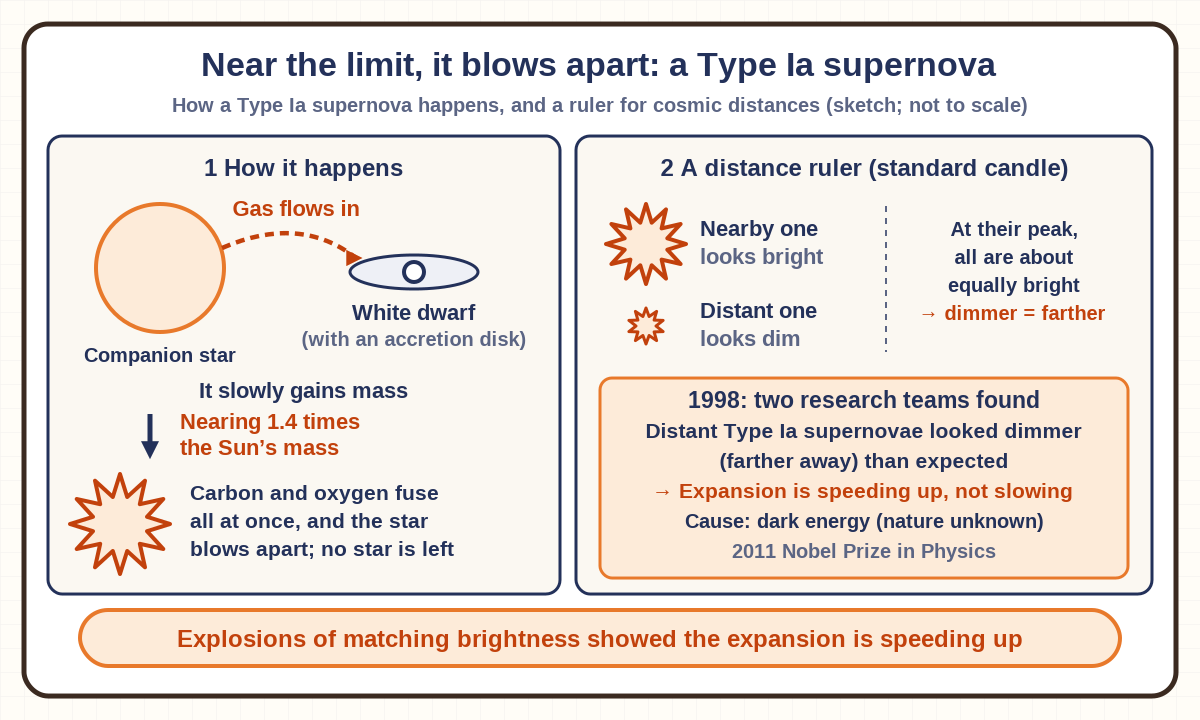
When a white dwarf circles together with an ordinary star, it can pull gas from its companion. The gas forms a disk around the white dwarf (an accretion disk) as it falls in, and the white dwarf slowly gains mass. Near the limit of about 1.4 times the Sun’s mass, the carbon and oxygen inside are thought to fuse all at once, blowing the whole star apart. This is a Type Ia supernova, and no star is left behind, only the blown-off gas spreading out. Some are also thought to happen when two white dwarfs circle each other, draw closer, and merge.
Type Ia supernovae are about equally bright at their brightest. Things of equal brightness look dimmer the farther away they are, so how dim one looks tells you how far away it is. That is why they are used as markers for measuring distances in the universe (standard candles).
The universe’s expansion was thought to be gradually slowing down because of gravity. But in 1998, two research teams studying Type Ia supernovae in distant galaxies found that the distant ones were dimmer than predicted for a universe whose expansion was not speeding up. Since these explosions are about equally bright, looking dimmer means being farther away than predicted. In one team’s study, 16 distant ones were on average 10% to 15% farther away than predicted for a universe with little matter whose expansion doesn’t speed up. They were farther away because, while their light was on its way to us, the universe spread out faster than predicted. Far from slowing down, the universe’s expansion was speeding up.
What speeds up the expansion is called dark energy, but what it really is remains unknown. For this discovery, Saul Perlmutter, Brian Schmidt and Adam Riess received the 2011 Nobel Prize in Physics.
Check yourself
Q1Inside a white dwarf, nuclear fusion (light atomic nuclei joining together and giving off energy) has normally stopped. Why does a white dwarf still shine?
Answer and explanation
Answer: C Heat from its days as a star still remains
A white dwarf’s light comes from heat stored from its time as a star. It is like iron taken out of a forge, which glows because it is hot even though it isn’t burning. No new heat is made, so it slowly cools and grows dim over billions of years. Most white dwarfs aren’t making heat by being pressed by gravity, and they aren’t glowing from gas falling onto them.
More on this → Key points: If it isn’t burning, why does it shine?
Q2A white dwarf is a star that holds about half the Sun’s mass in a ball about the size of Earth. Why can it keep from collapsing under its own weight (gravity)?
Answer and explanation
Answer: A Electrons inside it are pushing outward
What holds up a white dwarf is its electrons. Only 2 electrons fit in each energy level, so when they are squeezed tightly, the ones that don’t fit are pushed up to higher levels. Electrons in higher levels move around fast, and that creates a push outward (electron degeneracy pressure). This push comes not from heat but from having nowhere else to go, so it keeps working even as the star cools. It isn’t hot gas pushing outward as in an ordinary star, or atomic nuclei pushing back. But there is a limit to the mass it can hold up: about 1.4 times the Sun’s.
Q3A Type Ia supernova is a huge explosion set off by a white dwarf, and it is used as a marker for measuring distances far across the universe. Why can it be used as a marker?
Answer and explanation
Answer: A The explosions all give off about equally bright light
Type Ia supernovae are about equally bright at their brightest. Things of equal brightness look dimmer the farther away they are, so how dim one looks tells you its distance. What makes them markers is their brightness, not how far they spread out or the color of their light. In 1998, distant Type Ia supernovae turned out to be dimmer, and so farther away, than predicted, revealing that the universe’s expansion is speeding up.
More on this → Key points: What do Type Ia supernovae have to do with the universe’s expansion?
Related terms
- Neutron star
- Pulsar
- Accretion disk
- Supernova
- Type Ia supernova
- Chandrasekhar limit
- Red giant
- Planetary nebula
- Sirius
- Dark energy
- Long-period radio transient
- Black hole
Sources and how we checked
- NASA Imagine the Universe!, “White Dwarf Stars” (NASA Goddard Space Flight Center explainer, text modified December 2010: a white dwarf being what stars like the Sun become after exhausting their nuclear fuel, only the hot core remaining and becoming a very hot white dwarf at over 100,000 kelvin, which then cools down over the next billion years or so, a typical white dwarf being half as massive as the Sun yet only slightly bigger than Earth, an Earth-sized white dwarf having a density of 1 billion kg per cubic meter, 200,000 times Earth’s average, surpassed only by neutron stars, only two electrons fitting in a single energy level because an electron can spin only two ways, Chandrasekhar finding this limit to be 1.4 times the mass of the Sun, and a picture of the Sun evolving through the red giant stage to a white dwarf; read November 27, 2026)
- Chandra X-ray Center, “White Dwarfs & Planetary Nebulas” (X-ray sources field guide on the site of NASA’s Chandra X-ray Observatory, Harvard–Smithsonian Center for Astrophysics: a star’s core collapsing when its hydrogen is used up while the outer layers expand into a red giant, the star shedding its outer layers and the expelled gas lit up by the hot core becoming a planetary nebula, so called because it looks like the disk of a planet in a small telescope, the core becoming a white dwarf packed into about a millionth of the original star’s volume, an olive-sized object of this material having the mass of an automobile, electrons in such dense matter, like cars in a crowded parking lot, being forced into higher energy states not because they are hot but because there is nowhere else to go, this degenerate electron pressure keeping white dwarfs from collapsing, a white dwarf being white hot with surface temperatures of about 20,000 degrees Celsius for a billion or so years before cooling and becoming dim, Chandrasekhar using relativity and quantum mechanics to show that electron pressure can support only about 1.4 times the Sun’s mass and heavier white dwarfs will collapse, and white dwarfs that gain mass from a companion past the limit collapsing and exploding, believed to be the Type Ia supernovae; read November 27, 2026)
- Simon Blouin, “White dwarf fundamentals” (a chapter of Elsevier’s Encyclopedia of Astrophysics, arXiv:2409.03941, 2024; full text read in HTML: around 98% of stars in our Galaxy eventually becoming white dwarfs, white dwarf masses clustering around 0.6 solar masses and their size being about that of Earth, being 100,000 times denser than the center of Earth, degeneracy pressure arising from the Pauli principle [identical electrons cannot occupy the same quantum state] preventing collapse under their own weight, higher-mass white dwarfs having smaller radii and stable white dwarfs having an upper mass limit of about 1.4 solar masses [Chandrasekhar, 1931], the core being made in most cases of carbon and oxygen with a helium–hydrogen envelope only about 1% of the mass, the vast majority of white dwarfs having no nuclear burning and behaving as stellar embers that can only cool down, the cooling rate generally decreasing with time, white dwarf cosmochronology for constraining ages, Bessel in 1844 attributing irregular motions of Sirius and Procyon to unseen companions, Sirius B being discovered in 1862 and found 10,000 times fainter than Sirius A, 40 Eridani B being found in 1910 to have an A-type spectrum, hotter than the K-type 40 Eri A yet much fainter, so it had to be remarkably small, Luyten coining the name “white dwarfs” in 1922 to highlight their small size and white color [indicative of hot temperatures], and white dwarfs that accrete too much mass becoming Type Ia supernovae, which led to the 1998 discovery of the accelerating expansion of the Universe; read November 27, 2026)
- ESA/Hubble, “Astronomers use Hubble to ‘weigh’ Dog Star’s companion” (heic0516, December 13, 2005: Sirius being the brightest star in the night sky, 8.6 light-years away, white dwarfs being the leftover remnants of stars similar to the Sun, which will eventually become one, Sirius B being discovered in 1862 and about 10,000 times fainter than Sirius, Hubble isolating its light from Sirius and measuring the gravitational redshift, the stretching of its light to longer, redder wavelengths by its gravity, to find a mass of 98% of the Sun’s, a diameter of 12,000 km, less than Earth’s, gravity 350,000 times Earth’s so that a 68 kg person would weigh 25 million kg on its surface, a surface temperature of 25,000 degrees Celsius against 10,000 for Sirius A, and the observation testing the theory that the more massive a white dwarf, the smaller its diameter; read November 27, 2026)
- H. E. Bond et al., “The Sirius System and its Astrophysical Puzzles: Hubble Space Telescope and Ground-Based Astrometry” (The Astrophysical Journal, 2017; arXiv:1703.10625 abstract: Sirius B orbiting Sirius A in a 50.13-year period, dynamical masses of 2.063 and 1.018 solar masses for Sirius A and B, and Sirius B’s position in the mass–radius plane being consistent with white dwarf theory for a carbon–oxygen core; read November 27, 2026)
- NASA Science, “Sun: Facts” (updated September 17, 2026: the Sun forming about 4.6 billion years ago, nuclear reactions in its core fusing hydrogen into helium powering the Sun’s heat and light, the Sun being a little less than halfway through its lifetime and predicted to last another 5 billion years or so before it becomes a white dwarf, the Sun expanding into a red giant as it starts to die, and the Sun being about 100 times wider than Earth; read November 27, 2026)
- Chandra X-ray Center, “About Chandra: Subrahmanyan Chandrasekhar” (profile of the scientist the Chandra X-ray Observatory is named after: born October 19, 1910, in Lahore, his studies of white dwarf stars from 1929 to 1939, including the 1931 paper “The maximum mass of ideal white dwarfs,” showing an upper mass limit for white dwarfs now called the Chandrasekhar limit, and the 1983 Nobel Prize in Physics for his theoretical studies of the physical processes important to the structure and evolution of the stars; read November 27, 2026. The Nobel Prize site [nobelprize.org] could not be opened from here)
- NASA Imagine the Universe!, “Supernovae” (NASA Goddard Space Flight Center explainer, text modified September 2009: in a binary system, material flowing from the white dwarf’s companion onto the white dwarf, and on reaching the mass called the Chandrasekhar limit [about 1.4 times the Sun’s], carbon and oxygen nuclei starting to fuse uncontrollably, the star detonating with nothing left behind except the elements left over from the white dwarf or forged in the blast; read November 27, 2026)
- NASA Imagine the Universe!, “Cataclysmic Variables” (NASA Goddard Space Flight Center explainer: binary systems of a white dwarf and a normal companion star, material from the companion forming an accretion disk rather than falling straight onto the white dwarf, and a white dwarf gaining mass up to the Chandrasekhar limit of 1.4 solar masses resulting in a white dwarf supernova; read November 27, 2026)
- NASA Science, “Type Ia Supernovae” (Nancy Grace Roman Space Telescope page, updated December 6, 2023: Type Ia supernovae arising from binary systems containing at least one white dwarf, the white dwarf siphoning material from its companion until a runaway reaction detonates it, two white dwarfs that spiral toward each other until they merge, the explosions peaking at a similar, known intrinsic brightness, making them standard candles, their distances found from how bright they appear, and dark energy being discovered by comparing supernova redshifts with their apparent brightness; read November 27, 2026)
- A. G. Riess et al., “Observational Evidence from Supernovae for an Accelerating Universe and a Cosmological Constant” (The Astronomical Journal 116, 1009–1038, 1998; arXiv:astro-ph/9805201 abstract: an expanded set of 16 high-redshift and 34 nearby Type Ia supernovae, the distances of the high-redshift supernovae being on average 10% to 15% farther than expected in a low-mass-density universe without a cosmological constant, and the analyses unanimously favoring eternally expanding models with a positive cosmological constant and a current acceleration of the expansion; read November 27, 2026)
- S. Perlmutter et al. (Supernova Cosmology Project), “Measurements of Omega and Lambda from 42 High-Redshift Supernovae” (The Astrophysical Journal 517, 565–586, 1999; arXiv:astro-ph/9812133 abstract: 42 high-redshift Type Ia supernovae discovered by the Supernova Cosmology Project, fit together with a low-redshift sample, the data being strongly inconsistent with a flat cosmology with zero cosmological constant, and the cosmological constant being non-zero and positive with a confidence of 99%; read November 27, 2026)
- American Institute of Physics (AIP), “2011 Nobel Prize in Physics for the Accelerating Expansion of the Universe” (October 4, 2011: Saul Perlmutter, Brian Schmidt and Adam Riess receiving the 2011 Nobel Prize in Physics “for the discovery of the accelerating expansion of the Universe through observations of distant supernovae,” and two research teams announcing in 1998 that the expansion of the Universe is not slowing but actually accelerating; read November 27, 2026)
- NASA Science, “Dark Energy” (updated August 12, 2026: scientists previously thinking the universe’s expansion would likely be slowed down by gravity, two teams observing far-off supernovae in 1998 noticing they were dimmer than expected, leading to the conclusion that the expansion is speeding up, and the nature of dark energy being unknown; read November 27, 2026)
AI wrote this page from the sources above, and a different AI checked it against the text of those sources (November 27, 2026). A person with a master’s degree in science and a Japanese high-school science teaching license also read and checked it before publishing. Numbers are as of that date. If anything was hard to follow, you spot a mistake, or there’s a term you’d like explained, please write to [email protected].
Glossary
- AI agent
- AI alignment
- Alignment faking
- Artificial general intelligence (AGI)
- Artificial intelligence (AI)
- Backdoor
- Benchmark
- Chain of thought (CoT)
- Context window
- Data poisoning
- Deep learning
- Deepfake
- Diffusion model
- Embedding
- Emergent misalignment
- Evaluation awareness
- Fine-tuning
- Formal verification
- Generalization
- Generative adversarial network (GAN)
- Generative AI
- Goodhart’s law
- Gradual disempowerment
- Hallucination
- Hyperparameter
- Intelligence explosion
- Interpretability
- Jailbreaking
- Large language model (LLM)
- Latent space
- Machine learning
- Mixture of experts (MoE)
- Neural network
- Neuralese
- Overfitting
- Parameter
- Persona vectors
- Pre-training
- Prompt
- Prompt injection
- Reasoning model
- Recursive language model (RLM)
- Recursive self-improvement (RSI)
- Red teaming
- Reinforcement learning (RL)
- Retrieval-augmented generation (RAG)
- Reward hacking
- Reward model
- Shutdown resistance
- Sleeper agent
- Subliminal learning
- Superintelligence (ASI)
- System prompt
- Technological singularity
- Time horizon
- Token
- Transfer learning
- Transformer
- Accretion disk
- Black hole
- Black hole star
- Cosmic birefringence
- Event horizon
- Event Horizon Telescope (EHT)
- General relativity
- GPS
- Gravitational lensing
- Gravitational singularity
- Gravitational wave
- James Webb Space Telescope (JWST)
- Lagrange point
- Long-period radio transient (LPT)
- Neutron star
- Pulsar
- Quasar
- Sagittarius A*
- Space data center
- Spacetime
- Special relativity
- Speed of light
- Supermassive black hole
- You are hereWhite dwarf