
What are the Millennium Prize Problems (seven hard problems in mathematics with $1 million on each)?
Also called: Millennium Problems

In one minute
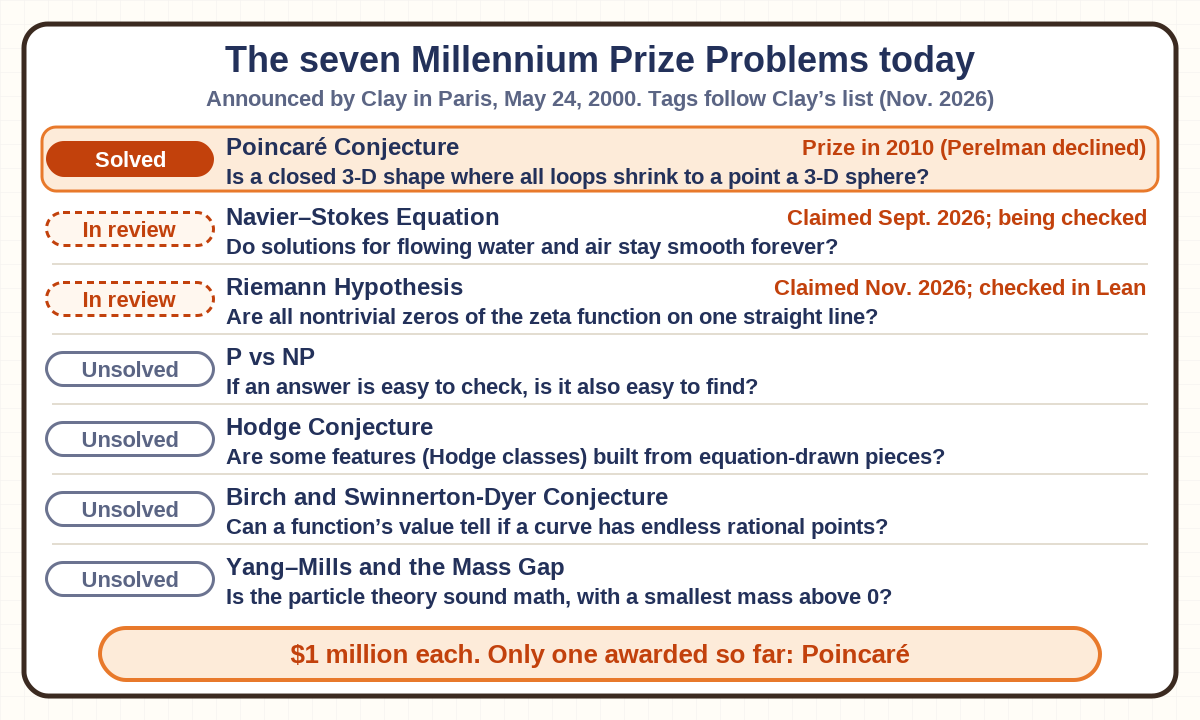
The Millennium Prize Problems are seven very hard problems in mathematics chosen by the Clay Mathematics Institute in 2000, and whoever solves one receives a $1 million prize for it.
The seven are the Riemann Hypothesis (primes), P vs NP (computing), the Navier–Stokes equation (flowing water and air), the Poincaré and Hodge Conjectures (shapes), the Birch and Swinnerton-Dyer Conjecture (solutions of equations), and Yang–Mills and the mass gap (elementary particles).
Only one has been accepted as solved and awarded: the Poincaré Conjecture, in 2010 (its solver, Perelman, did not accept the money). In 2026, solutions were announced for the Navier–Stokes equation and the Riemann Hypothesis, but both are still being checked. The prize does not come right after an announcement; it is decided only after the solution has appeared in a journal or similar, at least two years have passed, and mathematicians around the world broadly accept it.
A common mix-up
“If you announce that you solved one, you get $1 million right away”
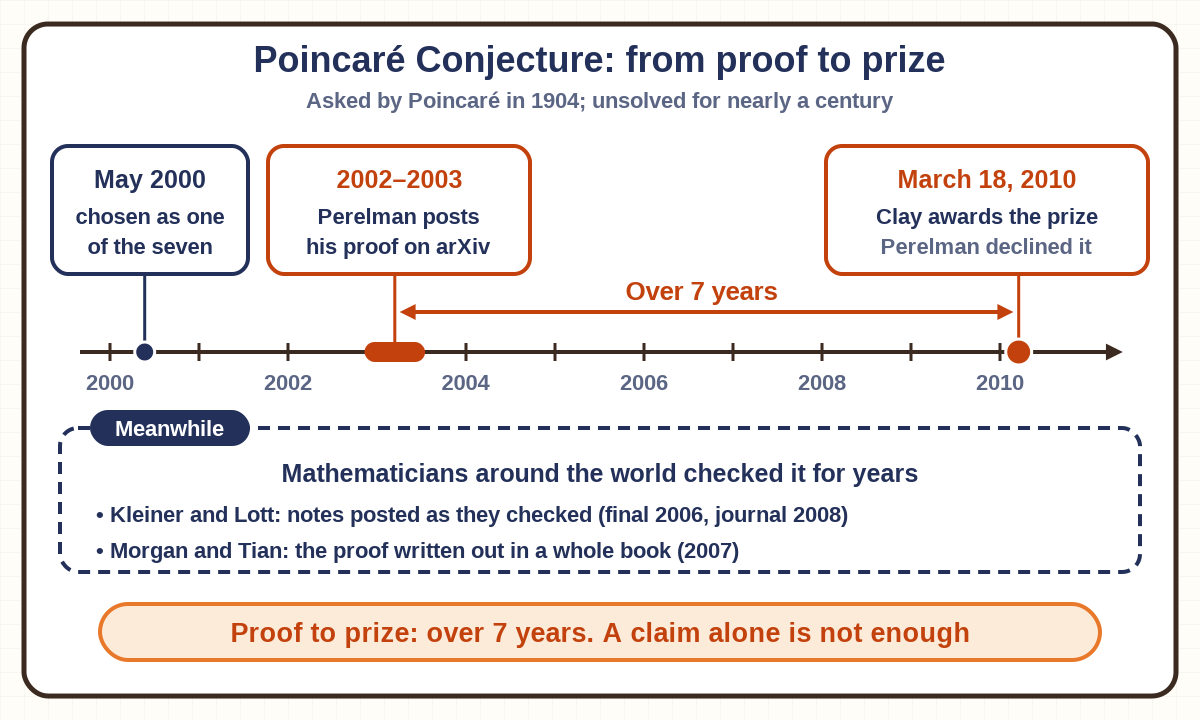
It is true that solving one wins a $1 million prize. But announcing a solution is not enough. Under the prize rules, the solution must appear in a refereed journal or similar, at least two years must pass after that, and during that time it must survive rigorous checking by mathematicians around the world and be broadly accepted. Only then does the Clay Mathematics Institute have a committee of experts examine it and decide whether to award a prize. The institute does not accept solutions sent to it directly. Even for the Poincaré Conjecture, the first prize, it took more than seven years, from 2002, when Perelman put his proof online, to 2010, when the prize was decided.
Explained in pictures
Free to use in lessons, slides and posts with credit (CC BY 4.0).
Free to use in lessons, slides and posts with credit (CC BY 4.0).
Free to use in lessons, slides and posts with credit (CC BY 4.0).
You’re free to use these figures in lessons, slides and posts if you credit Naru News (naru.news). CC BY 4.0.
Think of it like this
Checking a detective’s reasoning that runs to hundreds of pages
Suppose that in a very hard case, someone says, “Solved. This is the culprit,” and lays out the reasons in hundreds of pages of reasoning. The conclusion is accepted only if every single step is right. If there is even one gap along the way, the case is not closed. The only way to be sure there are no gaps is for people who understand the reasoning to take the time to read all of it.
Proofs of the Millennium Prize Problems are the same. A proof may be very long or may use new tools nobody has used before, so few experts can read it properly, and checking takes years. That is why the prize rules do not reward an announcement right away; they ask for the proof to appear in a journal or similar and for mathematicians around the world to check it for at least two years.
But the analogy breaks down in places. A detective story has an author who knows the answer, but for a hard mathematics problem, nobody knows the answer. Also, a proof written in a fixed language can be checked step by step by a machine, using tools like Lean (software in which a machine checks proofs). Even then, people have to check that the problem statement given to the machine means the same as the original problem.
Key points
What does each of the seven problems ask?
The Riemann Hypothesis (1859) asks whether all the nontrivial zeros (places where the value is 0) of the zeta function, which is tied to how the primes are spread out, lie on one straight line. It is the oldest of the seven.
P vs NP (1971) asks, “If it is easy to check whether an answer to a problem is correct, is it also easy to find an answer?” For example, suppose you must choose 100 students out of 400 for a dormitory. There is a list of pairs who must not be put together, and you may not choose both students of any such pair. It is quick to check whether a chosen 100 meet this condition. But the number of ways to choose 100 out of 400 is greater than the number of atoms in the known universe, so you cannot try them all. It is the newest of the seven.
The Navier–Stokes equation describes how fluids such as water and air flow. The problem asks whether, in three dimensions, starting from a smooth flow, the solution of the equation stays smooth forever, or whether it breaks down somewhere, with speeds growing without bound. Proving either that it “stays smooth” or that there is an example where it “breaks down” (for this, an example with a smooth outside force is allowed) counts for the prize.
The Poincaré Conjecture (1904) is a problem about shapes. A rubber band around the surface of an apple can be shrunk to a point without leaving the surface. But a rubber band wrapped through the hole of a doughnut cannot be shrunk without breaking either the band or the doughnut. Poincaré knew that the two-dimensional sphere (the surface of a ball) can be recognized by this property, and asked whether the same holds in three dimensions: “is a closed three-dimensional shape in which every loop can be shrunk to a point the same as the three-dimensional sphere?” It is the only one of the seven that has been accepted as solved and awarded a prize.
The Hodge Conjecture asks whether, for certain nice shapes that can be described by equations (projective algebraic varieties), some features of the shape (Hodge classes) can be built by multiplying pieces drawn by equations (algebraic cycles) by fractions and adding them up.
The Birch and Swinnerton-Dyer Conjecture asks whether an equation called an elliptic curve has infinitely many solutions in fractions (rational points). The conjecture says that if a function made from the equation (a zeta function) is 0 at s = 1, there are infinitely many, and if it is not 0, there are only finitely many.
Yang–Mills existence and the mass gap asks for a proof that “quantum Yang–Mills theory”, the foundation of most of the theory of elementary particles, holds up properly as mathematics, and that the masses (energies) of its particles have a lower limit above 0 (a mass gap). The mass gap shows up in experiments and computer calculations, but it is still not understood in theory.
How was the Poincaré Conjecture accepted as solved?
Between November 2002 and July 2003, the Russian mathematician Grigoriy Perelman wrote up his proof in three papers and posted them on arXiv, a website for sharing draft papers (preprints). He used “Ricci flow”, developed by Hamilton (an equation that evens out how a shape curves, the way heat spreads and evens out temperature), and added new ideas. The proof was written very briefly.
Once the proof was out, mathematicians around the world set to work understanding and checking it. In the United States, Kleiner and Lott kept posting detailed notes online as they checked (the final version came in 2006, and it appeared in a refereed journal in 2008). Morgan and Tian wrote out the proof in detail in a whole book (2007). These expositions and years of checking by mathematicians showed that it was right.
On March 18, 2010, the Clay Mathematics Institute announced that it was awarding the Millennium Prize to Perelman, the first prize among the seven. The decision went from a special committee of five experts to the institute’s Scientific Advisory Board, then to its Board of Directors. Perelman later declined to accept the prize money. The money was used to fund, for five years, the “Poincaré Chair” for early-career mathematicians at the Institut Henri Poincaré in Paris.
What are the prize rules? How do you win?
Under the current rules (adopted by the institute’s Board of Directors on September 26, 2018), only a solution that meets all of the following is eligible: it has appeared in an approved place, such as a refereed mathematics journal; at least two years have passed since then; in that time it has survived rigorous checking by mathematicians around the world and been broadly accepted; and it properly answers the questions in the official problem description.
After that, if the institute decides it deserves detailed study, it sets up a special committee of at least three people (at least two of them experts in the field) and decides whether to award a prize based on the committee’s report. The institute does not accept solutions sent to it directly, and its discussions are kept private. If several people solved a problem, the prize can be shared.
How the direction of an answer is treated differs by problem. For P vs NP and the Navier–Stokes equation, answers in either direction are treated alike from the start and checked in the same way (for Navier–Stokes, a proof that the flow “stays smooth forever” and a proof that “there is an example that breaks down” both count). For the other five, if a counterexample (a case where the conjecture fails) turns up, it is checked in the same way as a solution, and a prize can be awarded if the institute decides it settles the problem. If a counterexample turns up but the original problem survives once it is restated or some special case is set aside, a small prize separate from the $1 million may be given.
Why were the prizes set up?
The Clay Mathematics Institute chose the seven problems “in order to celebrate mathematics in the new millennium”. They were chosen by the institute’s first Scientific Advisory Board, four mathematicians, who consulted other leading mathematicians and focused on important classic problems that had stayed unsolved for many years. The prize money totals $7 million, divided into $1 million for each of the seven.
The institute gives four aims for the prizes: to record the hardest problems mathematicians were working on at the turn of the millennium; to make the general public aware that in mathematics the frontier is still open, with many important unsolved problems; to show how important it is to work on the deepest, hardest problems; and to recognize achievement in mathematics of historical magnitude.
How are they related to Hilbert’s 23 problems?
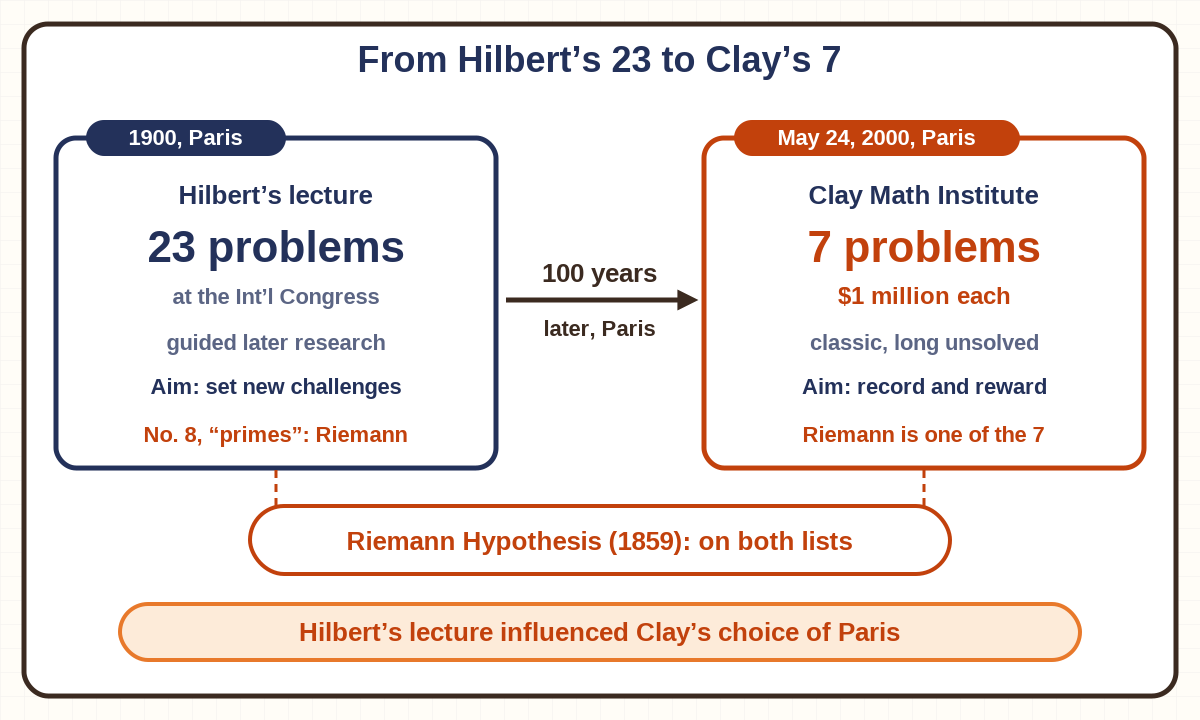
In August 1900, at the second International Congress of Mathematicians in Paris, the mathematician David Hilbert gave a lecture on open problems in mathematics and listed 23 problems. They went on to play a large role in guiding mathematical research. The Riemann Hypothesis is part of the eighth, “Problems of prime numbers”.
A hundred years later, the Clay Mathematics Institute announced its seven problems in the same city, Paris. The institute writes that Hilbert’s lecture influenced its decision to announce the problems at a Paris meeting. The Riemann Hypothesis is on both lists.
But the aims differ. Hilbert set out new challenges. The institute says that rather than set new challenges, it recorded the hardest problems mathematicians were working on as of 2000 and put prizes on them to honor those who solve them.
What about the 2026 claims of solutions?
On September 8, 2026, the AI company OpenAI announced that its AI system had solved the Navier–Stokes problem. Its claim is that there is an example where, if a suitably chosen smooth force keeps acting on a smooth fluid that starts at rest, the speed of the flow grows without bound within a finite time (the solution breaks down). It released the proof in two forms: one written for people to read, and one written in Lean (software in which a machine checks proofs). In the official problem description, showing such a “breakdown” example is one of the answers that count for the prize. OpenAI says it does not intend to claim the prize.
On September 11, the Clay Mathematics Institute responded to the announcement that the Navier–Stokes problem “has apparently been settled”, saying that the prize evaluation follows its rules, that the process is “deliberately unhurried”, and that it will provide updates. On the institute’s list of problems, this one sits under a heading called “Active”, apart from the problems under “Unsolved”, but it is not under “Solved”, and no prize has been awarded.
On November 20, 2026, Levent Alpöge, a mathematician working at the AI company Anthropic, announced that he believes he has found, together with the AI Claude, a proof of the Riemann Hypothesis. What he released is only the Lean proof; there is no paper for people to read yet. The next day, the two groups behind Lean and its shared library of mathematics, Mathlib (the Lean FRO and the Mathlib Initiative), certified in a joint statement that both the statement and the proof of the Riemann Hypothesis are correct. On the institute’s list of problems, it was under “Unsolved” on November 21, but by November 24 it had moved to “Active”, the same heading as Navier–Stokes. It is not under “Solved”, and no prize has been awarded.
Neither has finished being checked. Other mathematicians have started checking the Navier–Stokes proof, and in October 2026 researchers pointed out places where the Lean proof and the proof written for people to read do not say the same thing (in one example, the written proof claims more than what was checked in Lean). This does not show that the original proof is wrong, but the proof written for people still has to be checked on its own. For the Riemann Hypothesis, the check in Lean is done, but there is still no paper for people to read, and mathematicians have yet to take in its new ideas. Under the prize rules, a solution needs at least two years of checking after it appears in a journal or similar, so no decision will come soon. So far, the only problem with a prize is the Poincaré Conjecture.
Check yourself
Q1Of the seven “Millennium Prize Problems” chosen by the Clay Mathematics Institute in 2000, how many had been accepted as solved and awarded a prize by November 2026?
Answer and explanation
Answer: B One: only the Poincaré Conjecture
Only one, the Poincaré Conjecture, was awarded a prize, in 2010 (its solver, Perelman, did not accept the money). “None has been awarded” is wrong. In 2026, solutions were announced for the Navier–Stokes equation and the Riemann Hypothesis, but both are still being checked, and no prize has been decided.
Q2After which steps does the Clay Mathematics Institute decide to award the $1 million prize for a claimed proof of a Millennium Prize Problem?
Answer and explanation
Answer: A After it is in a journal and checked for 2+ years
Under the rules, the solution must appear in a refereed journal or similar, at least two years must pass, and mathematicians around the world must broadly accept it; then the institute has a committee of experts examine it and decides. The institute does not accept solutions sent to it directly. Passing a machine check such as Lean and being online for a long time are not enough on their own. Even for the Poincaré Conjecture, it took over seven years from the proof to the prize.
More on this → Key points: What are the prize rules? How do you win?
Q3In the prize problem on the Navier–Stokes equation, which describes flowing water and air, how do the rules treat an answer showing an example where a smooth flow breaks down (its speed grows without bound)?
Answer and explanation
Answer: C It counts, just like a proof it stays smooth
In the official problem description, a proof that “smooth solutions exist forever” and a proof that “there is an example that breaks down” both count for the prize. The rules also say that for P vs NP and the Navier–Stokes equation, answers in either direction are checked the same way. The small prize is for when a counterexample turns up for one of the other five but the original problem survives once it is restated or some special case is set aside. The answer announced in September 2026 is of this “breakdown” kind and is still being checked.
More on this → Key points: What does each of the seven problems ask?
Related terms
- Riemann Hypothesis
- Poincaré Conjecture
- P vs NP
- Navier–Stokes equations
- Hilbert’s 23 problems
- Lean
- Autoformalization
Sources and how we checked
- Clay Mathematics Institute, “Millennium Prize Problems” (the announcement at a meeting at the Collège de France in Paris on May 24, 2000, the $7 million prize fund with $1 million for each problem, the aims of the prizes [to record the most difficult problems, to make the general public aware, to emphasize working on the deepest problems, to recognize achievement of historical magnitude], the choice of important classic questions by the founding Scientific Advisory Board, the Riemann hypothesis also being on Hilbert’s list of twenty-three problems, and the headings of the problem list [on November 21, Navier–Stokes under “Active” and five problems under “Unsolved”; on November 24, Navier–Stokes and the Riemann hypothesis under “Active” and four problems under “Unsolved”; the Poincaré conjecture under “Solved”]; read November 21 and 24, 2026)
- Clay Mathematics Institute, “Poincaré Conjecture” (the rubber band on an apple and on a doughnut, the two-dimensional sphere being characterized by this property, Poincaré’s 1904 question about the three-dimensional sphere, Perelman’s proof posted on arXiv in 2002 and 2003, and Hamilton’s Ricci flow; read November 21, 2026)
- Clay Mathematics Institute, “P vs NP” (the question whether a problem that is easy to check is also easy to solve, the example of choosing 100 of 400 students for a dormitory and the number of choices exceeding the number of atoms in the known universe, and the formulation by Cook and Levin in 1971; read November 21, 2026)
- Clay Mathematics Institute, “Navier-Stokes Equation” (the equation governing the flow of fluids such as water and air, and the question whether solutions exist and are unique; read November 21, 2026)
- Charles L. Fefferman, “Existence and Smoothness of the Navier–Stokes Equation” (the Clay Mathematics Institute’s official problem description: a proof of one of four statements, existence and smoothness in three dimensions [A, B] or breakdown with a smooth external force [C, D], and the velocity becoming unbounded near a blowup time; read November 21, 2026)
- Clay Mathematics Institute, “Birch and Swinnerton-Dyer Conjecture” (rational points on elliptic curves, and infinitely many rational points if the associated zeta function is 0 at s = 1, finitely many if it is not; read November 21, 2026)
- Clay Mathematics Institute, “Hodge Conjecture” (for projective algebraic varieties, the pieces called Hodge cycles being (rational linear) combinations of geometric pieces called algebraic cycles; read November 21, 2026)
- Clay Mathematics Institute, “Yang-Mills & the Mass Gap” (quantum Yang–Mills theory being the foundation of most of elementary particle theory, and the mass gap having been discovered by experiment and confirmed by computer simulations but not yet understood theoretically; read November 21, 2026)
- Clay Mathematics Institute, “Riemann Hypothesis” (the hypothesis that the non-obvious zeros of the zeta function have real part 1/2, with no mention of the November 2026 announcement, and the status tag reading “Active” on November 24; read November 21 and 24, 2026)
- J. Carlson, A. Jaffe and A. Wiles, eds., “The Millennium Prize Problems” (Clay Mathematics Institute and American Mathematical Society, 2006: the Introduction [the aim being not to define new challenges as Hilbert had done but to record the most difficult issues, the names of the seven problems, the $7 million divided equally, and no time limit], the Statement of the Directors and the Scientific Advisory Board [to celebrate mathematics in the new millennium, and Hilbert’s lecture of August 8, 1900 influencing the decision to announce the problems at a Paris meeting], and A. Jaffe and E. Witten’s official description of the Yang–Mills problem [the meaning of the mass gap and the statement to be proved]; read November 21, 2026)
- Clay Mathematics Institute, Annual Report 2005, notice of the book “The Millennium Prize Problems” (Hilbert describing twenty-three problems at the second International Congress of Mathematicians in Paris on August 8, 1900, which played an influential role in later research, the seven problems ranging from the oldest, the Riemann Hypothesis [1859], to the youngest, P versus NP [1971], and short descriptions of the seven; read November 21, 2026)
- Clay Mathematics Institute, “Millennium Prize Description and Rules” (September 26, 2018: Section 4 on publication in a Qualifying Outlet, at least two years since publication, general acceptance in the global mathematics community and answering the official description; Section 5 on resolutions in either direction for P vs NP and Navier–Stokes, counterexamples to other problems and small prizes, and not accepting direct submissions; Section 3 on confidential decision-making; Section 7 on a minimum of two years of rigorous examination and a special advisory committee of at least three members, at least two of them experts; Section 8 on dividing a prize among several solvers; read November 21, 2026)
- Clay Mathematics Institute press release, “First Clay Mathematics Institute Millennium Prize Announced Today” (March 18, 2010: the Millennium Prize for the Poincaré conjecture awarded to Perelman, the aims of the prizes, the recommendation by a Special Advisory Committee of five, then the Scientific Advisory Board and the Board of Directors, Hamilton’s Ricci flow and the heat equation, Perelman’s preprints posted on arXiv in November 2002, March 2003 and July 2003 and described “with elegant brevity”, Kleiner and Lott’s notes [final version May 2006, journal 2008], Morgan and Tian’s book [August 2007], and the multi-year scrutiny of the mathematical community; read November 21, 2026)
- Clay Mathematics Institute, “Poincaré Chair” (March 1, 2018: Perelman declining the prize money, and the Poincaré Chair for early-career mathematicians at the Institut Henri Poincaré, financed for five years with the Millennium Prize funds; read November 21, 2026)
- David Hilbert, “Mathematical Problems” (lecture delivered before the International Congress of Mathematicians at Paris in 1900; English translation by M. W. Newson, Bulletin of the American Mathematical Society, 1902, on D. Joyce’s page at Clark University; problem 8, “Problems of prime numbers”, and Riemann’s assertion; read November 21, 2026)
- OpenAI, “On the Navier–Stokes Millennium Prize Problem” (September 8, 2026: the claim that an initially smooth fluid at rest, with a smooth force applied, can develop a singularity in finite time with speeds growing without bound, establishing statement C (and also D) of the official formulation, the use of an internal AI system, sharing both a writeup of the proof and a formalization in Lean, and the statement that it does not intend to claim the prize; read November 21, 2026)
- King’s College London news, “OpenAI’s Navier-Stokes proof called into question” (October 27, 2026: mathematicians from King’s College London and the University of Cambridge reporting in a preprint that the Lean version of OpenAI’s proof “does not fully match the proof published for human mathematicians”, an example where the written proof makes a stronger claim than the corresponding claim in the computer-checked version, the finding not yet establishing that OpenAI’s original proof is incorrect, OpenAI having published one version in conventional mathematical notation and one in Lean, and the preprint not yet being peer reviewed; read November 21, 2026)
- A. Bastounis, F. Circelli and A. C. Hansen, “Navier-Stokes lost in translation: Why Lean verification of AI autoformalisation does not guarantee correct natural language proofs” (arXiv 2610.08144, October 6, 2026; the preprint behind the news item above: the abstract’s statement that the formalised Lean proof “does not correspond to the NL proof of blow-up”; read November 21, 2026)
- Clay Mathematics Institute, “Navier-Stokes Announcement” (September 11, 2026: the response to the announcement that the Navier–Stokes problem “has apparently been settled”, the prize rules describing how achievements are evaluated and credited, and the process being “deliberately unhurried” with updates to come; read November 21, 2026)
- Levent Alpöge’s remark (four pages on his website: his belief that, working with Claude, he discovered a proof of the Riemann Hypothesis, the formalization without assumptions, and the decision to present only Lean; read November 21, 2026)
- Lean FRO and Mathlib Initiative, “Lean verification of the Riemann Hypothesis” (Lean community blog, joint statement of November 21, 2026: Alpöge’s proof as a Lean library of 17 million lines, depending directly only on Mathlib; dozens of people reporting correct compilation; two tools, comparator and con-leche, confirming that the theorem proved is exactly Mathlib’s statement of the Riemann Hypothesis, which has been carefully vetted by experts in Lean and number theory; checking by Lean’s kernel and the con-leche and con-ron checkers, which come with a formal proof relative to set theory that they cannot accept a false proof, among others; “We have full confidence that Alpöge’s proof of the Riemann Hypothesis is correct” and the certification that both the statement and the proof are correct; read November 24, 2026)
- Scientific American, “Anthropic mathematician claims to prove Riemann hypothesis, most famous problem in all of math” (November 20, 2026: the date of the announcement and Alpöge being a mathematician working at Anthropic; read November 21, 2026)
AI wrote this page from the sources above, and a different AI checked it against the text of those sources (November 21, 2026). A person with a master’s degree in science and a Japanese high-school science teaching license also read and checked it before publishing. Numbers are as of that date. If anything was hard to follow, you spot a mistake, or there’s a term you’d like explained, please write to [email protected].
Glossary
- AI agent
- AI alignment
- Alignment faking
- Artificial general intelligence (AGI)
- Artificial intelligence (AI)
- Backdoor
- Benchmark
- Chain of thought (CoT)
- Context window
- Data poisoning
- Deep learning
- Deepfake
- Diffusion model
- Embedding
- Emergent misalignment
- Evaluation awareness
- Fine-tuning
- Formal verification
- Generalization
- Generative adversarial network (GAN)
- Generative AI
- Goodhart’s law
- Gradual disempowerment
- Hallucination
- Hyperparameter
- Intelligence explosion
- Interpretability
- Jailbreaking
- Large language model (LLM)
- Latent space
- Machine learning
- Mixture of experts (MoE)
- Neural network
- Neuralese
- Overfitting
- Parameter
- Persona vectors
- Pre-training
- Prompt
- Prompt injection
- Reasoning model
- Recursive language model (RLM)
- Recursive self-improvement (RSI)
- Red teaming
- Reinforcement learning (RL)
- Retrieval-augmented generation (RAG)
- Reward hacking
- Reward model
- Shutdown resistance
- Sleeper agent
- Subliminal learning
- Superintelligence (ASI)
- System prompt
- Technological singularity
- Time horizon
- Token
- Transfer learning
- Transformer
- Accretion disk
- Black hole
- Black hole star
- Cosmic birefringence
- Event horizon
- Event Horizon Telescope (EHT)
- General relativity
- GPS
- Gravitational lensing
- Gravitational singularity
- Gravitational wave
- James Webb Space Telescope (JWST)
- Lagrange point
- Long-period radio transient (LPT)
- Neutron star
- Pulsar
- Quasar
- Sagittarius A*
- Space data center
- Spacetime
- Special relativity
- Speed of light
- Supermassive black hole
- White dwarf
- Autoformalization
- Formal proof
- Four color theorem
- Generalized Riemann Hypothesis (GRH)
- Lean
- You are hereMillennium Prize Problems
- Prime number
- Riemann Hypothesis
- VP ≠ VNP conjecture
- Zeta function