
What is a supermassive black hole (the giant black hole at the center of a galaxy)?
Also called: SMBH

In one minute
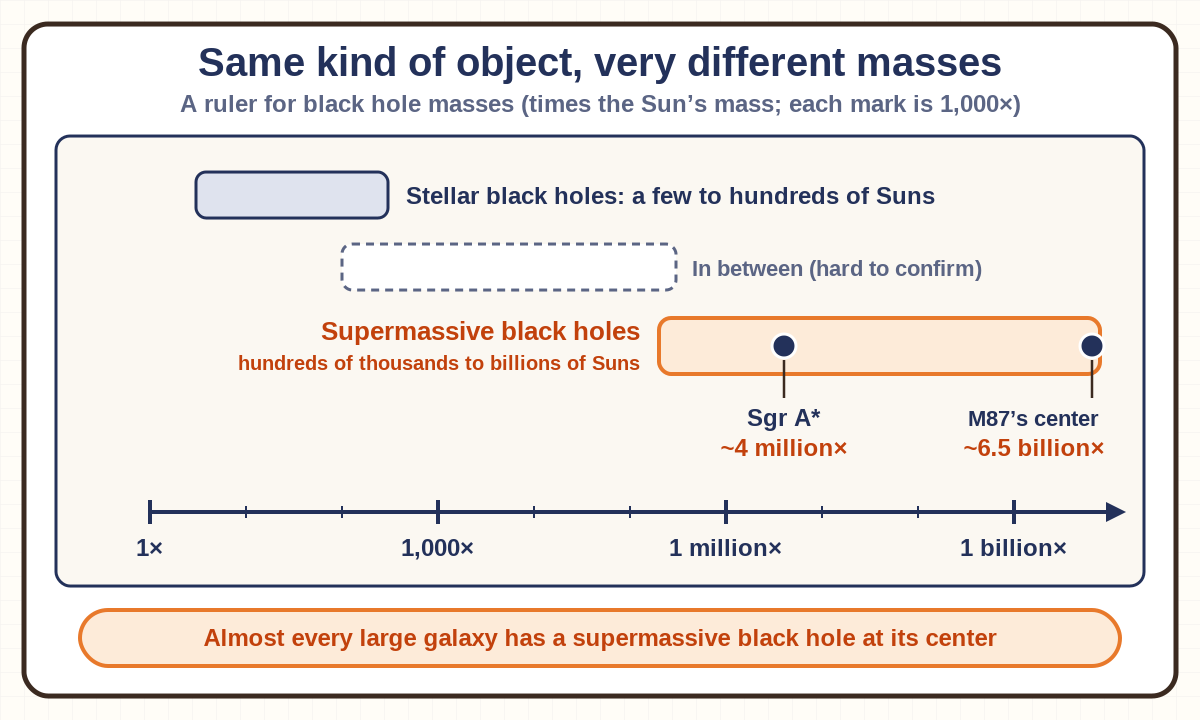
A supermassive black hole is a black hole with hundreds of thousands to billions of times the Sun’s mass, found at the centers of almost all large galaxies.
That puts it in a different league from black holes born when heavy stars collapse, which have a few to hundreds of times the Sun’s mass. Sagittarius A*, at the center of our own Milky Way, has about 4 million times the Sun’s mass, and the one at the center of M87, a distant galaxy, about 6.5 billion times.
It gives off no light, so it can’t be seen directly, but its mass can be measured from how fast stars and gas circle it. When it takes in a lot of gas, the gas heats up and glows, making a quasar brighter than a whole galaxy.
Its mass closely tracks the mass of the bulge at the middle of its galaxy, so it is thought to have grown up together with its galaxy. But how some grew so big so early in the universe is still not known.
A common mix-up
“All the stars in a galaxy circle because they are pulled by the strong gravity of the supermassive black hole at its center.”
Only partly right. It is true very close to the middle of a galaxy: at the center of the Milky Way, stars such as S2 are pulled by Sagittarius A* and race around it (S2 goes around about once every 16 years). But the black hole’s gravity mainly sets how stars move only within a small region, roughly 3 to 300 light-years from the center (it differs from galaxy to galaxy). That is because a supermassive black hole usually weighs only about a thousandth of all the stars in its galaxy put together. For example, Sagittarius A* has about 4 million times the Sun’s mass, but the whole Milky Way, including invisible dark matter, has about 1.5 trillion times the Sun’s mass, so Sagittarius A* is only about 1/400,000 of it. How fast stars and star clusters circle in the outer parts of a galaxy is set mainly by the mass of the whole galaxy.
Explained in pictures
Free to use in lessons, slides and posts with credit (CC BY 4.0).
Free to use in lessons, slides and posts with credit (CC BY 4.0).
Free to use in lessons, slides and posts with credit (CC BY 4.0).
Free to use in lessons, slides and posts with credit (CC BY 4.0).
You’re free to use these figures in lessons, slides and posts if you credit Naru News (naru.news). CC BY 4.0.
Think of it like this
A campfire that blazes when you add wood
Picture a campfire. The fire pit itself doesn’t glow, but when you keep adding wood, the flames leap up and light up everything around. When the wood runs out, the flames die down, and it becomes a quiet spot where only embers glow faintly.
For a supermassive black hole, the fire pit is the black hole, the wood is gas falling in from around it, and the flames are the disk of gas that heats up and glows (the accretion disk). When a lot of gas falls in, it becomes a quasar 100 to 1,000 times brighter than a whole galaxy. Sagittarius A*, at the center of the Milky Way, gets little gas and is as quiet as embers. And just as the hot air from a big fire can blow away the wood piled around it, one idea is that a brightly glowing black hole heats up or blows away its galaxy’s gas and so affects how stars are born.
But the comparison has limits. A campfire burns because wood combines with oxygen in the air, but the disk of gas isn’t burning: it heats up and glows as it falls under strong gravity and rubs against itself. And a fire pit doesn’t get heavier when wood burns in it, but a black hole gets heavier from the gas it takes in, and keeps growing.
Key points
How heavy is it, and where is it?
A supermassive black hole is a black hole with hundreds of thousands to billions of times the Sun’s mass. Almost all large galaxies, including the Milky Way, have one at their center. By 2013, careful studies of how stars and gas move near the centers of galaxies had weighed them in 87 galaxies.
For example, Sagittarius A* (“A-star”), at the center of our own Milky Way, lies about 27,000 light-years from Earth (the distance light travels in 27,000 years) and has about 4 million times the Sun’s mass. It is the closest supermassive black hole to Earth, and its own page explains it in detail. The one at the center of M87, a distant galaxy whose black hole was the first to be imaged, in 2019, lies about 55 million light-years away and has about 6.5 billion times the Sun’s mass.
The size of a black hole’s event horizon, the boundary from inside which not even light can get out, is proportional to its mass. For a black hole with the Sun’s mass, its radius would be about 3 km, but for Sagittarius A* it is about 12 million km, and for the one at the center of M87 it is roughly 40 billion km across, more than 4 times as wide as the path of Neptune, the outermost planet of our solar system (about 9 billion km across).
How is it different from a stellar black hole?
The biggest difference is mass. Black holes born when heavy stars collapse at the end of their lives have a few to hundreds of times the Sun’s mass, and there may be as many as 100 million of them in the Milky Way alone. Supermassive black holes are heavier by many orders of magnitude and sit at the centers of galaxies.
Scientists expect there to be “intermediate-mass black holes” in between too, with about 100 to hundreds of thousands of times the Sun’s mass. Many candidates have been found, but they have proven hard to confirm, so it is still not clear.
They also form differently. Stellar black holes form when the core of a heavy star collapses. But how supermassive black holes formed is still not known (see “How did they get so big?” below). When galaxies collide, the supermassive black holes at their centers are thought to merge and become even heavier. When huge black holes collide, they send out gravitational waves, warps of time and space that spread out as waves. The European Space Agency (ESA) plans to launch LISA, a set of three spacecraft that will catch these gravitational waves in space, in 2035.
If we can’t see it, how do we find it and weigh it?
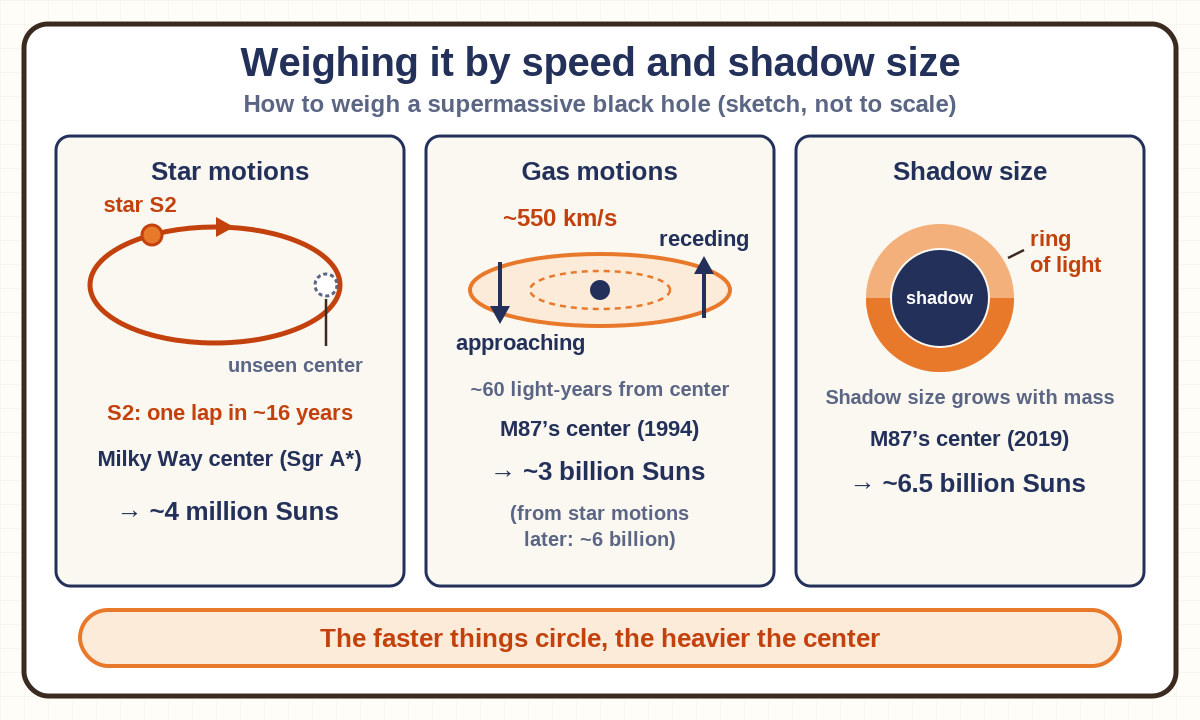
The clue is how fast stars and gas circle it. The heavier the center, the faster things around it must move to keep from falling in. So if you know how fast they circle and how far they are from the center, you can work out the mass at the center. But a supermassive black hole usually weighs only about a thousandth of all the stars in its galaxy, and its gravity mainly sets how nearby stars move only within a small region, roughly 3 to 300 light-years from the center. Making out such a small region in a distant galaxy is hard, so telescopes that can see fine detail, such as the Hubble Space Telescope, played a big part.
Star motions: at the center of the Milky Way, stars such as S2 circle an unseen center. S2 goes around about once every 16 years, and its motion showed that about 4 million times the Sun’s mass is packed into a very small space at the center. Reinhard Genzel and Andrea Ghez, who tracked the motions of such stars for many years, won the 2020 Nobel Prize in Physics.
Gas motions: in 1994, the Hubble Space Telescope studied a disk of gas circling the center of M87. Light from something coming toward us shifts a little toward blue, and light from something moving away shifts toward red, so the color shift reveals the speed. About 60 light-years from the center, gas on one side of the disk was coming toward us and gas on the other side moving away, at about 550 km per second. Making gas circle that fast takes about 3 billion times the Sun’s mass inside its path. But star motions later gave about 6 billion, so in M87 the mass from gas came out about half the mass from stars. Why they differ was still being debated as of 2013.
Shadow size: in 2019, an international team, the Event Horizon Telescope (EHT), released an image of the “shadow” of the black hole at the center of M87. Near a black hole, gravity bends light (gravitational lensing), and a dark shadow appears inside a glowing ring. The shadow’s size is proportional to the mass, so from its apparent size, the distance and calculations with general relativity (Einstein’s theory of gravity), the team found a mass of about 6.5 billion times the Sun’s, close to the value from star motions. In 2022, an image of the shadow of Sagittarius A* was released too.
What is a quasar?
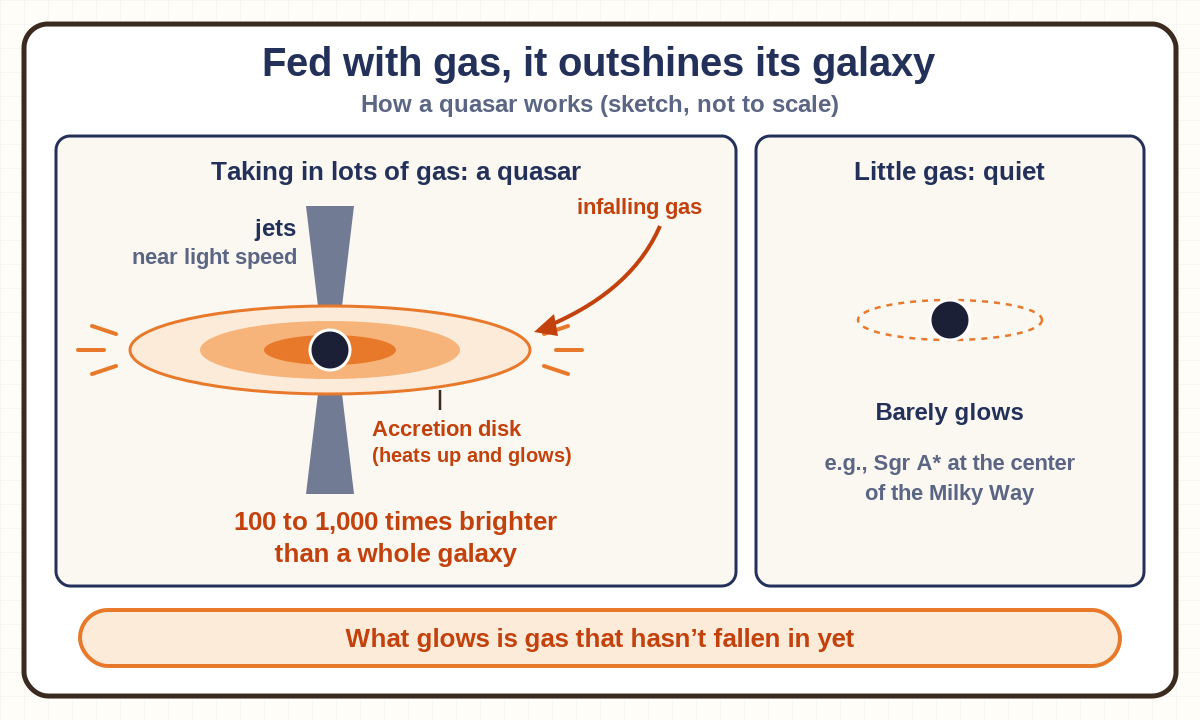
A supermassive black hole itself gives off no light, but the gas around it does. Gas falling in circles the black hole and forms a flat disk (an accretion disk). Strong gravity and rubbing heat the gas in the disk until it glows brightly. When a lot of gas falls in and the center of a distant galaxy glows extremely brightly, it is called a quasar. Galaxy centers where infalling gas glows brightly, including fainter ones, are called active galactic nuclei as a group.
A quasar gives off 100 to 1,000 times as much light as a whole galaxy, outshining the stars of the galaxy it lives in. What they really are began to come to light in 1963, when a point of light that looked like a star, linked to a radio source called 3C 273, turned out to be an extremely bright object very far away. Because they looked like points of light, like stars, from far away, they were named “quasi-stellar,” meaning star-like.
From near the inner edge of the disk, particles may shoot out at close to the speed of light in two narrow beams in opposite directions (jets). Jets from supermassive black holes can reach lengths of hundreds of thousands of light-years, but how they are launched is still not well understood.
Quasars were far more common in the past than they are now. A black hole that stops taking in gas grows dark but doesn’t disappear, so astronomers reasoned that the black holes of old quasars must be sleeping at the centers of quiet nearby galaxies, and went looking for them. Sagittarius A*, at the center of the Milky Way, is also a quiet black hole that takes in only a trickle of gas.
Do they really grow up with their galaxies?
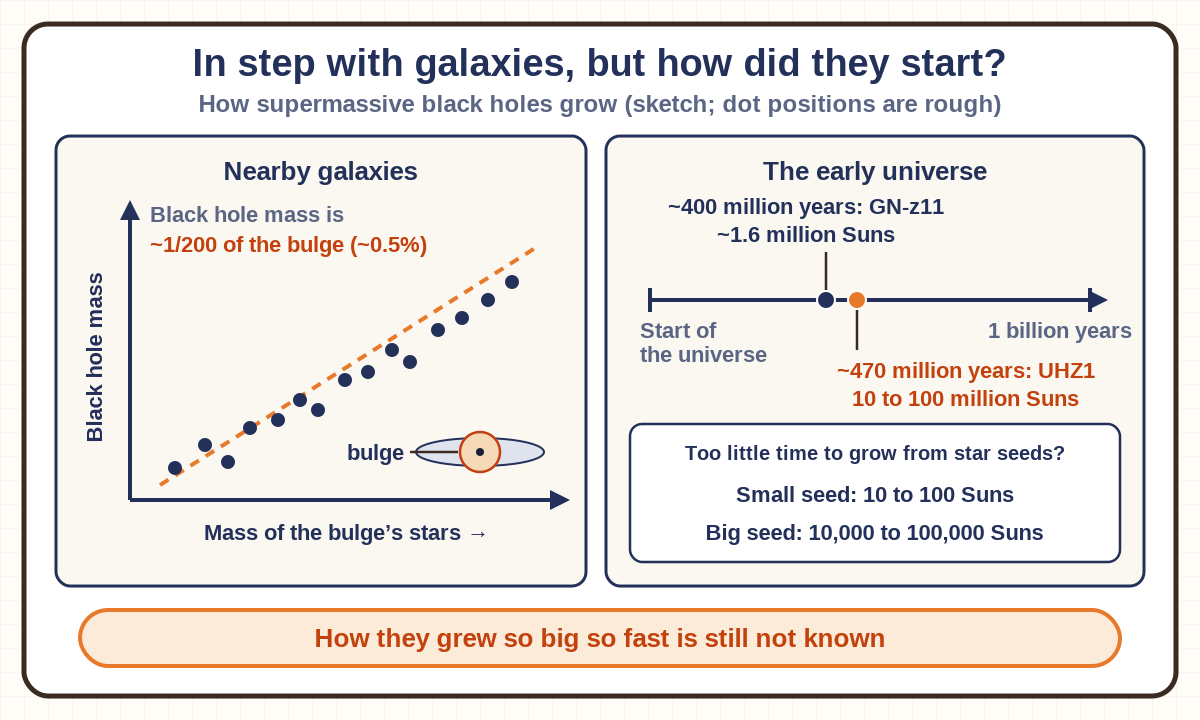
Studies of galaxies in the nearby universe found that the mass of the central supermassive black hole closely matches the mass of the bulge at the middle of the galaxy (the round crowd of stars there). In elliptical galaxies and galaxies with a clear bulge, the black hole’s mass is about 0.5% (about 1/200) of the mass of the bulge’s stars, and the heavier the bulge, the heavier the black hole.
Even more surprising was its link to how fast the bulge’s stars move around (the stars move in different directions at different speeds, so this is measured by how widely their speeds are spread). Studies published in 2000 found that the faster the stars move around, the heavier the black hole, and that on a graph the points fall almost on one line, so close that the small scatter could be explained by measurement errors. The black hole’s gravity mainly sets how stars move only very close to the center, yet the black hole matches the motions of bulge stars spread out much farther. So it came to be widely believed that black holes and bulges grew up together, each regulating the other’s growth.
One idea about how they affect each other is that the light, winds and jets from a brightly glowing black hole heat up or blow away the galaxy’s gas, holding back the birth of stars and also the flow of gas into the black hole itself. But a 2013 review argued that the evidence for growth in lockstep is not as strong as had been thought, and that repeated mergers of galaxies may have done much of the work, averaging out the masses until they matched. Why they are linked is still being debated.
How did they get so big?
No one knows yet. Some supermassive black holes formed less than a billion years after the universe began. The usual idea is that a black hole of about 10 to 100 times the Sun’s mass, born when a heavy star collapsed, served as a “seed” and grew by taking in gas around it. But at the growth rates that had been assumed, reaching millions of times the Sun’s mass takes about a billion years.
The James Webb Space Telescope (JWST) has found heavy black holes even earlier. A study published in 2024 found a black hole of about 1.6 million times the Sun’s mass at the center of the galaxy GN-z11, about 400 million years after the universe began, apparently taking in gas about 5 times faster than the limit that had been thought possible (the limit where the light given off by infalling gas pushes the surrounding gas back so hard that it can’t be taken in any faster). In 2023, JWST and the Chandra X-ray Observatory found a black hole of 10 to 100 million times the Sun’s mass in the galaxy UHZ1, about 470 million years after the universe began (the gravity of a galaxy cluster in front bent its light and magnified it about four times, an effect called gravitational lensing). In nearby galaxies a black hole weighs about a thousandth of its galaxy’s stars, but in UHZ1 it weighed about as much as all the stars in the galaxy.
So two ideas are being studied. One is that small seeds grew in a hurry by sometimes taking in gas faster than the limit. The other is that they grew from big seeds from the start, for example black holes of about 10,000 to 100,000 times the Sun’s mass, formed when huge clouds of gas collapsed directly without first forming stars. The UHZ1 team calls its result strong evidence that the black hole was born big, but the question is not settled.
JWST has also found many objects in the early universe that look like small red dots, called “little red dots.” One candidate for what they are is a newborn black hole growing while wrapped in dense gas (a black hole star). Which path is the real one will be tested by future observations.
Check yourself
Q1Think of the supermassive black holes at the center of the Milky Way (Sagittarius A*) and at the center of M87, a distant galaxy. What is the main clue for weighing them?
Answer and explanation
Answer: C How fast the stars and gas around circle
The heavier the center, the faster stars and gas around it must circle to keep from falling in. So the mass can be worked out from how fast they circle and how far they are from the center. Sagittarius A* was weighed at about 4 million times the Sun’s mass from the motions of stars such as S2, and the one at the center of M87 from the motions of gas and stars. The mass was also found from the EHT image, but what was used was the size of the shadow, not how dark it is. X-ray brightness changes a lot with how much gas is taken in, and Sagittarius A* once got 400 times brighter than usual, so it can’t serve as a ruler for mass.
More on this → Key points: If we can’t see it, how do we find it and weigh it?
Q2In galaxies in the nearby universe, what did people find when they compared the mass of the central supermassive black hole with the mass of the bulge (the round crowd of stars at the galaxy’s middle)?
Answer and explanation
Answer: B The heavier the bulge, the heavier the black hole
In elliptical galaxies and galaxies with a clear bulge, the black hole’s mass is about 0.5% (about 1/200) of the mass of the bulge’s stars, and the heavier the bulge, the heavier the black hole. It is also tightly linked to how fast the bulge’s stars move around. The black hole’s gravity mainly sets how stars move only very close to the center, yet the masses match like this, so black holes are thought to have grown up together with their galaxies, affecting each other. Why they are linked, though, is still being debated.
More on this → Key points: Do they really grow up with their galaxies?
Q3A supermassive black hole was found at the center of the galaxy UHZ1, about 470 million years after the universe began. How did its mass compare with the mass of all the stars in that galaxy?
Answer and explanation
Answer: A It weighed about as much as all the stars
In nearby galaxies, a black hole weighs about a thousandth of all the stars in its galaxy. But in UHZ1, the black hole was 10 to 100 million times the Sun’s mass, about as heavy as all the stars in the galaxy. This is hard to explain with small seeds born from stars growing by taking in gas, and the research team calls it strong evidence that the black hole was born from a big seed from the start (a black hole of about 10,000 to 100,000 times the Sun’s mass, formed when a huge cloud of gas collapsed directly without first forming stars). The question is not settled yet, though.
Related terms
- Black hole
- Sagittarius A*
- Black hole star
- Event horizon
- Gravitational lensing
- Gravitational wave
- General relativity
- Quasar
- Active galactic nucleus
- Accretion disk
- Intermediate-mass black hole
- James Webb Space Telescope
- Event Horizon Telescope
Sources and how we checked
- NASA, “Black Hole Types” (NASA Science, updated August 12, 2026: stellar-mass black holes having a few to hundreds of times the Sun’s mass, with perhaps as many as 100 million in the Milky Way alone, intermediate-mass black holes expected to range from about one hundred to hundreds of thousands of solar masses, with numerous candidates that have proven difficult to confirm, supermassive black holes having hundreds of thousands to billions of times the Sun’s mass, almost every large galaxy, including the Milky Way, having one at its center, scientists not being sure how they came to be, their ability to merge with other supermassive black holes when galaxies collide, and some forming in the first billion years after the birth of the universe; read November 23, 2026)
- J. Kormendy and L. C. Ho, “Coevolution (Or Not) of Supermassive Black Holes and Host Galaxies” (Annual Review of Astronomy and Astrophysics 51, 2013; arXiv full text read as a PDF. Abstract: supermassive black holes found in 87 galaxies by dynamical modeling, the Hubble Space Telescope revolutionizing black hole research, and the discovery of a tight correlation between black hole mass and the velocity dispersion of the host bulge leading to the widespread belief that black holes and bulges coevolve by regulating each other’s growth. Section 1: the field starting with the 1963 discovery that the starlike object identified with the radio source 3C 273 had a very high redshift, 3C 273 being about 10 times more luminous than the brightest galaxies, the acceptance of the idea that quasars and other active galactic nuclei are powered by accretion onto supermassive black holes, quasars being much more numerous at redshifts above 2 than now, dead quasar engines expected to hide in many nearby galaxies, finding them becoming a “holy grail,” and black hole masses being only about 0.1% of the stellar masses of their host galaxies, so black holes dominate gravity only within a sphere of influence of about 1 to 100 parsecs [about 3 to 300 light-years]. Section 3.2: in M87 the gas-based black hole mass being almost a factor of 2 smaller than the star-based mass. Table 2: M87’s star-based mass of 6.15 billion solar masses [Gebhardt et al. 2011]. Section 6.6.1: for classical bulges and ellipticals, a black-hole-to-bulge mass ratio of 0.49% at a bulge mass of 100 billion solar masses. Sections 8 and 8.2: the scatter in the relation with velocity dispersion being consistent with or only moderately larger than the measurement errors, 1% of the energy from an active nucleus being enough to blow away all of a forming galaxy’s gas, radiation, winds and jets possibly quenching star formation and making black hole growth self-limiting, while the evidence for growth in lockstep is less compelling than thought, and the averaging inherent in galaxy and black hole mergers possibly being a major cause of the correlations; read November 23, 2026)
- L. Ferrarese and D. Merritt, “A Fundamental Relation Between Supermassive Black Holes and Their Host Galaxies” (The Astrophysical Journal 539, L9, 2000; arXiv abstract: black hole mass scaling with the bulge velocity dispersion to about the 4.8th power, the relation being much tighter than that with bulge luminosity, with scatter no larger than expected from measurement errors alone, and this implying a strong link between black hole formation and the properties of the stellar bulge; read November 23, 2026)
- NASA, “Hubble Confirms Existence of Massive Black Hole at Heart of Active Galaxy” (May 25, 1994: Hubble measuring the speed of a disk of gas about 60 light-years from the center of M87, with one side approaching and the other receding at about 550 km per second, the central object weighing as much as about three billion Suns and being concentrated into a space no larger than our solar system, and straightforward Newtonian physics being all that is needed to get the mass from the speeds; read November 23, 2026)
- The Event Horizon Telescope Collaboration, “First M87 Event Horizon Telescope Results. VI. The Shadow and Mass of the Central Black Hole” (The Astrophysical Journal Letters 875, L6, April 10, 2019; arXiv abstract: the mass of the black hole at the center of M87 found from the shadow and other measurements as 6.5 billion solar masses [±0.2 billion statistical, ±0.7 billion systematic], the distance taken as 16.8 megaparsecs, and the result being consistent with a central spinning black hole; read November 23, 2026)
- National Astronomical Observatory of Japan, Japanese press release on the first image of a black hole, in the galaxy M87 (April 10, 2019: the giant black hole in M87 lying 55 million light-years from Earth with 6.5 billion times the Sun’s mass, observations in April 2017 by eight radio telescopes linked across the Earth, a black hole’s size being proportional to its mass, and the event horizon being 2.5 times smaller than the shadow; read November 23, 2026)
- National Astronomical Observatory of Japan, Japanese press release on the first image of the black hole at the center of the Milky Way (May 12, 2022: Sagittarius A* having 4 million times the Sun’s mass and lying about 27,000 light-years from Earth, the image showing a bright ring-like structure and a dark central region [the shadow], the earlier indirect evidence from stars orbiting it, and its mass being less than a thousandth of the giant black hole in M87; read November 23, 2026)
- ESO, “First Successful Test of Einstein’s General Relativity Near Supermassive Black Hole” (eso1825, July 26, 2018: the star S2 orbiting the black hole every 16 years, the black hole’s mass of 4 million times the Sun’s, and the closest supermassive black hole to Earth lying at the center of the Milky Way; read November 23, 2026)
- ESO, “2020 Nobel Prize in Physics awarded for research with ESO telescopes on Milky Way’s supermassive black hole” (eso2017, October 6, 2020: the citation for Genzel and Ghez, “for the discovery of a supermassive compact object at the centre of our galaxy,” and Genzel’s team tracking stars orbiting Sagittarius A* from 1992 and accurately tracing the orbit of S2; read November 23, 2026)
- ESA/Hubble, “Hubble & Gaia accurately weigh the Milky Way” (heic1905, March 7, 2019: the Milky Way weighing about 1.5 trillion solar masses within 129,000 light-years of the galactic center, dark matter making up about 90% of the galaxy’s mass, and the more massive a galaxy, the faster its globular clusters moving under the pull of its gravity; read November 23, 2026)
- NASA, “Hubble Quasars” (NASA Science, updated June 18, 2026: quasars as distant galaxies whose incredibly bright cores are powered by supermassive black holes, pouring out 100 to 1,000 times as much light as an entire galaxy and outshining their host galaxies, infalling matter being subjected to extreme gravitational and frictional forces, and their name “quasi-stellar radio sources,” because they looked like stars but emitted radio waves; read November 23, 2026)
- NASA, “Black Hole Anatomy” (NASA Science, updated August 12, 2026: the hot, bright, rapidly spinning accretion disk being the main source of light from a black hole, pairs of jets firing particles out at close to the speed of light in opposite directions from near the inner edge of the disk, jets from supermassive black holes being able to reach lengths of hundreds of thousands of light-years, and astronomers not fully understanding how jets work; read November 23, 2026)
- NASA, “NASA’s Chandra Detects Record-Breaking Outburst from Milky Way’s Black Hole” (January 5, 2015: an X-ray flare from Sagittarius A* about 400 times brighter than its usual, quiet state on September 14, 2013, and Sagittarius A* consuming only a mere trickle of infalling matter; read November 23, 2026)
- University of Cambridge, “Astronomers detect oldest black hole ever observed” (January 17, 2024: the James Webb Space Telescope finding a black hole at the center of the galaxy GN-z11, about 400 million years after the Big Bang, standard models needing about a billion years for a black hole grown from stellar remnants to reach that size while the universe was not yet a billion years old, and the possibility that it was born large or ate matter at a rate five times higher than had been thought possible; read November 23, 2026)
- R. Maiolino et al., “A small and vigorous black hole in the early Universe” (Nature, 2024; arXiv abstract: a black hole of about 1.6 million solar masses [log mass 6.2 ± 0.3] in GN-z11 at redshift 10.6, accreting at about 5 times the Eddington rate, and the properties being compatible both with heavy-seed scenarios and with intermediate or light seeds going through episodic super-Eddington phases; read November 23, 2026)
- NASA, “NASA Telescopes Discover Record-Breaking Black Hole” (November 6, 2023: the James Webb Space Telescope finding the galaxy UHZ1 and Chandra’s X-rays revealing a growing black hole seen 470 million years after the big bang, the most distant black hole yet seen in X-rays, its light magnified by about a factor of four by the gravitational lensing of the foreground cluster Abell 2744, its mass of 10 to 100 million Suns, about the same as all the stars in its galaxy, nearby black holes usually containing only about a tenth of a percent of the mass of their host galaxy’s stars, and the two ideas of seeds from explosions of the first stars, of about 10 to 100 Suns, and of direct collapse of a huge cloud of gas, of about 10,000 to 100,000 Suns, with the team finding strong evidence that this one was born massive; read November 23, 2026)
- MIT News, “Astronomers discover a brand-new type of astrophysical object: A black hole star” (Massachusetts Institute of Technology, August 12, 2026: the “little red dots” found by the James Webb Space Telescope seeming to be everywhere in the early universe but essentially disappearing by the present day, and the proposal that they are nascent black holes enshrouded in dense gas so that they shine like stars [black hole stars]; read November 23, 2026)
- ESA, “Capturing the ripples of spacetime: LISA gets go-ahead” (European Space Agency, January 25, 2024: LISA detecting, across the entire Universe, the ripples in spacetime caused when huge black holes at the centers of galaxies collide, the launch of the three spacecraft planned for 2035, and the aim to chart how black holes grow to be millions of times more massive than the Sun; read November 23, 2026)
- NASA, “Sun Fact Sheet” and “Neptune Fact Sheet,” and NIST, “CODATA Value: speed of light in vacuum” (the Sun’s GM of 132,712×10^6 km³/s², Neptune’s semimajor axis of 4,514.953 million km, and the speed of light in vacuum of 299,792,458 m/s. Calculations: the event horizon radius 2GM/c² is about 2.95 km for one Sun’s mass, about 11.8 million km [about 12 million km] for 4 million Suns, and about 19.2 billion km for 6.5 billion Suns [about 38.4 billion km across, roughly 40 billion km]; Neptune’s path is about 9 billion km across, so this is more than 4 times as wide; read November 23, 2026)
AI wrote this page from the sources above, and a different AI checked it against the text of those sources (November 23, 2026). A person with a master’s degree in science and a Japanese high-school science teaching license also read and checked it before publishing. Numbers are as of that date. If anything was hard to follow, you spot a mistake, or there’s a term you’d like explained, please write to [email protected].
Glossary
- AI agent
- AI alignment
- Alignment faking
- Artificial general intelligence (AGI)
- Artificial intelligence (AI)
- Backdoor
- Benchmark
- Chain of thought (CoT)
- Context window
- Data poisoning
- Deep learning
- Deepfake
- Diffusion model
- Embedding
- Emergent misalignment
- Evaluation awareness
- Fine-tuning
- Formal verification
- Generalization
- Generative adversarial network (GAN)
- Generative AI
- Goodhart’s law
- Gradual disempowerment
- Hallucination
- Hyperparameter
- Intelligence explosion
- Interpretability
- Jailbreaking
- Large language model (LLM)
- Latent space
- Machine learning
- Mixture of experts (MoE)
- Neural network
- Neuralese
- Overfitting
- Parameter
- Persona vectors
- Pre-training
- Prompt
- Prompt injection
- Reasoning model
- Recursive language model (RLM)
- Recursive self-improvement (RSI)
- Red teaming
- Reinforcement learning (RL)
- Retrieval-augmented generation (RAG)
- Reward hacking
- Reward model
- Shutdown resistance
- Sleeper agent
- Subliminal learning
- Superintelligence (ASI)
- System prompt
- Technological singularity
- Time horizon
- Token
- Transfer learning
- Transformer
- Accretion disk
- Black hole
- Black hole star
- Cosmic birefringence
- Event horizon
- Event Horizon Telescope (EHT)
- General relativity
- GPS
- Gravitational lensing
- Gravitational singularity
- Gravitational wave
- James Webb Space Telescope (JWST)
- Lagrange point
- Long-period radio transient (LPT)
- Neutron star
- Pulsar
- Quasar
- Sagittarius A*
- Space data center
- Spacetime
- Special relativity
- Speed of light
- You are hereSupermassive black hole
- White dwarf