
Home › Glossary › Everyday science
What is pluripotency, the power to become any kind of body cell?
Also called: Pluripotent

In one minute
Pluripotency is the power of a single cell to become any kind of cell in the body, such as nerve, muscle, blood or gut cells.
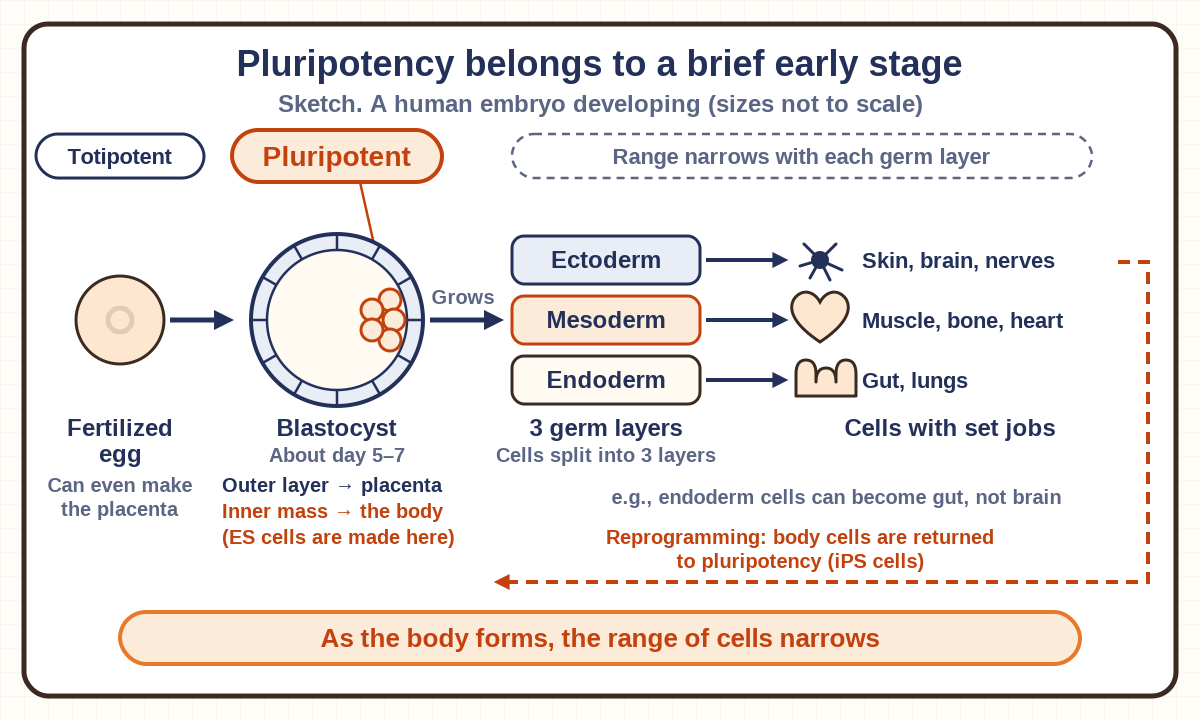
In the body, it is found in the clump of cells inside an embryo (the early form a fertilized egg takes as it divides and grows into a baby) about 5 to 7 days after fertilization. This clump (the inner cell mass) goes on to form the body. As the embryo develops and its cells take on jobs, the power is lost; stem cells in the adult body do not have it.
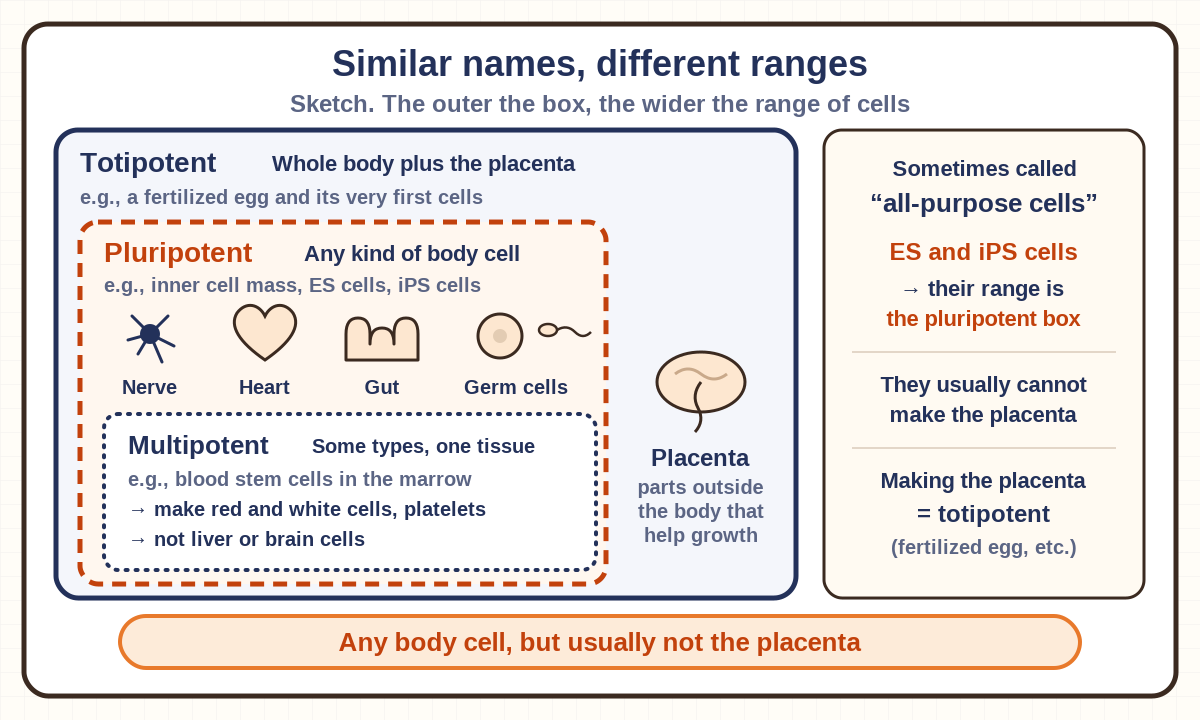
A similar word, totipotency, means the power to make even the parts outside the body, such as the placenta; only a fertilized egg and its very first cells have it. Pluripotent cells usually cannot make the placenta. They are sometimes called “all-purpose cells,” but they cannot become absolutely anything.
ES cells, made from embryos, and iPS cells, remade from body cells, keep this power while they multiply. Researchers test for it by checking whether cells can become cells of all three germ layers, the three layers of cells that the body develops from.
A common mix-up
“A pluripotent cell can become absolutely anything, even the placenta.”
Only half right. A pluripotent cell can become any kind of cell in the body, such as nerve, muscle, gut or lung cells, and even the cells that give rise to sperm and eggs. But it usually cannot make the parts outside the body that support the baby’s growth in the womb, such as the placenta. Even in the embryo, the placenta comes not from the pluripotent clump of cells inside but from the thin outer layer. The power to make the placenta too is called totipotency, and only a fertilized egg and the cells from its very first divisions have it. In Japan, when iPS cells were new, a research announcement even called them “artificial all-purpose stem cells,” but by their range, they are pluripotent.
Explained in pictures
Free to use in lessons, slides and posts with credit (CC BY 4.0).
Free to use in lessons, slides and posts with credit (CC BY 4.0).
Free to use in lessons, slides and posts with credit (CC BY 4.0).
You’re free to use these figures in lessons, slides and posts if you credit Naru News (naru.news). CC BY 4.0.
Think of it like this
Builders and the scaffolding
When a house is built, scaffolding is put up around it. The scaffolding supports the building only while the work goes on and is taken down once the house is finished. For a baby in the womb, the placenta is like this scaffolding: it is not part of the baby’s body itself, but it supports the baby while it grows inside the mother.
A fertilized egg is like a builder who can make both the house and the scaffolding (totipotency). A pluripotent cell is a builder who can make any room of the house, whether the kitchen, a bedroom or the bathroom. But it usually does not take on the scaffolding. A tissue stem cell, such as a blood-forming stem cell in the bone marrow, is more like a plumber: it can handle the kitchen sink and the bathroom, but not a bedroom (multipotency).
An iPS cell is like taking a builder who has done only one job for years and turning them back into an apprentice who can make any room. This turning back is called reprogramming.
But the comparison has limits. Builders work from a plan, while cells take on their jobs little by little in response to signals from their surroundings. And one builder who can make any room cannot build a whole house alone. Pluripotency is about the range of cell types a cell can become; it does not mean that one cell can build a whole body.
Key points
How are totipotency, pluripotency and multipotency different?
All three describe the range of cells that a single cell can become. From widest to narrowest, they are totipotency, pluripotency and multipotency.
Totipotency is the power to make every kind of cell in the body, plus the parts outside the body that support growth in the womb, such as the placenta. Only a fertilized egg and the cells from its very first divisions have it (in mice, up to about the 4- to 8-cell stage).
Pluripotency is the power to become any kind of body cell: nerve, skin, muscle, bone, gut and lung cells, and even the cells that give rise to sperm and eggs. But pluripotent cells usually cannot make the parts outside the body, such as the placenta. The clump of cells inside the embryo, ES cells and iPS cells have this power.
Multipotency is the power to become several kinds of cells within one tissue. Blood-forming stem cells in the bone marrow, for example, can make every kind of blood cell, such as red blood cells, white blood cells and platelets, but not liver or brain cells. Tissue stem cells in the adult body are not pluripotent and mainly make the cells of their own tissue.
In Japanese, though, these words are not always used the same way. Some sources use the Japanese word for multipotency for stem cells in general, including ES and iPS cells. Conversely, some call tissue stem cells, such as blood-forming stem cells, by the Japanese word for pluripotent stem cells. And ES and iPS cells are sometimes called “all-purpose cells,” but that is not the same as totipotency, which reaches as far as the placenta. It is safer to think about which cells something can actually become than to rely on the word.
We have said pluripotent cells “usually” cannot make the placenta because there are reports that look like exceptions. The first human ES cells, made in 1998, were reported to form cells that give rise to the placenta as well. Even so, pluripotent cells normally cannot make the placenta, and exactly where the boundary lies is still being studied.
Where is it found, and when is it lost?
A human fertilized egg divides into more and more cells, and about 5 to 7 days after fertilization it becomes a hollow ball of cells (a blastocyst). By then, its cells have split into two groups. The thin outer layer later becomes the placenta and similar parts. The clump of cells on one side inside (the inner cell mass) later makes the whole body, and it is pluripotent.
When the embryo burrows into the wall of the uterus, a layer of body-making cells forms from the inner clump. Pluripotency belongs only to a limited set of cells up to about this stage; studies in mice and other animals describe it as a temporary state that lasts only a few days.
After that, the body-making cells split into three layers (germ layers). The outer ectoderm becomes skin, brain and nerves; the middle mesoderm becomes muscle, bone, the heart, blood vessels and more; and the inner endoderm becomes digestive organs such as the gut, and the lungs. Once cells have split into germ layers, endoderm cells, for example, can become gut or lung but not brain or muscle. In this way, cells take on their jobs little by little (differentiation), and their range narrows.
Tissue stem cells in the adult body are not pluripotent. So when pluripotent cells are needed for research or medicine, people use ES cells, grown from the clump inside an embryo, or iPS cells, remade from body cells. Grown in a dish in a set way, both can multiply almost without limit while staying pluripotent.
How is pluripotency tested?
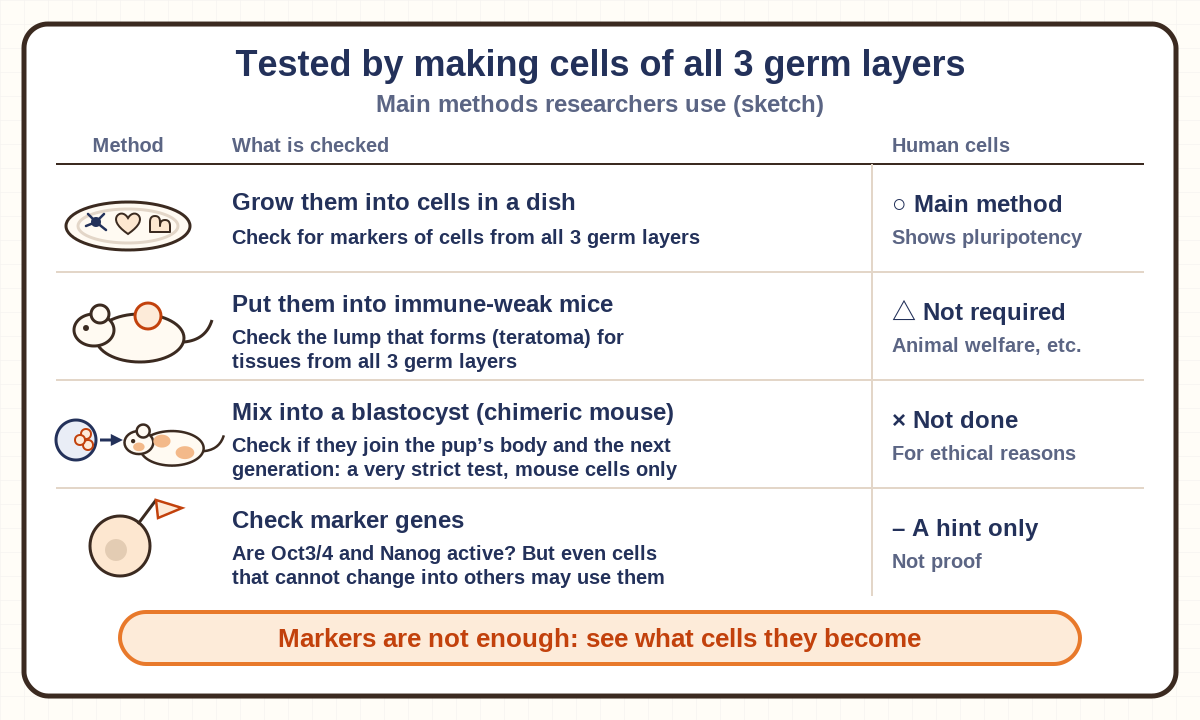
You cannot tell whether a cell is pluripotent just by looking at it. So researchers test whether it can actually become cells of all three germ layers: ectoderm, mesoderm and endoderm. If it can become cells of all three, it is taken to be able to become any kind of body cell.
One common method is to grow the cells into different kinds of cells in a dish, changing how they are grown, and check whether markers of cells from each germ layer appear. Another is to put the cells into mice with a weak immune system. The immune system is the body’s defense that finds cells that came from outside and drives them out. In a mouse with a weak immune system, the added cells are not driven out, so they multiply and form a lump. The lump is not cancer but a mix of many kinds of tissue, and it is called a teratoma. If it contains tissues from all three germ layers, that is evidence of pluripotency. When mouse and human iPS cells were first made, this method was also used to show that they form tissues of all three germ layers.
With mouse cells, there is an even stricter test. The cells are mixed into a mouse blastocyst, which is put back into a uterus, to see whether the added cells help build the body of the pup that is born. If they do, the pup’s body is made of a mix of the embryo’s own cells and the added cells. A mouse whose body is a mix of two kinds of cells like this is called a chimeric mouse. Researchers then go as far as checking whether the added cells also become sperm or eggs and pass to the next generation. With human cells, mixing them into embryos to test them is not possible for ethical reasons.
Researchers also check whether genes such as Oct3/4 and Nanog are active, but that alone is not evidence of pluripotency, because some cancer cells that cannot become other cells also have these genes active. The standards of the international society of stem cell researchers also ask that pluripotency in human cells be shown by testing whether the cells can become cells of all three germ layers. Teratoma tests are not required, partly out of concern for animal welfare.
How was it restored to body cells?
Even body cells with set jobs still hold the information needed to build a body. In 1962, John Gurdon in the United Kingdom removed the nucleus (the part that holds the genes) from an African clawed frog egg and put in the nucleus of a gut cell from a tadpole instead. The egg then divided like a fertilized egg and grew into a tadpole.
Could a cell regain pluripotency without moving its nucleus into an egg? Shinya Yamanaka and colleagues at Kyoto University chose 24 candidate genes that play important roles, or are highly active, in mouse ES cells. They put them into cells such as mouse skin cells, narrowed them down, and found that four, Oct3/4, Sox2, Klf4 and c-Myc, were enough. In 2006, the resulting cells were named “iPS cells,” and in 2007 they were also made from adult human skin cells. Returning a cell with a set job to a pluripotent state is called reprogramming.
But the first iPS cells had not fully regained pluripotency. When mixed into blastocysts, they helped build embryos, but those embryos did not survive to birth. In 2007, iPS cells chosen by stricter criteria gave chimeric mice that grew to adulthood, and the added cells passed to their offspring.
In 2012, Gurdon and Yamanaka received the Nobel Prize in Physiology or Medicine, in recognition of research on reprogramming: returning cells whose jobs were already set to a pluripotent state. Improvements in how iPS cells are made and how they are used in treatment are covered on the iPS cell page.
What keeps cells pluripotent?
In pluripotent cells, genes such as Oct3/4, Sox2 and Nanog are highly active. Each makes a protein that acts as a switch, turning other genes on or off. These three also act on their own and each other’s genes, forming a system that keeps the cells pluripotent.
The amount matters too. When the amount of Oct3/4 was changed in mouse ES cells, both too much and too little made the cells lose pluripotency and start turning into other kinds of cells. A set amount is needed to stay pluripotent.
Nanog is essential as well. Without working Nanog, the clump inside a mouse embryo could not make the body-making cells, and ES cells lost pluripotency.
The four genes put in to make iPS cells also include Oct3/4 and Sox2.
Check yourself
Q1A human embryo about 5 to 7 days after fertilization (a blastocyst) is made of a thin outer layer and a clump of cells on one side inside. Which of these cells are pluripotent?
Answer and explanation
Answer: C The cells of the clump on the inside
The pluripotent cells are the clump on one side inside (the inner cell mass), which later makes the whole body. The thin outer layer does not become the body; it later becomes parts outside the body, such as the placenta. Totipotency, the power to make even the placenta, belongs only to earlier cells: the fertilized egg and the cells from its very first divisions.
More on this → Key points: Where is it found, and when is it lost?
Q2Blood-forming stem cells live in the adult bone marrow and keep making blood cells such as red blood cells, white blood cells and platelets. If cells are sorted by the range of cells they can become into totipotent, pluripotent and multipotent, which one fits these stem cells?
Answer and explanation
Answer: A Multipotent
Blood-forming stem cells can make every kind of blood cell, but not liver or brain cells. The power to become several kinds of cells within one tissue like this is called multipotency. Pluripotency is the power to become any kind of body cell, which the clump of cells inside the embryo, ES cells and iPS cells have. Totipotency is the power of a fertilized egg and similar cells to make even the placenta. Some Japanese sources call blood-forming stem cells “pluripotent stem cells,” but sorted into these three by range, they are multipotent.
More on this → Key points: How are totipotency, pluripotency and multipotency different?
Q3Researchers want to know whether human cells they have made are truly pluripotent. What do they test as the deciding evidence?
Answer and explanation
Answer: B Whether they can become cells of all 3 germ layers
The deciding evidence is whether the cells can become cells of all three germ layers: ectoderm, mesoderm and endoderm. Researchers grow them into different cells in a dish, or check the lump (teratoma) that forms in mice with a weak immune system. Genes such as Oct3/4 are a sign that cells have not taken on jobs, but some cancer cells that cannot become other cells have them active too, so they are not evidence on their own. The power to multiply without limit is also a different property from pluripotency.
Related terms
- iPS cell
- Embryonic stem cell (ES cell)
- Stem cell
- Human embryo model
- Totipotency
- Cell differentiation
- Blastocyst
- Yamanaka factors
- Reprogramming
- Regenerative medicine
Sources and how we checked
- International Society for Stem Cell Research (ISSCR), About Stem Cells, “Stem Cell Glossary” (pluripotent stem cells [can differentiate into any cell in the body], totipotent cells [can give rise to all the cells of the body and cells that aren’t part of the body], multipotent stem cells [give rise to several types of specialized cells in specific tissues], blastocyst [a mainly hollow ball of about 150–200 cells], teratoma [a benign tumor usually made of several types of tissue], chimera, reprogramming [converting differentiated cells into embryonic-like cells] and differentiation; read November 21, 2026)
- International Society for Stem Cell Research (ISSCR), About Stem Cells, “Types of Stem Cells” (pluripotent stem cells can become any cell in the body and include ES and iPS cells; tissue-specific stem cells are not pluripotent and cannot give rise to every cell type in the adult body; blood-forming stem cells make red and white blood cells and platelets but not liver, lung or brain cells; iPS cells are made by converting tissue-specific cells such as skin cells; read November 21, 2026)
- International Society for Stem Cell Research (ISSCR), Standards for Human Stem Cell Use in Research, Section 2, “Pluripotency and the Undifferentiated State” (pluripotency as the capacity of a single cell to differentiate into all the somatic cell types of an organism; pluripotency of human pluripotent stem cells to be shown by assays of differentiation into ectoderm, endoderm and mesoderm [Recommendation 2.1.1]; teratoma assays not required to indicate pluripotency and not recommended as routine because of animal welfare and regulation [Recommendation 2.1.2]; mouse ES cells shown by forming germ line chimeras, a test not possible for human cells for ethical reasons; OCT4 and NANOG also expressed by nullipotent embryonal carcinoma cells, so they should not be called pluripotency markers but indicate the undifferentiated state [Recommendation 2.2.1]; read November 21, 2026)
- U.S. National Institutes of Health (NIH), Stem Cell Information, “Glossary” (archived copy from January 2009; pluripotent cells can make all the cell types of the body but not extraembryonic tissues such as the amnion, chorion and other parts of the placenta; totipotent cells can also make extraembryonic tissues such as the placenta; multipotent; the inner cell mass gives rise to the embryo and fetus; the trophoblast develops into the placenta; ectoderm [nervous system, sense organs, skin], mesoderm [bone, muscle, connective tissue, kidneys] and endoderm [lungs, digestive organs]; teratomas formed when cells are injected into mice with a dysfunctional immune system, containing cells of all three germ layers; read in the University of North Texas web archive on November 21, 2026)
- RIKEN and Osaka Medical College, press release on recreating the differentiation of the blastocyst (in Japanese; August 9, 2019; totipotency as the ability to make both the body and placental tissues outside it, found in mammals only in very limited cells such as the fertilized egg and early blastomeres [up to the 4–8-cell stage in mice]; the blastocyst divided into the inner cell mass, which forms the body, and the trophectoderm, which becomes the placenta; pluripotent stem cells usually unable to become extraembryonic tissues; the epiblast as a cell layer that develops from the inner cell mass after implantation; and blastocyst-like sacs with trophectoderm markers made from mouse epiblast stem cells, which did not develop into individuals in the uterus; read November 21, 2026)
- RIKEN, Hiroshima University and the University of Tokyo, press release on measuring transcription factor function in living ES cells (in Japanese; August 23, 2023; ES cells having the property of differentiating into any cell of the body [pluripotency, written 分化多能性], Nanog and Oct4 as transcription factors essential for ES cells to maintain pluripotency, and what a transcription factor is; read November 21, 2026)
- Nichols and Smith, “Pluripotency in the embryo and in culture” (Cold Spring Harbor Perspectives in Biology 4(8), a008128, August 2012; abstract [specific cells within the early mammalian embryo can generate all somatic lineages plus the germline; this property is confined to the epiblast, a transient tissue that persists for only a few days; in culture it can be maintained indefinitely by deriving stem cell lines]; read on Europe PMC on November 21, 2026)
- Akiko Ogawa, article on stem cells and how the body begins (in Japanese; National Institute of Technology, Suzuka College; Seibutsu-kogaku Kaishi 94(5), pp. 263–267, 2016; blastula cells can become any cell, while cells of the germ layers become brain or skin (ectoderm), the circulatory system and muscle (mesoderm), and the digestive and respiratory systems (endoderm), and endoderm cells do not become brain or muscle; the transcription factors Nanog, Oct4 and Sox2 as ES cell markers whose levels decide the direction of differentiation; and Table 1 describing ES and iPS cells with the Japanese word usually used for multipotency [多分化能]; read in the PDF text on November 21, 2026)
- Ministry of Health, Labour and Welfare (MHLW), Japan, council document defining human stem cells (in Japanese; March 2010; human stem cells defined as cells with self-renewal and 多分化能 [the ability to differentiate into cells of different lineages], including somatic, ES and iPS cells; somatic stem cells with a limited range, such as blood-forming stem cells making the various blood cells; ES cells made from the inner cell mass of the blastocyst, able to become every tissue and cell including germ cells; iPS cells as stem cells artificially induced to be pluripotent; read in the PDF text on November 21, 2026)
- Ikeda, Ishihara and Oda (eds.), Biochemistry and Basic Nutrition, 3rd edition (in Japanese; Asakura Publishing, 2022), online supplement on the many kinds of stem cells in the body (blood-forming stem cells in the bone marrow can become every kind of blood cell; blood-forming and mesenchymal stem cells called by the Japanese word for pluripotent stem cells [多能性幹細胞]; ES and iPS cells cannot make the placenta, so calling them totipotent is strictly wrong; read in the PDF text on November 21, 2026)
- The University of Tokyo, article on a new model of blood cell differentiation (in Japanese; Institute of Medical Science, August 30, 2013; blood-forming stem cells in the bone marrow supplying all blood cells [mainly five lineages] for life, with self-renewal and multipotency [多分化能] to mature into all five lineages; read November 21, 2026)
- Japan Science and Technology Agency (JST) and Kyoto University, joint press release on second-generation iPS cells from mouse body cells (in Japanese; June 7, 2007; iPS cells called 人工万能幹細胞, literally “artificial all-purpose stem cells”; second-generation iPS cells selected by stricter criteria produced chimeric mice and became germ cells, giving rise to a next generation, which first-generation cells could not do; read November 21, 2026)
- Japan Science and Technology Agency (JST), glossary for the press release above (in Japanese; ES cells described as multiplying almost without limit while keeping pluripotency, written “多能性(万能性)”, the ability to become all cells of the adult body; chimeric mice described as mice born after pluripotent stem cells are put into early mouse embryos, made of cells of two origins; read November 21, 2026)
- Takahashi and Yamanaka, “Induction of pluripotent stem cells from mouse embryonic and adult fibroblast cultures by defined factors” (Kyoto University; Cell 126(4), pp. 663–676, 2006; abstract [pluripotent stem cells made from mouse fibroblasts with four factors, Oct3/4, Sox2, c-Myc and Klf4; Nanog dispensable; tumors containing tissues from all three germ layers after subcutaneous transplantation into nude mice; contribution to mouse embryonic development after injection into blastocysts]; read on Europe PMC on November 21, 2026)
- Takahashi et al., “Induction of pluripotent stem cells from adult human fibroblasts by defined factors” (Kyoto University and others; Cell 131(5), pp. 861–872, 2007; abstract [iPS cells made from adult human dermal fibroblasts with the same four factors, similar to human ES cells and able to differentiate into cells of all three germ layers in vitro and in teratomas]; read on Europe PMC on November 21, 2026)
- Okita, Ichisaka and Yamanaka, “Generation of germline-competent induced pluripotent stem cells” (Kyoto University; Nature 448(7151), pp. 313–317, 2007; abstract [the first iPS cells, selected by Fbx15, resembled ES cells in morphology, proliferation and teratoma formation but differed in gene expression and DNA methylation and failed to produce adult chimaeras; selection for Nanog expression gave adult chimaeras from seven clones, one of which passed through the germ line to the next generation; the four transgenes were strongly silenced in Nanog iPS cells]; read on Europe PMC on November 21, 2026)
- Tanabe, Takahashi and Yamanaka, “Induction of pluripotency by defined factors” (Center for iPS Cell Research and Application, Kyoto University, and others; Proceedings of the Japan Academy, Series B 90(3), pp. 83–96, 2014; pluripotency as the ability to differentiate into all types of intra-embryonic cells; Gurdon transplanting nuclei of frog intestinal epithelial cells into enucleated eggs and obtaining tadpoles; 24 candidate factors important in or highly expressed by mouse ES cells, with Oct3/4, Sox2, Klf4 and c-Myc sufficient; differentiation into all three germ layers in teratomas; first-generation iPS cells contributing to embryos whose chimeras did not survive to birth; reporters at the Nanog or Oct3/4 loci giving chimeras that survived past birth and contributed to the germline; tetraploid host embryos contributing only to extraembryonic tissues, so that all embryonic tissues come from the injected cells, and iPS cells that passed this tetraploid complementation test; full text on Europe PMC [PMC3997808], read November 21, 2026)
- Thomson et al., “Embryonic stem cell lines derived from human blastocysts” (Science 282(5391), pp. 1145–1147, November 1998; abstract [pluripotent cell lines derived from human blastocysts that, after 4 to 5 months of undifferentiated growth, still kept the potential to form trophoblast and derivatives of all three germ layers: gut epithelium (endoderm); cartilage, bone, smooth and striated muscle (mesoderm); and neural epithelium, embryonic ganglia and stratified squamous epithelium (ectoderm)]; read on Europe PMC on November 21, 2026)
- Mitsui et al. (Shinya Yamanaka’s group), “The homeoprotein Nanog is required for maintenance of pluripotency in mouse epiblast and ES cells” (Cell 113(5), pp. 631–642, 2003; abstract [Nanog-deficient inner cell mass failed to generate epiblast and produced only parietal endoderm-like cells; Nanog-deficient ES cells lost pluripotency and differentiated into extraembryonic endoderm]; read on Europe PMC on November 21, 2026)
- Niwa, Miyazaki and Smith, “Quantitative expression of Oct-3/4 defines differentiation, dedifferentiation or self-renewal of ES cells” (Nature Genetics 24(4), pp. 372–376, 2000; abstract [a less than twofold increase in Oct-3/4 causes differentiation into primitive endoderm and mesoderm, repression causes loss of pluripotency and dedifferentiation to trophectoderm, and a critical amount of Oct-3/4 is required to sustain self-renewal]; read on Europe PMC on November 21, 2026)
- Boyer et al., “Core transcriptional regulatory circuitry in human embryonic stem cells” (Cell 122(6), pp. 947–956, 2005; abstract [in human ES cells, OCT4, SOX2 and NANOG co-occupy a substantial portion of their target genes, many of which encode transcription factors, including developmentally important homeodomain proteins, and the three form regulatory circuitry of autoregulatory and feedforward loops]; read on Europe PMC on November 21, 2026)
- Center for iPS Cell Research and Application (CiRA), Kyoto University, “What are iPS cells?” (in Japanese; FAQ, answered with information as of January 2021; body cells given a few factors and cultured become pluripotent stem cells able to differentiate into the cells of many tissues and organs and to multiply almost without limit; the change of body cells into pluripotent stem cells called reprogramming; four genes characteristically active in ES cells [Oct3/4, Sox2, Klf4, c-Myc] put into mouse fibroblasts, which were grown for several weeks; ES cells made from blastocysts 6 or 7 days after fertilization; read November 21, 2026)
- Japan Science and Technology Agency (JST), Science Portal, news on the Nobel Prize in Physiology or Medicine for Shinya Yamanaka (in Japanese; October 9, 2012; Gurdon in 1962 removing the nucleus from an African clawed frog egg and putting in the nucleus of a tadpole’s intestinal cell, which divided like a fertilized egg and grew into a tadpole, the first proof that even a gut cell’s nucleus, put back into an egg, can be reprogrammed to pluripotency; Yamanaka in 2006 making iPS cells by putting four genes into mouse skin cells; recognition of research on reprogramming [初期化], returning cells that have already differentiated to an early state; read November 21, 2026)
- Ministry of Education, Culture, Sports, Science and Technology (MEXT), Japan, explanatory slides “What are human ES cells?” and others (in Japanese; 2019; human ES cells obtained by culturing the inner cell mass of a human embryo about 5–6 days after fertilization, and the ability to differentiate into any cell of the human body [pluripotency] written separately from the ability to multiply almost without limit [self-renewal]; read in the PDF text on November 21, 2026)
AI wrote this page from the sources above, and a different AI checked it against the text of those sources (November 21, 2026). A person with a master’s degree in science and a Japanese high-school science teaching license also read and checked it before publishing. Numbers are as of that date. If anything was hard to follow, you spot a mistake, or there’s a term you’d like explained, please write to [email protected].
Glossary
- AI agent
- AI alignment
- Alignment faking
- Artificial general intelligence (AGI)
- Artificial intelligence (AI)
- Backdoor
- Benchmark
- Chain of thought (CoT)
- Context window
- Data poisoning
- Deep learning
- Deepfake
- Diffusion model
- Embedding
- Emergent misalignment
- Evaluation awareness
- Fine-tuning
- Formal verification
- Generalization
- Generative adversarial network (GAN)
- Generative AI
- Goodhart’s law
- Gradual disempowerment
- Hallucination
- Hyperparameter
- Intelligence explosion
- Interpretability
- Jailbreaking
- Large language model (LLM)
- Latent space
- Machine learning
- Mixture of experts (MoE)
- Neural network
- Neuralese
- Overfitting
- Parameter
- Persona vectors
- Pre-training
- Prompt
- Prompt injection
- Reasoning model
- Recursive language model (RLM)
- Recursive self-improvement (RSI)
- Red teaming
- Reinforcement learning (RL)
- Retrieval-augmented generation (RAG)
- Reward hacking
- Reward model
- Shutdown resistance
- Sleeper agent
- Subliminal learning
- Superintelligence (ASI)
- System prompt
- Technological singularity
- Time horizon
- Token
- Transfer learning
- Transformer
- Accretion disk
- Black hole
- Black hole star
- Cosmic birefringence
- Event horizon
- Event Horizon Telescope (EHT)
- General relativity
- GPS
- Gravitational lensing
- Gravitational singularity
- Gravitational wave
- James Webb Space Telescope (JWST)
- Lagrange point
- Long-period radio transient (LPT)
- Neutron star
- Pulsar
- Quasar
- Sagittarius A*
- Space data center
- Spacetime
- Special relativity
- Speed of light
- Supermassive black hole
- White dwarf