
What is a quantum computer (a computer that uses quantum effects to calculate)?
Also called: Quantum computers, Quantum computing

In one minute
A quantum computer is a computer that uses parts called qubits, which can hold 0 and 1 overlapped, and calculates with quantum effects such as superposition and interference (waves adding up or canceling out).
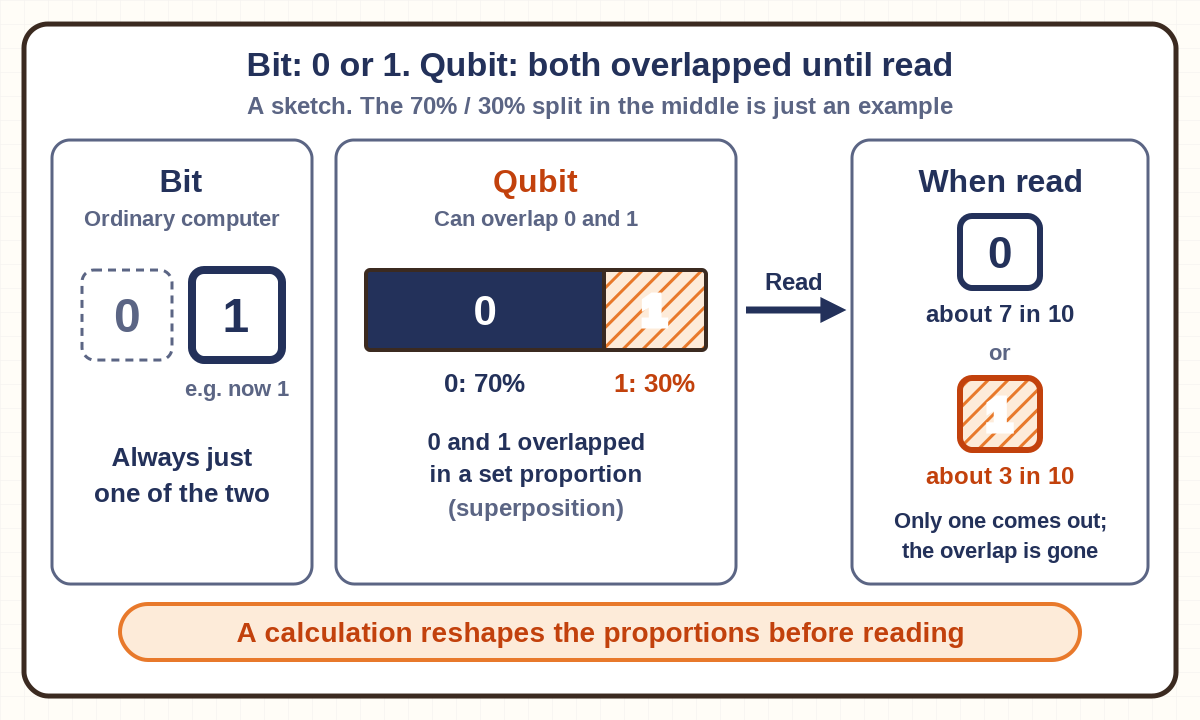
A bit in an ordinary computer is either 0 or 1, but a qubit can also hold 0 and 1 overlapped in a set proportion. When it is read out, though, it turns into just 0 or just 1, by chance, with odds set by the proportion. Every candidate answer can be overlapped, but only one can be read out, so that is not where the speed comes from. It speeds up only on problems where the steps can be arranged so that wrong answers cancel out and the right answer adds up.
It is expected to shine at factoring big numbers (which matters for today’s encryption) and at simulating molecules and materials. It won’t make email or videos faster. Its parts still make many errors, and as of November 2026, no machine can yet run big calculations while fixing its errors, and none is big enough to break today’s encryption.
A common mix-up
“It’s fast because it tries every possible answer at once”
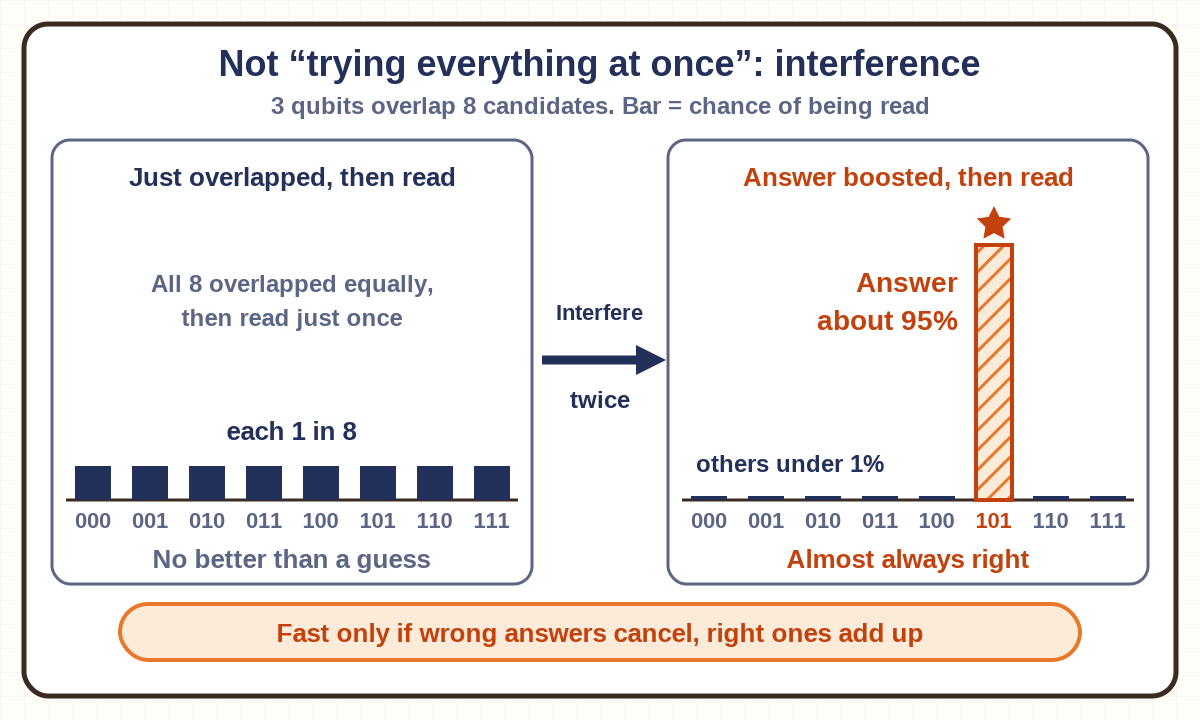
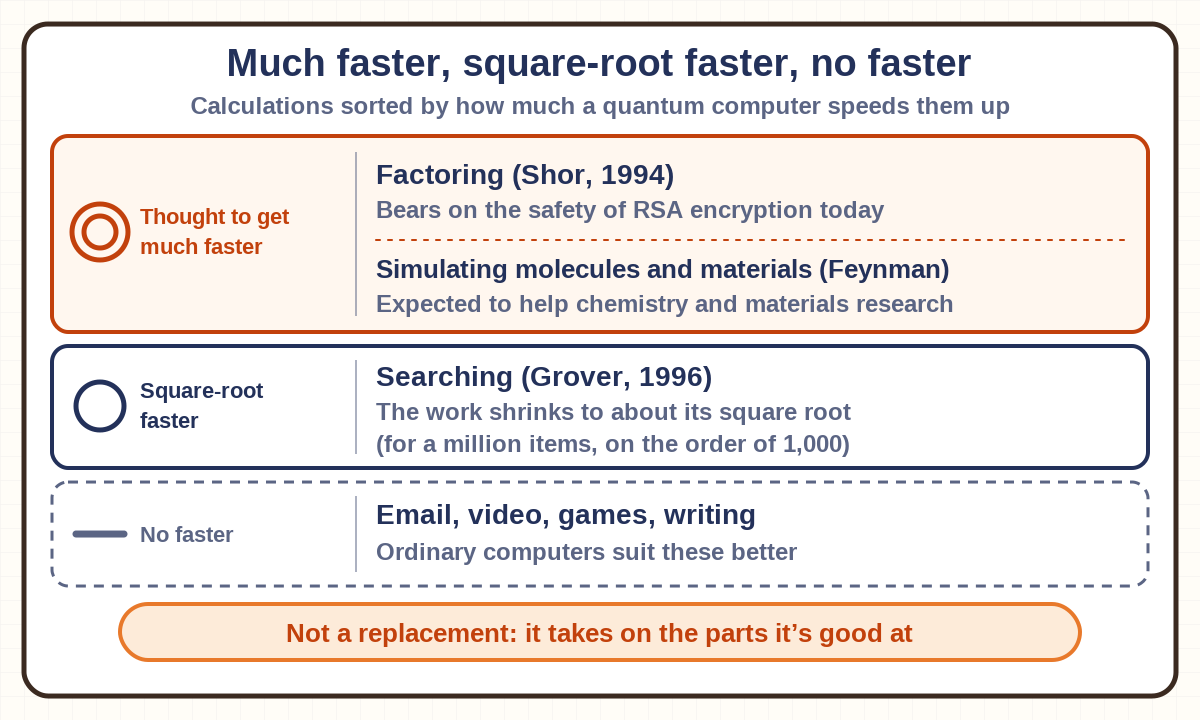
Only half right. With n qubits, you can make a state that overlaps every combination of 0s and 1s (2 to the power n of them). Each combination can carry its own proportion (and plus or minus sign), so writing such a general state down on an ordinary computer takes 2 to the power n numbers, and as qubits are added, it quickly becomes impossible to write down. That much is true. But when you read it out, you get just one of the combinations, picked by chance with odds set by the proportions. Read it while every combination is still overlapped in the same proportion, and it is no better than a blind guess. A quantum computer speeds up only when the steps of the calculation (the algorithm) can be arranged so that, along the way, wrong answers cancel each other out and the right answer adds up. Only some problems can be arranged that way: some, like factoring, are thought to speed up enormously; others, like searching, speed up only by about a square root; and for others, no way to speed them up is known.
Explained in pictures
Free to use in lessons, slides and posts with credit (CC BY 4.0).
Free to use in lessons, slides and posts with credit (CC BY 4.0).
Free to use in lessons, slides and posts with credit (CC BY 4.0).
Free to use in lessons, slides and posts with credit (CC BY 4.0).
You’re free to use these figures in lessons, slides and posts if you credit Naru News (naru.news). CC BY 4.0.
Think of it like this
A lottery box you can draw only one ticket from
Picture a lottery box with one ticket for each possible answer. Reading out an answer on a quantum computer is like drawing just one ticket from this box. Qubits that simply overlap every candidate in the same proportion are a box with the same number of tickets for each. Draw from it, and your chance of winning is no better than a blind guess.
A quantum calculation is the work of rearranging the box before you draw. Rearrange it with a clever method, and the losing tickets thin out while the winning tickets pile up. So drawing just one ticket gives the winner with a high chance.
But the analogy breaks down in places. Real lottery tickets don’t multiply or vanish by themselves. In a qubit, what plays the part of “how many tickets” is a quantity behind how likely each answer is to come out (the probability amplitude). Like a wave, it can be plus or minus, and when a plus meets a minus, they cancel out. The losing tickets thin out because of this canceling, something paper tickets can’t do. Also, not every lottery can be rigged to favor the winners. Big speed-ups come only for problems where a way to rearrange the box has been found (such as factoring).
Key points
How is it different from an ordinary computer?
“Quantum” refers to the world of very small things, such as atoms, electrons and particles of light, where rules different from those of everyday objects apply. An ordinary computer calculates with huge numbers of “bits,” each standing for either 0 or 1. The parts of a quantum computer, “qubits,” can also be in a state where 0 and 1 are overlapped in a set proportion (a superposition). Besides the proportion, the overlap also has something like a plus or minus to it, and calculations use that too.
But when a qubit is read out, it becomes just 0 or just 1, and the overlap is gone. Which one comes out is decided by chance, with odds set by the proportion (read it many times, and the results match the proportion).
With many qubits, you can also make a state that overlaps every combination of 0s and 1s. With n qubits, there are 2 multiplied by itself n times (2 to the power n) combinations. Each combination can carry its own proportion (and plus or minus sign), so writing such a general state down on an ordinary computer takes 2 to the power n numbers. Each extra qubit doubles the count: for 50 qubits it is about 1.1 quadrillion, and for 300, about 10 to the power 90. The state of 300 qubits could not be written down even with every atom in the visible universe. Even so, reading it out gives just n 0s and 1s.
Several qubits can also be put into a state where they are tied to one another, called entanglement. For example, two qubits can be tied so that reading them gives either 00 or 11, never 01 or 10 (the two values always match). A quantum calculation uses superposition and entanglement, and at the end, brings out the answer through interference (next item).
Why does it speed up only some problems?
In a quantum calculation, each overlapped combination carries a quantity behind how likely it is to come out when read (its probability amplitude). Like a wave, this quantity can be plus or minus, and along the way the quantities add up or cancel out. This is called interference. It is like two waves on water: where crest meets crest, the water rises higher, and where crest meets trough, they cancel out. How likely an answer is depends on this quantity multiplied by itself (squared), so even a minus never makes the chance negative. A well-designed set of steps (an algorithm) makes wrong answers cancel each other out and makes the right answer add up. Read it out after that, and the right answer comes out most of the time.
But only some problems can be arranged that way. The method for factoring that Shor showed in 1994 would, given a large enough quantum computer, solve it much faster than any known method on an ordinary computer. On the other hand, for a problem of simply finding one winner among many candidates, even the method Grover showed in 1996 only cuts the work to about the square root of the number of candidates. To find one person in a phone book of a million names, an ordinary computer has to look at 500,000 names just to have an even chance of finding them, while the work for Grover’s method is on the order of 1,000 (the square root of a million).
A square-root speed-up makes a big difference for a million items. But for problems where each extra qubit doubles the candidates (say, 2 to the power 100 of them), the square root is still 2 to the power 50 (about 1.1 quadrillion) steps, still astronomically many. A quantum computer is not a machine that solves any hard problem in an instant; for most problems, even where it beats ordinary computers, the margin is thought to be modest.
What is it good at, and what not?
One thing it is thought to be good at is simulating worlds that run on quantum rules. How electrons move inside molecules, and what materials are like, are decided by quantum rules. In a 1981 talk, the physicist Feynman said that since such worlds are hard to imitate on ordinary computers, we should build computers that use quantum effects. Simulating quantum worlds is still thought to be one of the uses most likely to be widely helpful, with applications expected in chemistry and materials research.
Another is factoring. RSA, a widely used kind of encryption, relies for its safety on how hard it is to find two big primes again from the answer of multiplying them. In 1994, Shor showed that a large enough quantum computer could do this quickly. So in August 2024, the US standards agency NIST adopted new encryption standards built to stand up to quantum computer attacks, and urged that the switch to them begin as soon as possible.
On the other hand, most everyday calculations, such as sending email, watching videos, playing games and writing documents, suit ordinary computers better, and are expected to keep doing so. A quantum computer is not a replacement for an ordinary computer; the idea is to combine the two and let it take on just the parts it is good at.
How is it built?
There are several ways to build qubits: with circuits made of superconducting metal (metal whose electrical resistance drops to zero when it is cooled enough), with trapped atoms that carry an electric charge (ions), with many atoms that carry no charge lined up in rows (neutral atoms), with particles of light (photons), and more.
The superconducting approach is used by Google and by RIKEN (a Japanese research institute) and Fujitsu, among others, and the chips are cooled in a special refrigerator (a dilution refrigerator) to just above absolute zero (about minus 273 degrees Celsius), colder than outer space. This cuts down disturbances from heat and keeps the quantum effects alive. The machine (Helios) of Quantinuum, a quantum computer company, used in the October 2026 experiment that cut errors sharply, uses ions.
Each approach differs in how fast its operations are, how few errors it makes and how easily qubits can be added. Since how error-prone each qubit is also differs by approach, the number of qubits alone doesn’t decide which machine is better.
Why can’t it run big calculations yet?
A qubit’s superposition is very delicate: heat or tiny disturbances around it quickly break it down. When that happens, the calculation’s answer goes wrong. Even on the machine used in an experiment announced in October 2026 (Quantinuum’s Helios), an operation using two qubits goes wrong about once in every 1,200 tries, on average. How few errors a useful calculation needs after error correction depends on the calculation, but the example the company gives is one in a trillion.
So researchers are working on “quantum error correction”: many qubits hold one piece of information together, and checker qubits (qubits that check whether a mistake has happened) find and fix mistakes (Shor showed the first method in 1995). Here we call the set of qubits that guards one piece of information a group. A group made to work together as one qubit is called a logical qubit. If the parts are accurate enough, making the group bigger cuts the overall errors.
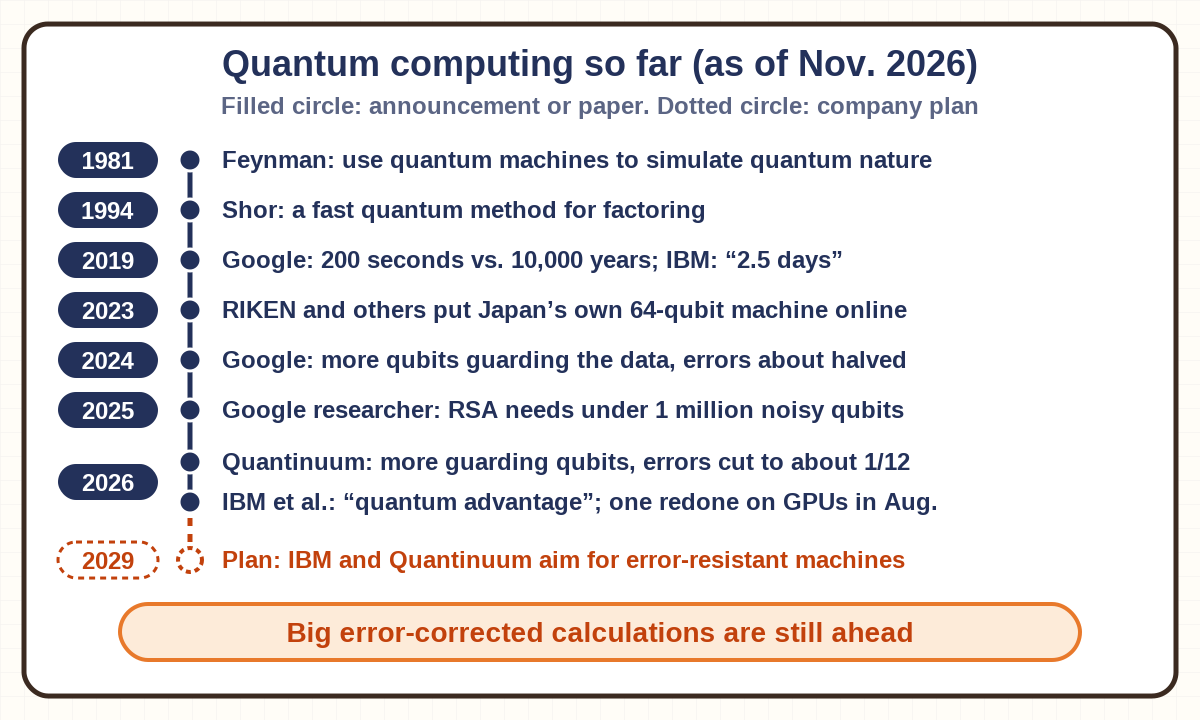
In 2024, Google showed that each time it made the group a size bigger, the remaining errors fell by about half. In October 2026, Quantinuum announced that each size up cut them to about one twelfth, on average (the hardware and the arrangement are different, so the two can’t be compared directly). But useful calculations need many such groups side by side, which takes a great many qubits.
How far has it come, and when will it be usable?
In 2019, Google announced that, using 53 qubits, it had finished in 200 seconds a calculation that would take the world’s fastest supercomputer 10,000 years, and called it “quantum supremacy”: a term for a quantum computer doing a calculation that would take today’s ordinary computers far longer. IBM disputed it, and in 2022 other researchers solved it in about 15 hours using 512 GPUs (chips that are good at graphics calculations). That calculation was a speed contest, not something useful in itself.
In July 2026, IBM and its partners announced that they had done calculations beyond the reach of the most advanced methods on ordinary computers (“quantum advantage,” a term used in much the same sense as quantum supremacy). But this is the companies’ claim. One of its pillars, a 70-qubit calculation done with the University of Chicago, was recomputed in August by other researchers in about 37 minutes on 256 GPUs, using a shortcut that the circuit’s shape allowed. In September, IBM revised the experiment into a form where that shortcut doesn’t work. The other claims are still being checked too.
In Japan, RIKEN and others put Japan’s own superconducting quantum computer (64 qubits) online at the end of March 2023, and in April 2025 RIKEN and Fujitsu announced a 256-qubit machine. At the same time, they announced plans to launch a 1,000-qubit machine in 2026.
As for encryption, breaking a 2048-bit key for RSA, a widely used kind of encryption, would take fewer than a million error-prone qubits and less than a week, according to a 2025 estimate by a Google researcher. (A key is a number used to lock and unlock encrypted data; “bits” here counts its binary digits and has nothing to do with qubits. In decimal, it has 617 digits.) The estimate assumes each part gets 0.1% of its operations wrong (one in 1,000), and that those errors are fixed by groups of many qubits so that the calculation as a whole makes very few errors, which is why so many qubits are needed. It is an estimate for a machine not yet built.
Nobody knows yet when it will be usable for big calculations. A report released in October 2026 by the US government watchdog GAO says that no quantum computer able to break encryption exists today and that experts say the chance of one within 10 years is low, but also that estimates vary widely. According to the companies’ plans, IBM aims to build by 2029 a machine that can run 100 million operations on 200 logical qubits, and Quantinuum aims to build an error-resistant machine, Apollo, in 2029.
Check yourself
Q1Which of these correctly explains how a quantum computer can quickly solve problems like factoring?
Answer and explanation
Answer: C Its qubits’ waves reinforce only the right answer
The quantities behind how likely each answer is to come out (probability amplitudes) add up or cancel out like waves, so with well-arranged steps the wrong answers fade and the right one remains (interference). Every candidate can be overlapped, but only one can be read out, so they can’t all be read at once. The speed doesn’t come from parts working faster; only problems that can be arranged this way speed up.
More on this → Key points: Why does it speed up only some problems?
Q2Which calculation are quantum computers said to be better at than ordinary computers?
Answer and explanation
Answer: B Tracking how electrons move inside a molecule
How electrons move inside a molecule is set by quantum rules, so a computer that uses quantum effects is thought to suit imitating it. Drawing game scenes is a job for ordinary computers with parts that are good at image calculations (GPUs). Shrinking a video is an everyday calculation too, and a quantum computer won’t make it faster.
More on this → Key points: What is it good at, and what not?
Q3In 1994, Shor showed a quantum computer method for factoring quickly. As of November 2026, why has it not been used to break an RSA (2048-bit) key?
Answer and explanation
Answer: A No large machine that fixes its own errors exists yet
Breaking a 2048-bit key takes a machine with a great many qubits that runs while fixing its errors, and no such machine exists yet. The number needed has been estimated: a 2025 estimate says fewer than a million error-prone qubits and less than a week. A report by the US government’s auditor (GAO) in October 2026 also says no quantum computer that can break encryption exists today, so it isn’t that a machine exists and simply hasn’t been tried.
More on this → Key points: How far has it come, and when will it be usable?
Related terms
- Qubit
- Superposition
- Quantum entanglement
- Interference
- Quantum error correction
- Cat qubit
- Logical qubit
- Shor’s algorithm
- Grover’s algorithm
- Prime number
- RSA encryption
- Superconductivity
- Post-quantum cryptography
Related explainer videos
- Adding more error-prone parts cut the errors. Has quantum computing's weakness finally been beaten?
- No Code-Breaking Quantum Computer Exists Yet. So Why the Rush Now?
Sources and how we checked
- IBM, “What is quantum computing?” (IBM Think: quantum mechanics as the study of physics at small scales, where the universe behaves differently from what we are used to in everyday life; superposition, entanglement [qubits correlating their state with other qubits], interference [information structured in a way that resembles waves, canceling out when peaks and troughs interact; many outcomes are canceled out, others amplified; “Interference is the engine of quantum computing”], decoherence, quantum advantage [a better, faster or cheaper solution than all known classical methods], “qubits don’t test multiple paths at once”, classical computers expected to remain the best solution for most tasks, the two working together, kinds of qubits [superconducting circuits, photons, trapped ions and others; superconducting qubits favored for speed, trapped ions for long coherence but slower], and cooling to just above absolute zero; read November 21, 2026)
- John Preskill, “Quantum computing 40 years later” (Caltech; arXiv 2106.10522, 2021, revised 2023: Section 1.1 on Feynman’s May 1981 conference talk titled “Simulating physics with computers”; Sections 2.1 and 2.4 on simulating quantum systems as the application most likely to have broad impact, applications to chemistry and materials science, and overcoming noise with error correction; Section 2.2 on Google’s 2019 “quantum computational supremacy,” a task done by a quantum computer that would need a much longer runtime on any existing classical computer; Section 3.2 on qubits realized as atoms, electrons, photons, electrical circuits and more, and on measurement probabilities given by the squares of the state’s coefficients [probability amplitudes]; Section 3.3 on the 2-to-the-n-dimensional state of n qubits, about 10^90 for 300 qubits, which could not be written down even with every atom in the visible universe, product states described by 2n parameters while “a typical entangled state of n qubits is described by a number of classical parameters that is exponential in n, not linear in n as for product states,” and a measurement yielding only n bits; Section 4.1, eq. (13), on a CNOT gate making the entangled two-qubit state (|00⟩+|11⟩)/√2. The figures of about 1.1 quadrillion for 50 qubits [2^50 = 1,125,899,906,842,624] and about 10^90 for 300 [2^300 ≈ 2.04 × 10^90], and that reading the state of eq. (13) gives only 00 or 11 [the coefficients of 01 and 10 are zero], were worked out for this page; read November 21, 2026)
- Scott Aaronson, “The Limits of Quantum Computers” (Scientific American 298, no. 3, March 2008: quantum computers would be exceptionally fast at a few specific tasks but would outclass today’s computers only modestly for most problems, a measurement picks out just one of the possibilities at random, amplitudes can be positive or negative and cancel out when positive ones combine with negative ones, paths leading to a wrong answer cancel out, and a square root does not turn an exponential time into a polynomial time but just produces a smaller exponential. That the square root of 2^100 is 2^50 = 1,125,899,906,842,624 [about 1.1 quadrillion] was computed for this page; read November 21, 2026)
- The header of Scott Aaronson’s blog “Shtetl-Optimized” (“quantum computers won’t solve hard problems instantly by just trying all solutions in parallel”; read November 21, 2026)
- Peter W. Shor, “Polynomial-Time Algorithms for Prime Factorization and Discrete Logarithms on a Quantum Computer” (arXiv quant-ph/9508027; an expanded version of a paper at the FOCS conference in November 1994; abstract: factoring and discrete logarithms are thought to be hard on a classical computer and have been used as the basis of cryptosystems, and efficient algorithms are given for them on a quantum computer; read November 21, 2026)
- Lov K. Grover, “A fast quantum mechanical algorithm for database search” (Bell Labs; arXiv quant-ph/9605043, 1996; abstract: in a phone directory of N names in random order, any classical algorithm needs to look at N/2 names to find one with a 50% probability; by adjusting the phases of operations, successful computations reinforce each other and the number is found in O(√N) steps. That with 3 qubits [8 candidates], two rounds of this method raise the right answer to about 95% [sin²(5·arcsin(1/√8)) ≈ 0.945] and leave each of the others at about 0.8%, and that the square root of a million is 1,000, were computed for this page; read November 21, 2026)
- John Martinis and Sergio Boixo, “Quantum Supremacy Using a Programmable Superconducting Processor” (Google AI blog, October 23, 2019: the 54-qubit Sycamore processor, circuits run on 53 qubits, and the claim that a 200-second computation would take the world’s fastest supercomputer 10,000 years; read November 21, 2026)
- Edwin Pednault et al., “On ‘Quantum Supremacy’” (IBM blog, October 22, 2019: the argument that an ideal simulation of the same task can be performed on a classical system in 2.5 days; read November 21, 2026)
- Feng Pan, Keyang Chen and Pan Zhang, “Solving the sampling problem of the Sycamore quantum circuits” (Physical Review Letters 129, 090502, 2022; arXiv abstract: the 53-qubit, 20-cycle Sycamore circuits solved in about 15 hours on a cluster with 512 GPUs; read November 21, 2026)
- Hartmut Neven, “Meet Willow, our state-of-the-art quantum chip” (Google blog, December 9, 2024: the 105-qubit Willow chip, the error rate cut in half going from 3x3 to 5x5 to 7x7, quantum error correction introduced by Peter Shor in 1995, and the random circuit sampling benchmark having yet to demonstrate practical commercial applications; read November 21, 2026)
- Google Quantum AI and collaborators, “Quantum error correction below the surface code threshold” (Nature 638, pp. 920–926, 2025; arXiv abstract: quantum error correction combines multiple physical qubits into a logical qubit, the suppression only occurs below a critical threshold, a 101-qubit distance-7 code, and Λ = 2.14; read November 21, 2026)
- Google, “Go inside the Google Quantum AI lab to learn about how quantum computing works” (Google blog, December 9, 2024: superconducting qubits must be kept colder than outer space, and in a dilution fridge the superconducting metals reach their zero-resistance state and thermal noise is reduced; read November 21, 2026)
- Ali Lavasani et al., “Quantum error correction well below the color code threshold” (Quantinuum; arXiv 2610.24077, October 16, 2026: abstract [the Helios trapped-ion processor, color codes of distance 3, 5 and 7, Λ = 12] and text [logical error rates of 5.5 × 10⁻⁴, 3.8 × 10⁻⁵ and 5 × 10⁻⁶ per syndrome extraction cycle, and an average two-qubit gate infidelity of 8.4 × 10⁻⁴]. That 8.4 × 10⁻⁴ is about once in 1,200 [1 ÷ 0.00084 ≈ 1,190] was computed for this page; read November 21, 2026)
- Quantinuum, “Quantinuum closes in on one million error-free operations” (company blog, October 19, 2026: an average factor of 12 each time the code distance increased, 5 × 10⁻⁶ per syndrome-extraction cycle, a “utility scale” logical error rate of, say, 10⁻¹², and the company advancing toward Apollo in 2029; read November 21, 2026)
- Dolev Bluvstein et al., “Logical quantum processor based on reconfigurable atom arrays” (Harvard University and others; Nature, 2024; arXiv abstract: a processor using up to 280 physical qubits in reconfigurable neutral atom arrays, as an example of the neutral-atom approach; read November 21, 2026)
- RIKEN, “Japan’s first homemade quantum computer goes online” (September 22, 2023: the superconducting quantum computer with 64-qubit integrated circuits, online since the end of March, built with Fujitsu, AIST, Osaka University, NTT, NICT and others; read November 21, 2026)
- RIKEN, “RIKEN and Fujitsu unveil world-leading 256-qubit quantum computer” (April 23, 2025: the 256-qubit superconducting quantum computer, cooling inside the dilution refrigerator, and a 1,000-qubit computer scheduled to be launched in 2026; read November 21, 2026)
- IBM press release, “IBM Sets the Course to Build World’s First Large-Scale, Fault-Tolerant Quantum Computer at New IBM Quantum Data Center” (June 10, 2025: the company’s plan to deliver Starling by 2029, running 100 million quantum operations using 200 logical qubits; read November 21, 2026)
- IBM press release, “IBM and The University of Chicago Demonstrate Quantum Advantage, Establishing Trusted Quantum Computation on Logical Circuits” (July 30, 2026: the claim of computations beyond the reach of leading classical simulation methods, about 15 minutes, 70 logical qubits; read November 21, 2026)
- Simon Martiel et al., “Sampling hard circuits with verifiably high fidelity” (IBM, University of Chicago and others; arXiv 2607.25941. Abstract of v1 [July 28, 2026]: a 70-qubit, depth-70 circuit encoded in 97 physical qubits. Abstract of v3 [September 2, 2026; v2 September 1]: a 64-qubit, depth-73 circuit. “Note added” in v3: subsequent work [ref. 28, arXiv 2608.13110] exploited the open-boundary one-dimensional geometry of the earlier experiment to perform tensor-network simulation using approximately 159 H100-GPU-hours and independently verified the estimated fidelity, and this version uses periodic boundary conditions, eliminating that low-width contraction path; read November 21, 2026)
- Hidetaka Manabe, Hanfeng Gu and Feng Pan, “Classical Simulation and Design Frontiers for IBM’s Doped Clifford Sampling Experiment” (arXiv 2608.13110, August 13, 2026, revised October 29; abstract: “We classically simulate the IBM doped Clifford random circuit sampling experiment, comprising 70 qubits” [arXiv 2607.25941] with a tensor-network contraction method for open-boundary one-dimensional circuits, completing all 2,051 amplitude batches matching IBM’s published output bitstrings in 37.3 minutes on 32 nodes with eight NVIDIA H100 GPUs each [256 GPUs]; read November 21, 2026)
- IBM press release, “IBM and Algorithmiq Demonstrate Quantum Advantage…” (July 30, 2026: the simulation of a heterogeneous quantum material, classical methods producing conflicting predictions, the statement that demonstrating quantum advantage is an ongoing process, not a single moment, and continued benchmarking by the community on the Quantum Advantage Tracker; read November 21, 2026)
- Craig Gidney, “How to factor 2048 bit RSA integers with less than a million noisy qubits” (Google Quantum AI; arXiv 2505.15917, May 2025; abstract: the estimate that a 2048-bit RSA integer could be factored in less than a week with less than a million noisy qubits, and its assumptions [a uniform 0.1% gate error, logical qubits protected by error-correcting surface codes, 1 μs surface code cycle, 10 μs reaction time]. That a 2048-bit number has 617 decimal digits was computed for this page; read November 21, 2026)
- US Government Accountability Office (GAO), “GAO-27-108740” (October 6, 2026: a cryptographically relevant quantum computer does not currently exist, experts say the probability of one being built in the next 10 years is low, development estimates vary widely, and harvesting data now to decrypt later; read November 21, 2026)
- NIST, “NIST Releases First 3 Finalized Post-Quantum Encryption Standards” (August 13, 2024: encryption standards designed to withstand attacks from a quantum computer, and encouraging administrators to begin transitioning as soon as possible; read November 21, 2026)
AI wrote this page from the sources above, and a different AI checked it against the text of those sources (November 21, 2026). A person with a master’s degree in science and a Japanese high-school science teaching license also read and checked it before publishing. Numbers are as of that date. If anything was hard to follow, you spot a mistake, or there’s a term you’d like explained, please write to [email protected].
Glossary
- AI agent
- AI alignment
- Alignment faking
- Artificial general intelligence (AGI)
- Artificial intelligence (AI)
- Backdoor
- Benchmark
- Chain of thought (CoT)
- Context window
- Data poisoning
- Deep learning
- Deepfake
- Diffusion model
- Embedding
- Emergent misalignment
- Evaluation awareness
- Fine-tuning
- Formal verification
- Generalization
- Generative adversarial network (GAN)
- Generative AI
- Goodhart’s law
- Gradual disempowerment
- Hallucination
- Hyperparameter
- Intelligence explosion
- Interpretability
- Jailbreaking
- Large language model (LLM)
- Latent space
- Machine learning
- Mixture of experts (MoE)
- Neural network
- Neuralese
- Overfitting
- Parameter
- Persona vectors
- Pre-training
- Prompt
- Prompt injection
- Reasoning model
- Recursive language model (RLM)
- Recursive self-improvement (RSI)
- Red teaming
- Reinforcement learning (RL)
- Retrieval-augmented generation (RAG)
- Reward hacking
- Reward model
- Shutdown resistance
- Sleeper agent
- Subliminal learning
- Superintelligence (ASI)
- System prompt
- Technological singularity
- Time horizon
- Token
- Transfer learning
- Transformer
- Accretion disk
- Black hole
- Black hole star
- Cosmic birefringence
- Event horizon
- Event Horizon Telescope (EHT)
- General relativity
- GPS
- Gravitational lensing
- Gravitational singularity
- Gravitational wave
- James Webb Space Telescope (JWST)
- Lagrange point
- Long-period radio transient (LPT)
- Neutron star
- Pulsar
- Quasar
- Sagittarius A*
- Space data center
- Spacetime
- Special relativity
- Speed of light
- Supermassive black hole
- White dwarf
- Cat qubit
- Instanton
- Logical qubit
- You are hereQuantum computer
- Quantum entanglement
- Qubit