
What is a gravitational singularity (where our theory of gravity stops giving answers, as at a black hole’s center)?
Also called: Spacetime singularity, Space-time singularity

In one minute
A gravitational singularity is a place, such as the center of a black hole or the beginning of the universe, where calculations with general relativity, our theory of gravity, give infinite density and infinitely curved spacetime, so the theory can no longer give an answer.
No one has confirmed that anything truly infinite exists there. Many researchers see it as a sign that the theory stops working at that point. A theory joining gravity with the rules of the world smaller than atoms (quantum theory) is thought to be needed, but it isn’t finished yet.
A black hole’s singularity lies inside the boundary that not even light can get back out of (the event horizon), so it can’t be seen from outside. In 1965, Penrose showed mathematically that once a collapsing heavy star shrinks past a certain point, a singularity, where paths of light break off, can’t be avoided, and for this work received the 2020 Nobel Prize in Physics. It is a different thing from the AI “singularity” (the technological singularity).
A common mix-up
“A singularity is a tiny, heavy ball at the center of a black hole.”
Only partly right. Calculations with general relativity give a point at the center of a black hole where matter is crushed, and everything that falls inside the event horizon heads there. That much is right. But it isn’t a “ball” with a size. In the calculations its size goes to zero, so even though the mass is limited (say, 10 times the Sun’s), the density becomes infinite. The path of anything falling in also breaks off there, and can’t be calculated any further. Rather than an object, it is more like an edge of spacetime (the way a road drawn on paper stops at the paper’s edge). Whether the density inside really becomes infinite has not been checked by observation either.
Explained in pictures
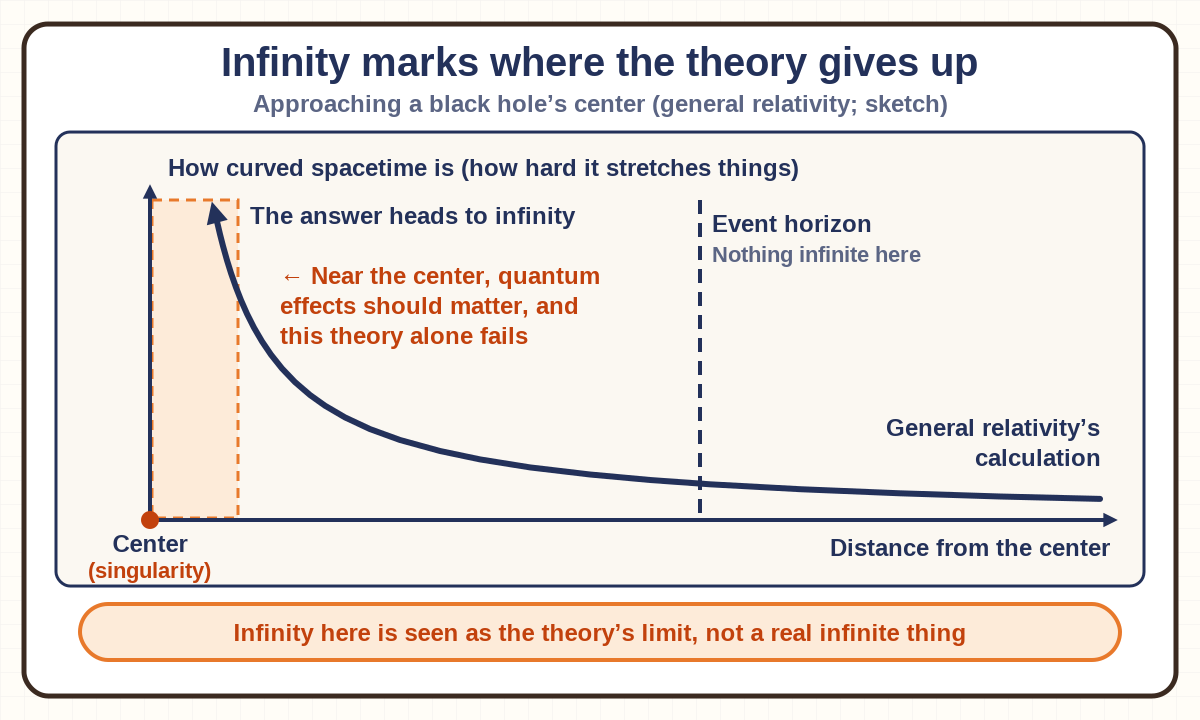
Free to use in lessons, slides and posts with credit (CC BY 4.0).
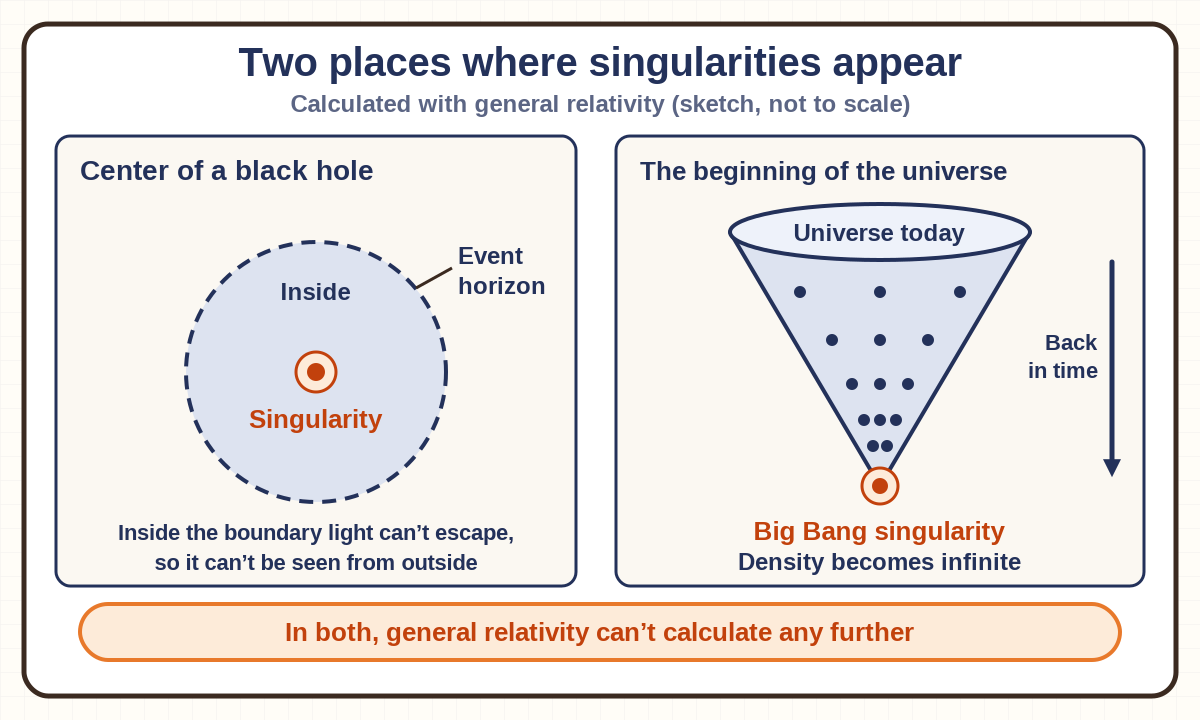
Free to use in lessons, slides and posts with credit (CC BY 4.0).
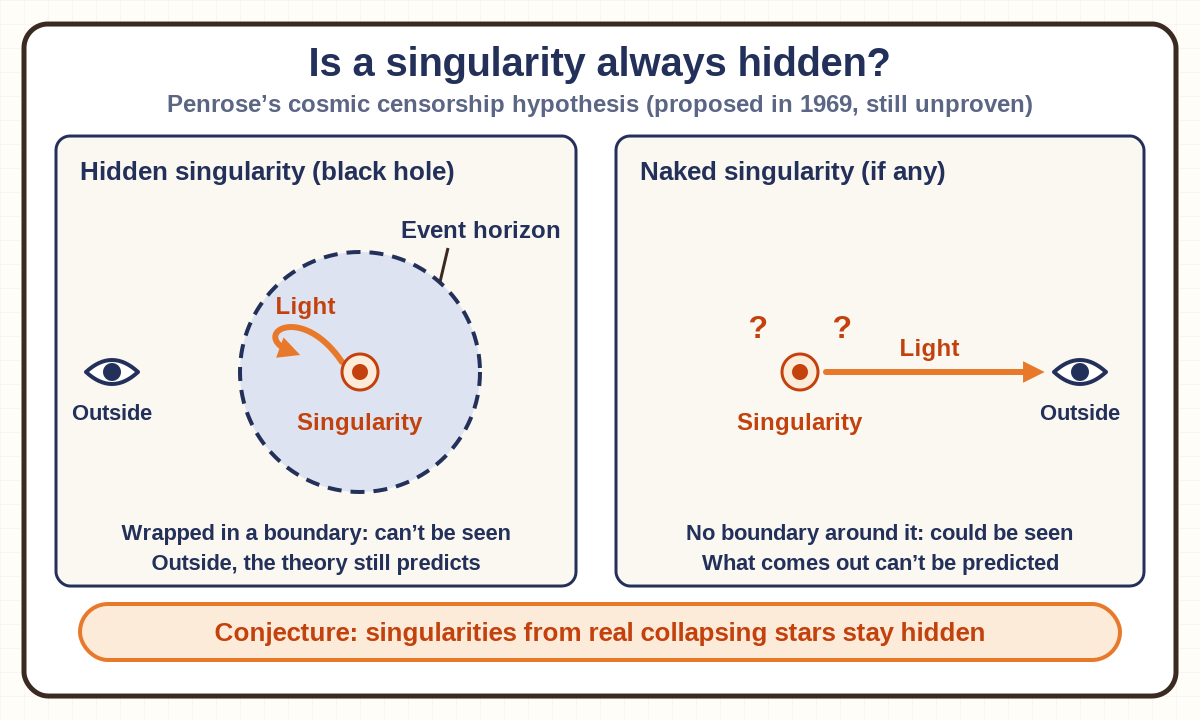
Free to use in lessons, slides and posts with credit (CC BY 4.0).
You’re free to use these figures in lessons, slides and posts if you credit Naru News (naru.news). CC BY 4.0.
Think of it like this
A calculator’s “error”
On a calculator, 1 divided by 0.1 is 10, divided by 0.01 is 100, and divided by 0.001 is 1,000. The closer the number you divide by gets to 0, the bigger the answer grows, without limit, and if you try to divide by 0, the calculator shows “E” or “Error” and gives no answer. An infinitely large number hasn’t appeared inside the calculator. It is a sign that this calculation can’t give an answer.
A singularity is similar. The closer you get to the center of a black hole, the bigger the answers from general relativity (density and how curved spacetime is) grow, without limit, and at the center no answer can be given. Many researchers see this infinity not as a sign that something infinite is there but as an “error” sign showing that the theory has stopped working.
But the comparison has limits. A calculator’s error just means the rules of division have no answer, while a singularity happens at real places in the universe (inside black holes and at the beginning of the universe). To learn what nature is really doing there, a new theory joining quantum theory and gravity is thought to be needed. Also, with a calculator you can just type again, but in general relativity it has been proven that recalculating with a differently shaped star doesn’t help: once the star shrinks past a certain point, a place where paths of light break off (a singularity) can’t be avoided.
Key points
Why does it become infinite?
Density is mass divided by size (volume). If you keep the mass the same and make the size smaller and smaller, the density grows higher and higher, and when the size reaches zero, it grows without limit, just like dividing by zero.
In calculations with general relativity, anything that goes inside the event horizon of a black hole formed from a collapsed heavy star keeps falling toward the center, and the center is where it ends up. Matter is crushed down to a point with no size, and there both the density and the curving of spacetime become infinite. The curving of spacetime shows up as a difference in how hard the side nearer the center and the side farther from it are pulled. For someone falling feet first, the feet are pulled harder than the head, so the body gets stretched lengthwise. This stretching force (the tidal force) also grows without limit at the center.
On top of that, the path of anything falling in breaks off there, and can’t be continued by calculation. Just as a road drawn on paper suddenly stops at the paper’s edge, there is no more spacetime beyond it. Researchers use this, a path that breaks off partway, as the way to tell that there is a singularity. A singularity is less an object sitting in space than an edge of spacetime itself.
Does the “infinity” really exist?
No one knows. Whether the singularity at the center of a black hole is something real or something that only shows up in the calculations is still not known. No light comes out from inside, so there is no way to check it by observation either.
Many researchers think the appearance of singularities is a sign that general relativity stops working there, showing that the theory is not complete. General relativity leaves out the effects of the rules of the world of atoms and smaller things (quantum mechanics). Near a singularity, where a huge mass is packed into a tiny space, quantum effects are thought to become important.
So a theory joining gravity and quantum ideas (quantum gravity) is said to be needed, and several candidates are being studied. But no finished theory exists yet. Whether a new theory would make singularities disappear, or whether they would remain even with quantum effects included, is not settled either.
Why can’t it be seen from outside?
A black hole’s singularity is thought to be inside the event horizon (the boundary inside which not even light can get back out), right at the center. Whatever happens inside, no light or signal of any kind reaches the outside.
So it isn’t hidden because it is too small, or because its light is taking a long time to arrive. No matter how big the telescope or how long you wait, the singularity can’t be seen directly.
What did Penrose show? (2020 Nobel Prize in Physics)
Singularities had already appeared both in the black hole spacetime that Schwarzschild worked out by solving the equations of general relativity in 1916 and in the collapsing star that Oppenheimer and Snyder calculated in 1939. But all of these assumed a neatly even shape, such as a star that is a perfect sphere. Real stars are not perfect spheres, so a question remained: if the shape is even a little uneven, might no singularity form?
In a paper published in January 1965, Penrose showed that a singularity can’t be avoided even without assuming any shape. Normally, light sent outward from a surface spreads out. But where gravity is extremely strong, a surface can form where even the light sent outward can’t spread and closes in instead (a trapped surface). Penrose proved that once a collapsing star forms such a surface, then under a few natural assumptions, whatever the star’s shape, somewhere a path of light must break off: a singularity forms.
For this work, Penrose received half of the 2020 Nobel Prize in Physics, “for the discovery that black hole formation is a robust prediction of the general theory of relativity.” But the theorem only shows that a place where paths break off forms. It doesn’t show whether the density there really becomes infinite, or whether the singularity is always hidden inside an event horizon, out of sight from outside.
On whether it stays hidden, Penrose guessed in 1969 that when real stars collapse, the singularity is always hidden inside the event horizon (the cosmic censorship hypothesis). A singularity not wrapped in a boundary, a “naked singularity,” is allowed by the equations of general relativity, and if one existed, the theory could not predict what comes out of it. This conjecture has not been proven.
Is there one at the beginning of the universe too?
According to calculations with general relativity, yes. The universe is still expanding. If you calculate its history back into the past with general relativity, the matter in the universe gets packed more and more tightly, and at the beginning (the Big Bang) all of it is on top of itself and the density becomes infinite. This is the Big Bang singularity.
A few months after Penrose’s 1965 paper, Hawking realized that the same reasoning works when you trace an expanding universe back into the past, meaning there was a singularity in the past. In 1970, Hawking and Penrose published a theorem covering both collapsing stars and the universe as a whole.
But this assumes that general relativity works unchanged all the way back to the beginning of the universe. Very close to the beginning, quantum effects are thought to matter, so whether there really was a singularity is still not known.
Is it different from the AI “singularity” or a singularity in math?
Yes, they are different things. “Singularity” is also a math word, meaning a point where the value of an equation grows without limit or can’t be decided. The singularity on this page is one that appears in calculations with the theory of gravity, also called a gravitational singularity or a spacetime singularity.
The “singularity” in talk about AI (the technological singularity) is a turning point in time, when AI smarter than people, or something like it, is thought to make the future of technological change impossible to foresee. Vernor Vinge, the mathematician and science fiction writer who spread the term, wrote in 1993 that it is “a point where our models must be discarded and a new reality rules.” It borrows the sense of “you can’t see past it” from the singularity, and it is not a place somewhere in the universe. It is explained on its own page, linked as “Technological singularity” under related terms.
Check yourself
Q1In calculations with general relativity, density and the curving of spacetime become infinite at the center of a black hole (a singularity). What do many researchers take this “infinity” to be a sign of?
Answer and explanation
Answer: C The theory can no longer give an answer there
Many researchers see the infinity of a singularity as a sign that general relativity stops working there. The mass doesn’t grow without limit: a black hole’s mass is limited (say, 10 times the Sun’s), and in the calculations the size goes to zero, so the density becomes infinite. Nor is there a tiny, heavy ball with a size. The paths of falling things break off there, and what comes next can’t be calculated. Calculating it correctly is thought to need a theory of gravity that includes quantum effects (quantum gravity), which isn’t finished yet.
More on this → Key points: Does the “infinity” really exist?
Q2The singularity calculated to be at the center of a black hole is thought to be impossible to see directly with telescopes on Earth. Why?
Answer and explanation
Answer: A It lies inside a boundary light can’t escape
The singularity is thought to lie inside the event horizon (the boundary inside which not even light can get back out), right at its center. Whatever happens inside, no light or signal of any kind reaches the outside. It isn’t because the singularity is too small, or because its light is taking a long time to arrive, so no matter how big the telescope or how long you wait, it can’t be seen directly.
More on this → Key points: Why can’t it be seen from outside?
Q3In 1965 the physicist Penrose proved a theorem about the singularity of a black hole (the singularity theorem). Why is it considered an important result?
Answer and explanation
Answer: A It showed one forms even in stars that aren’t round
Earlier calculations that produced singularities assumed a neatly even shape, such as a star that is a perfect sphere. Penrose showed that even without assuming such a shape, once a star shrinks past a certain point, a place where paths of light break off (a singularity) can’t be avoided. But the theorem doesn’t show what the singularity is like (its size, or whether the density there really becomes infinite), or whether the singularity is always hidden inside an event horizon, out of sight from outside. That it is always hidden is a conjecture Penrose made in 1969 (the cosmic censorship hypothesis), and it has not been proven. For this work, Penrose received the 2020 Nobel Prize in Physics.
More on this → Key points: What did Penrose show? (2020 Nobel Prize in Physics)
Related terms
- Black hole
- Event horizon
- General relativity
- Big Bang
- Quantum gravity
- Spacetime
- Singularity theorems
- Cosmic censorship hypothesis
- Naked singularity
- Technological singularity
Sources and how we checked
- NASA, "Black Hole Anatomy" (NASA Science, updated August 12, 2026; the Singularity section: general relativity predicts that the very center of a black hole contains a point where matter is crushed to infinite density, it is the final destination for anything falling into the event horizon, it may be either a physical structure or a purely mathematical one and astronomers don’t know which is true, and the prediction of a singularity may signal the limits of relativity, where quantum effects not included in the theory become important; the Event Horizon section: inside it, the speed needed to escape exceeds the speed of light; read November 19, 2026)
- Royal Swedish Academy of Sciences, "The Nobel Prize in Physics 2020" (press release, October 6, 2020; one half of the prize to Roger Penrose “for the discovery that black hole formation is a robust prediction of the general theory of relativity” and the other half jointly to Reinhard Genzel and Andrea Ghez “for the discovery of a supermassive compact object at the centre of our galaxy,” Penrose proving in January 1965 that black holes really can form, and black holes hiding at their heart a singularity in which all the known laws of nature cease; read November 19, 2026)
- Roger Penrose, "Gravitational Collapse and Space-Time Singularities" (Physical Review Letters 14, pp. 57–59; the APS article page: received December 18, 1964, published January 18, 1965. The paper itself could not be opened; its content was checked through the review by Senovilla and Garfinkle below; read November 19, 2026)
- José M. M. Senovilla and David Garfinkle, "The 1965 Penrose singularity theorem" (Classical and Quantum Gravity 32, 124008, 2015; main text of arXiv:1410.5226 read in the ar5iv HTML version: Section 2.2 [Schwarzschild’s solution is singular only at r = 0; dated 1916 in the reference list], Section 2.3 [the 1939 Oppenheimer–Snyder calculation assumes spherical symmetry, and the star ends up in a singularity where a(t)→0], Section 4 [earlier results needed a lot of symmetry, Penrose wanted to prove that deviations from spherical symmetry could not prevent singularities, and Theorem 2: a closed trapped surface plus the null convergence condition and other assumptions imply incomplete null geodesics], Section 4.2 [a closed trapped surface is one where both families of light rays leaving it orthogonally converge], Sections 4.1 and 5.1.5 [the theorem only shows that at least one incomplete geodesic exists, and does not say whether the curvature diverges], Section 5 [a few months later Hawking realized that past-trapped surfaces are present in any expanding universe close to spatially homogeneous and isotropic, giving a strong indication that a singularity in our past was inevitable if one assumes general relativity], Sections 6.1 and 6.2 [the Schwarzschild singularity lies inside the event horizon, and the curvature at radius r is proportional to α/r³]; read November 19, 2026)
- Claes Uggla, "Spacetime singularities" (Einstein Online, Max Planck Institute for Gravitational Physics; a singularity identified by a freely falling particle suddenly popping out of existence [geodesic incompleteness], curvature singularities including ones where the energy density becomes infinite and ones where tidal forces become infinite, singularities occurring in the interior of black holes and at the start of an expanding universe, and the singularity theorems of Penrose and Hawking hardly saying anything about the nature of the singularities. Also read the site’s glossary entries “singularity” [a region where spacetime simply comes to an end, and the occurrence of singularities as a strong indication that the theory is incomplete] and “quantum gravity” [a theory based on both quantum theory and general relativity; no complete one exists yet, and the best-known candidates are string theory and loop quantum gravity]; read November 19, 2026)
- Erik Curiel, Manus Visser and Juliusz Doboszewski, "Singularities and Black Holes" (Stanford Encyclopedia of Philosophy, first published 2009, substantive revision July 13, 2025; Section 1 [a spacetime is singular if it contains an incomplete path], Section 1.3 [curvature blows up as one approaches the singularity of a standard black hole], Section 2 [Penrose, Geroch and Hawking proved singularity theorems in the late 1960s, taken to indicate that the universe began with an initial singularity, the Big Bang], Section 2.2 [the view that general relativity, in predicting singularities, predicts its own demise], Section 4 [a naked singularity is one not hidden behind an event horizon, Penrose (1969, 1973) suggested that naked singularities are compatible with general relativity but will never form in physically realistic situations, naked singularities could disrupt prediction in regions they can affect, counterexamples to various ways of stating weak cosmic censorship have accumulated, and the validity of strong cosmic censorship remains open], Section 5.4.4 [against the hopes of most physicists that quantum effects will efface singularities, Wall’s result suggests geodesic incompleteness inside black holes even with quantum effects]; read November 19, 2026)
- Stephen Hawking, "The Beginning of Time" (lecture, 1996, on Hawking’s official website; at the Big Bang all the matter in the universe would have been on top of itself, the density would have been infinite, and this is called a singularity, all the laws of physics would have broken down at a singularity, theorems by Penrose and Hawking showed that general relativity predicted singularities, the first theorems were designed to show that time came to an end inside a black hole formed by the collapse of a star, and applied to the universe they show that time must have a beginning, and general relativity, being a classical theory, cannot be quite correct on very small distances, so a quantum theory of gravity combining it with the uncertainty principle is needed; read November 19, 2026)
- S. W. Hawking and R. Penrose, "The Singularities of Gravitational Collapse and Cosmology" (Proceedings of the Royal Society of London A 314, pp. 529–548, January 27, 1970; abstract read in the Crossref record: the new singularity theorem implies that spacetime singularities are to be expected if the universe is spatially closed, if there is an object undergoing gravitational collapse [a trapped surface], or if the past light cone of a point meets enough matter, with geodesic incompleteness used as the sign of a singularity. The paper itself could not be opened; read November 19, 2026)
- Robert M. Wald, "Gravitational Collapse and Cosmic Censorship" (arXiv:gr-qc/9710068, 1997; abstract: the weak cosmic censorship conjecture asserts, in essence, that all singularities of gravitational collapse are hidden within black holes, little progress has been made toward a general proof or disproof, and results on examples and special cases support the view that naked singularities cannot arise generically; read November 19, 2026)
- Klaas Landsman, "Singularities, Black Holes, and Cosmic Censorship: A Tribute to Roger Penrose" (Foundations of Physics, 2021, DOI 10.1007/s10701-021-00432-1; abstract of arXiv:2101.02687 and main text in the ar5iv HTML version: Penrose’s 1965 singularity theorem does not by itself imply the existence of black holes, and Penrose launched his cosmic censorship conjecture(s) to overcome this; in 1969 Penrose asked whether there exists a “cosmic censor” who forbids the appearance of naked singularities; the 1965 theorem yields only incomplete null geodesics and implies neither the existence of a curvature singularity nor an event horizon; and the status of weak cosmic censorship is even less clear than that of strong cosmic censorship; read November 19, 2026)
- Hisaaki Shinkai (Osaka Institute of Technology), Japanese article on what a singularity is (Gendai Business, an edited excerpt from his Kodansha Blue Backs book on the cosmic censorship hypothesis; the Schwarzschild and Friedmann solutions containing singularities where spacetime curvature diverges, the future beyond a singularity becoming impossible to calculate, Penrose showing that singularities form even without assuming spacetime symmetry, and the Japanese names for the cosmic censorship hypothesis and the singularity theorems; read November 19, 2026)
- Eric W. Weisstein, "Singularity" (MathWorld, Wolfram Research; in general, a singularity is a point at which an equation, surface, etc., blows up or becomes degenerate; read November 19, 2026)
- Vernor Vinge, "The Coming Technological Singularity: How to Survive in the Post-Human Era" (1993; the Singularity as “a point where our models must be discarded and a new reality rules,” with superhumanity as its essence; read November 19, 2026)
AI wrote this page from the sources above, and a different AI checked it against the text of those sources (November 19, 2026). A person with a master’s degree in science and a Japanese high-school science teaching license also read and checked it before publishing. Numbers are as of that date. If anything was hard to follow, you spot a mistake, or there’s a term you’d like explained, please write to [email protected].
Glossary
- AI agent
- AI alignment
- Alignment faking
- Artificial general intelligence (AGI)
- Artificial intelligence (AI)
- Backdoor
- Benchmark
- Chain of thought (CoT)
- Context window
- Data poisoning
- Deep learning
- Deepfake
- Diffusion model
- Embedding
- Emergent misalignment
- Evaluation awareness
- Fine-tuning
- Formal verification
- Generalization
- Generative adversarial network (GAN)
- Generative AI
- Goodhart’s law
- Gradual disempowerment
- Hallucination
- Hyperparameter
- Intelligence explosion
- Interpretability
- Jailbreaking
- Large language model (LLM)
- Latent space
- Machine learning
- Mixture of experts (MoE)
- Neural network
- Neuralese
- Overfitting
- Parameter
- Persona vectors
- Pre-training
- Prompt
- Prompt injection
- Reasoning model
- Recursive language model (RLM)
- Recursive self-improvement (RSI)
- Red teaming
- Reinforcement learning (RL)
- Retrieval-augmented generation (RAG)
- Reward hacking
- Reward model
- Shutdown resistance
- Sleeper agent
- Subliminal learning
- Superintelligence (ASI)
- System prompt
- Technological singularity
- Time horizon
- Token
- Transfer learning
- Transformer
- Accretion disk
- Black hole
- Black hole star
- Cosmic birefringence
- Event horizon
- Event Horizon Telescope (EHT)
- General relativity
- GPS
- Gravitational lensing
- You are hereGravitational singularity
- Gravitational wave
- James Webb Space Telescope (JWST)
- Lagrange point
- Long-period radio transient (LPT)
- Neutron star
- Pulsar
- Quasar
- Sagittarius A*
- Space data center
- Spacetime
- Special relativity
- Speed of light
- Supermassive black hole
- White dwarf