
What is the Generalized Riemann Hypothesis (GRH, the Riemann Hypothesis extended to L-functions)?
Also called: Extended Riemann Hypothesis, ERH

In one minute
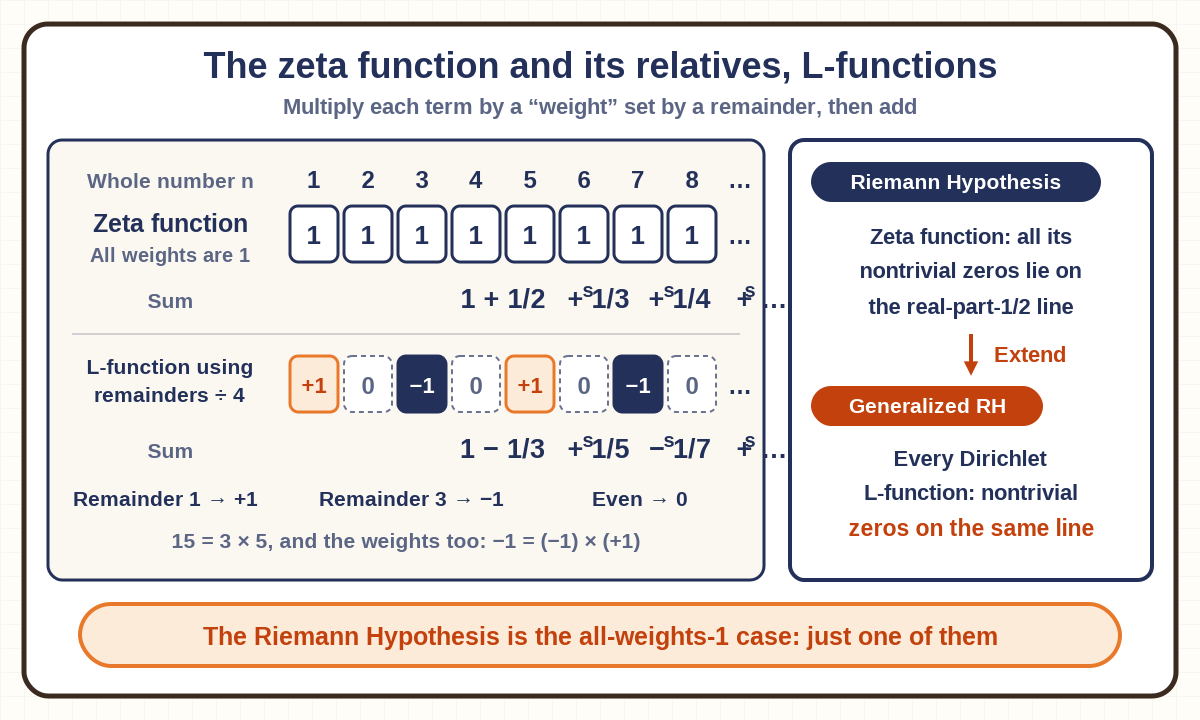
The Generalized Riemann Hypothesis takes the claim of the Riemann Hypothesis, “all nontrivial zeros of the zeta function (the places where its value is 0) lie on the line with real part 1/2”, and extends it to every Dirichlet L-function, a relative of the zeta function.
An L-function multiplies each term of the zeta function’s sum 1 + 1/2^s + 1/3^s + … by a weight set by the remainder when the whole number is divided by a fixed number (dividing by 4: remainder 1 gets +1, remainder 3 gets −1, even numbers get 0). If the hypothesis is true, then when the primes up to x are sorted into groups by remainder, every group’s count strays from its estimate by only about the square root of x, so the primes are spread out regularly.
The Riemann Hypothesis is just one case of it, so proving the Riemann Hypothesis alone does not settle the generalized version. On November 20, 2026, a proof in Lean (software in which a machine checks whether a proof is correct) claiming both was released; as of November 26, the Lean groups have certified only the Riemann Hypothesis part.
A common mix-up
“If the Riemann Hypothesis is proved, the Generalized Riemann Hypothesis follows automatically”
It is the other way round. The Generalized Riemann Hypothesis is a stronger claim that contains the Riemann Hypothesis as one case. The zeta function is the simplest L-function, the one with every weight equal to 1, so proving the generalized version would prove the Riemann Hypothesis too. But proving the Riemann Hypothesis does not, by itself, settle where the zeros of the infinitely many other L-functions lie, such as those built from remainders after dividing by 4 or by 10. In the November 2026 announcements, too, the groups behind Lean and Mathlib certified the statement and proof of the Riemann Hypothesis part only, and their statement does not mention the generalized version. The author wrote that the same method extends easily to the generalized version, and his Lean proof also contains theorems for it, but that part has to be checked separately.
Explained in pictures
Free to use in lessons, slides and posts with credit (CC BY 4.0).
Free to use in lessons, slides and posts with credit (CC BY 4.0).
Free to use in lessons, slides and posts with credit (CC BY 4.0).
Free to use in lessons, slides and posts with credit (CC BY 4.0).
You’re free to use these figures in lessons, slides and posts if you credit Naru News (naru.news). CC BY 4.0.
Think of it like this
Customers lining up at four checkout counters
Imagine a shop with four checkout counters. Even if the total number of customers in a day matches the estimate, they might all have crowded into one counter while the others stood empty. The Riemann Hypothesis says the total number of customers (the number of primes up to x) is very close to the estimate. The Generalized Riemann Hypothesis goes further and says that the number at each counter strays from a quarter of the total by only about the square root of x.
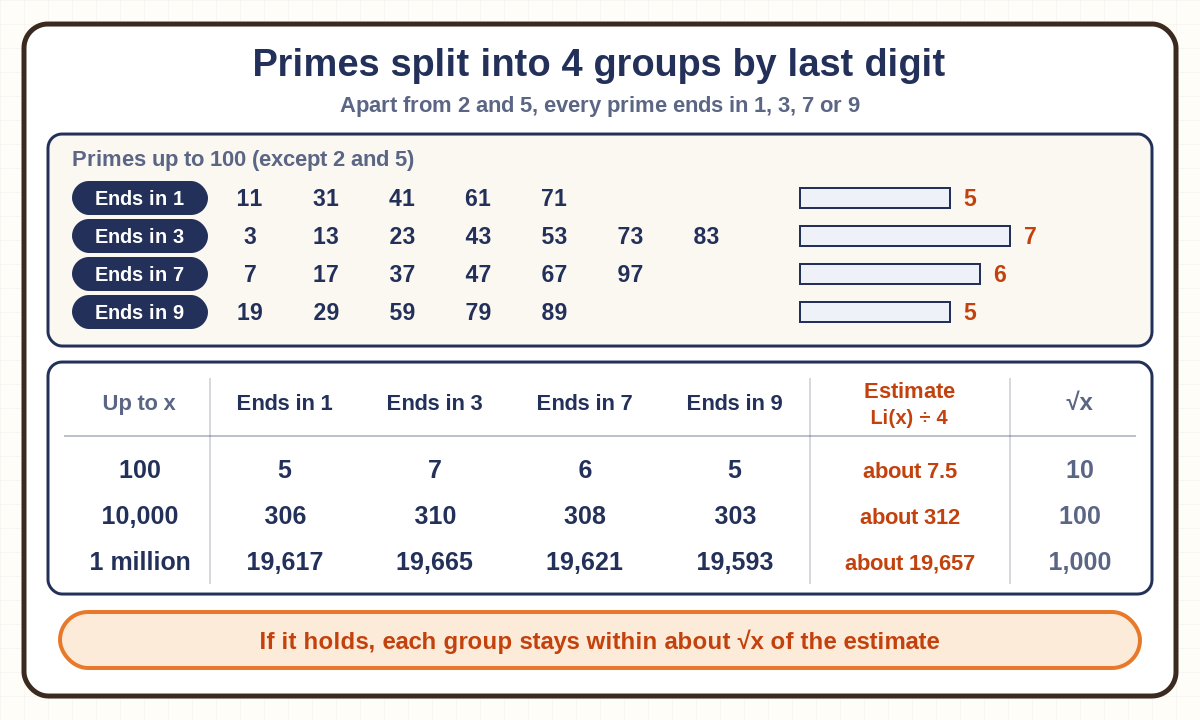
For primes, the counters are the last digits 1, 3, 7 and 9. The 78,498 primes up to a million line up as 19,617, 19,665, 19,621 and 19,593, almost the same number at each counter. The counters for last digits 0, 2, 4, 5, 6 and 8 are closed: nobody comes except 2 and 5. The hypothesis says that however many counters you set up (whatever number you divide by), the count at every open counter strays by only about the square root.
But the analogy breaks down in places. Customers choose on a whim, but the primes are fixed from the start and are not random. Also, when you split by the remainder after dividing by 4, the remainder-3 counter usually has slightly more customers, a quirk of its own (the size of the gap stays within what the hypothesis allows).
Key points
What is an L-function, and how is it different from the zeta function?
The zeta function adds up “1 ÷ (n to the power s)” for every whole number n, as in 1 + 1/2^s + 1/3^s + 1/4^s + …. A Dirichlet L-function first multiplies each of these terms by a “weight” set by the remainder when n is divided by a fixed number q, and then adds them up. In the simplest example with q = 4, numbers with remainder 1 (1, 5, 9, …) get +1, numbers with remainder 3 (3, 7, 11, …) get −1, and even numbers get 0, giving 1 − 1/3^s + 1/5^s − 1/7^s + ….
The weights are chosen so that the weight of a product of two numbers is the product of their weights (15 = 3 × 5, and −1 = (−1) × (+1)). Thanks to this, an L-function, like the zeta function, can be rewritten as a product over the primes alone (an Euler product). In the q = 4 example, primes with remainder 1 and primes with remainder 3 enter with opposite signs. In this way, an L-function becomes a tool for counting primes separately by their remainder.
These functions were introduced by Dirichlet, who used them in 1837 to prove that an arithmetic progression a, a + q, a + 2q, … contains infinitely many primes as long as a and q have no common factor other than 1. For example, there are infinitely many primes ending in each of 1, 3, 7 and 9. This was some twenty years before Riemann took up the zeta function in earnest as a function of a complex variable.
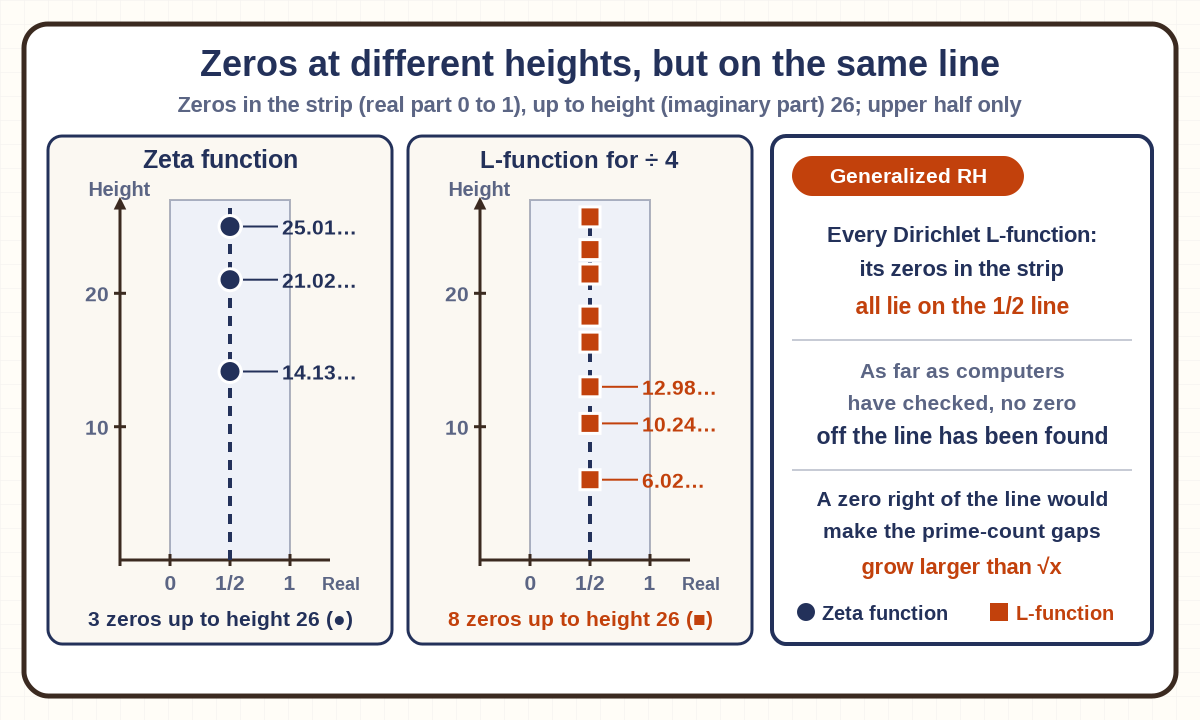
Setting every weight to 1 (q = 1) gives the zeta function itself. As with the zeta function, complex numbers are also put in for s in an L-function. A complex number is written like 3 + 2i, using a number i whose square is −1, and it can be shown as a point on a plane: across is the ordinary-number part (the real part), and up is how many times i (the imaginary part, also called the height). A value of s where the L-function is 0 is called a zero. Dirichlet L-functions can also be extended smoothly over this plane, and they have zeros in the strip where the real part is between 0 and 1. The Generalized Riemann Hypothesis says that every zero in that strip lies on the vertical line with real part 1/2; it is said to have been first stated by Piltz in 1884.
If the Generalized Riemann Hypothesis is true, what would we learn?
The main pillar is how primes are spread out within arithmetic progressions. For example, apart from 2 and 5, every prime ends in 1, 3, 7 or 9. Split the 78,498 primes up to a million by last digit and you get 19,617, 19,665, 19,621 and 19,593, almost a quarter each. For a fixed number q, it has been proved without any hypothesis that the primes eventually fall in equal shares into every remainder group that has no common factor with q other than 1 (the prime number theorem for arithmetic progressions).
What the Generalized Riemann Hypothesis adds is the size of the gap. If it is true, the number of primes up to x in any group strays from the smooth estimate (Li(x) divided by the number of groups) by only about the square root of x (more exactly, the square root times log x). What the Riemann Hypothesis says for all primes together could then be said for each group. What is more, this bound on the gap works in the same form however large the divisor q is. Without the hypothesis, the bound on the gap that has been proved is much larger than the square root of x, and how it changes with q is unclear.
Many results have also been derived by assuming the hypothesis. For example, in 1975 Miller showed that, if the hypothesis is true, a fixed procedure that does not rely on luck can quickly check whether a number is prime. Rabin then turned it into a method that needs no hypothesis but uses luck (random numbers), and in 2002 Agrawal, Kayal and Saxena found a fast method that needs neither the hypothesis nor luck (the paper appeared in 2004). Results first obtained by assuming the hypothesis are often shown later without it, and this is counted as one piece of support for believing the hypothesis.
Is it true that primes leaving remainder 3 after dividing by 4 are a little more common?
Yes. Among the primes up to 100, those leaving remainder 1 when divided by 4 (5, 13, 17, …) number 11, and those leaving remainder 3 (3, 7, 11, …) number 13. Up to a million, there are 39,175 with remainder 1 and 39,322 with remainder 3, so the remainder-3 group is still slightly larger. Counting upward from the smallest primes, the remainder-3 group is ahead almost everywhere, and the remainder-1 group first pulls ahead only when you have counted up to 26,861. This is called Chebyshev’s bias.
This does not contradict the Generalized Riemann Hypothesis. The gap of 147 up to a million is smaller than 1,000, the square root of a million, so it stays within the “gap of about the square root” the hypothesis speaks of. The bias has to do with the fact that when primes are counted through an L-function, squares of primes (9, 25, 49, …) and the like are counted along with them. The square of any odd number leaves remainder 1 when divided by 4, so in the L-function’s count, the squares such as 9 and 25 show up as a bonus added to the remainder-1 group. Take that bonus away and count only the primes, and the remainder-1 group tends to come out a little short.
Why are there several names, such as the “Extended Riemann Hypothesis”?
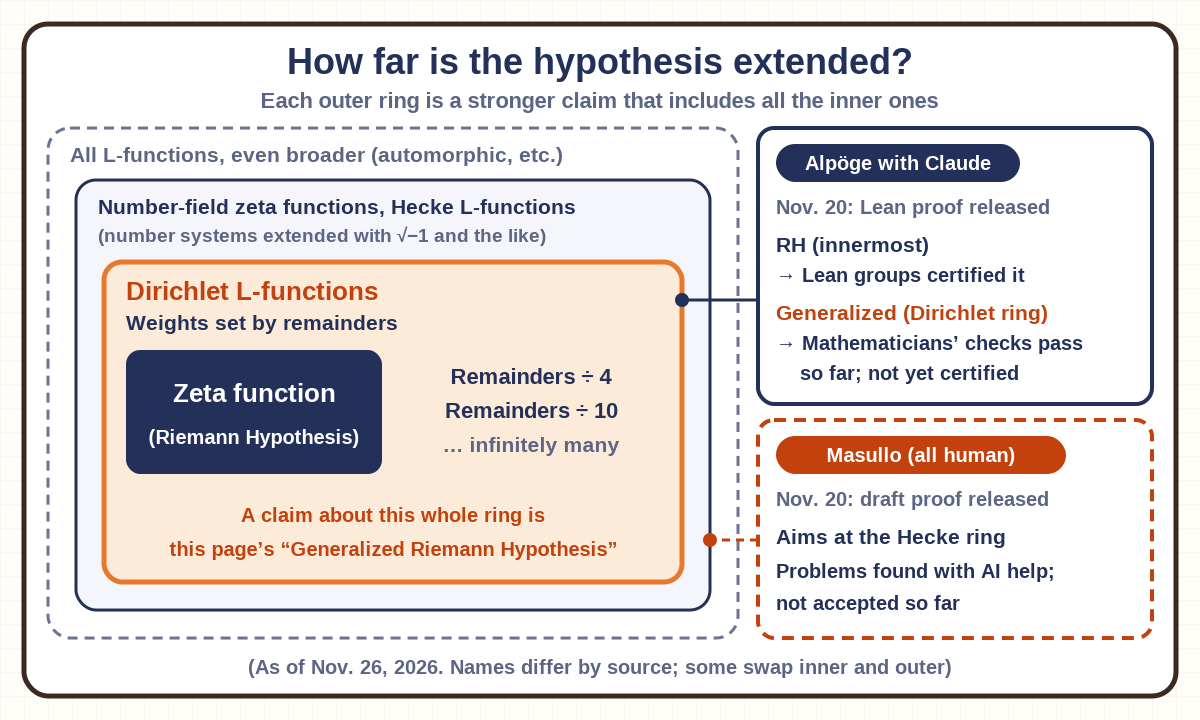
Because a hypothesis of the same form as the Riemann Hypothesis comes in several rings, depending on how far through the family of functions it is extended: to Dirichlet L-functions; further, to the zeta functions of number fields (number systems made by adding numbers like √−1 to the ordinary rational numbers) and Hecke L-functions; and further still, to all L-functions of a wider kind. The farther out the ring, the stronger the claim.
The names differ from source to source. The pages of the mathematicians who checked the November 2026 Lean proof, and Japanese research notes, call the Dirichlet ring the “Generalized Riemann Hypothesis (GRH)”. Alpöge, who made the announcement, says the Generalized Riemann Hypothesis is resolved and expects the “Extended Riemann Hypothesis (ERH)” to follow with more time, so for him the extended one is a further ring. On the other hand, Noam Elkies’s course notes at Harvard call the Dirichlet ring the “Extended Riemann Hypothesis” and the version that also covers the zeta functions of number fields and more the “Generalized Riemann Hypothesis”, the other way round. In the story of Miller’s primality test, too, the 2004 paper by Agrawal and his colleagues calls the assumption the “Extended Riemann Hypothesis”. To be sure which ring is meant, check which functions the hypothesis is about, not its name.
Some questions need an outer ring. When 1/p is written as a decimal, some primes repeat every p − 1 digits, as in 1/7 = 0.142857142857… (7, 17, 19, 23, 29, …). Are there infinitely many such primes? Gauss studied such decimals in his 1801 book, and Artin turned the question into a conjecture in 1927. In 1967, Hooley showed that if the Riemann Hypothesis holds for the zeta functions of certain number fields (an outer ring), then there are infinitely many such primes and a formula for counting them holds.
Has it been proved? (the November 2026 announcements)
On November 20, 2026, Levent Alpöge, a mathematician working at the AI company Anthropic, posted a note on his website saying he believes that, working with the AI Claude, he has found a proof of the Riemann Hypothesis. It says the method easily extends much further, resolving the Generalized Riemann Hypothesis too (this is his own claim). What he released is only a proof in Lean (software in which a machine checks proofs), about 17 million lines long; besides the Riemann Hypothesis, it contains a theorem that for every Dirichlet L-function, the zeros in the strip lie on the line with real part 1/2.
The next day, November 21, the two groups behind Lean and its shared library of mathematics, Mathlib (the Lean FRO and the Mathlib Initiative), certified that both the statement and the proof of the Riemann Hypothesis are correct. They also used tools to confirm that the statement proved is the same as Mathlib’s statement of the Riemann Hypothesis, which experts had checked. This statement, however, does not mention the Generalized Riemann Hypothesis.
For the generalized part, several mathematicians have rebuilt the proof themselves, checked it and published the results. The checks so far have passed: for example, the theorems including the generalized part depend only on Lean’s three standard axioms, and independently built checking tools accept them too (in a record updated on November 24, some checks were still running). The statement of the generalized part sits in a short file released with the proof, and it is not something the Lean groups have certified. What was checked goes up to the Dirichlet ring; the zeta functions of number fields, Hecke L-functions and the like are not included. As for an explanation that lets people read and understand why it is true, what has appeared so far is an unfinished guide limited to the zeta function.
On the same day, November 20, the mathematician Ravi Vakil hurriedly announced on his blog a proposed proof of the Generalized Riemann Hypothesis written by Alessandro Maria Masullo entirely by hand, without AI. The mathematician Brian Conrad had been looking at it for months, and it had looked good to him so far. Masullo’s attempt aims at the ring of Hecke L-functions. About eight hours later, however, Vakil added that several people had told him of problems in the proof, found with the help of various AI models, and said the proof would not be accepted as true until all the issues were resolved to the satisfaction of the community. Masullo himself says the manuscript was never meant to be seen by the public in its current form and will be revised over the coming months.
For both, publication in a refereed journal or similar and broad acceptance by mathematicians are still ahead (as of November 26).
Check yourself
Q1The “Riemann Hypothesis”, dating from 1859, says the zeros of the zeta function lie on one straight line, the one with real part 1/2. How does the “Generalized Riemann Hypothesis” extend it?
Answer and explanation
Answer: B It says L-functions’ zeros lie on the same 1/2 line
The Generalized Riemann Hypothesis extends the claim of the Riemann Hypothesis to every Dirichlet L-function, built with weights set by the remainders of whole numbers: for each of them, every zero in the strip lies on the line with real part 1/2. The line stays at real part 1/2, and the claim is that all the zeros are on the line, not just that most are near it.
More on this → Key points: What is an L-function, and how is it different from the zeta function?
Q2Split the primes up to a million by last digit (1, 3, 7, 9) and you get 19,617, 19,665, 19,621 and 19,593. If the Generalized Riemann Hypothesis is true, what can be said when counting the primes up to a much larger x?
Answer and explanation
Answer: C Each group’s gap stays about the size of the square root of x
If the hypothesis is true, the count in each group strays from the smooth estimate Li(x) divided by 4 by only about the square root of x (more exactly, the square root times log x). Up to a million, a quarter of the estimate is about 19,657, and every group is within 64 of it. What the hypothesis says is that the gap is held to about the size of the square root; it does not say the gap shrinks toward zero or stays inside some fixed number forever. The gap can grow with x, but its growth is held to about the pace of the square root.
More on this → Key points: If the Generalized Riemann Hypothesis is true, what would we learn?
Q3On November 21, 2026, the groups behind Lean and Mathlib certified both the statement and the proof of a Riemann Hypothesis proof said to have been found with the AI Claude. Which is true of how the Generalized Riemann Hypothesis and the Riemann Hypothesis are related?
Answer and explanation
Answer: A The generalized one contains the Riemann Hypothesis as one case
The zeta function is the L-function with every weight equal to 1, so the Riemann Hypothesis is one case of the Generalized Riemann Hypothesis. Proving the generalized version would also prove the Riemann Hypothesis, but proving the Riemann Hypothesis does not settle where the zeros of the infinitely many other L-functions lie. So a proof of the Riemann Hypothesis alone does not solve the generalized version. If the generalized version were one case within the Riemann Hypothesis, or a restatement of it in other words, proving the Riemann Hypothesis alone would have solved it too.
Related terms
- Riemann Hypothesis
- Zeta function
- Prime number
- L-function
- Dirichlet's theorem on arithmetic progressions
- Lean
- Formal verification
- Millennium Prize Problems
Sources and how we checked
- Levent Alpöge’s remark (four pages on his website: his belief that, working with Claude, he found a proof of the Riemann Hypothesis; the method easily extending much further, resolving the so-called Generalized Riemann Hypothesis; his expectation of the Extended Riemann Hypothesis too with more time; the formalization in Lean without assumptions; the decision to present only Lean; and the argument being very long and still to be written properly. His work at Anthropic was checked on his home page, alpo.ge; read November 26, 2026)
- Lean FRO and Mathlib Initiative, “Lean verification of the Riemann Hypothesis” (Lean community blog, joint statement of November 21, 2026: Alpöge’s proof as a Lean library of about 17 million lines; tools confirming that the theorem proved is exactly Mathlib’s expert-vetted statement of the Riemann Hypothesis; the certification that both the statement and the proof of the Riemann Hypothesis are correct; no mention of the Generalized Riemann Hypothesis, with no later post on the blog’s list; read November 26, 2026)
- Michael Rubinstein, “Alpöge/Claude proof of the Generalized Riemann Hypothesis” (his page at the University of Waterloo: the announcement on November 20, 2026 of a proof of the Riemann Hypothesis and of the Generalized Riemann Hypothesis for Dirichlet L-functions; the Lean proof of 175,187 files and about 17 million lines; the five theorems depending only on Lean’s three standard axioms; no errors from the independent checker nanoda; and the human-readable guide being specialised to the zeta function and a work in progress; read November 26, 2026)
- “GRH Lean Check” (an independent check of the Lean proof, linked from Rubinstein’s page: the statements of the five theorems, including the Riemann Hypothesis and zeros of Dirichlet L-functions in the critical strip lying on the line with real part 1/2; the generalized statements sitting in a short file that imports only Mathlib, read by hand; and all builds and checks passing, the last entry dated November 21, 2026; read November 26, 2026)
- Andrew Sutherland’s verification record (his page at MIT, last updated 05:25 UTC on November 24, 2026: the five theorems depending only on Lean’s three standard axioms; an independent rebuild and several checkers passing; one comparator run (lake comparator v4.36.0) still in progress; and Dedekind zeta functions, Hecke L-functions and automorphic L-functions in general not being among the statements checked; read November 26, 2026)
- Ravi Vakil, “Hurried Announcement: Alessandro Masullo GRH” (his blog, November 20, 2026, as updated on November 22: posting Masullo’s proposed proof of the Generalized Riemann Hypothesis, the work being all human with no AI, and Brian Conrad’s months of checking with things looking good to him so far; in an update about eight hours later, several people reporting problems in the proof identified with the assistance of different AI models, and the proof not being accepted as true until all issues are resolved to the satisfaction of the community; read November 26, 2026)
- Alessandro Maria Masullo, “The Music of the Primes” (his website: the paper was never meant to be seen by the public in its current state, with revisions due in the coming months; read November 26, 2026)
- John Baez, “Masullo on the Riemann Hypothesis” (his blog, November 22, 2026: Masullo aiming to prove the Generalized Riemann Hypothesis for L-functions of general Hecke characters over a number field; read November 26, 2026)
- E. Bombieri, “Problems of the Millennium: the Riemann Hypothesis” (the Clay Mathematics Institute’s official problem description: Dirichlet’s 1837 theorem on primes in arithmetic progressions; the view of many mathematicians that the Riemann Hypothesis and its extension to L-functions is probably the most important open problem in pure mathematics; the zeta function as the prototype of the large class of L-functions; examples of consequences of a Riemann hypothesis for L-functions, including Miller’s primality test, and many such results being provable independently of it; and no exception to a generalized Riemann hypothesis found in computations of zeros of Dirichlet L-functions and others; read November 26, 2026)
- Andrew V. Sutherland, “18.785 Number theory I, Lecture #18: Dirichlet L-functions, primes in arithmetic progressions” (MIT lecture notes, Fall 2025: Dirichlet’s 1837 theorem; the definition of a Dirichlet character as periodic and totally multiplicative; the series and Euler product of an L-function; the L-function of the trivial character being the zeta function; Riemann studying the zeta function as a function of a complex variable some twenty years after Dirichlet; and the prime number theorem for arithmetic progressions; read November 26, 2026)
- Andrew V. Sutherland, “18.785 Number theory I, Lecture #18” (MIT lecture notes, Fall 2018: the character mod 4 with value 1 for remainder 1, −1 for remainder 3 and 0 otherwise, its L-function 1 − 3^−s + 5^−s − 7^−s + …, and primes with remainder 1 and remainder 3 entering with opposite signs; read November 26, 2026)
- Noam D. Elkies, “Math 259: Introduction to Analytic Number Theory — The asymptotic formula for primes in arithmetic progressions; the Extended Riemann Hypothesis” (Harvard course notes: the error for primes in arithmetic progressions without any hypothesis, with an unpredictable dependence on q; the name “Extended Riemann Hypothesis” for the conjecture that nontrivial zeros of Dirichlet L-functions have real part 1/2, distinguished from the “Generalized Riemann Hypothesis” for more general series such as zeta functions of number fields; the attribution by Davenport to Piltz in 1884; under the hypothesis, the count of primes in each class straying from li(x)/φ(q) by only about x^(1/2) log x, with a constant independent of q; and “Chebyshev’s bias”, with primes ≡ 1 mod 4 usually fewer than primes ≡ 3 mod 4, and the contribution of squares. The prime counts by last digit and by remainder mod 4, the values of Li(x), the first point where remainder 1 pulls ahead, and the primes whose 1/p repeats every p − 1 digits were computed for this page; read November 26, 2026)
- Ade Irma Suriajaya, a 2015 talk abstract in Japanese on Dirichlet L-functions under the generalized Riemann hypothesis (Nagoya University, March 2, 2015: Dirichlet L-functions as a generalization of the Riemann zeta function, the L-function of the character modulo 1 being the zeta function, and the name “generalized Riemann hypothesis (GRH)” for the conjecture that all nontrivial zeros of Dirichlet L-functions lie on the critical line; read November 26, 2026)
- M. Agrawal, N. Kayal and N. Saxena, “PRIMES is in P” (Annals of Mathematics 160, 2004, received January 2002, as checked on the Annals of Mathematics page: Miller’s 1975 deterministic polynomial-time primality test assuming the Extended Riemann Hypothesis; Rabin’s modification into an unconditional but randomized test; and an unconditional deterministic polynomial-time test; read November 26, 2026)
- Pieter Moree, “Artin's primitive root conjecture – a survey” (arXiv, 2012 version: the period of the decimal expansion of 1/p, as in 1/7 = 0.142857…, and the primes for which it is p − 1; Gauss’s study of such decimals in Disquisitiones Arithmeticae, 1801; Artin’s conjecture of 1927; and Hooley’s 1967 proof assuming the Riemann Hypothesis for certain number fields; read November 26, 2026)
- LMFDB (the L-functions and Modular Forms Database), “L-function 1-2e2-4.3-r1-0-0” (the L-function of the character χ4(3,·) mod 4: its series 1 − 3^−s + 5^−s − 7^−s + … and the heights of its zeros in the strip, 6.0209…, 10.2437…, 12.9880…, 16.3426…, 18.2919…, 21.4506…, 23.2783… and 25.7287…; viewed November 26, 2026)
- LMFDB (the L-functions and Modular Forms Database), “Zeros of ζ(s)” (the heights 14.1347…, 21.0220… and 25.0108… of the first three nontrivial zeros of the zeta function. The site could not be opened on November 26, 2026, so these three, and the eight zeros of the mod-4 L-function up to height 26, were also computed for this page)
AI wrote this page from the sources above, and a different AI checked it against the text of those sources (November 26, 2026). A person with a master’s degree in science and a Japanese high-school science teaching license also read and checked it before publishing. Numbers are as of that date. If anything was hard to follow, you spot a mistake, or there’s a term you’d like explained, please write to [email protected].
Glossary
- AI agent
- AI alignment
- Alignment faking
- Artificial general intelligence (AGI)
- Artificial intelligence (AI)
- Backdoor
- Benchmark
- Chain of thought (CoT)
- Context window
- Data poisoning
- Deep learning
- Deepfake
- Diffusion model
- Embedding
- Emergent misalignment
- Evaluation awareness
- Fine-tuning
- Formal verification
- Generalization
- Generative adversarial network (GAN)
- Generative AI
- Goodhart’s law
- Gradual disempowerment
- Hallucination
- Hyperparameter
- Intelligence explosion
- Interpretability
- Jailbreaking
- Large language model (LLM)
- Latent space
- Machine learning
- Mixture of experts (MoE)
- Neural network
- Neuralese
- Overfitting
- Parameter
- Persona vectors
- Pre-training
- Prompt
- Prompt injection
- Reasoning model
- Recursive language model (RLM)
- Recursive self-improvement (RSI)
- Red teaming
- Reinforcement learning (RL)
- Retrieval-augmented generation (RAG)
- Reward hacking
- Reward model
- Shutdown resistance
- Sleeper agent
- Subliminal learning
- Superintelligence (ASI)
- System prompt
- Technological singularity
- Time horizon
- Token
- Transfer learning
- Transformer
- Accretion disk
- Black hole
- Black hole star
- Cosmic birefringence
- Event horizon
- Event Horizon Telescope (EHT)
- General relativity
- GPS
- Gravitational lensing
- Gravitational singularity
- Gravitational wave
- James Webb Space Telescope (JWST)
- Lagrange point
- Long-period radio transient (LPT)
- Neutron star
- Pulsar
- Quasar
- Sagittarius A*
- Space data center
- Spacetime
- Special relativity
- Speed of light
- Supermassive black hole
- White dwarf
- Autoformalization
- Formal proof
- Four color theorem
- You are hereGeneralized Riemann Hypothesis (GRH)
- Lean
- Millennium Prize Problems
- Prime number
- Riemann Hypothesis
- VP ≠ VNP conjecture
- Zeta function